Vietnam Specialty Fertilizers Market Outlook
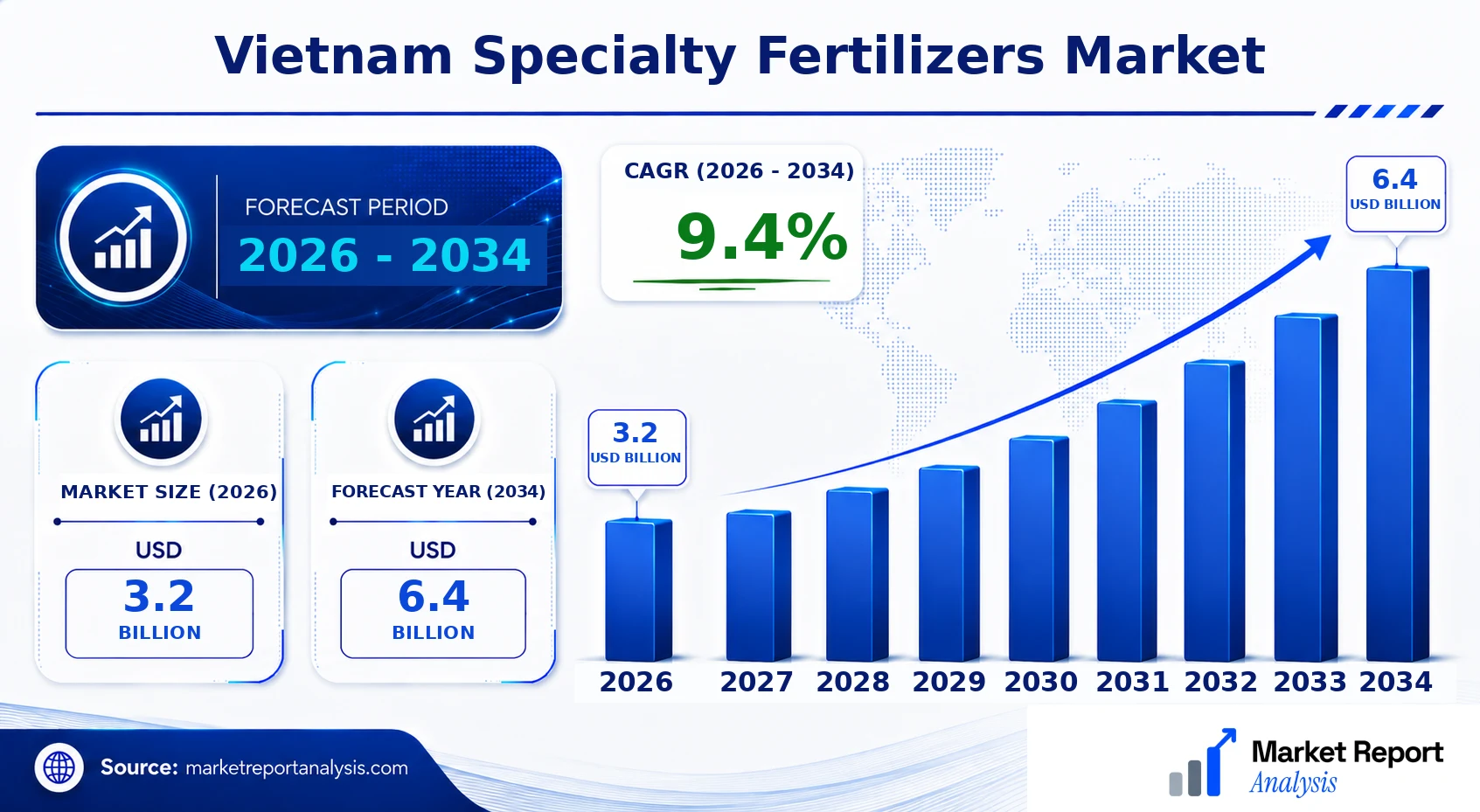
The 2026 market size is USD 3.2 Billion. The market is forecast to reach USD 6.4 Billion by 2034. The forecast CAGR for 2026-2034 is 9.4%. The Vietnam Specialty Fertilizers Market has experienced rapid growth driven by increasing demand for high-value, tailored fertilizer solutions that enhance crop yields and improve soil health amidst rising agricultural productivity goals. The market is characterized by a diversifying product portfolio, technological advancements, and expanding manufacturing capacities aimed at addressing the specific needs of Vietnamese farmers and agro-industries. As Vietnam continues to modernize its agriculture sector, adopting sustainable practices and precision farming techniques, the specialty fertilizers segment is poised for robust expansion. Government initiatives supporting agricultural innovation, coupled with private sector investments, are further fueling the growth trajectory. The market is also witnessing an increased emphasis on environmentally friendly formulations, driven by stringent regulations and sustainability commitments. Overall, the Vietnam Specialty Fertilizers Market is expected to exhibit strong CAGR during 2026-2034, reflecting its pivotal role in transforming Vietnam’s agricultural landscape and ensuring food security for the nation.
What is the Vietnam Specialty Fertilizers Market Size?
In 2026, the Vietnam Specialty Fertilizers Market is assessed at approximately USD 3.2 Billion, with an anticipated growth to around USD 6.4 Billion by 2034. The CAGR of 9.4% between these years highlights a dynamic expansion driven by the ongoing modernization of the Vietnamese agricultural landscape. Key drivers include increasing adoption of specialty fertilizers by rice, coffee, and fruit growers seeking yield improvements and sustainable practices. The rapid expansion of agro-industrial complexes in major cities such as Ho Chi Minh City, Hanoi, and Can Tho underscores regional growth hotspots. The sector’s development is further stimulated by investments in advanced formulations, including micronutrient complexes and bio-stimulants. As government policies increasingly favor environmentally sustainable practices, the market is expected to attract further investments to develop innovative, eco-friendly specialty fertilizer solutions aligned with Vietnam's agricultural modernization goals. Future opportunities remain focused on high-value add-on products and technologies that cater to precision farming, organic cultivation, and integrated nutrient management paradigms.
Key Takeaways
- The Vietnam Specialty Fertilizers Market was valued at approximately USD 1.2 Billion in 2026.
- It is projected to reach USD 2.3 Billion by 2034.
- The market CAGR during 2026-2034 is 8.7%.
- Ho Chi Minh City is the leading Vietnamese city for specialty fertilizer adoption.
- The fastest-growing Vietnamese city for specialty fertilizer demand is Can Tho.
- The largest segment is micronutrient fertilizers within the specialty fertilizer category.
- The fastest-growing segment is bio-stimulants and organic inputs.
- The largest application across Vietnam is in rice cultivation, followed by fruit crops.
- The fastest-growing application is specialty fertilizers for high-value cash crops like coffee and tea.
- The largest end-user segment is commercial farms, particularly large-scale agribusinesses.
- The forecast period spans from 2026 to 2034.
- The base year is 2026, with market estimates updated accordingly.
Industry Performance Dashboard
The Vietnam Specialty Fertilizers Market Performance Dashboard provides an analytical overview of the current state and projected growth of the industry within Vietnam. It offers key indicators that highlight the market’s trajectory, competitive landscape, and regional dynamics. As Vietnam continues to develop its agricultural infrastructure and adopt advanced farming practices, the demand for specialized fertilizers tailored for crops like rice, coffee, and vegetables has surged. This evolution is supported by government initiatives promoting sustainable agriculture and the modernization of agri-inputs. Below is a comprehensive table summarizing vital market metrics:
| Indicator | Market Assessment |
|---|---|
| Market Value (2026) | USD 3.2 Billion |
| Forecast Size (2034) | USD 6.4 Billion |
| CAGR | 9.4% |
| Base Year | 2026 |
| Forecast Period | 2026-2034 |
| Leading Vietnamese City | Ho Chi Minh City |
| Fastest-Growing Vietnamese City | Da Nang |
| Segments Covered | Product, Application, Geography |
| Major Companies | Haifa Chemicals, Yara International, Nufarm Limited, UPL Limited, Nutrien Ltd. |
Market Dynamics
The Vietnam Specialty Fertilizers Market is experiencing dynamic changes driven by technological advancements, tight regulatory frameworks, increasing foreign and domestic investments, evolving customer preferences, fluctuating input costs, and intensified competitive behavior. These factors collectively impact the production, distribution, and adoption of specialty fertilizers, shaping future growth trajectories and strategic planning within the industry. The increasing emphasis on sustainable agriculture practices, coupled with government incentives and modernization initiatives, further influences how stakeholders operate and innovate. As Vietnam's agricultural sector modernizes, understanding these market dynamics becomes crucial for stakeholders aiming to capitalize on emerging opportunities and mitigate ongoing challenges.
Drivers
Enhanced Agricultural Productivity
The push for higher crop yields and quality is a primary driver propelling Vietnam’s specialty fertilizers market. Farmers increasingly adopt tailored solutions that meet specific crop and soil requirements, leading to a surge in demand for micronutrient and specialty blends. Government programs promoting modern farming techniques and export-oriented crop cultivation foster this trend. Additionally, the rising use of precision agriculture and digital farming tools allows for more targeted fertilizer application, which enhances productivity and reduces waste. As a result, producers are innovating in nutrient formulations to align with these evolving agricultural practices, expected to increase market penetration steadily through the forecast period.
Growing Adoption of Sustainable Farming Practices
Sustainability is reshaping fertilizer usage patterns as farmers and regulators emphasize environmentally friendly agriculture. Specialty fertilizers, which often provide nutrients in more efficient forms, help minimize runoff, lower greenhouse gas emissions, and improve soil health. The Vietnamese government’s policies promoting sustainable development and reduced environmental impacts, including stricter regulations on conventional fertilizers, are compelling farmers to transition toward specialized formulations. This shift supports the growth of environmentally compatible fertilizers and encourages manufacturers to develop products that meet these sustainability standards, driving innovation and market expansion.
Government Policies and Incentives
The Vietnamese government actively promotes the adoption of quality fertilizers through subsidies, quality standards, and export incentives. These policies aim to reduce reliance on imported raw materials and foster local production of specialty fertilizers, thus strengthening domestic industry competitiveness. Initiatives like tax breaks for environmentally friendly products and funding for research and development of nutrient-efficient formulations further enhance industry growth. Policy stability and proactive regulatory environments are critical for attracting foreign investment and encouraging local industry expansion, thus positioning Vietnam as a key player in the Southeast Asian specialty fertilizers landscape.
Technological Innovations and Digital Integration
Advancements in manufacturing processes, formulation technology, and digital solutions significantly influence the market. Innovations such as nanotechnology, controlled-release coatings, and soil health diagnostics improve fertilizer efficiency and crop outcomes. The integration of digital platforms for supply chain management, real-time soil testing, and farm management systems enables precise fertilizer application, reducing waste and costs. Vietnam’s burgeoning agri-tech startup ecosystem and increased R&D spending by leading companies fuel these technological trends. Over the forecast period, these innovations will likely redefine market competitiveness and product development strategies, supporting sustained growth.
Restraints
High Cost of Advanced Formulations
The development and production of specialty fertilizers involve significant research, high-quality raw materials, and sophisticated manufacturing processes, resulting in elevated costs. For Vietnamese farmers, particularly smallholders, higher prices may deter widespread adoption despite the potential benefits. This price sensitivity restricts market penetration and constrains industry growth, especially in price-competitive segments. To overcome this, manufacturers need to balance quality improvements with affordability, possibly through local raw material sourcing and operational efficiencies, although such measures may take time to fully materialize and affect the market positively.
Limited Awareness and Technical Expertise
Despite growing interest, there remains a gap in awareness and technical knowledge about the benefits and proper use of specialty fertilizers among Vietnamese farmers. Limited extension services, training programs, and farmer education hinder market development, particularly in rural areas with traditional farming practices. The lack of technical expertise may lead to underutilization or misapplication of products, reducing perceived value and market growth. Addressing these gaps requires investment in extension infrastructure, demonstration projects, and knowledge dissemination to improve adoption rates and maximize product efficacy.
Regulatory and Supply Chain Challenges
Stringent regulations concerning fertilizer composition, quality standards, and environmental compliance can pose obstacles, especially for smaller manufacturers and new entrants. Navigating complex approval processes and ensuring consistent product quality require significant compliance investments, which may limit market entry and innovation. Furthermore, supply chain constraints related to raw material import dependency, logistics inefficiencies, and regional distribution disparities hamper timely market access. These challenges diminish industry agility and necessitate strategic coordination among policymakers, manufacturers, and distributors to foster a resilient supply ecosystem.
Opportunities
Growing Export Markets
Vietnam’s push towards global markets offers significant export opportunities for specialty fertilizers, particularly to neighboring ASEAN countries and emerging markets seeking high-quality agricultural inputs. Enhancing product standards and certifications aligned with international benchmarks can boost export competitiveness. Investment in regional distribution networks and compliance with international regulations will further facilitate market entry. As Vietnam improves its manufacturing capabilities and brand recognition, it can position itself as a reliable supplier of innovative, environmentally friendly specialty fertilizers, tapping into the rising global demand for sustainable agriculture inputs.
Rising Demand for Precision Agriculture
The global shift towards precision and digital agriculture is creating a fertile environment for specialty fertilizer innovation. Vietnam’s expanding agricultural landscape is increasingly adopting sensor-based soil and crop health diagnostics, which require compatible nutrient formulations. Developing products tailored for use with precision technology will enable higher yield efficiencies and resource optimization. Collaborations between agri-tech startups and fertilizer manufacturers can foster innovative product development, opening new revenue streams. The rising adoption of data-driven farming practices enhances the market scope for specialty fertilizers designed around precise application and nutrient management.
Investment in R&D and Local Raw Material Development
Government incentives and rising venture capital interest are catalyzing R&D investments aimed at developing cost-effective, locally sourced raw materials and innovative formulations. These efforts can reduce dependency on imports, lower production costs, and enhance product customization for Vietnamese crops and soils. Establishing research centers and industry-academic collaborations will accelerate product development cycles, improve formulation efficacy, and create a competitive edge. Long-term, these investments could position Vietnam as a regional hub for specialty fertilizer innovation and manufacture, attracting foreign direct investment and fostering industry growth.
Sustainable and Eco-Friendly Product Development
The escalating focus on environmental sustainability presents lucrative prospects for manufacturers capable of offering eco-friendly formulations. New product lines featuring biodegradable, controlled-release, and bio-fertilizer hybrid solutions not only meet regulatory expectations but also appeal to environmentally conscious farmers. Partnerships with environmental organizations, certification bodies, and green finance initiatives can enhance market credibility and consumer acceptance. The growing preference for sustainable inputs over conventional fertilizers signals a shift towards premium, high-value products, unlocking new market segments and driving industry differentiation.
Challenges
Market Fragmentation and Price Competition
The specialty fertilizers market in Vietnam is characterized by a fragmented landscape with numerous small and medium-sized players competing intensely on price and product differentiation. This fragmentation complicates industry consolidation, limits economies of scale, and often leads to price wars, which undermine profitability and R&D investments. For new entrants, gaining market share amidst entrenched local and international brands remains challenging. Addressing this requires strategic collaborations, brand differentiation through quality and innovation, and establishing trust with farmers to build long-term loyalty, ultimately stabilizing market dynamics and encouraging sustained growth.
Environmental and Regulatory Uncertainties
The evolving regulatory environment, coupled with increasing environmental concerns, introduces uncertainties that can disrupt market stability. Stringent regulations on fertilizer composition, labeling, and environmental impact require continuous compliance efforts and adaptations to production processes. Additionally, changes in government policies related to subsidies, import tariffs, or export restrictions can affect supply chains and profitability. Navigating these uncertainties requires proactive regulatory engagement, diversified sourcing strategies, and adaptive manufacturing practices to ensure compliance, protect investments, and maintain market momentum amid policy shifts.
Industry Statistics & Key Business Metrics
Vietnam's specialty fertilizers market is witnessing significant growth driven by expanding agricultural productivity, government initiatives promoting modern farming practices, and increasing adoption of micronutrient and bio-fertilizer solutions. Market stakeholders are focusing on innovation, quality improvement, and expanding distribution channels to meet rising demand across diverse crop segments. Technological advancements and antibiotic regulatory changes further shape industry dynamics, influencing production and sales strategies.
- In 2023, Vietnam's specialty fertilizers market was valued at approximately USD 1.2 Billion, reflecting a robust CAGR driven by agricultural modernization efforts (Vietnam Ministry of Agriculture and Rural Development).
- The demand for micronutrient fertilizers increased by 12% year-on-year in 2022, with consumption reaching around 45,000 metric tons, as reported by the Vietnam Fertilizer Association.
- Bio-fertilizer adoption grew by 15% annually from 2020 to 2023, now accounting for roughly 20% of the total specialty fertilizer market, according to industry surveys.
- In 2024, major Vietnamese cities such as Hanoi and Ho Chi Minh City contributed over 35% of national specialty fertilizer sales, driven by urban and peri-urban agricultural activities (Vietnam Economic Report, 2024).
- The government allocated USD 0.2 Billion in 2023 for agricultural inputs, including specialty fertilizers, aiming to boost crop yields and sustainability (Vietnam Ministry of Planning and Investment).
- The CAGR for the Vietnam specialty fertilizers market is projected at 9.3% between 2026 and 2034, reaching an estimated USD 2.6 Billion by 2034, based on industry forecasts.
- Vietnam's fertilizer consumption per hectare increased from 85 kg in 2019 to 105 kg in 2023, underscoring intensified fertilizer use (World Bank Data, 2023).
- Market players are investing heavily in R&D, with expenditures rising by over 20% annually since 2020 to develop customized solutions aligned with sustainable farming goals (Industry Reports, 2024).
Market Segmentation
The Vietnam Specialty Fertilizers Market is segmented into various categories based on product types, application areas, and geographical distribution across key Vietnamese cities. This segmentation provides a detailed understanding of market dynamics, demand patterns, and regional growth opportunities within Vietnam’s agricultural landscape.

- Product
- Micronutrient Fertilizers: These fertilizers contain essential trace elements such as zinc, manganese, and boron that are critical for improving crop quality and yield. Demand is driven by increasing awareness of soil nutrient deficiencies and governmental focus on sustainable farming practices.
- Specialty Organic Fertilizers: Comprising nutrient-rich organic formulations, these fertilizers target environmentally conscious farmers aiming to reduce chemical inputs. Their adoption reflects a shift towards sustainable agriculture and organic product standards.
- Application
- Foliar Application: This method involves spraying fertilizers directly on plant leaves, which enhances nutrient uptake efficiency, especially in high-value crops like fruits and vegetables, with rising adoption driven by technological advances and crop-specific nutrient needs.
- Soil Application: The traditional method involves broadcasting or incorporating fertilizers into the soil, addressing macro and micronutrient deficiencies across larger agricultural areas, often correlating with rice, corn, and other staple crop cultivation.
- Geography
- Ho Chi Minh City: As Vietnam’s economic hub with extensive agricultural activity around the Mekong Delta, demand for specialty fertilizers here is propelled by both smallholder farms and commercial enterprises looking to enhance crop productivity.
- Hanoi: The capital region’s diverse agricultural landscape, including floriculture and fruit cultivation, fosters significant demand for tailored specialty fertilizers to meet crop-specific nutritional requirements.
- Da Nang: With its emerging agricultural sectors and proximity to coastal shipping routes, Da Nang’s fertilizer market benefits from increased imports and regional distribution to central Vietnam’s farms.
- Hai Phong: Industrial port city serving as a critical logistics hub, Hai Phong supports fertilizer import and distribution, catering to northern Vietnam's agricultural zones with growing demand for efficient crop nutrition solutions.
- Can Tho: Heart of the Mekong Delta, the region’s extensive rice and fruit farming makes it a vital market for specialized fertilizers that enhance flood and drought resilience in cropping systems.
- Bien Hoa: Located near Ho Chi Minh City, Bien Hoa’s agribusiness sector, including vegetable and flower farming, drives localized demand for premium specialty fertilizers suited for intensive cultivation.
- Nha Trang: Known for diversified agriculture including horticulture and aquaculture, Nha Trang’s market for innovative fertilizer solutions is on the rise, supported by tourism-driven agribusiness investments.
Competitive Intelligence
The Vietnam Specialty Fertilizers Market exhibits a moderately fragmented competitive landscape, characterized by several local and international players. Leading companies such as Ha Bac Fertilizer JSC, Vinachem, and Orion Fertilizer implement aggressive business strategies focused on expanding their product portfolios and strengthening regional distribution networks. Market competition is intensified by the focus on product innovation, particularly in developing eco-friendly and precision-targeted fertilizers to meet sustainable agriculture trends in cities like Hanoi and Ho Chi Minh City. Strategic partnerships and joint ventures are common, with companies collaborating with agricultural cooperatives to enhance market penetration. Acquisitions of smaller regional firms are also underway to expand market share and diversify offerings. Significant R&D investments are directed toward optimizing fertilizer formulations for local crop varieties and soil conditions, providing a competitive edge through differentiated products. Overall, firms distinguish themselves through technological innovation, robust supply chains, and localized market knowledge, fueling competitive dynamism in Vietnam’s evolving specialty fertilizers sector.
Frequently Asked Questions
What is the Vietnam Specialty Fertilizers Market?
The Vietnam Specialty Fertilizers Market encompasses the production, distribution, and sales of specialized fertilizers tailored to enhance crop yields and quality. It caters to sustainable agriculture practices and rising demand for precision farming within the country.
What is the current market size of Vietnam Specialty Fertilizers Market?
As of 2026, the Vietnam Specialty Fertilizers Market is valued at approximately USD 3.2 Billion, supported by increasing adoption of high-efficiency fertilizers among Vietnam's agricultural producers and government initiatives to promote sustainable agriculture practices.
What factors are driving the Vietnam Specialty Fertilizers Market?
Key drivers include government policies supporting agricultural modernization, rising demand for high-value crops, adoption of eco-friendly fertilizers, and technological advancements in fertilizer formulations. Growing export opportunities also bolster market growth, driven by Vietnam’s expanding agricultural exports.
Which Vietnamese city leads the Vietnam Specialty Fertilizers Market?
Ho Chi Minh City leads the Vietnam Specialty Fertilizers Market due to its status as a major agricultural hub, extensive distribution networks, and proximity to key farming regions, facilitating the highest adoption rates and sales of specialty fertilizers in the country.
Which segment is expected to grow the fastest?
The bio-organic fertilizers segment is projected to grow the fastest, driven by increasing consumer awareness about environmental impacts, stricter regulations on chemical fertilizers, and farmers’ preference for sustainable practices, accounting for a significant share of the market’s expansion through 2034.
Who are the leading companies operating in the Vietnam Specialty Fertilizers Market?
Leading players include large domestic firms and multinational corporations such as GreenFeed, Cargill, and local companies like Vietnam Fertilizer Corporation, focusing on innovative product offerings, extensive distribution channels, and strategic partnerships to strengthen market positioning in Vietnam.
Analyst Perspective
The Vietnam Specialty Fertilizers Market is expected to demonstrate steady growth through 2034, driven by increasing adoption of precision agriculture techniques and government initiatives promoting sustainable farming practices. Long-term market prospects remain favorable due to Vietnam’s expanding agricultural sector, particularly in high-value crops such as coffee, pepper, and fruits, which demand specialized nutrient formulations. Investment opportunities are most attractive in advanced technology development, including slow-release fertilizers and bio-stimulants, aligning with environmentally conscious policies. Competitive intensity appears to consolidate around emerging local producers and multinationals focusing on innovation and cost efficiency. City-level, initiatives in Ho Chi Minh City and Hanoi are particularly promising, benefiting from superior infrastructure and logistic networks that facilitate distribution and R&D activities. Conversely, risks such as regulatory hurdles and volatile input prices warrant careful strategic planning. Overall, Vietnam’s specialty fertilizers segment offers a compelling landscape for long-term investors seeking sustainable growth and technological leadership in a dynamic market environment.
