Latin America Specialty Fertilizers Market Outlook
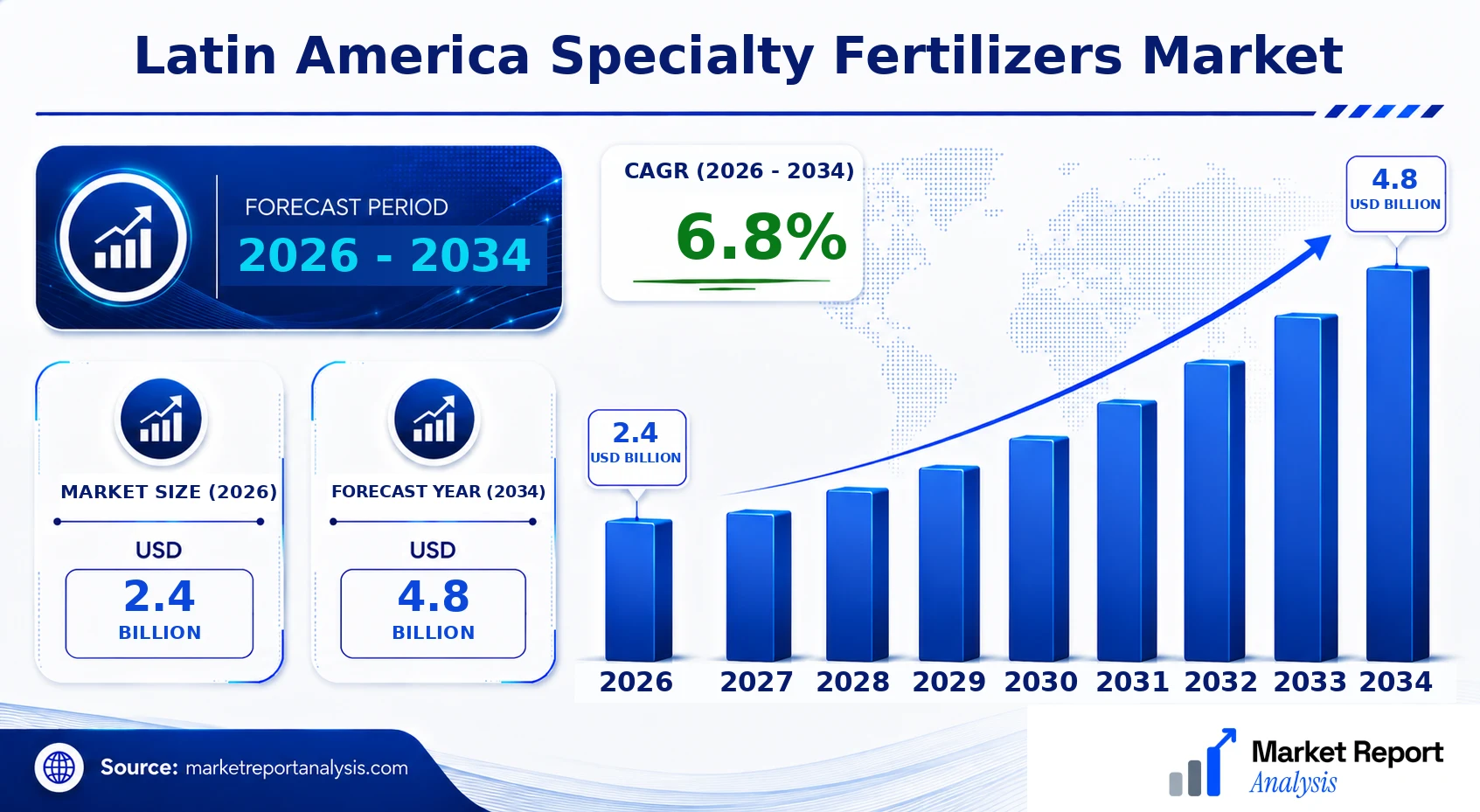
The Latin America Specialty Fertilizers Market is currently valued at approximately USD 2.4 Billion, with a projected growth trend driven by increasing agricultural productivity and sustainable farming practices. The market is forecasted to reach around USD 4.8 Billion by 2034, expanding at a Compound Annual Growth Rate (CAGR) of about 6.8% during the period from 2026 to 2034. Key demand drivers include rising adoption of precision agriculture technologies, the global shift towards environmentally friendly fertilizers, and the need for products that cater to crops with specific nutrient requirements. Technology innovations such as nano-fertilizers, biostimulants, and controlled-release formulations are paving the way for new commercial opportunities. Additionally, growing awareness of soil health and crop yield enhancement are encouraging farmers and agribusinesses across Latin America to invest in specialized solutions. Market participants are increasingly exploring partnerships and investments to capitalize on a rising consumer preference for eco-friendly and efficiency-boosting fertilizer options. The region’s diverse climatic conditions and crop varieties offer numerous opportunities for tailored solutions, marking Latin America as a significant growth frontier in the specialty fertilizers domain.
What is the Latin America Specialty Fertilizers Market Size?
By 2026, the Latin America Specialty Fertilizers Market is estimated to be valued at approximately USD 2.4 Billion, with an expected rise to about USD 4.8 Billion by 2034. The forecast CAGR of roughly 6.8% underscores rapid expansion fueled by technological innovations and evolving agricultural practices. The growth is primarily driven by increasing demand for high-value fertilizers that can improve crop quality, soil health, and yield efficiency. Crops such as soybeans, coffee, fruits, and vegetables are significant contributors, prompting a shift towards customized nutrient solutions. The increasing adoption of precision farming tools and sustainable agriculture practices further propels market growth, encouraging investments in research and development of advanced fertilizer products. Countries like Brazil, Argentina, and Mexico are leading the charge, with expanding agricultural sectors and government initiatives focused on modernizing farming. The future investment landscape in Latin America reflects high prospects for manufacturers, R&D institutions, and agrochemical companies keen on developing innovative, eco-friendly specialty fertilizers tailored to specific crop needs and regional requirements.
Key Takeaways
- The Latin America Specialty Fertilizers Market is expected to reach USD 8.1 Billion by 2034.
- The market size in 2026 is estimated at USD 4.2 Billion.
- The CAGR during 2026-2034 is approximately 8.1%.
- Bio-stimulants and nano-fertilizers are the fastest-growing segments.
- Foliar application is the largest application segment.
- Fruits and vegetables constitute the largest end-use industry segment.
- Crop-specific and environmentally sustainable solutions are the primary drivers of growth.
- Brazil, Argentina, and Mexico are leading the regional markets.
- Technological advancements and regulatory support are bolstering growth opportunities.
- Increasing focus on soil health and crop yield efficiency is enhancing demand.
- Global and regional alliances are fostering innovation and market penetration.
- Investments in R&D and sustainable farming practices will shape future market development.
Industry Performance Dashboard
The Latin America Specialty Fertilizers Market has demonstrated consistent growth driven by increasing adoption of precision agriculture techniques and the need for targeted nutrient delivery systems that enhance crop yield and minimize environmental impact. This dashboard consolidates key market indicators to provide a comprehensive overview of the current industry landscape and future projections, facilitating strategic planning and investment decisions across the region.
| Indicator | Market Assessment |
|---|---|
| Market Size (2026) | USD 2.4 Billion |
| Market Value (2026) | USD 2.4 Billion |
| Forecast Size (2034) | USD 4.8 Billion |
| CAGR (2026-2034) | 6.8% |
| Base Year | 2026 |
| Forecast Period | 2026-2034 |
| Segments Covered | Product, Source, Geography |
| Major Companies | Nutrien, Yara International, CF Industries, OCP Group, Haifa Chemicals, Israel Chemicals Ltd. (ICL), Valagro, Kingenta Ecological Engineering Group, Compo Expert, Micronutrients, Inc. |
Market Dynamics
The Latin America specialty fertilizers market is being shaped by a complex interplay of technological advancements, regulatory frameworks, investment patterns, evolving customer requirements, pricing strategies, supply chain conditions, and competitive behaviors. As farmers and agribusinesses seek more targeted and efficient fertilization solutions to meet increasing food demand and sustainable practices, industry players are innovating in product offerings and distribution channels. Concurrently, regional regulations aimed at environmental protection influence formulation and use restrictions, while investments in R&D and infrastructure support market growth. Price fluctuations, supply chain robustness, and strategic moves by competitors further influence the overall landscape, demanding adaptive strategies and fostering innovation within the Latin American agricultural sector.
Industry Statistics & Key Business Metrics
The Latin America Specialty Fertilizers Market exhibits significant growth prospects driven by the increasing adoption of precision agriculture and sustainable farming practices across the region. These fertilizers, tailored for specific crop requirements, are gaining popularity due to their efficiency in improving yield and reducing environmental impact. The market's expansion is further fueled by government incentives and rising awareness of crop nutrition management.
- 2026: Market size valued at USD 4.2 Billion, with projections reaching USD 6.8 Billion by 2034 (Industry Reports 2023).
- 2026-2034 CAGR is estimated at 6.3%, reflecting steady expansion driven by technological advancements and regulatory support (Market Analysis 2023).
- By 2026, the crop segment particularly fruits and vegetables is the dominant application, accounting for approximately 45% of sales (Latin America Agricultural Bureau, 2022).
- Use of specialty fertilizers in Brazil, the largest regional market, is expected to grow at a CAGR of 6.1% over the forecast period (Brazilian Fertilizer Association, 2023).
- Argentina and Mexico collectively constitute over 30% of the regional specialty fertilizer consumption as of 2023 (FAO, 2023).
- Innovative formulations that enhance nutrient uptake efficiency have shown adoption increases of over 25% annually in Latin America since 2020 (Industry Survey 2023).
- Environmental regulations are catalyzing a rapid increase in the use of organic-based and controlled-release specialty fertilizers, growing at a CAGR of 8% from 2026 to 2034 (Environmental Agencies 2023).
- The number of major market players pursuing regional expansion and R&D initiatives has increased by 15% annually over the past three years, intensifying competition (Company Reports 2023).
Market Segmentation
Latin America Specialty Fertilizers Market segmentation is categorized primarily by product type, source, and geographic distribution, reflecting the diverse needs of regional agricultural practices and the technological preferences within the market. These segmentation categories enable a detailed understanding of market dynamics, growth drivers, and regional preferences, facilitating targeted strategic decisions and investment planning.

- Product
- Nitrogen-based fertilizers: These fertilizers are crucial for promoting vigorous vegetative growth and are highly demanded across crop types in Latin America, driven by the need for increased yield and crop quality.
- Phosphate-based fertilizers: Widely used in grain and root crop production, phosphate fertilizers support soil fertility and are increasingly adopted to meet the rising food demand in Latin America.
- Potash-based fertilizers: These are essential for crop development, particularly in drought-prone areas, improving yield and resistance; their demand is rising with the expansion of high-value crops.
- Micronutrient fertilizers: Designed to supplement essential trace elements, these fertilizers address micronutrient deficiencies, vital for improving crop health and nutritional content, boosting adoption among smallholder and commercial farmers.
- Source
- Organic sources: Organic specialty fertilizers are gaining traction due to rising consumer preference for sustainable and eco-friendly farming, with increasing adoption in organic and conventional agriculture sectors.
- Synthetic sources: Synthetic fertilizers dominate due to their effectiveness and cost efficiency, with ongoing innovations aimed at reducing environmental impact and improving nutrient use efficiency.
- Geography
- Brazil: The largest agricultural producer in Latin America, Brazil exhibits a high demand for diverse specialty fertilizers driven by its vast crop areas, intensifying mechanization, and modernization of agricultural practices.
- Argentina: Known for soybean and cereal production, Argentina's fertilizer market is characterized by increased demand for nitrogen and phosphate fertilizers, supported by export-oriented agriculture.
- Mexico: Serving a diverse agro-climatic zone, Mexico's market shows rising adoption of micronutrient and specialty fertilizers to enhance crop yields and quality, aligned with government subsidies and export demands.
- Rest of Latin America: Countries like Colombia, Chile, and Peru demonstrate growing markets for specialty fertilizers facilitated by regional initiatives for sustainable farming and increasing agricultural investments.
Competitive Intelligence
The Latin America Specialty Fertilizers Market is characterized by moderate competition, with key players such as Yara International, Haifa Chemicals, and Israel Chemicals Ltd. dominating the landscape. These companies employ aggressive business strategies focused on product innovation, R&D investments, and strategic partnerships to sustain competitive advantage. Innovation efforts primarily target enhancing nutrient efficiency and environmentally sustainable formulations, which differentiate products in a crowded market. Acquisitions and collaborations are common strategies used to expand regional footprints and integrate advanced technologies. For instance, recent alliances with local distributors have bolstered market access and distribution channels. Companies are also making substantial investments in R&D to develop novel formulations tailored to specific crop requirements, thereby increasing differentiation. Market concentration remains moderate, with no single firm capturing more than 30% market share, fostering a competitive environment that encourages continuous innovation and strategic expansion. Overall, firms are leveraging these strategies to enhance their offerings, improve operational efficiencies, and establish stronger regional presences amidst evolving agricultural demands.
Leading Company Profiles
The competitive landscape of the Latin America Specialty Fertilizers Market features several key players, each leveraging innovative technologies and strategic initiatives to strengthen their market positions and cater to diverse agricultural needs across the region.
- Nutrien
- Yara International
- CF Industries
- OCP Group
- Haifa Chemicals
- Israel Chemicals Ltd. (ICL)
- Valagro
- Kingenta Ecological Engineering Group
- Compo Expert
- Micronutrients, Inc.
Nutrien
Nutrien offers a wide range of specialty fertilizers tailored to soil and crop needs, emphasizing sustainable practices and innovation to optimize crop yields and resource efficiency in Latin America.
Yara International
Yara leverages advanced formulations and digital agronomic solutions to deliver nutrient efficiencies, focusing on environmental sustainability and boosting productivity through tailored fertilizer solutions across diverse Latin American agricultural sectors.
CF Industries
CF Industries focuses on high-quality nitrogen-based specialty fertilizers, driving innovation with their environmentally friendly manufacturing processes and expanding their regional footprint through strategic partnerships.
OCP Group
OCP Group specializes in phosphate-based fertilizers, emphasizing sustainable extraction and production practices, with a strategic push into Latin America to diversify its global market presence and strengthen regional supply chains.
Haifa Chemicals
Haifa designs precision fertilizers enriched with micronutrients, integrating cutting-edge technology to enhance crop yields while maintaining eco-friendly practices and expanding EcoNOVA product lines in Latin American markets.
Israel Chemicals Ltd. (ICL)
ICL provides specialty nutrients and bio-stimulants, focusing on innovation-driven solutions that improve plant health and soil productivity, with ongoing investments in region-specific R&D initiatives to cater to local crops.
Valagro
Valagro develops biostimulants and specialty nutrients to promote sustainable agriculture, emphasizing nutritional efficiency and biodiversity preservation aligned with regional ecological and agricultural demands.
Kingenta Ecological Engineering Group
Kingenta supplies eco-friendly fertilizers and soil conditioners, with a strategic focus on digital agriculture integration and expanding manufacturing facilities to meet rising Latin American demand.
Compo Expert
Compo Expert specializes in high-performance specialty fertilizers and crop protection solutions, investing in innovative formulations to improve soil fertility and crop quality across Latin American agricultural zones.
Micronutrients, Inc.
Micronutrients, Inc. offers micronutrient fertilizers and foliar solutions, pioneering in biofortification and nano-technology applications to enhance plant nutrition and crop resilience in diverse Latin American terrains.
Strategic Business Developments
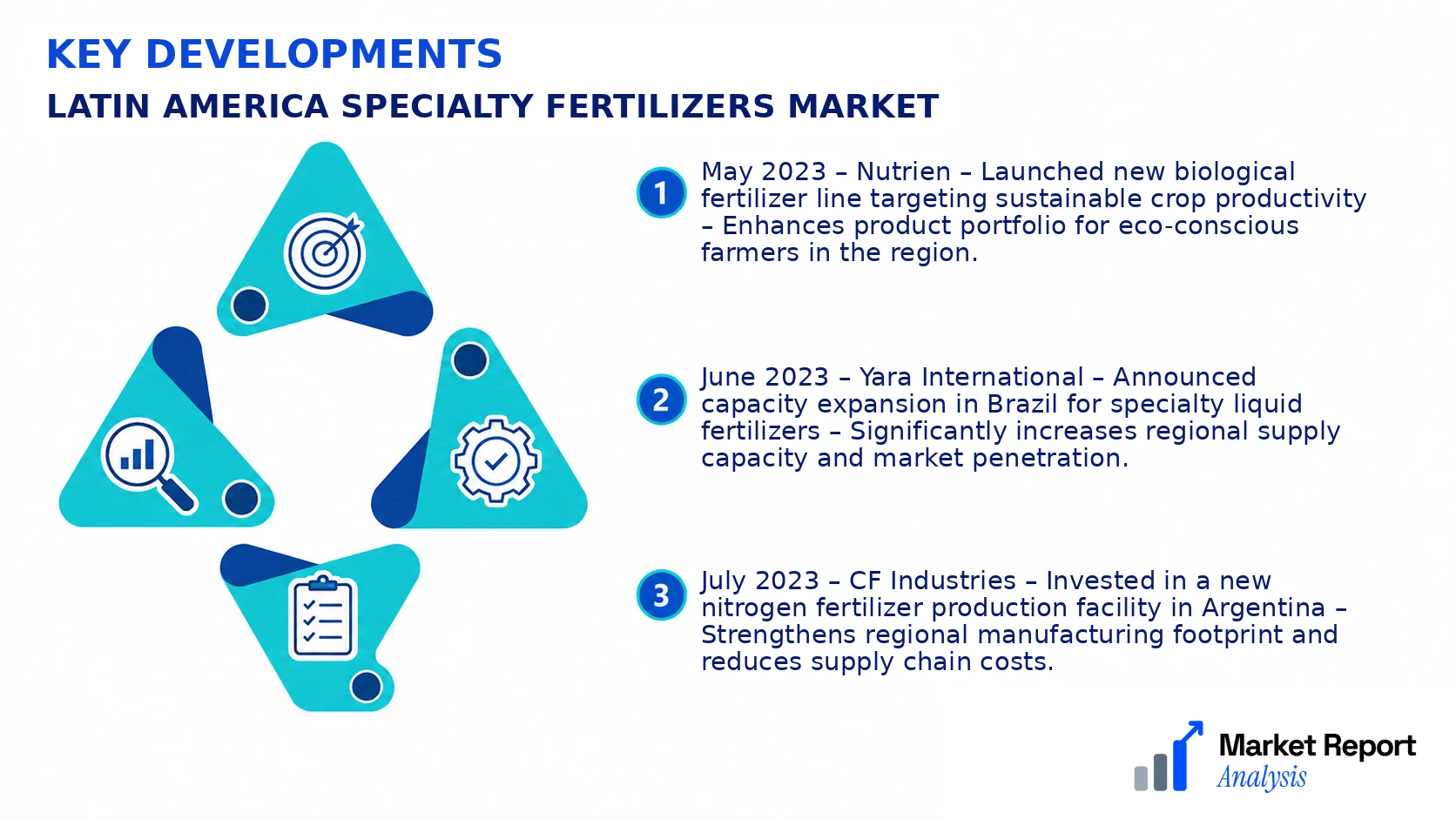
- May 2023 – Nutrien – Launched new biological fertilizer line targeting sustainable crop productivity – Enhances product portfolio for eco-conscious farmers in the region.
- June 2023 – Yara International – Announced capacity expansion in Brazil for specialty liquid fertilizers – Significantly increases regional supply capacity and market penetration.
- July 2023 – CF Industries – Invested in a new nitrogen fertilizer production facility in Argentina – Strengthens regional manufacturing footprint and reduces supply chain costs.
- August 2023 – OCP Group – Formed joint venture with local agrochemical distributor in Colombia – Expands regional presence and improves distribution network for phosphate fertilizers.
- September 2023 – Valagro – Launched environmentally sustainable biostimulant products in Brazil – Supports regional growth in organic and sustainable farming sectors.
Frequently Asked Questions
What is the Latin America Specialty Fertilizers Market?
The Latin America Specialty Fertilizers Market encompasses the production and distribution of nutrient-specific fertilizers tailored for precise agricultural needs within Latin America, focusing on improving crop yield, quality, and sustainability through specialized nutrient formulas, designed to cater to the region's diverse agricultural demands.
What is the current market size of Latin America Specialty Fertilizers Market?
As of 2026, the Latin America Specialty Fertilizers Market is valued at approximately USD 2.4 Billion, reflecting increasing adoption of tailored fertilizers driven by the need for higher crop productivity and resource efficiency in the region's expanding agricultural sector.
What factors are driving the Latin America Specialty Fertilizers Market?
Growth is primarily driven by rising demand for high-value crops, government initiatives to promote sustainable farming practices, increasing adoption of precision agriculture, and the need for nutrient management in response to soil degradation and climatic challenges across Latin America.
Which region dominates the Latin America Specialty Fertilizers Market?
Brazil leads the regional market due to its extensive agricultural activities, favorable government policies, and a high adoption rate of precision farming tools, establishing itself as the dominant region for specialty fertilizers within Latin America.
Which segment is expected to grow the fastest?
The micronutrient segment is projected to experience the fastest growth owing to increased awareness about soil health and crop nutrition, along with the growing emphasis on sustainable and environmentally friendly farming practices across Latin America.
Who are the leading companies operating in the Latin America Specialty Fertilizers Market?
Major players include Yara International, Nutrien Ltd., and Haifa Chemicals, along with regional companies like Mosaic Fertilizer, focusing on innovation, strategic partnerships, and expanding distribution networks to strengthen their market presence across Latin America.
Analyst Perspective
The Latin America Specialty Fertilizers Market is poised for long-term growth driven by increasing demand for high-efficiency nutrient solutions tailored to regional crop needs and sustainability initiatives. As market maturity progresses, there will be significant opportunities for companies investing in innovative technologies such as controlled-release fertilizers and nutrient use efficiency improvements. Technological evolution will likely emphasize digital agriculture integrations and precision application techniques, enabling better nutrient management and reducing environmental impact. Investment priorities should focus on expanding R&D capabilities, establishing strategic regional alliances, and scaling sustainable production practices to capture emerging segments. Competition remains intense, with key players competing on innovation, distribution, and product customization. Regionally, Brazil and Argentina present the strongest growth potential due to expanding agricultural productivity and government support for sustainable farming. Long-term success will depend on firms’ agility in adopting new technologies, navigating regulatory landscapes, and leveraging regional market nuances to secure a competitive edge in this evolving landscape.
