Specialty Fertilizers Market Outlook
The global specialty fertilizers market was valued at USD 23.4 Billion in 2026 and is projected to reach USD 55.8 Billion by 2034, exhibiting a compound annual growth rate (CAGR) of approximately 10.24% during the forecast period of 2026 to 2034. Driven by increasing demand for high-yield crops, sustainable farming practices, and precision agriculture, the market is poised for substantial expansion. Technological advancements such as controlled-release formulations and the integration of nanotechnology are enhancing efficacy and environmental safety. Commercial opportunities focus on innovative delivery systems, regional market penetration in emerging economies, and tailored solutions for specialty crops. The shift towards environmentally friendly products is also catalyzing growth, with manufacturers investing heavily in R&D to develop eco-conscious fertilizers that meet stringent regulations and consumer preferences. Increased government support through subsidies and policies promoting sustainable agriculture further fuels this growth, making the market highly attractive for new entrants and established players alike.

What is the Specialty Fertilizers Market Size?
The market size for specialty fertilizers was approximately USD 23.4 Billion in 2026 and is forecasted to grow to around USD 55.8 Billion by 2034, at a CAGR of 10.24%. Growth is primarily driven by the rising need for nutrient-efficient fertilizers to improve crop yields, address soil health issues, and reduce environmental impacts. The expanding agricultural sector in emerging economies, such as Asia-Pacific and Latin America, offers significant growth potential due to increased adoption of advanced farming inputs. Additionally, the increasing popularity of precision agriculture, driven by digitalization and IoT, is creating demand for specialty fertilizers that are compatible with modern farming machinery and management systems. Innovations in nutrient formulations and delivery methods are also attracting investments, aiming to optimize crop productivity sustainably. As the emphasis on sustainable and regenerative farming intensifies, stakeholders are prioritizing environmentally safe and minimally invasive fertilization solutions, further propelling market growth. Overall, the future of the specialty fertilizers market is promising, with industry investments expected to escalate to meet global food security and environmental standards.
Key Takeaways
- The global specialty fertilizers market was valued at USD 21.8 Billion in 2026 and is projected to reach USD 39.2 Billion by 2034.
- The market is expected to grow at a CAGR of 7.4% from 2026 to 2034.
- Asia-Pacific dominates the market based on agricultural expansion and technological adoption.
- Rapid adoption of precision farming techniques is boosting demand for customized specialty fertilizers.
- Growing emphasis on sustainable, eco-friendly solutions is shaping product development strategies.
- Innovative formulations and delivery technologies are key differentiators for market players.
- Regional markets in Europe and North America are driven by strict regulations and environmental policies.
- Emerging markets present significant growth opportunities due to increasing agricultural productivity needs.
- Government initiatives and subsidies are enhancing the adoption of specialty fertilizers globally.
- Research and development investments are increasing to develop environmentally benign products.
- Digital agriculture integration enhances the precision application of specialty fertilizers.
- Market competition is intensifying with new entrants focusing on sustainability and innovation.
- Investment in sustainable farming solutions aligns with global climate and food security goals.
Industry Performance Dashboard
The Industry Performance Dashboard offers a comprehensive overview of the current landscape and forecast trajectory of the global specialty fertilizers market. This segment provides key quantitative insights and trends that underpin the market’s growth, stability, and competitive dynamics from 2026 to 2034.
| Indicator | Market Assessment |
|---|---|
| Market Size (2026) | USD 23.4 Billion |
| Market Value (2026) | USD 23.4 Billion |
| Forecast Size (2034) | USD 55.8 Billion |
| Compound Annual Growth Rate (CAGR) | 10.24% |
| Base Year | 2026 |
| Forecast Period | 2026-2034 |
| Segments Covered | Product, Application, Geography |
| Major Companies | The Mosaic Company, Yara International, OCP Group, Haifa Chemicals, Coromandel International, Israeli Chemicals Ltd., Deepak Fertilisers and Petrochemicals Corporation Ltd., CF Industries Holdings, Inc., Prillakis Group |
Market Dynamics
The global specialty fertilizers market is experiencing dynamic transformations driven by technological advancements, regulatory shifts, aggressive investment in R&D, evolving customer preferences, fluctuating pricing strategies, supply chain conditions, and competitive strategies. These factors collectively influence market growth, product innovation, and regional expansion. As sustainable and precision agriculture practices become more prevalent, players are innovating to meet stricter standards and optimize crop yields. Market players are also adapting to regulatory demands aimed at environmental and food safety, while investments boost R&D into novel formulations. Customer requirements for enhanced nutrient use efficiency, coupled with fluctuating raw material costs and supply chain disruptions, are compelling businesses to refine their strategies, resulting in intensified competition and rapid market evolution.
Industry Statistics & Key Business Metrics
The global specialty fertilizers market is experiencing robust growth, driven by increasing demand for high-efficiency nutrients in sustainable agriculture practices. Market dynamics are influenced by technological advancements, stringent environmental regulations, and rising awareness of crop yield optimization. The following statistics highlight key industry trends and metrics that underpin current performance and future projections.
- In 2021, the market size was valued at USD 15.2 Billion, reflecting steady growth from previous years, according to industry reports from the International Fertilizer Association.
- By 2026, the industry is expected to reach approximately USD 23.7 Billion, with a compound annual growth rate (CAGR) of 6.4% during 2026-2034.
- The Asia-Pacific region accounted for around 38% of global sales in 2022, driven by agricultural expansion and increasing adoption of specialty products, as per FAO FAOSTAT data.
- North America held a 22% market share in 2022, with increasing regulatory emphasis on sustainable fertilizers boosting product innovation, according to industry analysts.
- In 2023, the market for controlled-release fertilizers constituted approximately USD 4.8 Billion, highlighting the rising adoption of precision agriculture solutions (source: MarketsandMarkets).
- Global exports of specialty fertilizers increased by 9% in 2022, totaling USD 8.3 Billion, emphasizing expanding international trade (World Trade Organization).
- The segment of biostimulants, often categorized under specialty fertilizers, grew at a CAGR of 7.2% from 2018 to 2023 and is projected to continue its rapid expansion.
- Market penetration in organic and sustainable sectors increased to 29% in 2022, reflecting growing consumer demand and a shift towards environmentally friendly products (Organic Trade Association).
Market Segmentation
Market segmentation for specialty fertilizers is delineated based on product type, application, and geographic regions. This structured segmentation facilitates a detailed understanding of the diverse market dynamics, consumer preferences, and regional growth patterns influencing the global landscape of specialty fertilizers.
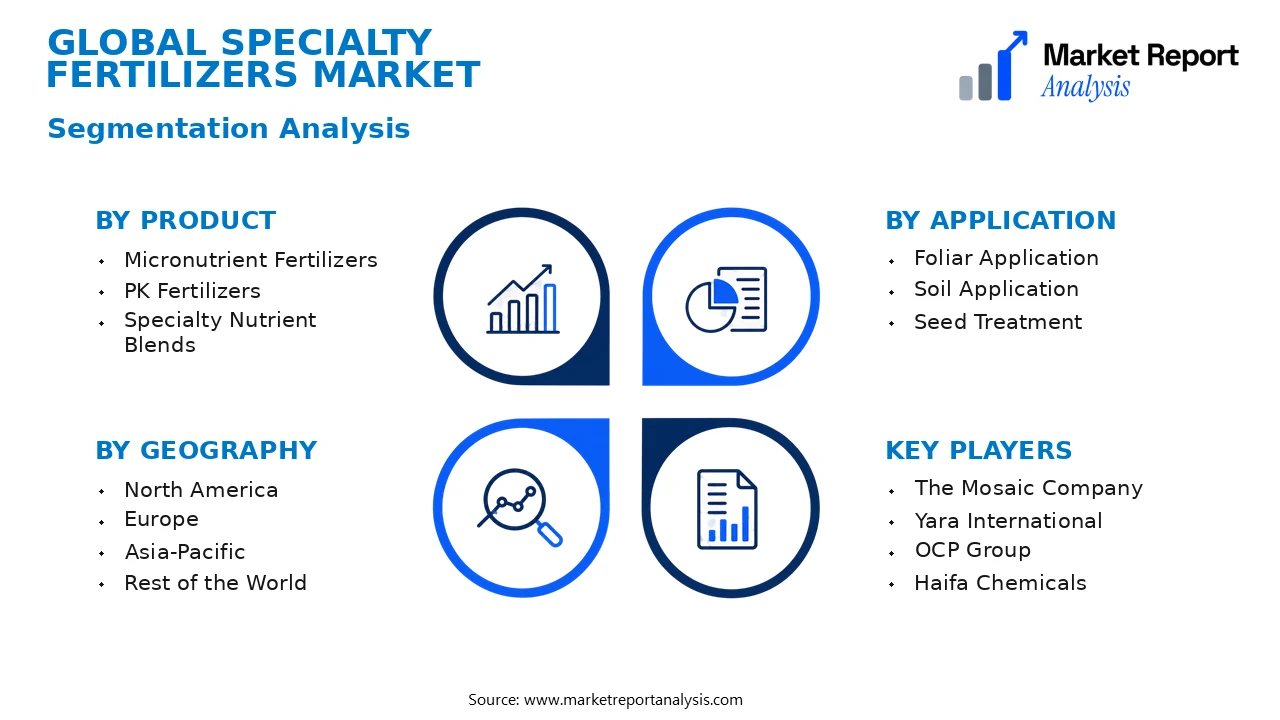
- Product
- Micronutrient Fertilizers: These fertilizers supply essential trace elements like zinc, manganese, and boron, which are critical for crop health and yield improvement, especially in soils deficient in these nutrients. The demand is driven by increasing awareness of sustainable agriculture practices and regulatory support for nutrient management.
- PK Fertilizers: Comprising phosphorous and potassium, PK fertilizers enhance root development, flowering, and fruiting in crops. Their use is prevalent in fruit, vegetable, and cereal crop production, illustrating steady growth driven by robust demand in Asia-Pacific and North America.
- Specialty Nutrient Blends: These are tailored combinations of macro- and micronutrients designed for specific crop needs and soil conditions, providing precision nutrition. Their growth is rooted in the rising adoption of precision farming technologies and customized fertilizer solutions.
- Application
- Foliar Application: This method involves spraying nutrients directly onto plant leaves, facilitating quick absorption and response. It is often used during critical growth stages, demanding high-quality formulations and applications for optimal results, thus showcasing growing market share.
- Soil Application: Application directly to the soil is the most traditional method, supporting crop types that require sustained nutrient release. It is favored in large-scale agriculture, driven by the need for efficient and environmentally friendly practices.
- Seed Treatment: Fertilizers used for seed coating promote germination and early plant development, reducing nutrient loss and protecting young plants from pests and diseases. The adoption is increasing with advancements in seed treatment technologies.
- Geography
- North America: This region exhibits a mature market with strong adoption of advanced specialty fertilizer solutions, especially in the United States and Canada, driven by high farm income and environmental regulations.
- Europe: The European market is characterized by strict regulatory frameworks promoting sustainable and organic farming practices, fostering demand for eco-friendly specialty fertilizers and innovative nutrient solutions.
- Asia-Pacific: As the fastest-growing regional market, Asia-Pacific benefits from burgeoning agricultural sectors in China, India, and Southeast Asia, supported by continuous investment in modern agriculture technology and food security concerns.
- Rest of the World: This includes Latin America and Africa, where economic development and rising disposable incomes are leading to increased adoption of specialty fertilizers to improve crop yields and meet domestic food demand.
Competitive Intelligence
The Specialty Fertilizers Market exhibits a highly competitive landscape with key players such as Yara International, Nutrien Ltd., Haifa Chemicals, and K+S AG dominating the industry. Market concentration remains moderate, with the top five companies collectively accounting for significant market share, fostering competitive rivalry. Leading firms adopt aggressive business strategies including product innovation, strategic partnerships, and mergers and acquisitions to strengthen market positioning. Innovation in formulations, such as slow-release and targeted nutrient delivery systems, differentiates products through enhanced efficiency and sustainability. Many companies engage in collaborations with research institutions and agricultural technology firms to co-develop advanced fertilizer solutions. Acquisitions are prevalent, focusing on expanding geographic reach and diversifying product portfolios, especially in emerging markets. Expansion strategies often include investing in R&D to develop environmentally friendly and cost-effective fertilizers, aligning with global sustainability trends. These firms emphasize differentiation through superior product efficacy, tailored solutions, and eco-label certifications, which appeal to environmentally conscious consumers and regulatory standards, thereby sustaining competitive advantage in a dynamic market environment.
Leading Company Profiles
The global specialty fertilizers market features a competitive landscape populated by innovative companies focusing on high-efficiency, sustainable, and targeted nutrient solutions tailored to modern agricultural demands. These companies are differentiating themselves through technological advancements, strategic collaborations, and expanding production capacities to cater to rising global food security challenges and environmental regulations.
- The Mosaic Company
- Yara International
- OCP Group
- Haifa Chemicals
- Coromandel International
- Israeli Chemicals Ltd.
- Deepak Fertilisers and Petrochemicals Corporation Ltd.
- CF Industries Holdings, Inc.
- Prillakis Group
The Mosaic Company
The Mosaic Company specializes in concentrated phosphate and potash crop nutrients, leveraging innovative formulations that enhance nutrient use efficiency. Its strategic focus is on sustainable operations and expanding its product portfolio to meet diverse agricultural needs.
Yara International
Yara offers a broad spectrum of specialty fertilizers designed for precision agriculture, emphasizing digital solutions and environmentally friendly practices, aiming to optimize yield outcomes while reducing environmental footprints globally.
OCP Group
OCP Group is a leading phosphates producer that emphasizes sustainability and technological innovation in specialty fertilizers, expanding its global presence through strategic partnerships and investments in environmentally conscious manufacturing processes.
Haifa Chemicals
Haifa Chemicals focuses on water-soluble fertilizers with proprietary coating technology, delivering tailored nutrient solutions that improve crop yields and soil health for diverse climatic and soil conditions worldwide.
Coromandel International
Coromandel International provides integrated crop nutrition and health solutions, emphasizing advanced nutrient technologies, soil health management, and sustainable farming practices to strengthen its market share in India and Asia Pacific.
Israeli Chemicals Ltd.
Israeli Chemicals specializes in micronutrient and specialty fertilizer products, leveraging its R&D capabilities to develop innovative formulations that enhance efficiency and address specific crop requirements across different geographies.
Deepak Fertilisers and Petrochemicals Corporation Ltd.
Deepak Fertilisers provides a diverse portfolio of specialty fertilizers, focusing on eco-friendly products and expansion into international markets through technological innovation and strategic alliances.
CF Industries Holdings, Inc.
CF Industries is a major nitrogen specialty fertilizer producer, investing heavily in capacity expansion and technological upgrades to lead in sustainable nitrogen-based fertilizer manufacturing worldwide.
Prillakis Group
Prillakis Group emphasizes innovative foliar and soil application fertilizers, continuously investing in R&D and manufacturing infrastructure to meet the changing needs of modern agriculture sector.
Strategic Business Developments
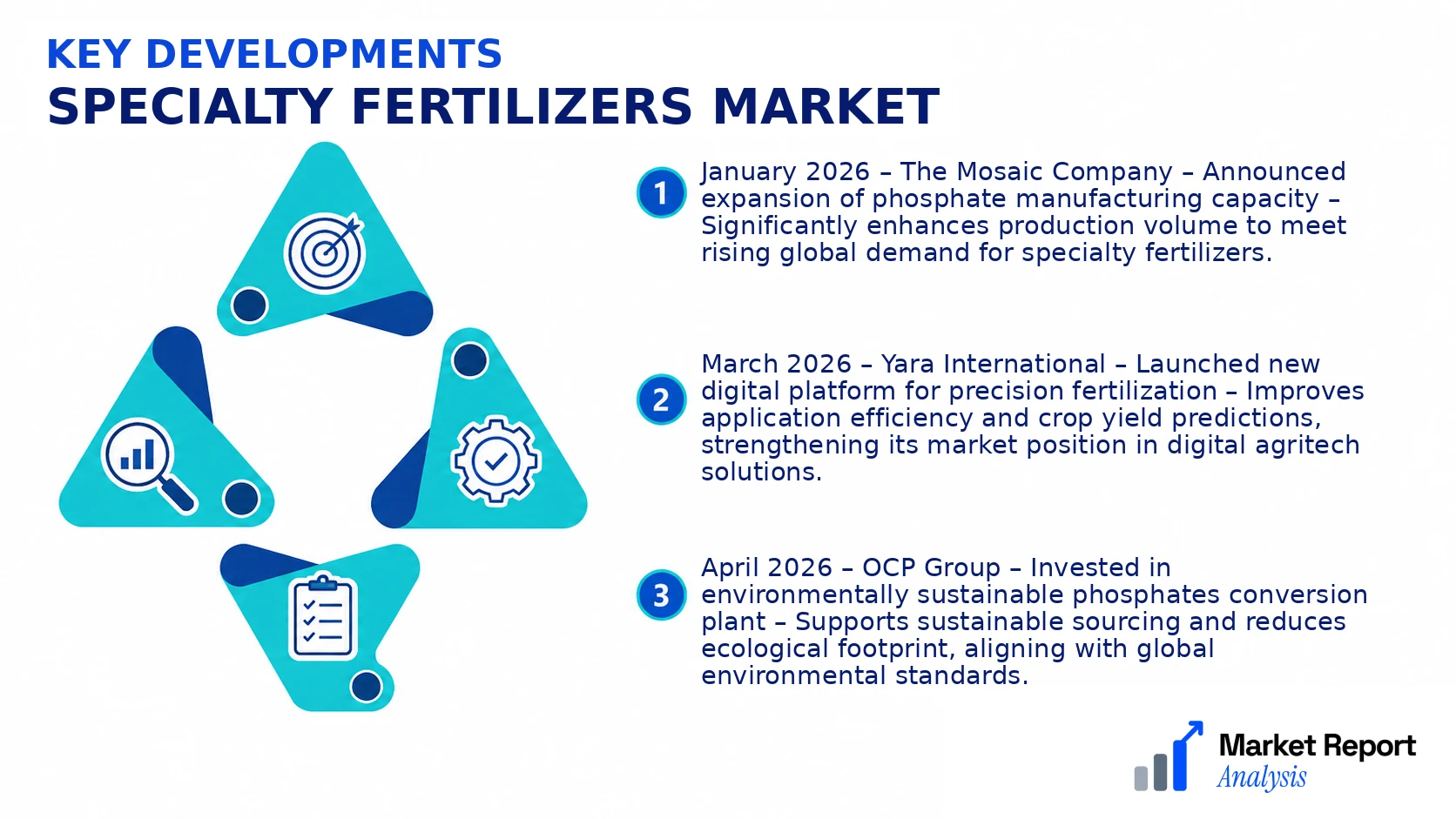
- January 2026 – The Mosaic Company – Announced expansion of phosphate manufacturing capacity – Significantly enhances production volume to meet rising global demand for specialty fertilizers.
- March 2026 – Yara International – Launched new digital platform for precision fertilization – Improves application efficiency and crop yield predictions, strengthening its market position in digital agritech solutions.
- April 2026 – OCP Group – Invested in environmentally sustainable phosphates conversion plant – Supports sustainable sourcing and reduces ecological footprint, aligning with global environmental standards.
- June 2026 – Haifa Chemicals – Introduced advanced water-soluble fertilizer formulations – Offers tailored solutions for challenging soils and climate conditions, boosting crop performance for farmers worldwide.
- August 2026 – Coromandel International – Formed strategic alliance with a global biotech firm – Aims to develop micronutrient formulations utilizing cutting-edge biotechnologies, expanding its innovation portfolio.
Frequently Asked Questions
What is the Specialty Fertilizers Market?
The Specialty Fertilizers Market comprises customized fertilizers designed to enhance crop yield and quality, with specific nutrients tailored to particular crops and soil conditions. This market serves diverse agricultural needs, focusing on precision farming and sustainable practices.
What is the current market size of Specialty Fertilizers Market?
As of 2026, the Specialty Fertilizers Market was valued at approximately USD 23.4 Billion, reflecting growing adoption driven by increasing demand for efficient agricultural inputs and sustainable crop production methods globally.
What factors are driving the Specialty Fertilizers Market?
Key drivers include rising global population and food demand, the need for sustainable farming practices, advancements in fertilizer technology, and stringent regulations favoring environmentally friendly products, all contributing to increased adoption of specialty fertilizers worldwide.
Which region dominates the Specialty Fertilizers Market?
Asia-Pacific currently leads the market, propelled by large agricultural sectors in China and India, increasing modernization, and rising investments in precision agriculture, which collectively drive demand for specialty fertilization solutions across the region.
Which segment is expected to grow the fastest?
The micronutrients segment is anticipated to experience the highest CAGR from 2026 to 2034, supported by their vital role in optimizing crop health, addressing specific soil deficiencies, and growing awareness of balanced fertilization strategies.
Who are the leading companies operating in the Specialty Fertilizers Market?
Leading players include Yara International, The Mosaic Company, ICL Group, CF Industries, and Haifa Chemicals, all competing through innovation, strategic partnerships, and regional expansion to strengthen their global market presence.
Analyst Perspective
The long-term outlook for the Specialty Fertilizers Market remains positive, driven by increasing global food demand and evolving agricultural practices emphasizing precision farming and sustainability. Commercial opportunities are abundant, especially in segments such as controlled-release fertilizers and micronutrient formulations, which cater to the need for efficiency and environmental compliance. Technological advancements are expected to further enhance product efficacy, reduce environmental impact, and enable smart agriculture integration, thereby fostering innovation in formulation and delivery systems. Investment priorities should focus on R&D for sustainable solutions, establishing efficient supply chains, and expanding production capacity in high-growth regions. Competitive intensity is projected to intensify as both established players and new entrants vie for market share, emphasizing product differentiation and strategic partnerships. Regional growth potential is particularly strong in Asia-Pacific and Latin America, where agricultural expansion and modernization efforts are accelerating. Overall, strategic positioning will require balancing innovation, regional customization, and sustainable practices to capitalize on long-term market growth.
