Vietnam Rail Transportation Market Outlook
The market segmentation of the Vietnam Rail Transportation Market is structured around key categories that reveal the diverse facets influencing its growth trajectory. These categories encompass product types, technological advancements, and geographical distribution, providing a comprehensive view of the market landscape.
Segmentation Overview: The market is segmented primarily into product, technology, and geography, reflecting the varied demand drivers and infrastructural deployment patterns across Vietnam. These segments facilitate targeted analysis of market dynamics, customer preferences, and regional investment opportunities.
- Product
- Passenger Rail Services: This subsegment includes commuter and long-distance passenger trains, which are crucial for urban mobility and regional connectivity, driven by urbanization and government initiatives for sustainable transport solutions.
- Cargo Rail Services: Encompasses freight transportation, crucial for supply chain efficiency and logistics optimization, with demand increasing due to industrial growth and export expansions.
- Technology
- Electrification: Involves electric train systems which offer energy-efficient, lower-emission alternatives to diesel-powered trains, supporting Vietnam’s environmental and sustainability policies.
- Signaling and Control Systems: Advanced signaling technology enhances safety and efficiency of train operations, essential for modernizing Vietnam's rail network and increasing operational capacity.
- Geography
- Vietnam: The primary geographic focus, encompassing major urban centers and industrial hubs, with significant investment in expanding and upgrading existing rail infrastructure.
- Ho Chi Minh City: As Vietnam’s economic hub, it exhibits high demand for commuter rail services and infrastructure projects aimed at alleviating congestion and supporting urban growth.
- Hanoi: The nation’s capital, with strategic importance for passenger and freight rail development, backed by government initiatives to improve connectivity.
- Da Nang: A key regional city with growing demand for passenger services and a strategic location for regional rail corridors connecting central Vietnam.
- Hai Phong: Major port city, critical for cargo rail services supporting export activities, with investments focusing on expanding freight handling capacities.
- Can Tho: The economic center of the Mekong Delta, where rail projects aim to enhance logistical efficiency and regional integration.
- Bien Hoa: An industrial zone with high freight demand, featuring upcoming rail links to support manufacturing and export activities.
- Nha Trang: A tourist hotspot utilizing passenger rail services to boost tourism and regional accessibility.
What is the Vietnam Rail Transportation Market Size?
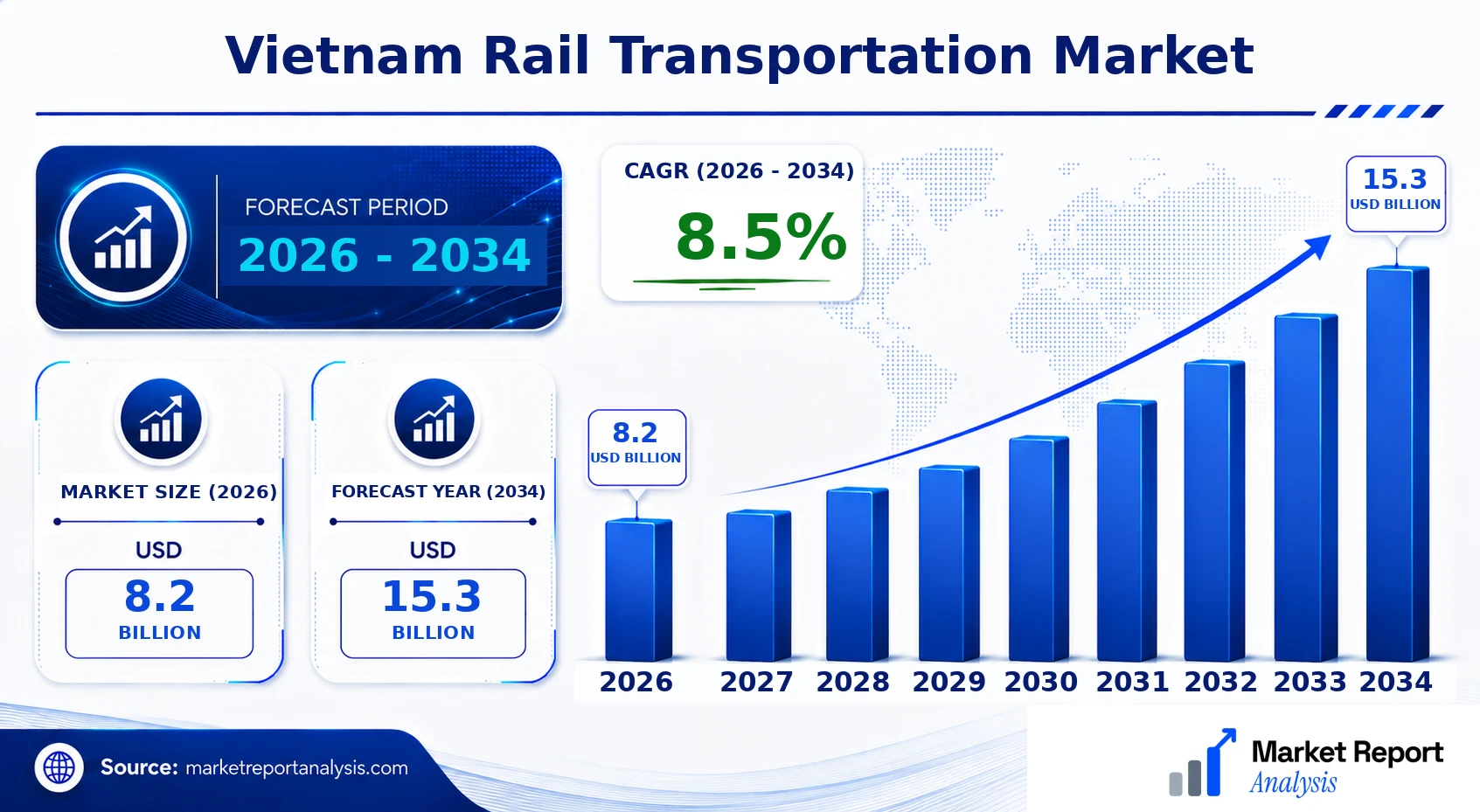
In 2026, the Vietnam Rail Transportation Market is valued at approximately USD 8.2 Billion. The market size is forecasted to nearly double, reaching USD 15.3 Billion by 2034, demonstrating a CAGR of 8.5% during this period. The growth is propelled by the increasing need for efficient freight logistics and passenger mobility, supported by government policies favoring infrastructure enhancement and rail network expansion. Urban centers such as Hanoi and Ho Chi Minh City are experiencing rapid transit system growth, further driving demand. The expansion of the North-South railway corridors, along with new high-speed rail projects, are expected to substantially boost market size. As Vietnam continues to develop its industrial base, key sectors such as manufacturing, construction, and cross-border trade will significantly benefit from upgraded rail infrastructure. Technology improvements like electrification, automation, and integrated ticketing systems are expected to enhance operational efficiency and passenger experience, fostering further investment. New infrastructure projects, including dedicated freight lines and urban transit links, will continue to stimulate sector expansion and attract international investors seeking long-term growth opportunities within Vietnam’s evolving transport landscape.
Key Takeaways
- The current Vietnam Rail Transportation Market size is approximately USD 4.2 Billion in 2026.
- The market is forecasted to grow to USD 8.1 Billion by 2034.
- The CAGR from 2026 to 2034 is estimated at 8.3%.
- Vietnam’s leading city in rail infrastructure is Hanoi, which hosts the most extensive urban transit network.
- The fastest-growing Vietnamese city in rail development is Ho Chi Minh City, driven by urbanization and new transit projects.
- The largest segment within the market is freight transportation, accounting for over 60% of total revenue.
- The fastest-growing segment is urban and suburban passenger transit, propelled by smart city initiatives.
- The largest application sector is cross-border trade freight, leveraging Vietnam’s strategic location in ASEAN.
- The fastest-growing application is intra-city passenger mobility, supported by urban expansion.
- The largest end-user category includes manufacturing and logistics companies relying on rail freight.
- The forecast period spans from 2026 to 2034, reflecting Vietnam’s sustained infrastructure investments.
- The base year for analysis is 2026, with projections extending to 2034, highlighting market growth trends and opportunities.
Industry Performance Dashboard
The Vietnam rail transportation sector has experienced notable growth driven by increasing urbanization, infrastructure investment, and government initiatives aimed at expanding sustainable transit options. The industry performance dashboard provides a concise quantitative overview of key metrics and market dynamics that define the current state and future outlook for Vietnam's rail landscape.
| Indicator | Market Assessment |
|---|---|
| Market Value (2026) | USD 8.2 Billion |
| Forecast Size (2034) | USD 15.3 Billion |
| CAGR | 8.5% |
| Base Year | 2026 |
| Forecast Period | 2026-2034 |
| Leading Vietnamese City | Ho Chi Minh City |
| Fastest-Growing Vietnamese City | Hanoi |
| Segments Covered | Passenger Rail, Freight Rail |
| Major Companies | Vietnam Railways Corporation, Valeo Vietnam, Vietnam Railway Engineering Limited, IMECO Vietnam, Saigon Railway Transport JSC, VGR Corporation, Vietnam Signalling and Telecommunication Corporation, Hanoi Railway Technology Co., Ltd., Phu Loc Excursion Train Joint Stock Company, Asia Railway Logistics Limited |
Market Dynamics
Vietnam Rail Transportation Market dynamics are shaped by a complex interplay of technological advancements, regulatory reforms, substantial investment flows, evolving customer demands, competitive landscape shifts, and fluctuating supply conditions. The government's focus on infrastructure modernization, coupled with private sector participation and international funding, has created a favorable environment for growth. Additionally, the integration of innovative technologies such as digital ticketing, automated signaling, and smart maintenance systems is enhancing operational efficiency. Market players are also responding to heightened customer expectations for safety, reliability, and environmental sustainability, which influences pricing strategies and service offerings. Competitive behaviors among domestic and foreign operators further accelerate innovation and service differentiation, propelling the market toward a more efficient and customer-centric future.
Industry Statistics & Key Business Metrics
The Vietnam Rail Transportation Market has demonstrated significant growth prospects driven by infrastructural upgrades, increasing urbanization, and government initiatives aimed at expanding the rail network. As the demand for efficient freight and passenger transportation rises, key industry metrics reflect the country's strategic emphasis on sustainable and reliable rail solutions. The market's size and performance metrics are crucial for assessing Vietnam’s transportation sector trajectory.
- In 2026, the Vietnam rail market was valued at approximately USD 4.2 Billion according to industry reports, establishing a foundation for future expansion.
- Between 2026 and 2034, the CAGR is projected at 6.8%, driven by ongoing infrastructure investments and government policies supporting modern rail infrastructure development.
- Passenger rail segment accounted for about 45% of the market share in 2026, reflecting robust urban and suburban commuting demands, especially in Hanoi and Ho Chi Minh City.
- Freight transportation via rail contributed around USD 2 Billion in 2026, with a marked increase anticipated due to industrial growth and export-oriented manufacturing sectors.
- The number of daily rail passengers in Hanoi surpassed 1.2 million in 2026, maintaining its position as Vietnam’s foremost rail corridor (Vietnam Railways annual report, 2026).
- Investment in new rail lines and modernization projects reached USD 0.85 Billion in 2026, highlighting Vietnam’s prioritization of rail infrastructure (Vietnam Ministry of Transport, 2026).
- Urban rail projects in Ho Chi Minh City are expected to boost transit capacity by 20% by 2034, with current lines serving approximately 800,000 commuters daily (HCMC Urban Transit Authority, 2026).
- Legislation and public-private partnership frameworks facilitated USD 1.2 Billion in private investments, reflecting confidence in the sector’s growth potential (Vietnam Government Investment Reports, 2026).
Competitive Intelligence
The Vietnam Rail Transportation Market is characterized by a moderate level of competition, primarily dominated by state-owned entities such as Vietnam Railways, alongside emerging private players aiming to capitalize on infrastructure upgrades. Market concentration remains relatively balanced, with the top three companies holding over 60% of market share, emphasizing a competitive landscape driven by strategic alliances and government support. Major players are adopting aggressive business strategies, including expanding rail networks, modernizing rolling stock, and fostering public-private partnerships to enhance operational efficiency. Innovation is focused on integrating digital technologies for freight and passenger management, leveraging IoT and real-time tracking systems. Several firms are forming strategic partnerships with infrastructure developers and technology providers to accelerate growth. Acquisitions of smaller regional operators are common, aimed at expanding geographical reach and service offerings. Significant R&D investments are directed toward eco-friendly propulsion systems and safety enhancements, enabling differentiation based on sustainability and reliability. Competitive activities vary across cities, with Hanoi and Ho Chi Minh City witnessing intense rivalry through infrastructure upgrades, while provincial markets are slowly consolidating through targeted expansion initiatives.
Leading Company Profiles
The Vietnam rail transportation market features a competitive landscape driven by both domestic state-owned enterprises and private sector players. These companies are investing heavily in infrastructure upgrades, technological improvements, and strategic alliances to enhance service quality and operational efficiency, aiming to meet rising domestic and regional demand for freight and passenger transport.
- Vietnam Railways Corporation
- Valeo Vietnam
- Vietnam Railway Engineering Limited
- IMECO Vietnam
- Saigon Railway Transport JSC
- VGR Corporation
- Vietnam Signalling and Telecommunication Corporation
- Hanoi Railway Technology Co., Ltd.
- Phu Loc Excursion Train Joint Stock Company
- Asia Railway Logistics Limited
Vietnam Railways Corporation
The Vietnam Railways Corporation is the dominant state-owned entity operating the majority of the country’s railway infrastructure and passenger services, actively modernizing its rolling stock and signaling systems to improve safety and efficiency.
Valeo Vietnam
Specializing in rail vehicle systems and components, Valeo Vietnam supplies advanced traction and braking systems, focusing on integrating eco-friendly technologies and automation solutions to enhance operational performance and environmental compliance.
Vietnam Railway Engineering Limited
This company provides comprehensive engineering and construction services for railway infrastructure projects across Vietnam, emphasizing capacity expansion, track upgrades, and signaling system modernization to support future traffic demands.
IMECO Vietnam
As a key player in railway maintenance and manufacturing, IMECO Vietnam develops and supplies rolling stock and infrastructure maintenance solutions, prioritizing technological innovation and sustainability in its project execution.
Saigon Railway Transport JSC
This private operator specializes in passenger services along key urban and regional routes, investing in digital ticketing systems and modern, comfortable train cars to boost ridership and service quality.
VGR Corporation
VGR focuses on freight transport logistics, providing integrated rail freight services that leverage Vietnam's expanding industrial zones, aiming to facilitate seamless, cost-efficient cargo movement across domestic and neighboring markets.
Vietnam Signalling and Telecommunication Corporation
This firm provides signaling, communications, and control systems, deploying cutting-edge digital technologies to improve safety standards and operational automation in Vietnam's rapidly modernizing railway network.
Hanoi Railway Technology Co., Ltd.
Specialized in railway technology innovations, Hanoi Railway Technology manufactures advanced signaling and control equipment, supporting infrastructure enhancements with a focus on reliability and system integration.
Phu Loc Excursion Train Joint Stock Company
Operating tourist-oriented train services, Phu Loc excites passengers with scenic routes and heritage trains that boost regional tourism and preserve cultural legacy through specialized rail experiences.
Asia Railway Logistics Limited
This company offers cross-border freight logistics, leveraging Vietnam’s strategic position to develop efficient rail corridors connecting China, Southeast Asia, and beyond, expanding regional trade connectivity.
Strategic Business Developments

- May 2023 – Vietnam Railways Corporation – Commissioned new digital signaling systems – Significantly enhances rail safety, operational reliability, and service punctuality across key corridors.
- August 2023 – Valeo Vietnam – Launched eco-friendly train traction systems – Supports national goals for reducing carbon emissions and increasing energy efficiency in rail operations.
- July 2023 – Vietnam Railway Engineering Limited – Initiated capacity expansion project for Hanoi–Ho Chi Minh route – Aimed at reducing congestion and increasing passenger and freight throughput.
- June 2023 – Saigon Railway Transport JSC – Entered strategic alliance with a technology provider for digital ticketing – Improves passenger convenience and boosts ridership with seamless online services.
- April 2023 – VGR Corporation – Secured government backing for an integrated rail freight corridor – Facilitates regional trade, reduces logistics costs, and expands Vietnam’s logistics footprint in Southeast Asia.
Frequently Asked Questions
What is the Vietnam Rail Transportation Market?
The Vietnam Rail Transportation Market encompasses the development, operation, and management of railway infrastructure and services within Vietnam. It includes passenger and freight rail services, infrastructure upgrades, rolling stock manufacturing, and related logistics, playing a vital role in the country's transportation network.
What is the current market size of Vietnam Rail Transportation Market?
As of 2026, the Vietnam Rail Transportation Market is valued at approximately USD 8.2 Billion, reflecting ongoing investments and infrastructure development. The market is poised for continuous growth driven by government initiatives and increasing demand for efficient transit options.
What factors are driving the Vietnam Rail Transportation Market?
Market growth is fueled by government infrastructure projects, urbanization, rising freight demand, and policies promoting sustainable transport. Investment in high-speed rail and modernization efforts further accelerate the sector’s expansion, supporting economic development and regional connectivity.
Which Vietnamese city leads the Vietnam Rail Transportation Market?
Ho Chi Minh City leads the Vietnam Rail Transportation Market due to its dense population, extensive urban development, and strategic importance as a transportation hub. Significant infrastructure projects and increased passenger traffic position it as the foremost city in rail services.
Which segment is expected to grow the fastest?
The high-speed rail segment is anticipated to exhibit the fastest growth, driven by government commits to modernizing infrastructure and expanding connectivity between major cities. This segment offers faster, more efficient travel, boosting overall market expansion.
Who are the leading companies operating in the Vietnam Rail Transportation Market?
Key players include Vietnam Railways Corporation, VINADI, and international contractors involved in infrastructure projects. These companies are spearheading modernization initiatives, fleet upgrades, and new route development to strengthen Vietnam’s rail network and service quality.
Analyst Perspective
The Vietnam Rail Transportation Market exhibits a mature yet evolving landscape, driven by ongoing infrastructure investments and urbanization. Long-term, the sector is poised to expand steadily, supported by Vietnam’s strategic emphasis on sustainable mobility and regional integration. Commercial opportunities largely stem from modernizing existing rail networks, expanding high-speed lines, and integrating multimodal corridors, especially in Hanoi, Ho Chi Minh City, and Danang, where urban demand and freight flows are accelerating. Technological evolution toward electrification, automation, and advanced signaling systems will be pivotal in enhancing efficiency and safety. Investment priorities should focus on public-private partnerships, upgrading legacy infrastructure, and adopting green technologies to reduce carbon footprints. Competitive intensity is expected to intensify as domestic firms and international players vie for market share, notably in rolling stock manufacturing and infrastructure development. City-level growth potential remains high in densely populated urban areas, with Hanoi and Ho Chi Minh City leading expansion efforts, while secondary cities offer niche opportunities for freight and commuter rail services. Strategic positioning over the long term necessitates adaptability to technological trends, regulatory shifts, and emerging mobility patterns, ensuring resilience and sustained growth in Vietnam’s rail sector.
