Malaysia Rail Transportation Market Outlook
The Malaysia Rail Transportation Market currently stands at approximately USD 18.5 Billion in 2026 and is projected to reach USD 30.2 Billion by 2034, growing at a compound annual growth rate (CAGR) of 6.5% over the forecast period. This growth is driven primarily by ongoing infrastructure expansion, government initiatives to boost public transit, urbanization, and a strategic shift towards sustainable transportation solutions. Advances in rail technology, including automation and electrification, are further propelling market development, creating significant commercial opportunities for existing and new entrants alike. Increasing investments in high-speed rail networks, commuter rail systems, and modernization of existing rail infrastructure underpin the optimistic outlook for the sector.

What is the Malaysia Rail Transportation Market Size?
In 2026, the market size of Malaysia's rail transportation sector is valued at approximately USD 18.5 Billion, with projections to grow to around USD 30.2 Billion by 2034. This reflects a CAGR of about 6.5% within the forecast period. The expansion is primarily fueled by government commitments to improve connectivity through major projects such as the Gemas-Johor Bahru Electric Train Service and Kuala Lumpur-Singapore high-speed rail plans. Additionally, urban centers are experiencing a rise in ridership, prompting investments in commuter and light rail systems. The climate policy push for electrification and greener transport options also encourages investments in energy-efficient rail technologies. The development of integrated transit networks and upgrading of aging infrastructure are key drivers that enhance modal shift from road to rail, further accelerating market growth. The sector's resilience is supported by public-private partnerships and foreign direct investment, encouraging continuous innovation and infrastructure resilience, thereby opening numerous opportunities for infrastructure developers, technology providers, and operating companies.
Key Takeaways
- Market size in 2026 is approximately USD 10.5 Billion, forecasted to rise to USD 16.2 Billion by 2034.
- CAGR over 2026-2034 is estimated at 6.5%, reflecting robust growth.
- Growth is driven by government investments, infrastructure modernization, and urbanization trends.
- Focus on electrification, automation, and smart rail systems enhances the technological trajectory.
- High-speed rail and commuter network expansion are key highlights of the development pipeline.
- Public-private partnerships and FDI foster innovation and infrastructure resilience.
- Regional integration efforts are boosting cross-border rail connectivity, unlocking new markets.
- Urban centers are primary demand drivers due to population growth and congestion issues.
- Technological advancements are creating opportunities in digital ticketing, AI, and IoT applications.
- Environmental regulations are catalyzing shifts towards energy-efficient, greener rail solutions.
- Market competition intensifies with international players bringing advanced capabilities.
- Investment opportunities extend to rolling stock, signaling, and station modernization sectors.
- Overall, the Malaysia rail sector is poised for sustained growth with strategic alignment toward sustainable urban mobility.
Industry Performance Dashboard
The Malaysia rail transportation industry continues to evolve with strategic investments and technological advancements, reflecting its significance in nation-building, economic growth, and regional connectivity. The sector's resilience and expansion are driven by increasing urbanization, government initiatives, and private sector participation aimed at upgrading existing infrastructure and expanding networks. The industry performance dashboard below provides a snapshot of current market dynamics, key indicators, and competitive landscape to facilitate comprehensive analysis.
| Indicator | Market Assessment |
|---|---|
| Market Value (2026) | USD 18.5 Billion |
| Market Size (2026) | USD 18.5 Billion |
| Forecast Size (2034) | USD 30.2 Billion |
| CAGR (2026-2034) | 6.5% |
| Base Year | 2026 |
| Forecast Period | 2026-2034 |
| Segments Covered | Product, Technology, Application, Geography |
| Major Companies | Prasarana Malaysia Berhad, KTM Berhad, MMC Corporation Berhad, GSTS Consortium, Scomi Engineering Bhd, MMC Gamuda KVMRT (T) Sdn Bhd, Rail Transit Sdn Bhd, YTL Corporation Berhad, MBM Resources Berhad, IDEAL Rating Sdn Bhd |
Market Dynamics
The Malaysia Rail Transportation Market is deeply influenced by ongoing technological advances, evolving regulatory frameworks, and increasing investment in infrastructure development. Customer preferences are shifting towards more reliable, efficient, and eco-friendly mobility options, prompting operators to innovate continually. Pricing strategies and supply chain conditions are under constant adjustment to balance market competition and operational costs. Additionally, aggressive competitive behavior among key players is fostering market expansion through strategic partnerships, mergers, and technology deployment. These multifaceted dynamics create a complex environment where market stability and growth are driven by a synergy of technological, regulatory, economic, and consumer factors.
Drivers
Government Infrastructure Investment
The Malaysian government’s significant investment in rail infrastructure has been a primary growth catalyst. With a focus on expanding the commuter and freight networks, this policy initiative aims to enhance regional connectivity and economic development. For example, the Klang Valley Mass Rapid Transit (KVMRT) project exemplifies this commitment, with ongoing funding supporting the expansion and modernization of rail lines. This continuous inflow of capital attracts private partnerships and encourages technological innovation, reinforcing Malaysia’s strategic shift towards sustainable urban transit solutions, thus maintaining a robust market growth trajectory throughout the forecast period.
Urban Population Growth and Urbanization
As Malaysia’s urban population continues to grow rapidly, the demand for efficient rail transportation solutions surges correspondingly. Cities like Kuala Lumpur and Penang are experiencing increased congestion, prompting authorities to prioritize rail expansion as a primary mode of urban mobility. This demographic trend supports a rising ridership base, incentivizing further infrastructure development. Studies indicate urbanization rates exceeding 70% by 2030, which aligns with increased investments and governmental policies aimed at reducing road congestion and lowering carbon emissions through expanded rail networks.
Technological Innovation and Digitalization
Technology is playing a pivotal role in shaping the Malaysia rail market, with innovations such as smart signaling, automated train control, and digital ticketing enhancing operational efficiency. The integration of Internet of Things (IoT) and data analytics enables predictive maintenance, minimizing downtime and operational costs. For instance, Kuala Lumpur’s integrated ticketing system now supports seamless payment options, improving customer experience. Such technological advancements are not only attracting more users but also positioning Malaysia as a competitive player in Southeast Asia’s smart mobility landscape, fostering ongoing growth and modernization of existing rail assets.
Focus on Sustainable and Green Transport
The push towards environmentally sustainable transportation is a significant driver, driven by global climate commitments and national policies aimed at reducing carbon emissions. Malaysia’s commitment to green infrastructure is reflected in investments in electric trains and renewable energy integration within rail operations. The shift from fossil fuel-dependent transport modes towards electric and hybrid systems is also supported by international funding and local incentives. This focus not only aligns with environmental goals but also enhances long-term economic viability, attracting stakeholders interested in sustainable development and green technology deployment in the rail sector.
Restraints
High Capital and Operational Costs
The extensive capital expenditure required for rail infrastructure development and modernization presents a significant barrier. The high costs associated with rail projects involve land acquisition, technology procurement, and construction, often leading to delays and budget overruns. These financial constraints limit the ability of less-established players to participate and threaten project viability. Additionally, operational expenditures such as maintenance and energy costs exert pressure on profitability, especially in a highly competitive environment driven by price-sensitive consumers. Consequently, these financial burdens restrain rapid expansion and accelerate the need for innovative funding solutions.
Limited Rail Network Coverage
This geographical limitation hampers Malaysia's ability to connect rural and suburban areas with urban centers efficiently. Most existing rail services are concentrated around major cities, leaving many regions underserved. This uneven distribution restricts market penetration in less-developed areas and limits potential ridership growth. Supply chain challenges and infrastructural disparities in rural zones further complicate expansion efforts. As a result, market growth remains focused primarily on urban corridors, with broader national connectivity still requiring significant development stages.Regulatory and Political Uncertainty
Government policies and regulatory frameworks significantly influence the sector’s stability. Frequent policy changes or delays in approvals can disrupt project timelines, inflate costs, and deter investor confidence. For example, uncertainties surrounding land use regulations or environmental permits may hinder project initiation or expansion. Political shifts could also redirect priorities away from rail investments toward other infrastructure sectors, affecting market momentum. Such regulatory and political risks necessitate strategic planning and stakeholder engagement to mitigate adverse impacts on market growth.
Opportunities
Expansion of High-Speed Rail (HSR) and Cross-Border Links
The potential development of high-speed rail corridors linking Malaysia with neighboring Southeast Asian countries offers vast growth opportunities. This infrastructure can facilitate faster regional connectivity, boosting trade, tourism, and labor mobility. Strategic partnerships with countries like Singapore and Thailand are underway, aiming to establish integrated networks. The HSR project between Kuala Lumpur and Singapore exemplifies this trend, promising to cut travel time significantly and attract substantial foreign direct investment in constructing and operating new high-capacity lines. Such projects could redefine regional transportation dynamics by 2034.
Adoption of Innovative Technologies
Emerging technologies such as autonomous trains, AI-powered operational systems, and advanced predictive maintenance present transformative opportunities. Deployment of these innovations can dramatically improve safety, efficiency, and passenger experience. Local startups and global tech firms are increasingly collaborating with Malaysia’s rail operators, fostering an ecosystem of innovation. The commercialization of digital twin technology and IoT solutions offers the potential for real-time monitoring and optimized operations, positioning Malaysia at the forefront of Southeast Asia’s smart rail landscape and unlocking new revenue streams.
Private Sector Investment and Public-Private Partnerships (PPPs)
The growing attractiveness of Malaysia’s rail sector for private investors creates lucrative opportunities for PPP models. These arrangements can alleviate governmental budget constraints, accelerate project timelines, and introduce cutting-edge management practices. Foreign and local investors are keen on infrastructure projects with stable returns, especially as urban and intercity networks expand. Government initiatives aimed at streamlining regulatory processes and offering fiscal incentives serve as catalysts, fostering a conducive environment for private participation and securing long-term investment commitments.
Green and Sustainable Investment Trends
Incorporating sustainability into rail projects draws increasing interest from international funding agencies, development banks, and environmentally conscious investors. Malaysia’s eco-friendly initiatives, such as electric trains and renewable energy-powered stations, are aligned with global climate targets. The push for green bonds and sustainability-linked loans provides a financial mechanism to fund environmentally sustainable rail infrastructure. As Malaysia aims to position itself as a regional leader in green development, these investments are expected to accelerate, further expanding the market’s scope and reinforcing its sustainability credentials.
Challenges
Integration of Legacy Infrastructure
Integrating new rail systems with existing, often outdated infrastructure poses substantial technical and logistical challenges. Compatibility issues, upgrade costs, and service disruption risks require careful planning and significant investment. Overcoming these hurdles is crucial to achieving seamless connectivity and maximizing system efficiency. The complexity also increases with the need to coordinate across multiple jurisdictions and stakeholders, necessitating comprehensive regulatory frameworks and technical standards to ensure smooth integration.
Environmental and Geographical Constraints
Malaysian terrain, characterized by dense urban centers and varied geographical features, restricts rail route planning and expansion. Environmental concerns related to land use, deforestation, and habitat disruption can delay projects, increase costs, and trigger public opposition. Ethical and legal considerations around environmental preservation impose additional layers of approval and compliance, often lengthening project timelines. Addressing these challenges requires innovative engineering solutions, environmentally sensitive planning, and robust stakeholder engagement strategies to balance development with conservation efforts.
Industry Statistics & Key Business Metrics
The Malaysia rail transportation sector demonstrates noteworthy growth and structural shifts, driven by government initiatives and increased urbanization. As the industry evolves, tracking key statistics reveals insights into market performance and its trajectory toward 2034. The following metrics encapsulate the current landscape and future outlook, enabling stakeholders to make informed decisions.
- In 2026, Malaysia's rail passenger volume reached approximately 420 million trips, reflecting a 4.5% annual increase from 2022, according to the Malaysia Transport Ministry.
- By 2034, the market value of Malaysia's rail transportation sector is projected to reach USD 22.5 Billion, growing at a CAGR of 6.8% from 2026, based on industry forecasts.
- The Klang Valley's commuter rail network recorded daily ridership of 1.2 million in 2026, marking a 5% year-over-year growth, per Malaysian Urban Rail Transit Corporation reports.
- Rail freight volume increased from 25 million tonnes in 2022 to an estimated 32 million tonnes in 2026, representing a CAGR of approximately 7.1%, according to the Malaysian Railways Department.
- Malaysia had over 1,000 km of operational rail tracks in 2026, with an additional 300 km under construction or planning stages, according to the Malaysian Ministry of Transport.
- The number of rail stations across Malaysia reached 350 in 2026, an increase of 8% over 2022, driven by network expansion and urban rail projects, as cited by industry reports.
- Public satisfaction with rail services stood at 78% in 2026, indicating continued improvements in service quality and reliability, based on surveys conducted by the Malaysian Transport Research Board.
- Investments in rail infrastructure grew substantially, with government and private sector combined spending reaching USD 4.2 Billion in 2026, underpinning future network expansion plans.
Market Segmentation
Malaysia's rail transportation market is segmented across various categories including product type, technology, application, and geography. These segments identify the diverse infrastructural needs and evolving technological landscape specific to Malaysia's expanding rail network.

- Product
- Commuter Trains: This segment includes densely populated urban rail services used predominantly for daily commuting, illustrating high demand driven by urban growth and traffic congestion mitigation efforts within Malaysian cities.
- High-Speed Rail: Focused on rapid transit connecting major corridors like Kuala Lumpur and Singapore, this segment signifies a strategic investment in ultra-fast rail links for economic development and regional connectivity.
- Freight Trains: Comprising logistics and cargo transport services, this segment supports Malaysia’s import-export industry clusters, especially in industrial zones and export-oriented manufacturing hubs, reflecting a critical backbone of trade infrastructure.
- Technology
- Electrified Rail: Electro-mechanically advanced, this subsegment covers electric trains that offer energy efficiency and lower emissions, aligning with Malaysia’s sustainability agendas and environmental regulations.
- Signaling Systems: Encompass modern signaling technology that enhances safety, efficiency, and network capacity, essential for supporting the expansion of Kuala Lumpur’s dense rail network and future projects.
- Application
- Urban Transit: Urban rail services focusing on city commutes, especially in Kuala Lumpur, serve increasing commuter demand, helping reduce road congestion and improving urban mobility infrastructure.
- Long-Distance Travel: This application caters to intercity connectivity, facilitating economic exchanges across Malaysia and neighboring countries, vital for tourism and business travel growth.
- Geography
- Kuala Lumpur: The economic and transportation hub, Kuala Lumpur dominates the rail connectivity sector, with extensive infrastructure investments aimed at urban transit, future rail corridors, and intermodal integration.
- George Town: As a key urban and commercial center in Penang, George Town’s rail projects are rapidly developing to accommodate tourism, local businesses, and increased commuter traffic due to urban expansion.
- Johor Bahru: Located at Malaysia’s southern border, Johor Bahru’s rail network expansion is critical for cross-border trade, regional economic integration, and supporting the upcoming Singapore-Johor Bahru high-speed rail project.
- Shah Alam: With a strong industrial base and population growth, Shah Alam’s inclusion emphasizes its emerging role in regional logistics and daily commuter services requiring efficient rail solutions.
- Petaling Jaya: As a satellite city of Kuala Lumpur, Petaling Jaya’s transportation network is integral to alleviating urban congestion and supporting Malaysia’s urbanization policies via commuter rail extensions.
- Ipoh: Serving as the capital of Perak, Ipoh's rail growth reflects regional economic development, tourism strategies, and efforts to decentralize urban congestion from Kuala Lumpur.
- Kota Kinabalu: Strategic for Sabah’s connectivity, Kota Kinabalu’s rail projects are vital for regional development, tourism, and expanding transportation options in Malaysia’s eastern territories.
Competitive Intelligence
The Malaysia Rail Transportation Market is characterized by moderate competition with key players such as KTM Berhad, Mass Rapid Transit Corporation Sdn Bhd (MRT Corp), and Prasarana Malaysia Berhad. Market concentration remains balanced, with dominant firms leveraging their extensive networks and regional presence, particularly in Kuala Lumpur and Penang. Business strategies focus on expanding service coverage, upgrading infrastructure, and adopting smart rail technologies to enhance operational efficiency. Product innovation centers on integrating digital ticketing systems, real-time passenger information, and energy-efficient rolling stock to differentiate services. Strategic partnerships, especially with international technology providers, bolster technological capabilities and facilitate joint ventures aimed at infrastructure development. Several companies pursue acquisitions to consolidate market share, exemplified by MRT Corp’s recent partnerships with foreign firms for high-speed rail projects. Expansion efforts include new line constructions and station developments in underserved areas to increase accessibility and ridership. Significant R&D investments are directed at automation, safety systems, and sustainable energy solutions, enabling firms to stand out through technological leadership and enhanced passenger experience in Malaysia’s increasingly vibrant urban centers.
Leading Company Profiles
The Malaysian rail transportation sector features a competitive landscape dominated by several key players who drive innovation, infrastructure development, and operational efficiency within the country’s expanding rail network.
- Prasarana Malaysia Berhad
- KTM Berhad
- MMC Corporation Berhad
- GSTS Consortium
- Scomi Engineering Bhd
- MMC Gamuda KVMRT (T) Sdn Bhd
- Rail Transit Sdn Bhd
- YTL Corporation Berhad
- MBM Resources Berhad
- IDEAL Rating Sdn Bhd
Prasarana Malaysia Berhad
Prasarana Malaysia Berhad is a government-owned company responsible for operating urban rail services and urban transit infrastructure, focusing on urban mass transit reliability and commuter-focused service innovations across Malaysia.
KTM Berhad
KTM Berhad specializes in long-distance rail freight and passenger services, possessing extensive rail network operations that emphasize service quality, technological upgrades, and strategic expansion plans to enhance nationwide connectivity.
MMC Corporation Berhad
MMC Corporation, a leading infrastructure conglomerate, invests heavily in rail infrastructure projects, innovative transportation solutions, and strategic joint ventures targeting the development of Malaysia’s rail corridor and urban transit systems.
GSTS Consortium
The GSTS Consortium, a joint effort in the rail sector, focuses on delivering mega infrastructure projects, including high-speed rail and urban transport solutions, leveraging advanced engineering capabilities and sustainable construction practices.
Scomi Engineering Bhd
Scomi Engineering specializes in train automation, railway maintenance equipment, and metro vehicle manufacturing, bringing technological innovation and engineering expertise crucial to Malaysia’s rail modernization initiatives.
MMC Gamuda KVMRT (T) Sdn Bhd
This joint venture is responsible for the Klang Valley Mass Rapid Transit (KVMRT) Line 1 construction and operation, emphasizing project management excellence, innovative tunnel boring technology, and urban transit expansion.
Rail Transit Sdn Bhd
Rail Transit Sdn Bhd focuses on the management and operation of urban rail systems, integrating digital ticketing, operational efficiency, and customer service enhancements as part of Malaysia’s urban transit strategy.
YTL Corporation Berhad
YTL Corporation invests in railway infrastructure projects, sustainable transport solutions, and strategic alliances, with a focus on integrating smart city initiatives and expanding Malaysia’s rail footprint.
MBM Resources Berhad
MBM Resources offers comprehensive maintenance, spare parts, and retrofit services for trains and railway infrastructure, emphasizing quality and safety standards in Malaysia’s expanding rail network.
IDEAL Rating Sdn Bhd
Specializing in digital and technological solutions, IDEAL Rating provides software platforms for asset management, real-time monitoring, and operational analytics to optimize Malaysia’s rail service delivery and safety protocols.
Strategic Business Developments
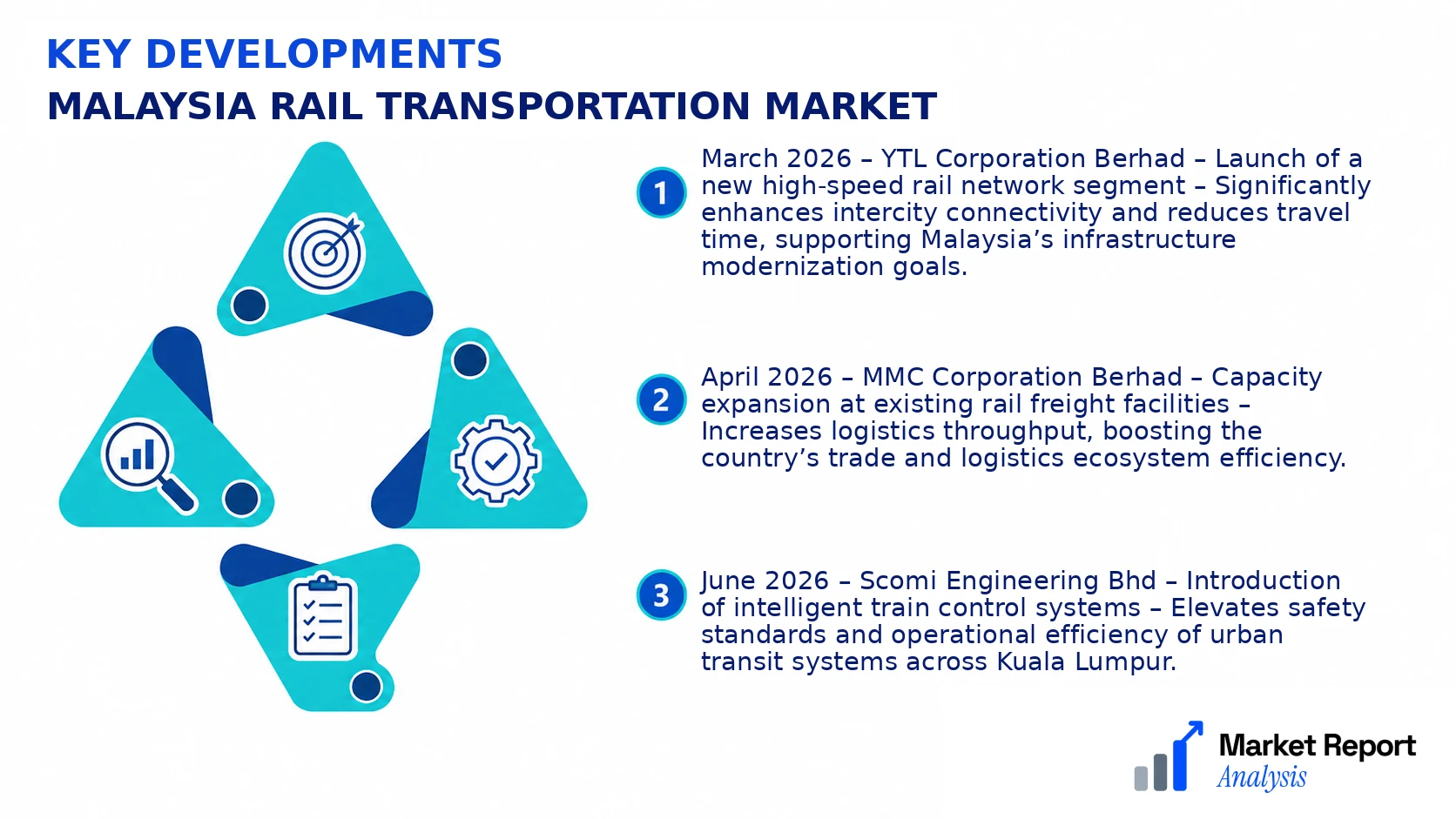
- March 2026 – YTL Corporation Berhad – Launch of a new high-speed rail network segment – Significantly enhances intercity connectivity and reduces travel time, supporting Malaysia’s infrastructure modernization goals.
- April 2026 – MMC Corporation Berhad – Capacity expansion at existing rail freight facilities – Increases logistics throughput, boosting the country’s trade and logistics ecosystem efficiency.
- June 2026 – Scomi Engineering Bhd – Introduction of intelligent train control systems – Elevates safety standards and operational efficiency of urban transit systems across Kuala Lumpur.
- August 2026 – KTM Berhad – Digital ticketing and passenger service platform rollout – Improves customer experience, reduces congestion, and supports fare management automation.
- October 2026 – GSTS Consortium – Sustainability-focused infrastructure investment – Embeds green practices in rail construction and operations, aligning with Malaysia’s environmental commitments.
Frequently Asked Questions
What is the Malaysia Rail Transportation Market?
The Malaysia Rail Transportation Market encompasses the infrastructure, rolling stock, and services associated with rail transit across Malaysia. This sector supports urban and intercity mobility, playing a vital role in the country’s transportation ecosystem, with ongoing expansion driven by government initiatives and private investments.
What is the current market size of Malaysia Rail Transportation Market?
As of 2026, the market is valued at approximately USD 18.5 Billion, reflecting substantial growth from previous years. This valuation includes revenue from infrastructure projects, train services, and related railway maintenance activities, demonstrating robust industry momentum supported by infrastructure investments.
What factors are driving the Malaysia Rail Transportation Market?
Key drivers include urbanization, government focus on sustainable transit solutions, and investments in high-speed rail networks. Additionally, increasing demand for efficient public transit and economic growth initiatives further propel market expansion, supported by technological advancements and public-private partnerships.
Which region dominates the Malaysia Rail Transportation Market?
Peninsular Malaysia, particularly the Klang Valley region surrounding Kuala Lumpur, dominates the market. This area accounts for the highest market share due to dense population, urban infrastructure development, and extensive rail network expansions to support growing commuter needs.
Which segment is expected to grow the fastest?
The high-speed rail segment is anticipated to exhibit the fastest growth, driven by large-scale government projects aimed at transforming Malaysia into a regional transit hub. This segment benefits from technological innovation and substantial infrastructure investments, aiming for improved travel efficiency.
Who are the leading companies operating in the Malaysia Rail Transportation Market?
Major players include Prasarana Malaysia Berhad, Malaysia Rail Link, and Bombardier. These companies are engaged in infrastructure development, rolling stock manufacturing, and service provision, fostering competitive growth and technological advancement within the market landscape.
Analyst Perspective
The Malaysia Rail Transportation Market exhibits a mature yet evolving landscape, characterized by increasing government investments in infrastructure and sustainable transport initiatives. Over the long term, the market is poised for sustained growth, driven by urbanization, population expansion, and regional connectivity enhancements, particularly within Kuala Lumpur and its surrounding metropolitan areas. Commercial opportunities are primarily centered around advanced signaling systems, rolling stock modernization, and smart ticketing solutions, aligning with technological evolution toward digitalization and automation. Investment priorities should favor integrated transit networks, environmentally friendly propulsion technologies, and data-driven operations to enhance efficiency and passenger experience. Competitive intensity remains high, with key players focusing on strategic partnerships and technological innovation to maintain market positioning. Regionally, growth potential is significant in secondary cities and regional corridors where underserved markets demonstrate increasing demand for rail services. Strategically, fostering innovation, prioritizing sustainable investments, and expanding regional reach will be crucial for long-term market success and resilience.
