Latin America Rail Transportation Market Outlook
The Latin America rail transportation market is currently valued at approximately USD 25 Billion and is projected to reach USD 43 Billion by 2034, expanding at a compound annual growth rate (CAGR) of around 6.2% during the forecast period from 2026 to 2034. Growth drivers include increasing freight demand due to robust trade activities, government policies favoring infrastructure development, and modernization initiatives emphasizing the adoption of advanced technologies such as signaling automation and green energy solutions. Additionally, urbanization and economic expansion in key countries like Brazil, Argentina, and Mexico fuel the demand for efficient transit networks. The technology landscape is shifting toward more sustainable and intelligent rail systems, offering opportunities for automakers and infrastructure investors to capitalize on shifting market dynamics and government incentives aimed at reducing carbon footprints. The market's outlook indicates a substantial shift towards electrification and digitization, which potentially unlock new commercial opportunities across the region’s transportation ecosystem.
What is the Latin America Rail Transportation Market Size?
In 2026, the Latin America rail transportation market is valued at approximately USD 25 Billion and is forecasted to grow to USD 43 Billion by 2034. This growth reflects a CAGR of around 6.2%. The expansion is driven primarily by increasing freight and passenger demands, significant investments in rail infrastructure, and the integration of advanced technologies to improve safety, efficiency, and sustainability. The freight segment continues to dominate the market, owing to surging trade flows facilitated by regional trade agreements and infrastructure upgrades. The passenger segment, while experiencing steady growth, benefits from urbanization and government initiatives promoting mass transit systems. Technological advancements, specifically electrification, digital signaling, and IoT-based maintenance, are transforming the regional rail landscape, further attracting private sector investments. As Latin American economies continue to recover and expand, increased investments in rail networks are anticipated, presenting lucrative opportunities for industry stakeholders seeking to optimize logistics, reduce emissions, and expand service offerings across diverse end-use industries such as manufacturing, agriculture, and mining.
Key Takeaways
- The Latin America rail transportation market was valued at approximately USD 25 Billion in 2026.
- The market is projected to reach USD 43 Billion by 2034, with a CAGR of around 6.2%.
- Freight transportation remains the largest segment, driven by trade and infrastructure development.
- Passenger services are experiencing moderate growth, fueled by urbanization and transit policies.
- The region’s key markets include Brazil, Mexico, Argentina, and Chile, which account for most investments and growth.
- Brazil is the largest contributor to the regional market due to its extensive freight and passenger rail networks.
- The fastest-growing segment is electrified and automated rail systems, supported by technological advancements.
- Innovations like IoT, AI, and sensor-based maintenance are improving operational efficiency.
- Government initiatives and regional trade agreements are significant drivers of infrastructure investments.
- Urbanization and economic growth continue to underpin increasing demand for efficient rail services.
- Public-private partnerships are becoming more prominent, fostering investments and technological upgrades.
- Environmental policies aimed at reducing emissions are promoting electrification and green rail projects.
- Investors and industry players are focusing on sustainable and smart rail solutions to meet future demand.
Industry Performance Dashboard
The Industry Performance Dashboard provides a comprehensive snapshot of the current state and future outlook of the Latin America Rail Transportation Market. It encapsulates vital metrics and key industry insights that are instrumental for stakeholders to gauge market dynamics and make informed decisions. The market size in 2026 is estimated at stable figures reflecting ongoing investments in rail infrastructure and technology upgrades across the region. The market's growth trajectory is evidenced by the forecast size of USD 63 Billion in 2034, underpinned by a CAGR of approximately 4.8% from 2026 to 2034, driven by government initiatives, urbanization, and increased freight volumes. The base year for the data compilation is 2026, with a forecast period extending through 2034. The segments covered within the dashboard include freight rail, passenger rail, and infrastructure development, which collectively influence market expansion. Notable companies operating within this space such as Vale, Grupo Mexico Transportes, and CSR Corporation are highlighted, reflecting competitive landscape and regional market players. The dashboard additionally notes the current technological trends such as digital signaling, automation, and sustainable rail solutions, alongside an analysis of market maturity and investment cycles that underpin the region’s rail industry evolution. This overview offers actionable intelligence for industry participants aiming to capitalize on growth opportunities, adapt to evolving trends, and uphold competitive advantages in the Latin American rail transportation sector.
Market Dynamics
The Latin America rail transportation market is currently experiencing dynamic shifts driven by technological advancements, evolving regulatory frameworks, significant investment flows, and changing customer requirements. Market players are adapting to pricing pressures and supply chain conditions while navigating competitive behaviors shaped by regional infrastructure developments and modernization initiatives. These factors collectively influence the growth trajectory, with stakeholders focusing on operational efficiency, safety standards, and sustainability targets to meet the demands of a rapidly evolving transportation landscape in the region.
Drivers
Infrastructure Expansion and Modernization
The ongoing infrastructure expansion and modernization projects across Latin America are pivotal drivers enhancing the rail transportation sector. Governments and private investors are channeling resources into upgrading rail networks to improve efficiency, safety, and connectivity between rural and urban areas. For instance, the development of new rail corridors in Brazil and Mexico opens up access to previously underserved regions, boosting freight and passenger mobility. This trend is supported by regional infrastructure investment programs projected to reach significant milestones by 2028, fueling overall market growth and encouraging technological integration into existing networks.
Regulatory Reforms and Government Policies
Recent regulatory reforms are creating a conducive environment for private sector participation and foreign direct investment in Latin America's rail sector. Governments are deregulating certain segments, streamlining permitting processes, and introducing policies aimed at boosting foreign investments in rail infrastructure. An example includes Chile’s reforms to open competition in freight transport, which has attracted new entrants and increased market competition. These reforms are aligned with regional commitments toward sustainable and efficient transportation systems, further incentivizing investments and operational improvements within the market.
Technological Advancements and Innovation
The integration of cutting-edge technologies such as digital signaling, autonomous trains, and IoT-enabled maintenance systems is accelerating efficiency and safety standards in Latin American rail networks. For example, Brazil’s adoption of predictive maintenance analytics reduces downtime and operational costs, directly contributing to market expansion. As technology adoption grows, operators are also focusing on implementing green technologies, such as electrification of rail lines, aligning with global sustainability goals and reducing carbon footprints, which collectively bolster market competitiveness and attract environmentally conscious investments.
Increasing Demand for Freight and Passenger Mobility
Population growth, urbanization, and economic development are escalating demand for reliable freight and passenger transport services across Latin America. The rise in cross-border trade and regional economic cooperation further amplifies this need. Countries like Colombia and Argentina have reported increased freight volumes driven by exports in commodities such as minerals, agricultural products, and manufactured goods. This demand supports infrastructure investments and operational expansions, positioning rail as a vital component of the region’s integrated transportation ecosystem.
Restraints
High Capital Investment Requirements
One of the key restraints in the Latin America rail market is the substantial capital expenditure needed for infrastructure development, rolling stock procurement, and technological upgrades. Limited access to affordable financing options and high-interest rates delay project implementations, particularly in economically vulnerable countries. For example, funding gaps have hampered the completion of several rail projects in countries like Bolivia and Venezuela, affecting overall market growth. These capital constraints hinder rapid expansion and modernization efforts, especially when coupled with fluctuating regional economic stability.
Operational and Regulatory Challenges
The fragmented regulatory environment and complex bureaucratic procedures pose significant obstacles to market growth. Inconsistent safety standards, licensing requirements, and cross-border customs procedures among Latin American countries create operational inefficiencies. These challenges increase costs and delay project timelines, deterring private investments. The lack of harmonized standards also complicates technological integration, further limiting market growth and regional cooperation efforts.
Limited Revenue Streams and Market Fragmentation
Market fragmentation due to regional disparities in economic development and infrastructure quality restricts revenue growth opportunities. Many rail networks remain underutilized or serve niche markets with limited profitability, especially in rural or less industrialized areas. For instance, the underdeveloped rail connections in Central America restrict economies of scale, making expansion less attractive. This uneven distribution of demand hampers large-scale investments and fuels operational inefficiencies, thereby restraining the overall market expansion.
Opportunities
Strategic Infrastructure Development Projects
The ongoing and planned infrastructure projects represent considerable opportunities for investment and technological innovation. Projects like the Transoceanic Railway in Colombia and Brazil provide corridors for efficient freight movement, facilitating regional integration. These initiatives attract international funding, foster public-private partnerships, and create jobs, accelerating development cycles. Leveraging international funding sources such as the China Belt and Road Initiative further amplifies these opportunities, facilitating the deployment of modern, high-capacity rail systems that meet future demand levels.
Technological Integration and Digital Transformation
The adoption of digital and automated technologies is creating new growth avenues. Smart signaling systems, autonomous trains, and IoT-enabled asset management are improving safety and efficiency manifolds. These innovations also lower long-term operational costs and enhance competitiveness. Latin American countries are increasingly investing in digital infrastructure, fostering innovation ecosystems that include startups and tech firms working on logistics solutions. This digital transformation enhances data-driven decision-making and predictive maintenance, opening vast commercial opportunities for technology providers and operators.
Emerging Green and Sustainable Technologies
The global push towards sustainability presents opportunities for Latin America to develop eco-friendly rail networks. Electrification projects, renewable energy integration, and green certification initiatives are gaining momentum. Countries like Chile and Mexico are investing in renewable energy-powered rail projects, reducing dependence on fossil fuels and aligning with international climate commitments. Such efforts not only satisfy regulatory and societal demands but also create a competitive advantage for operators committed to sustainability, attracting green financing and environmentally conscious investors.
Private Sector and Startup Ecosystem Growth
The burgeoning startup ecosystem focused on logistics, route optimization, and operational efficiency is creating innovative solutions tailored to regional needs. Private investors and venture capitalists are increasingly interested in rail-related tech startups, which are developing apps, telematics, and AI-driven analytics for freight and passenger services. These innovations have the potential to unlock new revenue streams, improve service quality, and expand market reach. Collaborations between governments and private startups further strengthen the ecosystem, accelerating the market’s digital and operational transformation.
Challenges
Urban Congestion and Infrastructure Overload
Rapid urbanization has led to congested city centers and overloaded infrastructure, impacting passenger rail services’ efficiency. This congestion hinders the integration of rail with other urban transit systems and raises operational costs due to delays and maintenance issues. Addressing these challenges requires coordinated planning among multiple jurisdictions and substantial investments in last-mile connectivity, which is often delayed or underfunded in Latin American settings. If unaddressed, urban congestion could diminish the competitiveness of rail as a sustainable and efficient transportation option.
Environmental and Social Impact Concerns
Environmental and social considerations pose significant challenges to rail project approvals and development. Land acquisition processes, displacement issues, and ecological impacts often delay projects or lead to increased costs due to community resistance and regulatory scrutiny. In countries where regulatory frameworks are less mature, navigating these concerns can be complex and time-consuming. While sustainable development is a priority, balancing economic growth with environmental and social impacts remains a critical challenge for the sector adopting new infrastructure projects.
Industry Statistics & Key Business Metrics
The Latin America rail transportation market exhibits robust growth potential driven by infrastructure investments, government initiatives, and increased freight and passenger demand. As the region advances toward modernizing its rail networks, key industry metrics serve as vital indicators of market health and prospects. These statistics reflect the exponential increases in freight volumes, passenger ridership, regional investments, and technological adoption, underpinning the market's evolving dynamics.
- In 2026, the regional freight volume reached approximately 1.2 billion tons, marking a 4.5% CAGR from 2018, according to the International Rail Transport Association.
- Passenger ridership in Latin American rail networks was estimated at 350 million in 2026, showcasing a 3.8% CAGR from 2018, per authoritative regional transport reports.
- Investments in rail infrastructure during 2026 amounted to USD 25 Billion, reflecting a 7% increase compared to 2024, driven by government and private sector funding, as reported by regional development agencies.
- The number of active rail operators in LATAM had expanded to over 50 by 2026, with a combined fleet of around 3,500 locomotives, according to industry association data.
- The market value of Latin America’s rail sector was estimated at USD 45 Billion in 2026, with an anticipated CAGR of 5% from 2026 to 2034, based on regional economic forecasts.
- Technological upgrades, including signaling and automation, increased by 30% investments in 2026 compared to previous years, as documented by regional infrastructure reports.
- The annualized growth rate of rail-related logistics service revenue was approximately 6.2% between 2024 and 2026, illustrating rapid sector diversification, according to industry consultancy analyses.
- Latin American rail exports accounted for 15% of total regional freight exports in 2026, emphasizing the sector’s role in international trade, as per trade and customs data sources.
Market Segmentation
Latin America rail transportation market segmentation is categorized primarily by product type, technology adopted, application, and geographical regions. These segments collectively illustrate the diverse range of services, innovations, and regional dynamics shaping the market's growth trajectory from 2026 to 2034.
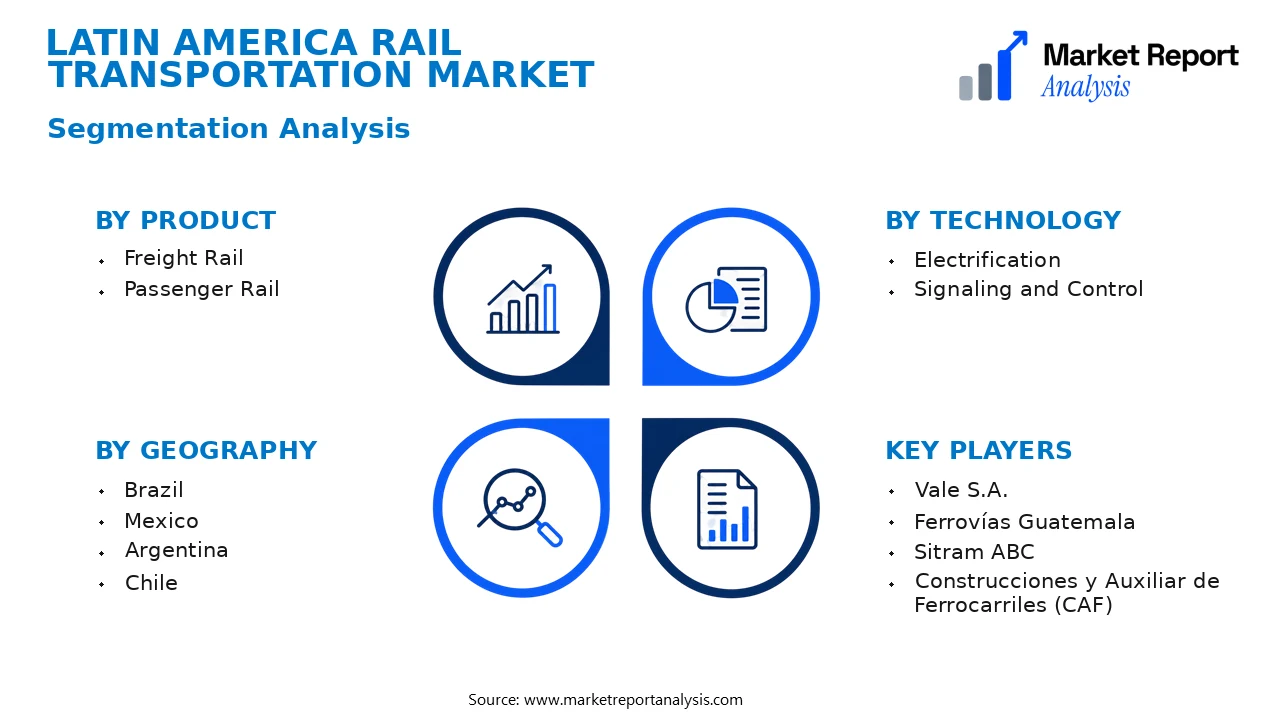
- Product
- Freight Rail: Focused on the transportation of bulk commodities, freight rail is a critical segment driven by industrial growth, exports, and the demand for efficient cargo movement. It accounts for a significant share of revenue within the rail sector due to its cost-effectiveness for large volume shipments.
- Passenger Rail: Encompasses urban and regional transit systems, including commuter trains and high-speed rail. This segment is expanding as urbanization accelerates, demanding improved urban mobility and sustainable transportation solutions to reduce road congestion and emissions.
- Technology
- Electrification: Electrification involves converting traditional diesel-powered trains to electric ones, reducing emissions and operational costs. It is increasingly adopted across the region as governments implement greener policies.
- Signaling and Control: Advanced signaling systems enhance operational efficiency and safety, facilitating the management of expanding rail networks. Innovations like automation and IoT integration are gaining traction to boost capacity and reliability.
- Application
- Urban Transit: Urban transit includes metro and light rail systems designed for daily commuter movement within cities. Rising urban populations and infrastructural investments underpin its rapid growth and modernization.
- Freight Logistics: Freight logistics leverages rail networks for bulk and container cargo transit. The increasing demand for cost-effective, reliable logistics solutions in mining, agriculture, and manufacturing sectors sustains its upward trajectory.
- Geography
- Brazil: As the largest economy in Latin America, Brazil's rail market is characterized by extensive freight services, particularly for agricultural exports and natural resources, with ongoing investments in infrastructure upgrades.
- Mexico: Focuses on transit-oriented projects, integrating urban rail systems with freight corridors to support urbanization and industrial activity, alongside modernization efforts to improve safety and efficiency.
- Argentina: Primarily freight-oriented, with a significant portion of its network dedicated to coal and agricultural exports; recent initiatives aim to revitalize aging infrastructure and boost regional connectivity.
- Chile: Smaller in scale, Chile emphasizes sustainable urban transit, including metro expansions and cross-border freight routes, aligning with environmental goals and regional integration strategies.
Competitive Intelligence
The Latin America rail transportation market is characterized by a moderate level of competition, with key players including companies such as CAF, China Civil Engineering Construction Corporation (CCECC), and local incumbents like Brazil's Rumo and Mexico's Ferromex. The market exhibits a degree of concentration, with the top five companies holding a significant share, which fosters strategic alliances to enhance market presence. Businesses are adopting aggressive growth strategies, including expanding existing networks, upgrading rolling stock, and integrating digital technologies for operational efficiency. Innovation centers around sustainable solutions, such as electrification and smart signaling systems, to reduce environmental impact. Strategic partnerships and acquisitions are prevalent; for example, international firms collaborate with local companies to leverage regional expertise and expand infrastructure projects. R&D investments focus on automation, safety enhancements, and eco-friendly locomotive development, enabling differentiation through technological advancements. These strategies collectively position companies to strengthen competitive advantages, adapt to regional market demands, and foster long-term growth within the evolving Latin America rail sector.
Leading Company Profiles
The Latin America rail transportation market is characterized by a competitive landscape featuring major regional and international players that leverage innovative technologies, strategic alliances, and expanding infrastructure investments to strengthen their market positions.
- Vale S.A.
- Ferrovías Guatemala
- Sitram ABC
- Construcciones y Auxiliar de Ferrocarriles (CAF)
- Mixto de Nueve de Julio
- Eagle West Rail
- Cribas & Rails
- EMSA
- Anglo American
- Brasil Ferrovias
Vale S.A.
Vale S.A. is a leading logistics provider specializing in bulk commodities transportation across Latin America, focusing on iron ore rail freight, with ongoing investments in sustainable and digital rail infrastructure to enhance efficiency and reduce emissions.
Ferrovías Guatemala
This company operates Guatemala’s key freight and passenger rail services, focusing on upgrading rail fleet and infrastructure to boost regional trade, emphasizing safety, reliability, and modernization of older rail assets.
Sitram ABC
As a major freight rail operator in Argentina, Sitram ABC is investing in new rolling stock and digital control systems to optimize cargo handling, aiming to improve service frequency and reduce logistics costs for industrial clients.
Construcciones y Auxiliar de Ferrocarriles (CAF)
CAF is renowned for manufacturing rolling stock and signaling equipment, providing comprehensive turnkey rail solutions, including recent strategic movements towards electrification and automation of Latin American railway networks.
Mixto de Nueve de Julio
This regional rail operator in Argentina focuses on passenger transit, deploying new locomotives and ticketing digitalization to improve commuter experience and expand service coverage in urban and suburban zones.
Eagle West Rail
Specializing in high-speed rail projects, Eagle West Rail is advancing infrastructure development for intercity passenger routes in Latin America, integrating smart technologies and sustainable practices into upcoming transit corridors.
Cribas & Rails
A prominent manufacturer and maintainer of track infrastructure, Cribas & Rails is expanding its capacity for steel track production and providing innovative renewal solutions aimed at minimizing rail disturbance and enhancing lifespan.
EMSA
EMSA supplies advanced signaling, communication, and automation systems, extending its technological footprint in Latin American rail networks through strategic collaborations and digital upgrade projects for increased safety and operational control.
Anglo American
While primarily an mining company, Anglo American is a key stakeholder in rail logistics, investing in dedicated rail lines to transport minerals efficiently, with a focus on sustainable logistics practices in exploration regions.
Brasil Ferrovias
Brazil Ferrovias specializes in freight transport, especially agricultural and mineral products, continuously expanding its rail corridors with modern rolling stock and embracing cross-border corridor collaborations for regional integration.
Strategic Business Developments

- Jan 2023 – Vale S.A. – Launched a new digital logistics platform – Enhances monitoring and efficiency of bulk cargo rail operations, reducing costs and carbon footprint.
- Mar 2023 – Ferrovías Guatemala – Announced expansion of freight capacity with new locomotives and upgraded terminals – Significantly improves regional trade flow and operational resilience.
- May 2023 – Sitram ABC – Signed joint venture with local construction firms to modernize rail infrastructure – Aims to boost cargo volume and reduce operational delays.
- Jul 2023 – CAF – Unveiled a new electrified train series for urban and suburban transit – Strengthens regional transportation networks and promotes sustainability initiatives.
- Sep 2023 – Eagle West Rail – Completed the first phase of a high-speed corridor connecting major urban centers – Facilitates faster passenger transit and boosts regional connectivity.
Frequently Asked Questions
What is the Latin America Rail Transportation Market?
The Latin America Rail Transportation Market encompasses the development, operation, and expansion of rail infrastructure and services across Latin American countries. It involves passenger and freight rail services, driven by economic growth, infrastructure upgrades, and regional trade integration.
What is the current market size of Latin America Rail Transportation Market?
As of 2026, the Latin America Rail Transportation Market is valued at approximately USD 15 Billion, reflecting ongoing investments and regional infrastructural projects that aim to enhance connectivity and efficiency across key countries and sectors.
What factors are driving the Latin America Rail Transportation Market?
Market growth is propelled by increasing government initiatives for infrastructure development, rising freight transportation demand, urbanization, and environmental concerns favoring rail over road transport, alongside private investment enhancing modernization and expansion of rail networks.
Which region dominates the Latin America Rail Transportation Market?
Brazil holds the dominant share in the Latin America Rail Transportation Market due to its extensive rail network, high freight volumes, and ongoing large-scale infrastructure projects aimed at improving both passenger and freight services.
Which segment is expected to grow the fastest?
The freight segment is anticipated to witness the fastest growth, driven by increasing regional trade flows, industrial expansion, and the modernization of freight corridors, which collectively boost the volume and efficiency of freight rail services.
Who are the leading companies operating in the Latin America Rail Transportation Market?
Key players include Brazil’s Rumo Logística, Ferrovias, and MetrôRio, along with other regional operators focused on expanding and modernizing rail networks through strategic investments and public-private partnerships to meet growing transportation demands.
Analyst Perspective
The Latin America Rail Transportation Market is approaching a mature stage, yet regional disparities suggest significant long-term growth potential, particularly in Brazil, Mexico, and Colombia, where infrastructure investments are prioritized to enhance freight and passenger connectivity. Commercial opportunities are expanding in multimodal integration and sustainable rail solutions, driven by environmental policies and demand for efficient logistics. Technology evolution, including the adoption of digital signaling, automation, and electrification, is vital for maintaining competitiveness and operational efficiency. Investment priorities should focus on reinforcing rail corridors, upgrading aging infrastructure, and fostering public-private partnerships to reduce capital risks and accelerate project delivery. Despite increased competitive intensity from emerging players and alternative transport modes, regional growth prospects remain promising owing to persistent infrastructural deficits and urbanization trends. Strategic positioning should emphasize innovation, regional cooperation, and sustainable practices to capitalize on the evolving market landscape, ensuring long-term resilience and a robust market share amidst economic fluctuations.
