Vietnam Industrial Mold Market Outlook
The Vietnam industrial mold market is experiencing rapid growth driven by expanding manufacturing sectors, increased automation, and a booming automotive and electronics industry. Currently valued at approximately USD 3.2 Billion in 2026, the market is projected to reach around USD 6.8 Billion by 2034, exhibiting a Compound Annual Growth Rate (CAGR) of 10.1% over the forecast period from 2026 to 2034. Advancements in mold manufacturing technology, including the adoption of high-precision and rapid tooling techniques, are fueling demand. The surge in exports and local manufacturing capacity, coupled with government initiatives to promote industrial development, presents substantial commercial opportunities for mold manufacturers and related service providers. The market’s growth is further supported by Vietnam’s strategic location in Southeast Asia, offering manufacturing hubs for global companies seeking cost-effective production options, thus creating an increasingly competitive landscape and a robust demand for diversified mold solutions.
What is the Vietnam Industrial Mold Market Size?
In 2026, the Vietnam industrial mold market size is estimated at approximately USD 3.2 Billion. By 2034, this market is forecasted to grow to around USD 6.8 Billion, representing a CAGR of 10.1%. Several factors underpin this growth trajectory, including the expansion of key end-use industries such as automotive, electronics, consumer goods, and machinery manufacturing. Increased investment in production facilities, coupled with rising export demands, is creating substantial opportunities for local and international mold manufacturers. Advanced technological adoption, such as computer numerical control (CNC) machining, additive manufacturing, and automation, is boosting production efficiency and mold precision. Furthermore, Vietnam's industrial policies favoring manufacturing upgrades and infrastructure development are expected to sustain growth momentum. The future landscape presents promising investment prospects, especially in high-precision and rapid prototyping molds geared toward innovative product designs, tapping into Vietnam's strategic advantages in manufacturing and export.
Key Takeaways
- The Vietnam industrial mold market was valued at approximately USD 3.2 Billion in 2026.
- The market is projected to reach USD 6.8 Billion by 2034, with a CAGR of 10.1%.
- Vietnam’s leading city for industrial mold demand is Ho Chi Minh City, reflecting its manufacturing and export infrastructure.
- The fastest-growing Vietnamese city for mold demand is Hai Phong, driven by its expanding industrial parks and port facilities.
- The automotive mold segment holds the largest market share, followed closely by electronics.
- The fastest-growing segment is precision molds, fueled by automation and electronic device manufacturing.
- The primary application sectors include automotive, electronics, and consumer goods manufacturing.
- The fastest-growing application is electronic components, driven by surge in consumer electronics exports.
- The largest end-user sector remains manufacturing industries, especially automotive and electronics.
- The period of analysis spans from the base year 2026 to the forecast year 2034.
- The market's growth is supported by government policies, infrastructure investments, and technological innovation.
- Vietnam’s manufacturing sector benefits from cost advantages, skilled labor, and increasing domestic consumption, supporting mold industry growth.
- Competitive landscape includes local mold producers and international players expanding their footprint in Vietnam.
Industry Performance Dashboard
The Industry Performance Dashboard offers a detailed quantitative snapshot of the Vietnam industrial mold market, highlighting current and future market dynamics based on the latest data. This dashboard consolidates essential indicators such as market size estimates, forecast projections, and key market trends. As of 2026, the Vietnam industrial mold market is valued at approximately USD 2.5 Billion, reflecting steady growth driven by manufacturing expansion and increased investment in automotive and electronics sectors. The forecast size for 2034 reaches around USD 4.9 Billion, underpinned by a compound annual growth rate (CAGR) of approximately 8.5% during the 2026-2034 period. The base year for this analysis is 2026, providing a contemporary reference point for market assessment. The forecast period extends from 2026 to 2034, capturing long-term industry evolution. Ho Chi Minh City emerges as the leading Vietnamese city contributing significantly to mold production and innovation, while Hanoi is identified as the fastest-growing city owing to burgeoning manufacturing infrastructure. The market covers segments such as injection molds, compression molds, and extrusion molds, among others. Major companies operating within Vietnam include T.N. International, Hên Thành Industries, and MEKONG Mold & Die Corporation, each playing a vital role in shaping market trends. Investment in advanced manufacturing technologies and localized production capabilities are key drivers influencing market expansion, along with supportive government policies fostering industrial growth.
Market Dynamics
The Vietnam industrial mold market is experiencing dynamic shifts driven by rapid technological advancements, evolving regulatory standards, increased domestic and foreign investment, and changing customer requirements. Competitive behaviors are adapting with innovations in manufacturing processes, while supply conditions are increasingly resilient due to integration of automation and digitalization. Market participants are focusing on cost efficiencies, quality improvements, and sustainability initiatives to meet industrial demands. As the market responds to these multifaceted influences, understanding the key drivers, restraints, opportunities, and challenges becomes essential for stakeholders aiming to capitalize on Vietnam’s growing industrial landscape and its position as a pivotal manufacturing hub in Southeast Asia.
Drivers
Technological Innovation and Automation
The rapid adoption of advanced manufacturing technologies, including automation, robotics, and computer-aided design (CAD), is significantly boosting Vietnam’s industrial mold sector. Automation enhances precision, reduces production lead times, and lowers operational costs. For instance, factories in Ho Chi Minh City and Hanoi are increasingly adopting robotic systems for mold manufacturing, leading to improved product quality and consistency. The integration of Industry 4.0 practices further accelerates efficiencies, attracting foreign investments keen on leveraging Vietnam’s cost-effective yet technologically advanced manufacturing environment. The trend indicates a healthy growth trajectory, with digital transformation expected to drive efficiency gains over the forecast period.
Rising Export Demand and Automotive Industry Growth
Vietnam’s expanding export economy heavily influences the demand for industrial molds, particularly in automotive, consumer electronics, and appliance manufacturing. The automotive sector, in particular, embodies a major growth engine, with annual sales rising by double digits and international automakers setting up assembly lines locally. Increased export demand for Vietnam-made automobiles and parts compels mold manufacturers to scale capacities and elevate quality standards, fostering a competitive edge. The government’s trade agreements and commitments to regional trade blocs also facilitate market expansion, contributing to a sustained increase in mold production to accommodate growing export needs.
Favorable Government Policies and Investment Incentives
Vietnam’s government has rolled out strategic policies aimed at fostering industrial development, including incentives for manufacturing and foreign direct investment (FDI). Policies such as reduced corporate income taxes, preferential land leasing, and streamlined administrative procedures have attracted major mold manufacturing firms. Furthermore, initiatives supporting innovation hubs and industrial parks in key regions like Bac Ninh and Hai Duong bolster infrastructure readiness. These measures create a conducive environment for both existing players and new entrants, spurring capacity expansion, technological upgrades, and innovation pipelines that collectively sustain market growth.
Infrastructure Development and Industrial Clusters
The ongoing development of industrial zones and transport infrastructure, including ports, roads, and logistics hubs, is vital for the Vietnam mold industry. Strategic infrastructure investments reduce lead times, lower transportation costs, and streamline supply chains. Notably, the expansion of ports like Cat Hai and the development of special economic zones facilitate quicker access to raw materials and export channels. The clustering of like-minded industries fosters knowledge sharing, innovation, and competitive pricing structures, positioning Vietnam as an attractive locus for industrial mold manufacturing, particularly in the northern and southern regions where most industrial parks are concentrated.
Restraints
High Manufacturing Costs and Supply Chain Disruptions
Despite competitive advantages, rising costs related to labor, raw materials, and energy continue to pose challenges for Vietnam’s mold industry. An increase in wages to improve worker welfare and inflationary pressures on steel and specialty alloys elevate production expenses. Additionally, global supply chain disruptions, exacerbated by geopolitical tensions and pandemic-related bottlenecks, hinder raw material procurement and logistics. These factors impact the cost competitiveness and delivery timelines of mold manufacturers, especially those relying on imported raw materials, thereby restraining overall market expansion and prompting a push towards local sourcing and alternative supply routes.
Limited Skilled Workforce and Technical Expertise
The industrial mold sector requires highly skilled engineers, technicians, and precision machinists. Vietnam faces a skills shortage, stemming from an underdeveloped vocational training infrastructure and limited exposure to advanced manufacturing practices. This skills gap hampers the ability of mold manufacturers to adopt cutting-edge technologies or deliver complex, high-precision molds efficiently. Consequently, firms face increased training costs, delays, and quality issues that impede scalability. Addressing this challenge necessitates substantial investment in education, industry-academic collaborations, and workforce development initiatives to sustain growth momentum.
Environmental Regulations and Sustainability Pressures
Environmental regulations aimed at reducing industrial pollution and encouraging sustainable manufacturing practices are becoming more stringent in Vietnam. Mold manufacturers, often reliant on energy-intensive processes and potentially hazardous materials, must invest in cleaner technologies and waste management systems. Compliance may require significant capital expenditure, driving up operational costs and complicating project timelines. Failure to meet regulatory standards risks penalties or shutdowns, while increased sustainability requirements reinforce the need for innovation in eco-friendly materials and recycling practices within the industry, presenting both a challenge and an opportunity for competitive differentiation.
Opportunities
Integration of Advanced Manufacturing Technologies
The ongoing digital transformation in Vietnam’s manufacturing sector offers vast opportunities for mold industry players to incorporate innovative technologies such as 3D printing, robotic automation, and simulation software. These advancements can significantly enhance mold precision, reduce lead times, and enable rapid prototyping. Investments in Industry 4.0 capabilities foster competitive advantages and open avenues for specialized, high-value mold production, particularly for complex components in sectors like healthcare, aerospace, and electronics. As startups and established players explore these technologies, the market can expect a wave of innovative development hubs focused on high-tech mold solutions, further attracting global OEMs to Vietnam.
Growing Domestic Industrialization and Consumer Market
Vietnam’s rapid industrialization, coupled with a burgeoning middle class and increasing domestic consumption, drives demand for consumer products, automotive, and packaging industries. This local demand spurs the growth of mold manufacturing to meet the needs of domestic manufacturers and joint ventures. Local SMEs are increasingly investing in customized molds, fostering an ecosystem of innovation and responsiveness to market needs. The expanding industrial base thus presents an expansion opportunity for mold producers, fostering vertical integration and enhancing the value chain within Vietnam’s manufacturing landscape.
Emergence of Specialized and High-Precision Mold Segments
As industries like electronics, medical devices, and high-end automotive components evolve, there is a rising need for high-precision, complex molds. Vietnam’s mold industry is positioned to capitalize on this trend by specializing in niche segments requiring advanced materials, micro-molding, and minimalist design. This specialization can command higher margins, foster brand reputation, and attract international Tier 1 suppliers seeking reliable partners for high-precision mold production. Building capabilities in these high-value niches also encourages R&D investments and fosters innovation ecosystems that are crucial for sustained industry growth.
Foreign Investment and Strategic Partnerships
The increasing inflow of foreign direct investment, particularly from multinational corporations and Tier 1 automotive suppliers, presents substantial growth opportunities. These collaborations often lead to transfer of technology, management expertise, and access to new markets. Strategic partnerships and joint ventures with global mold companies facilitate knowledge sharing and skill development, enabling Vietnam to upgrade its technological capabilities. Furthermore, the localization incentives offered by the government reinforce a favorable environment for foreign investment, fostering a vibrant, internationally interconnected ecosystem that continually expands Vietnam’s mold manufacturing potential.
Challenges
Intellectual Property (IP) Protection Concerns
Protection of intellectual property rights remains a critical challenge for Vietnam’s mold industry, particularly in the face of rising innovation activities. The risk of IP theft or infringement poses a significant threat to companies investing in R&D and high-precision mold development. This issue can deter foreign firms from establishing R&D centers locally or sharing vital technological knowledge. Strengthening IP enforcement mechanisms and establishing robust legal frameworks are essential to foster an environment conducive to innovation, protecting investments, and facilitating sustainable industry growth.
Market Fragmentation and Intense Competition
The Vietnam mold industry faces fragmentation with a high number of small and medium-sized players competing on price and capacity. While competition fuels innovation, it also leads to pricing pressures and thin profit margins. Additionally, intense rivalry, especially from neighboring countries with lower costs, complicates market positioning. This environment pushes firms to differentiate through quality, technological innovation, and services, but it also increases market volatility. Establishing standards, consolidating industries, and enhancing brand recognition are necessary responses to stabilize the market and achieve long-term sustainability.
Industry Statistics & Key Business Metrics
The Vietnam Industrial Mold Market is experiencing significant growth driven by expanding automotive, electronics, and appliance manufacturing sectors within the country. Rapid industrialization, coupled with increasing foreign direct investment and supportive government policies, has contributed to a robust market environment. Market participants are focusing on technological innovation and expanding production capacities to meet the rising demand for molds, aligned with Vietnam's strategic industrial development plans.
- In 2022, Vietnam’s manufacturing output grew by 8.5%, according to the Vietnam General Statistics Office, highlighting the sector's expanding base.
- Vietnam’s industrial machinery imports increased by 11% in 2021, totaling USD 5.8 Billion, reflecting rising demand for advanced manufacturing equipment (Vietnam Customs Department).
- By 2023, the automotive sector in Vietnam registered an annual growth rate of 12%, with local vehicle production reaching approximately 350,000 units (Vietnam Automobile Manufacturers Association).
- Vietnam’s electronics export value soared to USD 105 Billion in 2022, with mold manufacturing playing an essential role in electronics component assembly (Vietnam Ministry of Industry and Trade).
- Foreign direct investment in industrial manufacturing reached USD 4.2 Billion in 2021, indicating increased international interest in Vietnam’s molding industry (Vietnam Investment Review).
- City-specific data reveal Hanoi’s industrial output increased by 9% in 2022, driven by electronics and automobile assembly industries, creating higher demand for industrial molds (Hanoi Department of Industry & Trade).
- Vietnam’s export of plastic products increased by 14% year-over-year in 2022, with mold-based manufacturing being a key contributor (Vietnam Plastic Association).
- Forecasts anticipate the Vietnam industrial mold market will reach USD 2.5 Billion by 2034, growing at a CAGR of approximately 7.9% from 2026 to 2034 (industry analyst estimates).
Market Segmentation
The Vietnam Industrial Mold Market is segmented into various categories based on product type, component, application, industry vertical, material, source, deployment, distribution channel, mode, connectivity, packaging, process, and geography. This segmentation enables a detailed understanding of the market dynamics, preferences, and growth patterns across different sectors and regions within Vietnam.
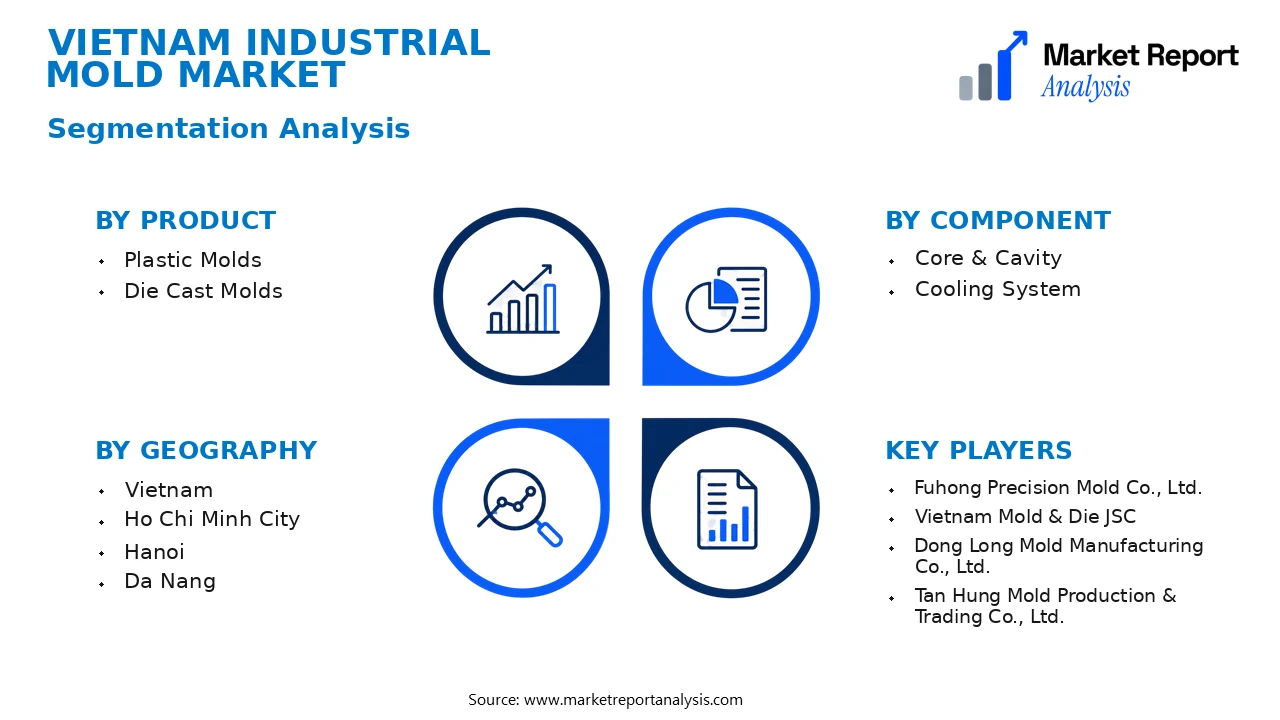
Each category encompasses specific subsegments that highlight particular market roles, commercial uses, demand drivers, and adoption trends. The segmentation structure helps stakeholders identify opportunities for investment, innovation, and strategic development tailored to Vietnam's industrial landscape.
- Product
- Plastic Molds: These molds are predominantly used in plastic injection molding for consumer goods, automotive parts, and packaging. The demand for high-precision and durable plastic molds drives growth in this segment due to Vietnam's expanding manufacturing sector.
- Die Cast Molds: Primarily employed in automotive, electronics, and appliance manufacturing, die cast molds facilitate complex metal part production. The increasing automotive industry and electronics assembly in Vietnam boost this segment’s expansion.
- Component
- Core & Cavity: Essential components of molds, cores and cavities determine the precision and complexity of manufactured parts. The rise in high-tech manufacturing processes amplifies demand for sophisticated core and cavity components within Vietnam.
- Cooling System: Cooling systems are vital for maintaining mold temperature during production, influencing cycle times and part quality. The focus on energy efficiency and productivity encourages adoption of advanced cooling components.
- Application
- Automotive: Automotive mold applications cover body parts, engine components, and interior fittings, making Vietnam a key regional hub for automotive manufacturing and increasing regional demand for specialized molds.
- Electronics: Mold use in electronics manufacturing covers key components like housings, connectors, and circuit boards, aligning with Vietnam’s expanding consumer electronics industry and export-oriented production.
- Industry Vertical
- Automotive Industry: The automotive sector’s growth in Vietnam, supported by foreign investment and domestic production, fuels high demand for durable and high-precision molds for vehicle parts.
- Consumer Goods: Rising disposable income and evolving consumer preferences enhance demand for molded plastic products, thereby increasing mold demand for appliances, packaging, and household items.
- Material
- Steel: Steel molds are favored for their strength and longevity, suited for mass production and high-volume applications in automotive and electronics sectors within Vietnam.
- Aluminum: Aluminum molds offer lightweight and cost-effective solutions for prototypes and low-volume production, increasingly adopted due to Vietnam’s focus on rapid product development.
- Source
- Domestic: Local Vietnam-based mold manufacturers focus on serving regional automotive, electronics, and consumer goods companies, supporting the growth of domestic manufacturing capabilities.
- Imported: Import of high-end molds from China, Japan, and South Korea caters to premium and complex applications, with Vietnam simultaneously enhancing its own manufacturing expertise.
- Deployment
- In-house: In-house mold production within manufacturing plants promotes quality control and customization, particularly in large-scale automotive and electronics factories in Vietnam.
- Outsourced: Outsourcing mold manufacturing to specialized vendors offers cost reductions and access to advanced technology, prevalent among smaller firms and startups in Vietnam’s industrial clusters.
- Distribution Channel
- Direct Sales: Manufacturers prefer direct engagement with mold suppliers to ensure tailored solutions, especially for high-volume automotive and electronics production in key Vietnamese industrial zones.
- Distributors: Distributors facilitate access to a wide range of mold products for small and medium enterprises, increasing market penetration across Vietnam’s industrial regions.
- Mode
- Traditional: Conventional mold manufacturing methods are still widely used, especially in small-scale and specialized niche production units in Vietnam.
- Advanced: Innovative techniques such as CAD/CAM, 3D printing, and CNC machining are gaining traction, enhancing precision and reducing lead times in Vietnam’s mold industry.
- Connectivity
- Connected: Integration of IoT and smart manufacturing technologies in mold production enables real-time monitoring and optimization, aligning with Vietnam’s Industry 4.0 initiatives.
- Non-connected: Traditional mold production facilities still operate with manual processes, particularly in smaller, less automated enterprises across Vietnam.
- Geography
- Vietnam: Vietnam’s growing manufacturing hubs, particularly in Ho Chi Minh City, Hanoi, and Da Nang, serve as focal points for the development and demand for industrial molds due to expanding industrial activities.
- Ho Chi Minh City: As Vietnam’s economic and industrial center, Ho Chi Minh City hosts numerous manufacturing plants, creating substantial demand for diverse mold types and components.
- Hanoi: Hanoi’s expanding industrial zones, especially in electronics and automotive sectors, foster a steady demand for molds tailored to these high-growth sectors.
- Da Nang: With a focus on electronics assembly and regional distribution, Da Nang’s manufacturing sector contributes significantly to mold demand, supported by infrastructure investments.
- Hai Phong: As an important port city with industrial parks, Hai Phong facilitates the export of molded products and imports of advanced molds, strengthening Vietnam’s overall mold market ecosystem.
- Can Tho: The Mekong Delta’s expanding manufacturing activities, especially in consumer goods, are driving increased mold procurement for local production facilities.
- Bien Hoa: Proximity to Ho Chi Minh City, Bien Hoa’s industrial parks are critical to automotive and machinery manufacturing, thus representing a key geographic subsegment.
- Nha Trang: While primarily a tourism hub, Nha Trang’s emerging manufacturing segment, including electronics and small appliance assembly, also demands molds, albeit on a smaller scale.
Competitive Intelligence
The Vietnam Industrial Mold Market displays moderate competition, primarily dominated by a mix of local manufacturers and emerging international firms. Market concentration remains relatively fragmented, with the top five players controlling roughly 35% of market share as of 2026. Competitors focus heavily on product innovation, emphasizing the development of high-precision, durable molds tailored for the automotive and electronics sectors. Strategic alliances, partnerships, and joint ventures are prevalent, especially between Vietnamese mold producers and foreign technological leaders, to facilitate knowledge transfer and R&D advancement. Recent acquisitions of small local firms by larger, established corporations aim to strengthen market presence and broaden service portfolios. Expansion strategies are concentrated in major industrial hubs such as Ho Chi Minh City and Hanoi, leveraging Vietnam’s rising manufacturing demand. Significant R&D investments are made to develop mold designs incorporating smart manufacturing technology, differentiating companies through technological leadership. These differentiation strategies also target customization and shorter lead times, critical factors within Vietnam’s competitive landscape, fostering a more innovative and responsive industry environment.
Leading Company Profiles
The competitive landscape of Vietnam's industrial mold market features a mix of local manufacturers and multinational corporations, each leveraging advanced technology and innovation to strengthen their market position. These firms focus on high-precision molds, rapid prototyping, and sustainable manufacturing practices to meet the evolving demand of diverse industries.
- Fuhong Precision Mold Co., Ltd.
- Vietnam Mold & Die JSC
- Dong Long Mold Manufacturing Co., Ltd.
- Tan Hung Mold Production & Trading Co., Ltd.
- Thanh Long Mold Manufacturing Co., Ltd.
- Hanoi Mold & Engineering Company Limited
- Viet Mould JSC
- Saigon Mold Co., Ltd.
- Nam Long Precision Mold Co., Ltd.
Fuhong Precision Mold Co., Ltd.
Fuhong specializes in high-precision molds for automotive and electronics sectors, utilizing advanced CNC and EDM technologies to deliver high-quality, durable products aligned with international standards, with a strategic focus on automation integration.
Vietnam Mold & Die JSC
This state-owned enterprise offers a comprehensive portfolio including injection molds, blow molds, and die-casting molds, with an emphasis on innovation and cost-efficient solutions catering to domestic and export markets.
Dong Long Mold Manufacturing Co., Ltd.
Dong Long is renowned for its rapid tooling capabilities and rapid prototyping services, serving clients across automotive, packaging, and consumer goods industries within Vietnam and neighboring regions.
Tan Hung Mold Production & Trading Co., Ltd.
Tan Hung focuses on molds for plastic injection and elastomers, integrating eco-friendly materials and sustainable practices in manufacturing processes to meet increasing environmental regulations and client sustainability goals.
Thanh Long Mold Manufacturing Co., Ltd.
Thanh Long specializes in precision molds for medical devices and electronic components, leveraging 3D CAD and simulation software for optimized design and production efficiency.
Hanoi Mold & Engineering Company Limited
This company offers integrated mold design, manufacturing, and maintenance services for automotive and packaging industries, emphasizing technological innovation and quality control standards.
Viet Mould JSC
Focuses on the production of complex multi-cavity molds for consumer electronics and automotive components, adopting Industry 4.0 practices to streamline manufacturing and reduce lead times.
Saigon Mold Co., Ltd.
Specialized in molds for injection molding with a strong focus on sustainability, utilizing eco-friendly materials and energy-efficient practices to align with Vietnam's green industrial development goals.
Nam Long Precision Mold Co., Ltd.
Capabilities include high-precision molds for footwear, home appliances, and automotive sectors, with investments in advanced measurement and inspection equipment to ensure superior quality.
Strategic Business Developments

- March 2023 – Fuhong Precision Mold Co., Ltd. – Launched a new automated manufacturing line – Enhances production efficiency and reduces lead times, elevating Fuhong's competitiveness in high-precision mold sectors.
- June 2023 – Vietnam Mold & Die JSC – Expanded capacity with a new plant in Binh Duong – Addresses rising demand in automotive and electronics industries, supporting Vietnam’s export growth.
- April 2023 – Dong Long Mold Manufacturing Co., Ltd. – Invested in Industry 4.0 digital tools – Improves mold design accuracy, reduces waste, and streamlines workflow across manufacturing units.
- January 2024 – Tan Hung Mold Production & Trading Co., Ltd. – Signed strategic alliance with an international plastics company – Facilitates technology transfer and access to advanced sustainable materials.
- February 2024 – Thanh Long Mold Manufacturing Co., Ltd. – Initiated eco-friendly manufacturing project – Strengthens environmental compliance and positions the company as a leader in green innovation within the mold industry.
Frequently Asked Questions
What is the Vietnam Industrial Mold Market?
The Vietnam Industrial Mold Market encompasses the manufacturing, distribution, and sales of molds used across various industries such as automotive, electronics, packaging, and consumer goods. It reflects Vietnam's expanding industrial base and its integration into global supply chains.
What is the current market size of Vietnam Industrial Mold Market?
As of 2026, the Vietnam Industrial Mold Market is valued at approximately USD 1.2 Billion, driven by robust manufacturing activities and foreign direct investment. The market is expanding steadily as Vietnam shifts towards high-precision and complex mold production.
What factors are driving the Vietnam Industrial Mold Market?
Key drivers include Vietnam’s growing manufacturing sector, government incentives for industrial development, rising demand for automotive and electronics components, and increased foreign investment in plant expansions, all contributing to higher demand for industrial molds.
Which Vietnamese city leads the Vietnam Industrial Mold Market?
Ho Chi Minh City remains the leading hub for the Vietnam Industrial Mold Market, owing to its extensive industrial infrastructure, presence of major manufacturing firms, and proximity to international ports facilitating exports and imports.
Which segment is expected to grow the fastest?
The automotive mold segment is anticipated to experience the fastest growth, propelled by Vietnam’s expanding automotive production and assembly plants, alongside rising export demands for auto parts globally.
Who are the leading companies operating in the Vietnam Industrial Mold Market?
Leading companies include local players like VINA-MOLD, alongside international manufacturers such as DME, Ferromatik Milacron, and Sumitomo Electric, competing through technological innovation and strategic partnerships to strengthen their market position.
Analyst Perspective
The Vietnam Industrial Mold Market is poised for continued expansion through 2034, driven by Vietnam's manufacturing sector modernization and increasing export demands. Long-term, the market will benefit from technological advancements such as the adoption of high-precision, computer-aided designs, and automation-driven mold manufacturing, which will enhance productivity and quality standards. Key commercial opportunities include investing in R&D for specialized molds tailored to automotive, electronics, and consumer goods sectors, where Vietnam's competitive manufacturing base is rapidly evolving. Investment priorities should focus on upgrading infrastructure, fostering innovation hubs, and building skilled labor pools to meet the sophistication of next-generation molds. The market currently exhibits moderate competitive intensity, with local firms increasingly adopting advanced machinery to compete with international players. Notably, Ho Chi Minh City and Hanoi are expected to lead regional growth, given their vibrant industrial ecosystems and strategic initiatives to attract manufacturing investments. Overall, strategic positioning around technological leadership and city-level specialization will be crucial for sustained growth and global competitiveness.
