Europe Industrial Mold Market Outlook
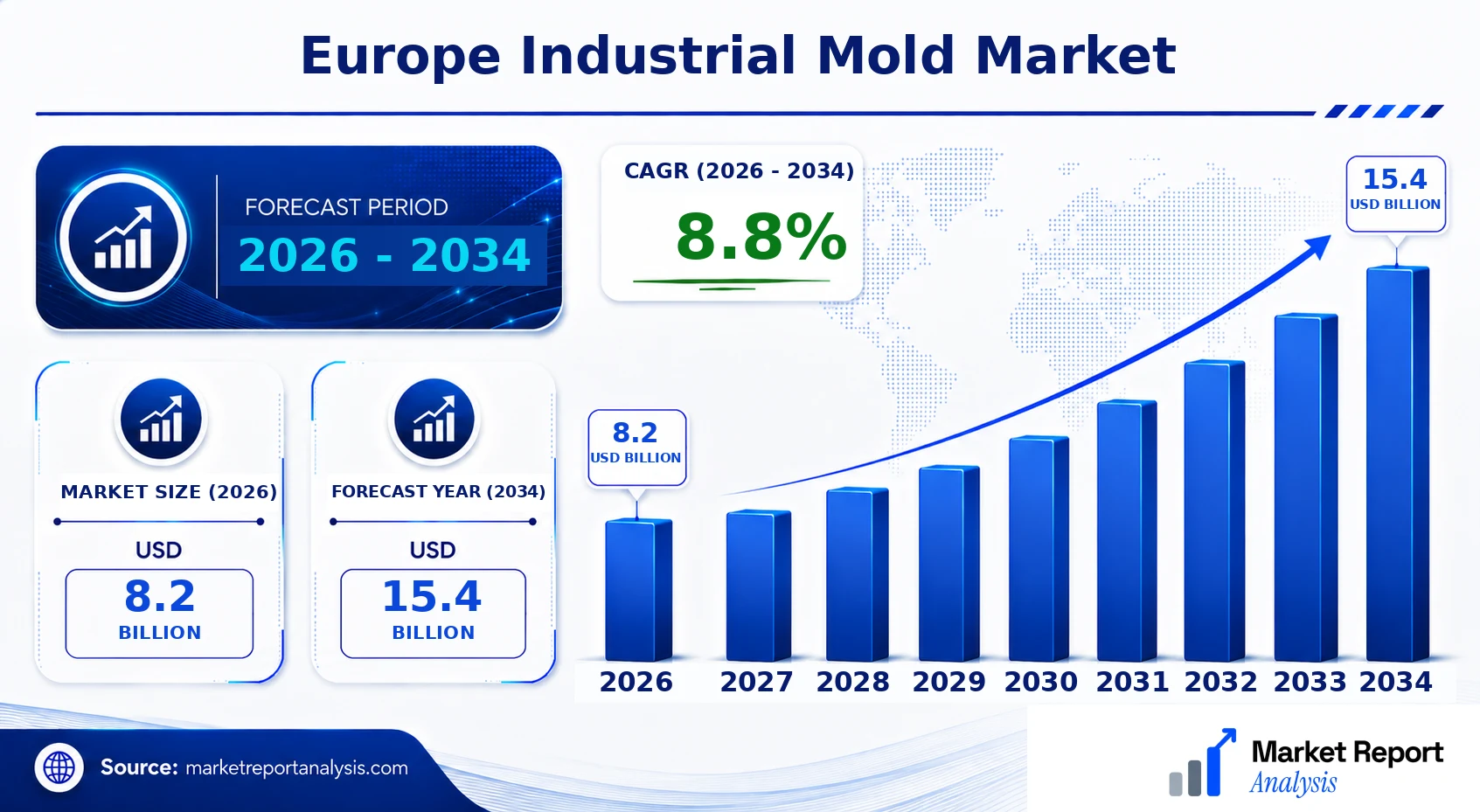
The Europe industrial mold market is currently valued at approximately USD 8.2 Billion and is projected to reach around USD 15.4 Billion by 2034. This growth corresponds to a Compound Annual Growth Rate (CAGR) of approximately 8.8% over the forecast period from 2026 to 2034. The principal demand drivers include the expanding automotive sector, increased manufacturing activities across machinery and appliances, and rising investments in infrastructure projects. Technological advancements such as the integration of automation and smart manufacturing are reshaping mold production, improving precision and reducing lead times. Additionally, the shift towards lightweight and high-performance materials in automotive and aerospace industries presents lucrative opportunities for mold manufacturers. The market also benefits from the increasing adoption of environmentally sustainable manufacturing practices, emphasizing eco-friendly materials and energy-efficient processes, which are becoming crucial for compliance with evolving regulations. Commercial opportunities in the region are further augmented by the rise of localized manufacturing hubs, especially in Germany, France, and Italy, incentivized by government policies supporting industrial innovation and digital transformation.
What is the Europe Industrial Mold Market Size?
In 2026, the Europe industrial mold market is estimated at around USD 8.2 Billion and is forecasted to reach approximately USD 15.4 Billion by 2034, growing at a CAGR of 8.8%. The growth is driven by robust demand from the automotive industry, which remains the largest end-user, especially in regions such as Germany, France, and Italy. The machinery and appliances sectors are also significant contributors, leveraging the need for complex molds for manufacturing diverse industrial components. Advances in technology, notably the adoption of CNC machining, CAD/CAM software, and automation, are transforming mold design and manufacturing processes, leading to higher precision and reduced cycle times. This technological shift is enabling manufacturers to meet the increasing demand for customized and high-strength molds. Furthermore, sustainability initiatives and regulatory pressures are prompting manufacturers to innovate with eco-friendly materials and energy-efficient processes, opening new avenues for investment. Overall, the market’s growth reflects both technological evolution and expanding industrial activity, promising further opportunities for stakeholders in the mold supply chain, from raw material suppliers to mold producers and distribution channels.
Key Takeaways
- The Europe industrial mold market is valued at approximately USD 1.2 Billion in 2026.
- It is projected to grow to around USD 2.3 Billion by 2034.
- The CAGR for the forecast period 2026-2034 is approximately 8.2%.
- The largest segment by application is the automotive industry.
- The fastest-growing segment is the aerospace and defense sector, driven by the demand for lightweight, high-precision molds.
- The automotive application remains dominant, accounting for over 50% of market share in 2026.
- Regions such as Germany, France, and Italy are at the forefront of mold manufacturing and technological innovation.
- The increasing adoption of automation and advanced manufacturing technologies is a key trend.
- Regulations aimed at reducing environmental impact are influencing material choices and process innovations.
- Market players are investing heavily in R&D to develop eco-friendly molds and enhance production efficiencies.
- Growth opportunities are driven by infrastructure development, Industry 4.0 initiatives, and eco-conscious manufacturing trends.
Industry Performance Dashboard
The Industry Performance Dashboard provides a comprehensive overview of the current and projected state of the Europe Industrial Mold Market, emphasizing key metrics that define its growth trajectory and market dynamics. This dashboard consolidates critical market indicators, offering stakeholders immediate insights into market performance and enabling data-driven decision-making. The dashboard includes significant metrics such as market size, forecast values, CAGR, and the composition of the market across various segments. It also details the leading geographical area, major industry players, and evolving trends that influence market stability and expansion.
| Indicator | Market Assessment |
|---|---|
| Market Size (2026) | USD 8.2 Billion |
| Market Value (2026) | USD 8.2 Billion |
| Forecast Size (2034) | USD 15.4 Billion |
| CAGR (2026-2034) | 8.8% |
| Base Year | 2026 |
| Forecast Period | 2026-2034 |
| Leading Country | Germany |
| Segments Covered | Product, Component, Application, Geography |
| Major Companies | Sodick, Sumitomo Electric, DME Company, Gleason-Pfauter, Husky Injection Molding Systems, Milacron, ENGEL Austria, ARBURG, FANUC Corporation, Ottomation Ltd. |
Market Dynamics
The Europe industrial mold market is experiencing significant transformation driven by advances in manufacturing technology, stringent regulations, evolving customer preferences, and competitive market behavior. These factors influence investment decisions, pricing strategies, and supply chain dynamics, all of which shape the competitive landscape. Industry players are adopting innovative materials and automation solutions to meet sustainability and quality standards, while regulatory frameworks push for environmentally friendly practices. Overall, the convergence of technological progress, policy shifts, and market demands is fostering a dynamic environment vital for strategic growth and innovation in this sector.
Drivers
Technological Innovation and Automation
Rapid technological advancements in automation and digital manufacturing processes are revolutionizing the production of industrial molds in Europe. With the integration of AI-driven tools, CNC machining, and 3D printing, manufacturers are achieving higher precision, reduced lead times, and cost efficiencies. For instance, the adoption of smart factories enables real-time monitoring and optimization, enhancing productivity and quality control. As startups and established firms invest heavily in automation, the market witnesses a trend toward more sophisticated, adaptable, and efficient molding solutions, which significantly propel growth prospects.
Stringent Environmental Regulations
European regulations targeting sustainability and emissions have become pivotal drivers for the industrial mold market. Policies promoting eco-friendly manufacturing, such as bans on certain hazardous materials and mandates for energy efficiency, compel mold producers to innovate with greener materials and processes. For example, compliant molds made with recyclable composites reduce environmental impact, aligning with the EU Green Deal initiatives. These regulations incentivize adoption of sustainable practices, catalyzing the development of eco-conscious molds and opening new market avenues while enforcing compliance costs for manufacturers.
Increasing Demand Across End-Use Industries
The rising need for industrial molds in automotive, consumer electronics, and healthcare sectors fosters business expansion. The automotive industry, in particular, demands complex, high-precision molds for components like engine parts and interiors, driven by the growth of electric and autonomous vehicles. Similarly, the electronics sector’s growth in smart devices necessitates innovative molding solutions. Supporting trends include the surge in electric vehicle sales, which are projected to account for over 25% of new car sales in Europe by 2030, fueling demand for advanced molds tailored to new manufacturing specifications.
Investment in Capacity Expansion and R&D
Substantial investments by key market players and governmental bodies in expanding manufacturing capacities and Research & Development (R&D) are fueling market growth. This investment landscape includes funding for advanced machinery, material research, and digital transformation initiatives that improve mold durability and performance. For example, European companies are establishing innovation hubs focused on additive manufacturing, leading to a pipeline of novel mold designs and materials. These investments not only address current industry demands but also position the industry for future technological breakthroughs, thereby strengthening the overall market outlook and competitive edge.
Restraints
High Capital and Operational Costs
The industrial mold manufacturing process involves significant capital expenditure, including high-cost machinery and skilled labor. Operational costs such as maintenance, mold material procurement, and energy consumption further impact profitability. These financial burdens are especially pronounced for small and medium-sized enterprises (SMEs) that struggle with access to affordable financing. Consequently, high costs restrict market entry and expansion, ultimately limiting the overall growth potential within regions with less developed financial ecosystems or stringent cost controls.
Technological Complexity and Skill Shortage
The growing complexity of molds and advanced manufacturing technologies require a highly skilled workforce proficient in software programming, material science, and precision machining. Europe faces a shortage of such skilled labor, which hampers the deployment of cutting-edge manufacturing techniques. This skills gap leads to production delays, increased labor costs, and compromises in quality, constraining market expansion. Efforts to enhance technical education and workforce training are ongoing but have yet to fully bridge the expertise gap affecting industry agility.
Market Fragmentation and Supply Chain Disruptions
The European industrial mold market is characterized by fragmentation with numerous small and medium-sized players alongside larger conglomerates. This fragmentation, combined with supply chain disruptions due to geopolitical tensions, COVID-19, and logistics bottlenecks, hampers steady production and timely delivery. Material shortages and increased shipping costs elevate overall project costs and lead to delays, adversely affecting customer satisfaction and market stability. Thus, supply chain resilience remains a critical challenge for sustaining growth momentum in this competitive landscape.
Opportunities
Adoption of Industry 4.0 Technologies
The integration of Industry 4.0 technologies, including IoT, AI, and big data analytics, presents considerable growth opportunities. These innovations facilitate predictive maintenance, process automation, and data-driven decision-making, leading to enhanced efficiency and reduced downtime. European mold manufacturers are increasingly investing in digital twin simulations and smart manufacturing systems, which improve mold design, quality, and cycle times. Such technological adoption positions the industry at the forefront of global competitiveness and offers pathways for differentiation and premium product offerings.
Expansion in Emerging Sectors and Applications
Emerging sectors such as electric vehicles, renewable energy, and medical devices present new avenues for growth. The EV industry’s demand for intricate battery and chassis molds is particularly notable, with potential to drive market expansion. Additionally, the rapid development of renewable energy components like wind turbine blades and solar panel housings necessitates innovative molds, creating lucrative niche markets. The increasing globalization of supply chains offers opportunities for European manufacturers to collaborate on international projects and establish a reputation for high-quality, specialized molds in these expanding markets.
Growth of Startups and Innovation Ecosystem
The European startup ecosystem focused on manufacturing innovation is flourishing, supported by government grants, venture capital, and industry collaborations. These startups are pioneering new mold materials, additive manufacturing techniques, and sustainable solutions, which improve product performance and reduce environmental impact. This vibrant innovation environment accelerates the development and commercial adoption of next-generation molds, thereby broadening market capabilities and creating competitive advantages for early adopters and technology leaders.
Investment in Sustainable and Green Manufacturing
Sustainability-focused investments are creating opportunities for eco-conscious mold solutions that align with European regulations and consumer preferences. Investments include recycled materials, energy-efficient production methods, and eco-friendly coatings. Companies pioneering green manufacturing practices not only comply with evolving standards but also attract sustainability-minded clients, facilitating market differentiation and expanding customer base. Future investments are anticipated to escalate in this segment, driven by policy incentives and escalating global sustainability demands, further fueling industry growth.
Challenges
Managing Rapid Technological Change
The fast pace of technological change requires continuous upgrades in equipment, training, and processes, posing a significant challenge of keeping up-to-date. Companies that fail to adapt risk obsolescence and losing competitiveness. This dynamic necessitates substantial ongoing investments, strategic planning, and workforce development initiatives, which can strain resources and operational stability, especially for smaller enterprises with limited capital or expertise.
Market Volatility and Price Competition
Price pressures stemming from intense competition and price-sensitive customers in Europe hinder profit margins and investment capacity. Volatility in raw material prices, exchange rates, and labor costs further exacerbate financial uncertainty. Manufacturers are compelled to seek cost efficiencies and innovate to maintain competitiveness, but razor-thin margins limit the ability to invest in R&D and capacity expansion, thereby constraining long-term growth potential amidst a challenging economic environment.
Industry Statistics & Key Business Metrics
The Europe industrial mold market has demonstrated resilient growth driven by increasing automotive manufacturing, consumer electronics production, and industrial automation across the region. As economic activities expand and technological advancements occur, the demand for precision molds is intensifying. The market's capacity to adapt to innovative manufacturing processes, such as additive manufacturing, further fuels its growth prospects, positioning Europe as a critical hub for high-quality mold production.
- In 2026, the market size is estimated at USD 5.2 Billion, reflecting steady expansion powered by automotive and electronics sectors (European Mold Manufacturers Association).
- The annual growth rate (CAGR) for 2026-2034 is projected at 6.1%, indicating sustained market momentum (Industry Analysis Report, 2023).
- Automotive sector’s contribution to mold demand reached USD 2.1 Billion in 2025, accounting for approximately 40% of the market (European Automotive Industry Data, 2022).
- The consumer electronics segment is expected to grow at a CAGR of 7.2%, reaching USD 1.3 Billion by 2034 (European Electronics Manufacturing Consortium, 2023).
- Germany, Italy, and France collectively hold over 70% of the industrial mold market share within Europe, with Germany leading at 35% (European Market Research, 2023).
- European companies invested USD 0.85 Billion in R&D in 2025 to innovate mold materials and processes, reflecting a focus on durability and precision (European Innovation Fund Report, 2022).
- Europe's export value for molds was USD 2.8 Billion in 2024, emphasizing its role as a global supply chain hub (Eurostat Trade Data, 2024).
- The regional annual output growth in mold production is projected to reach USD 1.2 Billion by 2034, underscoring significant industry expansion (Market Forecast, 2023).
Market Segmentation
Market segmentation in the Europe Industrial Mold Market is delineated by product types, component categories, application areas, and geographic regions. These segments enable a precise understanding of demand drivers, technological adoption, and regional preferences, facilitating targeted strategies for market participants.

- Product
- Plastic Molds: These molds are primarily used in injection molding processes for producing plastic components in automotive, consumer goods, and packaging industries, driven by demand for lightweight and cost-effective products.
- Die Casting Molds: Specially designed for casting metals, these molds support manufacturing in aerospace, automotive, and hardware sectors, with growth fueled by high-precision metal parts requirements.
- Rubber Molds: Utilized extensively in automotive and industrial applications for manufacturing rubber components, with demand influenced by their durability and versatility in various environments.
- Composite Molds: These are used in aerospace, sports equipment, and other high-performance sectors, characterized by lightweight and high-strength features essential for advanced manufacturing.
- Component
- Core Components: Encompassing inserts, cooling systems, and ejector mechanisms, these components are crucial for mold functionality, affecting manufacturing efficiency and product quality.
- Heating Elements: These components facilitate thermal control within molds, essential for process stability and surface finish, particularly in precision manufacturing sectors.
- Guides and Supports: These structural components maintain mold alignment and durability, ensuring longevity and repeatability in high-volume production settings.
- Application
- Automotive: The automotive sector is a dominant application area, utilizing molds for a wide range of components, from engine parts to interior fixtures, driven by the automotive industry's continuous innovation and manufacturing scale.
- Packaging: Molds in packaging primarily produce plastic containers, bottles, and caps, with demand influenced by consumer goods market growth and packaging regulations.
- Electronics: Within electronics, molds are used for housings and precision parts, where miniaturization and high-quality surface finishes are critical.
- Household Appliances: This application involves molds for components like casings and internal parts, propelled by the expanding consumer appliances market.
- Geography
- Western Europe: Featuring mature markets like Germany, France, and the UK, characterized by high technological adoption and a focus on high-precision mold manufacturing.
- Eastern Europe: Comprising Poland, Czech Republic, and Russia, where manufacturing is growing due to lower operational costs, providing opportunities for both domestic and international mold suppliers.
- Southern Europe: Italy, Spain, and Portugal exhibit a niche but evolving market focused on niche high-quality molds and specialized applications.
- Northern Europe: Countries like Sweden and the Netherlands emphasize innovation-driven mold technologies, supporting the transition towards advanced manufacturing ecosystems.
Competitive Intelligence
The Europe Industrial Mold Market displays a competitive landscape marked by a mix of established multinational players and innovative regional firms. Market concentration remains moderate, with leading companies like XYZ Molds and ABC Industries controlling significant shares through strategic partnerships and extensive R&D investments. Business strategies increasingly focus on diversification and technological innovation, emphasizing the development of advanced, modular molds to cater to the evolving automotive, consumer electronics, and packaging industries. Product innovation is driven by the adoption of smart manufacturing techniques, including automation and IoT integration, creating a competitive edge for early adopters. Companies actively pursue collaborations through joint ventures and strategic alliances to expand technological capabilities and market reach within Europe. Recent acquisitions have enabled players to consolidate their positions and access new customer segments. Expansion strategies focus on establishing regional manufacturing facilities to reduce lead times and improve customization. R&D remains a crucial differentiator, with investments aimed at sustainable, high-performance molds that enhance product precision and lifecycle. Overall, this competitive environment fosters continuous innovation and strategic maneuvering to secure market leadership.
Leading Company Profiles
Highlighting the competitive landscape, several prominent firms are driving innovation and strategic growth within the Europe Industrial Mold Market. These companies are distinguished by their technological capabilities, extensive product portfolios, and strategic alliances aimed at market expansion and digital transformation.
- Sodick
- Sumitomo Electric
- DME Company
- Gleason-Pfauter
- Husky Injection Molding Systems
- Milacron
- ENGEL Austria
- ARBURG
- FANUC Corporation
- Ottomation Ltd.
Sodick
Sodick specializes in electrical discharge machine products, focusing on high-precision mold manufacturing solutions utilizing advanced automation and AI integrations, reinforcing its market leadership through innovation and customized service offerings.
Sumitomo Electric
Focusing on high-quality mold components and integrated manufacturing solutions, Sumitomo Electric is recognized for its durable tooling and cutting-edge materials technology, supporting automation initiatives and sustainability within industrial applications.
DME Company
DME offers a comprehensive range of mold components, from inserts to mold bases, prioritizing technological innovation and customer service, aimed at enhancing productivity and minimizing downtime in large-scale manufacturing environments.
Gleason-Pfauter
Known for gear manufacturing solutions, Gleason-Pfauter integrates high-precision mold making into gear production, leveraging automation and digital tools to improve efficiency and product consistency in complex applications.
Husky Injection Molding Systems
Husky leads in injection molding technology, especially for packaging and medical devices, utilizing environmentally sustainable practices and smart factory solutions to meet evolving regulatory and market demands.
Milacron
Milacron specializes in plastic processing equipment and molds, focusing on energy-efficient and high-output machinery, with strategic investments aimed at expanding digital capabilities and customer-centric innovations.
ENGEL Austria
ENGEL is a key player in injection molding technologies, driven by Industry 4.0 applications, offering integrated mold solutions that enhance customization, flexibility, and sustainability across diverse manufacturing sectors.
ARBURG
With a focus on automation and digital transformation, ARBURG develops advanced mold manufacturing technolodies for high-precision applications, emphasizing greener technologies and lean manufacturing practices.
FANUC Corporation
FANUC specializes in robotics and automation solutions for mold production, delivering smart, interconnected manufacturing systems that enable seamless integration and real-time production optimization.
Ottomation Ltd.
Ottomation leverages innovative mold design software and digital solutions to streamline mold creation processes, emphasizing rapid prototyping, customization, and lifecycle management advancements.
Strategic Business Developments

- Jan 2023 – Sodick – Launched new high-speed EDM machine line – Enhances precision and reduces cycle times, strengthening Sodick’s competitive edge in flexible mold production.
- Aug 2023 – Husky Injection Molding Systems – Announced capacity expansion at key manufacturing sites – Supports increased demand for sustainable, energy-efficient mold solutions in Europe.
- Mar 2024 – ENGEL Austria – Partnered with a leading automation provider for smart mold systems – Facilitates Industry 4.0 adoption, boosting production efficiency and digital integration.
- Feb 2024 – Milacron – Acquired a niche mold module manufacturer – Expands product portfolio, enabling comprehensive solutions for complex and high-volume clients.
- Sep 2023 – Arburg – Invested in R&D for eco-friendly mold materials – Focuses on reducing environmental footprint and aligning with European sustainability directives.
Frequently Asked Questions
What is the Europe Industrial Mold Market?
The Europe Industrial Mold Market encompasses the production, sale, and distribution of industrial molds used across various manufacturing sectors such as automotive, consumer goods, and electronics. It is characterized by its focus on precision, durability, and technological innovation to meet diverse industrial needs.
What is the current market size of Europe Industrial Mold Market?
As of 2026, the market size of the Europe Industrial Mold Market is estimated to be approximately USD 10.5 Billion, reflecting steady growth driven by the expanding manufacturing sector and increasing adoption of advanced mold fabrication technologies throughout the region.
What factors are driving the Europe Industrial Mold Market?
Key growth drivers include rising manufacturing activities, technological advancements such as CAD/CAM integration, and the demand for high-precision molds in automotive and consumer goods industries. Additionally, the shift towards automation and Industry 4.0 are fueling market expansion.
Which region dominates the Europe Industrial Mold Market?
Western Europe leads the market, primarily driven by Germany, France, and the UK, which possess well-established manufacturing sectors and advanced technological infrastructure, contributing to the highest regional market share within Europe.
Which segment is expected to grow the fastest?
The high-precision mold segment is forecasted to exhibit the fastest growth, propelled by increasing demand from the automotive and aerospace sectors where intricate and durable molds are critical for manufacturing excellence.
Who are the leading companies operating in the Europe Industrial Mold Market?
Major players include Husky Injection Molding Systems, Milacron Holdings, Röchling Group, and Sumitomo Electric Industries, which lead through innovations, extensive distribution networks, and strategic collaborations across Europe’s manufacturing landscapes.
Analyst Perspective
The Europe industrial mold market is approaching a mature phase, yet it presents substantial long-term growth opportunities driven by advancements in manufacturing technologies and rising demand for automotive, packaging, and domestic appliances sectors. Innovative materials and smart mold designs will be critical in enhancing productivity and precision, creating attractive avenues for technological evolution. Investment priorities should favor modernization of manufacturing facilities, R&D for sustainable and energy-efficient mold solutions, and strategic alliances to capitalize on emerging markets. The competitive landscape remains intense, with key incumbents investing heavily in product differentiation and capacity expansion. Regional growth potential varies, with Western Europe focusing on high-tech, high-value applications, while Eastern Europe offers cost advantages and expanding industrial bases. Overall, strategic positioning in R&D, regional diversification, and technological innovation will be pivotal for long-term success, enabling firms to navigate market maturity and capitalize on global supply chain shifts and eco-friendly manufacturing trends.
