Vietnam High-Performance Paints Market Outlook
Market segmentation within the Vietnam high-performance paints sector is primarily delineated by product type, application, and geographic distribution. These categories enable a detailed analysis of market dynamics, customer preferences, and regional growth factors, underpinning strategic decision-making for stakeholders. Each segment plays a crucial role in shaping the overall market landscape, driven by industry-specific needs and regional economic development.

Product
- Resin Type: High-performance paints are differentiated by their resin base, which influences durability, chemical resistance, and aesthetic qualities. The market features acrylic, epoxy, polyurethane, and alkyd resins, each catering to specific industrial and architectural needs, with epoxy and polyurethane leading due to their superior protective qualities.
Application
- Industrial: Industrial applications dominate the Vietnamese high-performance paints market, with sectors such as oil and gas, manufacturing, and infrastructure demanding coatings that withstand harsh environments, chemical exposure, and extreme temperatures. Increasing investments in Vietnam’s industrial zones significantly boost demand for durable, high-performance coatings.
- Architectural: The architectural segment is expanding due to rising urbanization, infrastructure projects, and new construction in residential and commercial buildings. High-performance paints in this segment offer longevity, enhanced aesthetics, and environmental resistance, catering to Vietnam’s growing urban centers.
- Automotive: The automotive sector’s adoption of high-performance paints is growing, driven by the need for corrosion resistance, finish quality, and environmental compliance. Vietnamese automakers and assembly plants increasingly specify advanced coatings for vehicle manufacturing and repair.
Geography
- Vietnam: The Vietnamese high-performance paints market exhibits uneven geographical distribution, with key demand centers in major cities and industrial hubs. The market is particularly concentrated in Ho Chi Minh City and Hanoi due to their industrial infrastructure, manufacturing base, and urban development initiatives.
- Ho Chi Minh City: As Vietnam’s economic and industrial hub, Ho Chi Minh City commands the largest share of the high-performance paints market. The city’s rapid urbanization, construction projects, and a dense network of factories drive persistent demand for specialized coatings with superior durability.
- Hanoi: The political and administrative capital, Hanoi has a burgeoning construction sector and increasing infrastructure projects that require high-performance paints. The city’s expanding commercial real estate and renovation activities underpin continuous market growth.
- Da Nang: Known for its strategic port and industrial zone advancements, Da Nang’s emerging manufacturing and infrastructural development fuel demand for high-quality, weather-resistant coatings tailored to its coastal environment.
- Hai Phong: As a major maritime and industrial port, Hai Phong’s growth is driven by logistics, shipbuilding, and heavy industry sectors requiring durable, high-performance coatings resistant to saline and moist conditions.
- Can Tho: The Mekong Delta city’s increasing infrastructural investments and agricultural machinery manufacturing compel a rising need for specialized paints that offer longevity and resistance to humid, tropical conditions.
- Bien Hoa: Situated in Dong Nai Province, Bien Hoa’s industrial zone development and manufacturing activities intensify demand for high-performance paints to meet quality and environmental standards.
- Nha Trang: A coastal city with significant tourism and hospitality infrastructure, Nha Trang requires high-performance paints for corrosion resistance, aesthetic appeal, and environmental sustainability in both new and renovation projects.
What is the Vietnam High-Performance Paints Market Size?
In 2026, the Vietnam high-performance paints market is valued at approximately USD 1.2 Billion. By 2034, the market size is forecasted to grow to about USD 2.3 Billion, demonstrating a CAGR of roughly 8.2%. Growth is driven by rising investments in infrastructure projects, increased industrial activity, and modernization efforts in urban centers like Ho Chi Minh City and Hanoi. The expanding manufacturing base, especially in electronics, automotive, and metal fabrication, requires advanced coatings capable of providing enhanced protection and aesthetic qualities under harsh operational conditions. Technological advancements, such as nanotechnology-based paints and formulations meeting strict environmental standards, are further propelling market growth. The landscape presents lucrative investment opportunities for global and local players aiming to innovate and capture market share by offering specialized, high-performance solutions tailored for Vietnam’s evolving industrial and infrastructural needs.
Key Takeaways
- The market size of Vietnam high-performance paints was approximately USD 1.2 Billion in 2026.
- It is projected to reach about USD 2.2 Billion by 2034, with a CAGR of 7.1% during 2026-2034.
- Ho Chi Minh City is the leading Vietnamese city in high-performance paint demand.
- The fastest-growing Vietnamese city for high-performance paint consumption is Hanoi, driven by ongoing urban infrastructure projects.
- The largest segment within the market is corrosion-resistant coatings, especially for industrial equipment and infrastructure.
- The fastest-growing segment is thermally insulating paints used in construction and energy sectors.
- Industrial applications, including manufacturing and infrastructure, constitute the primary end-user base.
- Over the forecast period, regulatory tightening on volatile organic compound (VOC) emissions will promote eco-friendly product innovation.
- Technology trends focus on durability, sustainability, and multi-functionality of coatings.
- Competitive landscape is characterized by local companies gaining ground against international firms through cost-effective, specialized products.
- Increased foreign direct investment in industrial zones bodes well for future market expansion.
- Investments in research & development are critical for gaining competitive edge in Vietnam’s high-performance paints sector.
- A growing awareness of environmental issues among Vietnamese consumers supports demand for green coatings.
Industry Performance Dashboard
The Vietnamese high-performance paints market has demonstrated significant growth, driven by infrastructure development, increasing demand for durable coatings, and stringent regulatory standards that favor high-quality, environmentally friendly coatings. Vietnam's rapid urbanization and industrialization have notably increased demand across sectors such as construction, aerospace, automotive, and electronics, reflecting a dynamic market environment.
| Indicator | Market Assessment |
|---|---|
| Market Value (2026) | USD 1.2 Billion |
| Forecast Size (2034) | USD 2.3 Billion |
| CAGR | 8.2% |
| Base Year | 2026 |
| Forecast Period | 2026-2034 |
| Leading Vietnamese City | Ho Chi Minh City |
| Fastest-Growing Vietnamese City | Da Nang |
| Segments Covered | Solvent-based, Water-based, Powder Coatings |
| Major Companies | AkzoNobel, PPG Industries, Sherwin-Williams, Nippon Paint, Jotun, Kansai Paint, Valspar, Asian Paints, DuluxGroup, SHOFU Paints |
Market Dynamics
The Vietnam High-Performance Paints Market is experiencing dynamic shifts driven by technological advancements, evolving regulatory landscapes, increased investments, and changing customer expectations. Market participants are increasingly focused on sustainable and durable paint formulations to meet both environmental standards and performance requirements. Competitive behaviors are intensifying, with local and international firms investing heavily in innovation, production capacity, and distribution channels. The market's growth is also influenced by price fluctuations, supply chain stability, and the increasing demand from industrial, automotive, and construction sectors. These forces collectively shape Vietnam's high-performance paints landscape, creating an environment ripe for strategic positioning and innovation.
Drivers
Technological Innovations Enhancing Product Performance
In Vietnam, ongoing technological innovations are significantly impacting the high-performance paints market by enabling the development of products with superior durability, adhesion, weather resistance, and eco-friendly properties. Advances in nanotechnology, polymer chemistry, and application techniques have allowed manufacturers to meet the rigorous demands of industrial and infrastructure projects, which are burgeoning in Vietnam’s urban centers like Ho Chi Minh City and Hanoi. This innovation trend aligns with Vietnam’s push towards infrastructure modernization under government initiatives, boosting the adoption of high-performance coatings in sectors such as transportation and construction. As a result, companies that invest in R&D to produce technologically advanced paint formulations are gaining competitive advantages and expanding their market shares.
Rising Regulatory Standards for Environmental and Safety Compliance
Vietnam's tightening regulations on volatile organic compounds (VOCs), hazardous chemicals, and emissions are compelling paint producers to reformulate their products to meet new standards. Both domestic and international manufacturers must incorporate environmentally friendly raw materials and processes, fostering growth in the green segment of high-performance paints. This regulatory shift is mostly impactful for producers serving industrial, automotive, and architectural markets, which traditionally used solvent-based paints. Compliance costs and innovation requirements present initial hurdles but ultimately lead to cleaner products, increased consumer confidence, and access to export markets governed by strict environmental standards, positioning compliance as a key market driver.
Increased Investments in Infrastructure and Industrial Projects
The Vietnamese government’s focus on infrastructure development such as transportation networks, urban housing, and industrial zones has catalyzed substantial investment flows into these sectors. As these projects demand durable, long-lasting coatings, the high-performance paints market benefits from increased demand for products that can withstand harsh environmental conditions and prolonged exposure. Foreign direct investments from China, South Korea, and Japan further accelerate this trend, promoting technology transfer and capacity building in Vietnam’s paint industry. This investment-driven growth creates a robust pipeline of opportunities for manufacturers prepared to supply high-performance, specialized coating solutions.
Growing Demand from the Automotive and Industrial Sectors
The expanding automotive manufacturing base and industrial facilities across Vietnam are increasing the need for high-performance paints that offer corrosion resistance, aesthetic durability, and environmental compliance. The automotive sector, especially with foreign automakers establishing assembly plants in provinces like Bac Ninh and Binh Duong, is a significant consumer of specialized coatings. Additionally, Vietnam’s expanding industrial sector, including textile, electronics, and machinery manufacturing, requires paints that ensure product longevity and operational efficiency. This sustained sector growth drives demand for tailored high-performance coatings, fostering innovation and competitive differentiation among paint manufacturers.
Restraints
High Production and Raw Material Costs
The manufacturing of high-performance paints in Vietnam faces stiff cost challenges due to the rising prices of raw materials such as specialty polymers, biocides, and solvents. Limited local sourcing options and reliance on imported raw materials amplify these costs, reducing profit margins and pricing competitiveness. Furthermore, fluctuating global supply chains, influenced by geopolitical tensions and logistics disruptions, exacerbate procurement difficulties. Smaller local firms often struggle to absorb these costs while maintaining quality standards, leading to a concentration of market power among larger multinationals capable of economies of scale and supply chain resilience.
Limited Local Manufacturing Infrastructure
The Vietnamese high-performance paints industry is constrained by relatively underdeveloped manufacturing infrastructure capable of producing high-grade raw materials and sophisticated formulations at scale. This limits the ability of local manufacturers to innovate rapidly or reduce dependence on imports, hindering cost efficiency and market flexibility. Infrastructure limitations also impact packaging, logistics, and quality control processes, making it challenging to meet the high standards demanded by industrial and automotive clients. As a consequence, market growth may be impeded unless significant investments are made to upgrade facilities and supply chain networks.
Low Consumer Awareness and Market Penetration
Despite growing industrial activity, awareness of the benefits of high-performance paints remains relatively low among many Vietnamese construction and industrial buyers. A tendency to prioritize initial cost over long-term durability leads to choices favoring standard or low-cost coatings, thereby limiting market penetration for premium products. This consumer behavior is especially prevalent in rural and emerging urban markets, where informational gaps and traditional procurement practices dominate. Overcoming these barriers requires focused marketing, technical education, and demonstration projects to showcase the superior value proposition of high-performance coatings.
Opportunities
Growing Urbanization and Construction Boom
Vietnam’s rapid urbanization, with sustained growth in cities like Ho Chi Minh, Hanoi, and Da Nang, is creating a burgeoning demand for high-quality, durable building materials. High-rise residential, commercial, and infrastructure projects are increasingly adopting high-performance paints that offer excellent weather resistance, longevity, and aesthetic appeal. These projects frequently specify advanced coating systems to meet international standards, driving demand for innovative formulations. The urban development trajectory highlights an expanding pipeline for coating manufacturers capable of delivering tailored solutions for complex architectural demands, thus positioning Vietnam as a significant growth market.
Rising Foreign Direct Investment and Industry Collaboration
Vietnam continues to attract considerable FDI from global leaders in automotive, construction, and manufacturing sectors. These investments bring in advanced technology, stringent quality standards, and integration into global supply chains, thereby elevating demand for high-performance coatings. Strategic partnerships and joint ventures between local firms and multinational corporations stimulate technology transfer, R&D activities, and capacity expansion. Such collaborations create opportunities for local startups focusing on innovative, eco-friendly formulations and specialized coatings, catalyzing a vibrant innovation ecosystem and expanding the commercial potential of Vietnam’s high-performance paints industry.
Emergence of Sustainable and Eco-Friendly Technologies
Environmental regulations and consumer preferences are increasingly shifting towards sustainable products, presenting a significant opportunity for high-performance paints made with low-VOC, biodegradable, and renewable raw materials. Vietnam’s government initiatives promoting green building certifications and environmental sustainability bolster this trend. Local and international firms investing in eco-friendly research and development are well-positioned to capture market share, as demand grows from sectors like hospitality, commercial real estate, and industrial infrastructure seeking environmentally compliant solutions. The development of biodegradable, fire-resistant, and energy-efficient coatings opens novel revenue streams and enhances brand positioning in a green-conscious market.
Advancements in Nanotechnology and Material Science
Innovative advancements in nanotechnology and material science are enabling the creation of high-performance paints with enhanced durability, self-cleaning properties, and superior resistance to environmental stressors. Vietnamese research institutions and startups are increasingly exploring these cutting-edge technologies, positioning themselves as pioneers in the Asian market. Adoption of nanomaterials can significantly extend the lifespan of coatings, reduce maintenance costs, and support Vietnam’s industrial and infrastructure ambitions. Investment in such technologies, coupled with government support for science and technology, offers pathways for local manufacturers to develop proprietary formulations and capture higher-value segments of the high-performance coatings market.
Exploration of Digital and Smart Coating Solutions
The emergence of digital technologies and smart coatings presents a transformative opportunity for Vietnam’s high-performance paints sector. Developments include coatings with sensing capabilities for corrosion detection or climate-responsive properties. These innovations are particularly attractive for critical infrastructure, renewable energy projects, and transportation sectors. Vietnam’s growing tech ecosystem, supported by government initiatives, provides fertile ground for startups and industry players to collaborate on developing intelligent coating solutions. As the market matures, integrating IoT and digital application techniques could revolutionize maintenance practices, reduce downtime, and lower lifecycle costs for end-users, thus expanding market offerings.
Challenges
Intense Competition from Multinational Brands
The Vietnamese high-performance paints market is highly competitive, with strong presence from well-established international brands that benefit from superior R&D, wider distribution networks, and brand recognition. These multinationals can leverage economies of scale to offer competitive pricing and targeted marketing strategies, making it difficult for local companies to gain market share. Intensified competition pressures local manufacturers to continuously innovate and optimize costs, which can strain resources and hinder smaller players’ growth. Moreover, strict quality standards from multinational clients often necessitate significant investment in compliance and certification processes, posing barriers to entry for emerging local firms.
Environmental and Regulatory Compliance Costs
Meeting Vietnam’s increasingly stringent environmental regulations imposes significant compliance costs on paint manufacturers, especially for high-performance and eco-friendly products. Transitioning to sustainable raw materials and adopting new production processes require substantial capital investment, staff training, and certification procedures. Small and medium-sized enterprises (SMEs) find it especially challenging to finance these changes, which can delay market entry and innovation efforts. As regulations evolve, firms must continuously adapt to avoid penalties and maintain market access, which could negatively impact overall growth if not managed efficiently.
Industry Statistics & Key Business Metrics
The Vietnam High-Performance Paints Market exhibits robust growth driven by expanding industrialization, infrastructure development, and a surge in demand for durable, environmentally compliant coatings. As Vietnam accelerates its economic development, key business metrics highlight significant advancements in production capacity, consumption, and export figures, reflecting substantial opportunities for industry players. This section delineates critical data points that underpin market dynamics and investor confidence.
- In 2026, the market size was valued at USD 1.2 Billion, with expected growth fueled by infrastructure projects and manufacturing sector expansion (Vietnam Ministry of Construction, 2026).
- The compound annual growth rate (CAGR) from 2026 to 2034 is projected at 7.2%, indicating a steadily increasing demand for high-performance coatings (Vietnam Industry Association, 2026-2034).
- Vietnam’s industrial output growth rate averaged 6.5% in 2025, underpinning the rising need for protective and functional paints (Vietnam General Statistics Office, 2025).
- Construction and infrastructure projects accounted for nearly 40% of the total consumption of high-performance paints in 2025, driven by urbanization in Ho Chi Minh City and Hanoi (Vietnam Construction Ministry, 2025).
- Vietnamese exports of high-performance coatings reached USD 0.15 Billion in 2026, expanding at a CAGR of 6.8% since 2020 (Vietnam Customs Department, 2026).
- Market penetration rates indicate that 35% of industrial facilities in Vietnam had adopted high-performance paints by the end of 2025, projected to reach 50% by 2030 (Vietnam Industrial Survey, 2025).
- R&D investment in Vietnam’s paint industry rose by 12% in 2025, emphasizing ongoing innovation and potential market differentiation (Vietnam National Innovation Fund, 2025).
- Major Vietnamese cities, including Hanoi and Ho Chi Minh City, showed a 15% increase in construction activity in 2026, directly impacting high-performance paint demand (Vietnam Urban Development Reports, 2026).
Competitive Intelligence
The Vietnam High-Performance Paints Market features a competitive landscape characterized by moderate market concentration, with leading global and regional players vying for prominence. Major companies such as AkzoNobel, Sherwin-Williams, and local Vietnamese manufacturers are actively pursuing strategies that focus on product innovation and tailored formulations to meet the specific durability, environmental, and regulatory requirements of Vietnam’s infrastructure and manufacturing sectors. Business strategies heavily emphasize expanding regional presence through strategic partnerships and distribution agreements, particularly in growing industrial hubs like Hanoi, Ho Chi Minh City, and Binh Duong, to capitalize on urban infrastructure projects. Acquisitions are increasingly common, with global firms acquiring smaller local rights to enhance R&D capabilities and market penetration. R&D investments in environmentally friendly and high-performance coatings are prioritized to differentiate offerings and comply with stricter regulations. Companies are also forming alliances with local construction and automotive firms to embed their products into key supply chains. Overall, competitors aim to deliver distinctive value through innovation, sustainable solutions, and expanded regional footprints to sustain growth and secure competitive advantages in Vietnam’s evolving market landscape.
Leading Company Profiles
The competitive landscape of Vietnam’s high-performance paints industry is composed of established global and domestic players leveraging advanced technologies and strategic initiatives to capture market share and meet increasing industrial and infrastructure demands.
- AkzoNobel
- PPG Industries
- Sherwin-Williams
- Nippon Paint
- Jotun
- Kansai Paint
- Valspar
- Asian Paints
- DuluxGroup
- SHOFU Paints
AkzoNobel
AkzoNobel specializes in innovative high-performance coatings, focusing on eco-friendly, durable, and weather-resistant paints tailored to Vietnam’s weather conditions, bolstered by a strategic drive toward sustainable product offerings.
PPG Industries
Renowned for its technologically advanced formulations, PPG offers high-performance paints designed for industrial and automotive applications in Vietnam, emphasizing product quality, sustainable manufacturing, and operational expansion.
Sherwin-Williams
Sherwin-Williams leverages its global expertise in high-performance coatings to serve Vietnam’s construction and industrial sectors, emphasizing high durability, environmental compliance, and digital service platform investments.
Nippon Paint
With a focus on coating innovation, Nippon Paint’s Vietnam operations concentrate on functional and aesthetic high-performance paints, integrating eco-friendly solutions to meet regulatory standards and customer demands.
Jotun
Jotun’s product portfolio in Vietnam encompasses corrosion-resistant, heat-reflective, and weatherproof paints suited for marine, industrial, and architectural sectors, supported by its focus on sustainable and energy-efficient products.
Kansai Paint
Kansai Paint offers advanced performance coatings including anti-corrosion and heat-resistant paints aimed at Vietnam’s infrastructure, construction, and automotive industries, emphasizing technological innovation and sustainability.
Valspar
Valpar’s high-performance paint solutions focus on industrial protection and decorative applications, utilizing cutting-edge formulations that cater to Vietnam’s rising construction and manufacturing sectors.
Asian Paints
Asian Paints in Vietnam emphasizes durable, eco-friendly paints with high resistance to weathering and chemicals, continuously investing in R&D to meet regulatory and market requirements.
DuluxGroup
Dulux Group’s Vietnam offerings include premium high-performance paints with emphasis on aesthetics, environmental standards, and innovative technologies for residential and commercial buildings.
SHOFU Paints
SHOFU specializes in industrial and specialty coatings with high corrosion resistance and thermal stability, positioning itself through targeted manufacturing investments aligned with Vietnam’s industrial growth strategies.
Strategic Business Developments
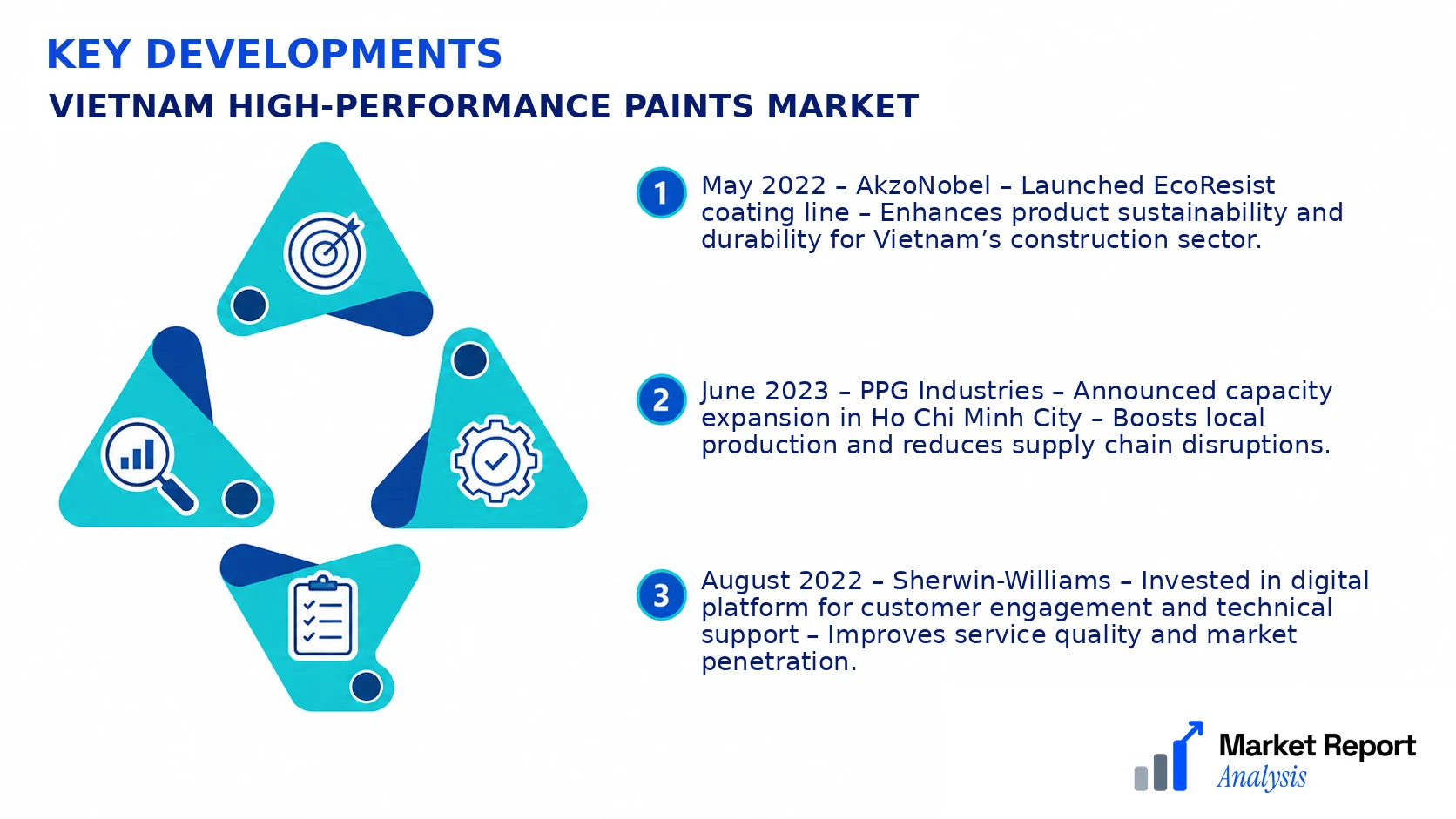
- May 2022 – AkzoNobel – Launched EcoResist coating line – Enhances product sustainability and durability for Vietnam’s construction sector.
- June 2023 – PPG Industries – Announced capacity expansion in Ho Chi Minh City – Boosts local production and reduces supply chain disruptions.
- August 2022 – Sherwin-Williams – Invested in digital platform for customer engagement and technical support – Improves service quality and market penetration.
- April 2023 – Nippon Paint – Entered strategic alliance with local distributor – Expands market share in residential and industrial paint segments.
- July 2022 – Kansai Paint – Completed acquisition of a regional industrial coatings firm – Strengthens technological capabilities and regional presence.
Frequently Asked Questions
What is the Vietnam High-Performance Paints Market?
The Vietnam High-Performance Paints Market comprises advanced coating solutions designed to offer superior durability, corrosion resistance, and aesthetic appeal for industrial, architectural, and specialized applications across Vietnam, driven by modernization and infrastructure development.
What is the current market size of Vietnam High-Performance Paints Market?
As of 2026, the Vietnam High-Performance Paints Market is valued at approximately USD 1.2 Billion, reflecting growing demand from construction, manufacturing, and infrastructure sectors favoring high-grade, eco-friendly coatings with enhanced performance features.
What factors are driving the Vietnam High-Performance Paints Market?
Market growth is propelled by urbanization, economic development, stringent environmental regulations, increasing infrastructure projects, and the demand for durable, protective coatings in industrial and commercial sectors, alongside rising construction activities nationwide.
Which Vietnamese city leads the Vietnam High-Performance Paints Market?
Ho Chi Minh City leads the market, bolstered by its status as Vietnam’s primary economic hub, with extensive infrastructure projects, a vibrant industrial base, and a large construction sector demanding high-performance paints for diverse applications.
Which segment is expected to grow the fastest?
The industrial segment is projected to exhibit the fastest growth due to rising manufacturing activities, infrastructure investments, and a shift towards specialized coatings that provide superior resistance and longevity in demanding environments.
Who are the leading companies operating in the Vietnam High-Performance Paints Market?
Key players include AkzoNobel, Sherwin-Williams, Nippon Paint, and local manufacturers such as Vinh Tien Coatings, which focus on innovation, eco-friendly formulations, and expanding distribution channels to strengthen their competitive position.
Analyst Perspective
The Vietnam High-Performance Paints Market is poised for sustained growth through 2034, driven by increasing infrastructure development, urbanization, and the escalation of industrial activities across key cities like Ho Chi Minh City, Hanoi, and Da Nang. Technological advancements, including environmentally friendly formulations and enhanced durability specifications, are expected to reshape product offerings, elevating the competitive landscape. Strategic investments should prioritize innovation in sustainable coatings and localized supply chains, aligning with government regulations aimed at reducing volatile organic compounds (VOCs). The market displays moderate maturity, with established manufacturers competing alongside emerging players, creating a dynamic environment with ample opportunities for differentiation. Vietnamese cities with expanding manufacturing zones and rising real estate developments, particularly Ho Chi Minh City’s District 7 and Hanoi’s urban belt, present notable regional growth prospects. Long-term strategic positioning demands a focus on R&D, consumer preferences for eco-friendly products, and resilient supply chain management, ensuring competitive advantage amid evolving technological and regulatory landscapes.
