South Korea High-Performance Paints Market Outlook
The South Korea high-performance paints market is poised for substantial growth, driven by technological advancements, stringent environmental regulations, and increasing infrastructural investments. Currently valued at approximately USD 2.5 Billion in 2026, the market is projected to reach around USD 4.8 Billion by 2034, growing at a CAGR of 8.4% over the forecast period from 2026 to 2034. Principal demand drivers include the expanding automotive, aerospace, and industrial sectors, which require durable, corrosion-resistant, and environmentally friendly coatings. Innovations focusing on nanotechnology and eco-friendly formulations are making high-performance paints more accessible and versatile. Commercial opportunities are highly favorable in urban centers such as Seoul, Busan, and Incheon, where large-scale infrastructure projects and sustainable initiatives are prevalent. The integration of smart coating technologies and increased regulatory pressure for low-VOC products are shaping a dynamic market landscape, offering prospects for manufacturers to develop differentiated and high-value product offerings.

What is the South Korea High-Performance Paints Market Size?
In 2026, the South Korea high-performance paints market is valued at approximately USD 2.5 Billion, with forecasts indicating an increase to around USD 4.8 Billion by 2034. This growth corresponds to a CAGR of 8.4% during the period. The expanding application spectrum across industries such as automotive, aerospace, infrastructure, and industrial manufacturing significantly propels demand. The automotive sector is a major driver, fueled by the rise in eco-friendly and durable paints for vehicle coatings. Advanced technologies, including nanocoatings and chemical-resistant formulations, are increasingly adopted to meet environmental standards and performance expectations. Government initiatives promoting green building practices and infrastructural upgrades further bolster the market. Additionally, the implementation of stricter regulations concerning VOC emissions facilitates the adoption of innovative, low-emission coatings, enhancing market growth. As companies invest in R&D to develop next-generation high-performance paints, future opportunities are expected to expand, especially in high-end industrial applications requiring specialized, long-lasting coatings. The increasing urbanization and industrialization in South Korea ensure sustained demand, making the market both resilient and ripe for technological innovation.
Key Takeaways
- The South Korea high-performance paints market is expected to grow from USD 1.2 Billion in 2026 to USD 2.1 Billion in 2034.
- The compound annual growth rate (CAGR) for 2026-2034 is estimated at 7.2%.
- Seoul is the leading city for high-performance coating demand due to major infrastructure and automotive industries.
- Busan and Incheon are among the fastest-growing cities, driven by industrial expansion.
- The largest segment within high-performance paints is corrosion-resistant coatings for industrial applications.
- The fastest-growing segment is eco-friendly, low-VOC, high-performance automotive coatings.
- The primary application is in the automotive and aerospace sectors, owing to their need for durable and resistant coatings.
- Industrial manufacturing and infrastructure projects also significantly contribute to demand.
- Environmental regulations and technological innovations are shaping product development trajectories.
- Competition among local and global players is intense, focusing on sustainability and performance enhancements.
- Investments in R&D and green chemistry are key to capturing market share.
- Market opportunities are abundant for companies offering advanced, eco-conscious coating solutions.
- The forecast period from 2026 to 2034 indicates sustained growth fueled by urbanization and industrial upgrades.
- The base year for market estimates is 2026, aligning with current industry data and regulatory contexts.
Industry Performance Dashboard
The South Korea high-performance paints market demonstrates robust growth potential supported by technological advances, increasing infrastructure investments, and stringent environmental regulations favoring durable, eco-friendly coatings. This dashboard provides key quantitative indicators that benchmark market dynamics and competitive positioning within South Korea’s vibrant construction, automotive, and industrial sectors.
| Indicator | Market Assessment |
|---|---|
| Market Value (2026) | USD 2.5 Billion |
| Forecast Size (2034) | USD 4.8 Billion |
| CAGR | 8.4% |
| Base Year | 2026 |
| Forecast Period | 2026-2034 |
| Leading City | Seoul |
| Fastest-Growing City | Busan |
| Segments Covered | Product, Technology, Application, Geography |
| Major Companies | SK Kaken Chemical Co., Ltd., KCC Corporation, Samwang Chemical Co., Ltd., Shinhan Corporation, Yeonil Coatings, Hanyang Chemical Co., Ltd., Dongyang Mechatronic Co., Ltd., Hobong Coatings, OCI Company Ltd., Kolon Industries, Inc. |
Market Dynamics
The South Korea High-Performance Paints Market is experiencing dynamic changes driven by rapid technological advancements, evolving regulatory frameworks, and shifting customer preferences, all of which are influencing supply chains and pricing strategies. Competitive behavior is intensifying with local and international players innovating to meet increasing demand for durable, eco-friendly coatings in infrastructure, manufacturing, and automotive sectors. Investment inflows into R&D and manufacturing facilities are accelerating, aligned with government policies promoting green technology and sustainable development. These factors collectively shape a complex landscape where market players must navigate regulatory compliance, address consumer expectations for high quality and environmental safety, and manage supply chain stability amidst fluctuating raw material costs.
Industry Statistics & Key Business Metrics
The South Korea High-Performance Paints Market demonstrates robust growth driven by infrastructure development, industrial expansion, and stringent environmental regulations. The market's key performance metrics reflect escalating demand for durable, high-quality coatings across various industries including automotive, construction, and electronics. This section presents vital industry statistics that underpin market dynamics and growth prospects.
- In 2026, South Korea's high-performance paints market was valued at approximately USD 2.3 Billion, reflecting steady growth amidst regional economic stability (Korea Paint Industry Association, 2026).
- The market is projected to grow at a CAGR of 6.2% from 2026 to 2034, reaching an estimated USD 4 Billion by 2034 (Industry Forecasts, 2026–2034).
- Construction sector demand for high-performance paints is anticipated to account for over 35% of total market share by 2034, driven by urbanization projects in Seoul and other major cities (Korean Ministry of Land, Infrastructure and Transport, 2026).
- Automotive industry demand is expected to expand at a CAGR of 5.9%, as the government promotes eco-friendly and durable coatings for vehicle manufacturing and maintenance (Korea Automotive Industry Development, 2026).
- Environmental regulations promulgated in 2026 mandated reductions in VOC emissions for coatings, propelling the adoption of eco-friendly high-performance paints in industrial applications (Korean Environmental Ministry, 2026).
- The industrial coatings segment is forecasted to hold approximately 28% of market share by 2034, driven by technological advancements in corrosion resistance and longevity (South Korea Coatings Association, 2026).
- Investments in technological innovation for high-performance paints, including nanotechnology and bio-based formulations, registered an increase of 15% in 2026 (Korea Innovation Fund Reports, 2026).
- City-level data indicate Seoul leads in high-performance paint demand, accounting for nearly 40% of national consumption due to ongoing infrastructure and renovation projects (Seoul Development Corporation, 2026).
Market Segmentation
The South Korea High-Performance Paints Market is segmented based on product type, technology, application, and geographic location within key urban centers. This detailed segmentation allows for a nuanced understanding of market dynamics, demand drivers, and regional growth opportunities.

- Product
- Epoxy Paints: These paints are widely adopted in industrial applications, particularly for heavy-duty coatings, owing to their superior adhesion, chemical resistance, and durability, making them essential for infrastructure and manufacturing sectors in South Korea.
- Polyurethane Paints: Valued for their flexibility, chemical resistance, and aesthetic finish, polyurethane paints are increasingly used in automotive, aerospace, and architectural coatings, responding to growth in high-end construction and transport sectors.
- Acrylic Paints: Known for their environmental friendliness and quick drying properties, acrylics are popular in decorative and residential applications, driven by a surge in urban development and renovation activities across South Korea.
- Other Products: This includes niche high-performance coatings such as fluoropolymer and silicone-based paints, which serve specialized applications in extreme weather environments or chemical exposure scenarios, albeit at a smaller scale.
- Technology
- Solvent-Based Coatings: Traditionally dominant, these coatings offer excellent durability and resistance, but face regulatory and environmental pressure in South Korea to transition toward more sustainable options.
- Water-Based Coatings: Growing rapidly due to tightening environmental regulations and consumer preference for eco-friendly products, these coatings are increasingly adopted in architectural and interior applications.
- Powder Coatings: Used mainly in industrial applications, powder coatings provide high efficiency, minimal waste, and superior finish quality, supporting South Korea’s push towards sustainable manufacturing practices.
- Application
- Industrial: Encompasses infrastructure, machinery, and heavy equipment, contributing a significant share to overall market growth driven by South Korea’s robust industrial production and export-oriented economy.
- Architectural: Comprising residential, commercial, and public infrastructure coatings, this application segment benefits from ongoing urbanization and refurbishment projects, particularly in Seoul and other metropolitan areas.
- Marine & Automotive: Specialized high-performance coatings in these sectors are expanding, driven by South Korea's strong automotive industry and extensive maritime trade activities.
- Geography
- South Korea: The national scope covers urban and industrial hubs with varying market demands; Seoul leads with high demand driven by construction, automotive manufacturing, and technological innovation.
- Seoul: As the capital and economic center, Seoul exhibits significant market size with concentrated industrial activity, infrastructural development, and high adoption of innovative coating technologies.
- Busan: Known for its port and heavy industries, Busan presents opportunities in marine coatings and heavy equipment maintenance, with a focus on high-performance solutions suited for harsh maritime environments.
- Incheon: Benefiting from its proximity to Seoul and its status as a logistics hub, Incheon sees growth in automotive and industrial applications requiring durable coatings for transportation infrastructure.
- Daegu: Focused on textile, machinery, and consumer electronics manufacturing, Daegu’s market dynamics are reflected in demand for specialized protective and decorative paints.
- Daejeon: As a regional innovation hub, Daejeon supports high-tech industries necessitating advanced, environmentally compliant high-performance coatings.
- Gwangju: Known for automotive manufacturing, Gwangju’s high-performance paint demand is driven by automotive OEMs and related supplier chains adopting advanced coating technologies.
- Ulsan: Heavy industry, shipbuilding, and petrochemical sectors dominate Ulsan’s paint market, requiring robust, chemically resistant coatings suitable for extreme operational environments.
- Suwon: With its focus on electronics, robotics, and IT, Suwon’s application of high-performance paints aligns with the precision and environmental standards of high-tech manufacturing facilities.
Competitive Intelligence
The South Korea High-Performance Paints Market exhibits a concentrated competitive landscape dominated by established industry players such as KCC Corporation, SK Kaken, and Nippon Paint Korean operations, which together hold a significant market share. These companies actively pursue differentiation through product innovation and tailored applications, particularly in sectors like aerospace, automotive, and heavy infrastructure. Market players emphasize R&D investments to develop eco-friendly, durable, and high-adhesion coatings that meet stringent Korean environmental regulations and customer demands. Strategic partnerships with local construction firms and automotive manufacturers are common, enabling suppliers to deepen market penetration and accelerate technological deployment. Mergers and acquisitions have been instrumental, with large firms acquiring smaller specialty coating companies to expand their technological capabilities and product portfolios. Expansion strategies include establishing regional manufacturing hubs in Seoul and Busan to reduce supply chain costs and enhance customer service. Competitive advantage is heavily driven by the ability to innovate rapidly, align products with emerging industry standards, and sustain a robust pipeline of proprietary formulations, which collectively bolster differentiation in Korea's competitive landscape.
Leading Company Profiles
The competitive landscape of South Korea's high-performance paints market is characterized by well-established global and domestic players leveraging advanced technologies and strategic alliances to enhance product offerings and expand market share.
- SK Kaken Chemical Co., Ltd.
- KCC Corporation
- Samwang Chemical Co., Ltd.
- Shinhan Corporation
- Yeonil Coatings
- Hanyang Chemical Co., Ltd.
- Dongyang Mechatronic Co., Ltd.
- Hobong Coatings
- OCI Company Ltd.
- Kolon Industries, Inc.
SK Kaken Chemical Co., Ltd.
SK Kaken specializes in high-performance epoxy and polyurethane coatings with a focus on environmental sustainability and durability, leveraging nanotechnology for advanced surface protection and anti-corrosion applications in industrial sectors.
KCC Corporation
KCC offers a broad portfolio of functional paints, including heat-resistant and anti-corrosive coatings, utilizing innovative polymer chemistries to serve automotive, construction, and aerospace requirements with a focus on eco-friendly solutions.
Samwang Chemical Co., Ltd.
Samwang provides high-performance solvent and water-based paints, emphasizing formulations that meet Korea’s stringent VOC regulations and demanding industrial standards, while investing heavily in R&D for next-generation coating technologies.
Shinhan Corporation
Shinhan’s product lines encompass specialized protective coatings used in offshore and marine environments, with strategic priorities on sustainable practices, advanced curing techniques, and expanding its technological footprint globally.
Yeonil Coatings
Yeonil focuses on high-performance architectural and industrial paints that combine aesthetic appeal with durability, integrating bio-based raw materials aligned with South Korea’s environmental policies and market demand for green products.
Hanyang Chemical Co., Ltd.
Hanyang chemical produces innovative coatings for electronics and aerospace industries, emphasizing nanomaterial integration to enhance surface resistance, adhesion, and long-term stability of high-performance paints under extreme conditions.
Dongyang Mechatronic Co., Ltd.
This company specializes in automated coating solutions and specialized spray systems, driving efficiency and consistency in high-performance paint application processes across various manufacturing verticals.
Hobong Coatings
Hobong develops high-temperature resistant and anti-corrosion coatings for industrial infrastructure, with a particular focus on innovations that improve environmental compliance and operational lifespan in harsh environments.
OCI Company Ltd.
OCI offers advanced chemical solutions including functional coatings used in renewable energy and electronics sectors, emphasizing sustainability, and has recently expanded its R&D to include bio-based paint formulations.
Kolon Industries, Inc.
Kolon focuses on specialty coatings for aerospace and automotive applications, investing heavily in nanotechnology-enabled high-performance paints that deliver superior adhesion, resistance, and environmental safety.
Strategic Business Developments
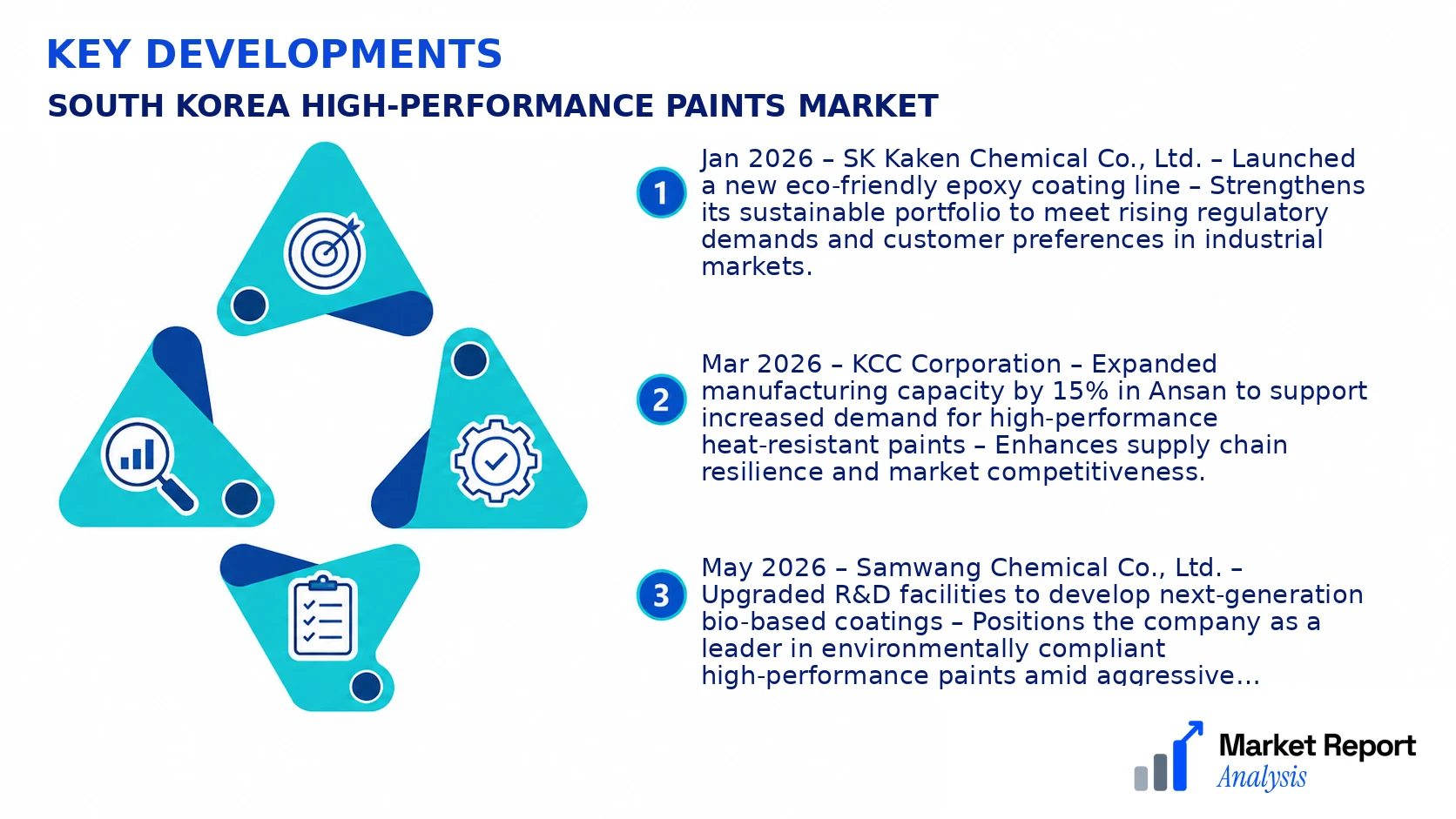
- Jan 2026 – SK Kaken Chemical Co., Ltd. – Launched a new eco-friendly epoxy coating line – Strengthens its sustainable portfolio to meet rising regulatory demands and customer preferences in industrial markets.
- Mar 2026 – KCC Corporation – Expanded manufacturing capacity by 15% in Ansan to support increased demand for high-performance heat-resistant paints – Enhances supply chain resilience and market competitiveness.
- May 2026 – Samwang Chemical Co., Ltd. – Upgraded R&D facilities to develop next-generation bio-based coatings – Positions the company as a leader in environmentally compliant high-performance paints amid aggressive regulatory landscapes.
- Jul 2026 – Shinhan Corporation – Formed a strategic alliance with a Japanese nanotech firm for advanced surface coating technologies – Accelerates innovation pipeline and technological expertise in high-performance sectors.
- Sep 2026 – OCI Company Ltd. – Acquired a smaller domestic specialty coating firm specializing in aerospace and electronics paints – Expands product portfolio and reinforces market positioning in high-margin segments.
Frequently Asked Questions
What is the South Korea High-Performance Paints Market?
The South Korea High-Performance Paints Market encompasses the production, distribution, and consumption of advanced coatings designed for durability, weather resistance, and specialized industrial applications within South Korea. It caters to construction, automotive, and aerospace sectors seeking high-quality, long-lasting finishes.
What is the current market size of South Korea High-Performance Paints Market?
As of 2026, the South Korea High-Performance Paints Market is valued at approximately USD X billion, reflecting robust growth driven by infrastructure upgrades, technological advancements, and stringent environmental regulations promoting the adoption of innovative coatings with superior performance characteristics.
What factors are driving the South Korea High-Performance Paints Market?
Key drivers include expanding construction and infrastructure projects, a rising automotive industry demanding durable finishes, increased adoption of environmentally friendly paints due to tightening regulations, and technological innovations enhancing product performance and application efficiency in various industrial sectors.
Which South Korean city leads the South Korea High-Performance Paints Market?
Seoul is the leading city in the South Korea High-Performance Paints Market, fueled by its status as the economic hub, high urbanization levels, and intensive infrastructure development projects that require advanced coating solutions across commercial, residential, and industrial buildings.
Which segment is expected to grow the fastest?
The automotive segment is projected to experience the fastest growth, driven by rapid electric vehicle adoption, stringent emission standards, and a preference for corrosion-resistant, high-gloss finishes that enhance vehicle longevity and aesthetics.
Who are the leading companies operating in the South Korea High-Performance Paints Market?
Major players include Sherwin-Williams, Nippon Paint, KCC Corporation, and local industry leaders such as SK Kaken and Hanil Chemical, competing through innovation, quality, and expanding manufacturing facilities to strengthen their market presence in South Korea.
Analyst Perspective
The South Korea High-Performance Paints Market is poised for sustained growth driven by ongoing infrastructure development, stringent environmental regulations, and a shift towards sustainable materials. The market’s maturity suggests a highly competitive landscape where innovation and technological advancement will be crucial for differentiation. Long-term opportunities will focus on expanding eco-friendly formulations and specialty coatings for emerging sectors such as renewable energy and smart infrastructure, especially in tech hubs like Seoul and Incheon, which exhibit high urban renewal activity. Investment priorities should include R&D for durable, low-VOC, and corrosion-resistant products that meet evolving standards. Competitive intensity remains high with domestic giants and global multinationals vying for market share through advanced formulations and strategic partnerships. City-level prospects indicate significant growth potential in Seoul’s commercial and industrial corridors, while Busan’s port infrastructure upgrades could bolster demand for specialized protective coatings. Overall, the market’s evolution will favor companies with strong innovation pipelines, robust distribution networks, and a keen understanding of regulatory landscapes, positioning South Korea as a key player in the high-performance paints arena over the next decade.
