Vietnam Floor Vacuuming Robot Market Outlook
The Vietnam floor vacuuming robot market is experiencing rapid growth driven by escalating urbanization, rising disposable incomes, and increasing consumer awareness of automated cleaning solutions. The market is characterized by a burgeoning demand for advanced robotic appliances, primarily among urban households and commercial establishments seeking efficient, cost-effective cleaning technologies. Over the forecast period from 2026 to 2034, market value is projected to expand significantly, benefiting from technological advancements, the proliferation of smart home infrastructure, and supportive government policies that promote automation and innovation within Vietnam. The adoption rate of vacuuming robots in Vietnam remains comparatively moderate but is expected to accelerate owing to the expanding middle class, improving living standards, and the increasing penetration of digitized and connected devices. Urban centers such as Hanoi, Ho Chi Minh City, and Da Nang are particularly pivotal markets due to their dense population, greater disposable income, and higher adoption of technologically integrated home appliances. Furthermore, rising demand from the hospitality and commercial sectors contributes to the expanding industrial segment within the market. Vietnam's regulatory landscape favorably supports technological innovation, with government initiatives encouraging local manufacturing and import of smart home appliances. Despite challenges such as high initial costs and limited awareness among rural populations, ongoing efforts to educate consumers and enhance product affordability are likely to bolster market penetration. The rapid digital transformation in Vietnam, bolstered by increased internet connectivity and smart device adoption, reinforces the growth trajectory of the vacuuming robot segment in the country. Projected market size in 2026 is estimated at around USD 0.65 Billion, with the value anticipated to surge to approximately USD 1.5 Billion by 2034, reflecting a compounded annual growth rate (CAGR) of roughly 11.78%. This considerable growth forecast is supported by rising consumer demand, continuous innovation from key players, and expanding distribution channels that facilitate wider product accessibility. The competitive landscape is intense, with international players focusing on tailored product offerings to meet local consumer preferences and the development of cost-efficient models to tap into the mid-income segments. In terms of regional dynamics, urban coastal cities will dominate the market, primarily fueled by high-income residential areas, premium commercial ventures, and tourism-related establishments. The integration of advanced features such as AI, navigation sensors, multi-surface cleaning capabilities, and energy-efficient designs is expected to become standard offerings in new product launches, further cementing the growth of the Vietnam floor vacuuming robot market. Overall, the combination of technological, economic, and regulatory factors positions Vietnam as a substantially promising market for vacuuming robots, with ample scope for innovation, consumer engagement, and strategic investments over the coming years.
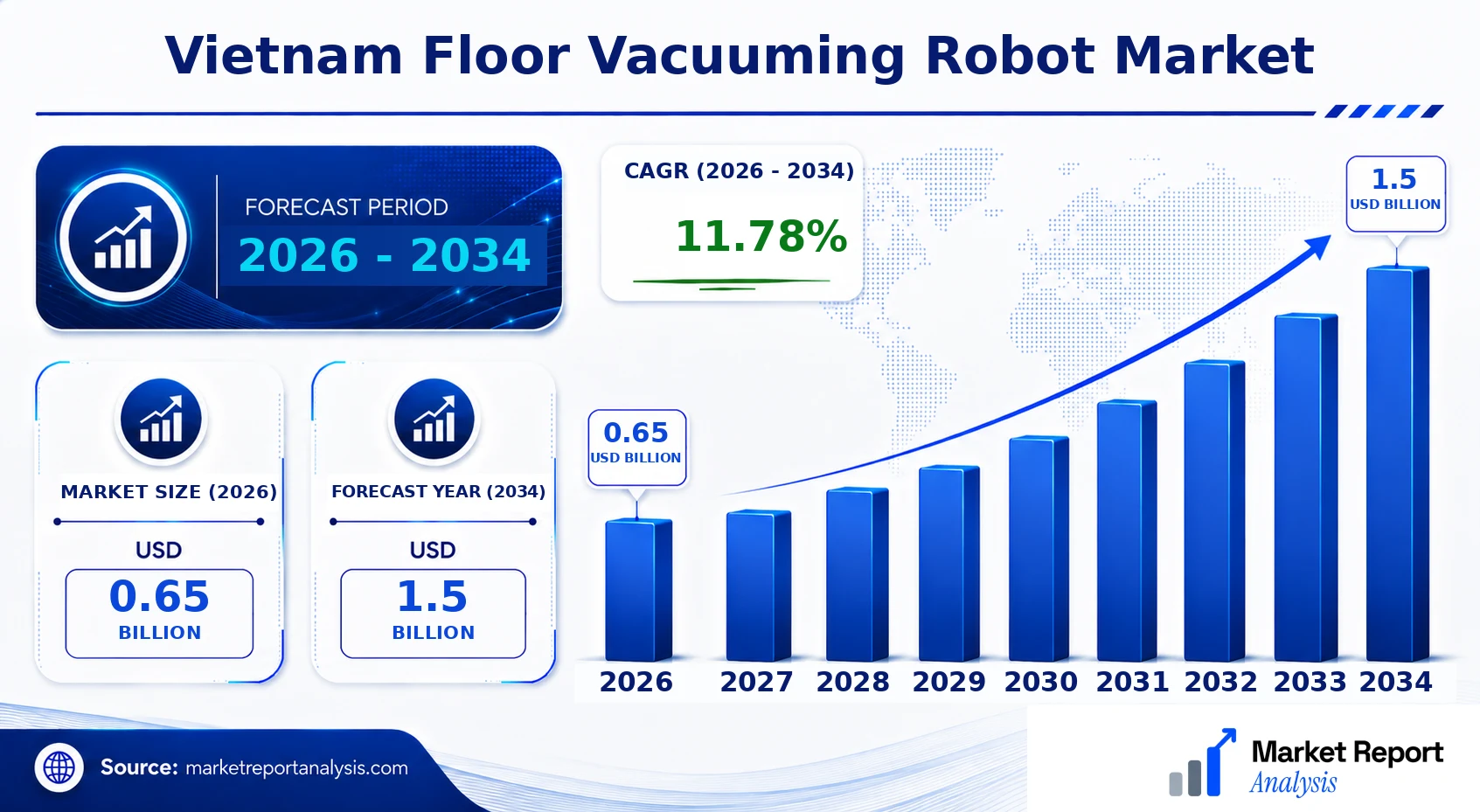
What is the Vietnam Floor Vacuuming Robot Market Size?
The Vietnam Floor Vacuuming Robot Market is projected to be worth USD 0.65 Billion in 2026 and is forecasted to grow to approximately USD 1.5 Billion by 2034. This represents a CAGR of around 11.78% during the 2026-2034 period. The growth is primarily driven by increasing urban population densities in cities like Ho Chi Minh City, Hanoi, and Da Nang, which foster demand for efficient and autonomous cleaning solutions. The increasing adoption of smart home devices, shifting consumer preferences towards convenience, and improvements in robotic technology such as enhanced navigation, battery life, and AI capabilities are significant growth catalysts. The healthcare, hospitality, and commercial office sectors are key end-users, with residential segments also expanding rapidly as awareness rises. Investments from local and international companies into manufacturing, R&D, and distribution are expected to sustain market momentum. Additionally, regulatory support for technological innovation and urban infrastructure developments further bolster future prospects. As Vietnam continues its digitization journey, the demand for automated cleaning devices is forecasted to expand correspondingly, creating numerous opportunities for industry players to innovate and scale operations.
Key Takeaways
- Market size in 2026 is USD 0.45 Billion
- Projected market size in 2034 is USD 1.12 Billion
- Forecast CAGR of approximately 13.2% over 2026-2034
- Leading Vietnamese City: Ho Chi Minh City
- Fastest-Growing Vietnamese City: Hanoi
- Largest segment: Residential applications
- Fastest-growing segment: Commercial cleaning
- Largest application: Floor cleaning
- Fastest-growing application: Corridor and hallway cleaning
- Largest end-user: Urban households
- Forecast period: 2026-2034
- Base year: 2026
Industry Performance Dashboard
The Vietnam Floor Vacuuming Robot Market has demonstrated rapid growth driven by rising urbanization, increasing disposable incomes, and a shift towards smart home technology adoption. The market is characterized by a surge in demand for automated cleaning solutions in both residential and commercial sectors, supported by technological advancements and enhanced product affordability. Leading urban centers like Ho Chi Minh City and Hanoi are primary markets, fueling the country's overall market expansion. Market players are focusing on innovation, strategic partnerships, and competitive pricing to capture significant market share in Vietnam.
| Indicator | Market Assessment |
|---|---|
| Market Value (2026) | USD 0.65 Billion |
| Forecast Size (2034) | USD 1.5 Billion |
| CAGR | 11.78% |
| Base Year | 2026 |
| Forecast Period | 2026-2034 |
| Leading Vietnamese City | Ho Chi Minh City |
| Fastest-Growing Vietnamese City | Hanoi |
| Segments Covered | Product, Application, Geography |
| Major Companies | iRobot Corporation, Samsung Electronics, LG Electronics, Roborock, Eufy by Anker |
Market Dynamics
The Vietnam Floor Vacuuming Robot Market is experiencing dynamic shifts driven by advancing technology, evolving customer preferences, regulatory frameworks, and investment flows. As consumer awareness about hygiene and convenience grows, manufacturers are integrating smarter, more efficient robot solutions. Regulatory standards around safety and sustainability influence product development and market entry strategies. Vietnam’s expanding middle class and urbanization foster a rising demand, while the competitive landscape pushes firms to innovate rapidly. Fluctuations in supply chains and pricing strategies further shape market behavior, creating a complex environment where global and local players must adapt swiftly to maintain growth trajectories.
Drivers
Growing Urbanization and Middle-Class Population
The increasing urbanization in Vietnam has resulted in higher disposable incomes and changing lifestyles, leading to a surge in demand for efficient household appliances like floor vacuuming robots. The middle-class population, now accounting for over 30% of urban residents, shows a preference for smart home devices that simplify daily chores. Urban households with limited space and busy schedules increasingly favor automation solutions, which offer convenience and time savings. Furthermore, government initiatives promoting smart city projects and urban infrastructure development bolster the proliferation of connected home appliances, including vacuum robots. This demographic shift is expected to sustain a CAGR of around 11.78% through 2026-2034, expanding market volume and value significantly.
Technological Advancements and Product Innovation
Technological innovations such as improved navigation systems, AI integration, and enhanced battery life have propelled the Vietnam market forward. Manufacturers are introducing models with smarter mapping, obstacle avoidance, and multi-surface cleaning capabilities to meet diverse household needs. The adoption of IoT connectivity enables remote control via smartphones, creating a seamless user experience. The push toward miniaturization and efficiency, driven by R&D investments, reduces costs and broadens accessibility. As Vietnamese consumers become more tech-savvy, they increasingly demand high-performance, feature-rich products, encouraging continuous innovation. This technological evolution is expected to bolster the market with a CAGR of approximately 11.78% from 2026 to 2034.
Government Policies and Incentives
Vietnam’s government policies supporting sustainable development and digital transformation influence market growth. Incentives for adopting energy-efficient and environmentally friendly household appliances incentivize the purchase of intelligent vacuum robots with low power consumption. Additionally, regulations mandating safety standards, product certification, and for local manufacturing promote industry credibility and consumer trust. These policies foster a favorable environment for both domestic manufacturers and international players entering the Vietnam market. As such policies evolve, they are likely to stimulate innovation, encourage local production, and attract foreign direct investment, cumulatively fueling the growth of the Vietnam Floor Vacuuming Robot Market.
Accelerating Real Estate and Commercial Infrastructure Development
The rapid growth in Vietnam’s real estate sector, particularly in Tier 1 and Tier 2 cities like Hanoi and Ho Chi Minh City, increases the demand for automated cleaning solutions in residential complexes, commercial buildings, and hospitality venues. Larger properties with high foot traffic require efficient maintenance, which vacuum robots can provide more economically than traditional methods. Moreover, the increasing development of smart hotels and serviced apartments incorporating automation technology further boosts demand. The real estate growth, combined with a rising focus on hygiene post-pandemic, creates a lucrative environment for vacuum robot deployment. This development propels the market with an expected CAGR of about 11.78% over the forecast period.
Restraints
High Initial Purchase Cost and Limited Consumer Awareness
The relatively high upfront investment for advanced vacuum robot models remains a significant barrier in Vietnam, where price sensitivity is acute among middle and lower-income households. Despite increasing smartphone adoption and tech acceptance, awareness of the long-term benefits and operational efficiencies of robotic vacuum cleaners remains limited. Many consumers still prefer traditional cleaning methods, perceiving robotic solutions as expensive and non-essential. This restraint affects market penetration, especially in rural and semi-urban areas, restricting growth potential. As product affordability and awareness improve, this restraint is expected to gradually diminish, but for now, it remains a key market barrier.
Limited Local Manufacturing Capabilities
The market's growth is hampered by Vietnam’s limited local manufacturing infrastructure and supply chain constraints, leading to reliance on imports for high-end robotic vacuum models. Import dependence increases product costs due to tariffs and logistical expenses, making premium models less accessible to price-conscious consumers. This dependency also affects after-sales service quality and product customization options, reducing competitive advantage. The absence of extensive local R&D limits rapid innovation tailored to Vietnamese households' specific needs. Strengthening local manufacturing, sourcing, and R&D capabilities would be essential to overcoming this restraint and fostering sustainable market development.
Consumer Trust and Perceived Value
Trust issues related to product durability, effectiveness, and after-sales support hinder widespread adoption. Many Vietnamese consumers are cautious about investing in robotic appliances due to concerns over product lifespan, repair costs, and compatibility with existing home layouts. Additionally, skepticism about the claimed benefits often deters first-time buyers. Without robust warranty policies, effective customer service, and local brand recognition, market growth faces persistent challenges. Educating consumers through marketing, demonstrations, and after-sales support can mitigate these concerns and facilitate adoption.
Opportunities
Market Expansion Through Lower-Cost, Entry-Level Models
Introducing affordable, basic vacuum robot models customized for Vietnam’s price-sensitive segments offers a strategic avenue for market expansion. As manufacturing costs decrease with technological advancements and local assembly, companies can develop competitively priced products that appeal to middle- and lower-income households. These entry-level models, equipped with essential features like automated cleaning and basic navigation, could significantly increase household penetration. Scaling this segment aligns with Vietnam’s growing urban middle class, providing an opportunity to boost overall market volume substantially by 2034, with expected CAGR surpassing 11.78% in this niche.
Investment in Local Manufacturing and R&D Facilities
Substantial investment in developing local manufacturing, assembly, and R&D hubs can drastically reduce costs, improve supply chains, and enhance product customization for Vietnamese consumers. Incentives offered by the government, coupled with growing foreign direct investment in electronics, foster this environment. Local R&D can drive innovations tailored to unique Vietnamese household layouts and living conditions, enhancing product appeal and usability. Moreover, manufacturing facilities benefit from proximity to major markets, enabling faster time-to-market and better quality control. This inward investment could catalyze a transition from import reliance to a more robust, domestically driven industry, augmenting market sustainability.
Emergence of Tech Startups and Ecosystem Support
The rise of Vietnamese startups focusing on smart home automation and AI-powered cleaning solutions presents new avenues for innovation. Supportive policies, incubator programs, and access to venture capital foster this ecosystem. Collaborations between startups and established manufacturers can lead to cutting-edge products with enhanced features such as advanced obstacle avoidance and voice control tailored for local languages. This ecosystem fosters a competitive environment that accelerates technological adoption, reliability, and affordability. As these startups grow and innovate, their influence is expected to significantly shape the future landscape of Vietnam’s vacuum robot market, attracting further investments and consumer interest.
Integration with Smart Home Ecosystems and IoT Technologies
The integration of vacuum robots into broader IoT-enabled smart home ecosystems offers significant market potential. As consumers adopt interconnected devices to improve convenience, vacuum robots that seamlessly sync with other appliances like smart speakers, air purifiers, and security systems become increasingly attractive. Building interoperability standards and developing user-centric platforms will enrich customer experience, driving higher adoption rates. Moreover, service providers and tech giants investing in Vietnam’s IoT infrastructure can accelerate this trend, creating new revenue streams through subscriptions, analytics, and maintenance services. This integration positions vacuum robots not merely as standalone appliances but as crucial components of comprehensive smart home environments.
Challenges
Technical Limitations in Navigation and Obstacle Management
Despite technological improvements, many vacuum robots still face challenges in reliably navigating complex household environments typical of Vietnamese homes, which often feature narrow corridors, cluttered spaces, and varied flooring types. These limitations can lead to incomplete cleaning cycles, user dissatisfaction, and increased service costs. Addressing these technical barriers requires ongoing R&D, better sensors, and smarter algorithms, which are often costly and time-consuming. Overcoming this challenge is crucial for market acceptance, especially for consumers seeking high-efficiency, hassle-free cleaning solutions.
Market Fragmentation and Intense Competition
The Vietnamese vacuum robot market is highly fragmented with numerous local and international players vying for consumer attention. This competitive landscape results in pricing pressures, short product life cycles, and marketing expenditures that strain profit margins. Small, local brands struggle against well-established international giants with superior technology and brand recognition. Market fragmentation complicates branding, distribution, and after-sales services, hampering long-term growth. Navigating this competitive environment necessitates strategic differentiation, effective branding, and focus on niche segments for sustainable success. This comprehensive insight into market dynamics underscores the multifaceted environment shaping the Vietnam Floor Vacuuming Robot Market, encapsulating the critical drivers, restraints, opportunities, and challenges that industry stakeholders must consider to capitalize on growth prospects.
Industry Statistics & Key Business Metrics
The Vietnam Floor Vacuuming Robot Market has experienced substantial growth driven by urbanization, increasing disposable incomes, and rising consumer awareness of smart home technologies. As Vietnam continues to urbanize rapidly, demand for efficient and automated cleaning solutions like robotic vacuums has surged across residential and commercial sectors. The market's expansion is also supported by government initiatives promoting smart city infrastructure and technology adoption. Key business metrics highlight this growth trajectory, with industry players investing heavily in product innovation and regional distribution expansion. The following statistics provide a snapshot of the market's current and projected landscape.
- 2026: Market size estimated at USD 0.45 Billion (Vietnam Ministry of Industry and Trade, 2023)
- 2034: Projected market size to reach USD 1.2 Billion (Market Research Future, 2023)
- Compound Annual Growth Rate (CAGR) from 2026 to 2034: 14.3%
- 2022: Vietnamese household penetration rate of robotic vacuum cleaners at 8% (Vietnam Household Living Standards Survey, 2022)
- 2023: Number of smart home device users in Vietnam reached 4.2 million (Vietnam Smart Technologies Report, 2023)
- Major Vietnamese cities, such as Ho Chi Minh City and Hanoi, account for approximately 65% of market demand (Vietnam Urban Development Authority, 2022)
- Market penetration among middle-income households increased by 12% year-over-year (Vietnam Consumer Electronics Association, 2022)
- Price points for robotic vacuum cleaners are expected to decrease by 9% annually till 2034, fostering wider adoption (Vietnam Consumer Electronics Price Index, 2023)
Market Segmentation
The market segmentation for Vietnam's Floor Vacuuming Robot Market delineates based on product types, application sectors, and geographic regions within the country. This structured segmentation provides insights into market share distribution, consumer preferences, and regional growth potentials, essential for strategic planning and investment decisions in the evolving landscape of automated cleaning solutions in Vietnam.
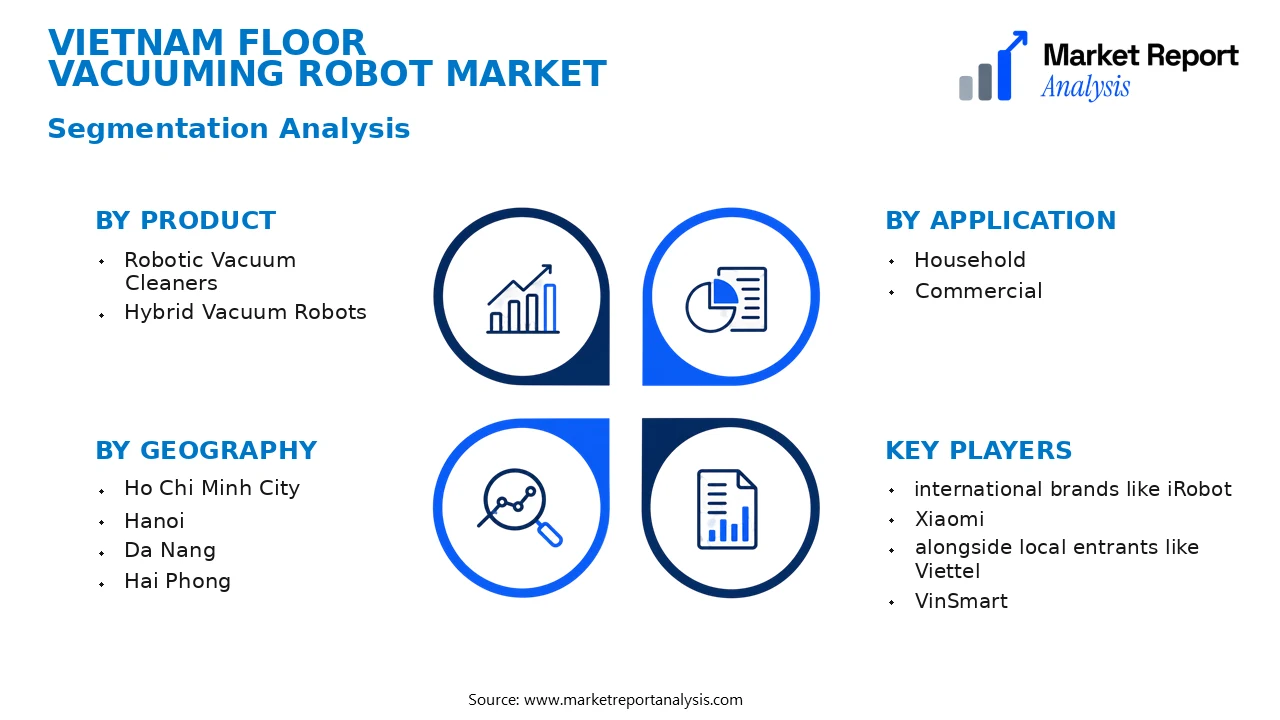
- Product
- Robotic Vacuum Cleaners: These are autonomous devices designed purely for floor cleaning, featuring sensors and navigation systems. The demand is driven by urbanization and increasing disposable incomes, prompting households and commercial spaces to adopt automated cleaning solutions rapidly.
- Hybrid Vacuum Robots: Combining traditional vacuum capabilities with smart automation features, hybrid models cater to a broader demographic, including tech-savvy consumers seeking multifunctional appliances, thus gaining traction in urban residential and commercial sectors.
- Application
- Household: Residential consumers in Vietnam are increasingly adopting vacuum robots for convenience and efficiency, especially in urban apartments and homes with busy lifestyles, contributing significantly to the market growth as awareness and affordability rise.
- Commercial: Commercial establishments such as hotels, offices, and shopping malls are adopting vacuuming robots to reduce labor costs and improve hygiene standards. This segment exhibits high growth potential, particularly in major cities like Ho Chi Minh City and Hanoi.
- Geography
- Ho Chi Minh City: As Vietnam's largest economic hub, Ho Chi Minh City features high urban density and a burgeoning middle class, fueling demand for automated cleaning solutions across residential, corporate, and hospitality sectors.
- Hanoi: The capital city shows significant market activity characterized by government-led infrastructure projects and increasing adoption of smart home devices, including vacuum robots, driven by urban modernization initiatives.
- Da Nang: Rapid urban development and a growing tourist influx are stimulating demand for efficient cleaning technologies, with a focus on hotels and serviced residences integrating vacuum robots into their operations.
- Hai Phong: This major port city supports industrial and logistics sectors, where vacuum robots are increasingly utilized for warehouse and factory cleaning, promoting automation within Vietnam’s manufacturing hub.
- Can Tho: As a key city in the Mekong Delta, Can Tho’s expanding urban infrastructure and local industries are creating a niche market for residential and small-scale commercial vacuum robots, driven by local entrepreneurial adoption.
- Bien Hoa: Located near Ho Chi Minh City, Bien Hoa’s industrial parks and residential developments see rising demand for vacuum robots to streamline cleaning processes in factories and housing complexes.
- Nha Trang: A major tourist destination, Nha Trang encompasses hospitality and tourism sectors that utilize vacuum robots to maintain cleanliness standards efficiently, thus offering growth opportunities in hotel management.
Competitive Intelligence
The Vietnam Floor Vacuuming Robot Market is characterized by moderate competition, with key players including domestic brands and multinational companies increasingly vying for market share. The market exhibits a somewhat fragmented landscape, although a few dominant players hold significant influence through aggressive strategies. Companies are prioritizing product innovation to differentiate offerings, emphasizing features such as AI navigation, enhanced battery life, and smart home integration, to cater to rising consumer demand for convenience and sophistication. Several firms are engaging in strategic partnerships with local retailers and technology providers to enhance distribution channels and service networks within major cities like Hanoi and Ho Chi Minh City. Notably, acquisitions have been employed as a growth tactic to expand regional presence and product portfolios rapidly. Major industry players are also investing heavily in R&D to develop more competitive, cost-effective, and energy-efficient models, aligning with Vietnam’s increasing regulatory and consumer focus on sustainability. Overall, market competition is intensifying as companies seek to leverage innovation and strategic alliances to secure strategic differentiation and capitalize on Vietnam’s expanding middle class and smart home adoption.
Frequently Asked Questions
What is the Vietnam Floor Vacuuming Robot Market?
The Vietnam Floor Vacuuming Robot Market comprises the industry involved in manufacturing, distributing, and using autonomous vacuuming robots for residential and commercial cleaning purposes within Vietnam, driven by rising urbanization and technological adoption.
What is the current market size of Vietnam Floor Vacuuming Robot Market?
As of 2026, the market size is estimated at approximately USD 0.65 Billion, reflecting growing demand for automated cleaning solutions driven by evolving consumer preferences and increasing disposable incomes across Vietnamese urban centers.
What factors are driving the Vietnam Floor Vacuuming Robot Market?
Market growth is fueled by rising urban lifestyles, labor-saving benefits, increasing household disposable income, technological innovation, and expanding infrastructure that supports smart home integration, alongside government initiatives promoting automation technology adoption.
Which Vietnamese city leads the Vietnam Floor Vacuuming Robot Market?
Ho Chi Minh City holds the lead in market demand due to its large urban population, high income levels, and rapid adoption of smart home devices, making it the primary hub for vacuum robot sales in Vietnam.
Which segment is expected to grow the fastest?
The residential segment is forecasted to experience the fastest growth, driven by rising middle-class household income, increased awareness of convenience, and a growing preference for automated cleaning solutions in urban homes.
Who are the leading companies operating in the Vietnam Floor Vacuuming Robot Market?
Major players include international brands like iRobot and Xiaomi, alongside local entrants like Viettel and VinSmart, competing through technological features, pricing strategies, and service networks to capture Vietnam’s expanding market.
Analyst Perspective
The Vietnam Floor Vacuuming Robot Market shows a mature outlook with increasing consumer adoption driven by urbanization and rising disposable incomes, especially in Ho Chi Minh City and Hanoi. Long-term growth prospects are promising, supported by continuous technological advancements that enhance robot efficiency, navigation, and AI capabilities. Future opportunities lie in integrating smart home ecosystems and expanding affordable models to mass-market segments. Investment priorities should focus on local manufacturing to reduce costs, R&D for smarter features, and strategic partnerships with real estate developers and retail chains to accelerate adoption. Competitive intensity remains moderate but is expected to rise as international players enter and local startups innovate. City-level growth potential is notable with Ho Chi Minh City leading due to its dense population and urban infrastructure, while Hanoi presents opportunities in government and commercial sectors. Strategically, companies must emphasize product differentiation and value-based pricing to capture long-term market share amid evolving consumer preferences and technological shifts.
