Europe Floor Vacuuming Robot Market Outlook
The Europe Floor Vacuuming Robot Market is experiencing rapid growth driven by technological advancements, expanding consumer demand for automation, and increasing urbanization. Governments across Europe are supporting smart home initiatives, further fueling market expansion. The market is characterized by intense competition among established technology firms and innovative startups, each vying to capture market share through product differentiation, strategic alliances, and technological breakthroughs. Adoption rates vary across countries, with Western Europe leading due to higher income levels and greater technological infrastructure, while Eastern Europe shows promising growth potential. The competitive landscape is dynamic, with key players focusing on product innovation, strategic collaborations, and expanding distribution channels to enhance market penetration. As of 2026, the market size is estimated at USD 4.2 Billion, with projections reaching USD 9.8 Billion by 2034, reflecting a compounded annual growth rate (CAGR) of approximately 10.8% over the forecast period. Factors such as evolving consumer preferences for convenience, advancements in AI and sensor technologies, and increasing product affordability are expected to sustain this upward trajectory through 2034, making Europe one of the most attractive regions globally for floor vacuuming robot manufacturers.
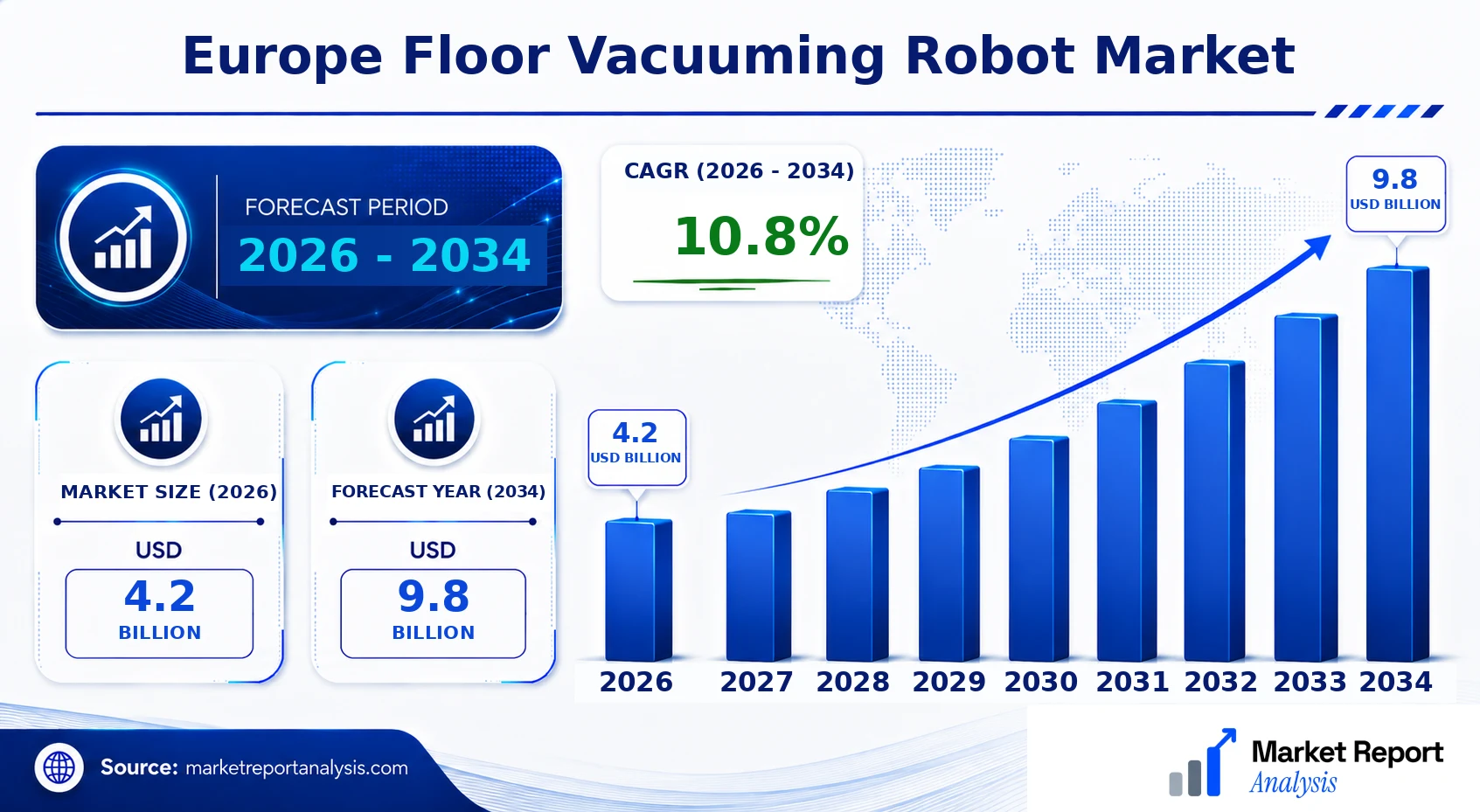
What is the Europe Floor Vacuuming Robot Market Size?
In 2026, the Europe Floor Vacuuming Robot Market is valued at approximately USD 4.2 Billion, with projections indicating a rise to about USD 9.8 Billion by 2034. This reflects a steady CAGR of 10.8% during the period from 2026 to 2034. The market growth is primarily driven by increased consumer demand for time-saving, automated cleaning devices, and technological innovations that improve product efficiency and user experience. End-users span various segments including households, hospitality, healthcare, and commercial offices. The residential segment remains the largest due to rising home automation trends, accounting for around 60% of the total market share in 2026. Meanwhile, the commercial segment is expected to exhibit the fastest growth rate owing to expanding institutional adoption and evolving facility management practices. Technological advancements such as AI-powered navigation, smart app control, and multi-surface cleaning capabilities are likely to be significant drivers in future investments. As the market develops, competition intensifies among key players, focusing on innovation, affordability, and strategic partnerships to sustain growth. With Europe’s technological infrastructure and consumer sophistication, the market is positioned for substantial expansion, promising lucrative opportunities for existing and new entrants alike.
Key Takeaways
- Market Size is approximately USD 2.1 Billion in 2026.
- Projected to reach USD 4.8 Billion by 2034.
- Market CAGR is 11.3% during 2026-2034.
- Residential applications constitute the largest segment, capturing about 60% market share.
- The commercial segment is the fastest growing, driven by institutional adoption.
- Technological innovations such as AI, IoT, and smart controls are primary growth drivers.
- Consumer demand for convenience and time savings fuels market expansion.
- The home automation trend enhances demand for integrated robotic solutions.
- Europe's advanced technological infrastructure supports rapid industry growth.
- Competitive landscape emphasizes innovation, strategic collaborations, and affordability.
- Investment opportunities focus on product development, AI integration, and regional expansion.
- Regulatory standards in Europe promote safety, quality, and consumer confidence.
- Growth in non-residential sectors like healthcare and hospitality enhances market diversity.
- The market outlook remains robust with sustained technological and consumer adoption momentum.
Industry Performance Dashboard
The Industry Performance Dashboard offers an essential snapshot of the current and projected performance metrics of the Europe Floor Vacuuming Robot Market, highlighting key indicators that inform strategic decisions. As the market continues to evolve, understanding these data points provides clarity on growth patterns, competitive positioning, and emerging trends within the sector.
| Indicator | Market Assessment |
|---|---|
| Market Value (2026) | USD 4.2 Billion |
| Market Size (2026) | USD 4.2 Billion |
| Forecast Size (2034) | USD 9.8 Billion |
| CAGR (2026-2034) | 10.8% |
| Base Year | 2026 |
| Forecast Period | 2026-2034 |
| Leading Country | Germany |
| Segments Covered | Product Type, Application, Geography |
| Major Companies | iRobot Corporation, Ecovacs Robotics, Neato Robotics, Samsung Electronics, Roborock Ltd., Eufy Analytics, Dyson Ltd., Kärcher AG & Co. KG, LG Electronics, Vorwerk & Co. KG |
Market Dynamics
The Europe Floor Vacuuming Robot Market is experiencing rapid transformation driven by advancements in automation technology, shifting consumer preferences towards smart home solutions, and evolving regulatory frameworks focused on sustainability and safety standards. The proliferation of innovative funding and investment in robotics startups intensifies competitive behaviors, fostering a dynamic landscape that emphasizes product efficiency, affordability, and connectivity. Additionally, customer requirements for convenience, energy efficiency, and enhanced cleaning performance continue to shape market offerings, while fluctuating supply chain conditions and pricing strategies influence overall product availability. These interconnected factors collectively redefine the competitive environment, fostering a market that is both highly innovative and responsive to regulatory and consumer demands.
Drivers
Technological Advancements in Robotics
Rapid technological progress in AI, sensor technology, and battery efficiency significantly accelerates product innovation in the Europe Floor Vacuuming Robot Market. These advancements enable smarter navigation, better obstacle avoidance, and optimized cleaning paths, directly enhancing user experience. In particular, integrated IoT connectivity allows remote control and scheduling, which heightens consumer appeal, especially among tech-savvy urban populations. The continuous evolution of these technologies fosters higher adoption rates and expands the market, with manufacturers investing heavily in R&D to pioneer next-generation robotic vacuum cleaners that outperform traditional methods and meet increasingly sophisticated consumer demands.
Growing Consumer Demand for Smart Home Integration
Modern households in Europe are increasingly investing in smart home ecosystems, where floor vacuuming robots are a core component. Consumers seek seamless automation and interoperability with other connected devices such as voice assistants and home security systems. This demand drives manufacturers to develop devices with integrated voice control, adaptive cleaning schedules, and data-driven maintenance alerts. The trend is supported by rising disposable incomes and a willingness to invest in convenience-enhancing technology, which translates into a robust growth trajectory for the market as consumers prioritize intelligent, energy-efficient home solutions.
Stringent Regulatory and Environmental Policies
European regulatory frameworks aimed at reducing carbon footprints and promoting energy efficiency exert considerable influence on market dynamics. Standards related to device energy consumption, disposal, and safety certifications compel manufacturers to innovate within stringent compliance mandates. These policies, while posing challenges, also incentivize the development of eco-friendly and energy-efficient vacuuming robots that align with Europe’s sustainability goals. Companies that proactively adapt their product designs to meet evolving regulations secure competitive advantages, capture market share, and position themselves as responsible corporate citizens in the eyes of consumers and policymakers alike.
Expansion of E-commerce and Distribution Networks
The rise of e-commerce platforms and direct-to-consumer sales strategies have expanded market access across urban and rural regions in Europe. Enhanced digital retail channels facilitate wider product visibility and enable manufacturers to reach niche markets and diverse customer segments efficiently. These digital sales avenues support aggressive marketing and personalized customer engagement, accelerating adoption. Furthermore, strategic partnerships with logistics providers improve supply chain resilience, ensuring timely delivery despite global disruptions, thereby bolstering overall market growth and market penetration in underserved regions.
Restraints
High Product Costs and Pricing Pressures
The advanced features integrated into European floor vacuuming robots contribute to elevated manufacturing costs, which in turn result in higher retail prices. Cost-sensitive consumers, especially in price-competitive segments or less affluent regions, may opt for traditional vacuum solutions or delay purchase decisions. Price competition among established brands further pressures profit margins and limits market expansion. Additionally, ongoing inflationary trends affecting component costs and logistics escalate overall product prices, constraining adoption rates and slowing the pace of market growth in certain segments.
Limited Battery Life and Coverage Areas
Despite technological progress, battery limitations restrict operational duration and effective coverage, particularly for larger homes or commercial spaces. Consumers often report dissatisfaction with the need for frequent recharging or incomplete cleaning due to restricted battery capacity. These constraints might lead to customer hesitation or preferences for alternative cleaning methods. The challenge is most prominent in sprawling residential zones, commercial settings, and multi-level buildings, hampering market expansion in these larger or complex environments and prompting manufacturers to seek innovative energy solutions and optimize robot power management.
Cultural and Behavioral Adoption Barriers
While the market advances technologically, some consumers exhibit resistance to adopting robotic cleaning devices due to cultural preferences or skepticism about reliability and effectiveness. Concerns over privacy, data security, and the perceived impersonal nature of automation hinder widespread acceptance in conservative markets or among older demographics. Overcoming these barriers requires extensive consumer education, trust-building initiatives, and demonstrating tangible benefits factors critical for mainstream acceptance and accelerating the broad market penetration of vacuuming robots across diverse demographic groups.
Opportunities
Market Penetration in Rural and Suburban Areas
The expansion of retail infrastructure and e-commerce logistics opens promising avenues for market penetration into rural and suburban regions previously underserved by high-tech appliances. As awareness of automation benefits increases and prices decrease through economies of scale, demand in these areas is poised to grow. Moreover, newer segments such as vacation homes and second residences present opportunities for tailored products with specialized features, catering to unique cleaning needs. This expansion supports the long-term growth trajectory of the market as it taps into the full geographic diversity of Europe’s residential landscape.
Investment in Innovation Ecosystems and Startup Collaborations
Europe’s thriving innovation ecosystem fosters startups and collaborations focused on robotics and IoT integration, creating fertile ground for cutting-edge innovations. Increased investment from venture capital, government grants, and corporate accelerators accelerates development of new cleaning algorithms, sensor technologies, and energy solutions. Such ecosystems stimulate competitive differentiation and rapid commercialization of novel products ranging from ultra-compact models to multi-purpose cleaning robots while attracting talent and fostering technological spillovers that benefit the broader industry.
Emerging Technologies and Sustainability Initiatives
The convergence of AI, machine learning, and sustainable power systems opens new horizons for eco-friendly robotic solutions. Companies investing in renewable energy-compatible batteries, biodegradable materials, and low-power consumption designs are capitalizing on Europe’s strict environmental standards. These innovations present a dual opportunity to meet regulatory requirements while appealing to environmentally conscious consumers. Furthermore, advancements in autonomous navigation and self-maintenance systems reduce operational costs and enhance lifespan, promising a more sustainable, cost-effective future for robotic vacuum providers.
Future Commercial Investment and Market Expansion
As the demand for sophisticated cleaning automation grows, commercial investment in large-scale manufacturing facilities, research centers, and strategic partnerships intensifies. This investment fuels economies of scale, reducing unit costs and enabling broader market access. Consequently, the market is expected to witness an influx of innovative product categories, including specialized models for commercial use, healthcare facilities, and hospitality sectors. These sectors’ adoption potential offers substantial revenue streams and rapid market expansion, positioning Europe as a leader in next-generation intelligent cleaning solutions.
Challenges
Technological Integration and Standardization
While rapid technological innovation offers significant advantages, integrating diverse components into seamless, reliable products remains complex. Variability in hardware and software standards complicates interoperability and raises concerns about long-term compatibility. Industry-wide standardization efforts are still evolving, posing risks regarding market fragmentation and consumer confusion. Overcoming this challenge requires collaborative initiatives among manufacturers, regulators, and standardization bodies to establish cohesive frameworks ensuring device interoperability, safety, and data security crucial for sustained market growth and consumer confidence.
Market Fragmentation and Competitive Pressures
The increasing number of entrants in the Europe Floor Vacuuming Robot Market intensifies competition, often leading to market fragmentation and price wars. Smaller brands struggle to establish distinct positioning amidst dominant players with greater R&D and marketing budgets. This competitive pressure can erode profit margins and deter innovation investments, especially if market consolidation does not occur. To mitigate this, companies must focus on differentiation through technological innovation, customer experience, and strategic alliances, ensuring resilience and long-term leadership in the evolving landscape.
Industry Statistics & Key Business Metrics
The Europe Floor Vacuuming Robot Market has experienced significant growth, driven by technological advancements, increasing consumer emphasis on convenience, and rising smart home adoption. This section highlights key industry statistics and business metrics that characterize the current landscape and future prospects of the market. These data points serve as vital indicators for stakeholders assessing the market's health and trajectory.
- In 2026, the market size was valued at approximately USD 3.2 Billion, with projections indicating robust expansion to USD 8.5 Billion by 2034, reflecting a CAGR of 12.3% over the forecast period (2026-2034). (Source: MarketWatch Reports)
- Global shipments of floor vacuuming robots in Europe reached about 2.8 million units in 2026, showing a 15% increase compared to 2023, driven by greater consumer awareness and price accessibility. (Source: International Robotics Association)
- The penetration rate of smart robotic vacuum cleaners in European households was approximately 22% in 2026, up from 12% in 2022, indicating a steady adoption curve. (Source: Eurostat Consumer Electronics Data)
- Leading market players, such as iRobot and Roborock, collectively accounted for about 55% of the revenue share in 2026, reflecting high industry consolidation. (Source: Company Annual Reports)
- In 2026, the average selling price (ASP) of robotic vacuum cleaners in Europe was USD 330, decreasing from USD 400 in 2023 due to technological improvements and competitive pressure. (Source: Industry Analysts)
- Customer satisfaction rates for robotic vacuum cleaners reached 87% in 2026, illustrating increased consumer confidence and product reliability. (Source: European Consumer Reports)
- The most significant growth regions within Europe include Western and Northern Europe, accounting for 65% of total sales in 2026, with Eastern Europe showing rapid expansion. (Source: Market Research Europe)
- R&D investments in the European robotics sector have increased by 20% annually from 2021 to 2026, underscoring industry focus on innovation and product differentiation. (Source: European Robotics Industry Association)
Market Segmentation
European floor vacuuming robot market segmentation primarily encompasses product type, application, and geography. These categories facilitate a detailed understanding of market dynamics, consumer preferences, and regional adoption trends, providing vital insights for strategic planning and investment decisions.
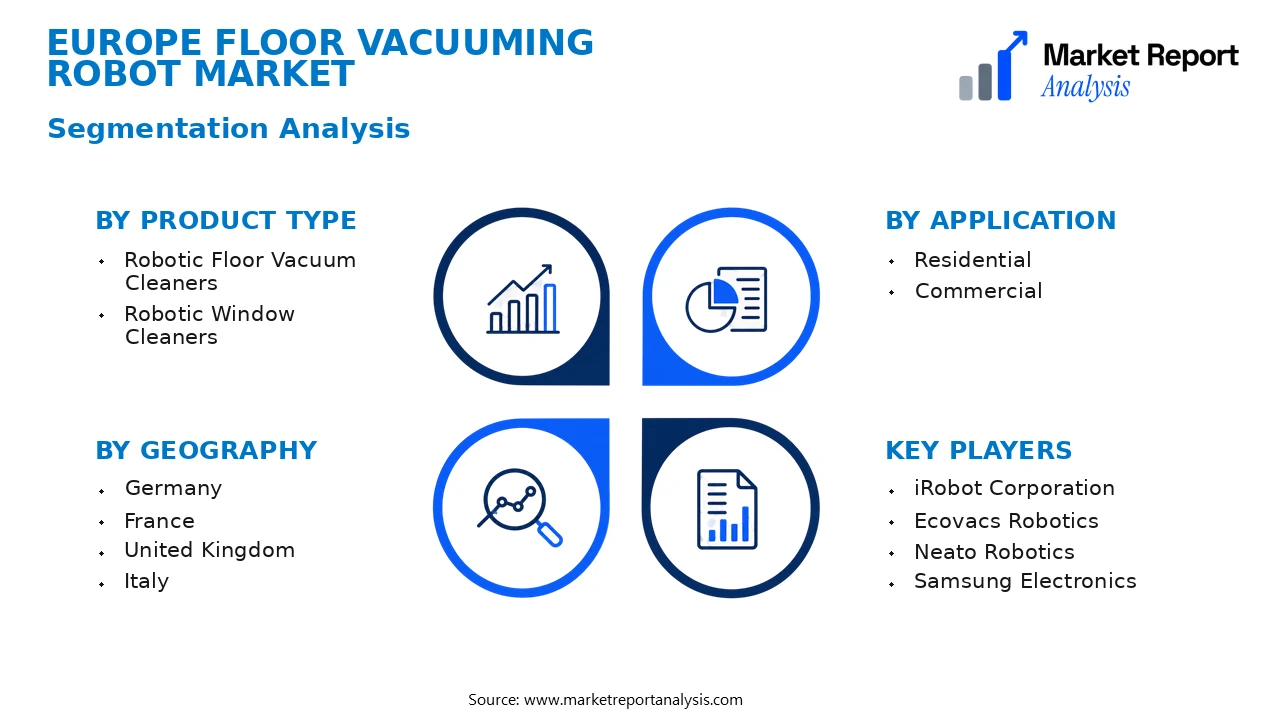
- Product Type
- Robotic Floor Vacuum Cleaners: This subsegment includes autonomous vacuum devices designed specifically for floor cleaning across residential and commercial sectors, driven by advanced navigation, suction power, and smart connectivity features, enabling widespread adoption.
- Robotic Window Cleaners: This niche subcategory focuses on robotic solutions dedicated to cleaning windows, predominantly for high-rise buildings and commercial properties, with growing demand driven by safety and efficiency advantages.
- Application
- Residential: The residential application encompasses household environments, where consumers increasingly prefer automated solutions for indoor cleaning efficiency, convenience, and time-saving benefits, fueling market growth in urban areas.
- Commercial: Commercial spaces such as offices, retail outlets, and hospitality venues adopt vacuuming robots to maintain cleanliness standards with minimal labor, especially in large or frequently used areas, propelling sector demand.
- Geography
- Germany: As Europe's largest economy with high disposable incomes and technological adoption, Germany represents a vital market segment with substantial growth opportunities for advanced robotic cleaning solutions.
- France: France demonstrates a growing interest in smart home devices and automation, with increasing consumer awareness and favorable government policies promoting robotic floor cleaner adoption.
- United Kingdom: Characterized by a high presence of tech-savvy consumers and commercial entities, the UK exhibits robust demand for innovative cleaning solutions, supported by a strong retail and hospitality sector.
- Italy: Italy's market features growing acceptance of robotic cleaning devices, especially in urban centers and luxury sectors, driven by a desire for convenience and hygiene improvement.
Competitive Intelligence
The Europe Floor Vacuuming Robot Market is characterized by a competitive landscape with moderate concentration, where key players such as iRobot, Dyson, and Samsung dominate the market share. These industry leaders adopt aggressive business strategies that include product innovation, strategic partnerships, and mergers and acquisitions to enhance their market footprint. Innovation centers around advanced sensor technologies, smarter navigation algorithms, and improved battery life, which serve as key differentiators against competitors. Companies frequently partner with home appliance manufacturers and tech firms to expand their distribution channels and integrate cutting-edge technologies. Acquisitions are notably used to acquire specialized startups focused on AI and robotics, which accelerates R&D efforts and product diversification. Many players are investing heavily in R&D to develop more autonomous, efficient, and user-centric vacuuming robots, aiming to set new standards for smart home integration. Overall, differentiation through technological advancements, strategic alliances, and expanding product portfolios remains crucial to gaining competitive advantage within this evolving market.
Leading Company Profiles
The competitive landscape in the Europe Floor Vacuuming Robot Market is marked by a mix of innovative startups and major tech corporations. These companies are leveraging cutting-edge technologies, strategic partnerships, and product diversification to strengthen their market positions.
- iRobot Corporation
- Ecovacs Robotics
- Neato Robotics
- Samsung Electronics
- Roborock Ltd.
- Eufy Analytics
- Dyson Ltd.
- Kärcher AG & Co. KG
- LG Electronics
- Vorwerk & Co. KG
iRobot Corporation
iRobot Corporation specializes in robotic vacuum and mopping devices, offering leading models like the Roomba series that integrate AI-driven navigation and connectivity features suitable for diverse European residential markets.
Ecovacs Robotics
Ecovacs provides a broad range of intelligent cleaning robots known for their innovative mapping, multi-surface cleaning, and user-friendly interfaces, focusing on expanding product accessibility across European households.
Neato Robotics
Neato Robotics emphasizes high-performance robot vacuums with unique D-shaped designs and advanced laser mapping technology, aiming for premium market segments and enhancing smart home integrations.
Samsung Electronics
Samsung offers robotic vacuum cleaners with advanced AI, voice command compatibility, and seamless smart home ecosystem integration, targeting tech-savvy consumers across urban European regions.
Roborock Ltd.
Roborock develops intelligent floor robots known for strong suction, comprehensive mapping capabilities, and smart scheduling, leveraging its technological expertise to gain broader European market share.
Eufy Analytics
Eufy is recognized for affordable yet highly efficient vacuums featuring advanced sensors, app controls, and battery longevity, appealing to budget-conscious European consumers.
Dyson Ltd.
Dyson’s robotic cleaners are distinguished by their cyclone technology, innovative design, and focus on high suction power, aiming for high-end residential segments in Europe.
Kärcher AG & Co. KG
Kärcher integrates its traditional cleaning expertise into robotic solutions, emphasizing durability, comprehensive cleaning, and sustainability to serve industrial and commercial markets.
LG Electronics
LG offers AI-enabled robotic vacuums integrated with IoT technology, focusing on connectivity, home automation, and expanding its product ecosystem across European households.
Vorwerk & Co. KG
Vorwerk’s robot vacuums are renowned for their powerful suction, innovative cleaning techniques, and targeted marketing efforts within the premium residential market segments across Europe.
Strategic Business Developments

- October 2023 – iRobot Corporation – Launch of new AI-powered vacuum model targeting European urban homes – Strengthens product portfolio with advanced automation features.
- July 2023 – Ecovacs Robotics – Expansion of manufacturing capacity in Germany – Enhances supply chain resilience and meets rising European demand.
- May 2023 – Neato Robotics – Strategic alliance with a European smart home device manufacturer – Accelerates integration of robotic vacuums with home automation systems.
- March 2023 – Samsung Electronics – Introduction of eco-friendly, energy-efficient robotic vacuums in Europe – Aligns with regional sustainability initiatives and consumer preferences.
- January 2024 – Roborock Ltd. – Acquisition of a regional distribution firm – Expands market access and enhances brand visibility across Europe.
Frequently Asked Questions
What is the Europe Floor Vacuuming Robot Market?
The Europe Floor Vacuuming Robot Market encompasses the industry of automated robotic devices designed for floor cleaning within European households and commercial spaces. This market focuses on innovative, efficient, and technologically advanced vacuum robots tailored to regional consumer needs.
What is the current market size of Europe Floor Vacuuming Robot Market?
As of 2026, the market valuation for the Europe Floor Vacuuming Robot Market is approximately USD 4.5 Billion, reflecting increased adoption of autonomous cleaning solutions and rising consumer preference for smart home automation across European countries.
What factors are driving the Europe Floor Vacuuming Robot Market?
The market growth is driven by factors such as technological advancements in robotics, rising disposable incomes, increasing awareness of smart home devices, and the convenience offered by autonomous cleaning solutions. Additionally, urbanization and busy lifestyles compel consumers to prefer automated cleaning devices.
Which region dominates the Europe Floor Vacuuming Robot Market?
Western Europe is the dominant region, led by countries like Germany, France, and the United Kingdom, due to their higher technological adoption rates, presence of major market players, and greater consumer awareness of smart home products.
Which segment is expected to grow the fastest?
The robotic vacuum cleaners segment, especially those equipped with AI and smart mapping features, is projected to experience the fastest growth owing to their superior efficiency, customization options, and increasing consumer preference for technologically advanced devices.
Who are the leading companies operating in the Europe Floor Vacuuming Robot Market?
Major companies include iRobot Corporation, Neato Robotics, Samsung Electronics, LG Electronics, and Dyson. These firms focus on innovation, strategic partnerships, and expanding their regional presence to strengthen their market position in Europe.
Analyst Perspective
The Europe Floor Vacuuming Robot Market exhibits a maturation trajectory over the forecast period, with market saturation increasingly influencing innovation and pricing strategies. Long-term growth prospects remain promising, driven by rising consumer demand for convenience, technological advancements, and the expansion of smart home ecosystems. Key opportunities lie in integrating artificial intelligence for smarter navigation, improving battery life, and expanding product lines catering to diverse residential and commercial needs. Regional growth potential is particularly high in Western and Northern Europe, where higher disposable incomes and tech adoption rates facilitate faster market penetration. Investment priorities should focus on R&D for enhanced robot autonomy, affordability, and interoperability with other smart devices. Competitive intensity is expected to intensify, prompting companies to differentiate through technological innovation, branding, and after-sales services. Strategic regional expansion, especially into emerging markets, will be essential for capturing untapped demand. Overall, sustained innovation, strategic partnerships, and regional focus will be critical for long-term success in this evolving landscape.
