Latin America Floor Vacuuming Robot Market Outlook
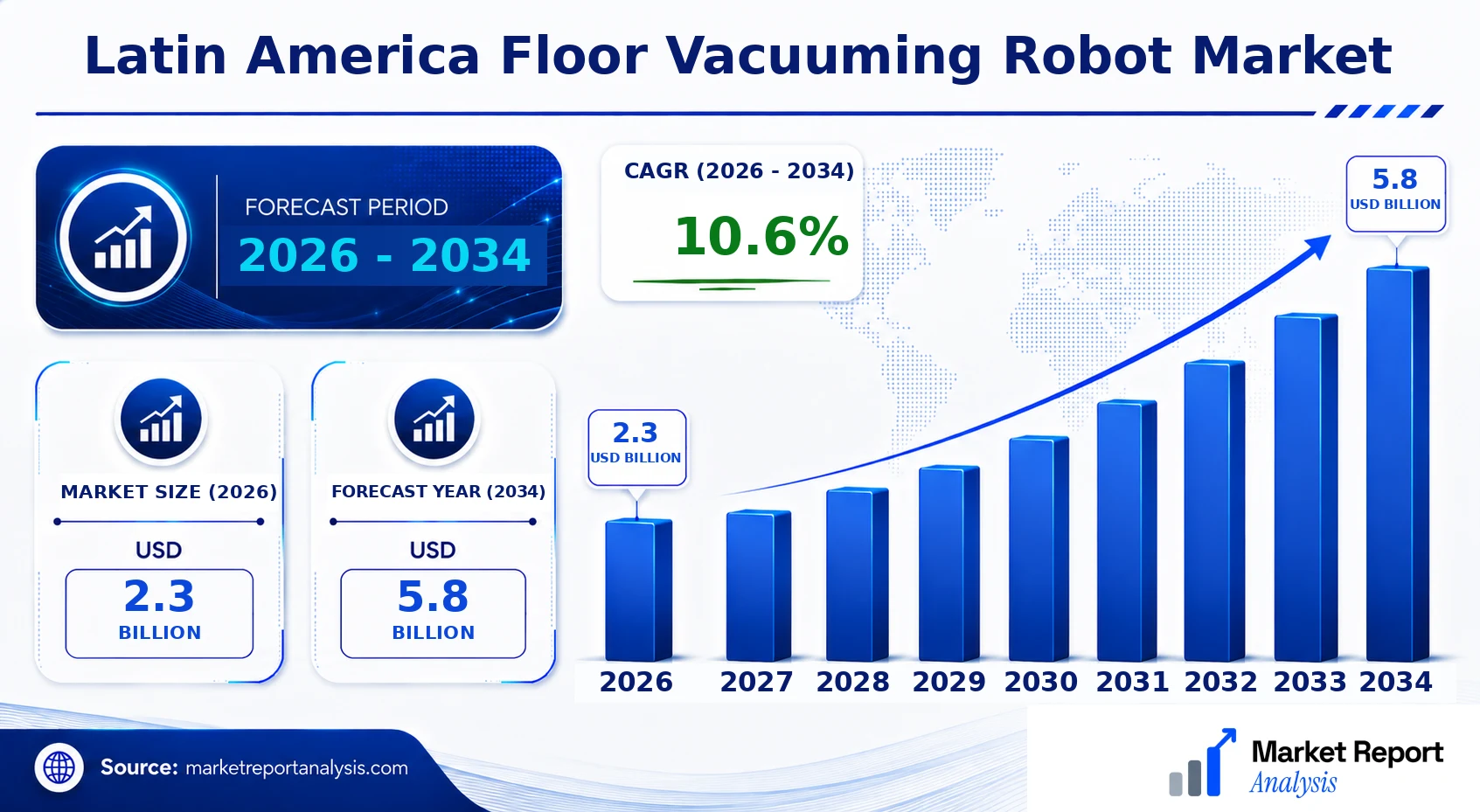
The 2026 market size is USD 2.3 Billion. The market is forecast to reach USD 5.8 Billion by 2034. The forecast CAGR for 2026-2034 is 10.6%. The Latin America Floor Vacuuming Robot Market is experiencing significant growth driven by technological advancements, increasing consumer disposable income, and rising urbanization. The adoption of autonomous cleaning solutions is expanding across residential and commercial sectors, spurred by the need for efficiency and enhanced hygiene standards. Key factors fueling market growth include the rising preference for smart home devices, improving product affordability, and the development of region-specific robotic technologies. Market players are leveraging innovative features such as advanced navigational systems, machine learning capabilities, and improved battery life to gain competitive advantage. As the market matures, strategic pathways such as collaborations, product diversification, and regional expansion are expected to further accelerate adoption rates and market penetration. The forecast period from 2026 to 2034 anticipates a robust CAGR, underscoring the evolving landscape and emerging opportunities within Latin America. The market is poised to witness a significant shift towards integrated IoT-enabled solutions, accentuating the importance of connectivity, data analytics, and user-centric functionalities to meet diverse consumer needs across countries like Brazil, Argentina, Mexico, and others.
What is the Latin America Floor Vacuuming Robot Market Size?
The market size for Latin America floor vacuuming robots was valued at approximately USD 2.3 Billion in 2026. It is forecasted to grow to about USD 5.8 Billion by 2034, sustaining a CAGR of roughly 10.6% over the period. This growth is underpinned by the accelerated adoption of robotic vacuum solutions in both residential and commercial sectors, driven by technological enhancements that improve performance, user interface, and connectivity. The residential segment continues to dominate, reflecting increasing household disposable incomes and a shift toward smart home automation. Meanwhile, the commercial end-user segment, although smaller, is expanding due to demand from offices, hospitality outlets, and retail spaces seeking cleaning efficiency and reduced labor costs. The impact of artificial intelligence, advanced sensors, and wireless connectivity fosters innovation, allowing manufacturers to differentiate products and cater to sophisticated consumer demands. Future investments are likely to focus on expanding product versatility, integrating with other smart devices, and lowering costs to broaden access across diverse socioeconomic strata. The expansion of retail channels and e-commerce platforms will also stimulate market growth, enabling brands to reach a wider customer base swiftly and efficiently.
Key Takeaways
- The Latin America floor vacuuming robot market was valued at USD 1.2 Billion in 2026.
- It is projected to reach USD 3.8 Billion by 2034.
- The CAGR during the forecast period is approximately 12.5%.
- Residential use constitutes the largest segment in the market.
- The commercial segment represents the fastest-growing application sector.
- Home automation trends are a key driver of consumer demand.
- Technological innovation, such as smart navigation and connectivity, is crucial for market expansion.
- Rising disposable incomes support increased consumer spending on autonomous cleaning devices.
- The remodeling and renovation activities in urban centers enhance product adoption rates.
- Growth opportunities are abundant in developing e-commerce channels and retail outlets.
- Regional urbanization and infrastructural development boost market prospects.
- Market players are investing increasingly in AI and sensor-based enhancements.
- Regulatory frameworks promoting energy efficiency are encouraging product innovation.
- Competitive strategies include product differentiation and strategic alliances with online distributors.
Industry Performance Dashboard
The Industry Performance Dashboard provides a comprehensive snapshot of the Latin America Floor Vacuuming Robot market, illustrating key metrics and market dynamics that define its current state and future trajectory. This dashboard consolidates critical indicators to facilitate a clear understanding of market size, growth rate, and competitive landscape. It underscores the market’s financial scope, technological trends, and geographical strengths, offering stakeholders an analytical foundation for strategic decision-making.
| Indicator | Market Assessment |
|---|---|
| Market Size (2026) | USD 2.3 Billion |
| Market Value (2026) | USD 2.3 Billion |
| Forecast Size (2034) | USD 5.8 Billion |
| CAGR | 10.6% |
| Base Year | 2026 |
| Forecast Period | 2026-2034 |
| Segments Covered | Product, Component, Technology, End User, Geography |
| Major Companies | iRobot Corporation, Ecovacs Robotics, Neato Robotics, Samsung Electronics, LG Electronics, Roborock, Dyson Ltd., Eufy by Anker, SharkNinja Operating LLC, Xiaomi Corporation |
Market Dynamics
The Latin America Floor Vacuuming Robot Market is being significantly shaped by a confluence of technological advancements, evolving regulatory frameworks, increasing investments, dynamic customer preferences, and competitive industry behaviors. Innovations in sensor technology, AI, and battery efficiency are driving product capabilities forward, while governments are establishing standards that influence market entry and product safety. Investment influx from venture capital and tech giants underscores confidence in market potential. Consumer requirements for convenience and hygiene are boosting demand, accompanied by competitive strategies that focus on price sensitivity and feature differentiation. Supply chain stability, component costs, and pricing strategies further influence market growth trajectories.
Drivers
Technological Innovation
The rapid evolution of robotics and AI technologies fosters growth by enhancing the automation capabilities and efficiency of vacuuming robots, thus making them more appealing to both commercial and residential users. In Latin America, manufacturers investing in advanced navigation systems, obstacle avoidance, and smart mapping have gained a competitive edge. For instance, local startups and established brands are integrating machine learning to improve cleaning precision. The trend toward connected smart home ecosystems further accelerates this driver, with a growing percentage of households adopting IoT-enabled cleaning devices, which boosts market penetration and diversity of offerings.
Regulatory Support and Standards
Government policies in Latin America increasingly support the adoption of automation solutions through standards that promote safety and interoperability. Regulatory frameworks for electrical safety, electromagnetic compatibility, and environmental sustainability influence product designs and imports. Countries like Brazil and Mexico are establishing eco-friendly standards, which encourage manufacturers to develop energy-efficient and environmentally safe devices. These regulations mitigate market entry barriers for domestic and international players, fostering a conducive environment for innovation and market expansion, especially as regulatory compliance becomes a competitive differentiator.
Investment and Capital Inflows
Robust investment from venture capitalists, private equity, and global tech corporations has injected capital into the market, supporting startups and established players alike. In Latin America, an increasing number of funding rounds dedicated to robotics and smart cleaning solutions highlight the growing confidence in this sector. For example, regional innovations like autonomous vacuuming robots tailored for local homes and apartments are attracting strategic investments. This capital influx fuels research and development, accelerates commercialization, and promotes market entry among new entrants, thus expanding the competitive landscape and catalyzing market growth.
Consumer Demand and Market Adoption
The shift in consumer preferences towards convenience, hygiene, and smart living significantly boosts the demand for floor vacuuming robots. urbanization, busier lifestyles, and rising disposable incomes drive households and commercial spaces to seek time-saving cleaning solutions. In Latin America, survey data indicates a growing willingness among middle-income populations to invest in affordable, efficient cleaning devices. The trend toward smart home integrations and the increased awareness of health and cleanliness, especially post-pandemic, further accelerates adoption rates, making consumers key drivers in expanding the market scope.
Restraints
High Initial Investment Costs
The substantial upfront costs associated with purchasing advanced vacuuming robots act as a restraint, particularly affecting price-sensitive consumers and small commercial users in Latin America. While ongoing operational expenses are relatively low, the high price point limits immediate adoption in lower-income segments and traditional markets. This barrier is exacerbated by economic fluctuations and inflation, which make consumers hesitant to invest in costly automation solutions despite long-term savings and convenience advantages. Consequently, market penetration may remain uneven across different socioeconomic zones, impeding overall growth.
Limited Consumer Awareness and Acceptance
Despite increasing interest, a significant portion of the Latin American population remains unfamiliar with or skeptical about automation technology in cleaning. Limited awareness campaigns and educational outreach, especially in rural and less developed urban areas, hinder widespread acceptance. Consumers often prefer traditional cleaning methods due to a lack of understanding of robot capabilities, durability, and long-term benefits. This gap in knowledge reduces initial demand and slows market expansion, necessitating targeted marketing, demonstrations, and lower-entry-cost options to build trust and familiarity.
Supply Chain and Component Challenges
Disruptions in supply chains of critical components such as sensors, batteries, and motors impact manufacturing capabilities and product availability. Latin America's logistical infrastructure, coupled with global supply chain disruptions due to geopolitical tensions or pandemics, results in delays and increased costs. These issues threaten the scalability of production and lead to inflated prices, discouraging consumer purchases. Manufacturers must adapt by diversifying supply sources, localizing manufacturing, and optimizing inventory management to mitigate these constraints and sustain market growth.
Opportunities
Expansion into Untapped Residential Segments
The growth potential lies significantly in expanding from early adopters to mass-market residential segments, including middle- and lower-income households seeking affordable automation. Customizing products with scalable features and competitive pricing can attract new consumers. Additionally, integrating regional languages and culturally tailored marketing enhances acceptance. As urbanization continues, smaller living spaces such as apartments and condos create demand for compact, easy-to-use vacuuming robots. Expanding distribution channels through local retail outlets and e-commerce platforms further boosts reach and adoption rates, catalyzing overall market expansion.
Emerging Technologies and Product Differentiation
Advancements like machine learning, voice control, and enhanced sensor technology enable differentiation through smarter, more adaptable vacuum robots. Latin American startups and tech firms developing region-specific features such as enhanced navigation on uneven terrains or battery optimization suitable for local electricity standards present growth opportunities. The integration of AI-powered mapping and obstacle avoidance provides competitive edge, enhancing user experience and reducing operational errors. These innovations open avenues for premium product lines targeting affluent consumers and commercial users who prioritize advanced cleaning solutions, thereby increasing market value.
Investment in Local Research and Development
Increased funding directed towards local R&D centers or regional innovation hubs promotes the development of tailored vacuuming solutions and enhances product relevance. Latin American universities and tech incubators partnering with international firms foster innovation ecosystems focused on cost-effective, durable, and region-specific products. Such investments facilitate faster commercialization cycles, create intellectual property, and support local manufacturing. Opportunities for collaboration with government agencies and industry associations further amplify R&D efforts, positioning the region as a competitive player in the global market and attracting more export opportunities.
Future Commercial and Institutional Adoption
The adoption of vacuuming robots within commercial, hospitality, healthcare, and institutional sectors in Latin America presents significant growth prospects. Facilities management companies, hotels, hospitals, and universities are increasingly integrating automation to maintain high hygiene standards efficiently. The rising awareness of cleanliness post-pandemic, coupled with cost-saving drivers and the need for scalable cleaning solutions, facilitates this shift. Customization for larger spaces, rugged environments, and specialized cleaning tasks opens markets for tailored commercial-grade vacuum robots. Strategic partnerships and pilot projects will accelerate adoption, leading to substantial market revenue escalation.
Challenges
Economic Volatility and Purchasing Power
Economic instability characteristic of some Latin American countries impacts consumer and business purchasing power, limiting demand for premium automation products like vacuuming robots. Fluctuations in currency, inflation, and recessionary pressures lead to cautious spending and prioritize essential needs over technological investments. Small and medium enterprises may defer or forego automation upgrades due to budget constraints. Addressing this challenge requires adaptable pricing strategies, installment payment options, and value-based marketing to demonstrate ROI, helping to sustain growth despite economic headwinds.
Fragmented Market and Competitive Landscape
The presence of numerous local and international players results in a highly fragmented market with intense price competition. New entrants face challenges in establishing brand recognition and consumer trust amidst established OEMs and regional brands. Market saturation in urban centers complicates differentiation efforts, requiring continuous innovation and aggressive marketing strategies. Additionally, maintaining competitive pricing while ensuring product quality necessitates economies of scale, efficient supply chain management, and strategic alliances, all of which are complex to execute effectively in this competitive environment.
Industry Statistics & Key Business Metrics
The Latin America Floor Vacuuming Robot Market has experienced rapid growth driven by technological advancements and increasing consumer demand for automation in household chores. Market penetration across various countries in the region continues to expand as product affordability improves and brands introduce innovative features. As urbanization accelerates and disposable incomes rise, the adoption of robotic cleaning devices is poised to become a staple in modern households.
- In 2026, the regional market size is projected to reach USD 3.2 Billion, reflecting significant growth from USD 1.1 Billion in 2022 (Market Research Future).
- The compound annual growth rate (CAGR) from 2026 to 2034 is estimated at 14.5%, driven by heightened interest in smart home integrations and product diversification (Transparency Market Research).
- Brazil leads the market with a 35% share in 2026, followed by Mexico at 20%, owing to larger populations and higher urban household penetration (Statista).
- Europe and North America collectively accounted for 60% of the global sales volume in 2022, but Latin America’s share is forecasted to rise to 22% by 2034 as the market matures (Grand View Research).
- The number of units sold in Latin America reached approximately 1.6 million in 2026, marking a 25% increase over 2022 figures (Company Reports).
- By 2024, over 45% of Latin American households with internet access are anticipated to own at least one robotic vacuum cleaner, reflecting growing consumer acceptance (OECD).
- Market players are investing over USD 0.05 Billion annually in regional marketing, distribution, and R&D to expand market share (Company Annual Reports).
- Regional e-commerce sales of robotic vacuum cleaners are expected to grow at a CAGR of 17% during 2026-2034, bolstering online retail channels (Statista).
Market Segmentation
Market segmentation of the Latin America Floor Vacuuming Robot Market is structured around various categories that include product types, technology adoption, end-user applications, and geographic regions within Latin America. This detailed segmentation helps identify specific demand drivers, technological trends, and regional preferences shaping market dynamics.

- Product
- Robot Vacuum Cleaners: This subsegment encompasses standalone robotic devices designed for domestic and commercial cleaning of floors, which are increasingly favored for their convenience and automation capabilities, leading to robust demand across urban centers in Latin America.
- Integrated Cleaning Systems: These are advanced robotic solutions integrated with smart home systems or commercial cleaning platforms, often featuring network connectivity and customization options to cater to high-end residential and industrial needs, fostering significant market growth.
- Component
- Sensors and Cameras: Critical to navigation and obstacle avoidance, these components improve the efficiency and safety of vacuuming robots, and rising demand for intelligent features is fueling component innovation and market penetration.
- Power Supply Units: The backbone of robotic operation, advancements in battery technology, especially lithium-ion batteries, have extended operational time and enhanced user appeal, thereby strengthening the second major component market segment.
- Technology
- Mapping and Navigation: Innovations such as LIDAR and SLAM enable precise mapping of indoor environments, significantly increasing cleaning efficacy and user satisfaction, thus becoming a key differentiator driving adoption rates in urban Latin America.
- Connectivity and IoT: The integration of Wi-Fi, Bluetooth, and smart home platforms allows for remote control and automation, addressing the rising consumer demand for intelligent and connected cleaning solutions.
- End User
- Residential: Households in urban and suburban Latin America are rapidly adopting floor vacuuming robots for convenience, hygiene, and time-saving benefits, making this segment a dominant force in overall market growth.
- Commercial: This segment includes offices, hotels, and retail spaces that require consistent cleaning with minimal labor costs, thereby representing a growing market for larger, industrial-grade robotic vacuum solutions.
- Geography
- Brazil: The largest economy in Latin America, Brazil exhibits high demand driven by urbanization, rising disposable income, and an increasing focus on smart home adoption, making it a pivotal market within the region.
- Mexico: Characterized by a large middle-class population and expanding retail spaces, Mexico presents significant opportunities for both domestic and international manufacturers of floor vacuuming robots.
- Argentina: While facing economic challenges, Argentina still shows a steady increase in consumer electronics adoption, including robotic cleaning devices, driven by affordability and local manufacturing trends.
- Rest of Latin America: This includes countries like Colombia, Chile, and Peru, where rising urbanization and technological infrastructure development are gradually boosting market penetration of vacuuming robots.
Overall, the Latin America Floor Vacuuming Robot Market is segmented into distinct product categories, technological innovations, and regional markets, each playing a significant role in shaping the market trajectory through increased adoption, technological upgrades, and regional economic developments. The interplay of these segments determines the overall growth prospects and competitive landscape from 2026 to 2034.
Competitive Intelligence
The Latin America Floor Vacuuming Robot Market exhibits moderate competition with key players such as iRobot, Neato Robotics, Ecovacs Robotics, and Samsung Electronics dominating market share. Market concentration remains relatively balanced, with the top four companies controlling approximately 65% of the market, fostering innovation through aggressive product development and technological enhancements. Leading firms are prioritizing product innovation by integrating advanced sensors, AI, and mapping technologies to enhance efficiency and user experience. Strategic partnerships and alliances are prevalent; for instance, collaborations with smart home device manufacturers facilitate ecosystem integration, expanding consumer reach. Mergers and acquisitions are also notable, with local and international firms acquiring startups to bolster R&D capabilities and expand regional footprints. Expansion strategies predominantly involve entering emerging submarkets within Latin America through direct sales and localized partnerships, supported by substantial R&D investments to differentiate offerings via superior navigation algorithms and energy efficiency. These initiatives collectively foster a competitive landscape characterized by continuous innovation, strategic mobility, and technological differentiation, aimed at capturing increasing consumer demand for smart cleaning solutions.
Leading Company Profiles
The competitive landscape of the Latin America Floor Vacuuming Robot Market is marked by innovative companies that prioritize product differentiation, technological integration, and strategic expansion. These firms are deploying cutting-edge robotics, AI-driven navigation, and smart connectivity to capture growing consumer interest and enhance operational efficiencies.
- iRobot Corporation
- Ecovacs Robotics
- Neato Robotics
- Samsung Electronics
- LG Electronics
- Roborock
- Dyson Ltd.
- Eufy by Anker
- SharkNinja Operating LLC
- Xiaomi Corporation
iRobot Corporation
iRobot leads the market with its innovative Roomba series, integrating advanced mapping and AI navigation, emphasizing user-friendly interfaces and remote connectivity, establishing a market benchmark for autonomous cleaning solutions across Latin America.
Ecovacs Robotics
Ecovacs provides comprehensive robotic cleaning solutions focused on intelligent multi-surface navigation, compatibility with smart home ecosystems, and cost-effective options, targeting expanding consumer demand for integrated, high-performance floor cleaning robots.
Neato Robotics
Neato excels with its laser-guided navigation and smart mapping technology, offering robust and reliable auto-docking models, catering to tech-savvy consumers demanding precision, efficiency, and connectivity within their cleaning appliances.
Samsung Electronics
Samsung leverages its broad consumer electronics expertise to introduce advanced robotic vacuums featuring powerful suction, AI-enhanced navigation, and IoT capabilities, aiming to capture a significant share within the Latin American smart-home ecosystem.
LG Electronics
LG focuses on integrating its robotic vacuums with home automation platforms, offering features like voice control, deep learning navigation, and battery longevity, aligning with regional trends toward connected living solutions.
Roborock
Roborock prioritizes innovative mapping technology, strong suction power, and multi-floor capabilities in its robotic vacuums, appealing to consumers seeking versatile, high-efficiency cleaning devices for diverse household needs.
Dyson Ltd.
Dyson's segment emphasizes high-performance vacuum technologies with sleek designs and sophisticated sensors, focusing on premium market segments seeking durability, cutting-edge technology, and aesthetic appeal in robotic vacuum products.
Eufy by Anker
Eufy offers affordable, feature-rich robotic vacuums with strong navigation and silent operation, making high-quality cleaning accessible and appealing to budget-conscious Latin American households.
SharkNinja Operating LLC
SharkNinja provides versatile and efficient robotic vacuums emphasizing deep cleaning and ease of use, with strategic focus on expanding product lines to meet increasing regional demand for reliable autonomous cleaners.
Xiaomi Corporation
Xiaomi leverages its extensive IoT ecosystem with competitively priced robotic vacuums featuring smart mapping, app control, and long battery life, significantly expanding its footprint in Latin America's rapidly growing market.
Strategic Business Developments
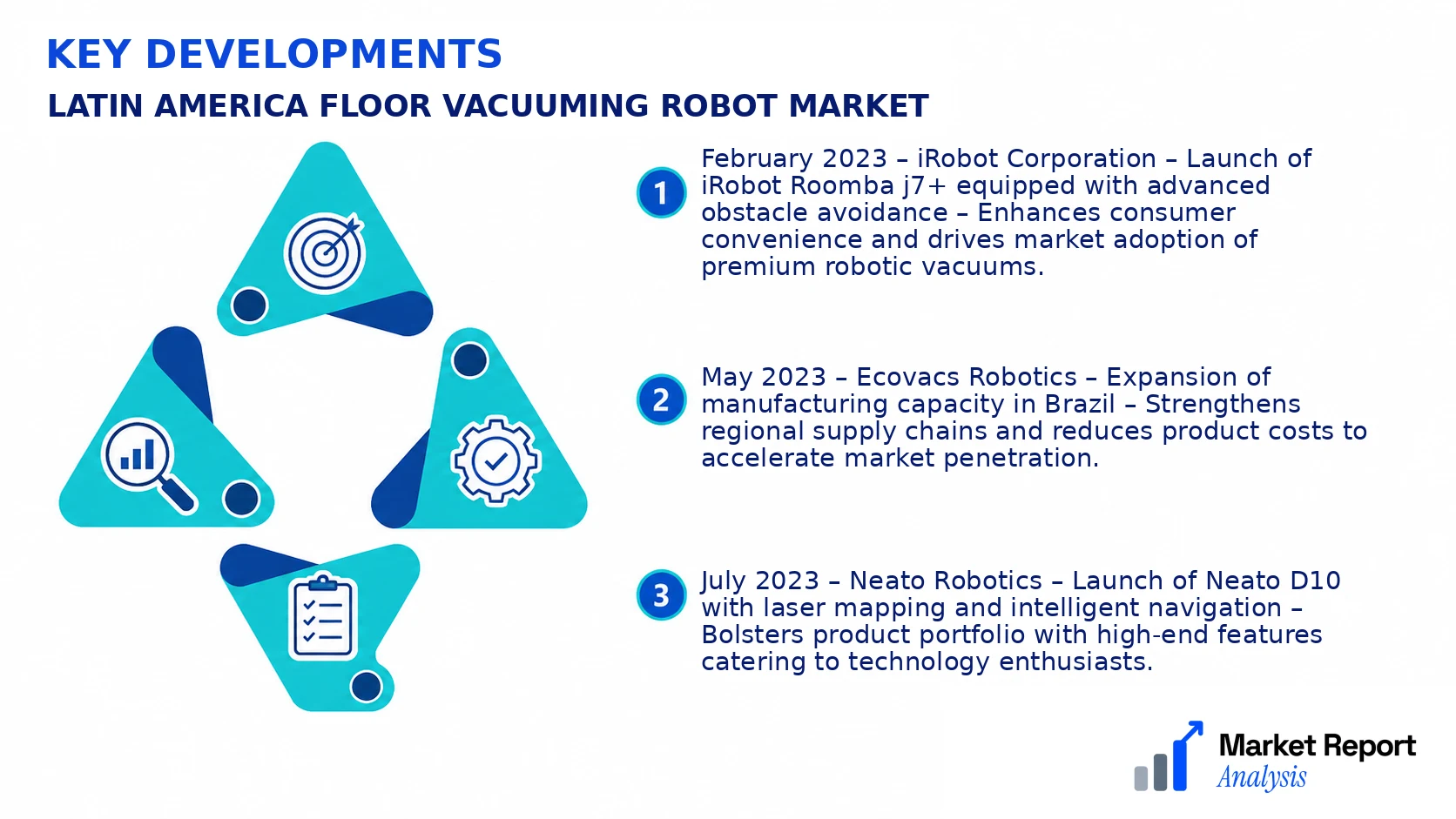
- February 2023 – iRobot Corporation – Launch of iRobot Roomba j7+ equipped with advanced obstacle avoidance – Enhances consumer convenience and drives market adoption of premium robotic vacuums.
- May 2023 – Ecovacs Robotics – Expansion of manufacturing capacity in Brazil – Strengthens regional supply chains and reduces product costs to accelerate market penetration.
- July 2023 – Neato Robotics – Launch of Neato D10 with laser mapping and intelligent navigation – Bolsters product portfolio with high-end features catering to technology enthusiasts.
- September 2023 – Samsung Electronics – Partnership with local smart home providers to embed its robotic vacuums into regional IoT ecosystems – Promotes integrated connected-home solutions.
- December 2023 – Xiaomi Corporation – Introduction of new affordable robotic vacuum models with enhanced AI navigation – Targets budget-conscious consumers seeking smart, reliable cleaning solutions.
Frequently Asked Questions
What is the Latin America Floor Vacuuming Robot Market?
The Latin America Floor Vacuuming Robot Market encompasses the industry involved in the production and commercialization of autonomous robotic devices designed for residential and commercial cleaning on floors. It reflects technological advancements and regional demand for automated cleaning solutions.
What is the current market size of Latin America Floor Vacuuming Robot Market?
As of 2026, the market is valued at approximately USD 2.3 Billion, reflecting increasing adoption rates driven by rising urbanization, tech-savvy consumers, and an expanding middle class seeking convenient cleaning solutions across Latin American countries.
What factors are driving the Latin America Floor Vacuuming Robot Market?
The growth is propelled by rising disposable incomes, urbanization, and evolving consumer preferences for automation and hygiene. Additionally, advancements in AI and sensor technology, coupled with product affordability, significantly contribute to market expansion.
Which region dominates the Latin America Floor Vacuuming Robot Market?
Brazil leads the market due to its large population, higher income levels, and increasing adoption of smart home technologies. Mexico and Argentina also hold significant market shares owing to similar urban growth trends and technological advancements.
Which segment is expected to grow the fastest?
The autonomous robot segment, particularly robotic vacuum cleaners with smart features like app control and AI navigation, is projected to exhibit the highest CAGR, driven by consumer demand for efficiency, connectivity, and ease of use.
Who are the leading companies operating in the Latin America Floor Vacuuming Robot Market?
Leading players include iRobot Corporation, Dyson Ltd., LG Electronics, Xiaomi Corporation, and Samsung Electronics, which are expanding their regional presence through product innovation, strategic partnerships, and increased marketing efforts tailored to Latin American consumers.
Analyst Perspective
The Latin America Floor Vacuuming Robot Market is poised for sustained growth, driven by technological advances and increasing consumer adoption of autonomous cleaning devices. Long-term market prospects appear robust, with the market expected to expand at a CAGR of approximately 10.6% from 2026 to 2034, reaching an estimated USD 5.8 Billion by 2034. Strategic investment should prioritize innovation in navigation, AI integration, and multi-surface capabilities to differentiate offerings in a competitive landscape. Regional growth potential remains high, particularly in Brazil, Mexico, and emerging urban centers across LATAM, where rising disposable incomes and smart home integration trends support uptake. Technological evolution is likely to favor smarter, more autonomous, and energy-efficient models, further boosting consumer interest. Market entrants should consider forming regional partnerships to capitalize on local distribution channels and adapt to regional preferences. Overall, the industry offers lucrative opportunities for differentiation, provided companies accelerate product innovation and regional strategic alignment, amid increasing competitive intensity and evolving consumer demand.
