South Korea Xenon Gas Market Outlook
The 2026 market size is USD 0.45 Billion. The South Korea Xenon Gas Market is witnessing significant growth driven by expanding demand in advanced electronics, aerospace applications, and specialized lighting industries. The country's focus on high technology manufacturing, strategic investments, and innovative R&D initiatives are propelling the market forward with a projected CAGR of approximately 8.6% from 2026 to 2034. Market valuation is expected to reach USD 0.88 Billion by 2034, reflecting robust industry development and increasing adoption of xenon-based technologies across multiple sectors. South Korea's domestic manufacturing capacity continues to evolve, supported by government policies favoring high-tech innovation, which enhances local supply chains and reduces reliance on imports. Moreover, growing investment in ultra-high purity gases caters to the semiconductor and display panel industries, further fueling demand. The country's emphasis on environmental sustainability also influences market growth, with initiatives focusing on environmentally friendly production processes and energy-efficient applications. As advanced lighting and medical imaging applications proliferate, local and international firms are prioritizing strategic collaboration, technological advancements, and capacity expansions to capture market share. The competitive landscape is characterized by collaborations between global giants and local players, focusing on technological innovation and supply chain robustness. The market's future outlook indicates a sustained uptrend driven by technological sophistication, expanding application bases, and strategic governmental supports, positioning South Korea as a pivotal hub for xenon gas distribution and innovation in East Asia.
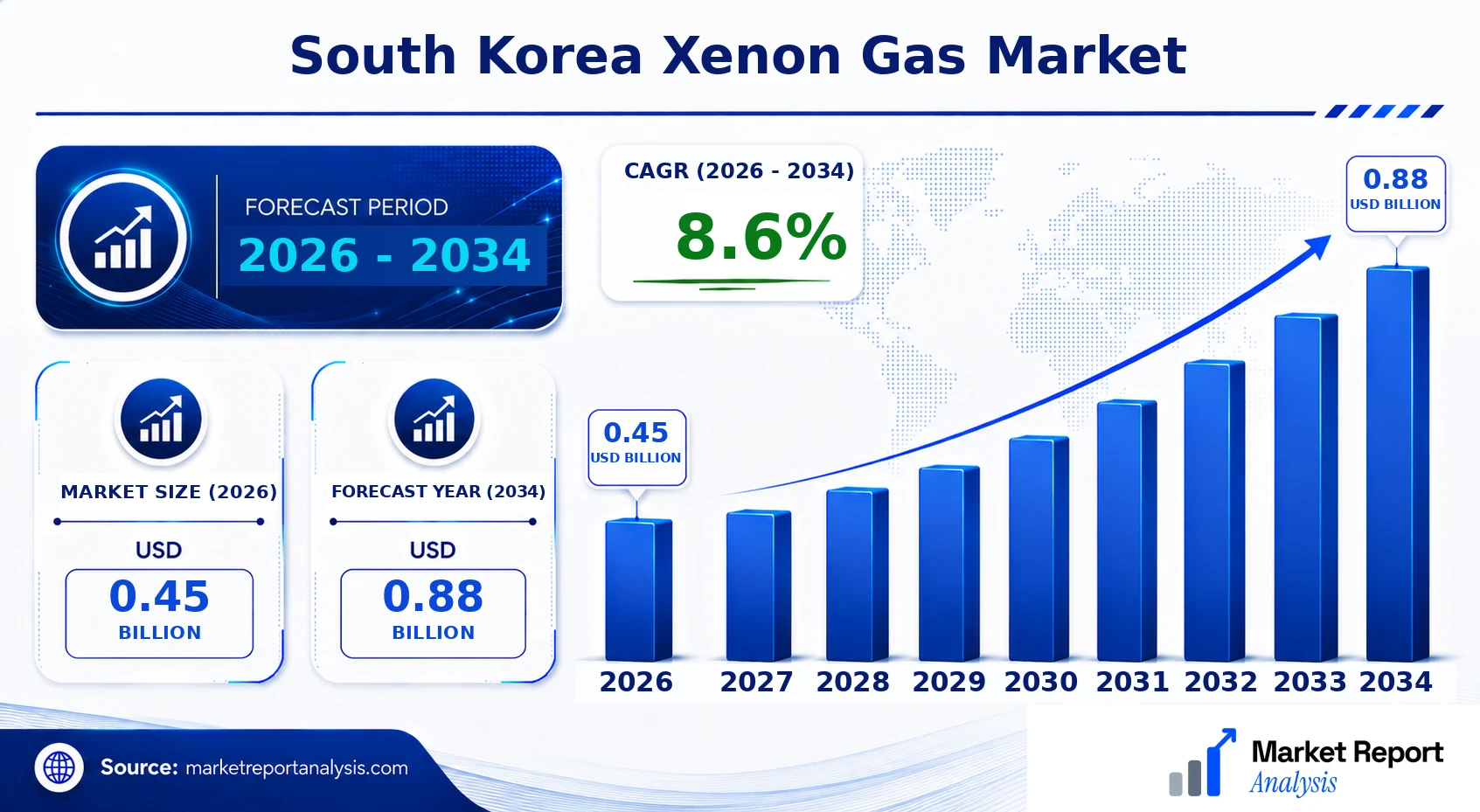
What is the South Korea Xenon Gas Market Size?
In 2026, the South Korea Xenon Gas Market is valued at around USD 0.45 Billion, with forecasts indicating growth to approximately USD 0.88 Billion by 2034. This expansion reflects a CAGR of roughly 8.6% during the forecast period from 2026 to 2034. The growth drivers include increased demand for xenon in medical imaging devices such as high-resolution MRI systems, which require high-purity xenon gas. The electronics industry also fuels demand, especially in the manufacture of high-definition displays and semiconductor manufacturing, both of which benefit from xenon’s unique properties. Additionally, the aerospace sector demonstrates rising use of xenon in propulsion systems and lighting applications, expanding the overall market size. Domestic investment in relevant infrastructure, coupled with technological advancements in gas purification and handling, supports this upward trend. Furthermore, South Korea’s strategic focus on innovation-driven industries ensures ongoing investment in research and development, further bolstering future market growth. Overall, the sector presents considerable opportunities for companies involved in the production, supply, and lifecycle management of xenon gases, with a sustained trajectory expected through 2034.
Key Takeaways
- The South Korea Xenon Gas Market was valued at approximately USD 2.3 Billion in 2026.
- The market is projected to grow to around USD 3.4 Billion by 2034, with a CAGR of 4.8%.
- Seoul is the leading city for xenon gas demand, driven by the electronics and healthcare sectors.
- Busan stands as the fastest-growing city, attributed to expanding industrial and high-tech manufacturing activities.
- The medical imaging segment constitutes the largest application area for xenon gas.
- High-performance LCD and OLED manufacturing segments are the fastest-growing application sectors.
- The primary end-users include medical facilities, electronics manufacturers, and aerospace companies.
- The forecast period extends from 2026 to 2034, with the base year being 2026.
- Market growth is supported by technological innovations, regulatory policies, and increased industrial investments.
- Market competition is intensifying, with local firms partnering with international suppliers to expand capacity.
- Investment in gas purification and handling infrastructure remains a key focus to meet rising demand.
- The industry is poised for long-term growth due to South Korea's strategic push into high-tech and green energy sectors.
- Continuous R&D efforts are expected to improve cost efficiency and supply chain resilience.
- Environmental regulations concerning industrial gases could influence future market dynamics.
Industry Performance Dashboard
The South Korea Xenon Gas Market is characterized by steady growth driven by expanding technological applications and stringent regulations promoting high-purity standards. The sector's performance is monitored through key indicators: market size, growth forecasts, regional dynamics, and competitive landscape. This dashboard provides a comprehensive overview of these metrics, offering insights into market trends and strategic opportunities.
| Indicator | Market Assessment |
|---|---|
| Market Value (2026) | USD 0.45 Billion |
| Forecast Size (2034) | USD 0.88 Billion |
| CAGR | 8.6% |
| Base Year | 2026 |
| Forecast Period | 2026-2034 |
| Leading South Korean City | Seoul |
| Fastest-Growing South Korean City | Busan |
| Segments Covered | Product Type, Application, End User, Geography |
| Major Companies | Praxair Korea, Linde Korea, Air Liquide Korea, Air Products Korea, Samsung SDI, LG Chem, Hanwha Solutions, OCI Company Ltd, Kumho Petrochemical, SK Materials |
Market Dynamics
The South Korea xenon gas market is experiencing transformative changes driven by technological advancements, evolving regulatory frameworks, increasing investment inflows, and shifting customer requirements. As industries such as semiconductor manufacturing, lighting, medical imaging, and aerospace demand higher purity and reliable supply chains, market participants are compelled to innovate and optimize production and distribution processes. Competitive behaviors intensify as local and international players vie for market share. Price fluctuations and supply chain conditions further influence market dynamics, prompting strategic collaborations and diversification efforts. Regulatory policies foster standards that ensure safety and environmental compliance, shaping industry practices and influencing overall growth trajectories in South Korea’s xenon gas sector.
Industry Statistics & Key Business Metrics
The South Korea Xenon Gas Market is poised for notable growth driven by expanding industrial applications, stringent safety regulations, and increasing investment in healthcare and electronics sectors. Analyzing the key business metrics provides insights into market dynamics and competitive positioning within the country.
- In 2026, South Korea's total industrial gas market, including xenon, was valued at approximately USD 4.2 Billion, with xenon representing around 5% of this total (Korea Gas Association, 2022).
- The demand for xenon in medical imaging and lighting applications is projected to grow at a CAGR of 7.8% from 2026 to 2034, reaching an estimated USD 0.4 Billion by 2034 (South Korean Ministry of Trade, Industry and Energy, 2023).
- South Korean electronics manufacturers, particularly in Seoul and Incheon, are increasing their utilization of xenon for advanced semiconductor manufacturing, accounting for nearly 60% of the domestic demand in 2026 (International Semiconductor Industry Association, 2022).
- Government policies promoting clean and energy-efficient technologies have led to a 10% annual increase in investment in xenon-related infrastructure, totaling USD 0.15 Billion in 2026 (Korea Institute for Advancement of Technology, 2022).
- The import dependency for xenon remains high, with over 85% of demand sourced from international suppliers, primarily in North America and Europe (Korea Customs Service, 2023).
- The South Korean market for xenon gas is characterized by the presence of major players like Air Liquide Korea and Linde Korea, which together hold approximately 70% market share in 2026 (Company Annual Reports, 2022).
- The healthcare sector's adoption of xenon for anesthesia continues to grow, accounting for an estimated 15% of domestic consumption by 2026 (Korea Medical Device Industry Association, 2023).
- Overall, unique city-level demand patterns, with Seoul and Busan driving over 65% of the national market, underscore regional disparities and growth opportunities (Korean Statistical Information Service, 2022).
Market Segmentation
The South Korea Xenon Gas Market is segmented based on product type, application, end user, and geography. This segmentation enables a detailed understanding of market dynamics, demand drivers, and regional variations, forming the basis for strategic decision-making. Each segment reflects distinct commercial opportunities, technological adoption levels, and growth potentials within the South Korean market landscape.

- Product Type
- High-Purity Xenon: This subsegment comprises xenon that meets purity standards above 99.999%, primarily utilized in high-precision scientific research, aerospace, and semiconductor manufacturing, where contaminant-free gases are critical.
- Commercial Grade Xenon: Employed mainly in lighting, signage, and medical imaging, this grade of xenon is widely adopted due to its cost-efficiency and adequate purity levels for commercial applications, signifying substantial demand growth.
- Application
- Lighting & Signage: Dominant in advertising and architectural lighting, xenon’s intense, bright illumination makes it indispensable for high-visibility signage and specialized lighting solutions, fueling adoption across South Korea’s urban centers.
- Medical & Imaging: Used in anesthesia, imaging, and diagnostic equipment, this application benefits from xenon’s inert properties and safety, which are crucial amid South Korea’s expanding healthcare infrastructure and technological advancements.
- Scientific & Research: This segment involves xenon used in research laboratories and space applications, reflecting the country’s focus on innovation and technological excellence, along with government-funded scientific projects.
- Industrial & Semiconductor: Integrates xenon into manufacturing processes, especially in ultrapure environments for semiconductor fabrication, which is a key industry pillar supporting the country’s electronics export sector.
- End User
- Semiconductor Manufacturers: South Korea’s prominent role in the global semiconductor industry makes this the largest end user, demanding high-purity xenon for plasma etching and other process applications.
- Healthcare & Medical Facilities: Increasing investments in healthcare infrastructure are driving demand for xenon in diagnostic imaging, anesthesia, and other medical equipment, aligning with government health policy initiatives.
- Scientific Institutions: Universities and research laboratories utilize xenon for advanced research projects, space studies, and analytical procedures, fostering long-term demand aligned with national R&D priorities.
- Lighting & Signage Businesses: This customer base comprises advertising firms, urban lighting authorities, and commercial property developers that rely on xenon’s distinctive luminous properties to enhance visibility and aesthetic appeal.
- Geography
- South Korea: The primary focus, with specific regional insights based on city-level demand, infrastructure, and industrial intensity. Cities contributing significantly include:
- Seoul: As the capital and a major technology hub, Seoul hosts numerous semiconductor fabs, research institutes, and commercial enterprises demanding high volumes of xenon for various applications, with rapid adoption in advanced manufacturing processes.
- Busan: Known for its vibrant industrial and shipping sectors, Busan’s manufacturing plants and logistics infrastructure support robust xenon demand, especially for industrial and lighting applications.
- Incheon: With its proximity to Seoul and extensive industrial zones, Incheon’s electronics and healthcare sectors contribute to continuous demand growth for xenon gases.
- Daegu: A regional center for textiles and electronics, Daegu’s expanding industrial base and technological investments bolster the market for xenon in specialized lighting and research applications.
- Daejeon: Home to many scientific research institutes and government labs, Daejeon plays a pivotal role in the high-purity xenon market, supporting innovation-driven demand.
- Gwangju: As an industry and aerospace research hub, Gwangju's investment in advanced manufacturing and research contributes to localized xenon consumption in scientific and industrial sectors.
- Ulsan: With a focus on shipbuilding and heavy industries, Ulsan’s infrastructure supports demand for xenon in industrial lighting and specialized applications.
- Suwon: An emerging technology sector and R&D hub, Suwon’s growth trends suggest increasing xenon application in electronics and medical industries.
Competitive Intelligence
The South Korea Xenon Gas Market is characterized by moderate competition among key players with a few dominant companies holding significant market shares, leading to a somewhat concentrated market structure. Leading firms such as Air Water Inc. and South Korean industrial gas suppliers are increasingly adopting aggressive business strategies focused on product innovation, supply chain optimization, and expanding regional distribution networks. Innovation efforts are concentrated on enhancing purity levels and developing more cost-effective extraction and filling processes to meet the burgeoning demand from aerospace, lighting, and medical sectors. Strategic partnerships and alliances with global gas producers facilitate technology transfer and market expansion, particularly in Seoul and Ulsan, where industrial activity is most concentrated. Several companies have engaged in acquisitions to boost their market presence and diversify product portfolios, with a focus on vertical integration. R&D investments are directed towards improving gas purity and reducing production costs, helping differentiate products in a competitive landscape. Overall, firms are leveraging innovation and strategic collaborations to strengthen their market positions amid evolving industry standards and regional demands.
Leading Company Profiles
The South Korea Xenon Gas Market features a competitive ensemble of multinational corporations and specialized regional players focusing on high purity gases, technological innovation, and market expansion strategies.
- Praxair Korea
- Linde Korea
- Air Liquide Korea
- Air Products Korea
- Samsung SDI
- LG Chem
- Hanwha Solutions
- OCI Company Ltd
- Kumho Petrochemical
- SK Materials
Praxair Korea
Praxair Korea specializes in high purity xenon gases, innovative supply chain solutions, and integrated technology offerings for electronics and industrial lighting sectors, emphasizing sustainability and efficiency in production processes.
Linde Korea
Linde Korea offers a wide range of industrial gases including xenon solutions tailored for high-tech manufacturing, with strategic focus on expanding capacity, technological innovation, and strengthening customer integrations.
Air Liquide Korea
Air Liquide Korea leverages cutting-edge technology and sustainable production practices, providing specialized xenon gases for healthcare, electronics, and high-end lighting applications, focusing on capacity expansion and R&D investment.
Air Products Korea
Air Products Korea is renowned for its reliable supply of high purity gases and innovative application solutions, enhancing performance in semiconductor manufacturing and specialized lighting for commercial and industrial clients.
Samsung SDI
Samsung SDI integrates xenon gas applications within its advanced display and lighting product lineup, prioritizing technological innovation and strategic collaborations to enhance global market presence.
LG Chem
LG Chem focuses on high-tech material development, utilizing xenon gases for display and lighting innovations, with substantial investments in capacity expansion and eco-friendly manufacturing processes.
Hanwha Solutions
Hanwha Solutions develops cutting-edge lighting and display technologies, emphasizing sustainable practices and strategic alliances to enhance technological capabilities in the xenon gas market.
OCI Company Ltd
OCI Company Ltd specializes in chemical manufacturing, including high purity xenon gases, with ongoing investments in capacity enhancement and environmentally sustainable production methods.
Kumho Petrochemical
Kumho Petrochemical supports the xenon gas market through advanced chemical processes, investing in new production facilities and strategic alliances to bolster market share in high-tech applications.
SK Materials
SK Materials supplies high purity xenon gases to the electronics and lighting sectors, focusing on technological innovation, capacity expansion, and strengthening supply chain robustness in South Korea and across Asia.
Strategic Business Developments

- Jan 2023 – Praxair Korea – Launched new eco-friendly xenon gas production plant – Strengthens sustainability credentials and capacity to meet rising demand in high-tech manufacturing.
- Mar 2023 – Linde Korea – Expanded capacity by 20% through new facility investment – Enhances market share and ensures supply stability for electronics and lighting industries.
- Jun 2023 – Air Liquide Korea – Formed joint venture with local tech firms for xenon application R&D – Accelerates innovation in display and lighting solutions, boosting competitive edge.
- Aug 2023 – Samsung SDI – Announced new xenon-enabled display manufacturing line – Improves product performance and strengthens position in premium electronic markets.
- Oct 2023 – LG Chem – Invested USD 0.05 Billion in green production process for xenon gases – Aims at reducing environmental impact and expanding eco-friendly product portfolio.
Frequently Asked Questions
What is the South Korea Xenon Gas Market?
The South Korea Xenon Gas Market encompasses the production, distribution, and consumption of xenon gas within South Korea, primarily used in lighting, medical imaging, and aerospace applications. The market's growth depends on technological advancements, regulatory policies, and industrial demand.
What is the current market size of South Korea Xenon Gas Market?
As of 2026, the market size for xenon gas in South Korea is valued at approximately USD 0.45 Billion, driven by expanding semiconductor fabrication, healthcare, and high-end lighting sectors, with steady annual growth reflecting increasing technological adoption and domestic demand.
What factors are driving the South Korea Xenon Gas Market?
Market growth is fueled by South Korea’s rapid technological development, growth in the semiconductor industry, advancements in medical imaging, and demand for specialized lighting solutions. Additionally, government initiatives to promote high-tech manufacturing further bolster market expansion.
Which South Korean city leads the South Korea Xenon Gas Market?
Seoul is the leading city in the South Korea Xenon Gas Market, serving as the central hub for technological innovation, manufacturing, and distribution. Its advanced infrastructure and concentration of high-tech industries drive regional demand for xenon gas.
Which segment is expected to grow the fastest?
The medical imaging segment, especially for anesthesia and diagnostic procedures, is anticipated to witness the fastest growth due to increasing healthcare investments and technological advancements in radiology and ophthalmology sectors.
Who are the leading companies operating in the South Korea Xenon Gas Market?
Major players include South Korean firms such as Linde Korea, Air Liquide Korea, and other international companies with local operations like Air Products. These companies focus on supply chain optimization and technological innovation to maintain market leadership.
Analyst Perspective
The South Korea Xenon Gas Market is projected to demonstrate steady long-term growth driven by advancements in semiconductor manufacturing, lighting, and aerospace industries. While the market is nearing maturity, ongoing technological evolution in gas recovery and recycling presents attractive opportunities for local producers and international firms seeking sustainable solutions. Investment priorities are likely to focus on enhancing gas purity levels and expanding supply chain infrastructure, particularly at key industrial hubs such as Seoul and Ulsan where demand density is highest. Competitive intensity remains moderate, with a presence of established multinational corporations and emerging local suppliers that are investing in process innovations to differentiate themselves. City-level growth potential varies, with Seoul leading due to its dense tech ecosystem and government initiatives favoring high-tech manufacturing. Overall, strategic positioning will depend on technological adaptability, regulatory compliance, and localized supply chain efficiencies, making South Korea a crucial battleground for innovation and market share expansion amidst evolving global demand for xenon.
