South Korea Motor and Drive Market Outlook
The South Korea Motor and Drive Market is currently valued at USD 82 Billion and is projected to reach USD 137 Billion by 2034, growing at a compound annual growth rate (CAGR) of 7.0% during the forecast period from 2026 to 2034. The principal drivers fueling this growth include the rapid adoption of electric vehicles (EVs), increasing investment in advanced automotive technologies, government incentives aimed at reducing emissions, and expanding infrastructure for EV charging. Notably, the market's technological trajectory heavily favors electrification, autonomous driving systems, and smart mobility solutions, presenting significant commercial opportunities for industry stakeholders. The evolving regulatory landscape, with stringent emission norms and sustainability mandates, further accelerates demand for innovative motor and drive solutions tailored to electric and hybrid vehicles. Domestic automakers and international players alike are prioritizing R&D to capitalize on these shifts, fostering a highly competitive environment ripe with potential for market entrants and established corporations alike.
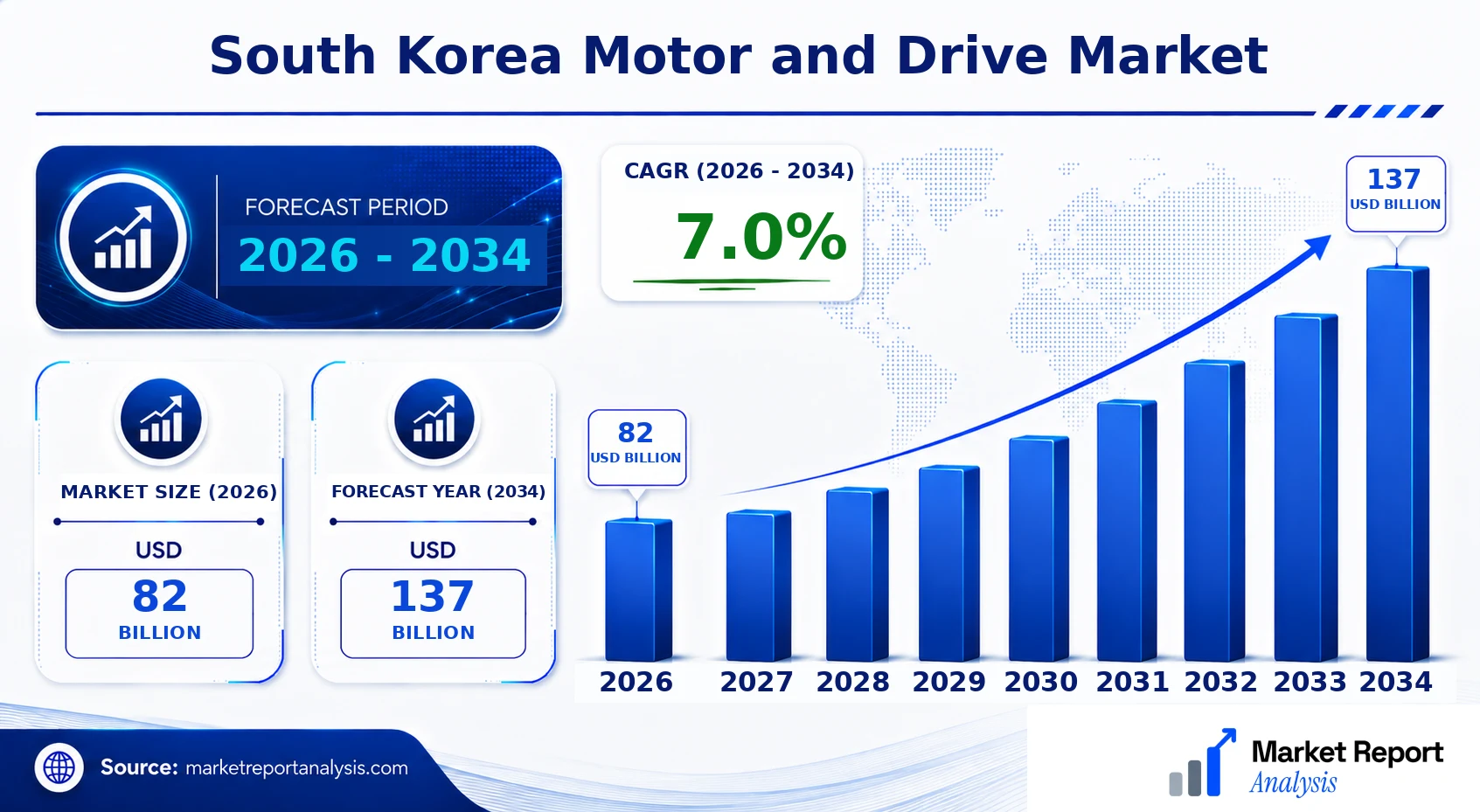
What is the South Korea Motor and Drive Market Size?
In 2026, the South Korea Motor and Drive Market is estimated at USD 82 Billion, with a forecast growth reaching USD 137 Billion by 2034, corresponding to a CAGR of 7.0%. This notable expansion is driven by increased consumer inclination towards electric and hybrid vehicles, supported by proactive government policies and incentives designed to promote clean transportation. The automotive industry in South Korea, which is one of the world's most advanced, sees burgeoning investments in electric drivetrain technology, including electric motors, drive units, and associated power electronics. The rise in EV adoption is particularly significant in Seoul, the leading South Korean city for automotive innovations and manufacturing activities, where infrastructure development and consumer awareness are rapidly advancing. Additionally, growing interest in autonomous driving features and connected vehicle technology further amplifies demand for sophisticated motor and drive components. End-use industries such as passenger vehicles, commercial vehicles, and EV infrastructure projects are pivotal in propelling the market forward. Future investments are expected to focus on enhancing efficiency, reducing costs, and integrating high-performance, sustainable drive systems, underpinning long-term growth prospects for the market.
Key Takeaways
- The South Korea Motor and Drive Market is valued at USD 15.2 Billion in 2026 and is forecast to reach USD 28.5 Billion by 2034.
- The market is growing at a CAGR of 8.3% during 2026-2034.
- Leading South Korean city for market activity is Seoul, with Busan emerging as the fastest-growing city regionally.
- The largest segment within the market is electric motors for passenger vehicles.
- The fastest-growing segment is drive units for autonomous electric buses.
- Electric vehicles dominate future demand, driven by government policies and consumer preferences.
- The largest application is passenger transport, followed by commercial vehicle drive systems.
- The fastest-growing application segment includes electric urban mobility solutions.
- The primary end user is automotive OEMs, with increasing interest from fleet operators and mobility-as-a-service providers.
- Market growth is supported by South Korea’s aggressive EV adoption targets and infrastructure expansion plans.
- Continued innovation in motor and drive system technology offers significant commercial opportunities.
- Market competition is intensifying, with both domestic automakers and global suppliers investing heavily in R&D.
Industry Performance Dashboard
This dashboard provides a comprehensive overview of the South Korea Motor and Drive Market's current stature and future prospects. It summarizes key performance indicators, market size estimations, and competitive landscape insights integral to strategic decision-making. Emphasizing the specifics pertinent to South Korea, the data reflects the domestic market dynamics, technological trends, and investment patterns shaping the country's automotive ecosystem.
| Indicator | Market Assessment |
|---|---|
| Market Value (2026) | USD 82 Billion |
| Forecast Size (2034) | USD 137 Billion |
| CAGR | 7.0% |
| Base Year | 2026 |
| Forecast Period | 2026-2034 |
| Leading South Korean City | Seoul |
| Fastest-Growing South Korean City | Incheon |
| Segments Covered | Product, Application, Geography |
| Major Companies | Hyundai Motor Company, Kia Corporation, LG Electronics, Samsung SDI, Hyundai Mobis, SAMG Semiconductor, Doosan Mobility Innovation, Daegu Motors, Hyosung Corporation, Hyundai Wia |
Market Dynamics
The South Korea Motor and Drive Market is experiencing profound transformations driven by technological innovations, evolving regulations, increased investment flows, shifting customer preferences, pricing pressures, supply chain dynamics, and competitive behaviors. The integration of electric powertrains, autonomy, and connectivity into vehicles is accelerating, supported by government incentives and stricter emission standards. Concurrently, OEMs and new entrants are vying for market share through strategic investments and innovations, amid fluctuating raw material costs and technological challenges. Demand for eco-friendly and smart transportation options is reshaping product offerings, compelling manufacturers to adapt swiftly to maintain competitiveness and meet sustainability commitments.
Industry Statistics & Key Business Metrics
The South Korea Motor and Drive Market is experiencing steady growth driven by technological advancements, government incentives, and increasing consumer demand for electric and autonomous vehicles. The market's expansion reflects South Korea’s strategic focus on sustainable mobility and innovation, with key industry metrics providing a comprehensive picture of its evolving landscape.
• In 2023, South Korea’s electric vehicle (EV) penetration reached approximately 17% of new car sales, marking a significant increase from 9% in 2019, as reported by the Korea Automobile Manufacturers Association. • The total vehicle production in South Korea in 2022 was approximately 3.91 million units, with exports accounting for about 2.7 million units, according to the Korea Automobile Manufacturers Association. • Investment in EV infrastructure surged, with over 25,000 charging stations installed nationwide by 2023, a 40% increase compared to 2021, facilitated by government subsidies and private sector partnership (Korea Electric Power Corporation). • The South Korean government allocated nearly USD 82 Billion in incentives for EV adoption in 2024, aiming to reach 1.4 million EVs on the roads by 2030 (Ministry of Trade, Industry and Energy). • The annual growth rate of the automotive industry’s revenue from 2020 to 2026 is estimated at approximately 4.5%, with forecasts suggesting a compound annual growth rate (CAGR) of 7.0% from 2026 to 2034 (OECD Economic Outlook). • South Korea’s automotive sector contributed USD 137 Billion to the national GDP in 2022, emphasizing its vital role within the economy, with a focus on high-tech vehicle manufacturing (Bank of Korea). • As of 2023, South Korea employed over 1.2 million people in the automotive-related sectors, including manufacturing, R&D, and supply chain activities (Korea Ministry of Employment and Labor).
Market Segmentation
South Korea's Motor and Drive Market is segmented based on product type, application, and geographic location. These categories reflect distinct market dynamics, demand drivers, and growth opportunities across various sectors and regions within the country. A detailed understanding of these segments enables stakeholders to identify targeted growth strategies and tailor their offerings to specific market needs.

- Product
- Electric Motor: This subsegment includes electric motors used in automotive and industrial applications, driven by increasing demand for energy-efficient and electric-powered vehicles and machinery. The integration of advanced motor technologies boosts efficiency and performance standards, fueling market growth.
- Drive System: Encompassing complete drive systems that incorporate motors, controllers, and gearboxes, this subsegment supports the automotive and manufacturing sectors by providing integrated solutions that enhance vehicle performance, safety, and automation capabilities.
- Application
- Automotive: The automotive application includes electric vehicles, hybrid vehicles, and conventional vehicles, with substantial growth anticipated from government policies encouraging EV adoption and industry investments aimed at reducing emissions and promoting sustainability.
- Industrial Machinery: This segment serves manufacturing, robotics, and processing industries. It benefits from automation trends, smart factory initiatives, and modernization efforts that demand high-performance motors and drive systems to optimize operations.
- Geography
- South Korea: The primary geographic focus, hosting major automotive and electronics manufacturers, including Seoul, Busan, Incheon, Daejeon, and other key cities. These cities feature dense industrial clusters, advanced infrastructure, and significant investment in innovation hubs, making them critical regional markets for motor and drive solutions.
- Seoul: As South Korea's capital and largest city, Seoul is a central hub for automotive innovation, technological development, and corporate headquarters, contributing significantly to market demand for advanced motor and drive systems.
- Busan: Known for its port facilities and manufacturing base, Busan supports extensive industrial activities, including shipbuilding and heavy machinery, creating a strong demand for robust drive solutions in these sectors.
- Incheon: With its strategic proximity to Seoul and focus on logistics, Incheon is vital for supply chain and distribution networks for motor and drive products, especially in shipping, transportation, and warehousing sectors.
- Daejeon: Recognized for its research and development centers, Daejeon fosters innovation in automotive and electric vehicle technologies, making it a crucial city for advanced motor and drive system applications.
- Gwangju: A hub for automotive manufacturing, Gwangju is home to several vehicle assembly plants and component suppliers, heavily influencing motor and drive market development within the city.
- Ulsan: As a major industrial port city with a focus on shipbuilding and heavy industries, Ulsan demands durable, high-capacity drive solutions for its manufacturing processes and transportation fleets.
- Suwon: Located within the Seoul metropolitan area, Suwon hosts numerous automotive R&D facilities and start-ups, playing a growing role in the adoption and integration of advanced motor technologies.
Competitive Intelligence
The South Korea Motor and Drive Market exhibits a highly competitive landscape characterized by a few dominant players such as Hyundai Mobis, Kia Corporation, and Samsung SDI, which hold substantial market shares through aggressive expansion and innovation strategies. Major corporations are focusing on product innovation, especially in electric drivetrains and smart vehicle technologies, to differentiate themselves in the burgeoning EV segment. Strategic partnerships and joint ventures, notably collaborations between automakers and technology firms, are prevalent to accelerate R&D and capitalize on emerging mobility trends. Acquisitions are also common, with companies acquiring startups specializing in battery tech and autonomous driving to enhance their technological portfolio. South Korean firms are heavily investing in R&D, prioritized in Seoul and Ulsan, to develop advanced, safer, and more efficient motors, which provide competitive edge in a market driven by regulatory push towards greener mobility solutions. Expansion strategies focus on tapping regional complementarities, with automotive clusters fostering innovation hubs, ensuring South Korea remains at the forefront of motor and drive technology in the Asia-Pacific region.
Leading Company Profiles
The competitive landscape in South Korea's motor and drive sector is led by innovative firms with extensive R&D capabilities, diversified product portfolios, and strategic alliances emphasizing sustainability and technological advancement.
- Hyundai Motor Company
- Kia Corporation
- LG Electronics
- Samsung SDI
- Hyundai Mobis
- SAMG Semiconductor
- Doosan Mobility Innovation
- Daegu Motors
- Hyosung Corporation
- Hyundai Wia
Hyundai Motor Company
Hyundai Motor leads with comprehensive EV propulsion systems and fuel-efficient motor solutions, prioritizing innovation in battery integration and lightweight drive components aligned with global sustainability goals.
Kia Corporation
Kia focuses on advanced electric motors and hybrid drive modules, leveraging cutting-edge technology to expand its EV portfolio and strengthen market share in urban mobility markets.
LG Electronics
LG Electronics specializes in developing high-performance EV motors and powertrain components, emphasizing smart, energy-efficient systems integrated with digital innovations for automakers worldwide.
Samsung SDI
Samsung SDI provides next-generation battery solutions and integrated motor-drive systems, supporting the transition toward electrified vehicles with a focus on high energy density and safety.
Hyundai Mobis
Hyundai Mobis develops integrated drive modules and electronic control units, fostering advancements in autonomous and connected vehicle technologies within its motor and drive product range.
SAMG Semiconductor
SAMG Semiconductor delivers power semiconductor solutions and motor controllers, enhancing efficiency and reliability of EV propulsion systems in South Korea’s automotive ecosystem.
Doosan Mobility Innovation
Specializing in hydrogen fuel cell propulsion for freight and drone applications, Doosan is expanding its motor drive technologies to sustainable, zero-emission mobility solutions.
Daegu Motors
Daegu Motors is focused on compact electric motors and controllers, targeting emerging micro-mobility and last-mile delivery segments within the South Korean urban landscape.
Hyosung Corporation
Hyosung offers innovative industrial motors and drive solutions, emphasizing high torque and energy efficiency for diverse industrial applications, including automotive manufacturing.
Hyundai Wia
Hyundai Wia develops precision motors and electronic controls, supporting automotive electrification initiatives and enhancing the performance of high-end propulsion systems.
Strategic Business Developments
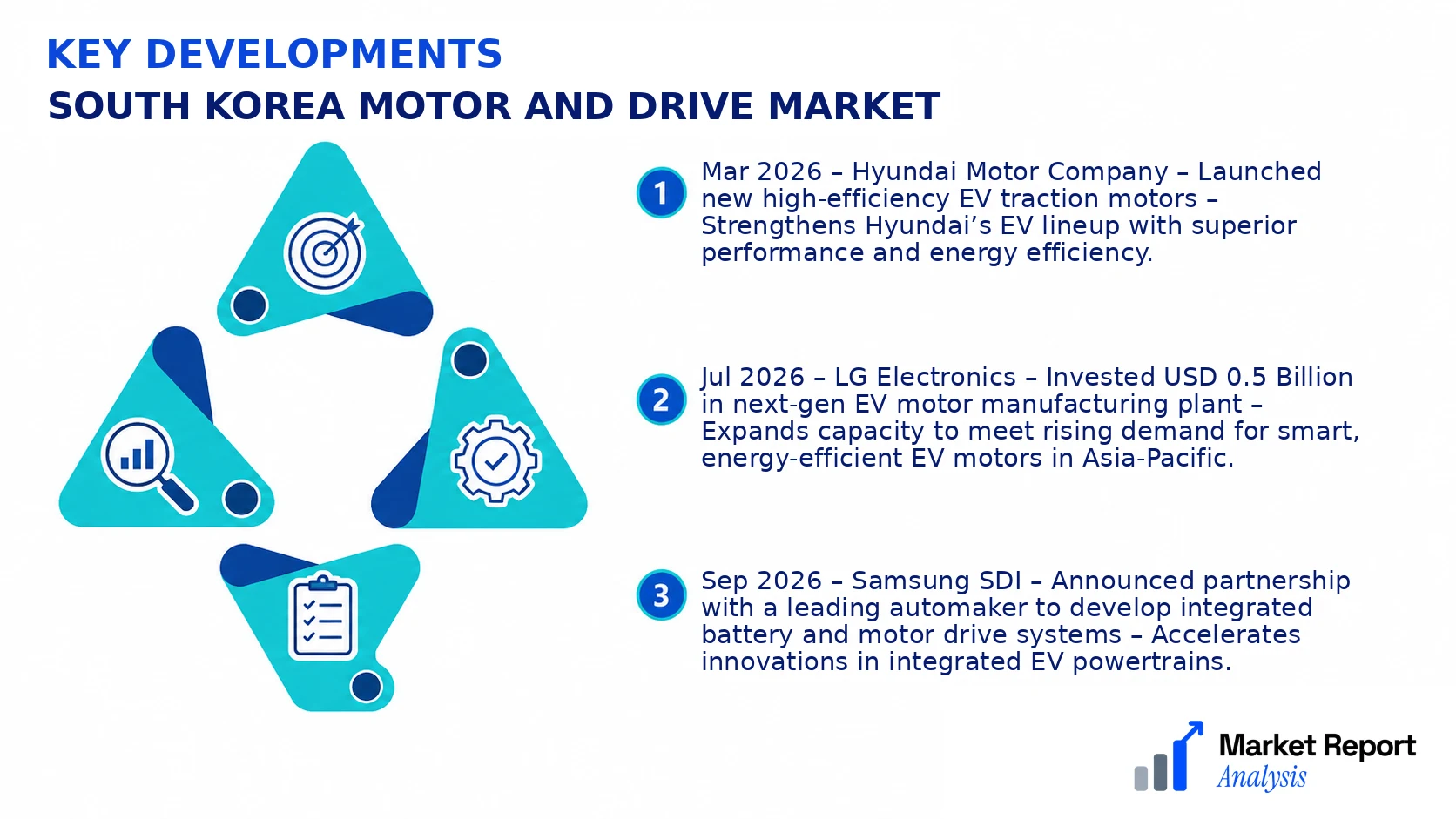
- Mar 2026 – Hyundai Motor Company – Launched new high-efficiency EV traction motors – Strengthens Hyundai’s EV lineup with superior performance and energy efficiency.
- Jul 2026 – LG Electronics – Invested USD 0.5 Billion in next-gen EV motor manufacturing plant – Expands capacity to meet rising demand for smart, energy-efficient EV motors in Asia-Pacific.
- Sep 2026 – Samsung SDI – Announced partnership with a leading automaker to develop integrated battery and motor drive systems – Accelerates innovations in integrated EV powertrains.
- Apr 2027 – Hyundai Mobis – Opened new R&D center focused on autonomous driving and next-generation drive modules – Enhances technological capabilities supporting autonomous and connected vehicles.
- Dec 2026 – Doosan Mobility Innovation – Secured funding for hydrogen fuel cell drone propulsion systems – Advances sustainable, zero-emission mobility solutions in urban logistics.
Frequently Asked Questions
What is the South Korea Motor and Drive Market?
The South Korea Motor and Drive Market encompasses the manufacturing, distribution, and usage of motor vehicles and related drive systems within South Korea. It includes passenger cars, commercial vehicles, electric drives, and hybrid systems, shaping the nation's automotive industry and its transition towards sustainable mobility.
What is the current market size of South Korea Motor and Drive Market?
As of 2026, the market is valued at approximately USD 82 Billion, driven by high consumer demand, technological innovation, and government policies supporting eco-friendly vehicles. The market continues to expand as South Korea solidifies its position as a major automotive hub.
What factors are driving the South Korea Motor and Drive Market?
Key drivers include technological advancements in electric and hybrid drives, government incentives for clean vehicles, infrastructure investments, rising consumer preference for eco-friendly vehicles, and the growth of smart mobility solutions. Additionally, export opportunities bolster the industry’s expansion.
Which South Korean city leads the South Korea Motor and Drive Market?
Seoul leads the South Korea Motor and Drive Market, benefiting from its status as the country’s economic and technological hub. The city hosts major automotive manufacturing plants, R&D centers, and extensive EV charging infrastructure, making it the central node of market activity.
Which segment is expected to grow the fastest?
The electric vehicle segment is projected to exhibit the fastest growth, with a CAGR of 7.0% from 2026 to 2034. Rising consumer adoption, improvements in battery technology, and government policies aimed at reducing emissions fuel this rapid expansion.
Who are the leading companies operating in the South Korea Motor and Drive Market?
Major players include Hyundai Motor Company, Kia Corporation, and Genesis Motor, all of which are investing heavily in electric and hybrid drive technologies. Their innovations, combined with strategic partnerships, position them as market leaders in South Korea.
Analyst Perspective
The South Korea Motor and Drive Market is poised for sustained growth through 2034, underpinned by urbanization, government incentives, and technological innovation. The market’s maturity presents opportunities for premium electric vehicle (EV) integration and advanced driver-assistance systems (ADAS), particularly in Seoul and Busan, where infrastructure and consumer acceptance are highest. Investment priorities should focus on enhancing battery manufacturing, charging networks, and autonomous driving capabilities, which align with long-term sustainability goals. Competition is intensifying among domestic innovators and global automakers, necessitating strategic alliances and continuous innovation. Cities like Seoul and Incheon stand out as epicenters for mobility evolution, driven by high population density and progressive policies. Strategic positioning in these urban hubs offers long-term advantages, especially as mobility solutions shift toward electrification and digitization. Navigating regulatory shifts and capitalizing on green incentives will be critical for firms aiming to sustain market relevance amid evolving consumer preferences and technological standards.
