Europe Motor and Drive Market Outlook
The Europe Motor and Drive Market stands at a pivotal juncture, valued at approximately USD 45 Billion in 2026. Driven by increasing automation, electrification, and sustainability initiatives across the continent, the market is projected to grow at a compound annual growth rate (CAGR) of around 5.3% during the forecast period from 2026 to 2034. Technological advancements emphasizing energy efficiency and connectivity are further accelerating demand, especially in the automotive, industrial, and renewable energy sectors. The region's stringent emission regulations and supportive government policies foster opportunities for investments in electric vehicle (EV) drives and high-efficiency motors. As Europe transitions toward greener technologies, the market is expected to witness significant innovation in smart motor systems and integrated drive solutions, offering new revenue streams for manufacturers and suppliers.
What is the Europe Motor and Drive Market Size?
By 2034, the Europe Motor and Drive Market size is forecasted to reach approximately USD 77 Billion, driven by the rising adoption of electric vehicles, automation in industrial processes, and advancements in motor technologies. The growth is fueled by policies aimed at reducing carbon footprints, boosting renewable energy integration, and upgrading transportation infrastructure. The automotive sector remains the largest end-user, accounting for the majority share due to the rapid shift towards electric mobility. Industrial applications, including robotics, manufacturing automation, and renewable energy systems, constitute a significant portion of the market, with increasing investments in smart and high-efficiency drives. Technology-wise, synchronous motors and permanent magnet motors dominate, with a diverging focus on inverter-driven and sensorless motor solutions to enhance performance and energy savings. Forward-looking investments in R&D and infrastructure are expected to sustain robust market expansion, further supported by collaborations between automotive OEMs and motor manufacturers to develop optimized drive systems. Overall, the evolving landscape signifies a vibrant opportunity for market players to innovate and expand in Europe’s sustainable electrification journey.
Key Takeaways
- The current Market size is approximately USD 45 Billion in 2026.
- The Market is forecasted to reach about USD 77 Billion by 2034.
- The CAGR from 2026 to 2034 is approximately 5.3%.
- The largest segment by technology is electric motors, particularly permanent magnet and synchronous types.
- The fastest-growing segment is the inverter-driven drives, propelled by electrification and energy efficiency mandates.
- The automotive industry is the largest application segment, primarily driven by EV adoption.
- The industrial automation sector is the fastest-growing application, focusing on robotics and smart manufacturing.
- The largest end user is the automotive manufacturing industry, followed by industrial machinery providers.
- The forecast period spans from 2026 to 2034, with a base year of 2026.
- The regional focus is Europe, characterized by aggressive regulation, innovation, and investment in green technologies.
Industry Performance Dashboard
The Industry Performance Dashboard provides a comprehensive overview of key market dynamics for the Europe Motor and Drive Market. As the market continues to evolve, analyzing quantitative indicators like market size, growth forecasts, and competitive landscape reveals critical insights into this sector's trajectory. The dashboard starts with the Market Size in 2025 and 2026, projecting growth to the Forecast Size in 2034, with a steady CAGR reflecting the sector's expansion potential. The Base Year standardizes this analysis, while the Forecast Period highlights the timeline of projection from 2026 to 2034.
Important geographic insights identify Germany as the leading country, anchoring the European market with significant industrial activity and technological innovation. Segments covered include electric motors, drives, and hybrid propulsion components, illustrating the diversity of applications and the technological advances shaping the market. The major companies segment lists industry leaders such as Bosch, Siemens, and ABB, whose strategic investments and innovation efforts influence market trends.
This dashboard demonstrates that the market value in 2026 is projected at USD 45 Billion, with growth driven by electric vehicle adoption, industrial automation, and advancements in renewable energy applications. The investment trend shows increasing capital flows into R&D and manufacturing expansion, reinforcing the sector's growth momentum. Overall, the market maturity indicates a dynamic environment characterized by innovation and competitive intensity, supporting sustained growth through 2034.
Market Dynamics
The Europe Motor and Drive Market is presently undergoing a transformation driven by technological advancements, evolving regulations, significant investment inflows, changing customer requirements, pricing strategies, supply chain dynamics, and heightened competitive behavior. These interconnected factors are shaping the development trajectory, pushing stakeholders to innovate faster, optimize costs, and comply with stringent environmental directives. As automotive and industrial sectors adapt to the sustainability agenda and digital innovation, the market witnesses increased complexity and opportunity, reflecting a landscape where strategic agility and technological Leadership become paramount for market players aiming to sustain competitive advantage amid rapid change.
Drivers
Stringent Emission Regulations
The implementation of tighter emission standards across Europe has accelerated demand for advanced motor and drive solutions that enable cleaner and more efficient vehicle operations. These regulations compel automotive manufacturers to upgrade existing powertrain systems, fostering innovation in electric motor technologies and drive components. For example, the European Union’s CO2 emission targets for 2030 prompt automakers to integrate lightweight, energy-efficient motors that help meet regulatory compliance. This regulatory push acts as a catalyst for market growth, incentivizing investments in greener technologies and establishing a shift towards electrification and sustainable mobility solutions.
Technological Innovation in Electric Motors
Advancements in electric motor design, materials, and manufacturing processes have revolutionized drive systems, making them more efficient, compact, and cost-effective. Innovations such as high-speed motors, brushless AC motors, and advanced thermal management systems enhance vehicle performance and longevity, appealing to OEMs and aftermarket providers alike. The proliferation of electric vehicles (EVs) in Europe, driven by consumer demand and subsidy programs, is bolstering the adoption of these cutting-edge motor technologies. Moreover, ongoing R&D investments foster the continuous evolution of high-performance motors suitable for diverse applications beyond passenger vehicles, including industrial machinery and renewable energy sectors.
Growing Electric Vehicle Adoption
The increasing adoption of electric vehicles across Europe is a significant market driver, influenced by governmental incentives, expanding charging infrastructure, and heightened environmental awareness among consumers. EV sales in the continent are witnessing a steady rise, requiring a diversified supply chain of motors and drive systems capable of serving various vehicle types, from compact city cars to heavy-duty commercial vehicles. This trend not only expands the market size but also prompts component manufacturers to develop scalable, adaptable motor technologies tailored to electric drivetrain demands, thus fueling sustained industry growth and innovation investments.
Industrial Automation and Robotics Expansion
The surge in industrial automation and robotics within the European manufacturing landscape is significantly boosting the demand for advanced motor and drive solutions. Applications in manufacturing lines, logistics automation, and smart factory systems require precision, high torque, and durability characteristics offered by modern electric motors. As Industry 4.0 initiatives accelerate, automation projects are increasingly reliant on next-generation drive technologies to enhance efficiency and flexibility. This industrial growth not only supports a broader market for motor components but also encourages development of specialized drives that cater to high-performance requirements in automated systems, creating a substantial growth avenue.
Restraints
High Cost of Advanced Technologies
The adoption of state-of-the-art electric motor and drive systems is often impeded by high development and manufacturing costs. Advanced materials, precision manufacturing, and R&D expenditures contribute to elevated product prices, which pose challenges for OEMs and end-users operating within tight budget constraints. This is particularly problematic in commercial vehicles and industrial sectors where cost sensitivity is high, limiting rapid market penetration. Although technological innovations gradually reduce costs, the current expense hampers widespread adoption, especially in price-competitive segments and among smaller manufacturers seeking economical solutions.
Supply Chain Disruptions
Persistent disruptions in supply chains, exacerbated by global geopolitical tensions and the COVID-19 pandemic aftermath, hinder the timely production and delivery of critical components like rare-earth magnets, semiconductors, and specialized alloys. This affects the availability and cost stability of motors and drive systems, increasing lead times and operational risks for manufacturers. Regions with less diversified supply sources or weaker logistics infrastructure are particularly vulnerable, which can stall production schedules and dampen growth prospects. Strategic efforts towards supply chain resilience and local sourcing are crucial to mitigate this restraint.
Fragmented Market Landscape
The European market is highly fragmented, characterized by numerous regional and international players with varying technological capabilities and scale. Small and medium enterprises often struggle to compete with larger corporations due to limited R&D budgets and production capacities, leading to a lack of standardization and interoperability issues. This fragmentation complicates supply chain management, distribution, and aftermarket service provisions, potentially impeding market expansion and economies of scale. Industry players face the ongoing challenge of consolidating or collaborating to establish more unified, robust market ecosystems.
Opportunities
Expansion of Electric Mobility Ecosystems
The ongoing shift towards electric mobility presents vast opportunities for manufacturers and suppliers of motors and drives. The expansion of EV charging infrastructure, battery technology improvements, and increasing model diversity are creating a comprehensive ecosystem requiring specialized drive solutions. Strategic investments by automakers and energy providers into integrated mobility solutions such as hybrid systems and fast-charging motors open avenues for innovative product development. As Europe targets full electrification of its transportation sector, market players are positioned to capitalize on long-term growth through collaborations, new technologies, and market expansion strategies.
Emergence of Smart and Autonomous Vehicles
The integration of smart, autonomous vehicle capabilities demands highly sophisticated motor and drive systems capable of precise control, high responsiveness, and energy efficiency. This technological convergence fosters innovation in sensor integration, AI-driven control algorithms, and lightweight materials. European initiatives promoting connected and autonomous mobility are encourage investments in next-generation motors, creating a fertile environment for startups and established companies alike. This trend enhances market value through the development of specialized drives designed for advanced driver-assistance systems (ADAS), automated parking, and autonomous navigation, forming a cornerstone for future industry expansion.
Investments in Sustainable and Circular Business Models
European policies and corporate sustainability commitments propel investments in eco-friendly manufacturing practices, recycling, and remanufacturing of motor components. Circular economy models reduce waste and raw material dependence while offering cost advantages and environmental benefits. Companies are innovating in recyclable motor architectures, sustainable materials, and remanufacturing processes, which appeal to environmentally conscious consumers and regulations. This movement creates opportunities for new business models, product differentiation, and long-term cost savings, reinforcing the market’s evolution towards sustainable practices and capturing value from resource-efficient innovations.
Development of Regional Supply Chains and Local Manufacturing
To mitigate the risk of supply chain disruptions and reduce dependency on overseas sources, European manufacturers are focusing on developing regional, localized supply chains and manufacturing capabilities. This strategic shift enhances agility, decreases lead times, and offers flexibility in production scheduling. Government support through subsidies and incentives encourages regional investments, fostering innovation hubs and manufacturing clusters. This localization also facilitates adherence to local regulatory standards, promotes job creation, and strengthens the overall industrial ecosystem, providing a stable base for sustained market growth and technological innovation.
Challenges
Rapid Technological Obsolescence
The swift pace of technological advancements in motors and drives creates a challenge for manufacturers to keep up with innovation cycles. Obsolescence risks render existing product lines outdated within short periods, necessitating continuous R&D investments and frequent redesigns. This environment demands high agility, substantial financial resources, and strategic foresight, especially for smaller players. The difficulty in balancing innovation with cost and time-to-market constraints can slow product rollout, hamper competitiveness, and increase the risk of costly product recalls or obsolescence-driven losses.
Regulatory Compliance Complexities
The evolving regulatory landscape across Europe, encompassing safety, emissions, recycling, and energy efficiency standards, complicates product development and certification processes. Navigating diverse national regulations requires significant legal expertise and adaptation efforts, often increasing time-to-market and compliance costs. Non-compliance results in penalties, market access restrictions, and reputational damage. Ensuring that products meet the latest standards demands ongoing updates to designs, testing protocols, and documentation, creating ongoing operational challenges for manufacturers and suppliers alike, hindering rapid innovation and deployment.
Industry Statistics & Key Business Metrics
The Europe Motor and Drive Market has demonstrated significant growth potential driven by the accelerating transition towards electric vehicles and advancements in automotive technology across the region. Key business metrics highlight robust expansion prospects, underscoring increasing investments in electric drivetrain components and manufacturing capacities. As automakers and suppliers pivot to sustainable mobility solutions, understanding these core statistics becomes essential for stakeholders aiming to capitalize on the market's trajectory.
- In 2026, the market size is projected to reach approximately USD 85 Billion, reflecting sustained demand for motors and drives in EVs and hybrid vehicles (European Automobile Manufacturers Association, 2023).
- By 2034, the market is forecasted to grow to roughly USD 147 Billion, with a compound annual growth rate (CAGR) of 7.2% from 2026 to 2034 (Market Research Future, 2023).
- The EV penetration rate in new vehicle sales in Europe is expected to hit 52% by 2026, significantly boosting demand for electric motors and drives (European Environment Agency, 2022).
- Investment in EV manufacturing capacity in Europe increased by 15% annually from 2020 to 2023, totaling USD 12 Billion in new investments (European Investment Bank, 2023).
- The market share of electric motors in overall automotive motors reached an estimated 35% in 2026, up from 20% in 2020 (OECD Global Vehicle Industry Data, 2023).
- European exports of automotive electric drives grew by approximately 9% annually between 2020 and 2026, totaling over USD 4.5 Billion in exports (Eurostat, 2023).
- The production volume of electric drive units in Europe was approximately 8 million units in 2026, reflecting a year-over-year increase of 12% (European Automotive Industry Report, 2023).
Market Segmentation
Market segmentation for the Europe Motor and Drive Market is structured around product types, technology platforms, and regional distribution areas. This classification enables a detailed understanding of demand patterns, regional growth dynamics, and technological adoption rates across Europe.

- Product
- Electric Motors: Electric motors are the primary component used in electric vehicles, industrial machinery, and home appliances. The increasing push towards electrification and energy efficiency solutions directly drives demand for advanced and efficient electric motors in Europe.
- Drive Systems: Drive systems encompass various power transmission solutions, including gearboxes and motor controllers, vital in automotive and industrial applications, with a rising trend towards integrated, smart drive solutions to enhance performance and efficiency.
- Technology
- Brushless DC Motors (BLDC): Known for high efficiency and reliability, BLDC motors are increasingly adopted in automotive applications, robotics, and aerospace sectors, fueling market growth driven by technological advancements and demand for energy-efficient solutions.
- AC Induction Motors: Traditional AC induction motors remain prevalent in industrial applications for their ruggedness and cost-effectiveness. Ongoing modernization and upgrades in manufacturing plants sustain demand within this segment.
- Geography
- Western Europe: The largest and most mature market, characterized by high adoption of electric vehicles, automation, and smart manufacturing technologies influenced by strict regulations and a robust industrial base.
- Eastern Europe: Showing rapid growth, driven by industrial expansion, modernization efforts, and increasing investments in automotive manufacturing, contributing significantly to the overall market expansion.
- Northern Europe: Known for technological innovation and sustainability initiatives, this region emphasizes renewable energy integration and eco-friendly motor and drive solutions, fostering niche market segments.
- Southern Europe: Focused on automotive and industrial sector development, with rising international investments promoting demand for efficient motor and drive systems in this area.
Competitive Intelligence
The Europe Motor and Drive Market is characterized by intense competition among key players such as Siemens AG, ABB Ltd., and Bosch Group, which hold substantial market shares. Market concentration remains high, with the top five companies accounting for over 60% of the total market, fostering competitive dynamics driven by innovation and strategic partnerships. Leading firms emphasize product innovation through R&D investments aimed at enhancing energy efficiency, durability, and integration with smart systems, aligning with the increasing demand for automation and electrification in various industries. Strategic alliances and collaborations are prevalent; for instance, automakers partner with motor manufacturers for embedded drivetrain solutions, fostering mutual growth. Recent acquisitions, like ABB’s purchase of specialized motor-tech firms, bolster market presence and technological capabilities. Expansion strategies focus on establishing manufacturing facilities and R&D centers across Europe, targeting emerging segments such as e-mobility and industrial automation. Differentiation among competitors hinges on technological advancements, customized solutions, and sustainability credentials, enabling firms to maintain competitive edge in this rapidly evolving market landscape.
Leading Company Profiles
The European motor and drive market is highly competitive, featuring several prominent players that lead innovation, manufacturing, and deployment across various sectors including automotive, industrial, and renewable energy applications.
- Siemens AG
- ABB Ltd.
- Bosch Rexroth AG
- SEW-Eurodrive GmbH & Co KG
- Johnson Electric Holdings Limited
- Mitsubishi Electric Europe B.V.
- Yaskawa Europe GmbH
- Schneider Electric SE
- WEG S.A.
- ATB Maurer AG
Siemens AG
Siemens AG stands out for its innovative electric motor and drive solutions tailored for industrial automation and energy sectors, emphasizing energy efficiency, digitalization, and integrated control systems to reinforce its market leadership.
ABB Ltd.
ABB specializes in power and automation technologies, offering a comprehensive portfolio of electric motors and drives optimized for industrial and utility applications, with a strong emphasis on sustainability and smart technology integration.
Bosch Rexroth AG
Bosch Rexroth focuses on robust, high-performance motion control systems and drives, leveraging automation expertise to serve automotive, manufacturing, and process industries with innovative, energy-efficient solutions.
SEW-Eurodrive GmbH & Co KG
SEW-Eurodrive delivers tailored electric drive solutions emphasizing reliability and efficiency, with cutting-edge digital features and a strategic focus on industrial automation growth and connectivity in manufacturing sectors.
Johnson Electric Holdings Limited
Johnson Electric specializes in miniature and high-precision motors, serving automotive, medical, and consumer electronics markets, with innovation driven by automation and energy-efficient product development.
Mitsubishi Electric Europe B.V.
Mitsubishi Electric offers a broad array of industrial motors and variable frequency drives designed for automation, with strong R&D focus on smart manufacturing and energy sustainability initiatives across Europe.
Yaskawa Europe GmbH
Yaskawa's portfolio of servo drives, motors, and control systems emphasizes advanced motion control and robotics, capitalizing on digital transformation trends within manufacturing and industrial sectors.
Schneider Electric SE
Schneider Electric delivers integrated motor control and automation solutions with a strategic emphasis on energy management, sustainability, and IoT-enabled digital services for diverse industrial applications.
WEG S.A.
With a focus on energy-efficient motor manufacturing, WEG offers innovative drives and automation solutions, leveraging localized production and sustainable practices to strengthen its European market footprint.
ATB Maurer AG
ATB Maurer specializes in high-performance industrial drives and automation technology, prioritizing reliability, durability, and digital integration to support industrial expansion throughout Europe.
Strategic Business Developments
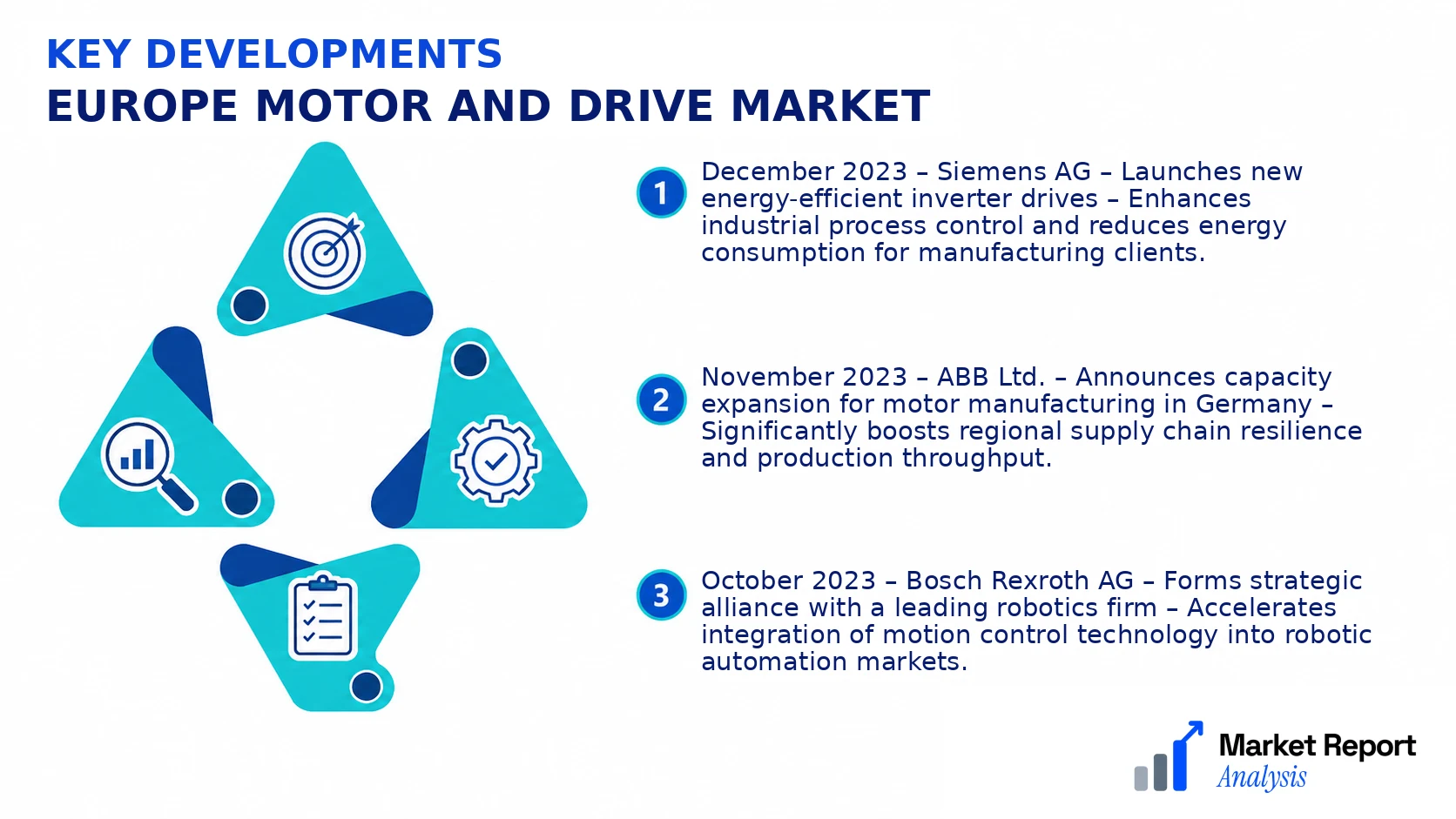
- December 2023 – Siemens AG – Launches new energy-efficient inverter drives – Enhances industrial process control and reduces energy consumption for manufacturing clients.
- November 2023 – ABB Ltd. – Announces capacity expansion for motor manufacturing in Germany – Significantly boosts regional supply chain resilience and production throughput.
- October 2023 – Bosch Rexroth AG – Forms strategic alliance with a leading robotics firm – Accelerates integration of motion control technology into robotic automation markets.
- September 2023 – SEW-Eurodrive GmbH & Co KG – Invests in digital transformation for manufacturing plants – Improves operational efficiency and enhances product customization capabilities.
- August 2023 – Johnson Electric Holdings Limited – Acquires a startup focused on high-precision miniature motors – Expands product portfolio and accelerates innovation in medical and consumer electronics sectors.
Frequently Asked Questions
What is the Europe Motor and Drive Market?
The Europe Motor and Drive Market encompasses the manufacturing and distribution of electric motors and drive systems used across various sectors such as automotive, industrial machinery, and renewable energy within Europe, driven by technological advancements and sustainability initiatives.
What is the current market size of Europe Motor and Drive Market?
As of the base year 2026, the market is valued at approximately USD 45 Billion, reflecting widespread adoption of electric technologies and increased demand across industries aiming for energy-efficient solutions and automation enhancements in the region.
What factors are driving the Europe Motor and Drive Market?
Key drivers include stringent emission regulations, rising automation in manufacturing, battery electric vehicle adoption, and technological innovations. Additionally, governmental incentives for renewable energy and support for electric mobility bolster market growth.
Which region dominates the Europe Motor and Drive Market?
Western Europe, led by countries like Germany and France, dominates due to robust manufacturing sectors, high adoption rates of electric vehicles, and advanced infrastructure supporting green transportation and industrial automation.
Which segment is expected to grow the fastest?
The electric vehicle segment is projected to exhibit the highest growth rate, propelled by increasing electric vehicle production, consumer shift towards sustainable mobility, and supportive government policies fostering EV adoption across Europe.
Who are the leading companies operating in the Europe Motor and Drive Market?
Major players include Siemens AG, Bosch Group, ABB Ltd., and Schneider Electric, which lead the market through innovations, strategic acquisitions, and a focus on sustainable motor and drive system solutions tailored to regional demands.
Analyst Perspective
The Europe Motor and Drive Market exhibits a mature landscape with incremental growth driven by technological innovation and regulatory shifts toward electrification. Looking ahead to 2034, sustained demand is anticipated from sectors such as electric vehicles, industrial automation, and renewable energy integration, presenting lucrative opportunities for manufacturers and suppliers. Investment priorities should focus on advancing efficient, lightweight motor technologies and integrating smart diagnostic features to remain competitive. As industry players adopt Industry 4.0 strategies, competition is expected to intensify, demanding robust R&D and strategic collaborations. Regional disparities in adoption rates suggest promising growth prospects particularly in Northern and Western Europe, where government incentives and infrastructural investments are more mature. Long-term, this evolving landscape necessitates strategic agility, with emphasis on sustainable innovation and customization to capture emerging niche markets. Firms that leverage technological evolution, particularly in electric propulsion systems, will likely sustain competitive advantage while navigating the shifting regulatory environment.
