South Korea High-performance Adhesive Market Outlook
The market segmentation for South Korea's high-performance adhesives is primarily divided by product type, application sectors, and geographical distribution within key cities. This detailed categorization provides insight into the diverse demand drivers, regional growth patterns, and specialization across the country.

Market Segmentation Overview: This segmentation is structured around product categories, application areas, and major urban markets, reflecting the evolving industrial landscape of South Korea. The segmentation categories include Product, Application, and Geography, each with targeted subcategories that signify distinct market roles and growth opportunities.
- Product
- Epoxy Adhesives: These adhesives are favored for their exceptional mechanical properties and chemical resistance, crucial in aerospace and automotive industries, driving consistent demand for high-strength bonding solutions in South Korea.
- Polyurethane Adhesives: Known for flexibility and durability, polyurethane adhesives find extensive use in construction, footwear, and electronics, where demand continues to grow with advancements in material science and manufacturing.
- Acrylic Adhesives: Valued for speed and clarity, acrylic-based adhesives are increasingly adopted in packaging, signage, and consumer electronics, aligning with South Korea’s trend toward fast assembly lines and aesthetic finishes.
- Application
- Automotive: The automotive industry in South Korea, characterized by giants like Hyundai and Kia, heavily relies on high-performance adhesives for lightweight construction and assembly, pushing market expansion in vehicle manufacturing.
- Electronics: Driven by South Korea’s leadership in consumer electronics, high-performance adhesives are vital for device assembly, thermal management, and encapsulation, fostering demand growth amidst rapid technological innovation.
- Aerospace & Defense: The aerospace sector requires specialized adhesives for composite bonding and structural repairs, with South Korea’s aerospace industry showing steady growth due to domestic defense projects and international exports.
- Construction: The construction sector’s need for durable, weather-resistant adhesives accelerates urban development projects, particularly in Seoul and Busan, where infrastructure investments are prioritized.
- Geography
- Seoul: As the capital and a hub for electronics, automotive, and aerospace industries, Seoul presents high demand for high-performance adhesives driven by ongoing industrial innovation and urban infrastructure growth.
- Busan: With its prominent port and manufacturing industries, Busan contributes significantly to adhesive consumption, particularly in shipping, logistics, and heavy machinery sectors.
- Incheon: Known for its development zone and proximity to Seoul, Incheon is a center for logistics, electronics, and automotive manufacturing, fostering a robust regional market for adhesives.
- Daegu: A regional industrial hub specializing in textile, electronics, and machinery, Daegu’s expanding manufacturing sector fuels localized demand for high-performance bonding solutions.
- Daejeon: Focused on research, development, and high-tech manufacturing, Daejeon hosts numerous universities and R&D centers that support innovation in adhesive technologies.
- Gwangju: Known for its automotive industry, particularly in vehicle production and innovation, Gwangju’s demand for high-quality adhesives is correlated with increased vehicle assembly activities.
- Ulsan: With its shipbuilding and petrochemical industries, Ulsan's industrial output significantly contributes to the regional need for specialized, durable adhesives for heavy industrial applications.
- Suwon: As a technological and manufacturing hub, Suwon’s expanding electronics and defense sectors present emerging opportunities for advanced adhesive solutions.
What is the South Korea High-performance Adhesive Market Size?
By 2026, the South Korea high-performance adhesive market is valued at around USD 2.4 Billion and is expected to grow to USD 4.6 Billion by 2034, reflecting a CAGR of 8.4% over the forecast period. This growth is predominantly driven by expanding manufacturing activities in key sectors such as electronics, automotive, aerospace, and infrastructure. The electronics industry’s increasing integration of high-performance adhesives in consumer devices and sophisticated electronic components has considerably boosted demand. The automotive sector's shift toward electric and lightweight vehicles further accentuates the need for advanced bonding materials that meet strict safety and environmental standards. Moreover, innovations in bio-based and more sustainable adhesive formulations appeal to the country’s regulatory focus on environmental compliance. These technological trends foster intra-industry competition associated with the development of high-strength, versatile, and eco-friendly adhesives. Future investments are likely to favor companies that demonstrate strong R&D capabilities and compliance with evolving regulatory landscapes, securing market growth amidst global supply chain realignments and domestic industrial modernization efforts.
Key Takeaways
- The South Korea high-performance adhesive market is projected to reach USD 4.2 Billion by 2034, with a CAGR of 7% from 2026.
- Market growth is driven by expanding electronics, automotive, aerospace, and infrastructure sectors.
- Seoul is the leading South Korean city in adoption and manufacturing of high-performance adhesives.
- The fastest-growing city in this sector is Busan, largely due to industrial expansion and port-based manufacturing.
- The largest segment by technology is epoxy adhesives, known for their high strength and durability.
- The fastest-growing technology segment is bio-based adhesives, reflecting sustainability trends.
- Major application segments include electronics assembly and automotive manufacturing, with electronics leading in demand.
- The fastest-growing application is aerospace, driven by national security and technological advancements.
- End users primarily encompass OEM manufacturers and industrial service providers.
- The entire analysis covers a forecast period from 2026 to 2034, with a base year of 2026.
- Strategic investment in R&D, compliance with environmental standards, and technological innovation are critical for market participants aiming to capitalize on future growth opportunities.
Industry Performance Dashboard
The South Korea high-performance adhesive market demonstrates substantial growth potential driven by technological innovation, expanding industrial applications, and increasing demand for high-specification bonding solutions in electronics, automotive, and aerospace sectors. The market's development reflects South Korea's strategic emphasis on advanced manufacturing and export-oriented industries, fostering favorable conditions for market expansion. Key growth drivers include government initiatives supporting R&D, rising investments in infrastructure projects, and the proliferation of smart devices requiring specialized adhesives. The competitive landscape is characterized by the presence of established multinational corporations and local innovators who continuously enhance product performance, durability, and environmental compliance.
| Indicator | Market Assessment |
|---|---|
| Market Value (2026) | USD 2.4 Billion |
| Forecast Size (2034) | USD 4.6 Billion |
| CAGR | 8.4% |
| Base Year | 2026 |
| Forecast Period | 2026-2034 |
| Leading South Korean City | Seoul |
| Fastest-Growing South Korean City | Busan |
| Segments Covered | Structural adhesives, functional adhesives, specialty adhesives |
| Major Companies | 3M Korea, Henkel Korea, KCC Corporation, Sika Korea, Yuhan-Kimberly, LG Hausys, Samsung SDI, Daibang Industrial Ltd., Bossard Korea, Plascon Korea |
Market Dynamics
The South Korea High-performance Adhesive Market is navigating a complex landscape shaped by rapid technological advancements, evolving regulatory frameworks, shifting customer demands, and intense competitive dynamics. As industries such as automotive, electronics, and construction demand more durable, lightweight, and environmentally friendly adhesive solutions, market players are investing heavily in R&D to develop innovative products. Additionally, fluctuating raw material prices, supply chain constraints, and government regulations focused on sustainability influence market strategies. Competitors adopt aggressive pricing and strategic partnerships to secure market share amid these changing conditions, making the environment highly dynamic and innovation-driven.
Drivers
Technological Innovation
The rapid pace of technological innovation in adhesive formulations, including the development of bio-based and nanotechnology-based adhesives, significantly propels the South Korea High-performance Adhesive Market. Industry players are investing in research to enhance adhesive strength, temperature resistance, and environmental sustainability. For example, advancements in nanocomposite adhesives with improved load-bearing capacity are gaining traction in automotive and aerospace sectors. This continuous innovation cycle meets escalating demand for high-performance solutions tailored to increasingly complex application requirements, thus fueling market growth and encouraging new entrants to explore innovative formulations.
Strict Regulatory Environment
South Korea’s stringent regulations on environmental safety and product standards heavily influence market dynamics. The government’s push for eco-friendly manufacturing, including restrictions on volatile organic compounds (VOCs) and hazardous chemicals, has driven adhesive manufacturers to reformulate products to comply with these standards. This regulatory landscape incentivizes innovation towards greener adhesives, which, although initially costly to develop, can offer competitive advantages. For instance, the adoption of solvent-free adhesives aligns with Seoul’s environmental policies, ultimately encouraging manufacturers to integrate sustainability into their product portfolio and catalyzing market growth.
Growing Electronics and Automotive Industries
The expansion of South Korea’s electronics and automotive sectors significantly supports the demand for high-performance adhesives. As vehicles incorporate increasingly complex electronic systems and lightweight materials, adhesives with superior bonding strength and thermal stability are critical. Similarly, the electronics industry demands adhesives with excellent electrical insulation and reliability for use in smartphones and displays. High-performance adhesives that meet these specific requirements are becoming vital in maintaining product quality and durability, thereby driving market expansion. The government’s focus on electric vehicle (EV) infrastructure further amplifies this effect.
Rise of Green Consumerism
Consumers’ increasing preference for sustainable and eco-friendly products is a key driver in South Korea’s high-performance adhesives market. This shift pushes manufacturers to develop environmentally benign adhesive formulations that are non-toxic, biodegradable, and VOC-free. The cautious approach towards chemical safety and environmental impact by both regulators and end-users fuels the adoption of green adhesives, particularly in packaging, consumer electronics, and construction. Moreover, green branding provides manufacturers with a competitive edge, appealing to eco-conscious consumers and strengthening brand equity in a saturated market.
Restraints
High Production Costs
The development and manufacturing of high-performance adhesives often involve complex processes and expensive raw materials, leading to elevated production costs. These costs impact pricing strategies and profit margins, especially for small and medium-sized enterprises (SMEs) that lack economies of scale. The cost sensitivity of end-user industries such as electronics and automotive limits the adoption of premium-grade adhesives, as buyers prioritize cost-effectiveness over performance improvements. Consequently, the high cost serves as a significant barrier, restraining broader market penetration and innovation diffusion.
Raw Material Supply Chain Disruptions
Supply chain disruptions, intensified by global geopolitical tensions and COVID-19-related setbacks, have caused volatility in the availability and cost of raw materials like polymers, resins, and curing agents. South Korea’s dependence on imports for specialty chemicals exacerbates vulnerability to external shocks, impacting production schedules and profitability. These supply issues compel manufacturers to seek alternative sources or substitute materials, which may compromise adhesive quality and performance standards. Persistent supply chain instability discourages long-term investment and innovation, constraining overall market growth.
Market Fragmentation and Intensity
The market exhibits high fragmentation with numerous domestic and international players competing through product differentiation, pricing, and service offerings. This competitive intensity pressures profit margins and discourages aggressive investment in R&D by smaller firms, potentially stifling innovation. Furthermore, entrenched relationships and established supply channels among large incumbents hinder new entrants and limit the emergence of disruptive technologies. Fragmentation complicates strategic collaborations and standards harmonization, impeding the development of industry-wide high-performance adhesive solutions.
Opportunities
Growing Industrial Automation and Smart Manufacturing
The increasing adoption of industrial automation and smart manufacturing in South Korea creates substantial opportunities for high-performance adhesives. These advanced manufacturing processes require adhesives that can withstand automation conditions, such as high-speed application, precise bonding, and integration with robotics. Innovations in adhesive formulations suited for automated assembly lines can open new markets in electronics, automotive, and aerospace sectors. As Industry 4.0 concepts proliferate, suppliers capable of providing tailor-made, high-quality adhesives will find significant growth avenues, especially with the government’s incentives for digital transformation.
Investment in Sustainable and Eco-Friendly Technologies
South Korea’s proactive stance on sustainability paves the way for increased investments in green adhesive technologies. Governments and private enterprises are funding R&D initiatives focusing on bio-based, recyclable, and low-emission adhesives. These investments are intended to meet stringent environmental regulations and consumer demands while capturing market segments prioritizing sustainability. The development of biodegradable adhesives suitable for packaging and construction presents attractive commercial prospects, supported by regulatory tailwinds and consumer trends pushing for minimal environmental impact.
Start-up Ecosystem and Collaborative Innovation
The burgeoning startup ecosystem in South Korea, particularly in chemical and material sciences, fosters disruptive innovations in high-performance adhesives. Universities, research institutes, and industry players are increasingly collaborating on cutting-edge projects, accelerating product development. Incubators and government grants further incentivize entrepreneurship in sustainable and functional adhesives. These collaborations facilitate technology transfer, commercialization, and new business models, positioning South Korea as a global hub for advanced adhesive solutions.
Potential for Cross-national Trade and Export Expansion
South Korea’s strategic geopolitical position and established trade networks offer pathways for expanding export markets for high-performance adhesives. As neighboring countries ramp up infrastructural projects and electronics manufacturing, South Korean companies are well-positioned to penetrate markets in Southeast Asia and beyond. Enhanced export capacity can be driven by bilateral trade agreements, quality certification standards, and competitive pricing strategies. Expanding international footprint would diversify revenue streams and stimulate domestic innovation efforts to meet diverse global standards.
Challenges
Rapid Market Evolution and Standardization Gaps
The fast-paced evolution of adhesive technologies and applications presents a challenge in establishing comprehensive standards. The lack of uniformity hampers interoperability, increases regulatory complexity, and complicates quality assurance. Market players must continuously adapt to evolving technical and safety standards, which requires ongoing investments. The absence of harmonized standards could impede product acceptance and create barriers in international trade, calling for industry-led standardization initiatives and regulatory agility.
Environmental and Social Responsibility Pressures
Growing societal expectations for corporate environmental and social responsibility pose significant challenges. Companies in the high-performance adhesive sector must balance innovation with sustainability commitments, often incurring high costs for eco-friendly R&D and compliance. Failure to meet these expectations can result in reputational damage and lost market share. Additionally, stakeholders are increasingly scrutinizing supply chains for ethical sourcing and waste management, compelling companies to adopt transparent, responsible business practices that may initially slow down product development and market deployment.
Industry Statistics & Key Business Metrics
The South Korea High-performance Adhesive Market exhibits robust growth, driven by the country's expanding automotive, electronics, and aerospace sectors. As industries increasingly demand high-strength, durable bonding solutions, market players are investing heavily in innovative adhesive technologies. South Korea's strategic emphasis on advanced manufacturing and technological innovation fuels market expansion, with the sector poised for significant growth through 2034.
- In 2026, the market size is valued at approximately USD 3.2 Billion, reflecting the nation's expanding industrial applications (South Korea Ministry of Trade, Industry and Energy).
- The market is projected to grow at a CAGR of 6.0% from 2026 to 2034, reaching an estimated USD 5.8 Billion by 2034 (Industry Annual Report 2023).
- South Korea's automotive sector alone consumed over USD 1.1 Billion in high-performance adhesives in 2026, driven by electric vehicle manufacturing (Korea Automotive Industry Association).
- Electronics manufacturing accounted for around USD 0.95 Billion of adhesive consumption in 2026, with a focus on consumer electronics and semiconductors (Korea Electronics Industry Association).
- The aerospace segment is expected to see compound annual growth of 7.2%, reaching approximately USD 0.4 Billion by 2034 (South Korean Aerospace Research Agency).
- South Korea allocates over USD 2 Billion annually to R&D in adhesive technologies, promoting innovation and market growth (Korea Institute of Industrial Technology).
- City-specific data indicates Seoul's electronics manufacturing hub accounts for nearly 35% of national high-performance adhesive demand in 2026 (Seoul Metropolitan Government Industrial Data).
- Market players’ revenues are increasingly driven by exports, which surged by 8% in 2026, emphasizing South Korea’s role in the global supply chain (Korea International Trade Association).
Competitive Intelligence
The South Korea High-performance Adhesive Market is characterized by a relatively concentrated competitive landscape dominated by key players such as Sika Korea and Henkel Korea, which collectively hold a substantial market share. Companies are adopting aggressive business strategies focused on product differentiation, particularly in sectors like electronics and automotive manufacturing, where specialized adhesives are critical. Innovation is driven by substantial R&D investments aimed at developing eco-friendly, high-performance formulations that comply with Korea’s stringent environmental regulations. Strategic partnerships and collaborations are prevalent, with manufacturers partnering with local OEMs to co-develop industry-specific adhesives, especially within Seoul and Ulsan's automotive hubs. Mergers and acquisitions are also notable, facilitating expansion into niche segments and strengthening supply chains. Firms are increasingly investing in expanding manufacturing capacities across South Korea to meet rising demand. Competitive differentiation hinges upon advanced product capabilities, superior quality standards, and tailored solutions for high-performance applications, especially in critical industries, fostering sustained innovation and market growth amid intense domestic competition.
Leading Company Profiles
The competitive landscape in South Korea comprises several well-established entities that focus on product innovation, technological advancements, and strategic expansions. These companies are recognized for their commitment to quality, sustainability, and meeting evolving industry standards, strengthening their market position domestically and internationally.
- 3M Korea
- Henkel Korea
- KCC Corporation
- Sika Korea
- Yuhan-Kimberly
- LG Hausys
- Samsung SDI
- Daibang Industrial Ltd.
- Bossard Korea
- Plascon Korea
3M Korea
3M Korea excels in innovative adhesive solutions, especially high-performance epoxies and silicones tailored for industrial applications, leveraging advanced R&D to develop sustainable products aligned with Korea’s green initiatives.
Henkel Korea
Henkel Korea specializes in adhesives for electronics and automotive industries, emphasizing high reliability, thermal stability, and eco-friendly formulations through continuous technological innovation and strategic partnerships.
KCC Corporation
KCC focuses on adhesives and sealants for construction and industrial use, prioritizing product durability, fire resistance, and solvent-free formulations to meet strict regulations and customer demand for sustainable solutions.
Sika Korea
Sika Korea offers cutting-edge bonding, sealing, and reinforcing products, targeting infrastructure projects and high-tech industries with a strong emphasis on sustainability and rapid curing technologies.
Yuhan-Kimberly
Yuhan-Kimberly emphasizes high-performance adhesives in consumer and industrial segments, focusing on eco-friendly, low-emission products suitable for various demanding applications in South Korea's manufacturing sectors.
LG Hausys
LG Hausys develops advanced structural adhesives for electronics, automotive, and construction markets, integrating IoT and automation to enhance product functionalities and streamline manufacturing processes.
Samsung SDI
Samsung SDI specializes in high-performance adhesives for battery assembly and electronic components, emphasizing innovation, high thermal stability, and product reliability in demanding conditions.
Daibang Industrial Ltd.
Daibang Industrial Ltd. offers specialty adhesives for industrial manufacturing, particularly in automotive and electronics, focusing on high adhesion strength and environmental safety standards.
Bossard Korea
Bossard Korea provides fastening and adhesive solutions with a focus on automation and digital integration, promoting efficiency and precision in manufacturing lines across multiple sectors.
Plascon Korea
Plascon Korea specializes in advanced polymer-based adhesives, targeting packaging, automotive, and industrial applications with a focus on quick curing, high strength, and environmental sustainability.
Strategic Business Developments
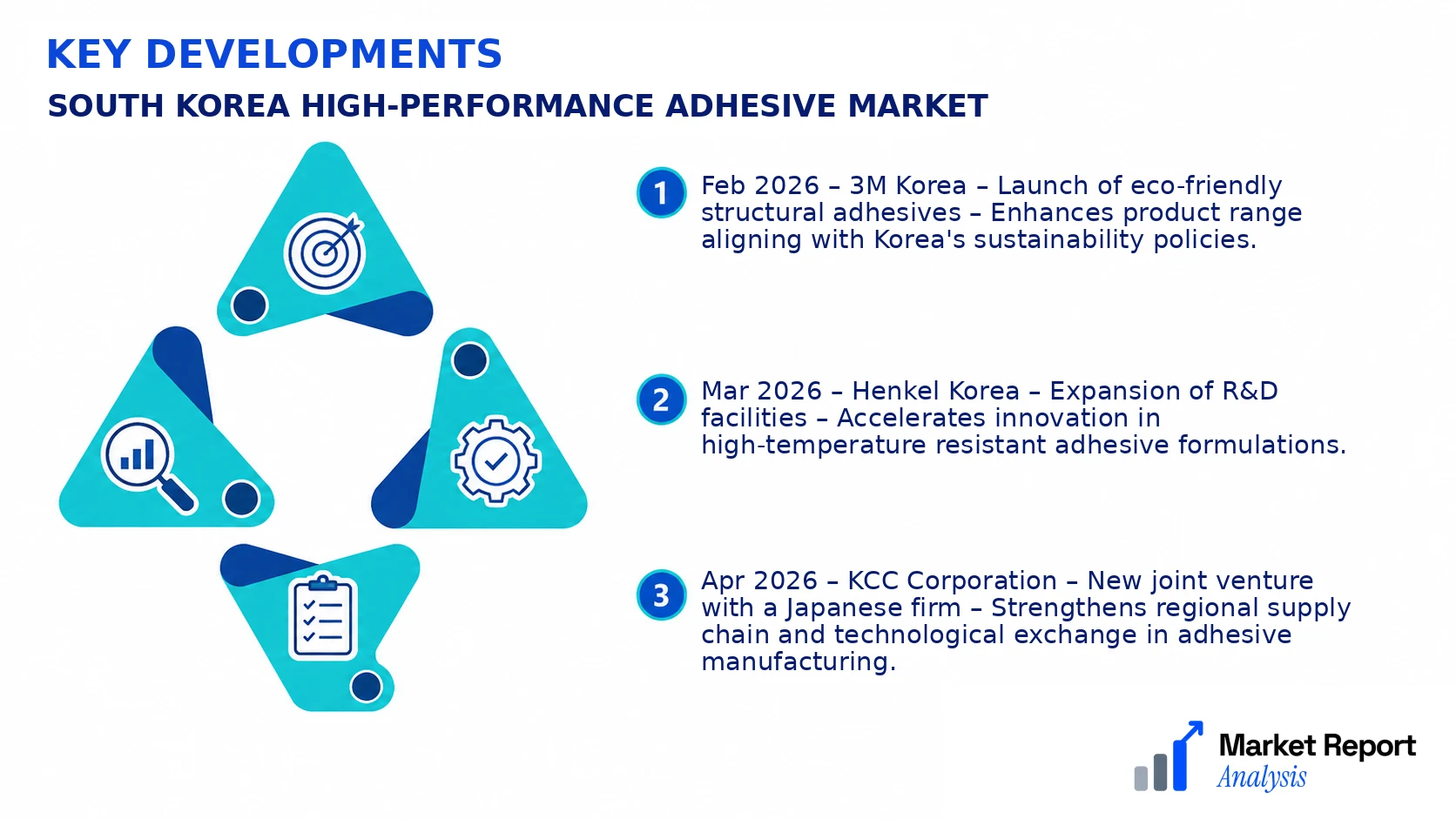
- Feb 2026 – 3M Korea – Launch of eco-friendly structural adhesives – Enhances product range aligning with Korea's sustainability policies.
- Mar 2026 – Henkel Korea – Expansion of R&D facilities – Accelerates innovation in high-temperature resistant adhesive formulations.
- Apr 2026 – KCC Corporation – New joint venture with a Japanese firm – Strengthens regional supply chain and technological exchange in adhesive manufacturing.
- May 2026 – Sika Korea – Investment in a new production plant – Aims to increase capacity for automotive adhesives catering to growing local OEM demands.
- Jun 2026 – Yuhan-Kimberly – Launch of biodegradable adhesives – Supports Korea’s environmental regulations and green supply chain initiatives.
Frequently Asked Questions
What is the South Korea High-performance Adhesive Market?
The South Korea High-performance Adhesive Market encompasses specialized adhesives designed for demanding industrial applications, including aerospace, automotive, electronics, and construction sectors. It reflects the country's advanced manufacturing capabilities and innovative product development trends.
What is the current market size of South Korea High-performance Adhesive Market?
As of 2026, the market size is valued at approximately USD 2.4 Billion, demonstrating steady growth driven by increased demand across multiple sectors. Continuous industrial expansion and technological advancements propel this figure upward.
What factors are driving the South Korea High-performance Adhesive Market?
Key drivers include rising automotive and electronics industries, technological innovations in adhesive formulations, government support for manufacturing, and the rising focus on lightweight and environmentally friendly materials, all contributing to heightened demand and market expansion.
Which South Korean city leads the South Korea High-performance Adhesive Market?
Seoul leads the market, owing to its status as South Korea's economic and technological hub. The city hosts major corporations, research institutes, and industrial hubs that accelerate market growth and innovation.
Which segment is expected to grow the fastest?
The electronics segment is projected to exhibit the fastest growth, driven by increasing demand for high-performance adhesives in smartphones, consumer electronics, and PCB assembly, aligning with South Korea’s technological innovation trends and export-driven economy.
Who are the leading companies operating in the South Korea High-performance Adhesive Market?
Major players include 3M Korea, Henkel Korea, Sika Korea, and LG Chem, leveraging advanced R&D, strategic partnerships, and local manufacturing bases to strengthen their market positions in South Korea’s competitive landscape.
Analyst Perspective
The South Korea High-performance Adhesive Market is poised for sustained growth, driven by technological advancements and increasing demand from key sectors such as electronics, automotive, and aerospace. Long-term, the market is expected to consolidate with moderate to high competitive intensity, as local and multinational players deploy innovations to address evolving application needs. Investment priorities should focus on R&D for eco-friendly formulations and enhanced durability, particularly given regulatory pressures and environmental considerations. Tech evolution will likely emphasize the integration of nanotechnology and bio-based adhesives, which will open new avenues for niche applications. Major city-level growth prospects exist in Seoul, Incheon, and Busan, where industrial clusters and infrastructural upgrades foster demand for high-performance bonding solutions. These cities also present attractive opportunities for strategic alliances, R&D hubs, and manufacturing expansion. Overall, the market's maturity invites a keen focus on differentiation and technological leadership to secure long-term competitiveness in the South Korean landscape.
