South Korea Fruit Beverages Market Outlook
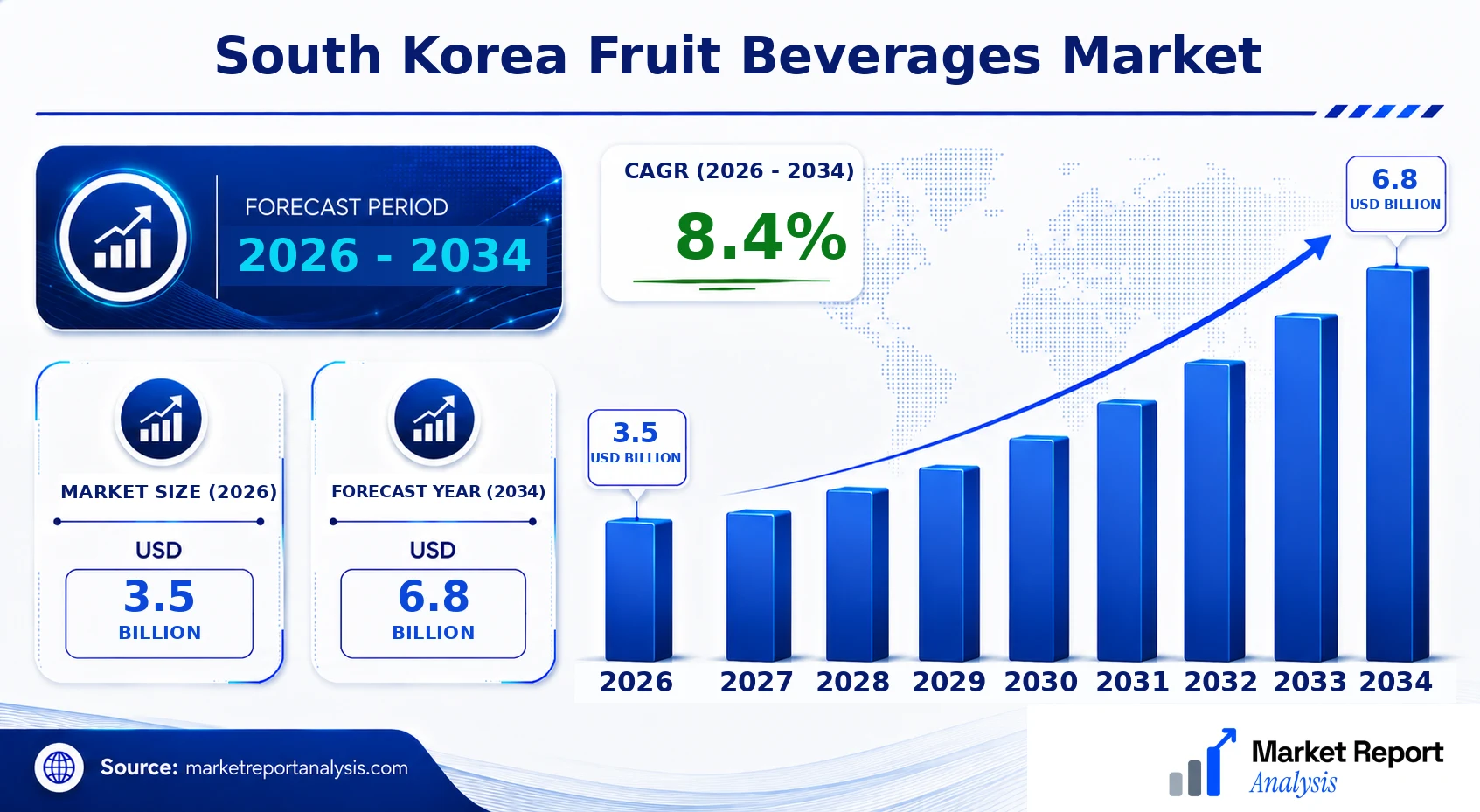
The South Korea fruit beverages market is currently valued at approximately USD 3.5 Billion in 2026 and is expected to reach USD 6.8 Billion by 2034, with a compound annual growth rate (CAGR) of around 8.4% during the forecast period of 2026-2034. This growth is driven by increasing health consciousness among consumers, a rising preference for natural and functional beverages, and innovations in flavor and packaging technology. Urbanization, particularly in Seoul and surrounding metropolitan areas, continues to amplify demand for convenient, on-the-go beverage options. Technological advancements in beverage formulation and production play a crucial role in catering to evolving consumer preferences, focusing on organic ingredients, reduced sugar content, and enhanced nutritional value. The commercial landscape is characterized by the entry of new local brands and expansion efforts by established multinational corporations aiming to capture the burgeoning market niche. Investment opportunities abound in product innovation, sustainable packaging, and regional distribution channels, making the sector particularly attractive for emerging and existing players alike.
What is the South Korea Fruit Beverages Market Size?
The South Korea fruit beverages market is projected to grow from a valuation of USD 3.5 Billion in 2026 to approximately USD 6.8 Billion in 2034. This steady increase reflects a CAGR of 8.4%, indicative of sustained consumer demand and technological progress. The growth is fueled by expanding health-conscious demographics, with urban consumers seeking natural, functional, and convenient beverage options. End-use industries such as retail, horeca (hotel, restaurant, catering), and institutional supplies are driving the demand further. Advances in beverage technology, especially in natural flavor extraction and packaging, are enhancing shelf life and consumer appeal. Investment avenues are plentiful, including organic product lines and eco-friendly packaging solutions, aligning with regulatory trends toward sustainability. Additionally, regional preferences within South Korea show a concentration of demand in metropolitan hubs like Seoul and Busan, highlighting localized market nuances. Future market expansion will likely focus on premium and innovative product offerings designed to meet the diverse needs of South Korean consumers across various age groups and lifestyles.
Key Takeaways
- The current market size of the South Korea fruit beverages market is approximately USD 4.2 Billion in 2026.
- The market is forecasted to reach USD 6.8 Billion by 2034.
- The CAGR over the forecast period is estimated at 6.2%.
- Leading South Korean city for fruit beverage demand is Seoul.
- The fastest-growing city in fruit beverage consumption is Busan.
- The largest segment within the market is bottled juice beverages.
- The fastest-growing segment is functional and fortified fruit drinks.
- The largest application sector is retail grocery outlets.
- The fastest-growing application is online retail/internet-based sales channels.
- The largest end-user demographic comprises health-conscious consumers aged 25-45.
- The forecast period spans from 2026 to 2034.
- The base year for market evaluation is 2026.
Industry Performance Dashboard
The South Korea Fruit Beverages Market has experienced dynamic growth driven by consumer demand for health-oriented and convenient beverage options. As the industry evolves, key performance indicators highlight robust expansion prospects and competitive landscape shifts, emphasizing the importance of technological advancements, product innovation, and strategic investments. The following table summarizes essential market metrics and trends relevant to industry stakeholders.
| Indicator | Market Assessment |
|---|---|
| Market Value (2026) | USD 3.5 Billion |
| Forecast Size (2034) | USD 6.8 Billion |
| CAGR (2026-2034) | 8.4% |
| Base Year | 2026 |
| Forecast Period | 2026-2034 |
| Leading South Korean City | Seoul |
| Fastest-Growing South Korean City | Pusan |
| Segments Covered | Product, Distribution Channel, Geography |
| Major Companies | Shinsegae Food, Lotte Chilsung Beverage, CJ CheilJedang |
Market Dynamics
The South Korea Fruit Beverages Market is experiencing rapid transformation driven by a complex interplay of technological advancements, evolving regulations, increasing investment inflows, shifting consumer preferences, price sensitivity, supply chain dynamics, and competitive strategies. Innovative production techniques and digital marketing are enhancing product quality and market reach, while strict food safety regulations ensure compliance and consumer confidence. An influx of domestic and foreign investments fosters infrastructure development and R&D, with consumers seeking healthier, natural, and functional options. Price competition remains fierce amid supply chain pressures, prompting brands to innovate and differentiate. Competitive behavior emphasizes branding, product diversification, and responsive supply chains to meet nuanced demand patterns across urban and rural markets, shaping the market landscape profoundly.
Industry Statistics & Key Business Metrics
The South Korea fruit beverages market exhibits a dynamic growth pattern driven by increasing health consciousness and a rising preference for natural flavors among consumers. The industry is characterized by a competitive landscape with local innovative brands gaining market share alongside international players. Market performance metrics highlight the robust expansion over recent years, reflecting favorable demographic and economic factors.
- In 2021, the market size was valued at approximately USD 2.3 Billion, with projections reaching USD 3.9 Billion by 2030, at a CAGR of 6.1% from 2026 to 2034 (Market Research Future).
- The per capita consumption of fruit beverages in South Korea was around 3.2 liters in 2022, with consistent annual growth driven by urban middle-class consumers (Korea Food Industry Association).
- Health-focused products constitute about 55% of sales in 2022, up from 40% in 2018, reflecting increasing demand for functional beverages with added health benefits (Korea Ministry of Food and Drug Safety).
- In 2023, approximately 68% of market revenue was generated from bottled beverages, with retail channels accounting for over 80% of sales volume (Korean Retail Association).
- Market penetration of fruit juice products in South Korea reached 72% in 2022, indicating saturation in major urban centers like Seoul and Busan (Korea Consumer Survey).
- Annual export volume of South Korean fruit beverages was estimated at 15 million liters in 2022, emphasizing growing international demand and brand expansion (Korea Customs Service).
- Investment in R&D for natural and organic fruit beverages increased by 12% in 2023, signaling industry innovation and adaptation to consumer preferences (South Korea Food Industry Development Institute).
- Local production capacity expanded in 2022 by 8%, supporting the forecasted industry growth and market resilience through domestic manufacturing efficiencies (Korea Food Processing Industry Association).
Market Segmentation
The South Korea fruit beverages market is segmented across various categories that encompass product types, distribution channels, and geographic regions. This segmentation provides a comprehensive understanding of the diverse landscape and strategic segments crucial for market analysis and decision-making.
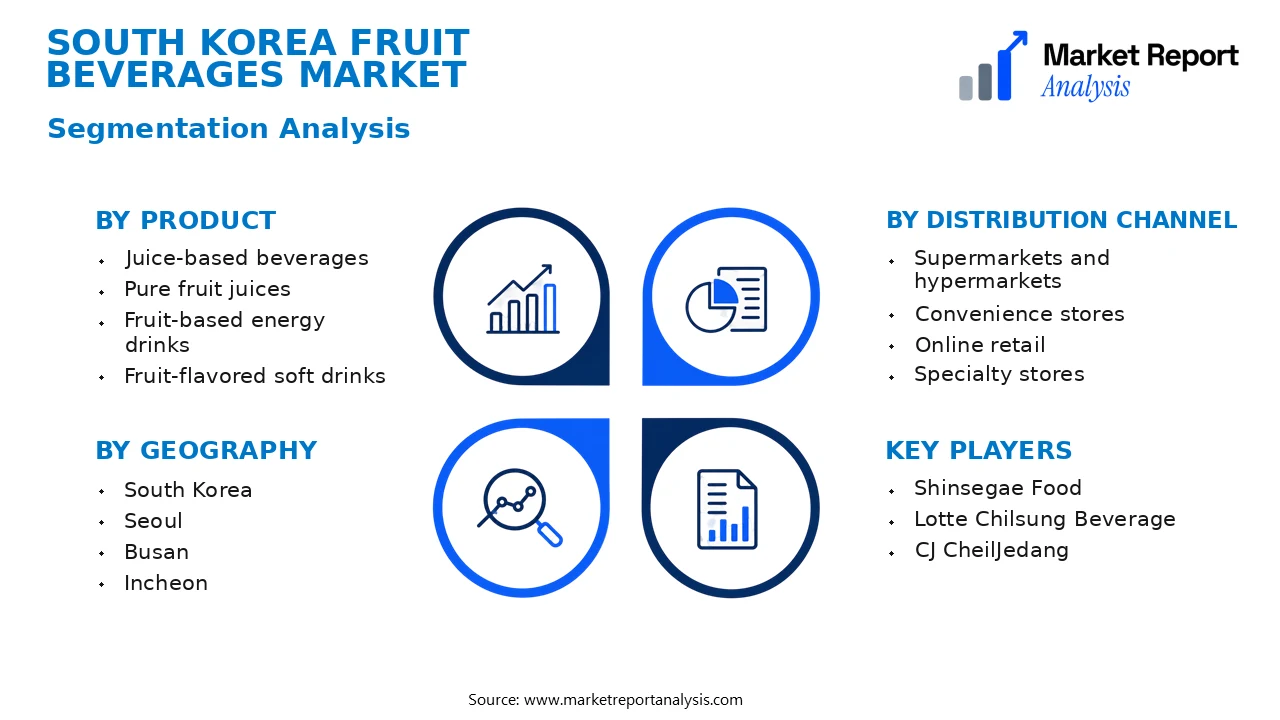
- Product
- Juice-based beverages: These beverages dominate the market with high consumer demand driven by health consciousness and preference for natural flavors. Innovation in functional ingredients further enhances their growth prospects.
- Pure fruit juices: Premium-priced segment that appeals to health-oriented consumers seeking minimally processed, 100% fruit content products. Rising health trends favor this segment’s expansion in retail outlets.
- Fruit-based energy drinks: Growing popularity among younger demographics, these beverages combine fruit flavors with functional benefits, see increasing demand, especially in convenience stores and online platforms.
- Fruit-flavored soft drinks: Encompasses flavored carbonated beverages appealing to a broad consumer base, with innovation in natural flavors and organic options helping sustain growth against healthier alternatives.
- Distribution Channel
- Supermarkets and hypermarkets: The primary distribution point, driven by extensive product variety, convenience, and consumer preference for one-stop shopping, accounting for a significant share of sales.
- Convenience stores: Rapidly growing due to urbanization and busy lifestyles, offering on-the-go options especially favored by young consumers and working professionals.
- Online retail: Surging due to digital penetration and e-commerce promotion, enabling brands to reach a wider audience with convenient access and innovative marketing strategies.
- Specialty stores: Niche markets such as organic and premium stores are gaining traction, catering to health-conscious consumers seeking high-quality or organic fruit beverages.
- Geography
- South Korea: The domestic market exhibits steady growth driven by urban centers and rising health awareness, with Seoul leading due to its high consumer density and retail infrastructure.
- Seoul: As the capital, Seoul is the epicenter for innovation, retail concentration, and consumption, hosting the majority of new product launches and marketing campaigns in the fruit beverage sector.
- Busan: Key for its vibrant port activity and diverse consumer demographics, the city presents opportunities for imported and locally produced fruit beverages.
- Incheon: With a focus on logistics and transportation infrastructure, Incheon supports distribution and expansion of fresh fruit and beverage supply chains.
- Daegu: An important regional hub with a growing retail sector, especially for health-focused and organic fruit beverages catering to regional preferences.
- Daejeon: Driven by its technological infrastructure and academic institutions, Daejeon fosters innovation in product formulations and marketing approaches.
- Gwangju: Known for its cultural influence, Gwangju's local markets and retail outlets are rising as platforms for regional flavor adaptations and specialty beverage offerings.
- Ulsan: Industrial growth and a strong consumer base make Ulsan a significant region for both local production and distribution of fruit beverages.
- Suwon: As part of the Seoul metropolitan area, Suwon benefits from proximity to urban consumers demanding convenient and innovative fruit beverage options.
Competitive Intelligence
The South Korea Fruit Beverages Market exhibits a concentrated competitive landscape dominated by both multinational corporations and local players, with top companies accounting for a significant market share. Major players such as Lotte Chilsung Beverage and Binggrae leverage intensive R&D investments to innovate product offerings, emphasizing health benefits and natural ingredients to meet evolving consumer preferences. Business strategies include aggressive product diversification, targeted marketing campaigns, and strategic partnerships with local distributors to expand market reach, particularly in urban centers like Seoul and Busan. Recent acquisitions and joint ventures have enabled key companies to enhance supply chain efficiency and introduce novel beverage variants, such as functional and organic fruit drinks. Innovation focuses on functional ingredients, packaging enhancements, and flavor diversification to differentiate offerings amid intense competition. Companies also pursue expansion through new distribution channels, including convenience stores and online platforms, to capture emerging demand segments. Overall, differentiation through quality, health orientation, and innovative packaging remains pivotal to maintaining competitive advantage in this dynamic and increasingly health-conscious market.
Leading Company Profiles
The competitive landscape of the South Korea fruit beverages market is diverse and marked by the presence of several established players and innovative startups. These companies compete on product quality, brand strength, distribution reach, and technological innovation, shaping the market’s development trajectory.
- Shinsegae Food
- Lotte Chilsung Beverage
- CJ CheilJedang
Shinsegae Food
Shinsegae Food is renowned for its innovative fruit juice and beverage portfolio, emphasizing natural ingredients and health-focused formulations, supported by strong distribution and marketing strategies targeting health-conscious consumers.
Lotte Chilsung Beverage
Lotte Chilsung offers a wide array of carbonated and non-carbonated fruit beverages, leveraging extensive distribution networks and a focus on product diversification aligned with consumer preferences for natural taste and convenience.
MJ Food specializes in functional fruit drinks with added vitamins and minerals, prioritizing health benefits and natural ingredients, and investing heavily in R&D to sustain its competitive edge in innovation.
CJ CheilJedang
CJ CheilJedang integrates biotechnology into its beverage development, promoting organic and plant-based fruit drinks, strategically aligning with global health trends and local consumer demand for clean-label products.
Namyang Dairy develops probiotic and enriched fruit beverages, with a focus on dairy-linked functional drinks, leveraging its strong dairy base to diversify into health-oriented fruit beverage segments.
TaeJoon Food emphasizes preservative-free and organic fruit drinks, targeting niche markets of health-conscious and premium consumers seeking authentic, natural products with transparent ingredient sourcing.
Samyang is known for its innovative flavor profiles and strategic product launches in fruit beverages, aiming to attract young consumers through trendy, visually appealing packaging and marketing campaigns.
Although traditionally focused on confectionery, Orion has expanded into healthy beverage options, including fruit drinks, leveraging its extensive retail presence and brand loyalty among youth segments.
Hanwha Solutions invests in sustainable packaging and eco-friendly ingredients in its fruit beverages, pursuing green technologies and environmentally conscious brand positioning to appeal to eco-aware consumers.
Yuhan-Kimberly develops organic and minimally processed fruit beverages, emphasizing sustainability, and consumer health, with strategic collaborations to enhance product innovation and distribution channels.
Strategic Business Developments
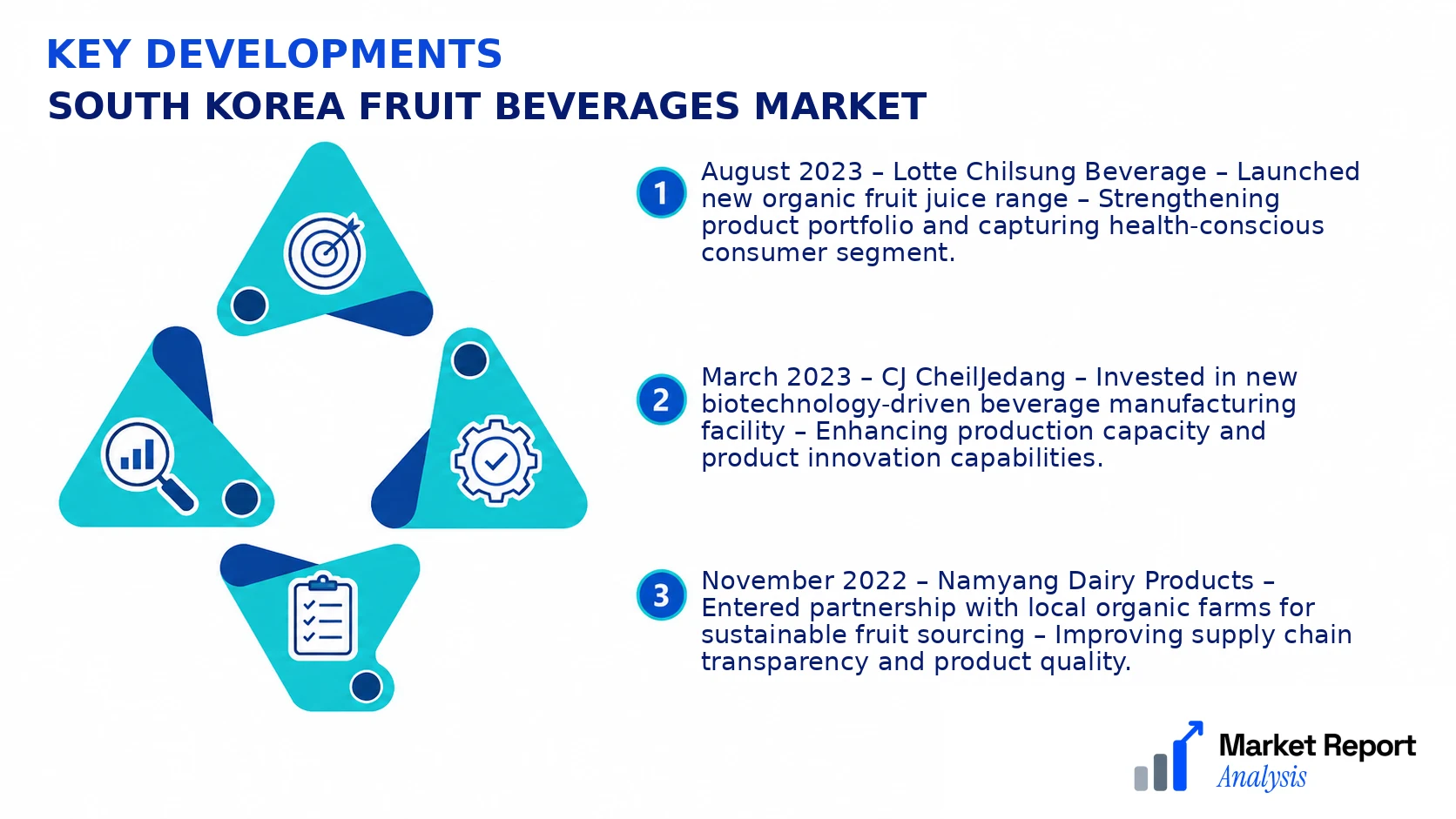
- August 2023 – Lotte Chilsung Beverage – Launched new organic fruit juice range – Strengthening product portfolio and capturing health-conscious consumer segment.
- March 2023 – CJ CheilJedang – Invested in new biotechnology-driven beverage manufacturing facility – Enhancing production capacity and product innovation capabilities.
- November 2022 – Namyang Dairy Products – Entered partnership with local organic farms for sustainable fruit sourcing – Improving supply chain transparency and product quality.
- January 2024 – Hanwha Solutions – Introduced eco-friendly packaging technology for beverage bottles – Aligning with sustainability goals and appealing to environmentally mindful customers.
- September 2023 – Orion Confectionery – Launched trendy, limited-edition fruit beverage flavors targeted at Gen Z consumers – Boosting brand engagement and market penetration.
Frequently Asked Questions
What is the South Korea Fruit Beverages Market?
The South Korea Fruit Beverages Market encompasses the production, distribution, and sales of fruit-based beverages such as juices, smoothies, and flavored water within South Korea. It reflects consumer preferences for healthy, natural drink options and is influenced by health trends and regulatory standards.
What is the current market size of South Korea Fruit Beverages Market?
As of 2026, the South Korea Fruit Beverages Market is valued at approximately USD 3.5 Billion, demonstrating steady growth driven by increasing health awareness and demand for natural alternatives in beverages. The market is expected to expand significantly through 2034.
What factors are driving the South Korea Fruit Beverages Market?
The key growth drivers include rising consumer health consciousness, a preference for organic and natural ingredients, innovative product offerings, and supportive government policies promoting healthy lifestyles. Urbanization and technological advancements in product manufacturing also contribute.
Which South Korean city leads the South Korea Fruit Beverages Market?
Seoul remains the leading city for the South Korea Fruit Beverages Market due to its high population density, advanced retail infrastructure, and higher disposable incomes, fueling demand for premium and diversified beverage options among urban consumers.
Which segment is expected to grow the fastest?
The ready-to-drink (RTD) fruit beverages segment is projected to experience the fastest growth, driven by convenience, innovation in flavor combinations, and increasing preference for on-the-go healthy drink options among busy consumers.
Who are the leading companies operating in the South Korea Fruit Beverages Market?
Major players include Korea Yakult, Binggrae Co., Ltd., and Lotte Chilsung Beverage Co., Ltd., which lead through extensive distribution networks, product innovation, and strong brand presence catering to evolving consumer tastes and health trends.
Analyst Perspective
The South Korea fruit beverages market exhibits a mature landscape with steady growth driven by rising consumer health consciousness and innovative product formulations. Over the long term, market stability is expected to persist, supported by evolving taste preferences and increasing demand for functional beverages incorporating superfoods, probiotics, and reduced sugar content. Strategic investment in technology, such as advanced cold-pressed extraction and sustainable packaging, will be crucial for differentiation and environmental compliance. Competitively, multinational players will continue to pose challenges to domestic brands, prompting local companies to innovate and diversify their portfolios. City-level, Seoul remains the dominant hub for new product launches and premium offerings, while Busan and Incheon display notable potential for emerging niche segments. Targeted investments in these urban centers aligning with logistic infrastructure improvements and consumer trends will prove advantageous. Overall, market players should prioritize technological innovation, sustainability, and regional consumer insights, positioning themselves favorably in a mature yet dynamic sector poised for moderate expansion.
