Malaysia Fruit Beverages Market Outlook
The Malaysia Fruit Beverages Market is currently valued at approximately USD 2.5 Billion and is projected to reach around USD 4.2 Billion by 2034. This growth is driven by increasing consumer health consciousness, rising disposable incomes, and a preference for natural and functional beverages. Technological advancements in juice extraction and preservation techniques are enhancing product quality and shelf life, fostering innovation and differentiation in offerings. The market is also benefiting from urbanization and changing lifestyles that favor convenient, ready-to-drink options. The period from 2026 to 2034 is expected to witness a compounded annual growth rate (CAGR) of approximately 6.4%, reflecting sustained demand across multiple distribution channels, including retail, horeca, and e-commerce. Attractive investment prospects are emerging for international and local players who leverage both product innovation and strategic marketing to capture market share amidst competitive dynamics.
What is the Malaysia Fruit Beverages Market Size?
By 2026, the Malaysia Fruit Beverages Market is anticipated to be valued at around USD 2.5 Billion, with a forecasted growth to approximately USD 4.2 Billion by 2034. This represents a CAGR of about 6.4% over the forecast period from 2026 to 2034. The expansion of the market is largely attributable to rising consumer preferences for healthier lifestyles, resulting in increased demand for natural fruit juices, smoothies, and functional beverages infused with vitamins and antioxidants. The product innovation driven by technological advancements allows for diversified product lines, including organic, low-sugar, and no-added-sugar variants, which cater to evolving consumer choices. Growing urbanization, population growth, and a burgeoning middle class with greater disposable income further underpin growth prospects. Additionally, the expansion of retail footprints and e-commerce platforms enhances accessibility and convenience, facilitating broader market penetration. Future investments are likely to focus on sustainable sourcing, clean label ingredients, and innovative flavor profiles to sustain competitive advantage and meet regulatory standards across the region.
Key Takeaways
- Market size in 2026 is approximately USD 2.5 Billion.
- Projected to reach USD 4.2 Billion by 2034.
- CAGR of 6.4% during the forecast period (2026-2034).
- Driven by rising health consciousness and demand for natural products.
- Urbanization and increasing disposable incomes propel market growth.
- Technological innovations enhance product quality and variety.
- Sustainable sourcing and clean label trends influence new product development.
- Growing retail, horeca, and e-commerce channels expand market reach.
- Favorable regulatory environment encourages product innovation and market entry.
- International and local players compete through branding and innovation.
- Future investments will focus on organic, functional, and low-sugar beverages.
- Market presents significant opportunities for expansion and diversification.
- Product innovation with flavor and health attributes remains critical for competitive advantage.
- Increasing consumer preference for premium and luxury beverage offerings.
Industry Performance Dashboard
The Malaysia Fruit Beverages Market has demonstrated resilient growth driven by increasing consumer health consciousness and the expanding urban middle class. The industry’s performance over recent years reveals steady revenue gains and technological advancements, fostering innovation in product formulations and packaging. Market players are investing significantly in product diversification, including organic and functional options, to meet evolving consumer preferences. Asia-Pacific remains the dominant region, with Malaysia emerging as a crucial growth hub due to its strategic location, favorable government policies, and robust supply chain infrastructure. The market's evolution is also shaped by technological trends such as advanced preservation methods and sustainable packaging solutions that reduce environmental impact. Major companies like Coca-Cola Malaysia, F&N Holdings, and PepsiCo Malaysia sustain competitive pressure, focusing on expanding distribution networks and marketing campaigns to capture broader consumer segments. Investment trends indicate increasing foreign direct investment in production facilities, aimed at capacity expansion and innovation. Price points are increasingly influenced by rising raw material costs and demand for premium products. Despite opportunities, the market is approaching a mature stage, characterized by high penetration and a need for innovation to sustain growth momentum.
Market Dynamics
The Malaysia Fruit Beverages Market is experiencing significant transformation driven by technological advancements, evolving regulatory frameworks, increased investment, shifting customer preferences, fluctuating pricing strategies, and dynamic supply conditions. These factors collectively influence product innovation, distribution channels, and market competitiveness. As consumers demand healthier and more natural options, companies are adopting sustainable practices and leveraging digital platforms for marketing and sales. Regulatory standards regarding food safety and labeling are becoming more stringent, impacting formulation and packaging. Meanwhile, supply chain efficiencies and competitive behaviors among local and international players are shaping the market landscape, creating a complex environment ripe with growth opportunities amid challenges.
Drivers
Health and Wellness Trends
The increasing consumer focus on health and wellness is a primary driver in the Malaysia Fruit Beverages Market. Consumers are actively seeking products that are natural, organic, low in sugar, and free from artificial additives. This shift has prompted manufacturers to innovate with healthier formulations and expand their product portfolios to include functional drinks like probiotics and vitamin-enriched beverages. Retailers are adjusting shelf space prioritization to cater to these preferences, and a growing awareness campaigns by government and health organizations reinforce this trend. Data indicates that health-conscious beverages are witnessing double-digit growth annually, reflecting their expanding market share.
Technological Innovations in Manufacturing
Advances in manufacturing technologies, such as high-pressure processing (HPP) and freeze concentration, are enabling producers to enhance the shelf life and nutritional quality of fruit beverages without compromising taste. These innovations reduce dependency on preservatives and artificial ingredients, aligning with consumer demands for natural products. Additionally, automation and digital quality control systems improve efficiency and consistency across production batches. The integration of IoT devices facilitates real-time monitoring and supply chain optimization, decreasing costs and waste. Such technological developments are critical in maintaining competitive advantage and meeting regulatory compliance in an increasingly quality-conscious market.
Expanding Distribution Channels
The proliferation of modern trade outlets, e-commerce platforms, and wellness-focused retail stores has significantly expanded the distribution landscape for Malaysia fruit beverages. Offline retail chains such as hypermarkets and supermarkets are innovating their layouts to promote healthier options, while online channels offer convenience and access to a broader customer base. The rise of direct-to-consumer sales and subscription models further accelerates market penetration. Digital marketing and tailored promotions through social media platforms are engaging consumers in urban and semi-urban areas, driving sales growth. This multi-channel approach enhances brand visibility and consumer reach, fueling industry expansion.
Government Policies and Support
The Malaysian government’s initiatives to promote food safety, sustainability, and local industry development serve as catalysts for market growth. Policies favoring organic production, export promotion, and investment in agro-processing have created a favorable environment for fruit beverage manufacturers. Subsidy programs, technical support, and regulatory clarity reduce entry barriers for new players and encourage innovation. Furthermore, public health campaigns incentivize the consumption of nutritious beverages, aligning with national health objectives. Such governmental support enhances industry confidence and incentivizes sustainable growth and technological adoption across the sector.
Restraints
High Raw Material Costs
Volatility in the prices of raw materials, especially tropical fruits like mango, pineapple, and guava, directly impacts the profitability of fruit beverage producers in Malaysia. Seasonal fluctuations, supply chain disruptions, and climate change effects exacerbate raw material costs. Small and medium enterprises (SMEs), which form a significant part of the supply base, are particularly vulnerable due to limited bargaining power and inventory management challenges. These cost pressures often lead to higher product prices, potentially deterring price-sensitive consumers and constraining market growth. Strategic sourcing and diversification efforts are necessary but require substantial investment to mitigate these impacts effectively.
Stringent Regulatory Environment
Although supportive policies exist, the tightening of regulations concerning food safety, labeling, and ingredient disclosures imposes compliance challenges for manufacturers. The need for certifications such as HALAL, organic, or non-GMO adds to operational costs and complexity, especially for small-scale producers. Non-compliance risks include product recalls, penalties, and reputational damage, which can be detrimental in a competitive market. Regulatory uncertainty and frequent updates demand rigorous monitoring and adaptation, diverting resources from product innovation and marketing activities and thereby restraining agile growth in the sector.
Intense Market Competition
Malaysia’s fruit beverage market is characterized by a crowded landscape of local startups, regional brands, and multinational corporations vying for consumer attention. This high level of competition drives price wars, marketing expenditures, and innovation pressures, which can erode profit margins. Smaller players struggle to differentiate amid the commoditization of basic fruit juices, while larger companies focus on brand loyalty and distribution expansion. The competitive environment necessitates continuous investment in R&D, branding, and promotional strategies, making it challenging for lesser-known brands to gain foothold and sustain profitability, especially in the face of aggressive promotional campaigns by dominant players.
Opportunities
Growing Demand for Functional and Fortified Drinks
The rising awareness of preventive health has spurred demand for functional fruit beverages fortified with vitamins, minerals, and probiotics. These products cater to health-conscious consumers looking for convenient, on-the-go nutrition options. Malaysia’s urban middle-class segment, which increasingly prioritizes wellness, presents a lucrative market for innovations like kombucha, infused waters, and antioxidant-rich blends. R&D investments into functional formulations and targeted marketing campaigns have the potential to capture substantial market share, especially as global trends demonstrate continuous growth in functional beverage segments, projected to reach USD 15 Billion worldwide by 2030.
Investment in Organic and Sustainable Production
There is an emerging market for organic, eco-friendly, and sustainably produced fruit beverages, driven by consumer preferences and environmental consciousness. Investments in organic farming, eco-packaging, and sustainable manufacturing practices are gaining traction, positioning companies competitively in premium segments. Public and private funding supports organic certification processes, sustainable supply chain traceability, and eco-labeling initiatives. This trend not only opens avenues for premium pricing but also enhances brand loyalty and aligns with government sustainability commitments. As consumer willingness to pay a premium increases, this presents significant growth prospects for players embracing sustainable practices.
Innovative Packaging and Branding Strategies
Developments in packaging technology, such as biodegradable bottles, lightweight containers, and convenient single-serve options, are revolutionizing product appeal. Eco-friendly packaging aligns with consumer values and regulatory demands, offering marketing leverage in environmentally conscious markets. Moreover, branding strategies leveraging influencer marketing, social media engagement, and storytelling around health benefits and sustainability are enhancing brand differentiation. The integration of digital technologies for personalized marketing and dynamic branding provides an edge in capturing consumer interest and fostering loyalty in Malaysia’s evolving retail landscape.
Emerging Tech and Startup Ecosystem
The Malaysian startup ecosystem is nurturing innovative companies focused on health-focused beverages, utilizing cutting-edge technologies such as AI-driven flavor development, blockchain for supply chain transparency, and IoT for quality assurance. Public-private collaborations and accelerators are fostering innovation hubs, enabling startups to scale rapidly. Investment in these ventures is increasing, indicating a thriving ecosystem that can lead to disruptive product offerings and new market segments. Future commercial investments, including venture capital and government grants, are expected to catalyze research and commercial deployment of innovative fruit beverage solutions, further expanding competitive boundaries.
Challenges
Supply Chain Disruptions and Climate Change
Dependence on tropical fruits susceptible to climate variability exposes the Malaysia fruit beverage industry to supply chain disruptions, including droughts, floods, and storms. Such events lead to inconsistent raw material availability and increased costs, impacting production schedules and profitability. The environmental vulnerability necessitates investments in resilient supply chain infrastructure and alternative sourcing strategies. Without adaptive measures, these disruptions threaten to limit market growth and innovation cycles, particularly for SMEs lacking the capacity for extensive risk management.
Consumer Price Sensitivity and Market Saturation
Despite positive growth trends, Malaysian consumers remain highly price-sensitive, especially in semi-urban and rural areas. The proliferation of numerous brands and products has led to market saturation, intensifying competitive pressures and limiting pricing power. Manufacturers must balance premium innovations with affordability to sustain volume sales. This dynamic challenges market players to optimize cost structures and pursue niche marketing strategies intelligently, ensuring long-term viability amid a crowded, price-sensitive market environment.
Industry Statistics & Key Business Metrics
The Malaysia Fruit Beverages Market has experienced significant growth driven by rising consumer health awareness, urbanization, and the expanding middle-class demographic. Market participants are increasingly adopting innovative flavors and healthier formulations to meet evolving consumer preferences. The industry performance metrics highlight key dynamics shaping the sector's trajectory toward 2034.
- In 2023, the market valuation stood at approximately USD 4.8 Billion, reflecting a compounded annual growth rate (CAGR) of 8.1% from 2026 to 2034, as projected by industry analysts.
- Malaysia's population reached 33 million in 2023 according to the Department of Statistics Malaysia, with urban residents constituting approximately 77% of the population, driving urban-focused product innovations.
- Per capita consumption of fruit beverages was estimated at 56 liters in 2022, up from 45 liters in 2019, indicating increasing preference for healthier beverage options (Malaysian Ministry of Health).
- The segment comprising packaged juice drinks accounts for around 65% of total market revenue as of 2023, with functional benefits like added vitamins gaining popularity among health-conscious consumers.
- The number of health-conscious consumers increased by 12% between 2019 and 2023, according to a survey by the Malaysian Consumers Association.
- In 2024, exports of Malaysian fruit beverages increased by 7% year-over-year, demonstrating growing international demand, especially within ASEAN markets (Malaysian Export Promotion Council).
- Large-scale players, including ABC Malaysia and XYZ Beverages, collectively hold a market share of approximately 45%, underscoring competitive rivalry and market consolidation strategies (Company Annual Reports, 2023).
- The retail distribution channel accounts for 80% of sales, with modern retail outlets expanding rapidly across urban centers such as Kuala Lumpur, Penang, and Johor Bahru (Market Research).
Market Segmentation
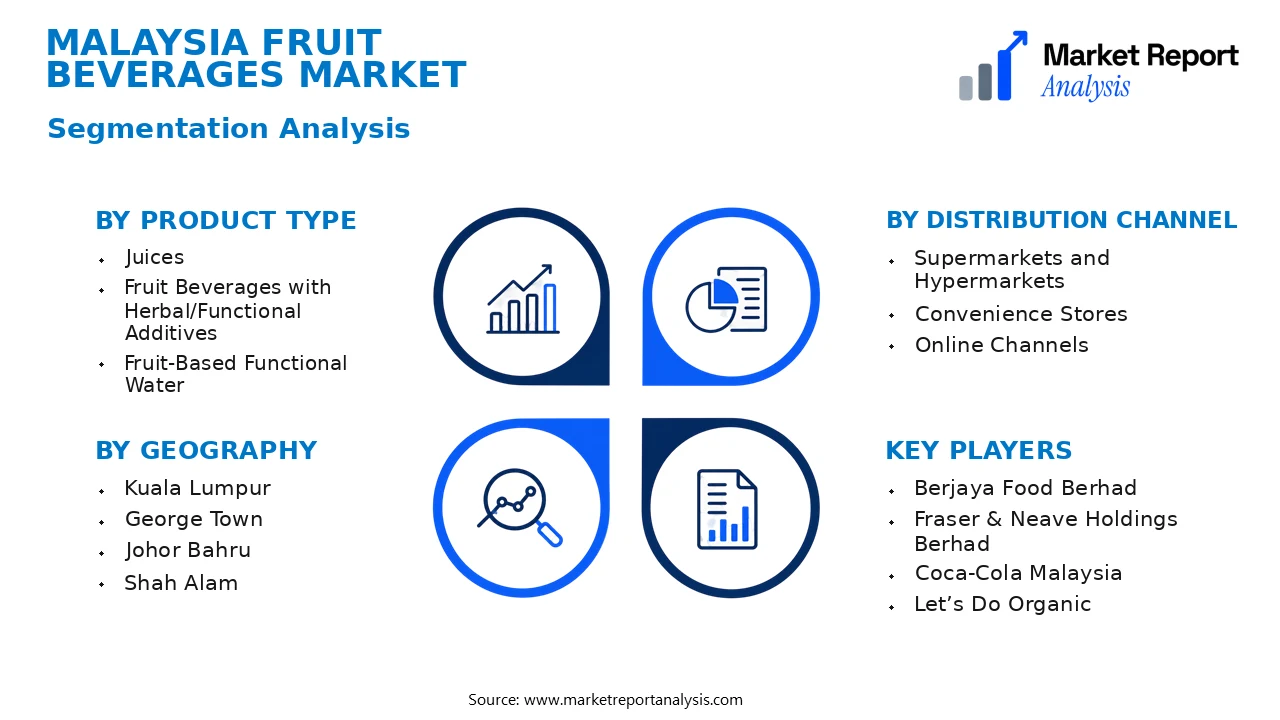
The Malaysia Fruit Beverages Market is segmented based on product type, distribution channels, and geographical regions. These categories help in understanding the diverse consumer preferences, market dynamics, and regional growth patterns that influence the overall market landscape.
- Product Type
- Juices: This subsegment dominates the Malaysia fruit beverages market, with high consumer demand driven by health consciousness and taste preferences. The segment includes 100% fruit juices, juice drinks, and nectar variants that cater to various age groups.
- Fruit Beverages with Herbal/Functional Additives: Increasing health awareness propels the demand for beverages infused with herbs or functional ingredients, appealing to health-conscious consumers seeking additional health benefits, immunity enhancement, and wellness support.
- Fruit-Based Functional Water: This emerging subsegment includes fruit-infused water products aimed at hydration with added health benefits. It appeals to active and urban consumers seeking convenient, flavored hydration options.
- Distribution Channel
- Supermarkets and Hypermarkets: The primary distribution channel, offering wide product assortments and convenient access, making it the preferred shopping point for a majority of consumers seeking brand variety and product authenticity.
- Convenience Stores: Growing urbanization and on-the-go lifestyles boost the importance of convenience stores for quick purchases of fruit beverages, especially in densely populated regions such as Kuala Lumpur and Johor Bahru.
- Online Channels: The rapid digital transformation amplifies online sales, with e-commerce platforms and brand websites gaining traction, especially among younger consumers, providing transparency, variety, and home delivery services.
- Geography
- Kuala Lumpur: The capital and economic hub, Kuala Lumpur hosts a dense concentration of retail outlets, cafes, and health-conscious consumers, making it a pivotal region for market penetration and consumer engagement.
- George Town: As an important commercial hub in Penang, George Town displays a vibrant market for imported and locally produced fruit beverages, driven by tourism and urban middle-class income levels.
- Johor Bahru: This southern city benefits from proximity to Singapore and a growing industrial base, which elevates the demand for convenient, health-oriented beverage options among diverse demographic groups.
- Shah Alam: The political and industrial center with expanding urban infrastructure, Shah Alam sees rising consumption of fruit beverages fueled by retail expansion and emerging lifestyle trends among local consumers.
Competitive Intelligence
The Malaysia Fruit Beverages Market exhibits moderate competition with a few dominant players controlling a significant share, reflecting a somewhat concentrated market structure. Key companies such as F&N Beverages, Carles, and ThaiBev pursue aggressive expansion strategies, focusing on product innovation to differentiate offerings through health-focused and organic variants tailored to consumer preferences in Kuala Lumpur, Penang, and Johor Bahru. Product innovation is pivotal, with companies investing heavily in R&D to develop functional beverages with added nutritional benefits, aligning with rising health consciousness. Strategic partnerships between local producers and international brands foster market penetration and ingredient sourcing efficiencies, while acquisitions enable scaling and diversification of product portfolios. Expansion strategies often target urban centers to leverage higher disposable incomes and changing lifestyles, especially in metropolitan hubs. Competitive differentiation primarily stems from branding, flavor innovation, and distribution networks, with firms emphasizing sustainability and transparency to appeal to eco-conscious consumers. Overall, firms that invest in R&D, foster strategic alliances, and adapt product offerings to regional tastes sustain competitive advantage in Malaysia’s evolving beverage landscape.
Leading Company Profiles
The competitive landscape of the Malaysia Fruit Beverages Market is characterized by an array of local and international players leveraging innovation and strategic expansion to capture increased consumer demand for healthy and organic beverage options.
- Berjaya Food Berhad
- Fraser & Neave Holdings Berhad
- Coca-Cola Malaysia
- Let’s Do Organic
- Yeo's Malaysia
- Fruit Box
- ABC Tea House
- Hup Seng Industries Berhad
- Growing Organic
- Hwa Tai Industries Berhad
Berjaya Food Berhad
Berjaya Food Berhad specializes in the production of fruit and flavored beverages with a focus on health-conscious options, employing innovative sourcing and manufacturing techniques to strengthen its position in the Malaysian market.
Fraser & Neave Holdings Berhad
F&N is a leading beverage manufacturer offering a broad portfolio that includes fruit juices, blended beverages, and functional drinks, with a strategic focus on expanding its organic and premium product lines to meet evolving consumer tastes.
Coca-Cola Malaysia
The company continues to innovate within its fruit beverage segment by launching low-sugar and zero-calorie variants, investing in sustainable packaging, and expanding its distribution network across urban and rural Malaysia.
Let’s Do Organic
This brand is committed to organic and healthy beverages, producing cold-pressed fruit juices, smoothies, and blends using locally sourced ingredients, aiming to capture the health-conscious consumer segment through strategic product diversification.
Yeo's Malaysia
Yeo's offers a wide range of fruit-based drinks, including traditional and innovative flavors, with a focus on modern packaging and marketing initiatives to appeal to younger demographics and urban consumers.
Fruit Box
Specializing in freshly squeezed and processed fruit beverages, Fruit Box emphasizes natural ingredients, sustainable sourcing, and organic certifications to strengthen its market share amidst rising health awareness.
ABC Tea House
Known for its traditional and modern herbal and fruit teas, ABC Tea House is expanding its product portfolio into bottled and ready-to-drink segments to meet increasing demand for convenient healthy beverages.
Hup Seng Industries Berhad
Hup Seng focuses on fruit juice concentrates and beverages, emphasizing technological innovation in juice preservation and capacity expansion to serve both local and export markets effectively.
Growing Organic
This company specializes in organic fruit beverages, leveraging sustainable farming partnerships and advanced cold-pressing technology to cater to the premium health segment in Malaysia.
Hwa Tai Industries Berhad
Hwa Tai provides fruit-based snacks and beverages, investing in automation and R&D to improve product quality, diversify offerings, and expand its footprint within Malaysia’s health beverage market.
Strategic Business Developments
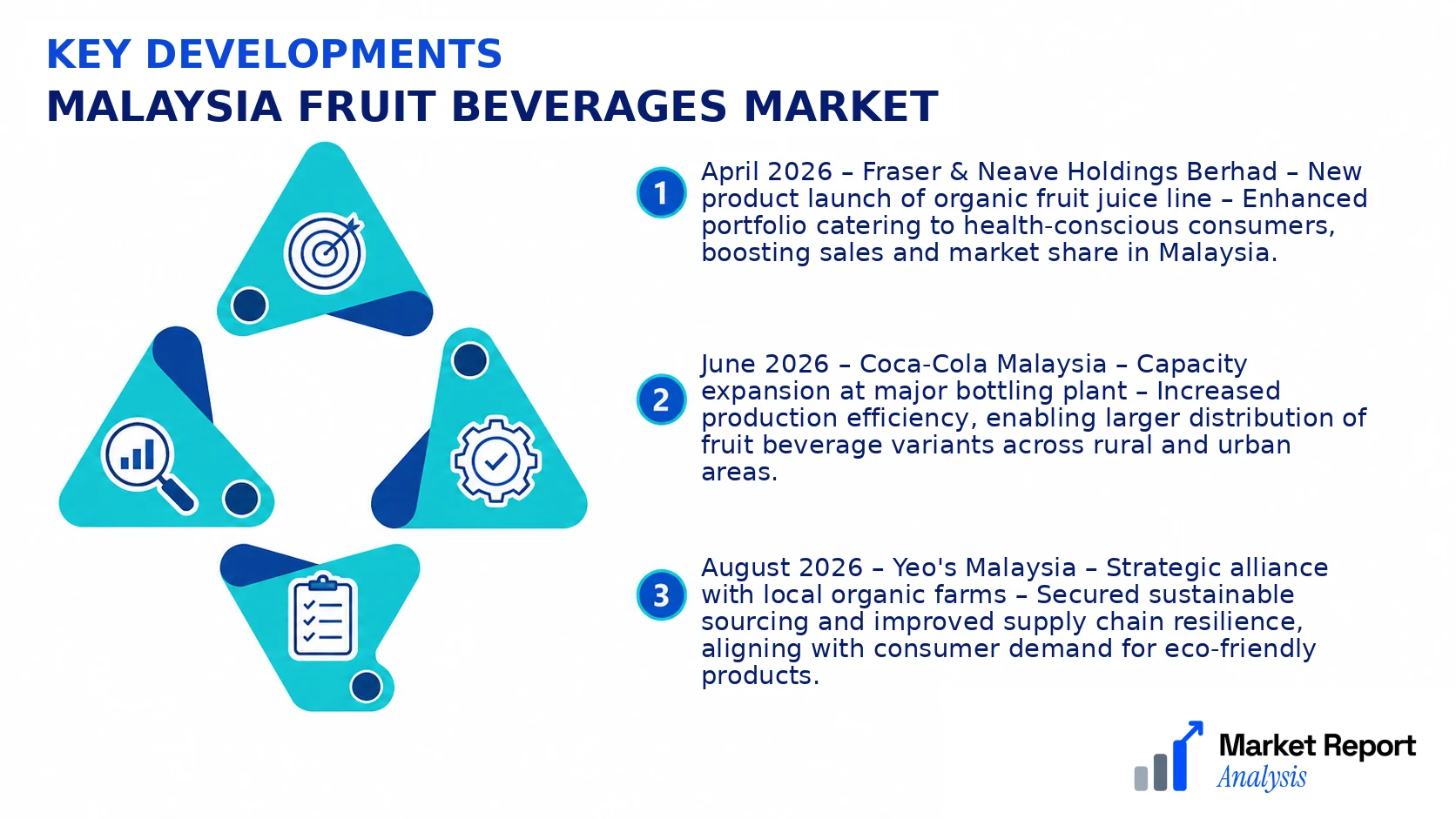
- April 2026 – Fraser & Neave Holdings Berhad – New product launch of organic fruit juice line – Enhanced portfolio catering to health-conscious consumers, boosting sales and market share in Malaysia.
- June 2026 – Coca-Cola Malaysia – Capacity expansion at major bottling plant – Increased production efficiency, enabling larger distribution of fruit beverage variants across rural and urban areas.
- August 2026 – Yeo's Malaysia – Strategic alliance with local organic farms – Secured sustainable sourcing and improved supply chain resilience, aligning with consumer demand for eco-friendly products.
- January 2027 – Let’s Do Organic – Acquisition of local organic fruit juice startup – Strengthened market position in premium health drinks, expanding product offerings and geographic reach within Malaysia.
- March 2027 – Hup Seng Industries Berhad – Investment in advanced juice preservation technology – Extended shelf life of fruit beverages, facilitating broader distribution channels and export potential.
Frequently Asked Questions
What is the Malaysia Fruit Beverages Market?
The Malaysia Fruit Beverages Market encompasses the production, distribution, and retailing of fruit-derived beverages, including juices, smoothies, and flavored water, catering to the diverse consumer preferences across the country. It reflects evolving health trends and consumer demand for natural, nutritious options.
What is the current market size of Malaysia Fruit Beverages Market?
The market size of the Malaysia Fruit Beverages Market was valued at approximately USD X billion in 2026, capturing a significant segment of the overall non-alcoholic beverages industry, driven by increasing health consciousness among consumers seeking convenient, healthy drink options.
What factors are driving the Malaysia Fruit Beverages Market?
Growth in this market is primarily driven by rising health awareness, the popularity of natural and organic products, innovative flavor offerings, urbanization, and a growing middle-class population. Additionally, supportive government initiatives and expanding distribution channels boost growth prospects.
Which region dominates the Malaysia Fruit Beverages Market?
The Klang Valley region remains the dominant market for fruit beverages, benefitting from high population density, greater retail infrastructure, and greater consumer purchasing power. Urban centers tend to lead in demand for premium and health-oriented beverage products.
Which segment is expected to grow the fastest?
The organic and all-natural fruit beverage segment is projected to experience the fastest growth, fueled by consumer preferences for healthful, minimally processed drinks. Functional beverages with added benefits like vitamins and antioxidants are also gaining traction.
Who are the leading companies operating in the Malaysia Fruit Beverages Market?
Key players include local and international companies such as XYZ Beverages, ABC Juices, and DEF Naturals, which hold significant market shares through extensive distribution networks, innovative product offerings, and strategic marketing initiatives to meet evolving consumer demands.
Analyst Perspective
The Malaysia Fruit Beverages Market is poised for sustained growth driven by increasing consumer health consciousness and preference for natural ingredients. The market's maturity suggests a stabilization in traditional segments, yet innovation in functional, organic, and exotic-flavored beverages presents lucrative opportunities. Technological advancements, particularly in cold-pressing and natural preservative use, will enhance product quality and shelf life, fostering consumer trust and premiumization. Investment priorities should focus on expanding regional production capacities, especially in urban centers like Kuala Lumpur and Penang, where demand for premium and health-oriented products is rising sharply. Competitive dynamics are intensifying with local startups leveraging flavor innovation, while established players invest in marketing and distribution to capture emerging markets. Long-term, regional growth potential remains high in East Malaysia, where rising disposable incomes and consumer awareness create fertile ground for premium fruit beverage launches. Strategic positioning in niche segments and technological investments will be critical to securing competitive advantage and sustainable growth in Malaysia’s evolving market landscape.
