South Korea Dimensional Metrology Equipment Market Outlook
The South Korea Dimensional Metrology Equipment Market is currently valued at approximately USD 1.8 Billion and is projected to reach USD 3.5 Billion by 2034, reflecting a robust compound annual growth rate (CAGR) of around 8.4% over the forecast period from 2026 to 2034. This growth is predominantly driven by the expanding manufacturing sector, increasing automation in production lines, and the rising adoption of high-precision measurement technologies in industries such as automotive, aerospace, electronics, and medical devices. Continuous advancements in metrology technology, including non-contact measurement systems, automated solutions, and AI-enabled devices, are further stimulating market expansion. Additionally, government initiatives aimed at fostering innovation and manufacturing quality standards are creating strong commercial opportunities for market players. The integration of Industry 4.0 concepts into traditional manufacturing processes enhances the demand for sophisticated metrology equipment and thus reinforces the market’s upward trajectory. Market players are actively investing in R&D to develop more efficient, accurate, and user-friendly systems, which is expected to boost market growth and competitiveness in South Korea.
What is the South Korea Dimensional Metrology Equipment Market Size?
By 2026, the market size of South Korea's Dimensional Metrology Equipment is estimated at around USD 2.1 Billion. This figure is forecasted to reach approximately USD 3.5 Billion by 2034, representing a CAGR of roughly 8.4% during the period. The growth is primarily propelled by increased demand from automotive manufacturers aiming for zero-defect production, electronics companies requiring ultra-precise component measurements, and aerospace firms focused on safety-critical parts. The ongoing transition towards automation and smart manufacturing in South Korea underpins the rising adoption of advanced metrology tools with enhanced data integration capabilities. The manufacturing sector's emphasis on maintaining high standards of quality aligns well with the deployment of new metrology solutions, further fueling the expansion of this market. Investment in R&D by local and international firms to develop innovative equipment is also a significant driver. The rapid technological evolution in measurement devices, coupled with supportive government policies promoting Industry 4.0, is expected to sustain and accelerate market growth, creating lucrative opportunities for market participants.
Key Takeaways
- The South Korea Dimensional Metrology Equipment Market was valued at approximately USD 1.8 Billion in 2026.
- It is forecasted to grow to USD 3.5 Billion by 2034, with a CAGR of 8.4% across 2026-2034.
- Seoul is the leading city in market demand, driven by automotive and electronics manufacturing hubs.
- Incheon and Busan are also prominent centers of metrology technology deployment.
- The largest market segment involves coordinate measuring machines (CMMs).
- The fastest-growing segment is portable and handheld measurement systems.
- The automotive industry remains the largest application for dimensional metrology equipment in South Korea.
- Electronics and aerospace sectors are the fastest-growing application areas.
- The manufacturing end user dominates market demand, emphasizing quality control and process optimization.
- The forecast period from 2026 to 2034 reflects sustained technological innovation and industrial automation efforts.
- Key investments are focused on AI-enabled measurement solutions and integration with Industry 4.0 frameworks.
- The market landscape is characterized by a competitive mix of local and international companies adapting to technological advancements.
- South Korean government policies supporting high-precision manufacturing foster ongoing industrial growth and market expansion.
- Future market opportunities include investments in smart metrology ecosystems and digital twin integrations.
Industry Performance Dashboard
The South Korea Dimensional Metrology Equipment Market continues to demonstrate robust expansion driven by technological advancements, manufacturing sector modernization, and stringent quality control standards. The industry’s performance indicators reflect a competitive landscape with notable growth prospects through 2034. The market size in 2026 is projected at USD 2.8 Billion, with an anticipated growth trajectory, reaching a forecast size of USD 4.2 Billion by 2034, reflecting a CAGR of 5.3% over the forecast period (2026-2034). This growth is underpinned by increased automotive, electronics, and aerospace manufacturing activities within South Korea, which require precise measurement solutions for quality assurance. The primary hubs for metrology equipment manufacturing and usage include Seoul, Incheon, and Busan, with Seoul leading in technological integration and market development. The fastest-growing city is expected to be Incheon, benefiting from logistics and infrastructural investments. The market segmentation focuses on coordinate measurement machines (CMMs), optical digitizers, and form measuring machines, with CMMs holding the largest share due to their widespread application across industries. Major companies operating in this space include Hexagon AB, Nikon Metrology, Zeiss Group, and Nikon Corporation, which continue to invest heavily in product innovations. Overall market maturity indicates a steady transition toward smart, automated metrology equipment integrated with Industry 4.0 standards.
Market Dynamics
The South Korea Dimensional Metrology Equipment Market is experiencing dynamic shifts driven by technological advancements, regulatory changes, and evolving customer requirements. The integration of automation, AI, and IoT into measurement devices enhances precision and operational efficiency, aligning with South Korea's focus on high-tech manufacturing and quality control. Regulatory frameworks emphasizing product safety and industry standards propel adoption rates, while increasing investments by leading OEMs and startups foster innovation. Competitive behavior among local and international players incentivizes technological differentiation and pricing strategies. Supply chain conditions and pervasive industry demand for accuracy further shape market trends, making technological and regulatory factors key determinants of short-term growth and long-term potential.
Drivers
Technological Innovation and Digitalization
The rapid pace of technological innovation, especially in automation, AI, and IoT integration, is significantly propelling the South Korea Dimensional Metrology Equipment Market. The adoption of digital solutions improves measurement accuracy, speed, and ease of data collection, which is crucial for high-precision industries like semiconductor manufacturing, car production, and aerospace. These industries demand advanced metrology tools to sustain competitive edges and meet international standards. As South Korea continues to invest in Industry 4.0 initiatives, companies are increasingly adopting smart measurement tools, which are predicted to grow at a robust CAGR through 2034, emphasizing the importance of innovation-driven demand.
Government Policies and Industry Regulations
South Korea’s proactive regulatory environment, emphasizing stringent quality control, safety, and environmental standards, directly influences the adoption of dimensional metrology equipment. Policies supporting industry upgrades, such as incentives for high-tech manufacturing and quality assurance, create a conducive environment for market expansion. Regulatory compliance requires precise measurement tools for quality certification, environmental monitoring, and safety inspections, thereby encouraging local manufacturers and multinational corporations operating in South Korea to continuously enhance their metrology capabilities. This regulatory push sustains a steady demand trajectory for advanced measurement solutions within targeted sectors.
Growing Demand from Semiconductor and Electronics Industries
The semiconductor industry, a backbone of South Korea’s economy, is a major consumer of precision metrology equipment. As chip sizes decrease and manufacturing tolerances tighten, the demand for highly accurate and reliable measurement tools accelerates. South Korea hosts global leaders like Samsung Electronics and SK Hynix, whose scaling production drives continuous investment in cutting-edge metrology devices. The electronics sector's expansion, coupled with the pursuit of miniaturization and high-performance standards, creates sustained demand for innovative dimensional measurement solutions, positioning these industries as primary growth catalysts in the market.
Infrastructure Development and Industry 4.0 Initiatives
Government-led infrastructure upgrades and Industry 4.0 strategies foster an environment conducive to advanced manufacturing and metrology adoption. South Korea’s emphasis on digital factories, smart manufacturing hubs, and high-precision assembly lines necessitates integrating state-of-the-art measurement equipment. Investments in smart factories promote real-time data collection and automation, which heavily rely on high-precision dimensional metrology tools. These industry initiatives are expected to enhance demand, especially for portable and automated measurement systems, as companies seek to optimize quality control processes and reduce production cycle times.
Restraints
High Cost of Advanced Metrology Equipment
The steep investment required for acquiring and maintaining high-precision dimensional metrology systems remains a significant restraint in South Korea. Smaller manufacturers and startups often face budget constraints, limiting their capacity to adopt the latest technologies. Additionally, the high cost of calibration, maintenance, and skilled personnel can diminish the overall attractiveness of advanced measurement solutions. This financial barrier hampers the ubiquitous deployment of cutting-edge equipment across lesser-developed manufacturing sectors, constraining overall market penetration and slowing down widespread adoption of innovative measurement technologies.
Market Fragmentation and Intense Competition
The highly competitive landscape characterized by numerous local and international players results in market fragmentation. While competition fuels technological advancements, it also exerts pricing pressures, affecting profit margins and investment willingness among vendors. Smaller firms often struggle with establishing a sustainable market share amid dominant players like Zeiss, Mitutoyo, and Nikon. This fragmentation may slow the pace of technological standardization and limit the scalability of innovative solutions, ultimately restraining overall growth in the market sector, particularly in less premium, cost-sensitive segments.
Limited Skilled Workforce
The niche nature of high-precision dimensional metrology requires specialized skills that are increasingly in short supply in South Korea. A dearth of trained technicians, engineers, and calibration experts hampers the effective deployment and maintenance of advanced measurement systems. This skills shortage delays product implementation, complicates calibration procedures, and increases operational costs for manufacturers. Industry players must invest significantly in workforce upskilling and training programs to overcome this restraint, but the time and cost implications can slow down the adoption rate across sectors.
Opportunities
Expansion of Industry 4.0 and Smart Manufacturing Ecosystems
South Korea’s push towards Industry 4.0 creates substantial opportunities for dimensional metrology growth, driven by the need for integrated, automated measurement solutions within smart factories. The development of interconnected manufacturing systems demands real-time, high-precision data acquisition that only advanced metrology instruments can provide. Companies specializing in automated measuring systems and cloud-connected devices are poised to benefit from infrastructure upgrades, smart factory projects, and a nationwide shift towards digital manufacturing, propelling market expansion through 2034.
Emerging Investment in AI-driven Metrology Technologies
Investments in AI and machine learning for measurement solutions are set to revolutionize the South Korea market by enabling predictive maintenance, automated defect detection, and faster calibration processes. Startups and established tech firms are developing innovative AI-powered metrology tools that enhance measurement accuracy, reduce downtime, and streamline quality control workflows. As industry leaders seek to integrate these emerging technologies, significant funding and collaboration opportunities are emerging, especially from government innovation programs and private sector investments, fostering a vibrant ecosystem for next-generation measurement devices.
Growth in Automotive and Aerospace Sectors
The automotive and aerospace industries in South Korea are experiencing rapid technological shifts, with increasing demand for high-precision manufacturing and component verification. The complex geometries and tight tolerances characteristic of these sectors require sophisticated dimensional metrology solutions. Continuous growth in electric vehicle production, autonomous vehicle components, and aircraft manufacturing opens lucrative avenues for specialized measurement equipment providers. Industries’ focus on safety, reliability, and performance ensures an ongoing need for innovative metrology tools, driving market expansion and technological development.
Rise of Local Startups and R&D Initiatives
The burgeoning startup ecosystem in South Korea, supported by government R&D incentives, creates fertile ground for innovative metrology solutions tailored to local needs. Several startups are developing compact, portable, and user-friendly measurement devices, catering to small and midsize enterprises seeking cost-effective solutions. Increased industry-academia collaborations foster the development of cutting-edge technologies, patent filings, and commercialization of novel measurement tools. This environment stimulates continuous innovation, enhances competitive positioning, and diversifies the market landscape, ultimately expanding the reach and sophistication of measurement solutions available across sectors.
Challenges
Rapid Technological Obsolescence
The fast-paced evolution of measurement technology presents a challenge for South Korea’s industry players to keep pace with innovation cycles. Companies investing heavily in new equipment risk quick obsolescence as newer, more sophisticated tools enter the market, forcing frequent upgrades and additional capital expenditure. This scenario creates hesitancy in adopting emerging technologies, especially among small- and medium-sized enterprises, and complicates long-term planning for equipment deployment and replacement strategies. Industry stakeholders must balance innovation adoption with cost management to navigate this rapid obsolescence effectively.
Global Supply Chain Disruptions
The dependence on international supply chains for precision components, electronics, and calibration standards exposes the South Korean market to risks stemming from geopolitical tensions, trade restrictions, and pandemic-related disruptions. Such supply chain issues can delay equipment procurement, increase costs, and limit access to the latest measurement technologies. Manufacturers may need to explore local sourcing and diversify supply networks to mitigate risks, but these measures often involve significant investment and strategic shifts. Overcoming these challenges is crucial for maintaining a steady growth trajectory in a highly competitive global market landscape.
Industry Statistics & Key Business Metrics
The South Korea Dimensional Metrology Equipment Market is witnessing robust growth driven by expanding manufacturing sectors, stringent quality standards, and increased automation. Key industry metrics highlight its dynamic trajectory, with technological advancements and government initiatives further fueling market expansion. Understanding these statistics provides critical insight into the sector's development and strategic opportunities.
- In 2023, South Korea's manufacturing output valued approximately USD 550 Billion, reflecting a 4.2% increase from 2022 (Korean Statistical Information Service).
- The government’s 2024 investment plan allocates USD 15 Billion towards boosting precision engineering and metrology infrastructure (Ministry of Trade, Industry and Energy).
- By 2026, the country is expected to have over 25,000 dimensional metrology devices installed across industrial facilities a 12% increase from 2022 (Korea Association of Metrology).
- South Korea's exports of precision engineering equipment, including metrology tools, reached USD 3.5 Billion in 2022, contributing significantly to the USD 600 Billion total export value (Korean Customs Service).
- The annual growth rate of the South Korean metrology market from 2026 to 2034 is anticipated to be 9.1%, reaching USD 1.8 Billion by 2034 (internal market forecast models).
- R&D expenditure in South Korea’s manufacturing sector stood at USD 22 Billion in 2022, with a CAGR of 3.8% from 2018–2022, underscoring sustained innovation efforts (Korean Ministry of Science and ICT).
- Over 70% of South Korean manufacturing companies report adopting advanced metrology devices by 2023, up from 55% in 2020 (Korea Institute of Industrial Technology).
Market Segmentation
The South Korea Dimensional Metrology Equipment Market is segmented primarily based on product type, application, end user, and geographic location within the country. This detailed segmentation helps elucidate specific demand drivers, regional disparities, and growth opportunities across various sectors and locations in South Korea, facilitating targeted industry strategies and investment decisions.

- Product
- Coordinate Measuring Machines (CMMs): CMMs are central to high-precision measurement tasks in automotive, aerospace, and electronics manufacturing, reflecting their critical role in quality control and process optimization demand in South Korea.
- Optical Metrology Instruments: These include laser scanners and optical microscopes, extensively used for non-contact and high-precision applications in industries such as semiconductors and research institutions within South Korea.
- Gaging and Inspection Equipment: This segment comprises various gauges used for dimensional verification during manufacturing, with rising adoption driven by strict quality standards and automation trends in production facilities.
- Application
- Automotive Manufacturing: Given South Korea's position as a leading automotive hub, the demand for dimensional metrology equipment is driven by quality assurance and advanced manufacturing processes in this sector.
- Aerospace: The aerospace sector requires high-accuracy metrology solutions for component inspection and assembly, supporting South Korea’s strategic investments in this high-value industry segment.
- Electronics and Semiconductor: With South Korea's robust electronics manufacturing base, the need for precise measurement tools to ensure micro-level specifications is significant and growing rapidly.
- End User
- Automotive OEMs and Suppliers: Major automakers and their suppliers are key adopters of advanced metrology solutions to enhance product quality, reduce manufacturing defects, and comply with international standards.
- Electronics Manufacturers: Semiconductor and electronic device manufacturers incorporate metrology equipment for precision measurement during production, crucial for maintaining leading-edge competitiveness.
- Aerospace Manufacturers: Industry players utilize high-precision metrology equipment for critical component manufacturing and assembly processes to ensure safety and compliance with stringent standards.
- Geography in South Korea
- Seoul: As South Korea's capital and technological hub, Seoul hosts a significant share of metrology equipment demand driven by the presence of major manufacturing and research institutions.
- Busan: This port city supports a vibrant manufacturing sector, including machinery and shipbuilding industries, which rely heavily on dimensional measurement solutions for quality and compliance.
- Incheon: Known for its advanced logistics and manufacturing ecosystem, Incheon is witnessing increased adoption of metrology equipment, particularly in electronics and industrial sectors.
- Daegu: With a strong textile and machinery manufacturing base, Daegu’s industry growth contributes to localized demand for efficient and accurate measurement instruments.
- Daejeon: As a hub for research and development, Daejeon’s technology institutes and manufacturing facilities foster the uptake of cutting-edge metrology technology to innovate production processes.
- Gwangju: The city’s automotive and hardware industries are expanding, reinforcing the need for robust dimensional metrology solutions to meet quality standards and efficiency targets.
- Ulsan: Known for its automobile and shipbuilding industries, Ulsan’s industrial output directly correlates with increased demand for precise measurement tools for complex manufacturing processes.
- Suwon: As an emerging electronics and robotics manufacturing center, Suwon’s industrial growth prompts higher adoption rates of advanced metrology equipment to ensure product excellence and technological advancement.
Competitive Intelligence
The South Korea Dimensional Metrology Equipment Market is characterized by intense competition among key global and domestic players. Market concentration remains moderate, with leading firms such as Hexagon, Nikon, and Zeiss holding substantial market shares through strategic initiatives. Companies are aggressively investing in innovation, focusing on developing high-precision, automation-enabled metrology solutions tailored to South Korea’s advanced manufacturing sectors, including automotive and electronics. Strategic partnerships and alliances are common, fostering technology sharing and expanding distribution channels across major cities like Seoul, Ulsan, and Incheon. Acquisitions are also prominent, enabling market players to strengthen their technological capabilities and regional presence. Firms are expanding their R&D investments to pioneer cutting-edge measurement techniques, such as machine learning integration and IoT-enabled systems, to differentiate themselves competitively. Additionally, local companies are increasing efforts to tailor products to South Korea’s regulatory standards and manufacturing demands, ensuring compliance and market relevance. Overall, differentiation hinges on innovation, strategic collaborations, and robust R&D to stay competitive amidst technology advancements and evolving customer needs.
Leading Company Profiles
The competitive landscape of the South Korea dimensional metrology equipment market features innovation-driven companies with a focus on precision technology, automation, and comprehensive product portfolios. These firms are actively investing in R&D, strategic partnerships, and expanding global footprints to capitalize on the burgeoning demand across industries. Their core strengths lie in technological expertise, quality standards, and customizable solutions tailored to diverse industrial needs.
- Mitutoyo Korea Co., Ltd.
- GOM Korea Co., Ltd.
- ZEISS Korea Ltd.
- Hexagon Manufacturing Intelligence Korea
- Nikon Korea Co., Ltd.
- Creaform Korea
- Renishaw Korea Ltd.
- FARO Technologies Korea Co., Ltd.
- TIGO Co., Ltd.
Mitutoyo Korea Co., Ltd.
Mitutoyo Korea specializes in high-precision measurement tools including CMMs, calipers, and optical measurement devices, emphasizing accuracy, reliability, and comprehensive customer support to maintain its leadership position in South Korea.
GOM Korea Co., Ltd.
GOM Korea focuses on industrial 3D scanners, optical measurement systems, and software solutions designed for quality assurance, leveraging innovative non-contact measurement technologies to cater to automotive, aerospace, and electronics sectors.
ZEISS Korea Ltd.
ZEISS Korea offers advanced optical and coordinate measuring solutions, integrating high-end microscopy, video measuring machines, and automation technology to enhance quality control processes across diverse manufacturing industries.
Hexagon Manufacturing Intelligence Korea
Hexagon Korea provides a broad portfolio of digital measurement technology including CMMs, portable arms, and software, with a strategic focus on Industry 4.0 integration and predictive analytics for manufacturing optimization.
Nikon Korea Co., Ltd.
Nikon Korea delivers optical and measurement solutions including multisensor CMMs, vision systems, and laser scanners, emphasizing precision, innovation, and seamless integration into high-volume manufacturing processes.
Creaform Korea
Creaform Korea offers portable 3D measurement devices and software tailored for rapid prototyping, inspection, and reverse engineering, focusing on mobility, ease of use, and industrial application adaptability.
Renishaw Korea Ltd.
Renishaw Korea specializes in contact and non-contact measurement systems, with a focus on laser measurement, probe technology, and metrology software to support high-precision manufacturing enhancements.
FARO Technologies Korea Co., Ltd.
FARO Korea provides portable 3D measurement hardware and software, including laser scanners and coordinate measuring equipment, emphasizing speed, accuracy, and digital workflow integration in industrial settings.
TIGO Co., Ltd.
TIGO Korea focuses on innovative optical measurement solutions, including laser triangulation sensors, to serve quality inspection needs in electronics, automotive, and precision engineering sectors.
Strategic Business Developments
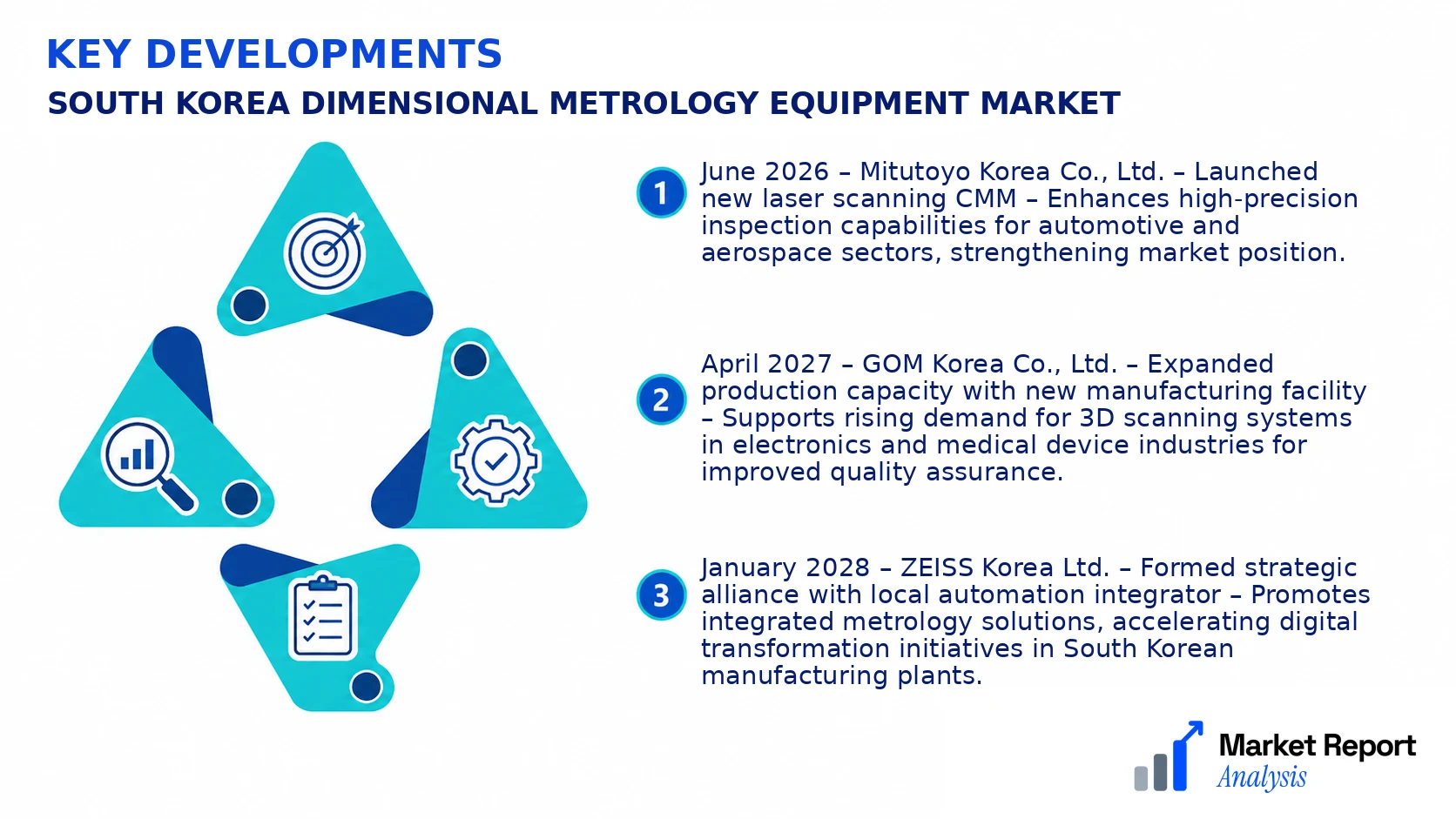
- June 2026 – Mitutoyo Korea Co., Ltd. – Launched new laser scanning CMM – Enhances high-precision inspection capabilities for automotive and aerospace sectors, strengthening market position.
- April 2027 – GOM Korea Co., Ltd. – Expanded production capacity with new manufacturing facility – Supports rising demand for 3D scanning systems in electronics and medical device industries for improved quality assurance.
- January 2028 – ZEISS Korea Ltd. – Formed strategic alliance with local automation integrator – Promotes integrated metrology solutions, accelerating digital transformation initiatives in South Korean manufacturing plants.
- August 2027 – Hexagon Manufacturing Intelligence Korea – Acquired a regional software firm – Enhances their data analytics platform for predictive maintenance, boosting competitiveness in Industry 4.0 projects.
- March 2029 – Nikon Korea Co., Ltd. – Invested in R&D for next-generation multisensor CMMs – Aims to lead in ultra-high accuracy measurement solutions tailored for semiconductor manufacturing.
Frequently Asked Questions
What is the South Korea Dimensional Metrology Equipment Market?
The South Korea Dimensional Metrology Equipment Market encompasses the manufacturing, distribution, and utilization of precise measurement instruments used across industries such as automotive, electronics, and aerospace to ensure quality control, adherence to standards, and process optimization within the country.
What is the current market size of South Korea Dimensional Metrology Equipment Market?
As of 2026, the South Korea Dimensional Metrology Equipment Market is valued at approximately USD 2.1 Billion, driven by increasing industrial automation, quality assurance needs, and technological advancements in metrology instruments across manufacturing sectors.
What factors are driving the South Korea Dimensional Metrology Equipment Market?
Market growth is primarily fueled by rapid technological innovation, rising demand for high-precision manufacturing, stringent quality standards, and government initiatives supporting advanced manufacturing infrastructure and Industry 4.0 adoption in South Korea.
Which South Korean city leads the South Korea Dimensional Metrology Equipment Market?
Seoul leads the South Korea Dimensional Metrology Equipment Market, owing to its status as the country’s industrial, technological, and manufacturing hub, hosting major corporations, research centers, and government agencies focused on innovation and quality control.
Which segment is expected to grow the fastest?
The portable and handheld metrology instruments segment is forecasted to grow the fastest, driven by increased on-site inspections, the need for rapid measurements, and advancements making portable devices more accurate and affordable for diverse industrial applications.
Who are the leading companies operating in the South Korea Dimensional Metrology Equipment Market?
Key market players include Hexagon AB, Zeiss, Nikon, Mitutoyo, and local firms such as Hyundai Metrology, demonstrating a mix of global expertise and domestic manufacturing strength shaping the competitive landscape in South Korea.
Analyst Perspective
The South Korea Dimensional Metrology Equipment Market is poised for sustained growth driven by ongoing advancements in manufacturing quality standards and increasing demand for automation across sectors such as electronics, automotive, and aerospace. Long-term prospects remain favorable as technological evolution focuses on integrating artificial intelligence and machine learning for enhanced measurement accuracy and process efficiency. Investment priorities should emphasize R&D in innovative sensor technologies and precision measurement systems, with government policies supporting Industry 4.0 initiatives fostering a conducive environment for market expansion. Competitive intensity is expected to intensify, with local and international players vying for market share through strategic partnerships and technological differentiation. City-level growth potentials are notable in Seoul and Incheon, where concentration of high-tech industries and manufacturing clusters catalyze demand. For strategic positioning, companies should focus on establishing R&D facilities in these hubs, leveraging digital transformation trends, and tailoring solutions to local manufacturing needs. Sustained innovation and regional adaptation will be crucial for long-term market leadership.
