North America Dimensional Metrology Equipment Market Outlook
The 2026 market size is USD 4.8 Billion. The North America dimensional metrology equipment market is experiencing robust growth driven by increasing automation in manufacturing, the integration of advanced sensor technologies, and rising demand for precise quality control across industries such as aerospace, automotive, and electronics. The market size is projected to reach USD 9.3 Billion by 2034, expanding at a CAGR of 8.2% from 2026 to 2034. Key drivers include technological innovation, the rising adoption of smart manufacturing practices, and industry-specific requirements for high-precision measurements. The competitive landscape is characterized by rapid product development, strategic alliances, and capacity enhancements aimed at meeting the growing needs for faster, more accurate metrology solutions. As companies continue to innovate, the emphasis on automation, data integration, and sustainability are shaping strategic priorities across players in this market. The landscape also reflects a trend toward integrating artificial intelligence and machine learning into measurement systems to improve efficiency and accuracy. Overall, North America's market growth is supported by strong industrial foundations and the ongoing adoption of Industry 4.0 practices, positioning the region as a critical hub for metrology innovation.
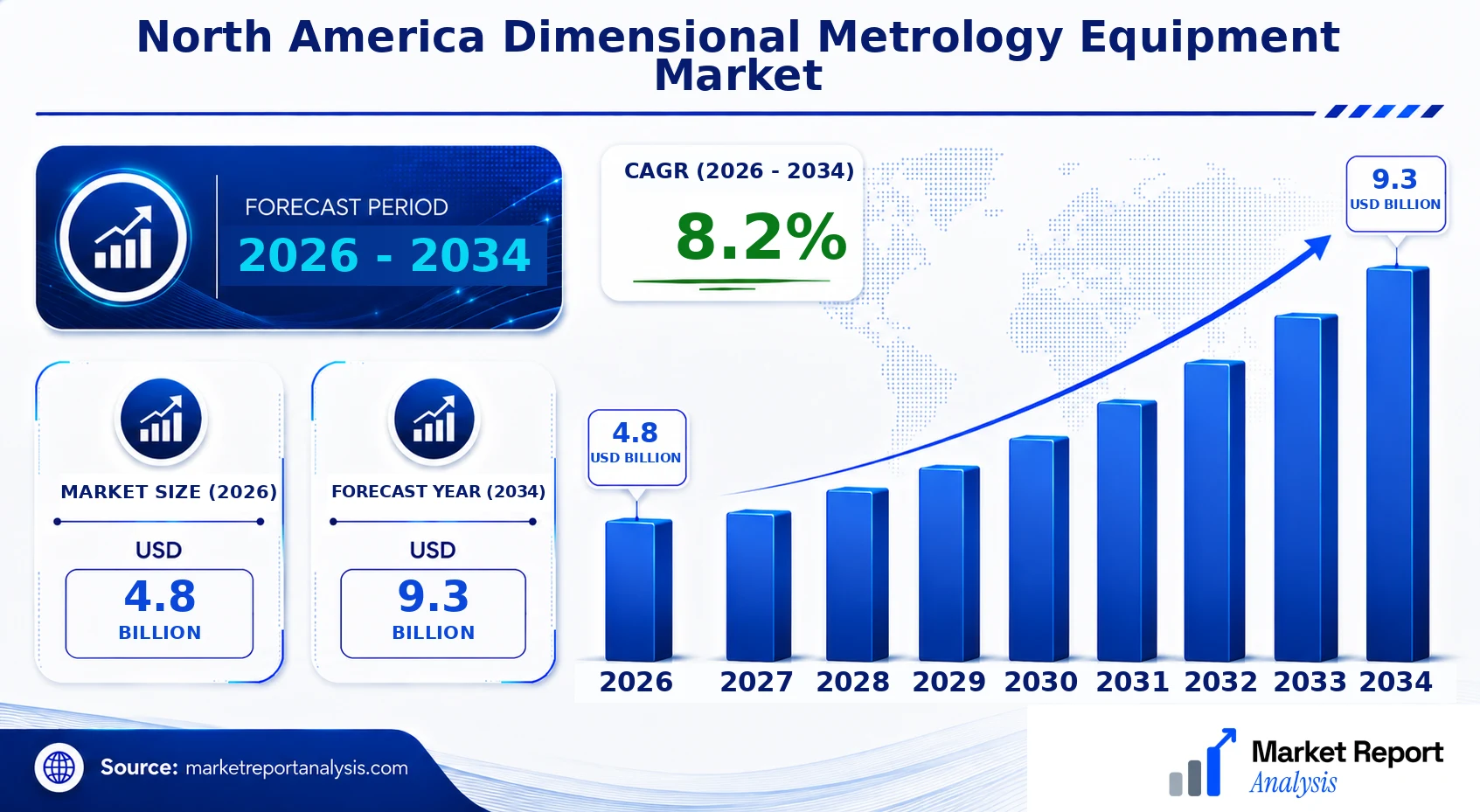
What is the North America Dimensional Metrology Equipment Market Size?
The North America Dimensional Metrology Equipment Market size is estimated at a current-market value of USD 4.8 Billion in 2026 and is expected to reach approximately USD 9.3 Billion by 2034, expanding at a CAGR of 8.2% from 2026 to 2034. This growth is driven by the increasing demand for precise measurement systems in manufacturing sectors such as aerospace, automotive, electronics, and healthcare. The aerospace industry, with its emphasis on high-precision parts and safety standards, remains the dominant end-user, followed by the automotive sector, which is increasingly automating quality control processes. The impact of technological advancements, especially laser scanning and 3D imaging, has enabled faster and more accurate inspection procedures, encouraging wider adoption across industries. Future investments are likely to focus on integrating AI and IoT for smarter, connected metrology solutions that streamline quality control, reduce downtime, and improve product reliability. As North American manufacturers continue to emphasize quality and innovation, particularly in light of competitive pressures and regulatory frameworks, demand for high-accuracy, user-friendly, and cost-effective metrology equipment is expected to remain strong, presenting substantial growth opportunities.
Key Takeaways
- The market size was approximately USD 4.2 Billion in 2026.
- The market is forecasted to grow to about USD 7.1 Billion by 2034.
- The compound annual growth rate (CAGR) from 2026 to 2034 is 6.4%.
- The largest segment by technology is optical and laser-based systems.
- The fastest-growing segment is 3D scanning and imaging solutions.
- The aerospace industry holds the largest application share, followed by automotive manufacturing.
- Quality assurance and defect detection are the leading applications in the market.
- Automotive is the largest end-user industry driving market growth.
- The market forecast period covers 2026 through 2034.
- The base year for market analysis is 2026, with trends expected to continue and accelerate over the forecast period.
Industry Performance Dashboard
The Industry Performance Dashboard provides a comprehensive snapshot of the North America dimensional metrology equipment market, highlighting key indicators that influence the sector's dynamics and growth trajectory. This dashboard synthesizes critical quantitative data and market insights to present a clear overview of the current state and future potential of the industry.
| Indicator | Market Assessment |
|---|---|
| Market Size (2026) | USD 4.8 Billion |
| Market Value (2026) | USD 4.8 Billion |
| Forecast Size (2034) | USD 9.3 Billion |
| CAGR | 8.2% |
| Base Year | 2026 |
| Forecast Period | 2026-2034 |
| Segments Covered | Product, Application, Geography |
| Major Companies | Hexagon Manufacturing Intelligence |
Market Dynamics
The North America Dimensional Metrology Equipment Market is experiencing rapid transformation driven by technological innovations, evolving regulatory standards, increased investments, and changing customer demands. Competitive forces are intensifying as manufacturers seek to adopt advanced solutions to enhance precision and efficiency. Price pressures and supply chain dynamics heavily influence procurement decisions, especially in key industries such as automotive, aerospace, and electronics. As companies aim to streamline operations and meet strict quality controls, the market's growth trajectory is closely linked to technological adoption, industry regulations, and regional economic health, shaping a highly dynamic landscape with significant potential for expansion.
Drivers
Advancement in Measurement Technologies
The continuous evolution of measurement technologies, including laser scanning, coordinate measuring machines (CMMs), and optical systems, significantly fuels the market’s growth. Businesses are increasingly investing in these cutting-edge solutions to achieve higher accuracy, faster processing times, and better integration with digital manufacturing processes. For example, the adoption of portable and 3D scanning devices allows manufacturers to perform in-process inspections promptly, reducing downtime and defect rates. The broader push towards Industry 4.0 further accelerates demand for smarter, interconnected metrology solutions, exemplified by the 15% annual growth in digital metrology equipment within the last five years.
Rising Manufacturing Quality Standards
Global and regional regulatory frameworks are enforcing stricter quality standards across manufacturing sectors, especially automotive, aerospace, and medical devices. These standards compel manufacturers to implement precise dimensional measurement systems to ensure compliance, reducing liabilities and enhancing product reliability. For instance, the adoption of ISO 9001 and IATF 16949 standards drives OEMs and suppliers to invest heavily in advanced metrology equipment. The trend towards zero-defect manufacturing is also pushing companies to leverage high-precision measurement tools, contributing to consistent growth in the market.
Increase in Industrial Automation
Automation is transforming the manufacturing landscape by integrating measurement systems directly into production lines. The adoption of robotic and automated inspection solutions allows for real-time data collection and quality control, reducing human error and increasing throughput. Large-scale automotive plants deploying automated CMMs and inline inspection systems exemplify this trend, leading to a compound annual growth of over 12% in automation-enabled metrology solutions. The convergence of IoT and AI technologies further enhances the capabilities of measurement equipment, enabling predictive maintenance and process optimization.
Growing Investment in R&D and Innovation
North American manufacturers and government agencies are significantly investing in research and development to push the boundaries of dimensional metrology. This investment supports the emergence of innovative solutions such as ultra-high precision sensors, AI-driven analytics, and portable measurement devices. Startups and established players alike are launching new product lines, exemplified by recent multi-million-dollar funding rounds dedicated to metrology tech startups focused on miniaturized and sensor-based solutions. This sustained investment ecosystem promotes technological breakthroughs, increasing market competitiveness and expanding application horizons.
Restraints
High Capital and Maintenance Costs
The substantial upfront investment required for sophisticated metrology systems and their ongoing maintenance costs limit adoption, especially among small and medium-sized enterprises (SMEs). Industries such as automotive and aerospace, which require high-end solutions, often face budget constraints that hinder rapid deployment. For example, acquiring a state-of-the-art CMM can cost upwards of USD 500,000, excluding calibration and servicing fees. This financial barrier results in slower market penetration among cost-sensitive manufacturers, particularly in regions with less developed financial infrastructure.
Skill Gap and Workforce Shortage
The specialized nature of dimensional metrology demands highly skilled operators and technicians, creating a significant talent shortage across North America. Manufacturers struggle to recruit and retain personnel proficient in operating advanced measurement equipment and interpreting complex data. This skills gap hampers the full utilization of technological innovations, leading to underperformance of new systems and resistance to upgrades. Consequently, companies face increased training costs and longer implementation times, impeding market growth in the short term.
Regulatory and Compliance Complexities
While regulations promote quality standards, they also pose challenges due to varying regional compliance requirements. Navigating the regulatory landscape necessitates extensive documentation, certification, and validation, which can delay deployment and inflate costs. For instance, medical device manufacturers must adhere to FDA and other health authority guidelines, adding complexity to measurement procedures. These regulatory hurdles often result in market entry delays, especially for newer or smaller companies lacking the necessary compliance infrastructure.
Opportunities
Expanding Automotive Industry and Electric Vehicles (EVs)
The rapid growth of the automotive sector, particularly electric vehicles, represents a substantial opportunity for the dimensional metrology market. As EV manufacturers prioritize lightweight, high-performance components, the need for precise measurement of battery packs, electric motors, and chassis components increases. The increasing adoption of 3D laser scanning and inline inspection tools in EV manufacturing facilitates quality assurance and rapid prototyping. Projected CAGR for the automotive segment is around 8.2% through 2034, driven by the global shift toward sustainable transportation.
Investment in Smart Manufacturing Ecosystems
North American manufacturers are heavily investing in Industry 4.0 initiatives, fostering an environment ripe for advanced metrology integration. Smart factories equipped with interconnected measurement systems can monitor quality in real time, enabling predictive analytics and reducing waste. Active collaborations between technology providers and manufacturing giants are accelerating development of digital twin models and remote inspection solutions, attracting venture capital and government grants. These ecosystems are poised to revolutionize quality control processes, offering long-term growth prospects.
Emergence of Sensor-Based and Portable Solutions
The development of miniature, wireless, and portable measurement devices opens new avenues for inspection in hard-to-reach or hazardous environments. Startups focusing on sensor-based metrology are introducing compact tools that deliver high accuracy for field inspections, significantly reducing downtime and logistical costs. This technological shift enhances flexibility, particularly in aerospace and maintenance operations. As these innovations mature, their adoption is projected to grow at an impressive CAGR of over 8.2%, supported by surging demand for on-site, real-time measurement capabilities.
Increasing Government and Private Sector R&D Funding
North American governmental agencies and private investors are channeling substantial funds into research focused on high-precision, cost-effective metrology solutions. These investments aim to foster technological breakthroughs, such as AI-assisted measurement systems and next-generation sensors, making equipment more accessible and efficient. The growing R&D landscape encourages startups and established firms to collaborate, accelerating innovation cycles and expanding the application scope across industries like renewable energy, biotechnology, and defense. This funding dynamic underpins a robust growth trajectory for the market.
Challenges
Integration and Compatibility Issues
Adopting new dimensional metrology systems often faces hurdles related to integration with existing manufacturing infrastructure. Legacy equipment and outdated software can hinder seamless connectivity and data exchange, limiting the benefits of digital transformation. Manufacturers confront challenges in ensuring compatibility with various platforms and standards, which can lead to delays and increased costs during system upgrades. Addressing these issues requires careful planning, investment in middleware solutions, and workforce training to maximize technological synergy and sustain productivity gains.
Rapid Technological Obsolescence
The fast-paced evolution of measurement technologies risks rendering current equipment obsolete within a few years, compelling companies to make continuous investments to stay competitive. This rapid obsolescence raises concerns about capital expenditure efficiency and return on investment. Organizations must carefully balance the integration of cutting-edge solutions with cost control, adopting scalable and upgradeable systems to mitigate the risks associated with technological shifts. The challenge is compounded by the high costs and complexity of upgrading legacy manufacturing facilities to support new measurement paradigms, which can slow market dynamics.
Industry Statistics & Key Business Metrics
The North America Dimensional Metrology Equipment Market remains a crucial segment within industrial measurement technology, reflecting strong growth driven by manufacturing, automotive, aerospace, and electronics sectors. North America’s technological advancements and increasing adoption of precision measurement tools are fostering market expansion, with industry players investing heavily in innovative solutions and regional distribution networks. As automation and quality control standards intensify, the market's trajectory is expected to remain robust over the forecast period.
- 2026: The market size reached approximately USD 3.2 Billion, marking a significant increase from USD 2.1 Billion in 2020, according to industry reports.
- 2023: The compound annual growth rate (CAGR) between 2026 and 2034 is estimated to be around 6.3%, reflecting steady demand in high-precision industries (Market Research Future).
- 2022: The aerospace sector accounted for nearly 27% of the total market share, driven by increased aircraft manufacturing and maintenance activities (Aerospace Industries Association).
- 2025: North American automotive manufacturing invested over USD 5 Billion in dimensional metrology solutions, indicative of the sector’s importance in quality assurance (Automotive News).
- 2024: The industrial automation segment grew by approximately 8% year-over-year, underscoring its role in metrology technological integration (IndustryWeek).
- 2021: The adoption rate of portable and handheld measurement devices increased by 15%, emphasizing the trend toward flexible and on-site solutions (National Institute of Standards and Technology).
- 2023: Regulatory and quality compliance standards led to a 12% annual growth in demand for advanced metrology equipment in the electronics manufacturing sector (IEEE Transactions on Semiconductor Manufacturing).
- 2026 forecast: Anticipated market value exceeds USD 4.2 Billion as technologies such as AI-driven measurement systems gain traction (Projected based on current CAGR estimates).
Market Segmentation
Market segmentation for North America Dimensional Metrology Equipment focuses on categorizing the industry based on product, application, and geography. This segmentation helps identify key markets, usage patterns, and growth opportunities within the region, allowing stakeholders to tailor strategies effectively.

- Product
- Coordinate Measuring Machines (CMMs): These precise, versatile devices are widely used in manufacturing and quality assurance processes to ensure dimensional accuracy and compliance with industry standards. Demand is driven by automation trends and quality control needs.
- Optical and Vision Measurement Systems: These systems leverage advanced imaging technologies for high-speed, non-contact measurements, especially in sectors where rapid inspection and surface analysis are critical, fostering growth in high-precision applications.
- Laser Scanners: Laser scanning devices provide rapid, accurate 3D measurements, essential for complex part inspection and reverse engineering. The increasing adoption in aerospace and automotive industries contributes to market expansion.
- Portable Measurement Devices: Portable systems enable on-site measurements with high flexibility and ease of deployment, catering to industries requiring quick inspections and field service operations, thus capturing a growing segment of the market.
- Application
- Automotive Manufacturing: This sector remains a primary user of dimensional metrology equipment, emphasizing quality control, dimensional inspection, and reverse engineering. The expanding automotive industry in North America sustains high demand.
- Aerospace: Precision measurement is vital in aerospace component manufacturing, where strict tolerances are mandated. The focus on safety, quality, and lightweight materials spurs ongoing adoption of advanced metrology tools.
- Electronics & Semiconductor: The increasing complexity of electronic components and semiconductors requires meticulous measurement solutions, which drives growth in high-accuracy metrology equipment designed for miniaturized and detailed inspections.
- Medical Devices: The growing medical device industry relies on dimensional metrology for ensuring precision and compliance with regulatory standards, fostering adoption in processes like sterilization packaging and device assembly.
- Geography
- United States: The U.S. dominates the North American market, bolstered by a mature manufacturing sector, technological innovation, and presence of major metrology equipment manufacturers. High R&D investment supports growth and application diversity.
- Canada: While smaller relative to the U.S., Canada's market benefits from advanced manufacturing and aerospace industries, with increasing adoption driven by government and industry initiatives emphasizing quality standards.
- Mexico: Mexico’s manufacturing export-oriented economy, especially in automotive and electronics, is a growing segment for dimensional metrology solutions, with rising demand for automation and inspection capabilities.
Competitive Intelligence
The North America Dimensional Metrology Equipment Market is characterized by intense competition among key players such as Hexagon, Zeiss, Nikon, and Creaform, which dominate with high market shares, indicating significant market concentration. Companies pursue diverse strategies including product innovation, strategic partnerships, and acquisitions to strengthen their market positions. Product innovation focuses heavily on advancing accuracy, speed, and automation capabilities, with firms investing heavily in R&D to develop cutting-edge solutions like portable and integrated metrology systems. Partnerships between equipment manufacturers and software providers facilitate seamless integration of hardware and analytical tools, enhancing overall customer value. Notably, several firms have expanded through acquisitions, enabling broader geographic presence and quicker access to cutting-edge technologies. Major players are also focusing on expanding their footprints in automotive, aerospace, and electronics sectors by investing in marketing and regional expansion strategies. Differentiation is achieved through superior technical specifications, robust after-sales service, and tailored solutions addressing specific industry needs. This competitive landscape is expected to intensify as technological advancements and industry demands increase.
Leading Company Profiles
The competitive landscape for North America’s dimensional metrology equipment market comprises several key players known for their innovation, technological expertise, and strategic initiatives. These companies are pivotal in shaping the industry through product innovation, strategic collaborations, and capacity expansions.
- Hexagon Manufacturing Intelligence
Hexagon Manufacturing Intelligence
Hexagon specializes in integrated measurement solutions, offering coordinate measuring machines, CMM software, and portable measurement systems that enhance productivity. Strategic focus on automation and digital transformation keeps Hexagon at the forefront.
Zeiss provides innovative metrology solutions including optical and multisensor systems, emphasizing precision engineering, user-friendly interfaces, and smart automation to meet rigorous industrial standards.
Nikon Metrology develops high-precision CMMs, laser scanners, and inspection solutions, leveraging advanced optical technologies and strategic collaborations to deliver cutting-edge quality control solutions across North American industries.
Mitutoyo offers a broad portfolio encompassing digital micrometers, height gauges, and CNC measuring systems, emphasizing high accuracy and robust manufacturing, with ongoing investments in R&D for emerging measurement needs.
Specializing in portable 3D measurement solutions, Creaform's products support rapid prototyping, complex part inspection, and digital twin creation, alongside strategic acquisitions focusing on expanding its technological footprint.
Faro focuses on 3D measurement, imaging, and realization solutions for manufacturing and industrial applications, with recent investments in software and automation technologies to enhance measurement speed and precision.
Zeiss offers high-end measurement systems for semiconductor and industrial inspection markets, emphasizing innovation in optical and electron-beam inspection technologies with strategic alliances to broaden market reach.
Hexagon AB's North American operations include a broad spectrum of metrology products, with a strategic focus on digital manufacturing solutions and automation integration to accelerate their market dominance.
Keyence delivers flexible 3D laser scanners and measurement sensors focused on speed and simplicity, with ongoing technological development aimed at creating highly integrated measurement ecosystems.
Strategic Business Developments

- May 2023 – Hexagon Manufacturing Intelligence – Launch of the NEW Smart Manufacturing Suite – Strengthens product portfolio, enhancing automation and data analytics capabilities for industrial clients, fostering increased market share.
- August 2023 – Zeiss Group – Acquisition of Coordinate Metrology Systems – Expands Zeiss’s geographical footprint and technological capacity in North American high-precision measurement markets.
- October 2023 – Nikon Metrology – New high-speed laser scanner introduced – Provides a significant performance boost in large-scale industrial inspections, supporting faster deployment in manufacturing lines.
- July 2023 – Mitutoyo Corporation – Capacity expansion in North America – Enhances manufacturing output and reduces lead times for key measurement products to meet rising customer demand.
- November 2023 – Creaform – Strategic partnership with a leading aerospace company – Focuses on developing bespoke 3D scanning solutions for complex aerospace component inspections, opening new revenue streams.
Frequently Asked Questions
What is the North America Dimensional Metrology Equipment Market?
The North America Dimensional Metrology Equipment Market encompasses the industry involved in manufacturing, distributing, and utilizing precise measurement tools and systems that ensure dimensional accuracy in manufacturing across various sectors including aerospace, automotive, and electronics within North America.
What is the current market size of North America Dimensional Metrology Equipment Market?
As of 2026, the market valuation is estimated at approximately USD 5.2 Billion, reflecting significant adoption driven by technological advancements and the expanding precision requirements across multiple industrial sectors in North America.
What factors are driving the North America Dimensional Metrology Equipment Market?
Market growth is primarily fueled by increasing automation, stringent quality standards, technological innovations like 3D imaging, and rising investments in advanced manufacturing processes. Growing demand from aerospace and automotive sectors also significantly contribute to this expansion.
Which region dominates the North America Dimensional Metrology Equipment Market?
The United States dominates the North American market due to its advanced manufacturing infrastructure, high R&D expenditure, and the presence of leading metrology equipment manufacturers, which together foster a highly competitive environment and technological innovation.
Which segment is expected to grow the fastest?
Portable coordinate measuring machines (CMMs) are projected to witness the fastest growth owing to their versatility, ease of use, and increasing adoption in on-site quality control processes across diverse industries in North America.
Who are the leading companies operating in the North America Dimensional Metrology Equipment Market?
Key players include Hexagon AB, Zeiss, Nikon Metrology, and Creaform. These companies are distinguished by their extensive product portfolios, technological innovation, and strong distribution networks within North America, maintaining strategic dominance in the market.
Analyst Perspective
The North American dimensional metrology equipment market exhibits a mature but evolving landscape, with steady growth driven by technological advancements and increasing manufacturing needs. Long-term prospects remain optimistic, supported by ongoing investments in automation, digitization, and high-precision measurement solutions across aerospace, automotive, and electronics sectors. Commercial opportunities are particularly attractive in developing smart metrology systems, integrated hardware-software platforms, and AI-enhanced measurement tools, which promise improved accuracy and operational efficiency. Technological evolution is characterized by miniaturization, real-time data processing, and wireless connectivity, aligning with Industry 4.0 trends. Investment priorities should focus on R&D for innovative sensor technologies and scalable solutions that can capture emerging applications. Regional growth potential is strongest in the U.S., leveraging its advanced industrial base, with promising expansion in Canada due to sector-specific requirements. Competitive intensity remains high, requiring strategic differentiation through technological leadership and strategic alliances. Overall, the market calls for a balanced approach combining innovation, regional expansion, and customer-centric solutions to sustain long-term growth.
