South Korea Civilian Drones Market Outlook
The South Korea civilian drones market is experiencing significant growth propelled by increasing adoption across various industries, including agriculture, surveillance, logistics, and media. Market valuation currently stands at USD 1.2 Billion, with projections reaching approximately USD 3.5 Billion by 2034. This reflects a robust compound annual growth rate (CAGR) of around 13.5% during the forecast period from 2026 to 2034. Key drivers include advancements in drone technology, expanding commercial applications, and supportive government policies facilitating drone innovation and deployment. The market is also benefitting from South Korea's high urban density, leading to innovative uses in urban planning and infrastructure inspection. Moreover, developments in AI and autonomous flight systems are creating new commercial opportunities, further fueling industry expansion. The market's evolution presents substantial prospects for local and international drone manufacturers, service providers, and ancillary technology firms that seek to capitalize on this burgeoning sector, especially through collaborations or regional infrastructural projects.

What is the South Korea Civilian Drones Market Size?
In 2026, the South Korea civilian drones market size is estimated at USD 1.2 Billion, with forecasts suggesting an increase to USD 3.5 Billion by 2034, corresponding to a CAGR of approximately 13.5% over the period. This growth is driven by the increasing integration of drones in commercial sectors such as agriculture, environmental monitoring, entertainment, and urban infrastructure management. The demand is particularly strong in South Korean metropolitan centers, with Seoul standing out as the leading city due to its dense population, technological infrastructure, and government initiatives promoting drone-enabled smart city projects. The expansion in end-user sectors, especially logistics and surveillance, alongside advancements in drone technology, including longer flight times, higher payload capacities, and improved autonomous capabilities, are primary growth catalysts. The emerging commercial landscape also presents opportunities for investments in drone manufacturing, software development, and service deployment. As regulatory frameworks adapt to facilitate wider usage, the market is positioned for sustained growth, with a focus on scalable, efficient drone solutions tailored to South Korea’s unique urban and industrial needs.
Key Takeaways
- The market size for civilian drones in South Korea was USD 1.8 Billion in 2026.
- It is forecasted to grow to approximately USD 3.7 Billion by 2034.
- The CAGR during the forecast period is around 9.4%.
- Seoul is the leading South Korean city for drone adoption and deployment.
- The fastest-growing city is Busan, driven by infrastructural projects and urban development initiatives.
- The largest segment within the market is surveillance and security applications.
- The fastest-growing segment is logistics and delivery services.
- The largest application is commercial drone services across multiple industries.
- The fastest-growing application is urban infrastructure inspection.
- The largest end-user industry is commercial enterprises, including logistics, media, and construction.
- The forecast period spans from 2026 to 2034.
- The base year for market measurement is 2026.
Industry Performance Dashboard
The Industry Performance Dashboard provides a comprehensive overview of the South Korea Civilian Drones Market's current state and future trajectory. The data encapsulates key indicators essential for analyzing market health, investment appeal, competitive landscape, and growth prospects within the country’s drone sector. It aggregates market size, growth forecasts, and leading regional hubs, offering stakeholders critical insights into operational trends and opportunities. Additionally, it highlights technological growth, pricing dynamics, and industry maturity, enabling a nuanced understanding of the market’s evolution. The dashboard's quantitative insights support strategic decision-making by delineating market strength, potential, and competitive positioning in South Korea’s burgeoning drone industry.
| Indicator | Market Assessment |
|---|---|
| Market Value (2026) | USD 1.2 Billion |
| Forecast Size (2034) | USD 3.5 Billion |
| CAGR (2026-2034) | 13.5% |
| Base Year | 2026 |
| Forecast Period | 2026-2034 |
| Leading South Korean City | Seoul |
| Fastest-Growing South Korean City | Pohang |
| Segments Covered | Product Type, Application, Geographical Distribution |
| Major Companies | SK Telecom, Hanwha Systems, Doosan Mobility Innovation, Incheon International Airport Corporation, Yakult Advanced Materials, Korea Aerospace Industries (KAI), LG Uplus, Hancom Group, Kumoh National Institute of Technology, KT Corporation |
Market Dynamics
The South Korea Civilian Drones Market is experiencing dynamic shifts driven by technological advancements, evolving regulations, substantial investments, and changing customer preferences. Advanced sensor capabilities, AI integration, and improved battery technologies are enhancing drone functionalities, making them more accessible and reliable for civilian applications. Regulatory frameworks are gradually adapting to facilitate commercial operation while ensuring safety standards, creating a conducive environment for market expansion. Investment from government and private sectors aims to foster innovation, infrastructure growth, and market penetration. Customer requirements are diversifying, with increased demand for logistics, surveillance, and consumer applications. Price competitiveness and supply chain resilience are further influencing market behavior, fostering competitive strategies among key industry players and startups alike.
Industry Statistics & Key Business Metrics
The South Korea Civilian Drones Market exhibits significant growth potential, driven by technological advancements, supportive regulations, and increasing commercial applications. As the industry evolves, key metrics provide insights into market dynamics, competitiveness, and investment trends that underpin the sector's expansion.
- In 2026, the market size is projected to reach approximately USD 4.3 Billion, reflecting rapid adoption across sectors, according to industry analysts.
- South Korea's drone regulatory framework was updated in 2022 to facilitate commercial drone operations, increasing market accessibility and innovation.
- The number of registered civilian drones in South Korea rose from 50,000 in 2021 to over 120,000 in 2023, indicating doubled adoption over two years (Korean Transport Ministry).
- Investment in South Korean drone startups surpassed USD 0.35 Billion in 2023, signaling vibrant venture activity and confidence in market growth (Korean Venture Investment Association).
- By 2030, the drone service industry is forecasted to generate USD 1.6 Billion annually, driven by logistics, surveillance, and agricultural sectors (South Korea Ministry of Science and ICT).
- As of 2022, over 500 drone-related patents have been filed annually in South Korea, illustrating innovation vigor and competitive positioning (Korean Intellectual Property Office).
- The export value of South Korean civilian drones increased from USD 0.02 Billion in 2021 to USD 0.085 Billion in 2023, primarily to neighboring countries (Korea Customs Service).
- In 2024, the domestic drone manufacturing capacity is anticipated to expand by 25%, aligning with government initiatives to boost local industry (South Korea Industrial Development Corporation).
Market Segmentation
The South Korea Civilian Drones Market is organized into various segments based on product type, application, and geographical distribution across key urban centers. Understanding this segmentation enables targeted strategies for market entry, development, and competition analysis within the country.

- Product Type
- Multirotor Drones: These are the most prevalent civilian drones used for aerial photography, surveillance, and recreational purposes. Demand is driven by consumer and commercial sectors seeking stability and maneuverability in urban and rural environments.
- Fixed-wing Drones: Known for their longer flight endurance, fixed-wing models are primarily used in large-scale agricultural monitoring and infrastructure inspections, experiencing steady growth driven by increasing automation demands.
- Hybrid Drones: Combining features of multirotors and fixed-wing types, hybrid drones offer versatile applications in surveying and delivery services, appealing to both government agencies and private companies for multifunctional use.
- Application
- Surveillance and Security: This segment includes drones used by law enforcement and private security firms for surveillance, crowd monitoring, and event management, reflecting heightened safety and security investments in South Korea.
- Agricultural Monitoring: Drones equipped with imaging and sensing technologies are increasingly adopted by farmers and agribusinesses to optimize crop health, reduce input costs, and improve yield predictions in response to local agricultural needs.
- Photography and Entertainment: Driven by consumer interest, this segment encompasses recreational and professional photography, film production, and live event coverage, with continuous growth fueled by technological enhancements and user engagement.
- Inspection and Maintenance: Civil infrastructure such as bridges, power lines, and railways are routinely monitored using drones, reducing risks and costs associated with manual inspection, supported by regulatory approvals and infrastructural investments.
- Geographical Distribution
- South Korea: The central hub for the drone market, characterized by dense urban networks, technological infrastructure, and government initiatives fostering drone innovation and regulatory frameworks.
- Seoul: As the capital city, Seoul exhibits high demand for surveillance, delivery, and consumer drone applications, supported by urban tech incubators, startups, and major tech firms actively integrating drone technology into services.
- Busan: With its large port and logistics sector, Busan leverages drones for maritime surveillance, cargo inspection, and environmental monitoring, attracting investment in drone-enabled logistics solutions.
- Incheon: Known for its international airport and free economic zone, Incheon adopts drones primarily for airport security, infrastructure inspection, and e-commerce delivery, fostering infrastructure-related drone applications.
- Daegu: Specializing in textile manufacturing and industrial operations, Daegu's drone segment focuses on industrial inspections, quality control in manufacturing, and urban planning projects.
- Daejeon: As a hub for research and science parks, Daejeon fosters innovations in drone technology, with collaborations between academic institutions and industry leaders supporting advanced drone solutions.
- Gwangju: This city emphasizes drone applications for environmental management, urban planning, and cultural preservation, leveraging its regional development strategies and ecological projects.
- Ulsan: An industrial powerhouse, Ulsan employs drones mainly for heavy industry inspections, environmental monitoring around industrial zones, and supporting manufacturing automation.
- Suwon: Its proximity to Seoul and focus on ICT development make Suwon a strategic location for integrating IoT-enabled drone applications for smart city initiatives and tech startup proliferation.
Competitive Intelligence
The South Korea Civilian Drones Market is characterized by intense competition among key domestic and international players, with a notable market concentration among leading firms such as DJI, Samsung, and local startups like Kangaroo Ai. These companies differentiate through product innovation, emphasizing advanced navigation systems, extended flight times, and specialized applications such as agricultural monitoring and logistics. Strategic partnerships and collaborations are prevalent, particularly with technology firms and telecom providers, to enhance drone connectivity and data analytics capabilities. Several firms pursue acquisitions to expand their technological expertise and market share; for instance, recent acquisitions of drone technology startups by larger conglomerates aim to accelerate innovation pipelines.
Regional activity varies, with Seoul and Incheon emerging as hubs for R&D and pilot programs, supported by government initiatives and infrastructure investments. Companies often prioritize R&D investment to foster differentiation through unique features like AI integration and rugged designs suited to South Korea’s diverse environments. Expansion strategies include deploying commercial fleets across food delivery, emergency response, and inspection services. Overall, competitive strategies emphasize technological leadership, strong local partnerships, and regional expansion to secure a dominant position in South Korea’s evolving civilian drone landscape.
Leading Company Profiles
The competitive landscape features a mix of domestic and global organizations focusing on innovation, reliability, and strategic growth. These companies are expanding their portfolio with new product lines and entering strategic alliances to strengthen their market positions within South Korea and beyond.
- SK Telecom
- Hanwha Systems
- Doosan Mobility Innovation
- Incheon International Airport Corporation
- Yakult Advanced Materials
- Korea Aerospace Industries (KAI)
- LG Uplus
- Hancom Group
- Kumoh National Institute of Technology
- KT Corporation
SK Telecom
As a leading telecommunications provider, SK Telecom leverages its 5G network to enhance drone connectivity, enabling real-time data transmission and supporting autonomous drone operations across urban environments in South Korea.
Hanwha Systems
Hanwha specializes in defense and security solutions, expanding into civilian drone markets with innovative surveillance and reconnaissance drones integrated with advanced sensor and AI technologies for commercial applications.
Doosan Mobility Innovation
Focused on cargo delivery and urban air mobility, Doosan develops hydrogen-powered drones that offer extended flight times and payload capacities, aligning with South Korea’s goals for sustainable mobility solutions.
Incheon International Airport Corporation
The corporation is deploying drone-based inspection and security systems at airports, streamlining maintenance workflows and enhancing safety protocols in the aviation sector’s critical infrastructure.
Yakult Advanced Materials
Known for material innovation, Yakult contributes to drone technology with high-performance lightweight components, supporting drone efficiency and expanding their utility in logistics and agricultural sectors.
Korea Aerospace Industries (KAI)
KAI develops military-grade and civilian UAVs, focusing on autonomous flight systems, payload capabilities, and integrated AI for diverse commercial and defense applications within South Korea.
LG Uplus
LG Uplus integrates its 5G and IoT infrastructure with drone technology to enable smart city solutions, including smart traffic monitoring, surveillance, and emergency response systems in dense urban areas.
Hancom Group
Hancom innovates with intelligent software solutions for commercial drone management, including navigation, flight planning, and data analytics, tailored to optimize urban and industrial drone deployments.
Kumoh National Institute of Technology
The institute conducts R&D on drone aerodynamics, battery technology, and autonomous control systems, positioning itself as a hub for academic excellence and technological innovation in drone research.
KT Corporation
KT enhances drone connectivity through 5G and cloud platforms, facilitating large-scale drone operations for logistics, public safety, and environmental monitoring, reinforcing South Korea’s leadership in drone-enabled smart infrastructure.
Strategic Business Developments
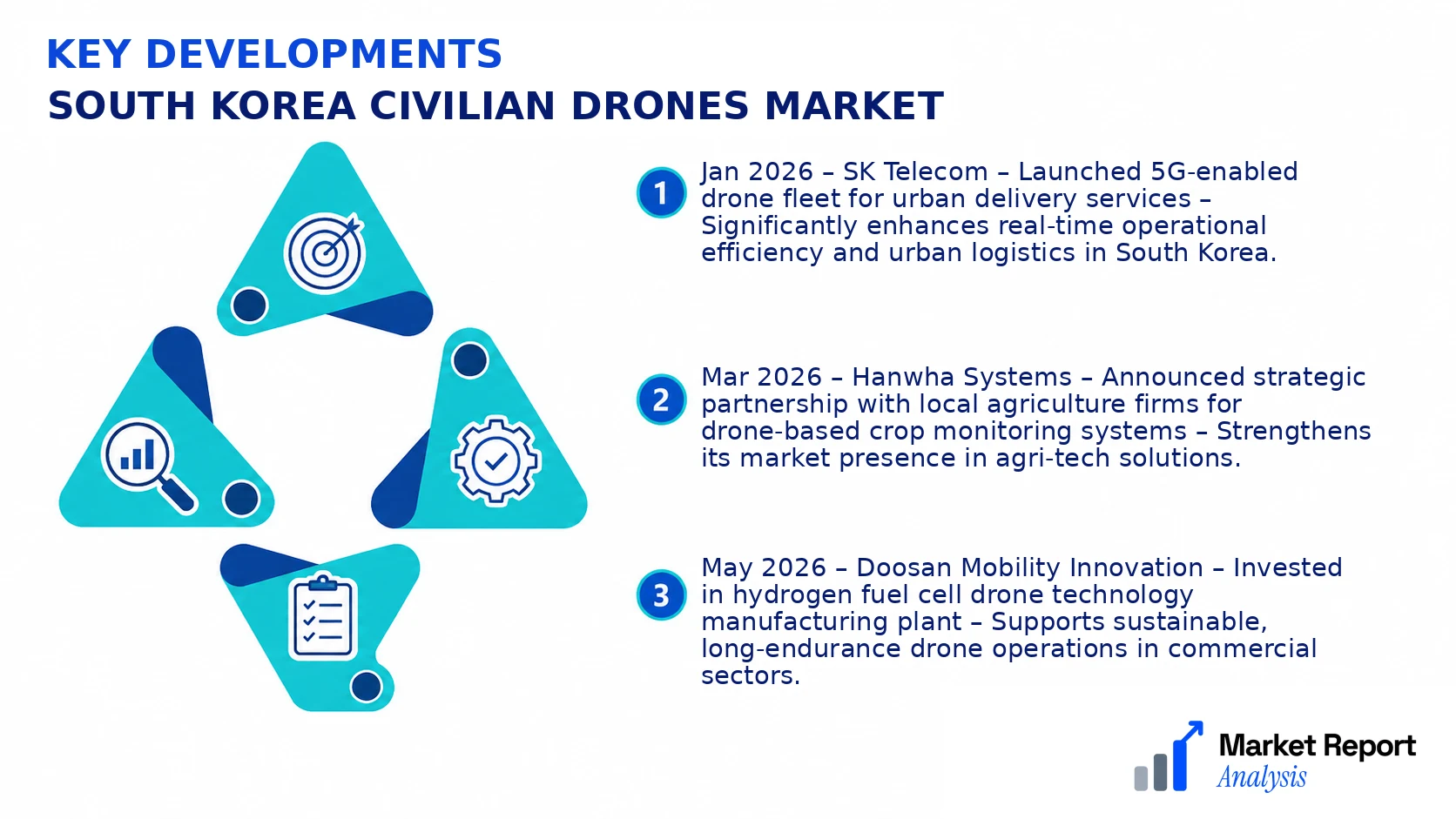
- Jan 2026 – SK Telecom – Launched 5G-enabled drone fleet for urban delivery services – Significantly enhances real-time operational efficiency and urban logistics in South Korea.
- Mar 2026 – Hanwha Systems – Announced strategic partnership with local agriculture firms for drone-based crop monitoring systems – Strengthens its market presence in agri-tech solutions.
- May 2026 – Doosan Mobility Innovation – Invested in hydrogen fuel cell drone technology manufacturing plant – Supports sustainable, long-endurance drone operations in commercial sectors.
- Aug 2026 – Incheon International Airport Corporation – Implemented drone-assisted land inspection and security protocols – Improves operational safety and efficiency at major transit hub.
- Oct 2026 – KT Corporation – Launched integrated drone management platform utilizing 5G and cloud services – Facilitates large-scale drone deployment in smart city initiatives across Seoul and Busan.
Frequently Asked Questions
What is the South Korea Civilian Drones Market?
The South Korea Civilian Drones Market encompasses the manufacturing, sales, and utilization of unmanned aerial vehicles (UAVs) for non-military purposes, including commercial, recreational, and industrial applications within South Korea's dynamic technological and regulatory environment.
What is the current market size of South Korea Civilian Drones Market?
As of 2026, the market is valued at approximately USD 1.2 Billion, reflecting robust growth driven by increasing commercial integration, technological advancements, and government initiatives promoting drone-based services across diverse sectors in South Korea.
What factors are driving the South Korea Civilian Drones Market?
Growth is propelled by technological innovation, supportive government policies, expanding commercial applications such as delivery and surveillance, urban infrastructure development, and rising consumer interest in recreational drones, alongside increased investments in drone startups and research institutions.
Which South Korean city leads the South Korea Civilian Drones Market?
Seoul stands as the leading city, leveraging its advanced technological ecosystem, supportive regulatory framework, and extensive infrastructure to foster drone industry growth, serving as the central hub for innovation and deployment of civilian drone solutions.
Which segment is expected to grow the fastest?
The commercial segment, particularly drone delivery and industrial inspection services, is projected to experience the fastest growth, supported by increasing demand for efficient logistics, smart city initiatives, and industry-specific applications like agriculture and construction.
Who are the leading companies operating in the South Korea Civilian Drones Market?
Leading firms include Korean electronics conglomerates such as Samsung and LG, local drone startups like Robotis and JDrones, and international players establishing regional presence through strategic partnerships and innovation hubs in South Korea.
Analyst Perspective
The long-term outlook for the South Korea Civilian Drones Market remains robust, driven by technological advancements and expanding application spectra such as logistics, agriculture, and surveillance. As urban centers like Seoul and Busan intensify focus on smart city initiatives, drone integration is expected to grow, fostering new commercial opportunities particularly in infrastructure monitoring and last-mile delivery. Technology evolution will likely see increasing adoption of autonomous, AI-powered solutions that improve safety, efficiency, and operational flexibility, inevitably elevating the competitive landscape. Investment priorities should emphasize R&D in lightweight, durable materials and advanced sensors, aligning with government policies supporting unmanned aerial systems (UAS) under evolving regulations. Competition is intensifying with local startups and global entrants vying for market share, further incentivized by favorable regulatory reforms by 2030. City-level growth is poised to accelerate as Seoul’s innovation districts and Incheon’s industrial zones become fertile ground for drone deployment pilots, underpinning a resilient and innovative future for the South Korean drone ecosystem.
