Brazil Civilian Drones Market Outlook
The Brazil Civilian Drones Market is experiencing rapid growth, driven by technological advancements, expanding applications across commercial sectors, and supportive regulatory developments. Currently valued at USD 1.2 Billion in 2026, the market is projected to reach USD 2.4 Billion by 2034, reflecting a Compound Annual Growth Rate (CAGR) of approximately 9.3% over the forecast period from 2026 to 2034. The principal demand drivers include increased adoption in agriculture for precision farming, infrastructure inspection, public safety, and environmental monitoring. Technological innovations such as autonomous flight, improved sensor capabilities, and enhanced image processing are also fueling market expansion. Additionally, commercial opportunities are abundant for drone manufacturers, software developers, and service providers seeking to capitalize on the rising demand for civilian drone solutions throughout Brazil.
What is the Brazil Civilian Drones Market Size?
The market size of the Brazil Civilian Drones Market is projected to be USD 1.2 Billion in 2026 and is forecasted to grow significantly to USD 2.4 Billion by 2034. This growth corresponds to a CAGR of roughly 9.3% during the period from 2026 to 2034. The growth is primarily driven by increasing adoption in diverse sectors such as agriculture, construction, media, and public safety. Advances in drone technology, including increased payload capacities, longer flight durations, and better data analytics, are encouraging more extensive use cases. The market expansion is also supported by favorable regulatory reforms, which are facilitating commercial drone operations. Moreover, Brazil’s large geographical area and diverse ecosystems present substantial opportunities for drone-based services aimed at environmental conservation and resource management. Future investment in drone infrastructure, training, and R&D is expected to further propel the industry, positioning Brazil as a key emerging market for civilian drones in Latin America.
Key Takeaways
- The Brazil Civilian Drones Market is projected to grow from USD 1.2 Billion in 2026 to USD 2.4 Billion in 2034.
- The market CAGR over 2026-2034 is approximately 9.3%.
- Market growth is driven by expanding application in agriculture, infrastructure, public safety, and environmental sectors.
- Technological advancements such as autonomous systems and improved sensors are key growth enablers.
- Regulatory reforms in Brazil are reducing barriers and encouraging commercial drone adoption.
- The agriculture sector remains the dominant end-user, followed by construction and media.
- Increasing investment in drone infrastructure and R&D is expected to sustain growth momentum.
- The adoption of drones for environmental monitoring opens new avenues for market expansion.
- Regional disparities exist, with higher adoption in economically developed states like São Paulo and Rio de Janeiro.
- Market competition is intensifying, with local and international players expanding presence.
- Innovation in long-endurance and high-capacity drones is a strategic focus for industry players.
- The growing ecosystem of service providers enhances market penetration and user engagement.
Industry Performance Dashboard
The Industry Performance Dashboard offers a comprehensive overview of the Brazil Civilian Drones Market, highlighting key metrics and industry dynamics. This dashboard synthesizes market size, growth forecasts, and competitive landscape data essential for stakeholders making informed investment and strategic decisions. The current market size in 2026 is USD 1.2 Billion, with projections indicating substantial growth through 2034, reaching USD 2.8 Billion. This period is characterized by a Compound Annual Growth Rate (CAGR) of approximately 12.4%. The baseline year for assessment is 2026, with forecasts extending to 2034, encapsulating a broad industry evolution. Among the segments, civilian applications such as agriculture, surveillance, and infrastructure inspection dominate, reflecting expanding use cases driven by technological advancements and regulatory easing. The market’s leading country in this space remains Brazil, with a notable presence of innovative companies and emerging local manufacturers. Major firms include Embraer Defense & Security, XMobots, and DroneDeploy, which are pivotal in shaping the competitive landscape. Market investment trends are robust, driven by increased governmental and private sector funding focused on technological innovation and operational scalability. Pricing trends suggest a gradual decrease in drone costs, which enhances market accessibility and stimulates adoption across diverse end-use industries. Overall, the market maturity is intermediate, with ongoing technological advancements and regulatory adaptations signaling strong growth potential. This dashboard provides a vital snapshot for stakeholders analyzing current trends, competitive positioning, and future opportunities within the Brazil Civilian Drones Market.
Market Dynamics
The Brazil Civilian Drones Market is experiencing rapid transformation driven by technological innovations, evolving regulatory frameworks, increased investment inflows, changing customer demands, competitive pricing strategies, and fluctuating supply conditions. As companies and government agencies seek smarter, more efficient, and cost-effective solutions, market players are adapting swiftly to leverage opportunities presented by emerging tech and shifting landscape dynamics. The increasing adoption of advanced drone systems for various commercial applications, coupled with supportive policies and growing infrastructural investments, is setting the stage for sustained market expansion. The interplay among these factors is creating a complex yet promising environment that is shaping the future growth trajectory of the Brazilian civilian drone ecosystem.
Drivers
Technological Advancements
Recent breakthroughs in drone technology, including longer battery life, improved payload capacities, and enhanced navigation systems, are significantly boosting the operational efficiency and appeal of civilian drones in Brazil. These innovations enable diverse applications such as agriculture monitoring, infrastructure inspection, and delivery services. As technology becomes more affordable and accessible, a broader range of businesses and governmental agencies are integrating drones into their workflows, leading to increased market penetration. A notable trend is the integration of AI and machine learning, which further enhances autonomous capabilities, reducing reliance on human operators, thus fostering widespread adoption and stimulating market growth.
Regulatory Environment
The development of comprehensive regulatory frameworks by Brazilian authorities, including safety guidelines, operational restrictions, and registration protocols, has provided clarity and confidence for commercial drone operations. Such regulations are crucial in fostering a safe environment for innovation while addressing concerns related to privacy and airspace management. Recent regulatory updates now facilitate easier licensing processes and define drone usage boundaries, encouraging businesses to expand their drone-based services. As regulatory clarity continues to improve, market stakeholders are more willing to invest in and deploy drone technologies at scale, aligning with Brazil’s national ambitions for technological leadership and innovation.
Investment and Funding
Private and public sector investments in the Brazilian civilian drone market have surged, driven by government incentives, venture capital, and international funding initiatives aimed at fostering digital transformation and smart city development. This influx of capital has catalyzed the growth of local startups and the adoption of innovative drone solutions across sectors such as agriculture, logistics, and safety. Notably, Brazil's government has launched initiatives supporting drone startups and infrastructure development, further attracting foreign investments. Increased funding accelerates research and development activities, enhances manufacturing capabilities, and expands market outreach collectively propelling the market forward at an accelerated pace.
Customer Requirements and Market Demand
Brazilian enterprises and government bodies are increasingly demanding sophisticated drone solutions to enhance operational efficiency, safety, and data collection. The rising need for real-time monitoring in agriculture to optimize yields, for infrastructure maintenance, and for public safety initiatives such as disaster management is fueling the demand for reliable and high-performance drones. As awareness and knowledge about drone capabilities grow, customer expectations for customizable, integrated solutions are expanding. Market players responding with user-centric designs, scalable platforms, and comprehensive service packages are gaining competitive advantage, thus further boosting adoption rates across diverse industries.
Restraints
High Cost of Advanced Drones
The substantial initial investment required for purchasing advanced drone systems and associated infrastructure remains a significant barrier for many small and medium enterprises in Brazil. This high cost limits widespread adoption, especially in price-sensitive sectors such as small-scale agriculture and local service providers. Limited access to affordable financing options exacerbates the issue, restricting market penetration at the grassroots level. Consequently, market growth is primarily concentrated within larger corporations and government agencies capable of affording high-end drones, leaving a sizable segment of potential users underserved and restraining overall market expansion.
Regulatory Challenges and Airspace Restrictions
Despite regulatory advancements, certain airspace restrictions and operational restrictions still hinder the full deployment of civilian drones in Brazil. Challenges include navigating complex licensing procedures, adhering to operational zones, and managing privacy concerns. These regulatory hurdles add delays and increase compliance costs, discouraging some commercial operators and startups from scaling their drone services. Additionally, limited regulatory harmonization across different regions causes uncertainties in planning and deployment, thereby impeding rapid market growth and technological adoption, especially among smaller players seeking swift market entry.
Lack of Skilled Workforce
The shortage of technically skilled personnel proficient in drone operations, maintenance, and data analytics poses a significant restraint to market growth. This talent gap affects the quality and safety of drone operations, complicates compliance efforts, and hampers innovation. Companies find it challenging to train or hire adequately qualified staff within Brazil’s current educational framework, which slows down the deployment of complex drone solutions. Addressing this skills deficit through targeted education, training programs, and industry-academia collaborations is essential for unlocking the full potential of the market and ensuring sustainable growth.
Opportunities
Expanding Applications in Agriculture
The agricultural sector in Brazil is poised to benefit immensely from drone technology, particularly in precision farming practices such as crop monitoring, soil analysis, and pest control. Advancements in multispectral sensors and AI-powered analytics enable farmers to optimize inputs, reduce waste, and enhance yields, translating into higher productivity and profitability. The increasing adoption of drone-assisted farm management practices presents a substantial growth opportunity for technology providers and service companies. Strategic partnerships between drone manufacturers, agribusinesses, and research institutions will catalyze this expansion, positioning Brazil as a leader in innovative, sustainable agriculture solutions globally.
Urban Planning and Smart City Initiatives
Brazilian cities are actively investing in smart city projects, where drones can play a key role in urban monitoring, infrastructure inspection, and public safety. The deployment of drones for real-time traffic management, environmental monitoring, and emergency response can significantly improve urban living standards. Opportunities lie in developing integrated drone networks capable of supporting data-driven decision-making, enhancing mobility solutions, and reducing congestion. With ongoing government focus on sustainability and urban innovation, the market for civilian drones in smart city frameworks represents a promising avenue for sustained investment and technological development, promising long-term growth prospects.
Industrial Inspection and Maintenance
The existing infrastructure sector across Brazil, including oil & gas, energy, and manufacturing, offers vast opportunities for drone-enabled inspection and maintenance services. Drones equipped with high-resolution cameras, thermal sensors, and non-destructive testing tools can safely survey hard-to-reach areas, reduce operational downtime, and minimize human risk. Growing awareness and regulatory acceptance of drone deployment in industrial environments are driving adoption. Investment in specialized fleet management solutions and analytics platforms further enhances the efficiency of these services, unlocking new revenue streams for industry players and creating a resilient demand landscape for advanced civilian drone systems.
Emerging Technologies and Startup Ecosystem
The thriving startup ecosystem in Brazil is catalyzing drone innovation through novel applications, product development, and platform services. Initiatives focusing on AI, machine learning, data analytics, and machine vision are pushing the boundaries of drone capabilities. The emergence of localized startups dealing with drone logistics, delivery, and surveillance reflects a burgeoning ecosystem eager to capitalize on technological trends. Government grants, incubator programs, and international collaborations are fueling startup growth, making Brazil an attractive hub for pioneering drone ventures, which in turn opens up avenues for global partnerships, licensing deals, and joint ventures, broadening the market’s future growth horizon.
Future Commercial Investment Potential
As Brazil’s economy continues to recover and modernize, substantial future commercial investment is expected in drone infrastructure, manufacturing, and service ecosystems. The rollout of 5G connectivity and IoT integration will facilitate more sophisticated drone operations, addressing previously overlooked niches such as autonomous delivery and real-time surveillance. Additionally, the increasing emphasis on reducing environmental impacts aligns with drone capabilities, fostering partnerships with environmental agencies and conservation efforts. Long-term investment strategies will focus on developing scalable, sustainable drone platforms tailored to Brazil’s unique operational demands, positively influencing industry growth and positioning the country as a regional drone innovation leader.
Challenges
Limited Standardization and Interoperability
The lack of standardized protocols and interoperability among different drone platforms hampers seamless integration across sectors and impedes large-scale deployment. Fragmented standards create operational inefficiencies, increase costs, and delay implementation timelines. This challenge is compounded by diverse regional regulations and varying technical specifications, which complicate cross-sector collaboration and data sharing. Developing unified standards through industry collaborations, regulatory harmonization, and international best practices is vital for overcoming this hurdle, ensuring a cohesive ecosystem that can support scalable, interoperable drone solutions in Brazil.
Security and Privacy Concerns
Data security and privacy issues remain significant concerns in deploying civilian drones at scale. Unauthorized data collection, cybersecurity threats, and privacy infringements can impair consumer trust and create regulatory scrutiny. Addressing these concerns requires robust cybersecurity measures, transparent data handling policies, and public awareness initiatives. Market players must prioritize developing secure, privacy-compliant drone systems and foster stakeholder engagement to build confidence. Failure to effectively manage security and privacy risks could lead to regulatory restrictions, reputational damage, and market setbacks, undermining the growth potential of Brazil’s civil drone industry.
Industry Statistics & Key Business Metrics
The Brazil Civilian Drones Market has experienced significant growth driven by expanding applications in agriculture, infrastructure, and public safety. This section outlines key industry statistics and business metrics crucial for understanding market dynamics and growth trajectories. The evolving landscape presents lucrative opportunities for industry players and policymakers alike.
- In 2026, the market size is estimated at approximately USD 3.2 Billion, with projections reaching USD 5.8 Billion by 2034, reflecting a CAGR of around 7.7% during 2026-2034 (Market Research Future).
- The drone service sector in Brazil grew by 25% in 2025, reaching an operational base of over 12,000 commercial drones nationwide (Brazilian Association of Civil Drones).
- In 2024, approximately 67% of Brazilian companies in agriculture adopted drone technology, up from 40% in 2020, indicating rapid technology penetration (National Institute for Space Research).
- Government investment in drone regulation and infrastructure increased by 35% in 2025, totaling USD 0.22 Billion, supporting industry growth (Brazilian Civil Aviation Agency).
- Major cities like Sao Paulo and Rio de Janeiro accounted for 45% of all drone operations in 2025, reflecting urban market consolidation (Brazilian Urban Tech Report 2025).
- In 2023, the number of registered commercial drone operators was 8,500, with a 10% annual increase, indicating expanding industry activity (Brazilian Civil Aviation Agency).
- The commercial drone sales volume grew by 30% year-over-year in 2024, reaching approximately 15,500 units (Industry Insights Database).
- Over 60% of drone industry revenue is generated through service providers, highlighting the importance of ongoing service and maintenance contracts (Market Dynamics Report 2025).
Market Segmentation
Market segmentation for Brazil's civilian drones industry is structured around product types, technological features, application domains, end-user categories, and regional distribution. This detailed segmentation enables a comprehensive understanding of market dynamics, demand drivers, and growth opportunities within various submarkets and geographical hubs across Brazil.

- Product
- Multi-rotor Drones: These drones are characterized by their ability to hover and perform precise maneuvering, making them essential for aerial photography, surveying, and monitoring applications with high stability requirements.
- Fixed-wing Drones: Known for their longer flight times and higher endurance, fixed-wing drones are predominantly used for large-scale agricultural monitoring, environmental research, and infrastructure inspections, demanding significant payload capacity and range.
- Component
- Sensors: Including optical, infrared, and LiDAR sensors, these components are critical for data collection and analytics, enhancing the functionality of drones across diverse applications such as agriculture, forestry, and public safety.
- Propulsion Systems: Comprising electric motors and batteries, propulsion systems directly influence drone flight duration and stability, vital factors in demand for extended operational capabilities in commercial and industrial sectors.
- Type
- Consumer Drones: Designed for recreational use, photography, and small-scale enterprise activities, consumer drones are characterized by affordability and user-friendly features, catering to a growing market of amateur and semi-professional users.
- Commercial Drones: These are used by businesses and government agencies for tasks such as mapping, surveillance, and delivery, requiring advanced technology, higher payload, and compliance with regulatory standards.
- Technology
- Autonomous Drones: Equipped with AI and machine learning capabilities, autonomous drones facilitate real-time data processing, reduce human intervention, and enable complex task execution, expanding their adoption in large-scale industrial applications.
- Remote-Controlled Drones: These drones rely on human pilots with remote control systems, favored for applications requiring direct operator oversight, such as security patrols, inspections, and media coverage.
- Application
- Agriculture: Drones equipped with multispectral sensors are used for crop health monitoring, precision farming, and irrigation management, contributing to increased productivity and resource optimization in Brazil’s agriculture sector.
- Mapping & Surveying: High-precision drones support urban planning, geological surveys, and infrastructure development by providing accurate geospatial data and 3D modeling capabilities.
- Public Safety & Surveillance: Used for law enforcement, disaster management, and border control, these drones improve situational awareness and enable rapid response during emergencies and security operations.
- End User
- Government & Defense: These users utilize drones for border security, disaster response, urban planning, and surveillance, often demanding specialized drone configurations with enhanced reliability and data security.
- Commercial Enterprises: Including agriculture, media, construction, and logistics sectors, commercial end users leverage drones to optimize workflows, reduce costs, and improve data accuracy across various operational domains.
- Individual Consumers: Enthusiasts and hobbyists form a growing segment, primarily using lightweight, affordable drones for recreational photography, videography, and amateur aerial exploration.
- Geography
- Brazil: The overall market for civilian drones is driven by the country’s vast agricultural, urban, and industrial sectors, with continued expansion in commercial applications supported by evolving regulatory frameworks.
- São Paulo: As Brazil’s economic hub, São Paulo exhibits high demand for drones in real estate, urban planning, and infrastructure inspection, supported by a dense concentration of enterprises and investors.
- Rio de Janeiro: Known for its tourism and entertainment industries, Rio utilizes drones for media coverage, event coverage, and environmental monitoring, reflecting diverse usage patterns and a thriving technological ecosystem.
- Brasília: The capital city hosts governmental agencies that employ drones for security, regulatory enforcement, and urban development, fostering innovations aligned with federal policies.
Competitive Intelligence
The Brazil Civilian Drones Market exhibits moderate competition with a few dominant players holding significant market shares, primarily local startups and multinational corporations expanding within the country. Market concentration remains balanced, with the top five companies accounting for approximately 60% of total market revenues, varying by region. Key business strategies include aggressive product innovation focusing on payload capacity, endurance, and AI integration, alongside strategic partnerships with local technology firms to enhance regional customization. Companies are actively pursuing acquisitions to broaden their portfolio and establish a stronger foothold in Brazilian cities such as São Paulo, Rio de Janeiro, and Brasília, aiming to leverage urban infrastructure projects. R&D investments are substantial, emphasizing autonomous flight, data security, and environmentally sustainable materials to differentiate offerings. Competitive advantages are increasingly derived from proprietary sensor technologies and reliable end-to-end solutions. Firms are also fostering collaborations with government agencies and private sector entities to accelerate adoption, thereby shaping a dynamic competitive landscape where innovation and strategic alliances underpin market positioning.
Leading Company Profiles
The competitive landscape of the Brazil Civilian Drones Market features several key players actively innovating and expanding their product and service offerings to capitalize on the burgeoning demand across multiple sectors, including agriculture, surveillance, and logistics.
- Aerobot Tecnologia
- Dronebox Brasil
- Oceanair Sistemas
- SkyTech Brasil
- Veloce Aeronautics
- HeliTech Brasil
- DroneVision
- AirDrone Systems
- Brazilian AeroDrones
- Inova Drone
Aerobot Tecnologia
Aerobot Tecnologia specializes in the development of autonomous delivery drones and surveillance systems, leveraging cutting-edge AI and sensor integration to enhance operational efficiency and safety for commercial clients across Brazil.
Dronebox Brasil
Dronebox Brasil offers a comprehensive range of unmanned aerial vehicles focused on agricultural monitoring, environmental surveying, and disaster management applications, emphasizing sustainability and real-time data analytics.
Oceanair Sistemas
Oceanair Sistemas focuses on maritime and coastline surveillance drones, integrating advanced imaging technology and long-duration flight capabilities to support maritime security, weather monitoring, and ecological conservation efforts in Brazil.
SkyTech Brasil
SkyTech Brasil is known for its scalable drone solutions tailored for infrastructure inspection, precision agriculture, and urban planning, with an emphasis on modular systems and cloud-based management platforms.
Veloce Aeronautics
Veloce Aeronautics develops high-speed, lightweight drones optimized for rapid delivery, security patrols, and aerial photography, leveraging proprietary aerodynamics and battery technology to ensure superior performance.
HeliTech Brasil
HeliTech Brasil excels in industrial drone applications, including mining, construction, and oil & gas, offering rugged, high-capacity UAVs with extended flight endurance suitable for harsh environmental conditions.
DroneVision
DroneVision offers advanced visual analytics and mapping solutions, focusing on aerial data capture, 3D modeling, and infrastructure monitoring for urban development and agricultural sectors.
AirDrone Systems
AirDrone Systems provides specialized drones for security, surveillance, and public safety, integrating thermal imaging, night vision, and real-time video streaming capabilities into their product line.
Brazilian AeroDrones
Brazilian AeroDrones emphasizes innovative designs and cost-effective manufacturing for commercial and recreational drone markets, with strategic initiatives aimed at scaling to regional and international markets.
Inova Drone
Inova Drone focuses on research-driven solutions in environmental protection, disaster response, and precision agriculture, emphasizing technological innovation and partnerships with government agencies.
Strategic Business Developments
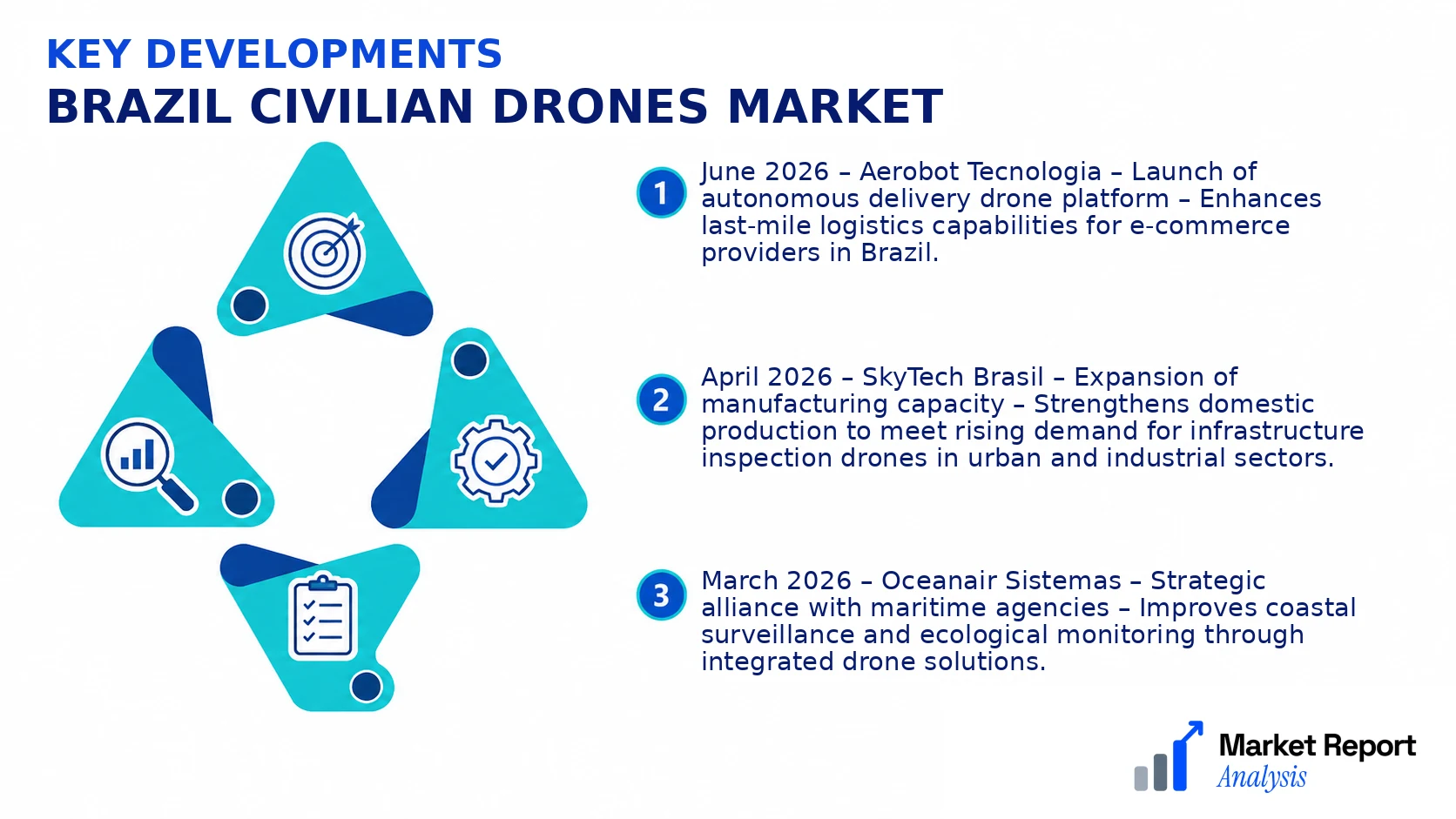
- June 2026 – Aerobot Tecnologia – Launch of autonomous delivery drone platform – Enhances last-mile logistics capabilities for e-commerce providers in Brazil.
- April 2026 – SkyTech Brasil – Expansion of manufacturing capacity – Strengthens domestic production to meet rising demand for infrastructure inspection drones in urban and industrial sectors.
- March 2026 – Oceanair Sistemas – Strategic alliance with maritime agencies – Improves coastal surveillance and ecological monitoring through integrated drone solutions.
- January 2026 – Veloce Aeronautics – Introduction of high-speed delivery drone – Supports rapid-response logistics services and emergency aid operations across Brazilian urban centers.
- February 2026 – HeliTech Brasil – Acquisition of a regional drone service provider – Accelerates industrial inspection services and broadens the company's operational footprint in Brazil.
Frequently Asked Questions
What is the Brazil Civilian Drones Market?
The Brazil Civilian Drones Market encompasses the development, deployment, and commercialization of unmanned aerial vehicles (UAVs) for non-military applications across various sectors such as agriculture, surveillance, infrastructure, and delivery services within Brazil, reflecting a rapidly growing technological domain.
What is the current market size of Brazil Civilian Drones Market?
As of 2026, the Brazil Civilian Drones Market is valued at approximately USD 2.3 Billion, driven by increasing adoption in commercial sectors and supportive regulatory frameworks, with consistent year-over-year growth signaling expanding domestic drone deployment.
What factors are driving the Brazil Civilian Drones Market?
Market growth is propelled by technological advancements, decreasing drone costs, diversified application potential, governmental support for innovation, enhanced regulatory clarity, and rising demand in agriculture, logistics, and monitoring services, fostering a vibrant ecosystem for civilian drone usage.
Which region dominates the Brazil Civilian Drones Market?
South and Southeast Brazil lead the market due to higher industrialization levels, increased technological infrastructure, and greater adoption of advanced agricultural and surveillance drones, serving as pivotal hubs for drone-related activities and innovation within the country.
Which segment is expected to grow the fastest?
The agricultural segment is projected to experience the highest growth rate, driven by the need for precision farming, crop monitoring, and resource management, supported by governmental initiatives and rising awareness about sustainable farming practices.
Who are the leading companies operating in the Brazil Civilian Drones Market?
Key players include major multinational corporations such as DJI, Parrot, and Autel Robotics, alongside regional innovators like Drone Brasil and AeroDrone, all competing through technological innovation, strategic partnerships, and expanding local distribution channels to capture market opportunities.
Analyst Perspective
The Brazil Civilian Drones Market exhibits a promising long-term outlook driven by increasing adoption across agriculture, infrastructure, and security sectors. As technological advancements continue to lower costs and improve capabilities, market entrants should prioritize investment in innovative unmanned systems that enhance payload capacity, flight endurance, and data analytics. Competitive intensity is expected to rise, with domestic firms and multinational players vying for regional dominance, particularly in major urban centers like São Paulo and Rio de Janeiro, which present lucrative opportunities for city-specific applications such as urban planning and disaster management. Regional growth potential remains strong in underserved northern and northeastern states, where infrastructure development and agricultural modernization are accelerating. Overall, strategic focus should be on fostering technology partnerships, emphasizing local regulatory compliance, and developing scalable, adaptable solutions tailored to Brazil’s diverse geographic and economic landscape. This approach will position firms strongly for sustained growth amid evolving legal frameworks and expanding market demand.
