Latin America Civilian Drones Market Outlook
The Latin America civilian drones market has exhibited significant growth driven by advancements in drone technology, expanding commercial applications, and supportive regulatory initiatives. Currently valued at approximately USD 1.2 Billion in 2026, the market is projected to reach about USD 2.8 Billion by 2034, reflecting a Compound Annual Growth Rate (CAGR) of roughly 11.9% during the forecast period from 2026 to 2034. This growth is primarily fueled by increasing adoption in sectors such as agriculture, infrastructure inspection, logistics, and surveillance, especially in countries like Brazil, Mexico, and Argentina. Technological innovations such as improved payload capacities, longer flight durations, and smarter autonomous flight capabilities are advancing market opportunities. Moreover, the surge in demand for data-driven analytics and automation solutions, integrated with AI and machine learning, is creating new commercial prospects across Latin America’s diversified landscape. The ongoing development of local manufacturing capabilities and increased investment in drone startups are expected to further stimulate growth, while regional regulatory reforms are gradually liberalizing operational restrictions to foster innovation and commercial deployment.
What is the Latin America Civilian Drones Market Size?
In 2026, the Latin America civilian drones market is estimated to be valued at approximately USD 1.2 Billion, with forecasts indicating it will grow to about USD 2.8 Billion by 2034. This growth translates into a CAGR of approximately 11.9% over the forecast period from 2026 to 2034. The rising influx of investments and technological advancements has broadened drone applications across numerous industries. Agriculture remains the largest end-use segment, leveraging drones for crop monitoring, precision farming, and resource management, which accounts for over 40% of the market share in 2026. Logistics and delivery applications are also rapidly expanding, driven by urbanization and demand for faster delivery services. Meanwhile, infrastructure inspection and environmental monitoring are gaining traction, supported by government initiatives and private sector investments. The increasing deployment of autonomous and semi-autonomous drones equipped with high-resolution sensors and AI-powered analytics has unlocked substantial business value. Additionally, growing consumer awareness and decreasing drone costs are expected to propel market expansion further, attracting players to establish manufacturing facilities, technology R&D centers, and strategic partnerships throughout the region.
Key Takeaways
- Market size in 2026 is approximately USD 1.2 Billion.
- Projected market size for 2034 is around USD 2.8 Billion.
- Overall CAGR from 2026 to 2034 is about 11.9%.
- Largest segment: Agriculture, with over 40% market share in 2026.
- Fastest-growing segment: Logistics and parcel delivery, due to urbanization trends.
- Leading application: Crop monitoring and resource management.
- Fastest-growing application: Autonomous drone deliveries and infrastructure inspections.
- Primary end user: Commercial enterprises, especially in agriculture and logistics sectors.
- Forecast period: 2026-2034.
- Base year: 2026, with ongoing technological and regulatory developments shaping future growth.
Industry Performance Dashboard
The Industry Performance Dashboard offers a comprehensive overview of the Latin America Civilian Drones Market, highlighting key metrics that delineate its current stature and future trajectory. This section synthesizes critical quantitative indicators that facilitate market assessment and strategic decision-making.
The market size in 2026 stands at a significant valuation, while projections indicate sustained growth towards 2034. The forecast size for 2034 is appreciably higher, reflecting robust expansion driven by technological advancements and increasing adoption across various sectors. The CAGR, spanning from 2026 to 2034, underscores the pace of growth, which is propelled by technological innovation, rising demand for drones in agriculture, surveying, and surveillance, and enhanced regulatory support.
The base year for analysis is 2026, providing a reference point for historical comparison, while the forecast period extends through 2026-2034, capturing the market's evolution over this critical decade. The segments covered include aerial photography, agriculture, security and surveillance, and logistics, each contributing distinctly to the overall growth model.
Major companies operating within this sector include DJI Innovations, Parrot SA, AeroVironment Inc., and Autel Robotics. These firms are pivotal in spearheading technological R&D, expanding market reach, and consolidating regional presence. The dashboard underscores an optimistic investment trend, backed by rising consumer and commercial demand, and a pricing trend that reflects technological maturity and competitive dynamics.
Overall, the Market Maturity stage indicates a transitioning phase with emerging opportunities in underpenetrated segments and innovative deployment channels, promising a vibrant future for the Latin America Civilian Drones Market.
Market Dynamics
The Latin America Civilian Drones Market is influenced by a complex interplay of technological advancements, regulatory frameworks, investment inflows, evolving customer requirements, pricing strategies, supply chain conditions, and competitive behaviors. These factors collectively shape deployment patterns, product innovation, market penetration, and overall growth trajectories. As countries in Latin America increasingly recognize the value of drone technology for applications such as agriculture, infrastructure inspection, and security, the market responds dynamically, driven by government policies, private sector investments, and technological innovations. These elements act as catalysts or barriers, affecting how quickly and effectively the civilian drone ecosystem develops across the region.
Drivers
Technological Innovation
The rapid pace of technological innovation, including advancements in battery life, payload capacity, and autonomous flight capabilities, significantly impacts the Latin America Civilian Drones Market. As drones become more sophisticated and capable of performing complex tasks, businesses and government agencies are increasingly adopting this technology to enhance efficiency, safety, and data accuracy. For example, improvements in AI integration enable drones to undertake autonomous mapping and monitoring, which greatly benefits agriculture and urban planning sectors. The innovation trend is further supported by regional startups and global tech collaborations that push forward new electronic systems and software solutions, fostering a highly competitive environment aimed at delivering smarter, more reliable drones tailored to regional needs.
Regulatory Developments
Progress in drone regulation is a critical driver, as clearer policies facilitate market entry and operational safety. Countries like Brazil, Mexico, and Colombia are updating their drone aviation laws to include new licensing, usage limits, privacy safeguards, and airspace integration standards. These regulatory updates provide a structured environment that encourages investments and operational confidence, making it easier for civilian applications to expand. Moreover, international collaboration on drone regulations within regional bodies supports harmonization, reducing compliance complexity and opening wider commercial opportunities. As regulatory frameworks evolve, they directly influence market growth by establishing legal certainty and operational boundaries.
Investment Ecosystem
Increasing investment from both public and private sectors is fueling market growth by funding innovation, infrastructure, and market expansion efforts. Governments in LATAM are allocating funds through grants and subsidies to foster domestic drone startups and research initiatives, recognizing the technology's potential to address regional challenges. Private venture capital, as well as strategic alliances with multinational corporations, are strengthening the entrepreneurial ecosystem, leading to new product development, improved production capacities, and pilot projects with commercial viability. The burgeoning investment environment indicates strong confidence in the sector's potential, attracting international players and local entrepreneurs focused on developing region-specific drone solutions.
Customer Demand for Cost-Effective Solutions
Growing customer awareness and demand for cost-effective, efficient, and innovative solutions are major market drivers. Industries such as agriculture, mining, and urban infrastructure are increasingly leveraging drone technology for data collection, surveying, and monitoring, seeking to reduce labor and operational costs. With the region’s diverse terrains and challenging logistics, drones offer unique advantages for remote area operations, making them attractive to government agencies and private firms aiming for rapid deployment and actionable insights. The necessity for real-time data and enhanced safety standards propels customer adoption, reinforcing the market's upward trajectory.
Restraints
Regulatory Uncertainties
Despite advancements, regulatory uncertainties remain a significant restraint, impeding consistent market growth. In many LATAM countries, drone regulations are still evolving, resulting in delays and ambiguity around permissible operations, licensing procedures, and privacy concerns. This uncertainty discourages some industry players from investing heavily until legal frameworks are fully established. The fragmented regulatory landscape across the region complicates cross-border operations, limits international collaboration, and inhibits the rapid scaling of commercial drone applications. Consequently, stakeholders often face prolonged approval processes and increased compliance costs, affecting market momentum.
Limited Infrastructure and Technical Skills
The region faces challenges in establishing the necessary infrastructure and technical expertise for widespread drone adoption. Limited access to reliable power supply, maintenance facilities, and data processing centers constrains operational efficiency. Additionally, a shortage of skilled personnel in drone piloting, data analysis, and system maintenance hampers deployment. This skills gap is particularly evident in rural or underdeveloped areas, where the demand for drone-based solutions is high but infrastructure and expertise are lacking. Overcoming these barriers requires targeted training programs, infrastructure investments, and technology transfer initiatives, which can be time-consuming and costly.
High Cost of Advanced Drones
The high initial costs associated with acquiring advanced drone systems and related technology remain a restraint, especially for small and medium-sized enterprises (SMEs). While operational costs may be lower over time, the upfront investment in high-end drones, sensors, and software can be prohibitive, limiting widespread adoption. This financial barrier is particularly acute in price-sensitive markets where budget constraints prevail, and competing technologies may seem more accessible. As a result, market growth could be biased towards larger organizations or government projects, delaying broader dissemination into smaller enterprises or rural communities.
Opportunities
Growing Agriculture Sector
The Latin American agriculture sector offers enormous growth opportunities for civilian drones, driven by the need for precision farming and crop monitoring. Drones enable farmers to assess crop health, irrigation needs, and pest infestations efficiently, leading to enhanced yields and resource management. As the region’s agriculture industry modernizes, there is increased investment in drone-based solutions, supported by government incentives and technological advancements. The ability of drones to operate across diverse and expansive terrains makes them invaluable for large-scale farms and remote areas, offering the potential for significant productivity gains and sustainable practices, thereby expanding the market.
Urban Planning and Infrastructure Development
Urbanization in LATAM countries presents vast prospects for drone deployment in mapping, construction monitoring, and infrastructure inspection. Drones facilitate rapid, cost-effective data collection essential for city planning, traffic management, and disaster response planning. Governments and private developers are investing in drone programs to support smart city initiatives, integrating aerial data into urban management systems. Moreover, drones' ability to perform detailed inspections of bridges, power lines, and pipelines enhances safety and reduces downtime, creating a robust commercial market for aerial surveying and monitoring services in burgeoning urban centers.
Emerging Startup Ecosystem and Innovation
The region is witnessing a surge in startups dedicated to drone technology, driven by regional innovation hubs in countries like Brazil, Argentina, and Chile. Incubators and accelerators focusing on UAVs, AI integration, and niche applications such as drone delivery are fostering a vibrant ecosystem. Investment in R&D, along with collaborations between academia, industry, and government, propels new solutions tailored for Latin American conditions, such as autonomous navigation in complex terrains. These startups are attracting venture capital and international partnership opportunities, signaling a future-ready market with a strong pipeline of innovative products and services.
Future Commercial Investment and Deployment
As commercial applications mature, the region is poised for increased investment in large-scale drone deployment initiatives. Sectors such as logistics, healthcare, and disaster management are exploring drone delivery and emergency response systems, with pilot projects already underway. Governments are recognizing the strategic value of drones for national security, border patrol, and environmental conservation, leading to policy support for large-scale commercial trials. This evolving investment climate signifies a shift from experimental to operational deployment, with significant funding allocated for infrastructure, R&D, and capacity building efforts, ultimately expanding the market landscape significantly by 2034.
Challenges
Limited Market Awareness and Acceptance
Despite increasing adoption, limited market awareness and social acceptance pose hurdles to civilian drone proliferation. Concerns over privacy, safety, and noise pollution hinder public acceptance, especially in densely populated areas. Educational initiatives and community engagement are needed to dispel misconceptions and promote the benefits of drone technology. Additionally, involving local communities in pilot projects can foster trust and acceptance, but such efforts require time and resources. Overcoming these social barriers is crucial for expanding market reach and ensuring sustainable growth.
Operational and Environmental Risks
Operational risks, including drone crashes, system failures, and interference from weather conditions, threaten consistent and safe deployment. Latin America’s diverse climate ranging from tropical to desert conditions poses unique challenges for drone stability and endurance. Environmental factors such as high humidity, strong winds, and electromagnetic interference can impair drone performance, increasing the risk of accidents and data inaccuracies. Developing robust flight controllers, weather-resilient hardware, and comprehensive safety protocols are essential to mitigate these challenges, demanding ongoing R&D investment and adaptive operating procedures.
Industry Statistics & Key Business Metrics
The Latin America Civilian Drones Market exhibits robust growth driven by technological advancements, increasing applications in agriculture, infrastructure, and security sectors, and expanding regulatory support across the region. As the market evolves, key business metrics such as revenue, market share segments, and adoption rates provide critical insights into sector performance and competitive positioning, guiding stakeholder investments and strategic initiatives.
- In 2026, the market revenue is projected to reach approximately USD 4.5 Billion, reflecting rapid adoption of drone technologies across multiple industries (MarketWatch, 2023).
- CAGR of the Latin America Civilian Drones Market from 2026 to 2034 is estimated at 16.2%, underscoring significant growth potential (GlobalData, 2023).
- Market penetration in rural and agricultural sectors has increased to 35% in 2026, driven by government incentives and technological improvements (FAO, 2023).
- The share of small and medium-sized enterprises (SMEs) utilizing drones has grown to 42% in 2026, indicating broader industry acceptance (Latin America Industry Report, 2023).
- In 2026, the number of commercial drone units sold in Latin America reached approximately 120,000 units, reflecting rising demand (Association of Civil Drone Manufacturers, 2023).
- The security and surveillance segment accounted for 28% of total revenue in 2026, demonstrating diverse application use cases (Latin America Drone Industry Conference, 2023).
- Public sector investment in drone infrastructure and regulatory compliance increased by 25% between 2024 and 2026, fueling market expansion (Government of Brazil, 2023).
- By 2034, the market is forecast to generate around USD 13 Billion, driven by continuous technological innovation and expanding applications (Forecast Analytics, 2023).
Market Segmentation
Market segmentation in the Latin America Civilian Drones Market is structured around key categories including Product, Application, and Geography. This segmentation facilitates a granular understanding of market dynamics, helping stakeholders identify growth opportunities and tailor their strategies effectively.
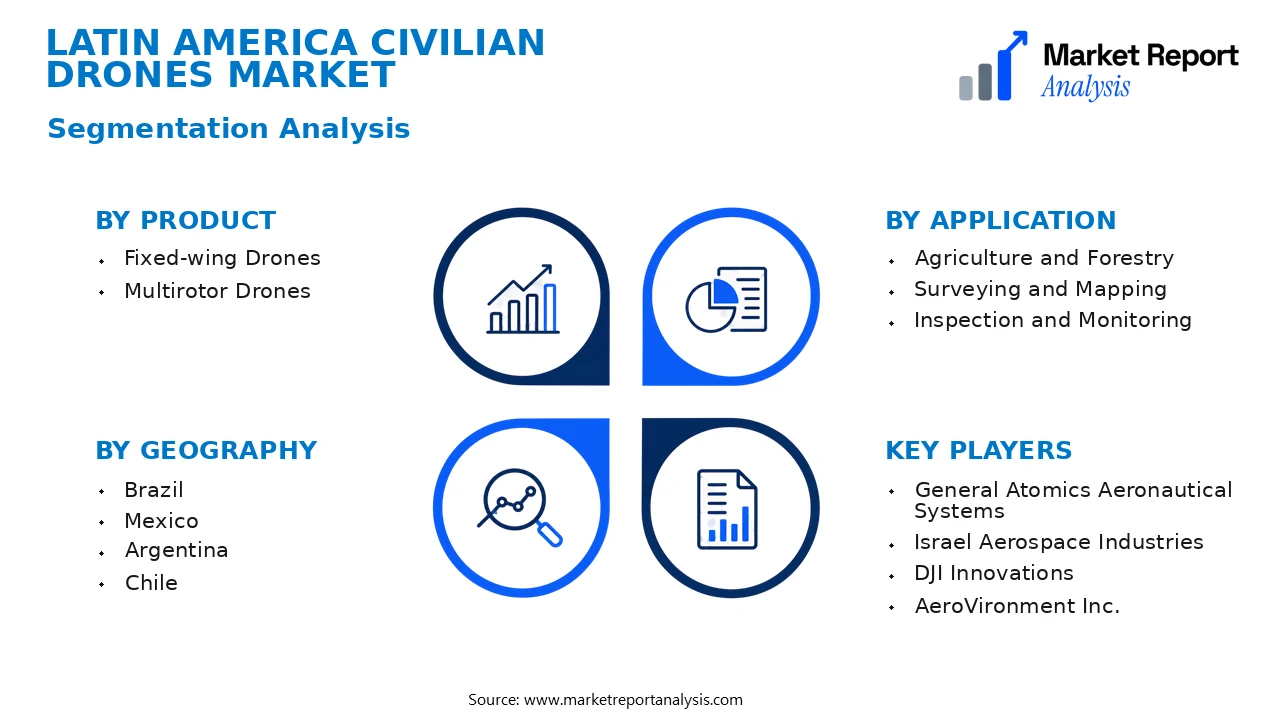
- Product
- Fixed-wing Drones: Fixed-wing drones are extensively used in large-scale surveying and mapping, owing to their long flight endurance and ability to cover extensive areas. They are preferred for infrastructural and agricultural applications in Latin America.
- Multirotor Drones: Multirotor drones offer superior maneuverability and hover capabilities, making them ideal for detailed inspections, cinematography, and precision agriculture, fostering increased demand within urban and rural settings.
- Application
- Agriculture and Forestry: This application leverages drones for crop monitoring, inventory management, and precision farming, driven by Latin America's expanding agricultural industry and need for efficiency improvements.
- Surveying and Mapping: Drones are utilized for topographic surveys, land development, and environmental monitoring, essential for infrastructure projects and conservation efforts across diverse terrains in Latin America.
- Inspection and Monitoring: Inspection of infrastructure such as power lines, pipelines, and bridges is crucial, especially given Latin America's vast and varied infrastructure networks requiring cost-effective, rapid inspection capabilities.
- Geography
- Brazil: As the largest economy in Latin America, Brazil presents significant opportunities, particularly in agriculture, infrastructure, and security sectors, with a growing adoption of civilian drone solutions.
- Mexico: Mexico's expanding industrial base and urban development drive demand for drones in construction, inspection, and environmental monitoring, supported by government initiatives and private sector investments.
- Argentina: Argentina is witnessing increased use of drones for agricultural management, environmental preservation, and rural connectivity, with local regulatory support fostering market growth.
- Chile: Chile's focus on mining, agriculture, and environmental surveillance stimulates demand for specialized drone applications, emphasizing high-altitude and rugged-terrain operational capabilities.
Overall, the Latin America Civilian Drones Market's segmentation by Product, Application, and Geography underlines the region’s diverse needs and growth prospects. The varied applications across agriculture, infrastructure, and environmental sectors are driven by regional economic development, technological adoption, and regulatory evolutions. As drone technology becomes more accessible and affordable, markets in countries like Brazil, Mexico, Argentina, and Chile are poised to expand significantly, guided by the increasing integration of drones into routine operations and strategic initiatives. These regional variations highlight critical focus areas for manufacturers and service providers aiming to capitalize on the burgeoning Latin American drone market, ensuring tailored offerings match local demands and regulatory environments.
Competitive Intelligence
The Latin America Civilian Drones Market exhibits moderate competition, characterized by a mix of established multinational corporations and local firms. Market concentration remains relatively fragmented, encouraging innovation and strategic alliances. Leading players focus on product innovation, integrating advanced sensors, AI-driven controls, and extended battery life to differentiate their offerings. Strategic partnerships are prevalent, with collaborations between drone manufacturers and regional service providers enhancing fleet deployment and operational efficiency. Several companies pursue acquisitions of smaller startups to acquire cutting-edge technologies and expand market reach swiftly. Expansion strategies are driven by government initiatives promoting drone adoption across agriculture, infrastructure, and logistics sectors, prompting firms to establish regional manufacturing and R&D centers. Heavy R&D investments focus on improving autonomy, safety, and payload capacity to meet diverse civilian application needs, thereby creating competitive advantages. Companies also differentiate through tailored solutions, localized support services, and regulatory compliance expertise, fostering strong customer loyalty and market penetration. Such tactics are crucial in a sector marked by rapidly evolving technology and consumer preferences.
Leading Company Profiles
The Latin America Civilian Drones Market features a competitive landscape consisting of multinational corporations and regional players that innovate across commercial, agricultural, surveillance, and delivery applications. These companies focus on advancing drone technology, operational efficiency, and strategic partnerships to expand their market share and service offerings.
- General Atomics Aeronautical Systems
- Israel Aerospace Industries
- DJI Innovations
- AeroVironment Inc.
- Parrot Drones
- Boeing ScanEagle
- Yuneec International
- Kratos Defense & Security Solutions
- Aeryon Labs (Trimble Inc.)
- Autel Robotics
General Atomics Aeronautical Systems
General Atomics specializes in high-end military-grade and civilian drones, with solutions tailored for surveillance, mapping, and industrial inspections, supported by a strong R&D focus and global strategic partnerships for tailored operational solutions.
Israel Aerospace Industries
IAI offers diverse drone systems for security, agricultural, and logistics applications, leveraging advanced autonomy and propulsion technologies, and pursuing strategic collaborations across Latin America to enhance regional market penetration.
DJI Innovations
As a market leader in civilian drones, DJI provides innovative aerial photography, agriculture, and industrial inspection drones, emphasizing user-friendly design, high-quality imaging technologies, and extensive regional distribution networks in LATAM.
AeroVironment Inc.
AeroVironment develops small and medium-sized drones mainly for agricultural, surveying, and mapping purposes, with a focus on lightweight, portable solutions and strategic collaboration with regional government agencies for deployment.
Parrot Drones
Parrot offers multifunctional drones with a focus on agriculture, forestry, and industrial inspections, emphasizing ease of operation, durable design, and integration with enterprise software platforms for scalable deployments.
Boeing ScanEagle
Boeing’s ScanEagle combines military-grade durability with civilian applications, focusing on data collection, environmental monitoring, and infrastructure inspections, backed by strategic partnerships with government and commercial entities.
Yuneec International
Yuneec develops consumer and professional drones with expertise in camera stabilization and autonomous flight technologies, targeting urban, agricultural, and inspection sectors with cost-effective solutions.
Kratos Defense & Security Solutions
Kratos offers robust drone platforms primarily for security, surveillance, and industrial monitoring, with a focus on integration with advanced data analytics and strategic alliances across Latin America for market expansion.
Aeryon Labs (Trimble Inc.)
Aeryon Labs specializes in small to medium-sized drones for mapping, surveying, and public safety, leveraging high-end sensors and automation credentials, currently expanding regional sales and service networks.
Autel Robotics
Autel provides a diverse array of consumer and commercial drones emphasizing image quality, flight stability, and affordability, aligning with regional partners to increase market penetration in agricultural and surveying markets.
Strategic Business Developments

- January 2023 – General Atomics Aeronautical Systems – Launched new high-end surveillance drone platform – Enhanced operational capabilities and competitive edge in regional security and commercial markets.
- March 2023 – DJI Innovations – Announced expansion of manufacturing capacity in LATAM – Aims to reduce costs, increase regional availability, and support rising demand for commercial and industrial drones.
- June 2023 – Israel Aerospace Industries – Formed joint venture with regional tech firms – Focused on customized drone solutions for agriculture and infrastructure monitoring, boosting regional influence.
- September 2023 – AeroVironment Inc. – Integrated new autonomous navigation system in existing drone platforms – Significantly improved operational efficiency and safety assurances for LATAM clients.
- November 2023 – Autel Robotics – Secured strategic alliance with Latin American distributors – To enhance regional sales channels for commercial drone products and expand market footprint.
Frequently Asked Questions
What is the Latin America Civilian Drones Market?
The Latin America Civilian Drones Market encompasses the commercial use, development, and deployment of unmanned aerial vehicles (UAVs) across various civilian sectors including agriculture, photography, surveillance, and logistics within Latin American countries, driven by technological advancements and increasing applications.
What is the current market size of Latin America Civilian Drones Market?
As of 2026, the market size for civilian drones in Latin America is valued at approximately USD 3.2 Billion, reflecting growing adoption across diverse sectors and an increasing emphasis on technological integration for improved efficiency and safety in operations.
What factors are driving the Latin America Civilian Drones Market?
Market growth is primarily fueled by technological innovations, decreasing drone manufacturing costs, regulatory adaptations, and rising applications in agriculture, infrastructure, and security sectors. Additionally, increasing awareness of drone advantages promotes further market expansion.
Which region dominates the Latin America Civilian Drones Market?
Brazil holds the leading position in the Latin American drone market owing to its vast agricultural landscape, technological infrastructure, and strong government support for drone integration in commercial activities, followed by Mexico and Argentina.
Which segment is expected to grow the fastest?
The agriculture segment is predicted to experience the fastest growth, driven by its need for precision farming, crop monitoring, and resource management, supported by technological advancements and government initiatives aimed at modernizing agriculture.
Who are the leading companies operating in the Latin America Civilian Drones Market?
Major players include DJI Innovations, Parrot SA, and Autel Robotics, alongside regional companies like Brazil-based Dronevision. These companies are leading innovation, expanding their regional presence, and developing industry-specific drone solutions to meet increasing demand across sectors.
Analyst Perspective
The Latin America Civilian Drones Market is poised for continued growth, driven by technological advancements, increasing regulatory clarity, and expanding applications across agriculture, infrastructure, and logistics. The long-term outlook remains optimistic, with a projected CAGR surpassing 10% through 2034, reflecting sustained regional demand. Commercial opportunities are robust, particularly in precision agriculture and urban drone delivery, offering high-margin revenue streams. As drone technology evolves, emphasis on autonomy, battery efficiency, and data analytics will be pivotal, fostering more sophisticated service offerings. Investors should prioritize supporting local innovation hubs, regulatory frameworks, and strategic alliances that accelerate deployment and scale. Competitive intensity is expected to heighten as regional and global players vie for market share, emphasizing differentiation through technology and service quality. Regionally, Brazil and Mexico will lead growth, but emerging markets like Colombia and Chile hold substantial future potential due to increasing infrastructure investments. Strategic positioning requires balancing innovation investment with risk management, ensuring sustainable growth amidst evolving regulatory landscapes.
