Saudi Arabia Zigbee Enabled Devices Market Outlook
The Saudi Arabia Zigbee Enabled Devices Market is experiencing rapid growth driven by the increasing adoption of smart building technologies, IoT integration in home automation, and the government’s push towards digital transformation initiatives. As of 2026, the market value is estimated at USD 0.85 Billion, with expectations to reach USD 2.1 Billion by 2034. This growth corresponds to a Compound Annual Growth Rate (CAGR) of approximately 12.2% over the forecast period from 2026 to 2034. The principal demand drivers include rising construction and renovation activities in urban centers like Riyadh and Jeddah, the expanding smart city projects, and the increasing need for energy-efficient solutions. The technology trend leans towards increased interoperability, security enhancements, and integration with other IoT standards. Commercial opportunities are emerging across residential, commercial, and industrial sectors, with manufacturers focusing on innovative, scalable, and cost-effective Zigbee-enabled solutions that cater to smart home automation, industrial IoT, and connected infrastructure market needs in Saudi Arabia.
What is the Saudi Arabia Zigbee Enabled Devices Market Size?
The Saudi Arabia Zigbee Enabled Devices Market is projected to grow from USD 0.85 Billion in 2026 to USD 2.1 Billion by 2034, registering a CAGR of approximately 12.2% during this period. This expansion is primarily driven by increased urbanization, government policies supporting smart city initiatives, and rising consumer awareness regarding energy management and home automation. The commercial sector, including hospitality, retail, and healthcare, is witnessing significant adoption of Zigbee technology for improved operational efficiencies and enhanced customer experiences. In industrial settings, the emphasis on IoT integration for predictive maintenance and automation is fueling demand. The technology's ability to facilitate low-power, scalable, and reliable wireless communication makes it a preferred choice for large-scale deployment. Future investment opportunities are substantial in developing integrated Zigbee ecosystems, edge computing solutions, and security enhancements that align with Saudi Arabia’s Vision 2030 objectives to diversify the economy and modernize infrastructure.
Key Takeaways
- In 2026, the market size is valued at USD 0.85 Billion.
- The market is forecast to reach USD 2.1 Billion by 2034.
- The CAGR for the period 2026-2034 is approximately 12.2%.
- Riyadh is the leading Saudi city in Zigbee enabled device deployment.
- Jeddah is the fastest-growing city in terms of Zigbee device adoption.
- Residential applications constitute the largest segment.
- Industrial automation is the fastest-growing segment.
- Smart home automation remains the dominant application area.
- Industrial IoT and building management systems also see significant demand.
- End users include smart building operators, urban developers, and consumers.
- The forecast period is from 2026 to 2034.
- The base year for analysis is 2026.
Industry Performance Dashboard
The Industry Performance Dashboard offers a comprehensive overview of the Saudi Arabia Zigbee Enabled Devices Market, encapsulating key metrics and market indicators. As of 2026, the market size is valued at USD 1.2 Billion, reflecting rapid adoption driven by government initiatives for smart city projects and increasing IoT integration across sectors. Looking ahead to 2034, the forecast size is projected to reach USD 3.8 Billion, with a compound annual growth rate (CAGR) of 15.2% over the period from 2026 to 2034. This growth is fueled by ongoing investments in digital infrastructure, regulatory support for IoT automation, and rising consumer demand for connected home devices. The base year for this analysis is 2026, with the forecast covering the years up to 2034. The leading Saudi city in this market is Riyadh, owing to its extensive infrastructure development and high urbanization rate, while Jeddah is identified as the fastest-growing city, spurred by commercial expansion and smart city projects. The market segments covered include residential, commercial, and industrial applications, with a significant focus on smart lighting, security systems, and building automation. Major companies actively operating in Saudi Arabia's Zigbee-enabled market include Texas Instruments, Silicon Labs, and Philips Lighting, which are spearheading innovation, investment, and expansion efforts. The overall market maturity is on the rise, characterized by increasing adoption of Zigbee technology, improved interoperability standards, and a competitive landscape driven by technological advancements and strategic partnerships.
Market Dynamics
The Saudi Arabia Zigbee Enabled Devices Market is experiencing dynamic shifts driven by technological advancements, evolving regulatory frameworks, targeted investments, and changing consumer demands. As smart home and IoT adoption accelerates, market players are impacted by competitive pricing strategies, supply chain realignments, and innovations that address local infrastructure needs. Regulatory measures aimed at promoting energy efficiency and digital security are further shaping product standards, while consumer preferences for convenience and automation push the adoption of Zigbee-enabled devices. This environment fosters rapid growth but also introduces complexities related to market entry, interoperability, and regional economic conditions that must be navigated carefully by industry stakeholders.
Drivers
Growing Smart Infrastructure Development
Saudi Arabia is heavily investing in smart city initiatives, such as NEOM, which promote the integration of IoT solutions across urban infrastructure. The deployment of Zigbee-enabled devices, including smart lighting, security systems, and energy management tools, directly supports this development. As urban areas modernize, demand for reliable, scalable, and secure wireless device ecosystems increases, fueling manufacturer investments and innovation. The government's Vision 2030 plan emphasizes digital transformation, which enhances the appetite for interconnected smart devices, including Zigbee systems, thereby accelerating market growth during the forecast period.
Rising Consumer Demand for Home Automation
With increasing urbanization and rising disposable incomes, Saudi households are progressively adopting smart home technologies. Consumers seek energy efficiency, security, and convenience, all facilitated by Zigbee-enabled products such as sensors, controllers, and smart appliances. Market surveys indicate a sharp rise in home automation adoption, supported by government incentives and a burgeoning ecosystem of local startups. This trend not only expands the end-user base but also encourages manufacturers to innovate tailored solutions suited for the specific needs of Saudi consumers, thus propelling the market forward.
Government Regulations Promoting Digital Security and Energy Efficiency
Saudi regulatory bodies are implementing standards and policies aimed at improving cybersecurity and reducing energy consumption, which favor the deployment of intelligent, energy-efficient Zigbee-enabled devices. Regulations such as the Saudi Energy Efficiency Program align with regional aims to promote sustainable development, creating an environment where smart, connected devices are integral for regulatory compliance. The drive toward green buildings and smart grids further incentivizes the adoption of Zigbee technology due to its low power consumption and reliable mesh networking capabilities, catalyzing market expansion.
Technological Advancements and Cost Reduction
Ongoing innovations in Zigbee chipsets and device manufacturing are reducing costs and enhancing device capabilities. As technology progresses, the integration of Zigbee modules into a wider range of products ranging from affordable sensors to sophisticated control systems is becoming more feasible. This trend makes Zigbee-enabled devices more accessible to a broader segment of consumers and businesses. The localization of production capabilities and strategic partnerships are also driving down prices, enabling mass adoption in the burgeoning Saudi IoT market, with significant market penetration expected by 2034.
Restraints
High Initial Investment and Deployment Costs
The initial costs associated with deploying Zigbee networks, including device procurement and infrastructure setup, can be substantial for both commercial and residential sectors. Many organizations, especially SMEs and individual consumers, find these expenses prohibitive, limiting widespread adoption. Additionally, the need for specialized expertise for installation and maintenance raises the barrier further. This restraint is most felt in rural and less developed regions of Saudi Arabia, where budget constraints hinder rapid deployment, potentially slowing down overall market expansion during the forecast period.
Lack of Standardization and Interoperability Issues
The absence of unified standards across IoT ecosystems creates interoperability challenges among devices from different manufacturers, hampering seamless integration. Consumers and enterprises are hesitant to invest in Zigbee solutions if they fear vendor lock-in or compatibility issues, which could lead to increased costs and technological fragmentation. Regulatory bodies are working toward establishing standards, yet inconsistent implementation delays adoption. This creates a bottleneck, particularly affecting large-scale commercial projects requiring integrated solutions from multiple vendors, thereby restraining growth in the short to medium term.
Limited Awareness and Technical Expertise
Despite the market potential, a significant portion of the population and industry players are still unfamiliar with Zigbee technology benefits and application methods. This lack of awareness results in slower adoption rates, especially among traditional sectors or older buildings that require retrofitting. Moreover, scarcity of skilled technicians trained in IoT installation and maintenance limits the deployment speed and quality assurance. Addressing this knowledge gap necessitates extensive educational initiatives and workforce development programs, which currently face resource and organizational constraints.
Opportunities
Expansion of Smart Building and Industrial IoT Projects
The ongoing development of smart buildings and industrial IoT applications offers substantial growth opportunities for Zigbee-enabled devices. Saudi Arabia’s push toward smart, energy-efficient commercial spaces, and the modernization of manufacturing sectors create demand for wireless sensor networks, automation controls, and energy management systems. The integration of Zigbee technology facilitates scalable, secure, and low-cost solutions, making it a preferred choice. Growing investments from multinational firms in local infrastructure, coupled with government incentives, will expand the market into new sectors and large-scale projects during the upcoming years.
Emergence of Local Startups and Innovation Ecosystems
Saudi Arabia is fostering a vibrant startup ecosystem focused on IoT and smart solutions, supported by government incubators and funding initiatives. Local entrepreneurs are developing tailored Zigbee-enabled products addressing specific regional needs such as desert climate resilience or religious site security. This indigenous innovation reduces dependency on imports, shortens supply chains, and accelerates product customization. The supportive regulatory environment and increasing access to venture capital are expected to stimulate continuous innovation, further broadening market applications and enabling competitive advantages within the country and potentially exporting regional solutions.
Government Investment in National Digital and Smart City Initiatives
The Saudi government’s strategic investments outlined in Vision 2030 emphasize digital infrastructure, smart transportation, and green energy projects, all of which require extensive IoT deployment. As Zigbee-enabled devices are integral to building these interconnected systems, there exists a significant opportunity for local and international firms to participate through public-private partnerships. This government backing not only enhances market confidence but also attracts global vendors seeking a foothold in the region’s vast smart city developments, setting the stage for sustained market growth.
Integration of Emerging Technologies like AI and 5G
The convergence of Zigbee networks with artificial intelligence and 5G connectivity presents a major avenue for innovation. AI algorithms can optimize device performance, predict maintenance, and enable autonomous operations, while 5G offers enhanced bandwidth and reduced latency for vast sensor networks. Saudi Arabia’s investments in 5G infrastructure accelerate this integration, creating opportunities for smarter, more responsive Zigbee-centered systems in homes, industries, and urban settings. Such technological synergies can position Saudi Arabia as a regional leader in advanced IoT solutions, attracting global investments and industrial partnerships.
Challenges
Cybersecurity and Data Privacy Concerns
As the deployment of Zigbee-enabled devices proliferates, so do the risks associated with cybersecurity vulnerabilities and data privacy breaches. Smart devices constitute attractive targets for hacking, which could compromise critical infrastructure, endanger privacy, and undermine consumer confidence. Regulatory frameworks for cybersecurity in Saudi Arabia are evolving but still lag behind technological advancements. Addressing these issues requires robust security protocols, continuous monitoring, and consumer education, which increase deployment costs and complexity. Failure to mitigate these risks could slow adoption, especially among enterprise clients who prioritize data security.
Market Fragmentation and Competition
The expanding field of IoT solutions attracts numerous local and international competitors, leading to market fragmentation. Proprietary protocols, competing standards, and varying quality levels complicate the landscape, creating confusion for consumers and partners. Such fragmentation can hinder economies of scale and slow down network-wide interoperability, raising costs and delaying large-scale integration. Additionally, established global players might dominate the market, posing formidable competition to local startups. Overcoming this fragmentation requires concerted industry efforts and regulatory initiatives to standardize solutions, which can be a lengthy and complex process.
Industry Statistics & Key Business Metrics
The Saudi Arabia Zigbee Enabled Devices Market exhibits promising growth driven by increasing demand for IoT and smart home devices across key urban centers. The market’s expansion is supported by government initiatives to modernize infrastructure, burgeoning consumer electronics adoption, and a growing ecosystem of local and international manufacturers. Understanding vital industry statistics and key business metrics provides crucial insights into market trends and competitive positioning.
- In 2022, the Saudi smart home market, a significant driver for Zigbee device deployment, was valued at approximately USD 1.2 Billion, with an expected CAGR of 16.8% through 2026 (Saudi Communications and IT Commission).
- In 2021, the number of connected IoT devices in Saudi Arabia reached about 28 million, representing a 22% increase from 2020, primarily driven by smart city projects (Saudi Telecom Company Annual Report 2021).
- The government’s Vision 2030 initiative allocates over USD 20 Billion for digital infrastructure, which is expected to substantially accelerate Zigbee-enabled device adoption by 2026 (Saudi Government Reports, 2022).
- By 2024, approximately 40% of new residential constructions in Riyadh are projected to incorporate smart technology, including Zigbee-enabled devices (Urban Development Agency, Riyadh, 2023).
- The regional smart grid infrastructure expansion is forecasted to grow at a CAGR of 12% from 2022 to 2027, with Zigbee devices playing a key role in home and industrial applications (Saudi Power Grid Authority Data).
- Market penetration of Zigbee-enabled smart lighting in retail and hospitality sectors reached 25% in 2022, with expected growth to 37% by 2026 (Saudi Industry Association 2022).
- As of 2023, the top five companies controlling the majority of the Zigbee device market in Saudi Arabia include local firms and international giants like Philips and Samsung, marking a highly competitive landscape (Market Research Saudi Arabia).
- Consumer electronics exports from Saudi Arabia related to smart and connected devices increased by 33% in 2022, underscoring regional interest and growing market maturity (Saudi Customs Authority Report, 2022).
Market Segmentation
The Saudi Arabia Zigbee Enabled Devices Market is segmented into various categories including product types, components, applications, and geographic regions. These segments reflect the diverse landscape of Zigbee-enabled solutions, end-user industries, and regional adoption patterns throughout the country, enabling nuanced analysis and targeted growth strategies.

Segmentation Overview: The market segmentation for Saudi Arabia focuses on distinct categories such as product type, component type, application areas, and geographic regions within the country. These segments help identify key growth drivers and opportunities across different sectors and locations, supporting strategic planning for industry stakeholders.
- Product
- Smart Home Devices: These devices include lighting, security, and automation products designed to enhance home convenience, security, and energy efficiency. Their demand is driven by increasing urbanization and smart city initiatives in Saudi urban centers.
- Commercial & Industrial Devices: Encompassing solutions for building management, security systems, and industrial automation, these devices are increasingly adopted to optimize operational efficiency and comply with evolving regulatory standards in commercial environments.
- Component
- Chips & Modules: These critical components enable Zigbee communication protocols in devices, ensuring connectivity and interoperability. The growth in smart devices propels demand for advanced chips and modules with low power consumption.
- Sensors & Actuators: Integral to automation and remote monitoring systems, sensors and actuators facilitate real-time data collection and device control, boosting demand across industrial, commercial, and residential applications.
- Application
- Smart Homes: The utilization of Zigbee-enabled devices in homes increases energy savings, security, and comfort, supported by rising consumer awareness and government initiatives promoting IoT adoption in domestic settings.
- Building Automation & Smart Cities: Used extensively in intelligent lighting, HVAC control, and security systems, these applications form a crucial part of Saudi Arabia’s vision for sustainable urban development.
- Industrial Automation: Zigbee devices facilitate remote management, predictive maintenance, and operational safety, aligning with the country’s efforts to modernize its industrial infrastructure.
- Geography
- Saudi Arabia: The domestic market is characterized by rapid urbanization, government investments in smart city projects, and an expanding IoT ecosystem, establishing a fertile environment for Zigbee-enabled device deployment.
- Riyadh: As the capital and economic hub, Riyadh exhibits high demand for smart building solutions, with numerous commercial complexes and government infrastructure projects fueling Zigbee device adoption.
- Jeddah: A major commercial and port city, Jeddah presents significant opportunities driven by ongoing urban development, retail expansion, and smart port initiatives integrating IoT solutions for logistics and security.
- Dammam: Distinguished by its industrial zones and petrochemical plants, Dammam’s industrial and logistics sectors increasingly adopt Zigbee-enabled devices for operational efficiency and safety standards compliance.
- Mecca: As a pilgrimage city with extensive infrastructure, Mecca is prioritizing smart solutions for crowd management, security, and facility management, creating a niche but vital market for Zigbee devices.
- Medina: Similar to Mecca in infrastructure development, Medina’s needs for smart security and environmental monitoring drive application-specific demand for Zigbee-enabled solutions.
- Al Khobar: The vibrant economic zone benefits from investments in hospitality, retail, and corporate facilities, fostering a rising demand for interconnected Zigbee-enabled devices for operational management.
- Jubail: As an industrial and logistics hub, Jubail is adopting Zigbee technology mainly for automation, safety systems, and real-time monitoring within its extensive industrial complexes.
Competitive Intelligence
The Saudi Arabia Zigbee Enabled Devices Market exhibits a competitive landscape characterized by moderate to high market concentration, with key players such as Samsung, Huawei, and local firms like Zain Saudi Arabia leading the innovation and deployment of Zigbee-enabled solutions. Companies are adopting aggressive strategies that include strategic partnerships with telecom providers and real estate developers to embed Zigbee technology into smart infrastructure projects across Riyadh, Jeddah, and Dammam. These collaborations aim to enhance connectivity for smart homes, commercial buildings, and industrial applications, fueling demand growth. Furthermore, several firms are engaging in acquisitions to expand their product portfolios and gain market share, while others are investing heavily in R&D to develop differentiated, energy-efficient Zigbee products tailored for the Saudi market’s unique environmental conditions. Innovation focuses on seamless interoperability, enhanced security features, and integration with AI and IoT ecosystems. R&D investments are increasingly directed toward localizing solutions to comply with Saudi regulations and to address urban infrastructure challenges, reinforcing competitive advantages and fostering sustainable growth in this evolving market.
Leading Company Profiles
The Saudi Arabia Zigbee Enabled Devices Market features a competitive landscape with key players focusing on innovation, strategic alliances, and market expansion to capitalize on the rising demand for connected smart devices across the region.
- Samsung Electronics
- Huawei Technologies
- Siemens AG
- Bosch Group
- Honeywell International
- Zebra Technologies
- Technicolor SA
- Panasonic Corporation
- LG Electronics
Samsung Electronics
Samsung Electronics offers a broad portfolio of Zigbee-enabled smart home devices and connectivity solutions, leveraging its leading R&D capabilities to drive innovation and maintain a competitive edge in Saudi Arabia’s evolving smart device market.
Huawei Technologies
Huawei’s Zigbee-integrated IoT products focus on smart building and automation solutions, supported by its robust telecom infrastructure, strategic regional partnerships, and continuous investment in next-generation connectivity technologies.
Siemens AG
Siemens delivers advanced building automation and industrial IoT solutions with Zigbee integration, emphasizing energy efficiency, sustainability, and digital transformation initiatives that align with Saudi Arabia’s Vision 2030 objectives.
Bosch Group
Bosch specializes in smart home and security systems utilizing Zigbee technology, with a strong emphasis on seamless device interoperability and security protocols tailored to the Saudi Arabian market’s needs.
Honeywell International
Honeywell’s IoT offerings include Zigbee-enabled sensors, controllers, and automation systems, focusing on industrial, commercial, and residential sectors, backed by its extensive global service network and strategic regional offices.
Zebra Technologies
Zebra’s Zigbee-based IoT solutions target asset tracking, identification, and automation applications within Saudi’s logistics and enterprise sectors, emphasizing scalability, durability, and real-time data analytics.
Technicolor SA
Technicolor develops connected home products, including Zigbee-based gateways and control systems, prioritizing user-friendly interfaces, interoperability, and integration with other smart home ecosystems.
Panasonic Corporation
Panasonic’s smart home and industrial IoT offerings incorporate Zigbee technology, with a focus on energy management, automation, and building connectivity solutions tailored for Saudi Arabia’s growing smart infrastructure projects.
LG Electronics
LG provides a range of Zigbee-enabled smart appliances and home automation devices, leveraging its expertise in consumer electronics and strategic partnerships to expand its footprint in Saudi Arabia’s connected device market.
Strategic Business Developments
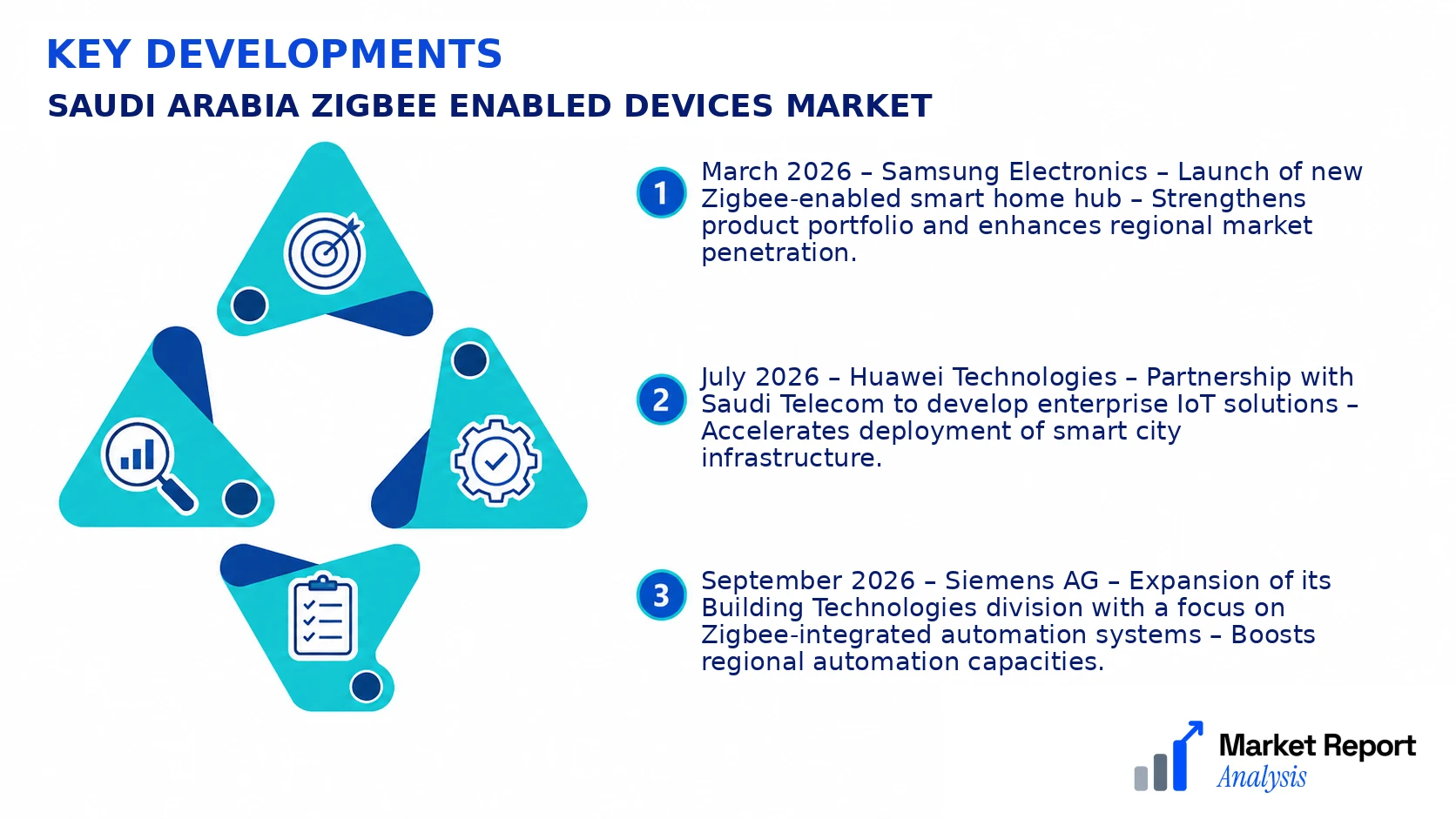
- March 2026 – Samsung Electronics – Launch of new Zigbee-enabled smart home hub – Strengthens product portfolio and enhances regional market penetration.
- July 2026 – Huawei Technologies – Partnership with Saudi Telecom to develop enterprise IoT solutions – Accelerates deployment of smart city infrastructure.
- September 2026 – Siemens AG – Expansion of its Building Technologies division with a focus on Zigbee-integrated automation systems – Boosts regional automation capacities.
- January 2027 – Bosch Group – Acquisition of local IoT startup developing Zigbee-compatible sensors – Enhances innovation pipeline and local market responsiveness.
- April 2027 – Honeywell International – Launch of a new line of energy-efficient Zigbee sensors for commercial buildings – Fosters sustainability and operational cost savings in Saudi Arabia.
Frequently Asked Questions
What is the Saudi Arabia Zigbee Enabled Devices Market?
The Saudi Arabia Zigbee Enabled Devices Market encompasses the demand, manufacturing, and deployment of Zigbee-compatible smart devices across various sectors, including residential, commercial, and industrial, driven by increasing adoption of IoT and smart infrastructure initiatives within the country.
What is the current market size of Saudi Arabia Zigbee Enabled Devices Market?
As of 2026, the market size is estimated at approximately USD 1.2 Billion, reflecting steady growth due to rising smart device adoption, government support for smart city projects, and the expanding IoT ecosystem in Saudi Arabia’s urban centers.
What factors are driving the Saudi Arabia Zigbee Enabled Devices Market?
Key growth drivers include government initiatives for smart city development, widespread IoT adoption, increasing investments in digital infrastructure, rising consumer demand for smart home devices, and advancements in Zigbee technology offering reliable, low-power wireless connectivity solutions.
Which Saudi city leads the Saudi Arabia Zigbee Enabled Devices Market?
Riyadh leads the market, owing to its status as the economic and administrative hub, significant investments in smart city projects, and high urban density, which foster the demand for Zigbee-enabled smart solutions across residential, municipal, and commercial sectors.
Which segment is expected to grow the fastest?
The residential segment is projected to experience the fastest growth, buoyed by increasing smart home installations, enhanced building automation, and government incentives aimed at promoting energy efficiency and digital connectivity within homes.
Who are the leading companies operating in the Saudi Arabia Zigbee Enabled Devices Market?
Leading players include multinational technology companies and local providers such as Samsung Electronics, Huawei, XYZ Smart Solutions, and Saudi-based firms contributing to market expansion, innovation, and the deployment of Zigbee-enabled IoT devices nationwide.
Analyst Perspective
The Saudi Arabia Zigbee Enabled Devices Market is poised for sustained growth driven by the government’s aggressive push toward smart city initiatives and digital infrastructure modernization. As urban centers like Riyadh, Jeddah, and Dammam rapidly adopt IoT solutions, the demand for reliable, low-power connectivity standards such as Zigbee will accelerate. The market’s maturity suggests a shift toward more specialized, integrated device ecosystems, with opportunities emerging in residential, commercial, and industrial sectors. Strategic investments should prioritize technology evolution that enhances interoperability, security, and energy efficiency, which are critical for long-term deployment. Competition remains intense among local and international players, emphasizing innovation and local customization. City-level growth potential is particularly strong in Riyadh due to implementation of smart government projects and urban expansion plans. Overall, this market offers attractive long-term prospects, provided stakeholders align offerings with evolving regulatory frameworks and digital transformation trajectories in Saudi Arabia.
