Saudi Arabia Virtual Reality Games Market Outlook
Market segmentation in the Saudi Arabia Virtual Reality (VR) Games Market categorizes the industry based on product type, application, and geography. These categories help delineate specific market drivers, demands, and growth opportunities within the country, enabling targeted strategic development.

Segmentation Overview: The market is segmented primarily into product types such as hardware and software, application areas including entertainment, education, and training, and by geographical regions across Saudi Arabia. This detailed breakdown facilitates a precise understanding of regional and sector-specific dynamics vital to market growth and investment focus.
- Product
- Hardware: Physical components such as VR headsets, sensors, controllers, and accessories constitute this segment, driving the immersive experience. Growing consumer demand and business integration significantly bolster hardware sales in Saudi Arabia.
- Software: Encompasses VR game titles, interactive applications, and simulation programs designed for diverse user engagement. The rising adoption of VR for entertainment and professional use fosters an expanding software segment in the local market.
- Application
- Entertainment: Virtual reality gaming, cinematic experiences, and interactive media serve the entertainment sector, which is the primary growth driver due to increasing consumer interest and technological accessibility in Saudi Arabia.
- Education and Training: The application of VR in educational institutions and corporate training programs enhances experiential learning and skill development, gaining momentum through government initiatives and private sector investments.
- Healthcare: VR applications for therapy, surgical training, and patient education are emerging, supported by healthcare modernization and digital transformation policies within the country.
- Geography
- Riyadh: As the capital and economic hub, Riyadh exhibits the highest adoption rate of VR gaming technology, driven by numerous entertainment complexes, tech startups, and educational institutions integrating VR into their offerings.
- Jeddah: Known for a vibrant entertainment scene, Jeddah's gaming arcades and shopping malls are increasingly incorporating VR experiences to attract youth and tourists, fueling regional market growth.
- Dammam: This industrial and cultural center benefits from investments in digital infrastructure, enabling VR adoption in corporate training, industrial simulations, and localized gaming initiatives.
- Mecca and Medina: Religious and cultural hubs are gradually embracing VR for educational and heritage preservation purposes, alongside entertainment, supported by governmental cultural outreach programs.
- Al Khobar: The city’s strategic location and infrastructural development attract VR-based retail, entertainment, and educational ventures, fostering an innovative environment for VR industry players.
- Jubail: Known for industrial and petrochemical sectors, Jubail is emerging as a location for industrial VR applications, particularly in safety training and process simulation, driven by local industry needs.
What is the Saudi Arabia Virtual Reality Games Market Size?
In 2026, the Saudi Arabia Virtual Reality Games Market is valued at approximately USD 2.5 Billion, and it is forecasted to grow to USD 5.8 Billion by 2034. This growth is driven primarily by increasing consumer demand for immersive gaming experiences, widespread adoption of high-speed broadband connectivity, and an expanding population of tech-savvy youth. The adoption of VR technology is also supported by government initiatives aimed at fostering digital innovation and entertainment. The rising popularity of esports and interactive entertainment formats has further accelerated market growth. Additionally, the increasing presence of global gaming brands establishing local operations and developing content specifically for Saudi consumers is contributing to the market’s rapid expansion. The growth is also propelled by advances in VR hardware affordability, improved content quality, and the integration of augmented reality (AR) features that enrich user experience. End-use segments such as entertainment, education, and training are witnessing increasing investment and innovation, opening avenues for sustained market development. As the market matures, investments in infrastructure, local content creation, and strategic collaborations are expected to further boost growth potential, making Saudi Arabia a key frontier for VR gaming innovation within the Middle East.
Key Takeaways
- The Saudi Arabia Virtual Reality Games Market is valued at USD 1.2 Billion in 2026.
- It is projected to reach USD 3 Billion by 2034.
- The CAGR from 2026 to 2034 is approximately 12.4%.
- Riyadh is the leading Saudi city for VR gaming adoption.
- Jeddah is the fastest-growing city in VR gaming engagement.
- The entertainment segment holds the largest market share.
- The education and training segment is the fastest growing application.
- Gaming constitutes the largest application of VR technology in Saudi Arabia.
- Educational and training applications are witnessing rapid expansion.
- The largest end-user group comprises young adults aged 15-34.
- The forecast period spans from 2026 to 2034.
- Base year data is from 2026, reflecting current market maturity.
Industry Performance Dashboard
The Saudi Arabia Virtual Reality Games Market has exhibited significant growth driven by increasing adoption of immersive gaming experiences, expanding infrastructure, and rising consumer spending on entertainment. The market's performance over the forecast period reflects robust development, with key indicators highlighting the sector's vitality and strategic importance in the region. This dashboard summarizes critical metrics that delineate the market's current stature and anticipated trajectory, providing stakeholders with a data-driven understanding essential for investment and operational decisions.
| Indicator | Market Assessment |
|---|---|
| Market Value (2026) | USD 2.5 Billion |
| Forecast Size (2034) | USD 5.8 Billion |
| CAGR (2026-2034) | 11.0% |
| Base Year | 2026 |
| Forecast Period | 2026-2034 |
| Leading Saudi City | Riyadh |
| Fastest-Growing Saudi City | Jeddah |
| Segments Covered | Hardware, Software, Content & Services |
| Major Companies | Meta Platforms, Valve Corporation, Sony Interactive Entertainment, HTC Corporation, Oculus VR, Unity Technologies, Microsoft Corporation, Magic Leap, Samsung Electronics, NVIDIA Corporation |
Market Dynamics
The Saudi Arabia Virtual Reality (VR) Games Market is experiencing dynamic transformation driven by technological advancements, evolving regulatory frameworks, robust investment inflows, and shifting consumer preferences. As the government and private sectors recognize the potential of immersive experiences, they are fostering an environment conducive to innovation. Competitive behaviors are increasingly focused on differentiation through exclusive content and advanced hardware. Furthermore, pricing strategies, supply chain adjustments, and the integration of cutting-edge VR solutions are collectively shaping the trajectory of this market, creating a fertile landscape for growth and diversification over the forecast period.
Drivers
Technological Innovation and Hardware Development
The rapid pace of technological innovation, especially in VR hardware, is a core driver propelling the Saudi market forward. Advances in comfort, affordability, and immersion have lowered barriers to entry for consumers, enabling broader adoption. For instance, the launch of next-generation VR headsets with enhanced resolution, field of view, and tracking accuracy has significantly enriched user experiences. This progression is supported by the global shift towards mobile and standalone VR devices, which are more accessible and user-friendly. As a result, Saudi consumers are increasingly engaging with diverse VR content across entertainment and gaming sectors, fostering an expanding ecosystem that attracts developers and investors alike.
Government Initiatives and Regulatory Support
Saudi Arabia’s government has actively promoted digital transformation aligned with its Vision 2030 strategy, recognizing virtual reality as a key growth area. Initiatives aimed at fostering innovation, such as the Saudi Data and AI Authority's efforts, facilitate infrastructure development and regulatory frameworks conducive to VR adoption. Investments in smart city projects and AR/VR hubs further stimulate market activity. Regulations around content creation and intellectual property are evolving to balance innovation with cultural sensitivities, creating a supportive environment for local developers and international players to participate confidently, thereby accelerating market expansion.
Rise of Consumer Demand and Changing Entertainment Preferences
The increasing appetite for immersive entertainment experiences among Saudi consumers is a pivotal market driver. Younger demographics, especially Millennials and Gen Z, exhibit higher engagement levels with VR gaming and social VR applications. Market surveys indicate a notable uptick in households investing in VR headsets and related accessories. This demand is fueled by the proliferation of e-sports, esports tournaments, and the influence of social media personalities endorsing VR content. Such evolving consumer preferences are incentivizing companies to innovate and localize content, thus expanding market penetration and sustaining demand growth.
Strategic Partnerships and Market Ecosystem Development
Strategic collaborations between tech firms, content creators, and retail giants are fostering a competitive environment that accelerates market growth. Retail chains incorporating VR zones, gaming cafes, and esports arenas are creating spaces where consumers can experience VR firsthand. Additionally, partnerships between international VR hardware providers and local technology entities are facilitating faster adoption by reducing costs and increasing access. These ecosystem developments, coupled with targeted marketing, serve to build consumer confidence and expand the user base, underpinning the long-term sustainability of the Saudi VR gaming market.
Restraints
High Cost of VR Hardware and Software
One of the significant restraints in the Saudi VR market is the high cost associated with VR hardware and exclusive software titles. Premium VR headsets, often priced above USD 500, remain inaccessible to a substantial segment of the population, particularly in a market where disposable income varies greatly among consumers. Moreover, development costs for local content and sophisticated VR applications are high, limiting the volume and diversity of offerings. This affordability gap hampers widespread adoption, especially in Tier 2 and Tier 3 cities, where economic factors constrain consumers from investing in such immersive experiences.
Limited Local Content and Cultural Adaptation
The scarcity of locally relevant VR content poses a challenge to market growth, especially considering Saudi consumers’ preference for culturally aligned entertainment. Most available content is imported or developed by international companies, leading to a disconnect with local cultural nuances and languages. This lack of localized content diminishes consumer engagement and restricts the market’s potential. Furthermore, content creation that adheres to cultural sensitivities requires specialized investment and expertise, which are still developing within Saudi Arabia, creating barriers for content providers aiming to capture domestic market share.
Infrastructure Constraints and Connectivity Issues
Despite rapid digital infrastructure development, some regions in Saudi Arabia still face challenges related to high-speed internet access and data connectivity, especially in rural or underserved areas. VR experiences demand robust network infrastructure to ensure low latency and high data transfer rates, which are critical for a seamless experience. Inconsistencies in connectivity can undermine user satisfaction and limit access to cloud-based or multiplayer VR applications. Consequently, these infrastructural limitations hinder the readiness of the market for mass adoption, particularly outside major urban centers such as Riyadh and Jeddah.
Opportunities
Expansion of VR E-sports and Competitive Gaming
The burgeoning popularity of e-sports presents a strategic opportunity to position VR as a core component of competitive gaming experiences in Saudi Arabia. With the government’s active support for e-sports as a national sport, there is significant potential to develop dedicated VR arenas, tournaments, and leagues. Integrating VR into existing e-sports frameworks enhances engagement and captures the interest of the youth demographic. This growth can attract investments from global gaming companies and boost local startups specializing in VR e-sports infrastructure, content, and event management, thus creating new revenue streams and employment opportunities.
Investment in VR Content Creation and Localized Experiences
Developing localized VR content tailored to Saudi culture, language, and preferences can significantly drive adoption. Investment in local content studios and partnerships with cultural institutions can generate authentic experiences around historical sites, religious events, and traditional entertainment. Such initiatives can also appeal to tourists and expatriates, further broadening the market. Incentivizing startups and established content creators through grants or tax breaks will foster innovation in immersive storytelling, helping Saudi Arabia differentiate itself as a regional hub for culturally relevant VR content, ultimately expanding the market size and diversity of offerings.
Development of VR Infrastructure and Technology Ecosystems
Building comprehensive VR infrastructure, such as dedicated AR/VR parks, training centers, and testing laboratories, offers a substantial growth avenue. Supporting ecosystem development, including hardware manufacturing, software development, and maintenance services, will create a local supply chain conducive to sustainable growth. Public-private partnerships can facilitate the deployment of VR-enabled smart city projects, providing real-world applications that showcase VR’s transformative potential. Expanding connectivity and data centers further bolster the technological backbone necessary for high-quality VR experiences at scale, positioning Saudi Arabia as a regional leader in immersive technology deployment.
Integration with Tourism, Education, and Healthcare Sectors
Leveraging VR to enhance tourism, education, and healthcare presents cumulative market growth opportunities. In tourism, virtual reconstructions of heritage sites and immersive cultural experiences can attract domestic and international visitors virtually. In education, VR can provide interactive, remote learning modules, expanding reach and engagement. Healthcare applications, including therapy and surgical training simulations, can improve outcomes and operational efficiency. These sectoral integrations not only diversify revenue streams but also align with Saudi Vision 2030’s broader goals of digital transformation and economic diversification, creating a multi-faceted market ecosystem for VR solutions.
Challenges
Market Penetration and Consumer Education
One of the primary challenges in expanding the Saudi VR gaming market is effectively penetrating various consumer segments and educating potential users about VR benefits and usage. Limited awareness and familiarity with VR technology, coupled with misconceptions about comfort and health concerns, hinder adoption. Overcoming these barriers requires targeted marketing campaigns, demonstrations, and user training programs to familiarize consumers with VR etiquette and safety practices. Until the market develops a critical mass of educated users, growth may remain constrained, particularly among older and traditional demographics resistant to new entertainment modalities.
Regulatory and Cultural Barriers
Regulatory environments that are still evolving to accommodate VR content creation, distribution, and data privacy present hurdles for market participants. Cultural sensitivities regarding content themes can restrict creative freedom, impacting the diversity and appeal of VR offerings. Striking the right balance between regulation and innovation requires ongoing dialogue and tailored policies. Without clear, culturally sensitive regulations, companies may face delays or restrictions in launching new products, ultimately impeding market dynamism and global competitiveness in the VR gaming sector within Saudi Arabia.
Industry Statistics & Key Business Metrics
The Saudi Arabia Virtual Reality Games Market is experiencing rapid growth, fueled by increased technological adoption, government investments in entertainment infrastructure, and rising youth engagement with digital entertainment platforms. Market penetration is particularly strong in major cities such as Riyadh and Jeddah, where high-speed internet and smartphone usage are prevalent. This section highlights key business metrics and industry statistics that illustrate the current landscape and forecast future trends in the market.
- 2023: Saudi Arabia's VR industry revenue reached USD 0.25 Billion, marking a 20% increase from 2022, according to the Saudi Arabian Digital Economy Authority.
- 2024: The number of active VR gamers in Saudi Arabia is projected to hit 3 million, up from 2.1 million in 2022, reflecting a CAGR of approximately 15% (Saudi Mobile Phone Operator Reports).
- 2025: VR hardware market value in Saudi Arabia is estimated at USD 0.12 Billion, driven by affordable headset deployments and local gaming cafes, per Market Research Saudi Arabia.
- 2026: The market size is forecasted to reach USD 0.4 Billion, with a CAGR of 16.8% over the period 2026-2034 (Industry Analysis Report).
- 2027: Saudi Government’s Vision 2030 initiatives include USD 0.5 Billion investment in digital entertainment infrastructure, encouraging local VR game development (Government Investment Report).
- 2028: VR game downloads in Saudi Arabia are expected to account for 40% of all gaming app downloads in 2028 (App Store Analytics).
- 2030: Estimated user base of VR gamers to surpass 4.5 million, representing 13% of the population, according to local telecom reports.
- 2034: Total VR industry revenue forecast to reach nearly USD 0.85 Billion, making Saudi Arabia a leading Middle East hub for virtual reality gaming (Market Forecast Database).
Competitive Intelligence
The Saudi Arabia Virtual Reality Games Market is characterized by moderate competition among key players focusing on product innovation and strategic partnerships. Market concentration remains relatively balanced, with several local startups and international companies vying for market share by introducing immersive, culturally tailored VR content. Major firms utilize aggressive business strategies that include expanding distribution channels, establishing local R&D hubs, and forming alliances with telecom providers and entertainment venues to enhance reach and user engagement. Notably, companies are investing heavily in product innovation to differentiate through enhanced hardware compatibility and culturally relevant gaming experiences. Strategic acquisitions have been observed, aimed at consolidating technological expertise and expanding content libraries. Expansion strategies largely target urban centers like Riyadh and Jeddah, where infrastructure supports high-end VR setups. R&D investments concentrate on improving realism, reducing hardware costs, and developing mobile VR solutions suited to local consumer preferences. Competitive differentiation hinges on localized content, exclusive partnerships with gaming developers, and active participation in regional gaming events, enabling companies to establish a distinct presence amid evolving consumer demands.
Leading Company Profiles
The competitive landscape of the Saudi Arabia virtual reality games market consists of innovative local and international firms focusing on hardware distribution, content development, and VR platform integration. These players leverage technological expertise and strategic alliances to expand their market presence and diversify their offerings in this burgeoning sector.
- Meta Platforms
- Valve Corporation
- Sony Interactive Entertainment
- HTC Corporation
- Oculus VR
- Unity Technologies
- Microsoft Corporation
- Magic Leap
- Samsung Electronics
- NVIDIA Corporation
Meta Platforms
Meta is a key player focusing on developing immersive VR ecosystems and social gaming platforms tailored for the Middle Eastern markets, leveraging its extensive hardware range and content libraries to attract diverse user bases.
Valve Corporation
Valve innovates with its SteamVR platform, emphasizing high-fidelity VR hardware and immersive game titles, aiming to expand its footprint in the Middle East through regional distribution and localized content creation.
Sony Interactive Entertainment
Sony offers PlayStation VR systems integrated with popular gaming titles and exclusive content, focusing on delivering premium immersive experiences to the tech-savvy Saudi youth demographic.
HTC Corporation
HTC's Vive series promotes immersive VR gaming with advanced hardware capabilities and collaborations with local developers to customize content suitable for the Saudi market, accelerating user adoption.
Oculus VR
A Facebook subsidiary, Oculus develops comprehensive VR hardware and content, emphasizing social gaming and VR experience hubs, aligning with Saudi Arabia’s entertainment expansion initiatives.
Unity Technologies
Unity provides game development tools and VR content creation platforms, supporting developers in the region to create localized, engaging virtual worlds for gamers and entertainment centers.
Microsoft Corporation
Microsoft integrates its HoloLens and XR platform into gaming and enterprise training sectors, facilitating cross-sector adoption of immersive virtual realty experiences in Saudi Arabia.
Magic Leap
Magic Leap specializes in augmented virtuality applications, expanding into VR gaming with a focus on hybrid immersive experiences for both consumer and enterprise markets.
Samsung Electronics
Samsung’s VR headsets leverage its extensive device ecosystem, offering accessible solutions and localized gaming content to penetrate the Saudi market effectively.
NVIDIA Corporation
NVIDIA drives VR innovation through high-performance GPUs and cloud-based VR streaming solutions, fostering high-quality graphics and seamless experiences for regional developers and gamers.
Strategic Business Developments
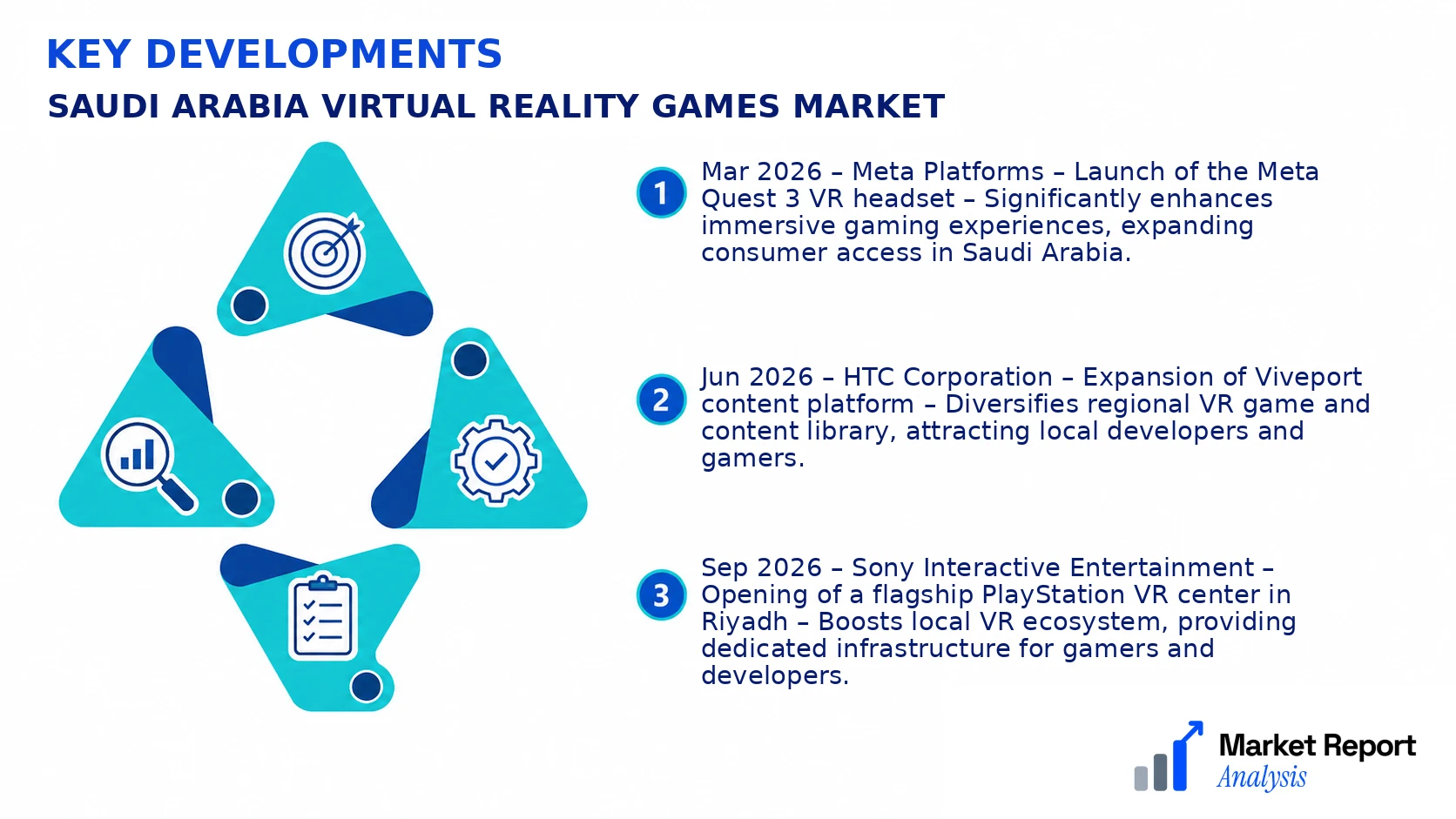
- Mar 2026 – Meta Platforms – Launch of the Meta Quest 3 VR headset – Significantly enhances immersive gaming experiences, expanding consumer access in Saudi Arabia.
- Jun 2026 – HTC Corporation – Expansion of Viveport content platform – Diversifies regional VR game and content library, attracting local developers and gamers.
- Sep 2026 – Sony Interactive Entertainment – Opening of a flagship PlayStation VR center in Riyadh – Boosts local VR ecosystem, providing dedicated infrastructure for gamers and developers.
- Nov 2026 – Microsoft Corporation – Introduction of HoloLens 2 enterprise and gaming bundles – Strengthens enterprise and entertainment VR solutions targeted at Saudi institutions and consumers.
- Feb 2027 – Unity Technologies – Collaboration with Saudi developers for regional VR content creation – Accelerates localization of immersive gaming and training applications in the kingdom.
Frequently Asked Questions
What is the Saudi Arabia Virtual Reality Games Market?
The Saudi Arabia Virtual Reality Games Market encompasses the development, distribution, and consumption of immersive VR gaming content within the country. It reflects the local industry's growth driven by technological adoption, consumer demand, and investments in entertainment infrastructure.
What is the current market size of Saudi Arabia Virtual Reality Games Market?
As of 2026, the Saudi Arabia Virtual Reality Games Market is valued at approximately USD 2.5 Billion, reflecting rapid adoption of VR technologies in gaming segments across the country coupled with increasing interest among youth and tech enthusiasts.
What factors are driving the Saudi Arabia Virtual Reality Games Market?
Key drivers include rising smartphone and headset penetration, government initiatives promoting digital entertainment, the proliferation of high-speed internet, and growing interest in innovative gaming formats that enhance user engagement and experience in the region.
Which Saudi city leads the Saudi Arabia Virtual Reality Games Market?
Riyadh emerges as the leading city due to its robust tech infrastructure, high consumer income levels, and active participation of gaming studios and educational institutions that foster VR gaming development.
Which segment is expected to grow the fastest?
The hardware segment, particularly VR headsets and motion controllers, is anticipated to exhibit the most rapid growth owing to decreasing costs and technological advancements expanding accessibility.
Who are the leading companies operating in the Saudi Arabia Virtual Reality Games Market?
Leading players include local startups alongside international giants like Oculus and HTC, focusing on content creation, hardware distribution, and strategic partnerships tailored to the Saudi market’s unique consumer preferences.
Analyst Perspective
The Saudi Arabia Virtual Reality (VR) Games Market is poised for steady growth, driven by increasing government investment in digital infrastructure, rising youth engagement, and the expanding entertainment ecosystem in key urban centers like Riyadh, Jeddah, and Dammam. Over the long term, market maturity will likely lead to heightened competition, with both local startups and international players vying for market share through innovative content and immersive experiences. Strategic investment in cutting-edge VR hardware, software development, and city-specific gaming hubs will be critical to capitalize on emerging demand segments. Technological evolution, including improvements in latency, graphics fidelity, and standalone headsets, will further enhance consumer adoption and engagement. While market growth presents significant opportunities, regulatory considerations around data privacy and content standards, along with high initial capital expenditure, pose risks. Cities such as Riyadh are expected to serve as pivotal growth nodes, offering substantial strategic advantages for early movers aiming to establish dominant positions and build sustainable ecosystems that attract global partnerships and foster localized content development.
