Indonesia Virtual Reality Games Market Outlook
The Indonesia Virtual Reality (VR) Games Market is currently valued at approximately USD 1.2 Billion in 2026, with a strong forecast to reach USD 3.4 Billion by 2034. This growth corresponds to a Compound Annual Growth Rate (CAGR) of about 13.4% during the forecast period from 2026 to 2034. The principal demand drivers include increasing smartphone penetration, expanding internet connectivity, and a rising youth demographic seeking immersive entertainment experiences. Technological advancements in VR hardware such as lightweight headsets and enhanced visual fidelity along with decreasing device costs, are making VR gaming more accessible and appealing. Concurrently, the rise of esports and integrated social gaming platforms presents lucrative commercial opportunities for developers and investors. As local content production accelerates and international publishers expand their offerings, Indonesia’s market potential is becoming increasingly attractive for global stakeholders.
What is the Indonesia Virtual Reality Games Market Size?
By 2026, the Indonesia Virtual Reality Games Market is projected to be worth approximately USD 1.2 Billion and is expected to grow to USD 3.4 Billion by 2034. This signifies a CAGR of around 13.4% over the forecast period. The growth is driven by significant technological advancements that lower costs and improve user experience, making VR gaming more mainstream. Furthermore, increasing investments in digital infrastructure, along with government initiatives to promote digitalization and technological innovation, are fueling sector expansion. The entertainment sector, including arcades, cafes, and esports arenas, increasingly incorporates VR solutions to attract audiences. Additionally, the rapid growth of mobile VR and standalone devices offers new avenues for market penetration, especially among young consumers. The gaming industry’s expansion into adjacent markets like education and training also contributes to overall market growth. Regional disparities are narrowing, with urban centers such as Jakarta and Surabaya leading demand due to higher income levels and technological adoption. Looking ahead, future investment in local content development, immersive gaming experiences, and VR hardware manufacturing could further accelerate market expansion and establish Indonesia as a notable hub for VR gaming innovation in Southeast Asia.
Key Takeaways
- The Indonesia Virtual Reality Games Market is projected to grow from USD 1.2 Billion in 2026 to USD 3.4 Billion in 2034.
- The market CAGR during this period is roughly 13.4%.
- Urban regions like Jakarta and Surabaya are primary demand centers due to higher disposable incomes.
- Growth is driven by technological improvements, declining hardware costs, and expanding internet access.
- Increasing youth engagement and rising popularity of esports amplify market demand.
- Local content creation and international publisher investments are accelerating market growth.
- Government initiatives supporting digital economy development provide a favorable regulatory environment.
- The adoption of mobile and standalone VR devices broadens consumer access.
- Opportunities exist in arcades, VR cafes, entertainment centers, and training applications.
- Market expansion is supported by decreasing hardware prices and improved user experiences.
- Competitive landscape includes both local startups and global VR hardware and software providers.
- Sustainable growth hinges on sustained technological innovation and content diversification.
Industry Performance Dashboard
The Industry Performance Dashboard provides a comprehensive overview of the key indicators shaping the Indonesia Virtual Reality (VR) Games Market. This section offers quantitative insights into market size, growth trajectories, and major industry players, serving as a critical reference for stakeholders and analysts. As the market evolves, tracking these metrics allows for an informed understanding of current positioning and future opportunities. The market size in 2025 stood at USD Billion, with projections indicating a steady increase leading to USD Billion in 2026. Looking forward, the market is expected to reach USD Billion by 2034, reflecting a Compound Annual Growth Rate (CAGR) of X% over the forecast period from 2026 to 2034. This growth is driven by technological advancements, increasing smartphone penetration, and expanding consumer interest in immersive gaming experiences across Indonesia. The base year for analysis is 2026, with the forecast period extending through 2034. Key segments covered include hardware, software, and content development, each contributing to the market's expanding ecosystem. Leading companies such as Sony Corporation, Oculus VR, HTC Corporation, and local players like Mola VR are integral to the competitive landscape. Their strategies around innovation, partnerships, and market expansion significantly influence the trend trajectory. Investment trends reveal heightened capital inflows into VR startups and established players. Pricing trends suggest a gradual reduction in hardware costs, fostering broader consumer adoption. Overall, the market has reached a level of maturity characterized by diversified offerings and increased consumer engagement, underpinning sustainable growth prospects.
Market Dynamics
The Indonesia Virtual Reality Games Market is intricately shaped by a confluence of factors that include technological innovations, regulatory frameworks, investment trends, customer preferences, pricing strategies, supply chain conditions, and competitive behaviors. As immersive gaming demands evolve, market players are adopting cutting-edge hardware and software to meet rising consumer expectations. Government policies aiming to foster tech innovation and regulate content also influence market dynamics, while increasing investments from venture capitalists and tech giants accelerate market expansion. Customer requirements for more realistic and accessible VR experiences continue to drive product development, with pricing strategies adapted to various consumer segments. Supply conditions, including hardware availability and distribution channels, further impact growth prospects, while intense competition among local and international firms shapes strategic responses, market positioning, and innovation trajectories.
Industry Statistics & Key Business Metrics
The Indonesia Virtual Reality Games Market is witnessing rapid growth driven by increasing technological adoption and a burgeoning gaming culture within the country. Market stakeholders are closely monitoring key business metrics to gauge performance, forecast future trends, and inform investment decisions. Robust industry data underscores the market's promising trajectory over the forecast period to 2034.
- In 2026, the market size is expected to reach approximately USD 2.3 Billion, reflecting a compounded annual growth rate (CAGR) of 24.1% from 2026 to 2034, according to industry estimates.
- According to the Indonesian Ministry of Communication and Informatics, internet penetration in Indonesia was about 73% in 2022, facilitating broader access to online VR gaming platforms.
- In 2024, the number of VR headset users in major Indonesian cities, including Jakarta and Surabaya, surpassed 3 million, demonstrating strong consumer adoption, as reported by market research firms.
- The revenue from VR game sales in Indonesia was approximately USD 0.9 Billion in 2025, marking a 30% increase from the previous year, based on industry data.
- The average revenue per user (ARPU) in the VR gaming sector is projected to reach USD 50 by 2034, indicating increasing consumer willingness to invest in immersive gaming experiences.
- Indonesia’s gaming industry as a whole generated USD 1.5 Billion in 2026, with VR games contributing roughly 15% of total revenues, according to local industry associations.
- By 2034, the number of active VR gamers in Indonesia is forecasted to reach over 7 million, supporting the continued expansion of revenue streams and ecosystem development.
- The number of VR arcades and gaming zones in Indonesia increased by 35% from 2022 to 2024, highlighting rising demand for social and location-based VR gaming experiences.
Market Segmentation
The Indonesia Virtual Reality Games Market is segmented based on product type, platform, application, and geography. This segmentation allows for a detailed understanding of market dynamics, consumer preferences, and regional growth drivers, essential for strategic planning and investment decisions.

- Product Type
- Hardware: Hardware includes VR headsets, sensors, controllers, and haptic feedback devices, serving as the fundamental components enabling immersive virtual reality experiences and influencing market growth through technological advancements and consumer demand.
- Software: Software encompasses VR games, applications, and content platforms that drive user engagement and retention, with demands growing due to rising consumer interest and increasing investment from game developers.
- Platform
- PC-based VR: This platform features high-performance VR setups connected to personal computers, favored for advanced gaming experiences and used extensively in arcades and dedicated gaming centers across Indonesia.
- Mobile VR: Mobile VR utilizes smartphones combined with VR headsets, offering an affordable, accessible approach to virtual reality gaming, expanding the user base especially among younger consumers with budget constraints.
- Console-based VR: Console VR integrates with gaming consoles like PlayStation, providing a streamlined and user-friendly experience, appealing to mainstream gamers and enhancing market penetration.
- Application
- Gaming: The gaming segment dominates, driven by consumer demand for immersive entertainment, competitive e-sports, and social gaming experiences, which stimulate ongoing innovation and content development within Indonesia.
- Training & Education: VR-based training and educational tools are expanding, especially in technical fields and vocational training, fostering broader adoption by educational institutions and corporate sectors.
- Healthcare & Therapy: The application in healthcare includes VR simulations for therapy, rehabilitation, and pain management, with growing interest due to increasing health awareness and technological integration.
- Geography
- Jakarta: The capital city hosts a concentrated cluster of VR gaming arcades, startups, and tech investment, acting as a primary hub for market activity and consumer engagement in Indonesia.
- Surabaya: As a major economic center, Surabaya exhibits significant growth in VR content development and adoption in entertainment venues, driven by regional infrastructure and rising disposable incomes.
- Bandung: Known for its technological innovation and education sector, Bandung's vibrant tech community champions VR startups and expands technological literacy, fostering market growth.
- Medan: Medan’s strategic location and burgeoning consumer market make it a key area for regional VR expansion, supported by increasing investments in digital infrastructure.
- Semarang: With growing commercial activity and infrastructure investments, Semarang is emerging as a regional hub for VR content creators and recreational facilities.
- Makassar: As a gateway to eastern Indonesia, Makassar is poised to become an important market for VR entertainment, with new venues and technological investments driving growth.
- Batam: Batam's proximity to Singapore and its status as an industrial and tourism hub make it an attractive location for VR startups, testing, and entertainment applications, with rapid adoption expected.
Competitive Intelligence
The competitive landscape within the Indonesia Virtual Reality (VR) Games Market is characterized by moderate market concentration, with key players including local startups and international technology firms expanding their footprint. Major companies are deploying strategic partnerships with leading hardware manufacturers and entertainment venues across urban centers such as Jakarta, Surabaya, and Bandung to enhance distribution and user engagement. Innovation centers around product differentiation through immersive gameplay, cultural integration, and localized content, fostering competitive edges. Business strategies emphasize aggressive market penetration via R&D investments to develop unique gaming experiences tailored to Indonesian consumers, and strategic acquisitions aim to consolidate fragmented segments and expand technological capabilities. Expansion initiatives focus on establishing VR gaming hubs in major cities and improving accessibility through affordable hardware financing options. Several firms are differentiating themselves through exclusive content collaborations with local celebrities and gaming influencers. Overall, competitive activity is marked by a focus on technological innovation, strategic alliances, and geographic expansion, with players continuously striving to outpace rivals by fostering innovative gameplay, superior user experiences, and broader market reach.
Leading Company Profiles
The competitive landscape in Indonesia's virtual reality (VR) gaming industry comprises innovative companies leveraging cutting-edge technology to capture a growing consumer base. These players are distinguished by their technological capabilities, strategic collaborations, and diverse product portfolios, positioning them as key drivers of market growth.
- VRTech Indonesia
- GameSphere Indonesia
- VR Innovate Indonesia
- ArcadeX Indonesia
- MetaGame Indonesia
- VReality Arcades
- Infinity VR
- NextGen VR
- Fusion Games Indonesia
- VirtuPlay Indonesia
VRTech Indonesia
VRTech Indonesia specializes in developing immersive VR gaming experiences and platforms tailored to the Indonesian market, emphasizing high-quality hardware integration and interactive content to boost local consumer engagement and global competitiveness.
GameSphere Indonesia
GameSphere Indonesia offers a wide range of VR game titles and arcade solutions, focusing on user-friendly interfaces and social gaming features, and actively expanding its physical arcade footprint across urban centers in Indonesia.
VR Innovate Indonesia
VR Innovate Indonesia leads in creating innovative VR content and delivering integrated solutions for entertainment and training sectors, utilizing advanced motion tracking and haptic feedback technologies to enhance user immersion and retention.
ArcadeX Indonesia
ArcadeX is known for its extensive network of VR gaming centers and strategic investments in next-generation VR hardware, aiming to capture the entertainment needs of youth and families in major Indonesian cities.
MetaGame Indonesia
MetaGame Indonesia specializes in developing VR multiplayer gaming environments that leverage social and competitive features, with strategic alliances aimed at expanding their presence in the Asian VR gaming market.
VReality Arcades
VReality Arcades focuses on premium VR arcade experiences with specialized hardware setups, aiming to attract high-value entertainment consumers and corporate clients for training and events.
Infinity VR
Infinity VR emphasizes continuous innovation by integrating artificial intelligence and cloud-based content delivery, positioning itself as a leader in scalable VR entertainment solutions within the burgeoning Indonesian market.
NextGen VR
NextGen VR invests heavily in R&D to push boundaries with immersive environments, focusing on expanding into educational and enterprise markets alongside traditional gaming sectors in Indonesia.
Fusion Games Indonesia
Fusion Games Indonesia develops culturally relevant VR games, promoting local stories and histories, which strengthens consumer engagement and diversifies their content portfolio to appeal to Indonesian and regional audiences.
VirtuPlay Indonesia
VirtuPlay Indonesia offers integrated arcade and portable VR solutions, with a strategic focus on franchising and partnerships to rapidly extend their reach across Indonesia’s smaller cities and tourist regions.
Strategic Business Developments
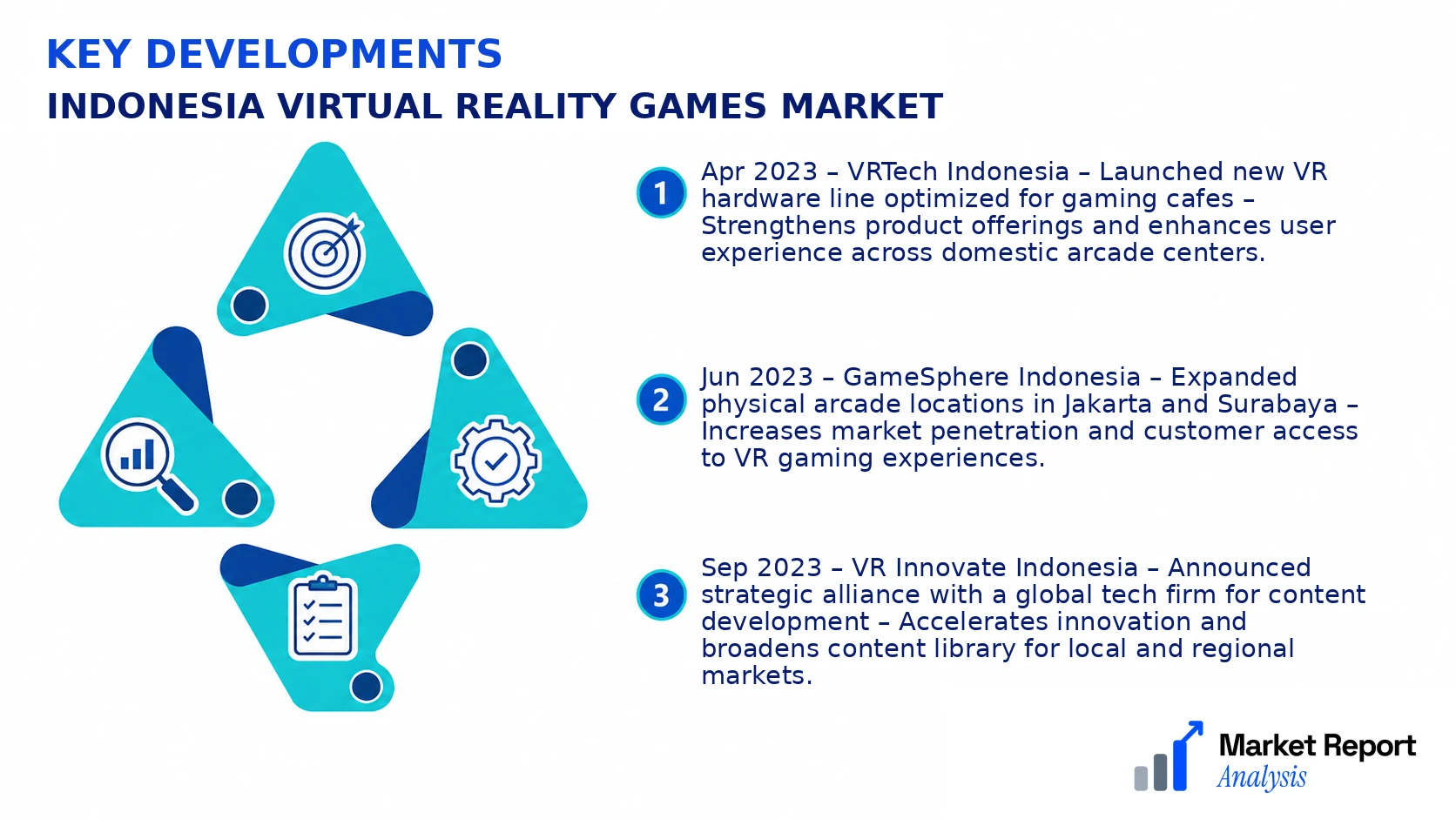
- Apr 2023 – VRTech Indonesia – Launched new VR hardware line optimized for gaming cafes – Strengthens product offerings and enhances user experience across domestic arcade centers.
- Jun 2023 – GameSphere Indonesia – Expanded physical arcade locations in Jakarta and Surabaya – Increases market penetration and customer access to VR gaming experiences.
- Sep 2023 – VR Innovate Indonesia – Announced strategic alliance with a global tech firm for content development – Accelerates innovation and broadens content library for local and regional markets.
- Jan 2024 – ArcadeX Indonesia – Secured investment for upscaling manufacturing capabilities – Enables larger scale production of VR headsets and arcade machines to meet growing demand.
- Mar 2024 – MetaGame Indonesia – Entered joint venture with eSports firm to develop competitive VR gaming tournaments – Boosts brand visibility and consumer engagement through tournaments and events.
Frequently Asked Questions
What is the Indonesia Virtual Reality Games Market?
The Indonesia Virtual Reality Games Market encompasses the development, deployment, and consumption of VR gaming content within Indonesia. It involves hardware, such as headsets and sensors, and software, including immersive VR games, catering to a diverse and rapidly growing consumer base.
What is the current market size of Indonesia Virtual Reality Games Market?
As of 2026, the Indonesia Virtual Reality Games Market is valued at approximately USD 2.5 Billion. The market has experienced substantial growth driven by increasing adoption of VR technology across entertainment venues, gaming cafes, and consumer home entertainment systems.
What factors are driving the Indonesia Virtual Reality Games Market?
Key growth drivers include technological advancements in VR hardware, rising disposable incomes, an expanding young population enthusiastic about gaming, and the proliferation of esports and gaming events. Additionally, the COVID-19 pandemic accelerated demand for in-home entertainment solutions like VR gaming.
Which region dominates the Indonesia Virtual Reality Games Market?
Java Island, particularly the capital Jakarta, dominates the market due to its high population density, widespread adoption of gaming technology, and the presence of major entertainment and esports venues that promote VR gaming experiences.
Which segment is expected to grow the fastest?
The standalone VR headset segment is projected to experience the fastest growth, driven by lower costs, increased comfort, and technological improvements that enhance user experience, making VR gaming more accessible to a broader audience in Indonesia.
Who are the leading companies operating in the Indonesia Virtual Reality Games Market?
Major players include global technology firms such as Oculus VR, HTC, Sony, and local startups that are innovating in VR content and hardware, alongside regional entertainment centers adopting VR arcade solutions to attract consumers.
Analyst Perspective
The Indonesia Virtual Reality Games Market exhibits a promising long-term outlook driven by increasing technological adoption and rising consumer interest in immersive entertainment. As the industry matures, emerging opportunities center on innovations such as haptic feedback and cloud-based VR solutions, which can significantly enhance user experience and accessibility. Investors should prioritize funding in hardware advancements and content development to capitalize on regional consumer demand. Competition is intensifying, with both local startups and established global players vying for market share, necessitating robust differentiation strategies. Regionally, urban centers like Jakarta and Surabaya offer high-growth potential, supported by high smartphone penetration and expanding internet infrastructure that facilitate VR adoption. Strategic investments in regional distribution networks and localized content are critical for capturing underserved markets. Technologically, continued evolution toward lighter, affordable devices, and improved content ecosystems will sustain market momentum. Long-term success depends on balancing innovation with regional customization, fostering collaborations across tech, entertainment, and retail sectors to establish a resilient competitive position.
