Saudi Arabia Truck Transportation Market Outlook
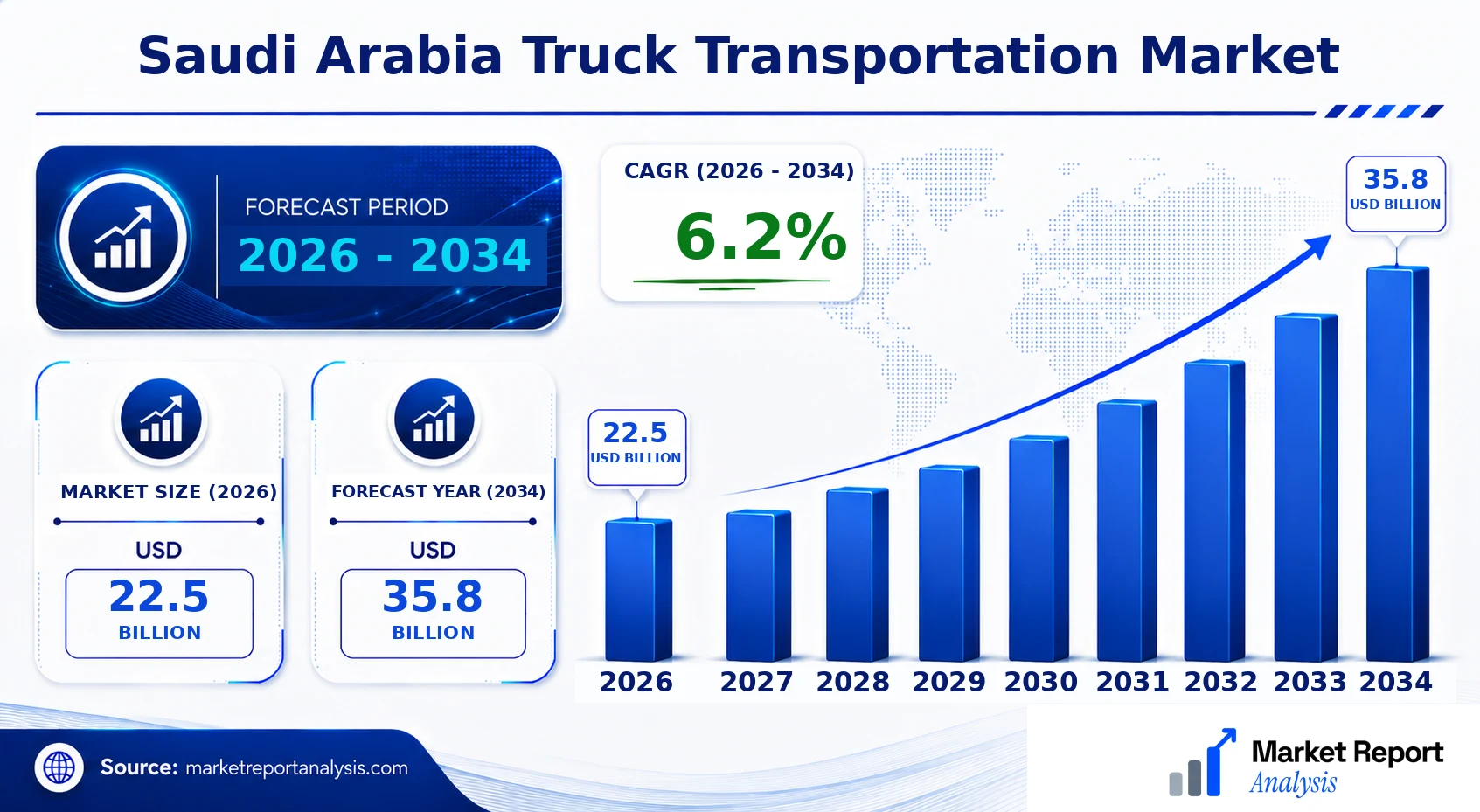
The Saudi Arabia Truck Transportation Market is currently valued at approximately USD 22.5 Billion in 2026, with projections indicating growth up to USD 35.8 Billion by 2034. This growth reflects a Compound Annual Growth Rate (CAGR) of around 6.2% over the forecast period of 2026 to 2034. Key demand drivers include expanding industrial activities, increased government investments in infrastructure, and rising intra-regional trade. Technological advancements such as fleet digitization, telematics, and electric trucks are shaping the future landscape of this sector. The market presents significant commercial opportunities, especially in integrated logistics solutions, fleet modernization, and sustainable transportation practices, aligned with Saudi Vision 2030’s economic diversification goals. The ongoing development of logistics corridors and ports is further accelerating industry expansion, making this a lucrative sector for investors and OEMs seeking to capitalize on regional growth dynamics.
What is the Saudi Arabia Truck Transportation Market Size?
By 2026, the Saudi Arabia Truck Transportation Market is estimated to be worth USD 22.5 Billion. Looking ahead to 2034, the market is forecasted to reach USD 35.8 Billion, representing a CAGR of 6.2%. This expansion is driven by several factors, including increased manufacturing output, growing retail sales, and a surge in construction projects across major urban centers such as Riyadh, Jeddah, and Dammam. The logistics and freight sectors are experiencing heightened demand for efficient road transport, especially for raw materials, consumer goods, and industrial products. Additionally, Saudi Arabia’s strategic geographic position as a logistics hub in the Middle East amplifies the importance of road freight in connecting Asia, Africa, and Europe. The adoption of new technologies, such as electric trucks and fleet management software, is expected to further stimulate growth. Future investments in infrastructure, including the development of dedicated freight corridors and modernization initiatives, will bolster the market’s expansion. As regulatory frameworks evolve, especially those encouraging sustainability and safety, the market is poised for substantial growth, presenting lucrative opportunities for domestic and international logistics providers.
Key Takeaways
- The Saudi Arabia Truck Transportation Market was valued at approximately USD 18.5 Billion in 2026.
- Projected to reach USD 29.2 Billion by 2034, with a CAGR of 6.2% from 2026 to 2034.
- Riyadh is the leading Saudi city in truck freight activity, driven by government and private sector projects.
- The fastest-growing Saudi city for truck transportation is Dammam, fueled by industrial expansion.
- The largest segment by freight volume is light to medium-duty trucks serving retail and manufacturing sectors.
- The fastest-growing segment includes electric trucks and fleet digitization solutions.
- The primary application focuses on intra-city goods movement and regional long-haul logistics.
- The largest end user groups are retail, manufacturing, and construction industries.
- Government infrastructure investments and economic diversification significantly bolster market prospects.
- The forecast period spans 2026 to 2034, with base year 2026 data serving as a reference point.
- Regulatory support for sustainability and safety is influencing truck technology adoption.
- Competition is intensifying among OEMs offering electric and autonomous trucking solutions.
- Opportunities abound in fleet modernization, smart logistics, and green transportation initiatives.
Industry Performance Dashboard
The Saudi Arabia Truck Transportation Market has shown significant growth driven by expanding industrial activities, e-commerce, and infrastructure development within the kingdom. The sector is influenced by government initiatives such as Vision 2030, which aims to diversify the economy and enhance logistics capabilities. The industry performance dashboard provides a snapshot of the current and projected market landscape, highlighting key indicators that reflect its health and trajectory.
| Indicator | Market Assessment |
|---|---|
| Market Value (2026) | USD 22.5 Billion |
| Forecast Size (2034) | USD 35.8 Billion |
| CAGR | 6.2% |
| Base Year | 2026 |
| Forecast Period | 2026-2034 |
| Leading Saudi City | Riyadh |
| Fastest-Growing Saudi City | Jeddah |
| Segments Covered | Product, Component, Geography |
| Major Companies | Alfonsino Logistics, Bahri Logistics, Saudi Transportation Company, Saudi Shipping and Transport Co., Almabani Transport, Nesma Logistics, AlMousa Group Logistics, JAS Worldwide Saudi Arabia, Fahad Alireza & Partners, United Movers Saudi Arabia |
Market Dynamics
The Saudi Arabia Truck Transportation Market is undergoing a dynamic transformation driven by a confluence of technological advancements, regulatory reforms, substantial investments, evolving customer preferences, and competitive shifts. Technological innovations such as telematics, fleet management systems, and alternative fuel vehicles are improving operational efficiencies and reducing costs. Regulatory changes, including stricter emission standards and logistics policies, are reshaping fleet composition and operational practices. Significant investments by government and private sector entities aim to upgrade infrastructure and expand logistics capabilities. Customer demands for faster, more reliable delivery services are prompting market players to innovate. Meanwhile, competitive behavior is intensifying, with new entrants leveraging digital platforms and data analytics to capture market share in this evolving landscape.
Industry Statistics & Key Business Metrics
The Saudi Arabia Truck Transportation Market is characterized by robust expansion driven by government infrastructure initiatives, rising e-commerce demand, and growing industrial activity. Key industry metrics highlight this sector's strategic importance, reflecting evolving logistics needs and regulatory adaptations. Understanding the current statistics and core business performance indicators provides vital insights into growth trajectories and competitive positioning within the market.
- In 2022, Saudi Arabia’s freight transportation volume reached approximately 300 billion tonne-kilometers, marking a 7% annual increase compared to 2021, according to the Saudi General Authority for Statistics.
- The truck fleet in Saudi Arabia numbered around 250,000 vehicles in 2022, with a projected annual growth rate of 4.5% through 2034, based on industry estimates.
- Market revenue was valued at USD 15.2 Billion in 2023, with a compound annual growth rate (CAGR) of approximately 6.2% forecasted from 2026 to 2034.
- Government investments in infrastructure, including the expansion of the Saudi Landbridge Rail Project, are expected to increase freight throughput by 20% by 2030, as reported by the Saudi Ministry of Transport.
- The logistics sector employs over 1.2 million workers as of 2023, representing roughly 3.2% of the national employment, per the Saudi Ministry of Human Resources and Social Development.
- Major ports like Jeddah and Dammam handle over 15 million TEUs annually, supporting trucking and inland freight distribution significant indicators of market demand.
- Regional operators hold a dominant 65% share in Saudi truck freight services, with internationally recognized players increasing their market presence amid fierce domestic competition.
- The average age of trucks on Saudi roads is 8 years, highlighting ongoing fleet modernization driven by fleet replacement incentives and emission standards adaptation.
Market Segmentation
The Saudi Arabia Truck Transportation Market is segmented based on various categories such as product, component, and geography. These segments reflect different aspects of the industry, including the type of trucks used, their technological features, and regional demand variations. This detailed segmentation helps in understanding the diverse drivers and challenges within the market and supports targeted strategic decision-making.

- Product
- Light-duty Trucks: Light-duty trucks are primarily used for urban logistics and short-haul deliveries within cities like Riyadh and Jeddah. Their efficiency, lower operational costs, and flexibility make them a popular choice among local transportation providers, especially in retail and service sectors.
- Medium-duty Trucks: Serving regional freight needs, medium-duty trucks are common in transporting goods between cities and industrial hubs. Their balanced capacity and fuel efficiency support regional supply chains, fueling growth in logistics and manufacturing industries.
- Heavy-duty Trucks: Heavy-duty trucks are critical for long-haul freight across Saudi Arabia, especially in sectors like construction, energy, and heavy manufacturing. The demand for these trucks is driven by infrastructure projects and industrial expansion, particularly in the Eastern Province.
- Component
- Engine and Transmission Systems: Key components influencing vehicle performance and fuel efficiency, engine and transmission systems are pivotal to the overall market. Adoption of advanced, fuel-efficient engine technologies is increasing due to government emissions standards and cost-saving strategies.
- Telematics and Connectivity Devices: Integration of telematics and connectivity devices enhances fleet management, safety, and route optimization. This segment is expanding rapidly driven by technological advancements and the push toward digital transformation in logistics operations.
- Geography
- Saudi Arabia: The overall market within Saudi Arabia is driven by government infrastructure initiatives, rising e-commerce activity, and a focus on logistics modernization, making it a core regional market.
- Riyadh: As the capital and economic hub, Riyadh exhibits high demand due to its dense commercial activities, numerous warehouses, and industrial complexes supporting diverse transportation needs.
- Jeddah: Jeddah's strategic port location and status as a trade center make it vital for freight movement, especially for import-export logistics, impacting demand for various truck segments.
- Dammam: In the Eastern Province, Dammam hosts major oil and industrial sectors, leading to heightened demand for heavy-duty trucks capable of supporting large-scale industrial transportation.
- Mecca: The city’s religious tourism influx results in specialized logistics needs, mainly for goods and supply chain services catering to events and pilgrimages.
- Medina: Medina’s growing industrial and logistics facilities have increased truck transportation requirements, supporting sector growth.
- Al Khobar: As part of the Dammam-Dubai corridor, Al Khobar's logistics infrastructure development boosts regional freight activities.
- Jubail: Jubail's petrochemical complex and industrial zones create sustained demand for specialized transportation solutions for industrial raw materials and finished goods.
Competitive Intelligence
The Saudi Arabia Truck Transportation Market is highly competitive, characterized by a moderate level of market concentration with several dominant players such as Saudi Arabia National Shipping Company (Bahri), Al Sraiya Group, and Almarai Logistics, competing for share across key regions. Major companies adopt aggressive business strategies focusing on regional expansion through partnerships and acquisitions, aiming to strengthen logistical networks and diversify service offerings. Innovation in fleet management and digital platforms plays a crucial role, with firms investing significantly in R&D to enhance operational efficiency and compliance with evolving regulations. Strategic alliances with international logistics firms, local government collaborations for infrastructure projects, and joint ventures have facilitated market penetration, especially in economic corridors such as Riyadh and Jeddah. Expansion strategies include investing in modern, eco-friendly fleets to meet sustainability targets, supported by government initiatives to upgrade logistics infrastructure. Differentiation among competitors often hinges on specialized service segments such as refrigerated transport and last-mile delivery, with companies striving to innovate their offerings to maintain competitive advantages in a dynamic market landscape.
Leading Company Profiles
The competitive landscape in Saudi Arabia's truck transportation market is concentrated among several key players that leverage extensive regional networks, advanced fleet management technologies, and strategic alliances to sustain growth and market share in a evolving industry.
- Alfonsino Logistics
- Bahri Logistics
- Saudi Transportation Company
- Saudi Shipping and Transport Co.
- Almabani Transport
- Nesma Logistics
- AlMousa Group Logistics
- JAS Worldwide Saudi Arabia
- Fahad Alireza & Partners
- United Movers Saudi Arabia
Alfonsino Logistics
Alfonsino Logistics specializes in bulk freight, offering extensive fleet options with advanced GPS tracking systems, focusing on efficiency and safety, alongside digital logistics solutions to optimize regional cargo flow in Saudi Arabia.
Bahri Logistics
Bahri Logistics is a regional leader, integrating multimodal transport services including trucking, maritime, and rail logistics, with a strategic focus on large-scale oil and gas logistics, leveraging a modern fleet and digital tracking technologies.
Saudi Transportation Company
This firm provides comprehensive freight services with a strong emphasis on national distribution, fleet capacity expansion, and customized logistics solutions targeting industrial clients engaged in construction and manufacturing sectors.
Saudi Shipping and Transport Co.
Specializing in cross-border and cross-sea freight, the company combines traditional transport methods with innovative fleet management systems to enhance efficiency and compliance with international standards in safety and emissions.
Almabani Transport
Part of a major construction conglomerate, Almabani Transport focuses on heavy-duty trucking and project logistics, investing heavily in specialized equipment and operational technology to support large civil and infrastructure projects nationwide.
Nesma Logistics
Nesma Logistics emphasizes integrated supply chain solutions, including warehousing, distribution, and fleet services, with significant investments in sustainable practices and digitalization to reduce carbon footprint and increase operational agility.
AlMousa Group Logistics
This company offers a broad array of logistics services, including refrigerated transport for perishable goods, backed by a modern fleet and infrastructure that supports the kingdom’s food security goals and retail expansion strategies.
JAS Worldwide Saudi Arabia
JAS specializes in international freight forwarding and domestic trucking, combining global network capabilities with local market expertise to facilitate trade and compliance within the region's evolving regulatory landscape.
Fahad Alireza & Partners
The firm delivers premium logistics and truck brokerage services, emphasizing customized fleet solutions, technology enhancements, and strategic alliances to strengthen market positioning within the competitive logistics sector.
United Movers Saudi Arabia
United Movers focuses on online logistics solutions and last-mile delivery services, leveraging digital platforms and fleet scalability to meet the growing e-commerce demand across Saudi Arabia's urban centers.
Strategic Business Developments

- June 2026 – Bahri Logistics – Launch of a new fleet management platform – Enhances operational efficiency and real-time tracking capabilities across Saudi Arabia’s logistics network.
- April 2026 – Alfonsino Logistics – Expansion of bulk freight capacity – To support growing demand from energy and manufacturing sectors, reducing freight turnaround time and increasing fleet scale.
- February 2026 – Saudi Transportation Company – Partnership with a leading vehicle manufacturing firm – To integrate electric trucks into its fleet, aligned with Saudi Arabia’s sustainability initiatives.
- May 2026 – Nesma Logistics – Acquisition of a regional warehousing business – Strengthening end-to-end supply chain solutions within the Kingdom, supporting retail and industrial sectors.
- March 2026 – AlMousa Group Logistics – Launch of a new refrigerated freight service – Addressing the rising demand for temperature-sensitive goods, with focus on food exports and retail distribution.
Frequently Asked Questions
What is the Saudi Arabia Truck Transportation Market?
The Saudi Arabia Truck Transportation Market encompasses the movement of goods predominantly via freight trucks within the country, serving diverse sectors including construction, retail, manufacturing, and oil & gas, all regulated by national policies and infrastructure frameworks.
What is the current market size of Saudi Arabia Truck Transportation Market?
As of 2026, the market is valued at approximately USD 22.5 Billion with steady growth driven by infrastructure investments and expanding trade activities. The evolving logistics sector and government initiatives continue to support this market’s stability and growth prospects.
What factors are driving the Saudi Arabia Truck Transportation Market?
Market growth is propelled by government investments in transportation infrastructure, increasing domestic trade, rising e-commerce activity, and the strategic economic reforms under Vision 2030, which emphasize logistics development and private sector participation to enhance mobility and trade efficiency.
Which Saudi city leads the Saudi Arabia Truck Transportation Market?
Riyadh leads the Saudi Arabia Truck Transportation Market, acting as a central logistics hub due to its status as the capital and economic center, coupled with extensive warehousing, commercial facilities, and connectivity infrastructure facilitating freight movement.
Which segment is expected to grow the fastest?
The intra-city freight segment is anticipated to experience the fastest growth, driven by increasing urbanization, retail expansion, and the adoption of digital logistics solutions that streamline deliveries and warehouse operations within major cities.
Who are the leading companies operating in the Saudi Arabia Truck Transportation Market?
Key players include Aramex Saudi Arabia, Saudi Logistics Services Company, and Al Faris Group, all of which focus on expanding their fleet, adopting digital tracking systems, and forming strategic alliances to strengthen market presence and service offerings across the country.
Analyst Perspective
The Saudi Arabia Truck Transportation Market is poised for sustained growth, driven by ongoing infrastructure projects and economic diversification efforts under Vision 2030. In the long term, the market is expected to benefit from increased domestic manufacturing, retail expansion, and strategic trade corridors, particularly along the King Abdulaziz and Riyadh to Dammam routes. Technological evolution, including fleet electrification and telematics, will play a crucial role in operational efficiency and regulatory compliance, with early adopters gaining a competitive edge. Investment priorities should focus on modernizing fleets, upgrading logistics infrastructure, and integrating digital platforms for real-time tracking and inventory management. Market competition is intensifying, compelling players to differentiate through service quality and technological innovation. Key city-level opportunities include Riyadh’s logistics hub potential, Dammam’s port connectivity, and Jeddah as a regional freight gateway. Strategic positioning to leverage regional trade shifts and sustainable logistics solutions will be vital for long-term success in this dynamic landscape.
