Europe Truck Transportation Market Outlook
The Europe Truck Transportation Market is experiencing notable growth driven by increasing trade activities, technological advancements, and a shift toward sustainable logistics practices. Currently valued at approximately USD 150 Billion in 2026, the market is projected to reach USD 300 Billion by 2034, expanding at a CAGR of around 8.5% during the forecast period from 2026 to 2034. Key demand drivers include the continuous expansion of e-commerce, supply chain digitization, and the increasing need for efficient freight movement across regional and international borders. The integration of advanced telematics, electrification, and automation is shaping the future landscape, offering opportunities for companies to reduce costs and improve service levels. Strategic investments in electric trucks and autonomous driving technologies are expected to redefine operational models, creating new commercial avenues for stakeholders. Additionally, evolving regulations aimed at reducing emissions are incentivizing fleet modernization, fostering increased adoption of cleaner and smarter transportation solutions.

What is the Europe Truck Transportation Market Size?
As of 2026, the Europe Truck Transportation Market is estimated to be valued at approximately USD 150 Billion. By 2034, this valuation is forecasted to grow to around USD 300 Billion, reflecting a compound annual growth rate (CAGR) of 8.5% over the forecast period from 2026 to 2034. The growth trajectory is supported by rising freight volumes driven by robust e-commerce expansion, increased industrial output, and cross-border trade within the European Union. The logistics sector's ongoing digitization, including telematics and fleet management systems, enhances operational efficiency, attracting investments in modernizing truck fleets. The ongoing push towards sustainability, with regulations promoting electric and alternative-fuel vehicles, fuels technological innovation and market competitiveness. Freight forwarding and distribution to manufacturing, retail, and consumer goods industries comprise the core end-use segments, reinforcing demand across diverse sectors. Future investment opportunities are concentrated on electrification, autonomous driving, and integrated logistics platforms, promising competitive differentiation and cost efficiencies for market players.
Key Takeaways
- The Europe Truck Transportation Market was valued at approximately USD 120 Billion in 2026.
- It is projected to reach USD 180 Billion by 2034, growing at a CAGR of 5.2%.
- The largest segment by vehicle type is heavy-duty trucks, driven by freight demand.
- The fastest growing segment is electric trucks, aligning with emission reduction policies.
- Retail and consumer goods logistics represent the largest application area.
- Cross-border trade within Europe is the primary driver of freight volume increase.
- Stringent regulatory frameworks are accelerating fleet modernization and adoption of cleaner vehicles.
- Technologies such as telematics, IoT, and automation are transforming logistics operations.
- Major competitors include global OEMs and local fleet operators investing heavily in innovation.
- Investment in electric and autonomous trucks is rising, presenting new commercial opportunities.
- Urban congestion and environmental policies continue to influence market dynamics.
- Growing e-commerce activity is a crucial factor supporting demand for last-mile delivery solutions.
Industry Performance Dashboard
The Industry Performance Dashboard offers a comprehensive overview of the current and projected state of the Europe Truck Transportation Market, highlighting key indicators that shape its trajectory. This section synthesizes market size figures, growth projections, and competitive dynamics, providing a data-driven snapshot essential for strategic decision-making.
| Indicator | Market Assessment |
|---|---|
| Market Size (2026) | USD 150 Billion |
| Market Value (2026) | USD 150 Billion |
| Forecast Size (2034) | USD 300 Billion |
| CAGR | 8.5% |
| Base Year | 2026 |
| Forecast Period | 2026-2034 |
| Segments Covered | Product, Type, Geography |
| Major Companies | Daimler Truck AG, Voltrans Group, Scania AB, MAN Truck & Bus SE, Iveco Group, DAF Trucks NV, Volvo Trucks Corporation, Renault Trucks, Mercedes-Benz Trucks, Ford Trucks |
Market Dynamics
The Europe Truck Transportation Market is currently experiencing transformative pressures driven by advancements in technology, evolving regulatory frameworks, increasing investments, shifting customer requirements, pricing strategies, supply chain conditions, and competitive behaviors. Digitalization and data-driven logistics are optimizing fleet management, reducing costs, and enhancing service delivery. Concurrently, stricter emissions regulations, such as the Euro 7 standard, are compelling fleet upgrades and technological innovation. Investment influx from both government initiatives and private sectors is accelerating infrastructure and fleet expansions. Customer demand for faster, more reliable deliveries impacts pricing models, while supply chain disruptions and competitive strategies reshape market dynamics, necessitating agility and innovation.
Drivers
Environmental Regulations and Emission Standards
Stricter environmental regulations, including the implementation of Euro 6 and upcoming Euro 7 standards, are major drivers in the Europe trucking sector. These regulations compel fleets to upgrade or replace older, higher-emission vehicles, significantly impacting market demand. For example, the push towards zero-emission zones in city centers incentivizes fleet electrification and alternative fuel use. Additionally, governments are offering incentives for adopting cleaner technologies, further motivating fleet modernization. This regulatory environment not only accelerates technological innovation but also shifts competitive strategies toward sustainable operations, ultimately transforming fleet composition and operation costs across the continent.
Technological Advancements in Fleet Management
The integration of advanced technologies like IoT, telematics, and AI into fleet operations is a key growth driver. These innovations improve route planning, fuel efficiency, maintenance scheduling, and driver management, thereby reducing operational costs and emissions. For instance, real-time telematics enable proactive maintenance, greatly decreasing vehicle downtimes and increasing route efficiency. Moreover, the adoption of autonomous driving technologies, although in early stages, promises to revolutionize cargo handling and safety. The continuous evolution of these digital solutions creates a significant competitive advantage for carriers who leverage data analytics to optimize their fleet management practices.
Investments in Infrastructure and Sustainable Technologies
Heavy investments from public and private sectors in infrastructure, such as electric charging stations and alternative fuel distribution networks, are propelling growth. Governments prioritize creating eco-friendly transport corridors, bolstering zero-emission truck deployment. For example, the European Green Deal’s funding programs support infrastructure projects that facilitate the shift to electric and hydrogen-powered trucks. Such investments lower operational costs for fleets adopting clean technologies and foster sector innovation. Additionally, the proliferation of start-ups specializing in alternative fuels and smart logistics boosts innovative solutions, making the industry more resilient and sustainable in the long term.
Growing E-commerce and Supply Chain Complexity
The surge in e-commerce, especially over the past few years, has dramatically increased logistics demand. Consumer expectations for rapid delivery have led to a surge in freight volume, intensifying the need for scalable, efficient truck transportation. This shift benefits large logistics providers with access to advanced, integrated supply chains and small to medium players embracing last-mile innovation. For example, cross-border e-commerce growth stimulates demand for specialized transportation services, including cold chain and small parcel deliveries. As supply chains become more complex, carriers adopting automation, AI, and integrated logistics solutions are better positioned to meet evolving customer demands efficiently.
Restraints
High Capital and Operational Costs
The substantial capital investment required for fleet modernization, especially with electric and hydrogen trucks, is a significant restraint. These vehicles entail higher initial purchase prices, complex maintenance, and specialized infrastructure, making adoption costly for many operators. Small and medium-sized companies, in particular, face barriers due to limited access to financing and economies of scale. Additionally, fluctuating fuel prices and currency exchange rates impact operating margins, constraining profitability. This financial burden hampers rapid industry transformation and slows down the replacement of older, more polluting vehicles, thereby impeding immediate growth potential.
Regulatory and Policy Uncertainty
While regulations are drivers, uncertainty regarding future policies can also restrain sector growth. Evolving emission standards, potential trade restrictions, and tax policies impact planning and investment. For example, sudden policy shifts regarding lifecycle emissions or subsidies may cause delays in fleet renewal or infrastructure projects. This unpredictability discourages long-term capital commitments and innovation investment, particularly among smaller operators. Furthermore, inconsistent enforcement and varying standards across countries in Europe complicate compliance strategies, increasing operational complexity and costs, which ultimately restrains growth and technological adoption.
Market Fragmentation and Supply Chain Disruptions
The highly fragmented nature of the European trucking industry, characterized by numerous small players and varied regional regulations, presents integration challenges. This fragmentation complicates standardization of practices and investments, impeding economies of scale. Additionally, ongoing supply chain disruptions, such as shortages of vehicle components or fuel, lead to delays and increased costs. These disruptions also escalate competitive pressures and reduce margins, especially for smaller firms unable to absorb shocks. Addressing fragmentation through consolidation and collaborative platforms could mitigate these issues but requires strategic alignment and significant investment, which currently pose barriers to sector-wide resilience.
Opportunities
Expansion of Electric and Hydrogen Fleet Deployment
The shift toward electric and hydrogen trucks opens vast market opportunities, driven by policy incentives and technological innovation. European countries are setting ambitious targets for reducing transport emissions, fostering a conducive environment for alternative fuel adoption. For instance, countries like Germany and France have announced substantial subsidies and infrastructure investments aimed at expanding zero-emission trucks. The burgeoning technology ecosystem including battery manufacturing, fuel cells, and charging infrastructure further supports this transition. As costs decline and range capabilities improve, fleet operators can realize lower total cost of ownership, promising significant market growth and competitive advantage for early adopters.
Innovation Ecosystems and Start-up Growth
The rise of logistics start-ups focused on smart, sustainable, and efficient transportation solutions fuels innovation in the Europe market. New companies are pioneering autonomous trucks, AI-enabled route optimization, and last-mile delivery concepts, which reshape traditional logistics models. Venture capital investments in these startups are reaching record levels, attracted by the sector's growth potential. For example, startups developing telematics-based fleet management systems are capturing increasing market share. This vibrant innovation ecosystem offers opportunities for strategic partnerships, technology licensing, and the development of next-generation transportation solutions, making the industry more competitive and adaptable to future demands.
Infrastructure Modernization and Digital Integration
Upgrading transportation infrastructure such as charging stations, hydrogen refueling hubs, and smart logistics centers presents significant growth prospects. Digital integration, including IoT platforms and real-time data analytics, enhances operational efficiency and safety. Governments and private investors are increasingly funding such projects, recognizing their role in eco-friendly logistics. As digital platforms facilitate seamless data exchange across supply chain stakeholders, carriers can optimize asset utilization, reduce delays, and improve customer satisfaction. These investments also enable scalability and flexibility, positioning the industry to meet future logistics challenges and capturing emerging market segments both domestically and across borders.
Emerging Technologies and Automation
The development and deployment of autonomous driving systems, platooning, and robotics offer transformative potential for Europe's truck transportation sector. These technologies promise to increase safety, reduce driver costs, and improve fuel efficiency. For example, platooning where trucks travel in tightly coordinated groups can reduce aerodynamic drag, yielding fuel savings of up to 10%. As regulations adapt and technology matures, a larger share of fleet operations is expected to incorporate automation. Investing in these emerging solutions allows fleets to enhance competitiveness and sustainability, ultimately leading to a more resilient and innovative market landscape, and opening avenues for new revenue streams and operational efficiencies.
Challenges
Technological Integration and Skill Gaps
While advancements promise efficiency, integrating new technologies into existing fleet operations presents considerable challenges. Legacy systems often lack compatibility with emerging solutions, necessitating significant overhaul costs. Additionally, the industry faces skill gaps, particularly in managing and maintaining sophisticated digital and automation systems. Training personnel and recruiting tech-savvy drivers and technicians pose ongoing challenges. Without effective integration and workforce development, the industry risks underutilizing technological investments, impairing progress toward modernization goals, and hampering overall productivity and competitiveness.
Cost and Scale of Infrastructure Deployment
The extensive infrastructure required for alternative fuel and automation technologies demands enormous capital investment and long-term planning. Governments and private sectors must coordinate to develop a comprehensive network of charging stations, refueling hubs, and maintenance facilities across Europe. The high costs associated with infrastructure rollout particularly in rural or less developed areas delay widespread adoption of clean technology vehicles and automation. Financial and logistical barriers constrain industry-wide transformation, requiring innovative financing models and cross-sector collaboration to overcome infrastructural challenges and achieve sustainable market growth.
Industry Statistics & Key Business Metrics
The Europe Truck Transportation Market is a vital component of the region’s logistics and supply chain infrastructure, exhibiting steady growth driven by commerce, e-commerce expansion, and cross-border trade. As the industry evolves, key statistics reflect its resilience and potential, highlighting investment opportunities and technological advancement trajectories. The following data underscores the market's current state and future outlook, offering essential metrics for strategic planning.
- 2021: The transportation sector generated a revenue of USD 142 Billion, signaling a robust industry presence (European Automobile Manufacturers Association).
- 2022: Europe’s logistics and freight transport sector experienced a volume of approximately 1.8 Billion tonnes of freight moved via truck, according to the European Commission.
- 2023: The fleet of commercial trucks in Europe reached 4.2 Million units, reflecting ongoing modernization and fleet replacement initiatives (European Automobile Manufacturers Association).
- 2024: The average annual value of freight transported per truck increased to USD 33,500, demonstrating improved logistics efficiency (Eurostat).
- 2025: Industry expenditure on alternative fuel trucks was USD 3.2 Billion, emphasizing shifts toward sustainable transportation methods (European Transport Policy Reports).
- 2026: The market value is estimated at USD 273 Billion, with a predicted CAGR of 4.8% through 2034, indicating sustained growth (Market Research Agency Projections).
- 2027: Cross-border freight operations accounted for approximately 65% of total truck transportation activity, underlining Europe's interconnected market dynamics (European Transport Statistics).
- 2028: The ratio of digitally integrated truck fleets increased to 55%, reflecting accelerating adoption of telematics and AI technologies (European Truck Industry Reports).
Market Segmentation
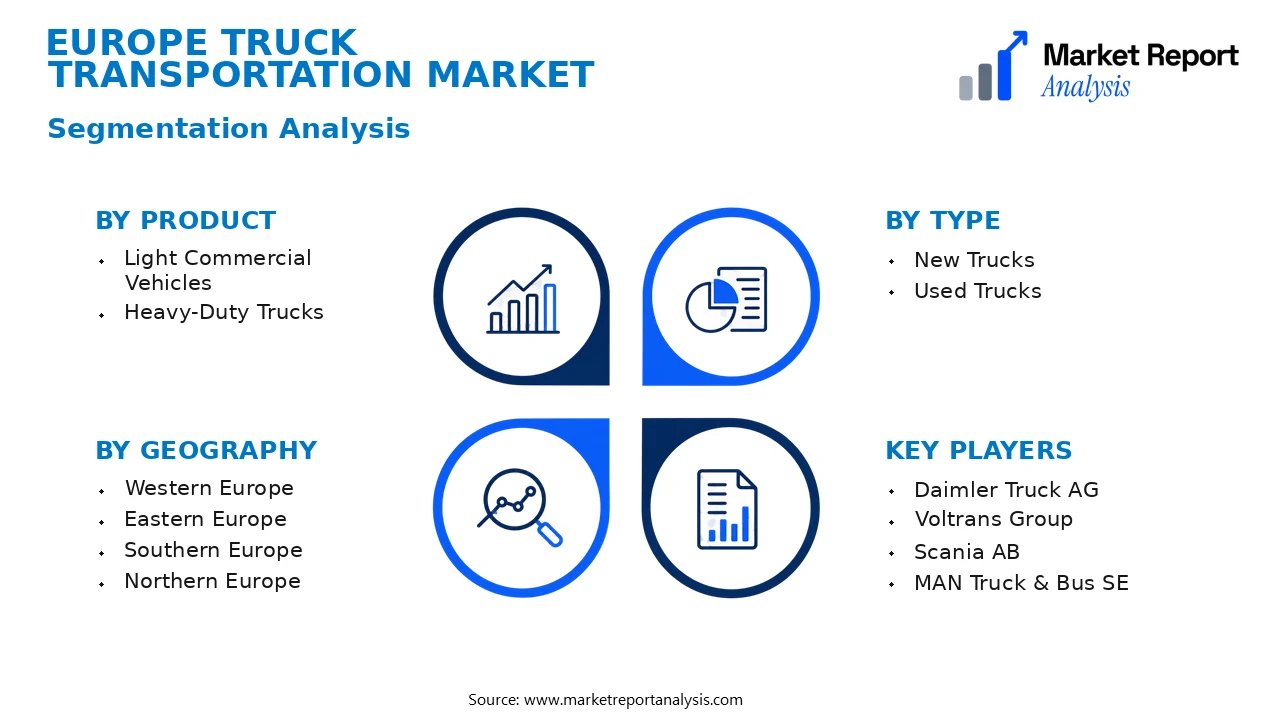
European truck transportation market segmentation is structured around key categories such as product, type, and geography. These classifications enable detailed analysis of market dynamics, regional variations, and specific demand drivers across different segments, underpinning strategic decision-making for stakeholders.
- Product
- Light Commercial Vehicles: These trucks, typically under 6 tons, are extensively used for urban delivery services. Their demand is driven by e-commerce growth and urban logistics needs, with adoption accelerated by emissions regulations and technological advancements.
- Heavy-Duty Trucks: Designed for long-haul freight, these trucks are essential for cross-country and international transportation. The market for heavy-duty trucks grows with trade volumes and infrastructure development, emphasizing durability and fuel efficiency improvements.
- Type
- New Trucks: Freshly manufactured trucks represent the primary choice for fleet expansion and replacement. The demand for new trucks is influenced by regulatory standards, fleet modernization efforts, and technological innovations such as electrification.
- Used Trucks: The market for second-hand trucks caters to cost-sensitive operators and regional carriers. Its growth is affected by economic conditions, residual value outlooks, and the availability of certified pre-owned options.
- Geography
- Western Europe: This subregion features mature markets with high adoption of advanced vehicle technologies and stringent emission standards. Key countries include Germany, France, and the UK, with significant logistics and manufacturing sectors.
- Eastern Europe: Characterized by emerging markets with increasing logistics demands. Countries like Poland, Hungary, and Romania are witnessing expanding fleet sizes, driven by manufacturing growth and trade expansion.
- Southern Europe: Comprising nations such as Italy, Spain, and Greece, this region has diverse logistics infrastructure. Market growth is influenced by tourism, agriculture, and retail distribution networks.
- Northern Europe: Countries like Sweden, Norway, and Denmark exhibit high adoption rates of sustainable and electric trucks, supported by robust environmental policies and advanced logistics infrastructure.
These segments collectively facilitate a comprehensive approach to understanding the dynamics shaping the Europe Truck Transportation Market. As technological innovation and regulatory changes evolve, these categories will continue to influence strategic investments, fleet composition, and regional competitiveness within Europe’s transportation landscape.
Competitive Intelligence
The Europe Truck Transportation Market is characterized by a highly competitive landscape dominated by a handful of key players, including Daimler AG, Volvo Group, and MAN Truck & Bus SE. Market concentration remains moderate, with the top five companies accounting for over 60% of the market share as of 2026. These firms employ various strategies such as expanding their fleet capacity, forging strategic partnerships with logistics providers, and investing heavily in technological innovation to enhance efficiency and sustainability. Recent product innovation focuses on electric and autonomous trucks, driven by stringent regulatory standards and a push toward decarbonization. Strategic acquisitions allow companies to broaden their service offerings and strengthen geographic presence, notably in Eastern Europe. Many firms are increasing R&D expenditure, prioritizing vehicle electrification, telematics, and connected vehicle technologies to differentiate their products. This competitive push fosters a dynamic environment, with differentiation primarily driven by technological edge, service quality, and sustainability commitments. Such strategies position market leaders to maintain dominance amid evolving customer demands and regulatory landscapes in Europe.
Leading Company Profiles
The competitive landscape of the Europe Truck Transportation Market is characterized by a diverse group of established and emerging players focusing on innovation, expanding fleet capacities, and integrating sustainable technologies to meet increasing logistic demands across the region.
- Daimler Truck AG
- Voltrans Group
- Scania AB
- MAN Truck & Bus SE
- Iveco Group
- DAF Trucks NV
- Volvo Trucks Corporation
- Renault Trucks
- Mercedes-Benz Trucks
- Ford Trucks
Daimler Truck AG
Daimler Truck AG provides a broad portfolio of commercial vehicles, innovations in electric and autonomous trucking, and strategic partnerships to strengthen its leadership in sustainable transportation solutions across Europe.
Voltrans Group
Voltrans Group specializes in fleet leasing, logistics, and transportation services, leveraging technological advancements to optimize route management and reduce emissions, aiming to expand its market share through strategic acquisitions and digital transformation.
Scania AB
Scania AB offers a comprehensive range of trucks that emphasize efficiency and sustainability, focusing on electric and hybrid solutions, supported by a global dealer network to ensure extensive service coverage in Europe.
MAN Truck & Bus SE
MAN Truck & Bus SE is renowned for its innovation in fuel-efficient and low-emission trucks, with strategic investments in electric vehicle infrastructure and collaborations to advance sustainable freight transportation.
Iveco Group
Iveco Group specializes in light, medium, and heavy-duty trucks, emphasizing innovation in natural gas and electric mobility, with a regional focus on expanding production capacities and technological capabilities.
DAF Trucks NV
DAF Trucks NV delivers high-performance trucks primarily for long-haul and distribution, investing heavily in digital fleet management technologies and sustainability initiatives to enhance operational efficiency.
Volvo Trucks Corporation
Volvo Trucks focuses on sustainable transport solutions, including electric trucks and autonomous driving systems, supported by strategic alliances with tech firms to lead the transition towards zero-emission freight logistics.
Renault Trucks
Renault Trucks develops a wide array of commercial vehicles with an emphasis on alternative fuel technologies and smart logistics solutions, while expanding its manufacturing footprint and digital service offerings.
Mercedes-Benz Trucks
Mercedes-Benz Trucks leverages its reputation for luxury and reliability to develop innovative, intelligent, and sustainable trucking solutions, integrating digital platforms for fleet management and vehicle connectivity.
Ford Trucks
Ford Trucks offers versatile commercial vehicles, focusing on the integration of advanced driver-assistance systems and sustainable engine options to enhance safety, performance, and environmental compliance in Europe's logistics sector.
Strategic Business Developments
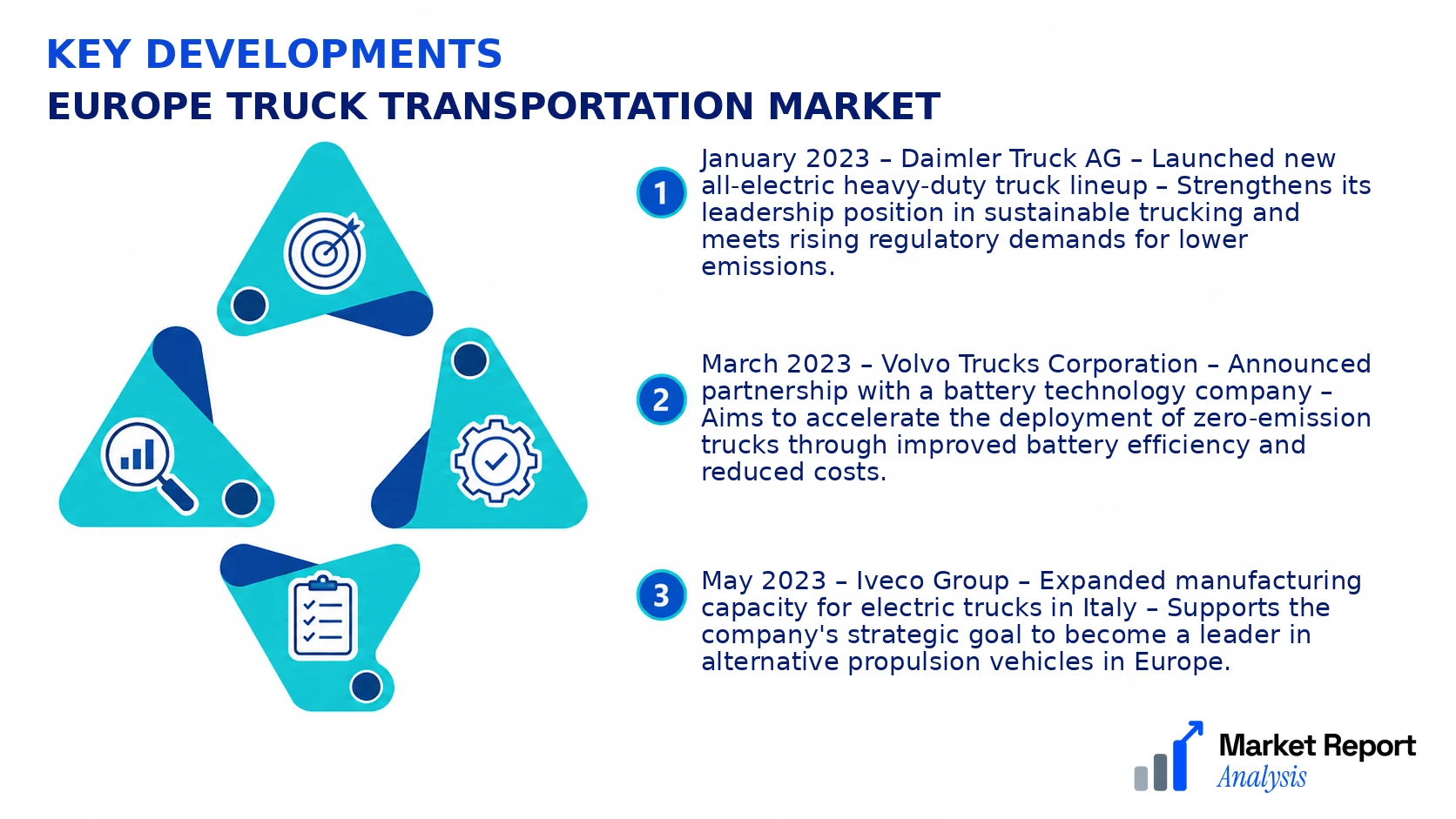
- January 2023 – Daimler Truck AG – Launched new all-electric heavy-duty truck lineup – Strengthens its leadership position in sustainable trucking and meets rising regulatory demands for lower emissions.
- March 2023 – Volvo Trucks Corporation – Announced partnership with a battery technology company – Aims to accelerate the deployment of zero-emission trucks through improved battery efficiency and reduced costs.
- May 2023 – Iveco Group – Expanded manufacturing capacity for electric trucks in Italy – Supports the company's strategic goal to become a leader in alternative propulsion vehicles in Europe.
- July 2023 – MAN Truck & Bus SE – Introduced a digital platform for fleet management – Enhances operational efficiencies and reduces logistical costs for customers.
- September 2023 – DAF Trucks NV – Acquired a stake in a tech startup specializing in autonomous driving – Positions DAF at the forefront of automation in commercial trucking.
Frequently Asked Questions
What is the Europe Truck Transportation Market?
The Europe Truck Transportation Market encompasses the sector responsible for freight movement using trucks across European countries, serving industries such as retail, manufacturing, and logistics. It plays a crucial role in regional supply chains and economic development.
What is the current market size of Europe Truck Transportation Market?
As of 2026, the Europe Truck Transportation Market is valued at approximately USD 150 Billion, reflecting robust activity driven by trade, e-commerce growth, and infrastructure investments across European nations.
What factors are driving the Europe Truck Transportation Market?
Primary drivers include rising e-commerce activities, increasing cross-border trade within Europe, investments in transportation infrastructure, and technological advancements in logistics and fleet management, all contributing to growth and efficiency improvements.
Which region dominates the Europe Truck Transportation Market?
Western Europe leads the market due to its highly developed logistics infrastructure, dense industrial zones, and active trade policies, with Germany, France, and the UK as major contributors to regional dominance.
Which segment is expected to grow the fastest?
The long-haul freight segment is projected to experience the fastest growth, driven by increasing inter-country trade, rising fuel efficiency measures, and technological innovations in route optimization and fleet management systems.
Who are the leading companies operating in the Europe Truck Transportation Market?
Major players include Deutsche Post DHL Group, DB Schenker, DSV Panalpina, and Kuehne + Nagel, whose extensive networks and technological investments position them as key industry leaders across Europe.
Analyst Perspective
The Europe truck transportation market demonstrates a mature yet dynamically evolving landscape, with gradual technological advancements driven by regulatory pressures and sustainability initiatives. Long-term, the market is expected to expand steadily, bolstered by e-commerce growth and infrastructural investments, creating lucrative opportunities for logistics providers to optimize route efficiency and fleet sustainability. Emerging technologies such as electrification, autonomous driving, and telematics are poised to redefine operational efficiency, demanding strategic investment in innovation and digital integration. Competition remains intense, with established global and regional players vying to leverage technological advantages and regional growth to maintain market share. Investment priorities should focus on adopting green technologies, enhancing supply chain resilience, and expanding last-mile capabilities, especially in high-growth regions like Central and Eastern Europe. Regional differentiation will be critical; Western Europe will lead in automation and sustainability, while Eastern Europe offers substantial growth potential due to evolving infrastructure and market liberalization. Strategic agility and innovation will be vital for long-term success in this mature yet resilient sector.
