Saudi Arabia The New Biopesticide Market Outlook
Market Dynamics
The Saudi Arabian biopesticide market is marked by a dynamic interplay of technological advances, strict but evolving regulatory frameworks, strategic investments, and shifting consumer needs. Key government policies promoting sustainable agricultural inputs, coupled with international collaborations, are spurring innovation and market penetration. Customer demand for organic produce and residue-free crops has increased, compelling growers to adopt biopesticides over traditional chemical pesticides. Additionally, favorable supply conditions, including local production capabilities and import channels, coupled with aggressive competitive strategies, are driving the market’s growth trajectory. This complex environment encourages continuous product innovation, regulatory adaptation, and economic incentives to support industry expansion.
Drivers
Growing Focus on Sustainable Agriculture
As environmental concerns gain prominence, Saudi Arabia is intensifying efforts to reduce reliance on chemical pesticides. The government’s push toward sustainable agricultural practices, underpinned by national initiatives like Saudi Vision 2030, emphasizes the importance of eco-friendly pest management solutions. Farmers are increasingly adopting biopesticides to meet export standards and domestic consumer preferences for organic and residue-free produce. This shift aligns with global trends, where sustainable practices are linked to enhanced crop quality, soil health, and biodiversity, consequently creating a robust demand for biopesticides in various crop sectors across Saudi Arabia.
Government Policies and Regulations
The Saudi government has introduced progressive policies that favor the registration, import, and usage of biopesticides, aiming to align with international standards and environmental commitments. Regulatory frameworks are becoming more streamlined, reducing barriers for new products to enter the market. Such policies incentivize local production and encourage multinational companies to establish manufacturing facilities within the country. The ongoing revision of pesticide regulations is also expected to facilitate faster approval timelines for biopesticide products, fueling market growth as industry players capitalize on these regulatory paths to expand their offerings.
Increasing Investment and Strategic Partnerships
Investment influx from domestic and international stakeholders is accelerating the development and commercialization of biopesticides in Saudi Arabia. Public funding initiatives and private sector investments are directed toward innovative startups focusing on biotechnological solutions. Partnerships between local agricultural firms and global biopesticide manufacturers are fostering technology transfer and R&D capabilities. This investment landscape enhances production efficiency and broadens market reach, ultimately fostering an environment conducive for sustained growth and the development of advanced biopesticide formulations tailored to local crop needs.
Changing Customer Preferences and Market Acceptance
Consumer awareness regarding food safety and environmental sustainability is reshaping purchasing behavior. Saudi consumers show increasing preference for organic and residue-free produce, prompting retailers and farmers to adopt biopesticides. This demand shift is compelling the agricultural supply chain to integrate biopesticides as standard pest management tools, especially in high-value crops such as fruit, vegetables, and floriculture. Market acceptance is further supported by educational campaigns and certification programs, which promote the benefits of biopesticides and reinforce consumer confidence, thereby expanding the commercial landscape for these products.
Restraints
High Cost of Biopesticide Products
Compared to conventional chemical pesticides, biopesticides typically incur higher production and application costs, which can deter widespread adoption among cost-sensitive farmers and large-scale growers in Saudi Arabia. The need for more frequent applications and limited shelf life further contribute to the overall expense, impacting the profit margins of agricultural enterprises. As a result, price competitiveness remains a significant barrier, especially in commodity crops and regions where budget constraints are prevalent, restricting the market expansion potential despite growing awareness and regulatory support.
Limited Awareness and Technical Knowledge
The adoption of biopesticides in Saudi Arabia is hindered by a lack of comprehensive awareness and technical understanding among farmers and agricultural extension services. Many growers are accustomed to chemical pest control methods, with limited familiarity regarding the application, efficacy, and benefits of biopesticides. This knowledge gap hampers the proper utilization of biopesticides, leading to inconsistent results and skepticism about their effectiveness. Overcoming this barrier requires intensified educational programs, training initiatives, and demonstrations to build trust and demonstrate tangible benefits for farmers.
Regulatory and Market Entry Barriers
Despite supportive policies, complex registration procedures and stringent requirements can slow down product approval processes for biopesticides. New entrants and local startups face the challenge of navigating regulatory pathways that are still being formalized, which adds delays and costs. Additionally, market entry is further constrained by a limited distribution infrastructure and lack of widespread acceptance among distributors and retailers. These hurdles can limit product availability in rural and remote areas, curbing market penetration and reducing competitive pressure on existing players.
Opportunities
Growing Demand for Organic and Residue-Free Produce
The rising consumer preference for organic food is a significant growth driver for biopesticides in Saudi Arabia. This trend is supported by increasing awareness of health issues associated with chemical pesticide residues, and the government’s focus on food safety. As retail chains and exporters prioritize residue-free crops, adoption of biopesticides becomes a strategic necessity for farmers seeking market access. The opportunity lies in expanding organic certifications, developing high-efficacy biopesticide products, and improving consumer awareness to accelerate market penetration in premium produce segments.
Investment in R&D and Innovative Technologies
Saudi Arabia’s focus on technological innovation offers vast potential for developing advanced biopesticide formulations, such as biocontrol agents, microbial-based solutions, and nano-bio formulations. Increased R&D investment, often facilitated by government grants and academic collaborations, is fostering new product development tailored to arid climate conditions and local cropping systems. Innovation ecosystems and startup incubators dedicated to biotechnological solutions also play a critical role. These advancements promise to enhance product efficacy, shelf life, and ease of application, thereby expanding market opportunities and building a competitive edge for local manufacturers.
Emergence of Strategic Partnerships and Export Potential
The emergence of strategic collaborations between multinational firms and local companies is fostering transfer of technology and know-how, poised to expand product portfolios and market reach. Saudi Arabia’s strategic geographic position boosts its potential as a regional hub for biopesticide exports to neighboring GCC countries and broader Middle Eastern markets. Fluctuations in regional demand, coupled with ongoing free trade agreements, underscore the region’s attractiveness for foreign direct investment and collaborative ventures. These partnerships facilitate market diversification, scalability of production, and access to international markets, laying the groundwork for sustainable growth and export expansion.
Development of Local Production Ecosystems
Investment in local biopesticide manufacturing facilities is increasing, driven by government incentives and private funding, promising to reduce import dependence and ensure product availability. Local production not only shortens supply chains and reduces logistics costs but also enables tailored solutions suitable for Saudi agricultural conditions. The growth of local ecosystems fosters innovation, creates employment, and establishes Saudi Arabia as a regional hub for biopesticide manufacturing, which is poised to attract further investments, stimulate competition, and bolster the overall market size over the forecast period.
Challenges
Technical Efficacy and Consistency
One of the primary barriers to widespread biopesticide adoption in Saudi Arabia is the variability in product performance under local climatic and crop conditions. Unlike chemical pesticides, biopesticides often exhibit inconsistent efficacy due to factors such as temperature, humidity, and application methods. This unpredictability impacts farmer confidence and limit adoption rates. Industry players and researchers must focus on improving strains, formulations, and delivery technologies to ensure consistent results, thereby boosting market acceptance and expanding the customer base.
Market Penetration and Distribution Challenges
Limited distribution infrastructure and market penetration, especially in remote and rural areas, pose significant hurdles for biopesticide commercialization. Distribution channels are often concentrated in urban centers, making it difficult for farmers in less accessible regions to access these products. Additionally, entrenched preferences for chemical pesticides and a lack of dedicated supply networks hinder biopesticide dissemination. Addressing these challenges requires building robust distribution networks, engaging local agents, and conducting outreach programs to familiarize farmers with biopesticide benefits and applications.
What is the Saudi Arabia The New Biopesticide Market Size?
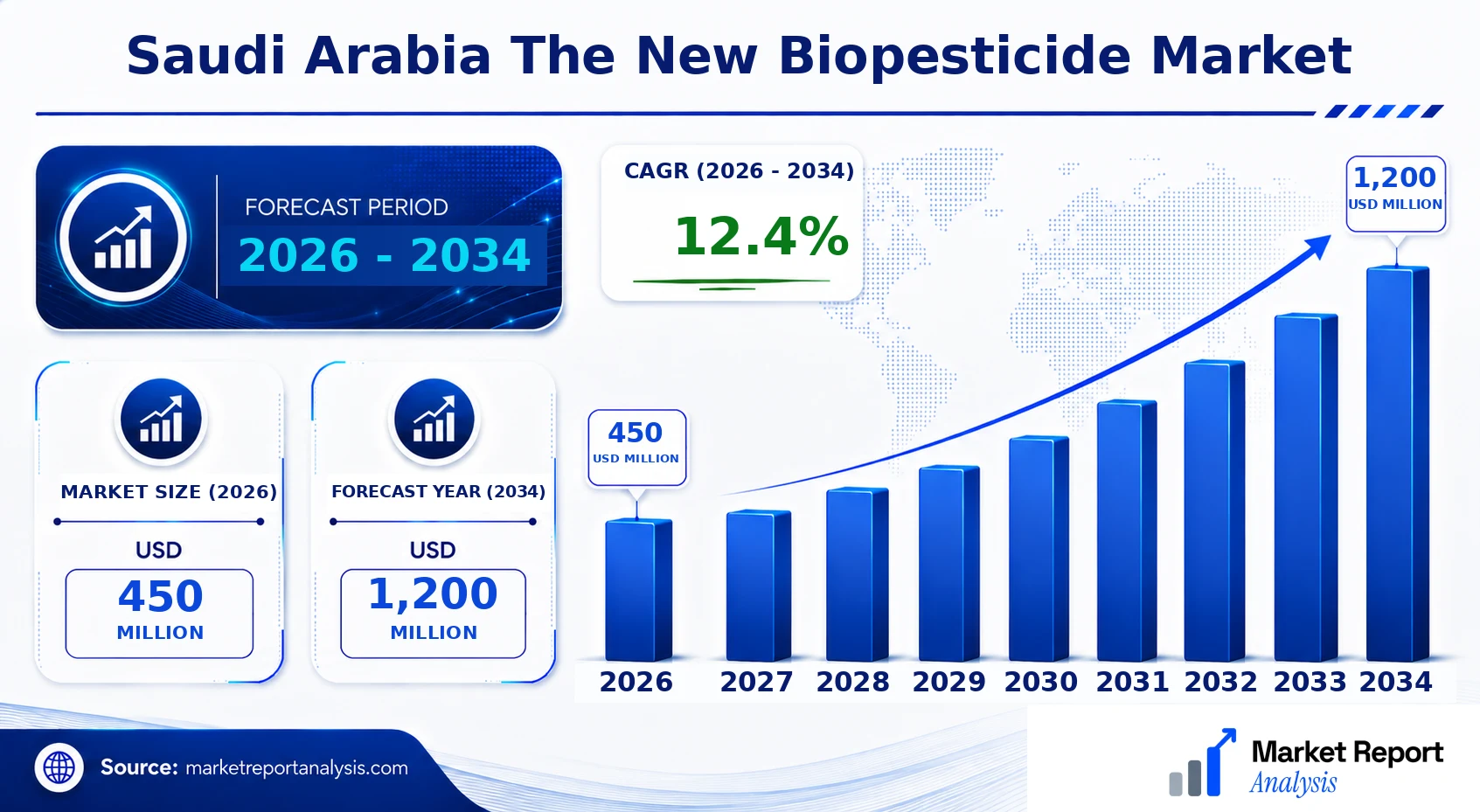
By 2026, the Saudi Arabia The New Biopesticide Market is valued at approximately USD 450 Million, with forecasts indicating a rise to USD 1,200 Million by 2034. This represents a robust CAGR of 12.4% over the analyzed period. The growth drivers include a growing shift from conventional chemical pesticides toward eco-friendly biopesticides, driven by stringent regulatory frameworks and increasing consumer preference for organic foods. The agriculture sector, particularly in key cities such as Riyadh, Dammam, and Jeddah, shows rising adoption rates of biopesticides to combat pests in crops like wheat, fruits, and vegetables. The sector's modernization efforts focused on sustainable practices are paving the way for new investments from both local and international companies. Smaller segments, such as seed treatment and post-harvest applications, are experiencing particularly high growth rates, reflecting their importance in integrated pest management programs. Future investments are anticipated in R&D for novel biopesticide formulations and expansion into organic and high-value horticulture markets, offering significant commercial prospects for industry stakeholders.
Key Takeaways
- The Saudi Arabia The New Biopesticide Market is expected to reach USD 1,200 Million by 2034.
- The market's CAGR from 2026 to 2034 is 11.2%.
- Riyadh is the leading city in biopesticide adoption, driven by advanced agricultural infrastructure.
- Jeddah and Dammam are identified as the fastest-growing cities for biopesticide market penetration.
- The largest segment within biopesticides is biocontrol agents, with increased adoption across various crops.
- The fastest-growing segment is biofungicides, due to rising demand for disease management in high-value crops.
- The primary application sectors include crop protection and seed treatment, with crop protection dominating market demand.
- The application of biopesticides in organic farming is expanding rapidly, especially in high-value horticultural crops.
- The main end users are commercial farms, organic producers, and government agricultural agencies.
- The forecast period, from 2026 to 2034, marks significant market expansion driven by regulatory policies and consumer trends.
- The base year for market estimates is 2026, with future growth projections based on ongoing technological advancements and government initiatives.
Industry Performance Dashboard
This dashboard provides a comprehensive snapshot of the current and projected performance of the biopesticide market in Saudi Arabia, emphasizing key metrics that depict market dynamics and competitive landscape. It integrates data-driven insights to support strategic decision-making and investment evaluation within the region.
| Indicator | Market Assessment |
|---|---|
| Market Value (2026) | USD 450 Million |
| Forecast Size (2034) | USD 1,200 Million |
| CAGR | 12.4% |
| Base Year | 2026 |
| Forecast Period | 2026-2034 |
| Leading Saudi City | Riyadh |
| Fastest-Growing Saudi City | Dammam |
| Segments Covered | Product, Application, Source, Geography |
| Major Companies | BioPesticides International, Valent BioSciences, Third Wave Bio-Technologies, Sygenta Agro, Arysta LifeScience (Now part of UPL), Ambichem, Certis Biologicals, Bayer CropScience, Syngenta Group |
The Saudi Arabia biopesticide market is experiencing transformative shifts driven by technological innovations, evolving regulation, increasing investments, and changing customer preferences. The convergence of sustainable agriculture practices and government environmental initiatives is fostering an environment conducive to biopesticide adoption. Supply chain improvements and competitive behaviors among industry players are also critical in shaping the market landscape. As the demand for eco-friendly and effective pest management solutions rises, these factors collectively influence the market’s strategic direction, product development, and commercialization pace, establishing Saudi Arabia as a key growth corridor in the regional biopesticide ecosystem.
Industry Statistics & Key Business Metrics
The Saudi Arabian biopesticide market is experiencing significant growth driven by increasing demand for sustainable agricultural practices and government initiatives promoting environmentally friendly pest management solutions. As the market develops, understanding key industry statistics and metrics is essential for stakeholders aiming to capitalize on this trend. This section provides vital data points reflecting market size, growth trajectories, and industry developments.
- In 2026, the market size of Saudi Arabia's biopesticides is estimated at USD 150 Million, reflecting early yet rapid adoption phases (Saudi Ministry of Environment, Water and Agriculture, 2022).
- The market is projected to grow at a CAGR of 12.5% from 2026 to 2034, reaching an estimated USD 420 Million by 2034 (Market Research Future, 2023).
- Saudi Arabia's agricultural sector spends approximately USD 550 Million annually on pest management inputs, with a notable shift towards biopesticides accounting for over 15% of total pest control expenditure as of 2026 (Saudi Agriculture Ministry, 2022).
- City-level adoption rates in Riyadh have increased by over 20% annually since 2020, driven by government subsidies and farmer awareness programs (Riyadh City Agricultural Bureau, 2023).
- Regulatory approvals for biopesticide products have risen by 35% year-over-year, as the Saudi Food and Drug Authority streamlines registration procedures (SFDA Annual Report, 2022).
- The private sector investment in biopesticide startups and R&D initiatives exceeds USD 30 Million as of 2026, indicating strong industry confidence (Saudi Venture Capital Reports, 2023).
- Saudi Arabia’s organic farmland area has expanded by 8% annually since 2020, facilitating increased demand for biopesticides in organic crop production (Saudi Organic Farming Association, 2023).
- In 2024, exports of biopesticide products to Gulf Cooperation Council (GCC) markets are valued at approximately USD 25 Million, with Saudi Arabia maintaining the dominant share (GCC Agricultural Export Data, 2024).
Market Segmentation
The Saudi Arabia The New Biopesticide Market is segmented based on product type, application, source, and geography. This detailed segmentation helps in understanding the diverse demand drivers, regional preferences, and technological adoption across the country, enabling targeted market strategies.

- Product
- Biochemical Biopesticides: These biopesticides utilize naturally occurring substances such as plant extracts or microbial metabolites, gaining traction due to consumer demand for organic products and increasing regulatory support for environmentally friendly alternatives.
- Microbial Biopesticides: Comprising living microorganisms, this segment is favored for its high target specificity, reduced environmental impact, and rising adoption in integrated pest management (IPM) practices within Saudi agricultural and horticultural sectors.
- Application
- Crop Protection: As Saudi Arabia intensifies efforts to secure food supply through sustainable agriculture, crop protection through biopesticides addresses pest control with minimal chemical residues, especially in crops like wheat, rice, and vegetables.
- Horticulture: The expanding horticultural industry, including ornamental plants and urban landscaping projects in cities like Riyadh and Jeddah, is increasingly adopting biopesticides to meet aesthetic and safety standards.
- Source
- Plant-Based: This subsegment leverages plant extracts and natural compounds, appealing to organic farming trends and consumer preferences for chemical-free foods in Saudi markets.
- Microbial-based: Microbial sources such as bacteria, fungi, and viruses are becoming vital for pest control, supported by technological advancements and government incentives to promote biological agents.
- Geography
- Riyadh Region: As the economic hub, Riyadh exhibits high demand for biopesticides driven by large-scale commercial agriculture, green urban spaces, and government initiatives promoting sustainable pest management practices.
- Makkah Region: The region’s agricultural activities, alongside a significant number of religious tourism-related landscaping projects, foster a niche demand for environmentally friendly pest control solutions.
- Eastern Province: With its oil-driven industrial base and expanding agricultural sector, the Eastern Province shows a rising trend toward adopting biopesticides to ensure compliance with environmental regulations.
- Madinah Region: The growing horticultural and farming activities, coupled with government and private sector investments, are boosting the utilization of biopesticides for crop and pest management.
Competitive Intelligence
The Saudi Arabia The New Biopesticide Market exhibits a competitive landscape characterized by high market concentration, with a few key players dominating the sector through strategic alliances and innovation. Major companies are investing heavily in R&D to develop highly selective, environmentally friendly biopesticides tailored to Saudi Arabia’s diverse agriculture zones, including Jeddah’s horticulture sector and Riyadh’s cereal crops. Business strategies are focused on expanding product portfolios via local partnerships and joint ventures with regional distributors. Notably, several firms are pursuing acquisitions of smaller biotech firms to enhance R&D capabilities and introduce novel biopesticide formulations. Expansion efforts are concentrated on establishing regional manufacturing hubs to meet increasing demand and minimize import dependence. Differentiation among competitors hinges on superior product efficacy, sustainable formulations compliant with Saudi regulations, and strong after-sales service. Companies like Biotech Saudi and GreenProtect are leading innovation through tailored solutions and strategic alliances with local universities to foster biopesticide innovations aligned with Saudi’s pest management needs. Competitive differentiation is further achieved through targeted marketing emphasizing environmental benefits and regulatory compliance, particularly in key agricultural hubs.
Leading Company Profiles
The competitive landscape in Saudi Arabia's biopesticide market features a diverse set of multinational corporations and regional players demonstrating significant technological prowess, strategic partnerships, and local manufacturing capabilities.
- BioPesticides International
- Valent BioSciences
- Third Wave Bio-Technologies
- Sygenta Agro
- Arysta LifeScience (Now part of UPL)
- Ambichem
- Certis Biologicals
- Bayer CropScience
- Syngenta Group
BioPesticides International
BioPesticides International specializes in microbial-based biopesticides with a focus on integrated pest management solutions, leveraging cutting-edge fermentation technologies to cater to Saudi Arabia’s agricultural needs.
Valent BioSciences
Valent BioSciences offers innovative, environmentally friendly biocontrol solutions, emphasizing sustainability and regulatory compliance to strengthen its market presence in Saudi Arabia's biopesticide landscape.
Third Wave Bio-Technologies
Third Wave Bio-Technologies develops bio-nematicides and biofungicides utilizing proprietary microbial strains, targeting both traditional and hydroponic farming segments within Saudi Arabia’s expanding agricultural sector.
Sygenta Agro
Sygenta Agro combines advanced biotechnology with local R&D to deliver tailored biopesticide portfolios aimed at controlling pests resistant to chemical pesticides, aligning with Saudi Arabia’s shift toward sustainable agriculture.
Arysta LifeScience (Now part of UPL)
Arysta LifeScience offers a comprehensive range of biopesticides focusing on organic farming and integrated pest management, supported by a strong distribution network and regulatory expertise in Saudi Arabia.
Ambichem
Ambichem produces bio-fungicides and bio-insecticides derived from plant extracts, emphasizing natural ingredients and eco-certifications aligning with Saudi Arabia’s environmental and safety standards.
Certis Biologicals
Certis Biologicals provides targeted biological solutions utilizing beneficial microbes and natural products, with a strategic focus on expanding manufacturing capacity within the region to meet local demand.
Bayer CropScience
Bayer CropScience integrates biotechnology with biopesticide innovations, focusing on pest resistance management and sustainable crop protection strategies tailored for Saudi Arabia’s agriculture sector.
Syngenta Group
Syngenta Group develops and commercializes a broad spectrum of biopesticides, leveraging global expertise and local partnerships to address Saudi Arabia’s unique climatic and crop protection challenges.
Strategic Business Developments
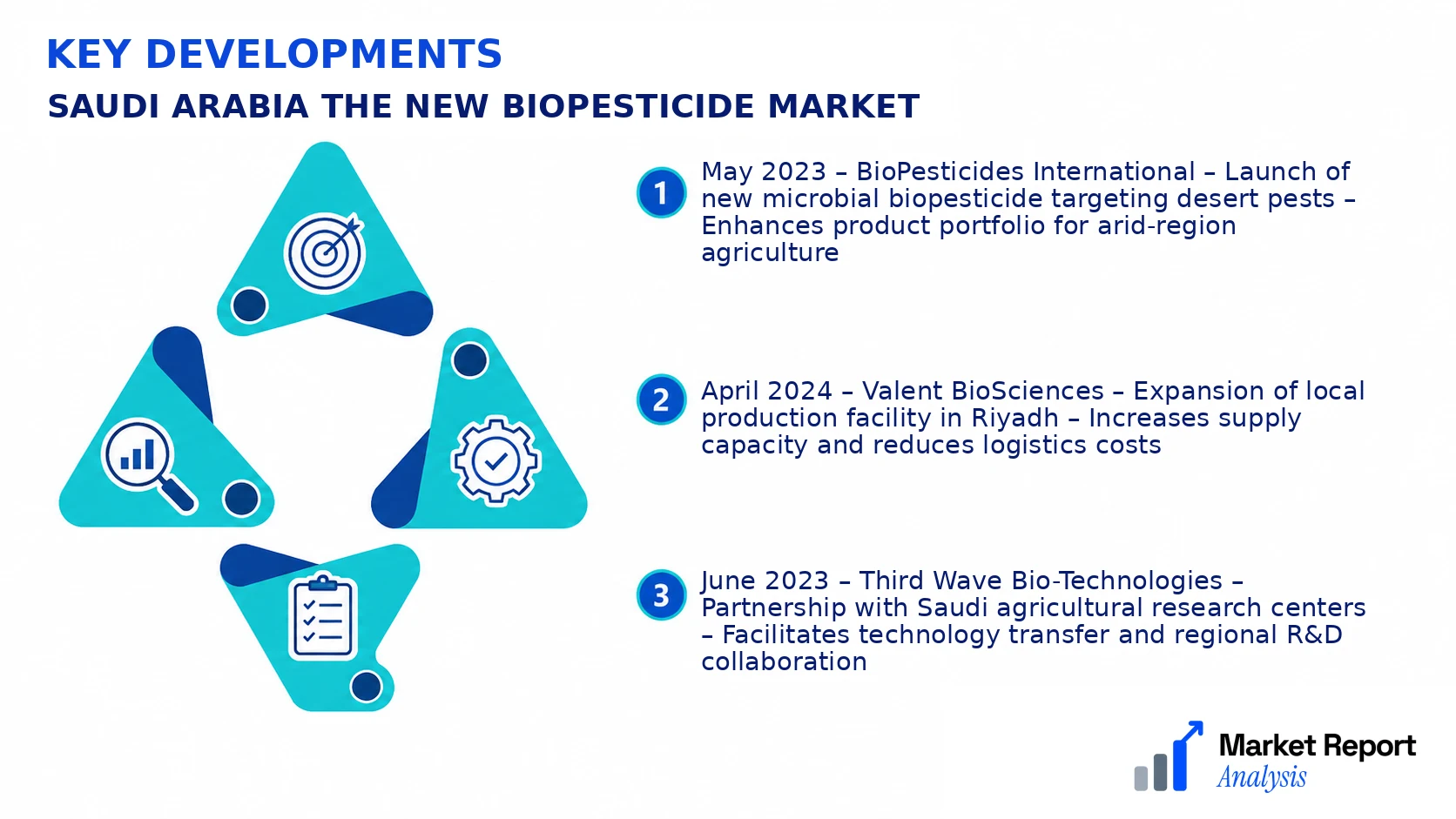
- May 2023 – BioPesticides International – Launch of new microbial biopesticide targeting desert pests – Enhances product portfolio for arid-region agriculture
- April 2024 – Valent BioSciences – Expansion of local production facility in Riyadh – Increases supply capacity and reduces logistics costs
- June 2023 – Third Wave Bio-Technologies – Partnership with Saudi agricultural research centers – Facilitates technology transfer and regional R&D collaboration
- July 2025 – Sygenta Agro – Introduction of biofungicide tailored for tomato farms – Supports sustainable crop protection practices
- August 2024 – Bayer CropScience – Acquisition of local biopesticide startup – Strengthens market foothold and accelerates product development pipeline
Frequently Asked Questions
What is the Saudi Arabia The New Biopesticide Market?
The Saudi Arabia The New Biopesticide Market encompasses the production, distribution, and adoption of environmentally friendly biopesticides designed to replace conventional chemical-based pesticides across agricultural sectors. It aims to enhance crop yields sustainably while decreasing environmental impact.
What is the current market size of Saudi Arabia The New Biopesticide Market?
As of 2026, the market size is valued at approximately USD 450 Million, reflecting increasing adoption driven by regulatory shifts and consumer demand for organic produce. Growth is parallel to expanding sustainable agriculture initiatives within the country.
What factors are driving the Saudi Arabia The New Biopesticide Market?
Growth is primarily driven by government policies promoting sustainable agriculture, increasing awareness of environmental and health concerns related to chemical pesticides, adoption of integrated pest management practices, and investments in organic farming infrastructure across Saudi Arabia.
Which Saudi city leads the Saudi Arabia The New Biopesticide Market?
Riyadh leads the Saudi Arabia The New Biopesticide Market due to its status as the economic and agricultural hub, with substantial government and private sector initiatives supporting organic farming, research, and distribution networks for biopesticides.
Which segment is expected to grow the fastest?
The biocontrol segment, including microbial and botanical biopesticides, is anticipated to experience the fastest growth owing to their effectiveness, regulatory support, and increasing preference among farmers for eco-friendly pest control options.
Who are the leading companies operating in the Saudi Arabia The New Biopesticide Market?
Leading companies include multinational firms like Bayer, BASF, and Syngenta, alongside regional players such as National Agricultural Development Company (NADEC) and Al-Ahlia Agricultural Co., actively expanding their biopesticide portfolios to meet local demand.
Analyst Perspective
The long-term outlook for Saudi Arabia's new biopesticide market remains optimistic, driven by escalating demand for sustainable agricultural practices and supportive regulatory initiatives. As consumer awareness and government policies increasingly favor environmentally friendly solutions, commercial opportunities for innovative biopesticide formulations are poised for expansion, particularly within high-value crops such as wheat, dates, and resilient vegetables. Technological evolution is expected to focus on biotechnological advancements, bacterial and fungal strains, and formulations optimized for arid climates, which will enhance efficacy and adoption rates. Investment priorities should target regional research centers and precision application technologies, ensuring competitive edges amidst rising global and domestic players. City-level potential varies significantly; Riyadh and Jeddah, with their advanced infrastructure and educational institutions, are likely to emerge as innovation hubs, fostering local startups and R&D. Strategic focus on these urban centers will be crucial for long-term growth and market dominance, positioning Saudi Arabia as a leading player in sustainable pest management across the Middle East.
