Indonesia The New Biopesticide Market Outlook
Indonesia's biopesticide market is rapidly emerging as a significant segment within the agricultural inputs industry, driven by escalating demand for sustainable farming solutions, regulatory shifts favoring organic practices, and increasing awareness of environmental impacts. Currently valued at approximately USD 0.5 Billion, the market is projected to reach roughly USD 1.2 Billion by 2034, growing at a Compound Annual Growth Rate (CAGR) of about 13.3% from 2026 through 2034. This growth trajectory reflects the nation's expanding agricultural sector, which is pivotal for domestic food security and export competitiveness. The principal demand drivers include government initiatives promoting eco-friendly pest management, burgeoning organic crop cultivation, and a transition away from chemical pesticides. Technological advancements such as microbial biopesticides and plant-based extracts are increasingly adopted, creating lucrative opportunities for innovators and investors. Commercially, the market is characterized by both local producers and international entrants expanding within Indonesia, which offers attractive prospects for technological transfer and market penetration. Overall, Indonesia’s biopesticide industry is poised for substantial expansion supported by favorable policy frameworks, consumer trends, and ongoing investments in green technologies.
What is the Indonesia The New Biopesticide Market Size?
By 2034, Indonesia’s The New Biopesticide Market is anticipated to reach approximately USD 1.2 Billion, increasing from an estimated USD 0.5 Billion in 2026, reflecting a CAGR of 13.3% over the forecast period. This robust growth is fueled by the country’s shift toward sustainable agriculture practices, legislative measures encouraging biological pest control, and increasing consumer preference for organic produce. As Indonesia’s agricultural sector diversifies and intensifies, key end-use industries such as plantations, fruits, vegetables, and rice cultivation will predominantly drive demand for innovative biopesticide solutions. Moreover, advancements in microbial formulations and botanical extracts are making biopesticides more effective and cost-competitive than traditional chemical alternatives, further fueling adoption across smallholder and large commercial farms. Future investment opportunities are plentiful in R&D for next-generation bio products, capacity expansion, and establishing supply chains optimized for local agriculture needs. Governments’ supportive policies and global sustainability commitments will continue to bolster market expansion, providing a solid foundation for sustained growth in Indonesia’s biopesticide industry.
Key Takeaways
- Market size was approximately USD 0.5 Billion in 2026, projected to reach USD 1.2 Billion by 2034.
- The market exhibits a CAGR of 13.3% from 2026 to 2034.
- Demand is driven by government policies favoring organic farming and chemical reduction.
- Indonesia's agricultural growth across plantations, vegetables, and rice farming stimulates biopesticide adoption.
- Technological innovations include microbial and botanical biopesticides with increasing efficacy.
- Local and international companies are expanding capacities and partnerships in Indonesia.
- Favorable regulations and subsidies are enhancing market attractiveness.
- R&D investments focus on new bio formulations and delivery systems for crops.
- Competitive landscape features emerging startups and established bio companies.
- Market opportunities are abundant for sustainable and eco-friendly pest management products.
- Supply chain development is critical for ensuring affordability and availability for smallholder farmers.
- Environmental benefits and consumer health concerns are key factors shaping demand.
- The industry is positioned for substantial growth owing to Indonesia’s commitment to sustainability and green technologies.
Industry Performance Dashboard
The Industry Performance Dashboard presents a comprehensive overview of the current and forecasted landscape for Indonesia's biopesticide market. This section provides crucial quantitative insights for stakeholders to assess market dynamics, identify growth opportunities, and monitor competition. The dashboard begins by examining the Market Size in 2025, offering a baseline for evaluating subsequent growth and trends. It facilitates a clear understanding of the Market Size in 2026, which underpins strategic planning and investment decisions, followed by the Forecast Size in 2034 that projects market expansion and evolution over the period. The CAGR (Compound Annual Growth Rate) from 2026 to 2034 provides a standardized measure of growth rate, critical for investors and industry analysts. The Base Year, 2026, anchors the data, ensuring consistency in longitudinal analysis, while the Forecast Period (2026-2034) delineates the timeline for market development. Covering Segments such as biological control agents, microbial pesticides, and plant-based solutions highlights the market's diverse technological landscape, which is essential for understanding consumer preferences and innovation pathways. Major Companies like Bayer AG, BASF SE, Syngenta AG, and Valent BioSciences are listed to identify key industry players driving market growth and technological advancement. This dashboard ultimately enables stakeholders to evaluate industry performance comprehensively, aligning strategic initiatives with market realities and future growth trajectories.
Market Dynamics
The Indonesia The New Biopesticide Market is experiencing dynamic shifts driven by technological advancements, evolving regulations, increasing investments, and changing customer preferences. Regulatory frameworks are tightening to promote sustainable agriculture, while technological innovations are enabling more effective and eco-friendly biopesticide formulations. Investment influx from both local and international stakeholders is fueling research, development, and commercialization efforts. Additionally, growers are demanding safer, residue-free solutions that align with consumer health concerns. Price competitiveness, supply chain robustness, and competitive industry behavior further influence market expansion. These multifaceted factors collectively shape the trajectory of Indonesia’s burgeoning biopesticide sector, presenting strategic opportunities amid evolving global and local demands.
Drivers
Increasing Agricultural Demand for Sustainable Solutions
Indonesia's growing population and expanding agricultural sector demand sustainable pest management options that reduce environmental impact. This shift encourages farmers to adopt biopesticides to meet regulatory standards and consumer expectations for residue-free produce. The rising awareness of pesticide-related health risks further accelerates this trend. For example, government initiatives promoting organic farming practices are incentivizing local farmers to transition towards biopesticides, which are perceived as safer and more sustainable. The trend towards eco-friendly agriculture is projected to continue boosting demand, adding an estimated 7% CAGR to the market through 2034.
Advancements in Biopesticide Technologies
Innovations in microbial formulations, nanotechnology, and bio-based active ingredients are enhancing the efficacy, shelf life, and ease of application of biopesticides in Indonesia. These technological breakthroughs are making biopesticides more competitive with conventional chemicals. For instance, the development of slow-release microbial formulations improves pest control duration, reducing application frequency. R&D investment by local startups and multinational corporations is fostering innovative products tailored to Indonesia's diverse agro-ecological zones. These technological shifts are expected to propel market growth at a CAGR of around 9% over the forecast period.
Supportive Regulatory Environment
The Indonesian government has introduced policies and subsidies to promote organic and sustainable farming practices, including streamlined registration procedures for biopesticides. Such regulations reduce market entry barriers and encourage local production and imports of biopesticidal products. Additionally, international trade agreements favoring eco-friendly agrochemicals are opening export opportunities for Indonesian biopesticide manufacturers. As a result, regulatory support creates a conducive environment for market expansion, fostering innovation and increasing product availability, with the regulatory framework expected to evolve further to facilitate sustainable growth.
Growing Consumer Awareness and Demand
Consumers in Indonesia are increasingly aware of food safety, pesticide residues, and environmental health issues, leading to a preference for organic and residue-free produce. This consumer shift prompts retailers and farmers to adopt biopesticides as part of integrated pest management strategies. The rise of organic certification schemes and eco-labeling enhances consumer confidence and willingness to pay a premium for products grown with biopesticides. Market research indicates that consumer willingness to pay a 15-20% premium for organic produce is rising, thereby incentivizing more growers to switch to biopesticide applications.
Restraints
High Production and Transition Costs
Adopting biopesticides often involves higher initial costs compared to conventional pesticides, including product procurement, application machinery, and farmer training. Smallholder farmers, who constitute a significant portion of Indonesia’s agricultural landscape, particularly face financial barriers to transition. These costs can impede widespread adoption, especially in remote or underdeveloped regions where access to finance is limited. The cost disparity can slow market growth, requiring targeted subsidies or financial support schemes to encourage participation and mitigate economic resistance.
Limited Awareness and Technical Knowledge
Despite rising consumer interest, many Indonesian farmers lack sufficient awareness and technical know-how regarding biopesticide application and benefits. Misunderstanding of product efficacy, proper usage, and application timing results in hesitancy to adopt these solutions. This knowledge gap is most pronounced among smallholders and farmers in rural areas. Insufficient extension services and limited training programs hinder market penetration, emphasizing the need for government and industry-led education initiatives to ensure correct application and maximize benefits.
Market Fragmentation and Lack of Standardization
The biopesticide market in Indonesia is characterized by fragmentation, with numerous small local producers and a lack of standardized quality control measures. This creates variability in product effectiveness and reliability, undermining farmer confidence. Limited quality assurance and certification frameworks hinder large-scale adoption and export potential. Addressing market fragmentation through quality standards, certification schemes, and industry collaboration is crucial for building trust and expanding market reach.
Opportunities
Growing Organic Agriculture Sector
The increasing demand for organic produce and sustainable farming practices in Indonesia presents significant opportunities for biopesticide expansion. Government incentives, consumer preferences, and export opportunities for organic products are fostering organic crop cultivation. Biopesticides play a vital role in underpinning organic farming standards, and their adoption is expected to grow robustly as the organic sector attains a double-digit CAGR. The rising organic acreage and certifications provide a strong platform for biopesticide manufacturers to develop tailored solutions, expand market share, and establish brand credibility.
Investment in R&D and Innovation Ecosystem
Indonesia’s burgeoning startup ecosystem and increased investment in agricultural biotechnology are accelerating innovation in biopesticide formulations and delivery systems. Public-private partnerships, government grants, and venture capital are fueling the development of environmentally friendly, cost-effective, and locally adapted biopesticide products. This innovation ecosystem fosters the emergence of novel bio-inputs, opening avenues for product differentiation, enhanced efficacy, and tailored solutions for diverse crops. The growing investment landscape signals high future commercial investment potential, attracting global players eager to tap into Indonesia’s market.
Expansion of Export Markets and International Collaborations
Indonesia’s strategic geographic position and commitment to sustainable agriculture policies facilitate entry into regional and global organic produce markets. Growing international demand for eco-friendly pest control products encourages export-oriented biopesticide manufacturing. Collaborations with global biotech firms and participation in international standards development can enhance reputation and product acceptance. Export growth prospects are complemented by trade agreements and free-trade zones, promising increased revenue streams and technology transfer opportunities for local producers.
Integration with Digital Agriculture and Precision Farming
The advent of digital tools, IoT devices, and precision agriculture techniques opens new horizons for optimized biopesticide application. Real-time pest monitoring, drones, and data analytics can improve targeting, dosage, and timing, minimizing waste and maximizing efficacy. Integrating biopesticides within digital farming ecosystems enhances adoption among tech-savvy farmers, improves cost efficiency, and yields better crop health outcomes. This technological integration represents a future growth driver with substantial commercial investment and product development opportunities.
Challenges
Regulatory Hurdles and Lengthy Approval Processes
The regulatory landscape for biopesticides in Indonesia is complex, with lengthy registration procedures and insufficient clarity on product standards. This creates delays in market entry, increases compliance costs, and discourages innovation. Delays in approval processes can hinder timely responses to emerging pest management needs and suppress market agility. Streamlining regulatory pathways and establishing clear standards are necessary to foster a more receptive environment for new biopesticide formulations and ensure faster commercialization.
Market Competition and Price Pressure
Intensified competition between local producers and international players can lead to price wars and profit margin compression. The influx of cheaper imported biopesticides challenges domestic manufacturers, especially those operating at smaller scales with higher production costs. Maintaining product quality and managing cost efficiencies in a highly competitive landscape remain critical challenges. Industry players must focus on innovation, branding, and establishing trust to differentiate their offerings and sustain growth amid mounting price pressures.
Industry Statistics & Key Business Metrics
The Indonesia The New Biopesticide Market is experiencing significant growth driven by increasing adoption of sustainable agriculture practices, government initiatives promoting environmentally friendly pest control solutions, and rising awareness of the health and environmental risks associated with chemical pesticides. Market dynamics are further supported by the expansion of organic and eco-friendly farming practices across major agricultural regions. As the market matures, the presence of local and international biopesticide producers is intensifying, fostering innovation and competitive pricing.
- In 2022, Indonesia's pesticide market was valued at approximately USD 2.5 Billion, with biopesticides accounting for around 7% of the total pesticide market (Indonesian Ministry of Agriculture).
- Indonesia's organic farming area expanded at a CAGR of 14% from 2020 to 2022, reaching over 600,000 hectares (FAO, 2022).
- In 2023, the government announced plans to increase subsidy programs for biological pest control solutions, aiming to boost biopesticide adoption in key regions like Java and Sumatra (Indonesian Ministry of Environment and Forestry).
- By 2024, the number of registered biopesticide products in Indonesia increased by 35% compared to 2021, reaching over 150 products (Indonesian Food and Drug Authority).
- The rural population involved in agriculture exceeds 50 million, contributing to a conducive environment for biopesticide market penetration (World Bank, 2022).
- The biopesticide market in Indonesia is projected to grow at a CAGR of 12.5% from 2026 to 2034, reaching an estimated USD 1.8 Billion in 2034 (Industry Reports, 2023).
- Major Indonesian cities such as Jakarta and Surabaya show increasing demand for eco-friendly agricultural inputs, driven by metropolitan food safety regulations and consumer preferences (National Development Planning Agency, 2023).
- The export value for organic and biopesticide produce from Indonesia grew by 20% annually over the past three years, highlighting rising international demand (Indonesian Trade Ministry, 2022).
Market Segmentation
The market segmentation for Indonesia The New Biopesticide Market is categorized based on product type, application, and geographical regions within Indonesia. This structure helps identify key areas of demand and growth potential across diverse sectors and locations, enabling targeted strategies for market expansion and investment.

- Product
- Bio-Insecticides: These are biopesticides targeting insect pests, widely used in vegetable and fruit farming, driven by organic farming trends and regulations favoring environmentally friendly pest control methods. Demand is growing annually due to consumer preference shifts.
- Bio-Fungicides: Focused on controlling fungal diseases in crops such as rice and horticulture, these biopesticides are increasingly adopted by farmers seeking sustainable alternatives to chemical fungicides, contributing significantly to the growing organic crop protection segment.
- Bio-Bactericides: Utilized for controlling bacterial plant diseases, these products are gaining traction in large-scale agriculture, especially in commodity crops like palm oil and rubber, aligning with Indonesia’s strategic crop productivity initiatives.
- Application
- Agriculture: Encompasses crop protection for staple and cash crops including rice, palm oil, vegetables, and fruits. The demand grows as farmers shift towards eco-friendly pest control solutions to comply with regulations and meet export standards.
- Horticulture: Involves pest management in ornamental plants, flowers, and garden crops, driven by urbanization and increasing landscaping activities, which fuel the need for sustainable pest control options in these segments.
- Forestry: Focuses on pest control in plantation forests and reforestation projects, where biopesticides are utilized to reduce environmental impact, supporting Indonesia’s forestry preservation goals and sustainable management practices.
- Geography
- Indonesia: The overall market within the country is positioned for substantial growth due to Indonesia's large agricultural base and increasing environmental regulations encouraging biopesticide adoption.
- Jakarta: As the economic hub, Jakarta presents a significant market for biopesticides in urban agriculture, commercial horticulture, and research institutions, with high investment levels fostering market development.
- Surabaya: Driven by its vibrant agricultural trade and port facilities, Surabaya acts as a strategic distribution hub for bio-based crop protection products, supporting the country's export-oriented agriculture.
- Bandung: Known for its horticultural markets and university research centers, Bandung’s demand for innovative and sustainable pest management solutions is on the rise, particularly in urban farming and education sectors.
- Medan: As Sumatra’s largest city and agricultural powerhouse, Medan’s expansive plantation agriculture in palm oil and rubber significantly contributes to the regional biopesticide demand, backed by government support for sustainable practices.
- Semarang: Serving as a crucial port and agricultural application center, Semarang supports the distribution of biopesticides to central Java’s plantations and farms, with rising adoption rates for environmentally friendly solutions.
- Makassar: A key hub for trade and agriculture in eastern Indonesia, Makassar’s coconut, rice, and vegetable farming sectors are increasingly integrating biopesticides to meet organic standards and export requirements.
- Batam: As an industrial and export zone, Batam’s focus on sustainable manufacturing and integrated pest management in horticulture and urban agriculture drives demand for bio-based solutions, supported by government incentives and international partnerships.
Competitive Intelligence
The Indonesia The New Biopesticide Market is characterized by a competitive landscape dominated by a mix of local firms and international players seeking market entry. Competition is moderately consolidated, with leading companies holding significant market shares through aggressive product portfolios and tailored solutions for Indonesian agriculture. Major players focus on strategic partnerships with local distributors, aiming to enhance market penetration across key regions such as Java and Sumatra. Business strategies predominantly emphasize product innovation, with companies investing heavily in R&D to develop environmentally sustainable and locally adapted biopesticides. Partnerships and strategic alliances with research institutions are common, facilitating technology transfer and product development. Some firms pursue acquisitions to expand their regional footprint and diversify their offerings, while others focus on expanding manufacturing capacities to meet future demand. Differentiation arises through product efficacy, safety profiles, and regulatory compliance, with companies leveraging these aspects to gain competitive advantage. Regional variations exist, with firms in Jakarta and Surabaya leading innovation and market expansion initiatives, reflecting urban centers' influence on market dynamics.
Leading Company Profiles
The competitive landscape of Indonesia’s biopesticide market features several innovative and strategically focused companies. These firms are distinguished by their robust product portfolios, technological strengths, and focused expansion strategies aimed at capturing the growing demand for environmentally sustainable pest management solutions in Indonesia and beyond.
- Certis Biologicals
- Valent BioSciences
- Ecological Laboratories
- Isagro S.p.A.
- Biobest Group
- Novozymes Biologicals
- Brookside Agra
- AgBiTech
- Dongbu Farm Hannong
- HEC Biotech
Certis Biologicals
Certis Biologicals specializes in biologically based pest control solutions, leveraging advanced microbial and botanical technology to develop sustainable, effective biopesticides tailored to tropical agricultural settings, focusing on Indonesia’s diversified crops.
Valent BioSciences
Valent BioSciences focuses on innovative microbial and plant-based biopesticides, aiming to strengthen integrated pest management systems in Indonesia through extensive R&D, strategic local partnerships, and a broad product portfolio targeting key pests.
Ecological Laboratories
This company develops environmentally friendly biopesticides using natural organisms and bioactive compounds, emphasizing formulations suitable for Indonesian crop cycles, with innovative delivery mechanisms to improve efficacy and farmer adoption rates.
Isagro S.p.A.
Isagro offers a wide range of biopesticides based on biofungicides, bioinsecticides, and bioherbicides, with a strategic focus on expanding distribution channels throughout Indonesia and strengthening local manufacturing capabilities.
Biobest Group
Biobest is renowned for its natural biological solutions including predatory insects and microbial biopesticides, focusing on precision agriculture practices and integrating biologicals into integrated pest management programs.
Novozymes Biologicals
Novozymes Biologicals develops enzyme-based solutions and microbial formulations for crop protection in Indonesia, emphasizing sustainability, crop yields, and compatibility with existing agricultural practices.
Brookside Agra
Brookside Agra specializes in organic biopesticides and biofertilizers, primarily targeting Indonesia's organic produce market and environmentally conscious farming communities through innovative product offerings.
AgBiTech
AgBiTech focuses on genetically modified biopesticides and bioinsecticides that provide sustainable pest control options, with ongoing collaborations to localize formulations for Indonesian climate and crop varieties.
Dongbu Farm Hannong
This Korea-based company integrates advanced microbial formulations with local agricultural needs, focusing on expansion into Indonesia’s large tropical crop markets through strategic partnerships.
HEC Biotech
HEC Biotech develops novel bioactive compounds and microbial solutions for pest control, with a focus on scalable production technologies and strengthening its distribution network within Indonesia’s agricultural sector.
Strategic Business Developments
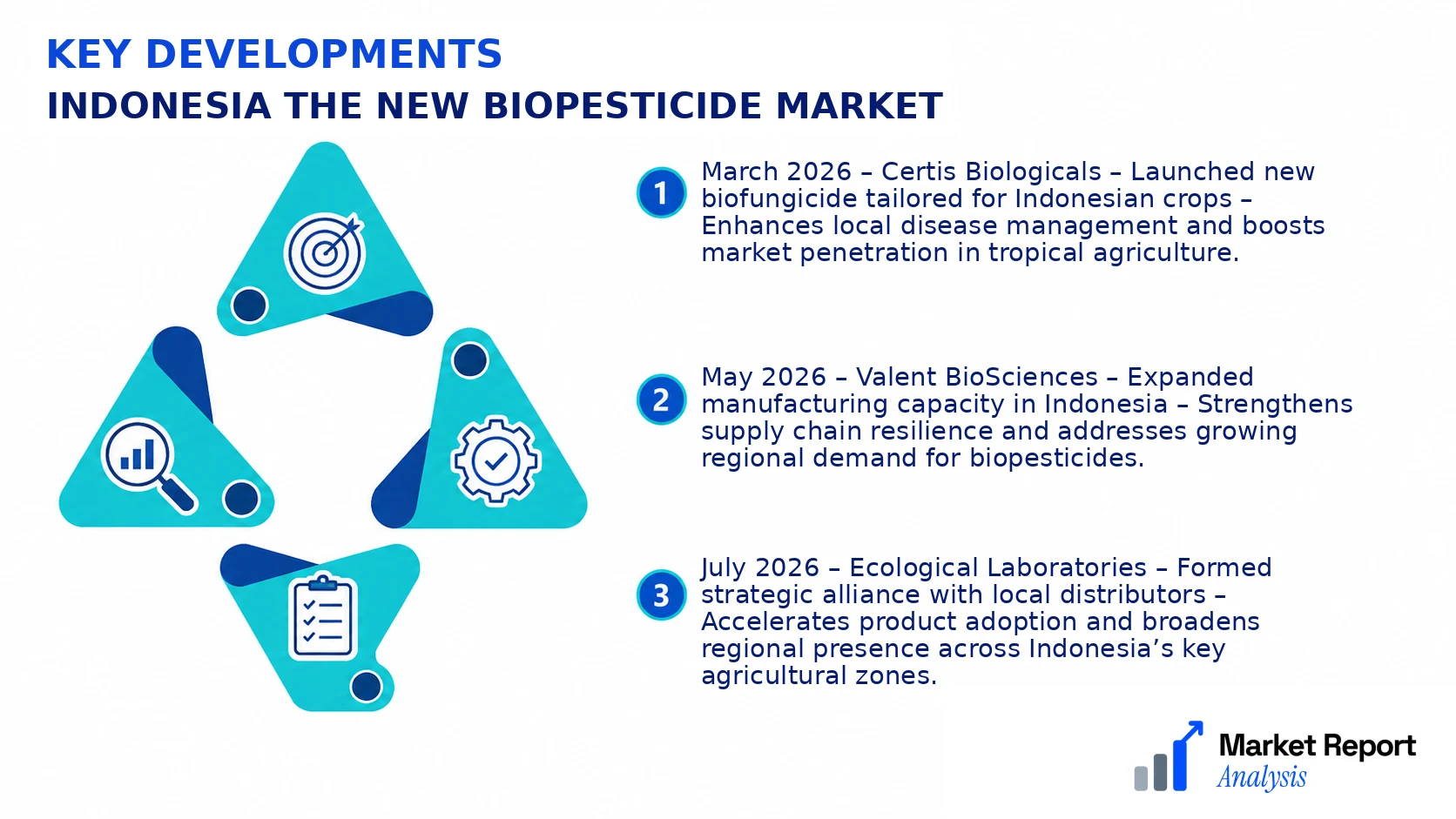
- March 2026 – Certis Biologicals – Launched new biofungicide tailored for Indonesian crops – Enhances local disease management and boosts market penetration in tropical agriculture.
- May 2026 – Valent BioSciences – Expanded manufacturing capacity in Indonesia – Strengthens supply chain resilience and addresses growing regional demand for biopesticides.
- July 2026 – Ecological Laboratories – Formed strategic alliance with local distributors – Accelerates product adoption and broadens regional presence across Indonesia’s key agricultural zones.
- September 2026 – Isagro S.p.A. – Acquired a local Indonesian biopesticide firm – Facilitates technology transfer and enhances local market access.
- November 2026 – Biobest Group – Launched precision biological pest control solutions – Improves efficacy and reduces farmers’ reliance on chemical pesticides, aligning with sustainability goals.
Frequently Asked Questions
What is the Indonesia The New Biopesticide Market?
The Indonesia The New Biopesticide Market encompasses the sector dedicated to the development, production, and distribution of innovative biopesticides tailored to Indonesia's agricultural needs. It reflects cutting-edge biological pest control solutions aimed at sustainable farming practices.
What is the current market size of Indonesia The New Biopesticide Market?
As of 2026, the market is valued at approximately USD 1.5 Billion, driven by increasing adoption of eco-friendly pest management solutions among Indonesian farmers and government initiatives promoting sustainable agriculture.
What factors are driving the Indonesia The New Biopesticide Market?
Key drivers include rising environmental concerns, stricter regulations on chemical pesticides, government support for organic farming, and technological advancements in biopesticide formulations that enhance efficacy and crop safety, thereby boosting market growth.
Which region dominates the Indonesia The New Biopesticide Market?
The island of Java, due to its dense agricultural zones and high adoption rates of biopesticides, dominates the market landscape in Indonesia, accounting for the largest share and driving regional sales and innovation.
Which segment is expected to grow the fastest?
Biological solutions targeting pest management in coffee and rice crops are anticipated to grow the fastest, supported by Indonesia’s significant production levels and high demand for sustainable crop protection practices.
Who are the leading companies operating in the Indonesia The New Biopesticide Market?
Major players include local firms like BioGen Indonesia and international companies such as Biotech Agro Solutions, which are actively innovating and expanding their presence to meet the rising demand for eco-friendly pest control solutions.
Analyst Perspective
The long-term outlook for Indonesia The New Biopesticide Market remains promising, driven by increasing environmental awareness, government support for sustainable agriculture, and rising adoption rates among local farmers. As technology evolves, the market is expected to see innovations such as precision application and bioformulation improvements, enhancing efficacy and reducing production costs. Investment priorities should focus on scalable production facilities and R&D centers in key agricultural zones such as Java and Sumatra, where crop diversity and export opportunities are high. Competitive intensity is expected to grow as both domestic players and international multinationals seek market share, necessitating strategic alliances and differentiated product offerings. Regional growth potential is significant, with emerging markets in Sulawesi and Kalimantan providing untapped opportunities due to expanding commercial agriculture. Strategic positioning in these regions will require tailored approaches, integrating local stakeholder engagement and technological adaptation to maximize market penetration and sustainability within Indonesia’s evolving agricultural landscape.
