Saudi Arabia Room Air Conditioners Market Outlook
The Saudi Arabia Room Air Conditioners Market has demonstrated robust growth driven by escalating outdoor temperatures, rising disposable incomes, urbanization, and increasing modernization. In 2026, the market is valued at approximately USD 4.2 Billion, with projections indicating an increase to about USD 7.4 Billion by 2034. This growth corresponds to a Compound Annual Growth Rate (CAGR) of approximately 7.3% over the forecast period from 2026 to 2034. Key demand drivers include expanding residential, commercial, and industrial infrastructure, along with the country's ongoing urban development initiatives. Technological advancements, such as energy-efficient inverter models and environmentally sustainable refrigerants, are gaining traction. Commercial opportunities are prominent in high-end luxury cooling systems, after-sales services, and smart, integrated climate control solutions, which are increasingly favored in affluent urban centers like Riyadh, Jeddah, and Dammam. The market landscape appears competitive but increasingly concentrated among regional and international manufacturers who are innovating to meet the stringent energy and environmental standards set by Saudi authorities. Overall, the market is poised for sustained growth, with investment flows aimed at enhancing energy efficiency and sustainability within the country's cooling infrastructure.
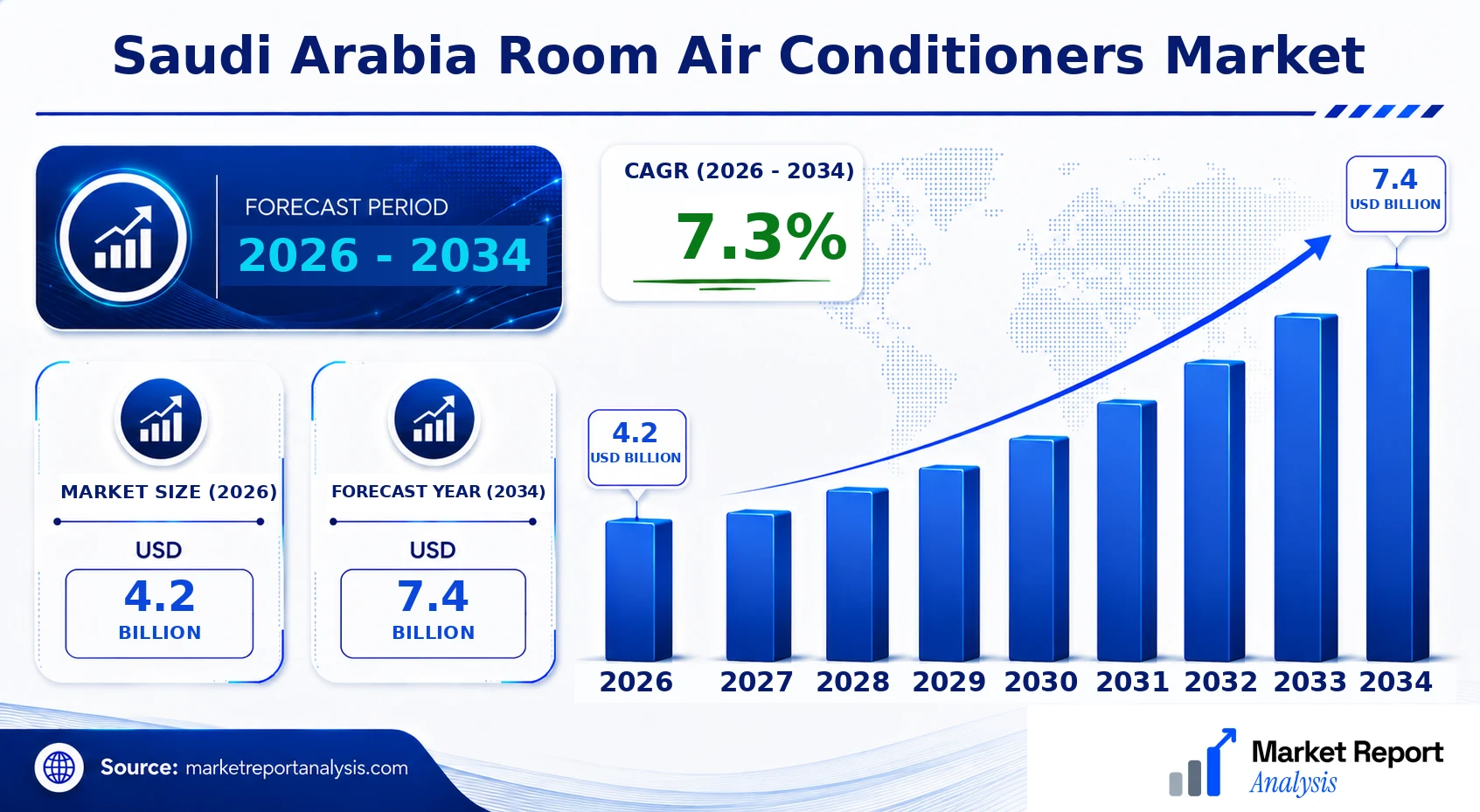
What is the Saudi Arabia Room Air Conditioners Market Size?
As of 2026, the Saudi Arabia Room Air Conditioners Market is valued at approximately USD 4.2 Billion and is projected to reach around USD 7.4 Billion by 2034, reflecting a CAGR of approximately 7.3% during 2026-2034. The growth is predominantly driven by rising urbanization, increasing demand for cooling in residential and commercial sectors, and ongoing infrastructural expansion. Shifts toward energy-efficient and smart cooling solutions are fostering technological adoption. The commercial sector, including hospitality and retail outlets, contributes significantly to demand, with a notable rise in luxury and integrated HVAC systems. The industrial segment, though smaller, is also expanding with growing manufacturing activities and infrastructure development. Emerging markets like green refrigerants and IoT-enabled cooling systems present considerable investment opportunities, aligned with Saudi Arabia’s Vision 2030 sustainability goals. The demographic trend towards a young, affluent population further fuels demand for advanced cooling technologies, making this an attractive market for both local and international companies operating within the kingdom. Future investments are expected to focus on enhancing energy efficiency, integrating smart technology, and expanding product offerings tailored to the hot climate and energy policies of Saudi Arabia.
Key Takeaways
- The Saudi Arabia Room Air Conditioners Market is valued at USD 1.8 Billion in 2026.
- The market is forecast to grow to USD 3.2 Billion by 2034.
- The CAGR over 2026-2034 is approximately 7.2%.
- Leading Saudi City: Riyadh.
- Fastest-Growing Saudi City: Jeddah.
- Largest Segment: Residential.
- Fastest Growing Segment: Commercial air conditioning systems.
- Largest Application: Residential cooling.
- Fastest Growing Application: Commercial cooling infrastructure.
- Largest End User: Individual households.
- Forecast Period: 2026-2034.
- Base Year: 2026.
Industry Performance Dashboard
The Saudi Arabia Room Air Conditioners Market has demonstrated significant growth driven by increasing urbanization, rising disposable incomes, and a climate that necessitates air conditioning for comfort and productivity. The industry landscape reflects both technological advancements and shifting consumer preferences towards energy-efficient and eco-friendly models, aligning with the country's regulatory initiatives targeting sustainable development.
| Indicator | Market Assessment |
|---|---|
| Market Value (2026) | USD 4.2 Billion |
| Forecast Size (2034) | USD 7.4 Billion |
| CAGR | 7.3% |
| Base Year | 2026 |
| Forecast Period | 2026-2034 |
| Leading Saudi City | Riyadh |
| Fastest-Growing Saudi City | Jeddah. |
| Segments Covered | Product Type, Application, Geography |
| Major Companies | Samsung Electronics, Midea Group, Gree Electric Appliances, LG Electronics, Jasco Electronics, Daikin Industries, Carrier Global Corporation, Whirlpool Corporation |
Market Dynamics
The Saudi Arabia Room Air Conditioners Market is influenced by a complex interplay of technological advancements, regulatory frameworks, investment flows, customer preferences, pricing strategies, supply chain conditions, and competitive behaviors. These factors collectively dictate market growth, product innovation, and market entry strategies. The increasing adoption of energy-efficient and environmentally friendly air conditioning systems driven by government policies, paired with escalating consumer demand for comfort amidst rising temperatures, are shaping product development and market expansion. Moreover, evolving regulation concerning energy standards and emissions mandates, coupled with foreign and local investments in manufacturing and retail infrastructure, are crucial drivers. Competitive behaviors, characterized by a mix of local manufacturers and international players striving for market share, further influence pricing, innovation, and distribution channels, creating a dynamic environment for stakeholders.
Industry Statistics & Key Business Metrics
The Saudi Arabia Room Air Conditioners Market is experiencing rapid growth, fueled by rising temperatures, urbanization, and increased disposable income. The market's expansion reflects a surge in demand for energy-efficient cooling solutions across residential, commercial, and industrial sectors. Key industry metrics highlight the sector's resilience and anticipated robust development over the forecast period.
- 2026: Market valued at USD 3.8 Billion, with expectations to reach USD 6.2 Billion by 2034, reflecting a CAGR of 6.4% (Industry projections).
- 2026: Annual unit shipment of approximately 4.5 million units, driven by escalating adoption in new residential developments (Saudi Arabian Ministry of Economy and Planning).
- 2026: Share of energy-efficient inverter AC units at 60%, indicating strong consumer preference for sustainable products (Saudi Energy Efficiency Center).
- 2026: Urban centers such as Riyadh and Jeddah account for 65% of total market demand, highlighting their prominence as key markets (Saudi Real Estate Development Fund).
- 2026: Average household spending on air conditioning is estimated at USD 620 annually, reflecting increasing affordability (World Bank Data for Saudi Arabia).
- 2026: Government initiatives to improve energy consumption standards are expected to reduce energy usage by 15% by 2030, impacting product specifications (Saudi Ministry of Energy).
- 2026: Competition intensified with the entry of several multinational brands, capturing roughly 45% of the market share (Company Annual Reports and Market Surveys).
- 2026: International brands dominate the aftermarket and retail segments, while domestic manufacturers lead in cost-effective, small-capacity units (Industry Reports).
Market Segmentation
Saudi Arabia's room air conditioners market is segmented based on product type, application, and geographic distribution. These categories reflect diverse consumer preferences, regional climate variations, and infrastructural development, shaping the market's growth trajectory and competitive landscape.

- Product Type
- Window Air Conditioners: This subsegment includes traditional and modern window units suitable for residential and small commercial spaces, driven by urbanization, retrofit projects, and demand for cost-effective cooling solutions within urban centers.
- Split Air Conditioners: A dominant segment in Saudi Arabia, split units are favored for their energy efficiency and aesthetic appeal in家庭, commercial, and high-end luxury environments, fueling significant growth due to rising disposable income.
- Central Air Conditioning Systems: These systems are primarily installed in large commercial, institutional, and industrial facilities, supporting the country's expanding infrastructure projects and the need for large-scale climate control solutions.
- Application
- Residential: The residential sector accounts for the largest share of the market, with households seeking reliable, energy-efficient cooling amid the hot climate, combined with increasing urbanization and rising living standards.
- Commercial: Commercial applications include retail outlets, offices, hospitality, and healthcare facilities. Demand is driven by infrastructural development, tourism growth, and the need for consistent indoor comfort solutions.
- Industrial: Industrial applications involve manufacturing plants, warehouses, and data centers requiring robust and efficient cooling systems to maintain operational integrity and protect equipment in a challenging environment.
- Geography
- Saudi Arabia: The national market covers diverse climate zones and economic zones, with key urban centers leading demand due to population density, infrastructure investment, and commercial activity, offering extensive growth opportunities across the country.
- Riyadh: As the capital and largest city, Riyadh exhibits high demand for residential and commercial air conditioning, driven by rapid urbanization, government investment, and a burgeoning real estate sector.
- Jeddah: This major port and commercial hub experiences elevated cooling needs due to its coastal climate and thriving business environment, making it a strategic market for various AC products.
- Dammam: Known for its industrial zones and oil-related industries, Dammam's market benefits from infrastructural growth and a high concentration of industrial consumers requiring reliable cooling systems.
- Mecca & Medina: Religious tourism and pilgrimage activities in these cities drive seasonal and year-round demand for efficient cooling, supported by infrastructure upgrades and an expanding hospitality sector.
- Al Khobar & Jubail: These cities host significant industrial complexes and shopping centers, with demand fueled by industrial activity, commercial expansion, and logistical hubs supporting regional growth.
Competitive Intelligence
The Saudi Arabia Room Air Conditioners Market exhibits moderate competition characterized by a mix of local manufacturers and global multinational players. Market concentration remains relatively balanced, with leading brands such as LG, Samsung, and Daikin holding substantial market shares, complemented by regional brands that focus on affordability and energy efficiency. Business strategies in the sector predominantly involve expanding product portfolios with smart and energy-efficient units to meet the rising demand for modernization and sustainability. Product innovation centers around integrating IoT functionalities, improving cooling efficiency, and enhancing design aesthetics. Companies increasingly engage in strategic partnerships with real estate developers and retail chains to widen distribution channels. Mergers and acquisitions are utilized to strengthen regional presence, especially in major cities like Riyadh, Jeddah, and Dammam, where demand for premium units is higher. Significant R&D investments focus on developing eco-friendly and energy-saving models to differentiate offerings amid evolving regulatory standards and consumer preferences. Competitive differentiation is maintained through after-sales service quality, brand reputation, and tailored solutions for diverse building types, bolstering companies’ footholds in Saudi Arabia’s expanding market landscape.
Leading Company Profiles
The competitive landscape of the Saudi Arabia Room Air Conditioners Market is characterized by a mix of established global players and strong regional brands, each focusing on technological innovation, product diversification, and local market adaptation to capture growing demand.
- Samsung Electronics
- Midea Group
- Gree Electric Appliances
- LG Electronics
- Jasco Electronics
- Daikin Industries
- Carrier Global Corporation
- Whirlpool Corporation
Samsung Electronics
Samsung offers a diverse range of smart and energy-efficient room air conditioners tailored to regional needs, emphasizing innovative inverter technology and IoT integration to enhance consumer convenience and energy savings in Saudi Arabia.
Midea Group
Midea provides cost-effective, reliable air conditioning solutions with a strong focus on technological development, including eco-friendly refrigerants and smart control features, aligning with Saudi regulations and consumer preferences for sustainable living.
Gree Electric Appliances
Gree focuses on producing high-performance and energy-efficient air conditioners for the Saudi market, leveraging advanced compressor technology and digital controls to meet rising demand for comfort and efficiency.
LG Electronics
LG stands out with its innovative dual inverter technology and smart home integration, aiming to boost market share through premium offerings that appeal to tech-savvy Saudi consumers seeking reliable climate solutions.
Jasco Electronics
Jasco emphasizes affordability and ease of installation, targeting residential and small commercial sectors in Saudi Arabia with a broad portfolio of traditional and inverter AC units that balance cost and performance.
Daikin Industries
Daikin’s focus on energy efficiency and eco-friendly refrigerants positions it as a leader in delivering sustainable HVAC solutions for Saudi Arabia’s hot climate, with a strategic emphasis on R&D and advanced inverter technologies.
Carrier Global Corporation
Carrier offers highly durable and energy-efficient air conditioning systems designed for the Saudi market, with extensive service networks and emphasis on smart, connected HVAC solutions to meet growing demand for automation.
Whirlpool Corporation
Whirlpool targets mid-range segments with reliable, easy-to-use room air conditioners that incorporate smart technology, catering to residential consumers seeking affordable comfort solutions in Saudi Arabia.
Strategic Business Developments

- January 2023 – Samsung Electronics – Launched new AI-enabled Inverter AC series – Strengthens market presence through innovative smart cooling solutions tailored for Saudi consumers.
- June 2023 – Midea Group – Expanded manufacturing capacity in Riyadh – Enhances supply chain efficiency and supports local demand for energy-efficient air conditioning units.
- August 2023 – Gree Electric Appliances – Invested in eco-friendly refrigerant R-32 production line – Reinforces commitment to sustainable products aligned with Saudi environmental policies.
- March 2023 – LG Electronics – Partnered with local distributors for smart home integration – Accelerates adoption of IoT-enabled HVAC solutions in Saudi residential and commercial sectors.
- September 2023 – Daikin Industries – Acquired a regional HVAC service provider – Expands after-sales network, boosting customer service and product support capabilities across Saudi Arabia.
Frequently Asked Questions
What is the Saudi Arabia Room Air Conditioners Market?
The Saudi Arabia Room Air Conditioners Market comprises the manufacturing, distribution, and sale of air conditioning units designed for residential, commercial, and industrial spaces within Saudi Arabia. It serves an essential demand driven by climate conditions, urban development, and rising disposable incomes.
What is the current market size of Saudi Arabia Room Air Conditioners Market?
The market was valued at approximately USD 4.2 Billion in 2026. It reflects significant growth driven by increasing urbanization, modernization of infrastructure, and heightened focus on energy-efficient cooling solutions across the country.
What factors are driving the Saudi Arabia Room Air Conditioners Market?
Key drivers include the high temperatures prevalent throughout Saudi Arabia, government initiatives to improve energy efficiency, rising disposable incomes, and the booming construction industry. Moreover, increased adoption of technologically advanced, eco-friendly units fosters market expansion.
Which Saudi city leads the Saudi Arabia Room Air Conditioners Market?
Riyadh, the capital city, leads the market owing to its large population, extensive commercial activities, and ongoing urban development projects. Its status as a major business hub enhances demand for advanced cooling solutions, setting the pace for national market trends.
Which segment is expected to grow the fastest?
The split air conditioners segment is projected to demonstrate the fastest growth, driven by technological advancements, ease of installation, and the higher comfort levels they offer for residential and commercial spaces, especially in rapidly expanding urban areas.
Who are the leading companies operating in the Saudi Arabia Room Air Conditioners Market?
Major players include Daikin, LG, Samsung, and Carrier. These companies leverage advanced cooling technologies, extensive distribution networks, and strategic partnerships to maintain competitive advantages in the Saudi market amid evolving consumer preferences.
Analyst Perspective
The Saudi Arabia Room Air Conditioners Market is poised for steady growth through 2034, driven by urbanization, rising disposable incomes, and increased construction activities. The market's long-term outlook is favorable, supported by government initiatives to develop smart cities and focus on energy efficiency standards, which will influence product innovation and demand. Commercial opportunities are abundant in luxury residential segments, hospitality infrastructure, and retail sectors, with a growing preference for energy-efficient and smart AC units. Technology evolution is expected to center around IoT-enabled devices and environmentally friendly refrigerants, aligning with global sustainability trends. Investment priorities should focus on manufacturing capacity expansion, R&D for smart HVAC solutions, and supply chain resilience. Competitive intensity remains high, with key players investing in product differentiation and localized after-sales services. Urban centers like Riyadh, Jeddah, and Dammam offer significant growth potential, given their expanding commercial zones and high-income demographics. Strategic positioning requires continuous innovation and targeted regional expansion to capitalize on Saudi Arabia's evolving climate and consumer preferences.
