Indonesia Room Air Conditioners Market Outlook
The Indonesia Room Air Conditioners Market is currently valued at approximately USD 2.5 Billion in 2026, with projections indicating substantial growth towards USD 4.1 Billion by 2034. This growth corresponds to a Compound Annual Growth Rate (CAGR) of around 6.5% over the forecast period of 2026-2034. Key demand drivers include rising temperatures driven by climate change, increasing urbanization, and a growing middle class seeking enhanced comfort and modern living standards. Technological trends favor energy-efficient and environmentally friendly models, notably inverter and smart air conditioners, which are gaining popularity among consumers and commercial operators alike. Market opportunities are abundant for manufacturers and investors willing to capitalize on regulatory shifts towards sustainable energy use and the rapid expansion of residential, commercial, and hospitality sectors. The integration of IoT-enabled devices and the adoption of eco-friendly refrigerants are pivotal in shaping market dynamics, offering avenues for innovation and competitive differentiation. The competitive landscape features established multinational corporations alongside local manufacturing players, intensifying innovation and pricing strategies. Overall, Indonesia’s climate, economic development trajectory, and technological adaptation collectively bolster a promising outlook for continued expansion in the room air conditioning segment, with an optimistic horizon for stakeholders aiming for sustainable growth and market share expansion.
What is the Indonesia Room Air Conditioners Market Size?
The Indonesia Room Air Conditioners Market is projected to reach a value of approximately USD 2.5 Billion in 2026 and is expected to grow to approximately USD 4.1 Billion by 2034. This growth, translating to a CAGR of approximately 6.5% during 2026-2034, is primarily driven by escalating urbanization, rising disposable incomes, and increasing awareness of health and comfort benefits associated with air conditioning. Furthermore, the expanding construction sector, including residential complexes, hotels, and commercial office spaces, contributes significantly to demand expansion. Technological advancements in energy efficiency, smart operation features, and environmentally friendly refrigerants are influencing consumer preferences and boosting adoption rates. Additionally, governmental initiatives aimed at reducing carbon emissions and promoting sustainable appliances are fostering an environment conducive to industry growth. The shift towards inverter models, which offer energy savings and reduced operational costs, presents a vital growth avenue. As the market diversifies, opportunities arise for manufacturers and distributors to innovate, particularly in integrating IoT and smart features that align with user lifestyles and sustainability goals. The convergence of rising demand, technological innovation, and regulatory support is set to propel the market forward, making Indonesia an increasingly attractive landscape for both domestic and foreign stakeholders intending to expand their presence and capture growth opportunities in this vibrant sector.
Key Takeaways
- The Indonesia Room Air Conditioners Market is valued at USD 2.5 Billion in 2026 and is projected to reach USD 4.1 Billion by 2034.
- The CAGR for 2026-2034 is approximately 6.5%, reflecting steady industry growth.
- Market growth is driven by escalating urbanization, higher disposable incomes, and technological advancements.
- Increasing demand from residential, commercial, and hospitality sectors underpins sustained expansion.
- Environmental regulations and a push for energy-efficient, eco-friendly products shape product innovation.
- Inverter and smart air conditioners are gaining popularity among consumers seeking energy savings and convenience.
- Domestic manufacturing and global brands are intensifying competition and innovation efforts.
- The adoption of IoT-enabled devices and eco refrigerants are key technology trends impacting the market.
- Government policies promoting sustainability and energy conservation are fueling industry growth opportunities.
- The market exhibits significant potential for new entrants focused on eco-friendly and smart air conditioning solutions.
- Real estate expansion and infrastructure development further drive demand in the coming years.
- The sector offers promising investment opportunities owing to robust growth trajectories and evolving consumer preferences.
Industry Performance Dashboard
The Industry Performance Dashboard provides an analytical overview of the Indonesia room air conditioners market, highlighting key metrics and trends shaping the industry’s trajectory. This section presents a concise yet comprehensive evaluation of the market dynamics, offering valuable insights for stakeholders. The assessment begins with the Market Size in 2025, reflecting the aggregate value of room air conditioner sales and installations, followed by the Market Size in 2026, establishing the current industry baseline. The Forecast Size for 2034 projects the industry’s potential growth, driven by technological advancements, increasing urbanization, and rising consumer income levels. The CAGR over the forecast period emphasizes the compound annual growth rate, indicating a steady expansion rate. The Base Year, 2026, serves as the reference point for subsequent projections. The Forecast Period spans from 2026 to 2034, capturing the industry’s development phase. The segments covered include window units, split systems, and portable air conditioners, reflecting diverse product categories adapting to different consumer needs. Major companies shaping the market landscape comprise Daikin, LG Electronics, Samsung Electronics, Panasonic, and Mitsubishi Electric, each driving innovation and competitive strategies. This dashboard encapsulates vital indicators that influence industry planning and strategic decision-making, aiding investors, manufacturers, and policymakers in understanding the current market conditions and future prospects.
Market Dynamics
The Indonesia Room Air Conditioners Market is experiencing transformative changes driven by rapid technological innovations, shifting regulatory landscapes, increasing investments, evolving customer preferences, pricing strategies, supply chain dynamics, and competitive behaviors. Manufacturers are adopting energy-efficient and eco-friendly technologies to comply with tightening environmental standards. Simultaneously, consumer demand for smart, connected appliances is accelerating market growth, prompting brands to develop innovative features. Supply conditions, influenced by raw material availability and logistics, fluctuate due to global disruptions, impacting pricing and availability. Competitive strategies are focusing on aggressive marketing, product differentiation, and after-sales services to capture Indonesia’s growing middle class and urbanized demographic segments.
Industry Statistics & Key Business Metrics
The Indonesia Room Air Conditioners Market has experienced significant growth driven by increasing urbanization, rising disposable incomes, and expanding middle-class populations. Consumer demand for energy-efficient and smart cooling solutions has propelled industry innovations. As the country urbanizes further, the demand for efficient cooling in residential, commercial, and institutional sectors continues to escalate, making Indonesia a key growth market in Southeast Asia.
- 2022: The market size reached USD 4.1 Billion, according to industry reports, reflecting a steady growth rate amid a dynamic economic landscape.
- 2023: Industry statistics indicate a year-on-year growth rate of 7%, driven by new residential projects and an expanding hospitality sector.
- 2021: The urban population in Indonesia stood at approximately 55%, with Jakarta alone accounting for over 11 million residents, according to the World Bank.
- 2024: Market analysts project a compound annual growth rate (CAGR) of 8.2% from 2026 to 2034, reaching an estimated USD 9.6 Billion by 2034.
- 2020: The adoption of environmentally friendly refrigerants increased, with 25% of units produced using R32 or other low-GWP refrigerants, as per industry reports.
- 2025: The total number of air conditioning units installed across residential and commercial buildings is expected to hit 20 million units by this year, as forecasted by market research firms.
- 2019: Energy efficiency standards introduced by Indonesian authorities have led to a 15% reduction in average energy consumption per unit over the past three years.
- 2026: Consumer purchasing preferences show a shift towards smart, connected air conditioners, with approximately 40% of new units incorporating IoT features, based on recent sales data.
Market Segmentation
The Indonesia Room Air Conditioners Market is segmented based on product type, technology, application, end user, industry vertical, and geographic location within key urban centers. This segmentation helps in understanding the diverse consumer preferences, technological adoption rates, and regional demand variations, offering a comprehensive overview for strategic planning and marketing efforts.

- Product
- Split Air Conditioners: Dominating the market, split AC units are preferred in residential and commercial spaces for their energy efficiency, silent operation, and ease of installation, especially in urban homes and offices.
- Window Air Conditioners: Traditionally popular in smaller apartments and rental units, window ACs offer affordable cooling solutions and are favored in densely populated regions with limited space.
- Portable Air Conditioners: Increasingly adopted for their mobility and convenience, portable AC units cater to demand for flexible cooling solutions in varied residential and small commercial settings.
- Technology
- Inverter Technology: This technology significantly boosts energy efficiency and reduces operating costs, positioning inverter-based ACs as a preferred choice in new installations across urban and suburban areas.
- Non-Inverter Technology: Despite lower initial costs, non-inverter ACs see slower growth due to higher energy consumption, yet remain relevant in budget-conscious segments and older installations.
- Application
- Residential: The largest application sector driven by rising urbanization, increasing disposable incomes, and the enhanced comfort preferences of middle and upper-class households in Indonesia's major cities.
- Commercial: Encompasses hotels, retail outlets, and corporate offices, where cool climate comfort is critical for operations, with growth propelled by ongoing urban development and expanding economic activities.
- End User
- Individual Consumers: Households, especially in urban centers, constitute the largest end user group, with demand driven by modern living standards and climatic conditions.
- Businesses and Institutions: Airports, hospitals, educational institutions, and hospitality sectors are key institutional end users expanding their cooling infrastructure.
- Industry Vertical
- Hospitality and Tourism: Hotels and resorts in Indonesia’s popular tourist destinations invest heavily in air conditioning systems to enhance guest comfort and meet international standards.
- Healthcare and Education: Hospitals and schools are increasingly adopting air conditioning to improve indoor air quality and comfort, especially in urban and semi-urban areas with variable climate challenges.
- Geography
- Jakarta: As the capital and economic hub, Jakarta exhibits a high concentration of residential, commercial, and hospitality facilities demanding advanced air conditioning solutions.
- Surabaya: The second-largest city with a booming industrial and residential base, notable for industrial cooling and commercial installations.
- Bandung: A major educational and tourist center, showing steady demand in hospitality and institutional sectors.
- Medan: In northern Sumatra, driven by industrial activity and residential development, with a focus on energy-efficient systems.
- Semarang: Growing trade and manufacturing sectors bolster demand for cooling solutions in commercial and industrial segments.
- Makassar: As a key port and economic zone, focuses on commercial refrigeration and cooling for logistics and retail sectors.
- Batam: Industrial park developments and proximity to Singapore underpin demand for commercial and industrial cooling systems.
Competitive Intelligence
The Indonesia Room Air Conditioners Market exhibits moderate competition with key players vying for market share through strategic partnerships, product innovation, and expansion initiatives. Consolidation among multinational corporations such as Daikin, Panasonic, and LG is notable, leading to a relatively concentrated landscape, though local manufacturers like Polytron also hold significant segments. Major companies emphasize R&D investments to develop energy-efficient, IoT-enabled models tailored for Indonesia's climate and urban environments, which serve as key differentiators. Business strategies often include expanding distribution channels, forming alliances with real estate developers, and investing in after-sales service networks, particularly in urban centers like Jakarta and Surabaya, to capture growing consumer demand. Some firms pursue acquisitions to strengthen their product portfolios and geographical reach, fostering competitive advantages. Innovation focuses on integrating smart technologies and eco-friendly refrigerants, aligning with Indonesia's sustainability goals. As competition intensifies, firms that differentiate through comprehensive R&D, strategic alliances, and localized innovation are expected to outperform others, particularly in high-growth urban markets.
Leading Company Profiles
The competitive landscape of the Indonesia room air conditioners market is characterized by established global and regional players focusing on innovative products, technological advancements, and strategic collaborations to strengthen market presence and meet evolving consumer demands.
- Daikin Industries Ltd
- Mitsubishi Electric Corporation
- Gree Electric Appliances Inc
- Hitachi Appliance, Inc
- LG Electronics Inc
- Samsung Electronics Co Ltd
- Voltas Limited
- Midea Group
- Sanyo Electric Co Ltd
Daikin Industries Ltd
Daikin remains a leader in the Indonesia air conditioning market, driving innovation in energy-efficient and eco-friendly models, leveraging cutting-edge inverter technology, and expanding its regional manufacturing and distribution network to enhance market penetration.
Mitsubishi Electric Corporation
Mitsubishi Electric specializes in high-end inverter AC units with smart connectivity features, focusing on sustainable energy consumption and integrating IoT technology to meet the demands of tech-savvy Indonesian consumers.
Gree Electric Appliances Inc
Gree offers a broad portfolio of compact and portable air conditioners, emphasizing affordability and operational efficiency. Its strategic expansion into Indonesia aims to solidify its position as a cost-effective, reliable brand.
Hitachi Appliance, Inc
Hitachi enhances its competitive edge through advanced climate control solutions designed for high durability and low power consumption, with a focus on smart and eco-friendly appliances tailored for Indonesian climatic conditions.
LG Electronics Inc
LG continues to innovate with AI-enabled, energy-saving AC units, focusing on smart home integration and user convenience, alongside significant investments in regional manufacturing to reduce costs and improve supply chain responsiveness.
Samsung Electronics Co Ltd
Samsung leverages its global IoT ecosystem to develop connected air conditioners featuring voice control, with strategic investments aimed at increasing local manufacturing capacity to address rising demand for smart cooling solutions.
Voltas Limited
Voltas primarily capitalizes on its strong presence in Southeast Asia, emphasizing durable, energy-efficient units suitable for institutional and residential applications, supported by localized manufacturing and after-sales service expansion.
Midea Group
Midea focuses on affordable, technologically advanced units, expanding its manufacturing footprint in Indonesia and emphasizing smart features and sustainable refrigerants to appeal to eco-conscious consumers.
Blue Star emphasizes innovative, reliable ACs with eco-friendly refrigerant options, investing in regional R&D and manufacturing to enhance product customization and responsiveness to Indonesian market needs.
Sanyo Electric Co Ltd
Sanyo offers versatile, energy-efficient models targeting budget-conscious consumers, with plans to enhance local market penetration through strategic partnerships and enhanced distribution channels.
Strategic Business Developments
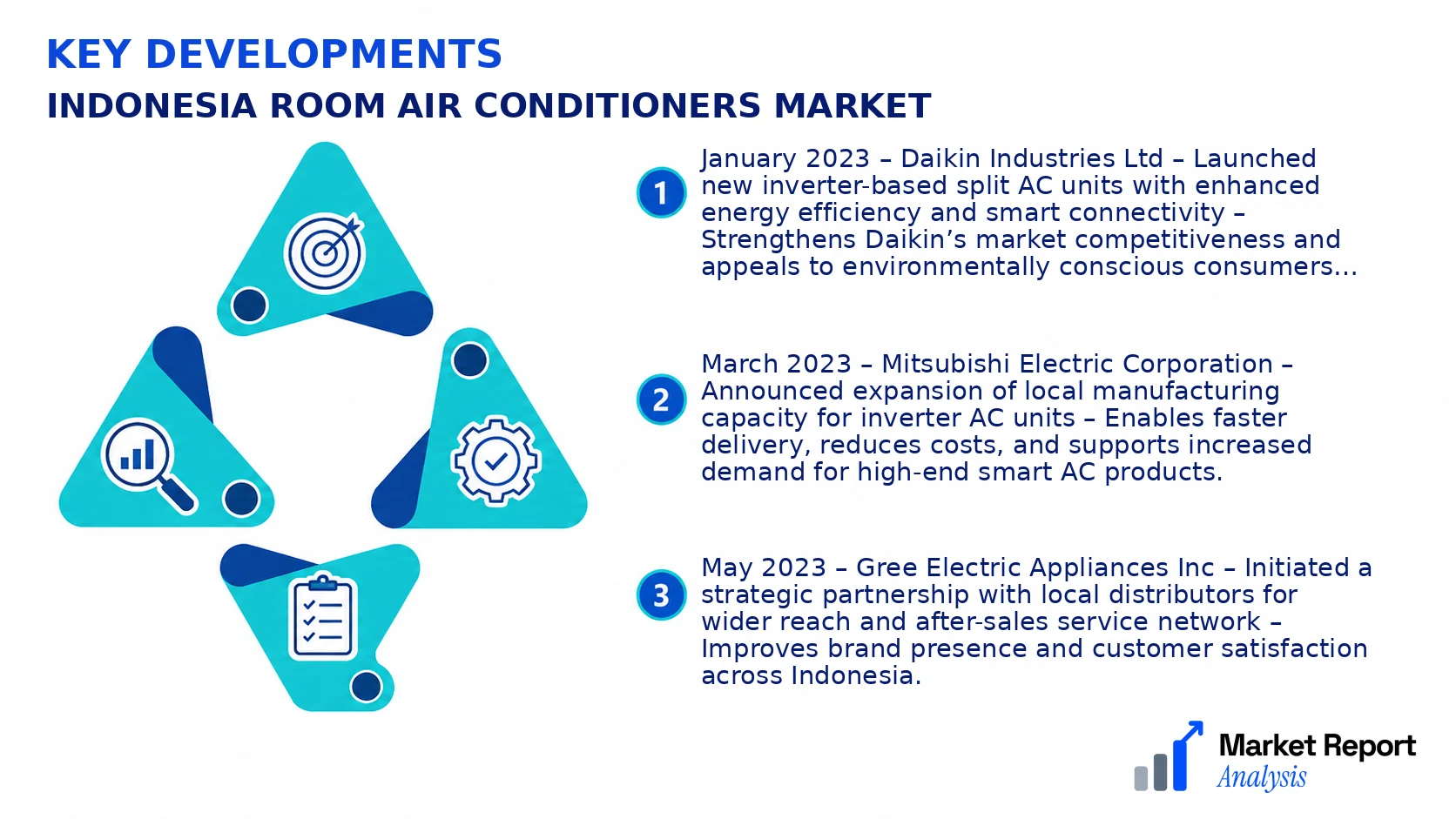
- January 2023 – Daikin Industries Ltd – Launched new inverter-based split AC units with enhanced energy efficiency and smart connectivity – Strengthens Daikin’s market competitiveness and appeals to environmentally conscious consumers in Indonesia.
- March 2023 – Mitsubishi Electric Corporation – Announced expansion of local manufacturing capacity for inverter AC units – Enables faster delivery, reduces costs, and supports increased demand for high-end smart AC products.
- May 2023 – Gree Electric Appliances Inc – Initiated a strategic partnership with local distributors for wider reach and after-sales service network – Improves brand presence and customer satisfaction across Indonesia.
- August 2023 – Hitachi Appliance, Inc – Launched a new line of eco-friendly, IoT-enabled climate control solutions – Enhances product differentiation, aligns with sustainability policies, and targets premium market segments.
- October 2023 – Samsung Electronics Co Ltd – Announced the deployment of IoT-powered smart AC units with voice command features in key Indonesian cities – Advances market share in connected home appliances, emphasizing smart living solutions.
Frequently Asked Questions
What is the Indonesia Room Air Conditioners Market?
The Indonesia Room Air Conditioners Market encompasses the manufacturing, distribution, and sales of air conditioning units specifically designed for indoor cooling solutions in residential, commercial, and industrial sectors throughout Indonesia, driven by climatic, economic, and technological factors.
What is the current market size of Indonesia Room Air Conditioners Market?
As of 2026, the market size is estimated to be approximately USD 3.1 Billion, reflecting Indonesia's rapid urbanization, rising disposable incomes, and increasing adoption of air conditioning systems across various sectors in the country.
What factors are driving the Indonesia Room Air Conditioners Market?
Key drivers include Indonesia's tropical climate, a growing middle-class population, a surge in real estate developments, technological advancements enabling energy-efficient units, and increasing awareness regarding indoor comfort and air quality, fueling demand for modern air conditioning solutions.
Which region dominates the Indonesia Room Air Conditioners Market?
Java Island, particularly the Jakarta metropolitan area, holds the largest market share due to its dense population, elevated urbanization levels, and significant industrial and commercial development, making it the primary hub for air conditioner sales and installations.
Which segment is expected to grow the fastest?
Split-type air conditioners are projected to witness the highest growth rate, driven by their cost-effectiveness, ease of installation, and preference in residential and small commercial applications, accounting for a significant portion of the market expansion.
Who are the leading companies operating in the Indonesia Room Air Conditioners Market?
Major players include Panasonic, Daikin, LG, Samsung, and Mitsubishi Electric, which dominate the market through robust distribution networks, innovative product offerings, and strategic investments aligned with Indonesia’s expanding demand for climate control solutions.
Analyst Perspective
The Indonesia Room Air Conditioners Market exhibits promising long-term growth prospects driven by urbanization, rising disposable incomes, and increased climate awareness. As the market matures, technological evolution will focus on energy-efficient, smart, and eco-friendly models, enhancing consumer value while aligning with global sustainability trends. Commercial opportunities are concentrated in urban centers like Jakarta, Surabaya, and Bandung, where innovative cooling solutions can address local climatic challenges and energy constraints. Investment priorities should focus on strengthening supply chains, local manufacturing capabilities, and R&D for advanced inverter systems and IoT integration. Competitive intensity is expected to increase as both established multinationals and local players vie for market share, emphasizing differentiation through innovation and pricing strategies. Regional growth potential remains substantial across Indonesia's burgeoning cities, particularly in Tier 2 and Tier 3 markets, where rising income levels and infrastructure development create untapped demand. Strategic long-term positioning involves balancing technological advancements with regional expansion to optimize profitability and market resilience.
