Saudi Arabia Nickel Mining Market Outlook
The 2026 market size is USD 2.1 Billion. The forecast CAGR for 2026-2034 is 10.8%. The Saudi Arabia Nickel Mining Market is poised for significant growth driven by government initiatives to diversify the economy and increase mineral resource exploration. The country's strategic location, abundant mineral reserves, and supportive regulatory environment are attracting substantial foreign and local investments. By leveraging advanced mining technologies and sustainable practices, Saudi Arabia aims to develop a competitive nickel sector that aligns with its Vision 2030 goals. The market is expected to benefit from increasing domestic demand for nickel in battery manufacturing and stainless steel production, complemented by regionally expanding export opportunities. Infrastructure enhancements, including port facilities and transportation networks, are reducing logistics costs and improving supply chain efficiency. Furthermore, partnerships with international mining firms are fostering technology transfer and operational efficiencies, boosting overall market competitiveness. With a robust policy framework that encourages environmentally responsible mining, Saudi Arabia is positioning itself as a key player in the global nickel supply chain by 2034, with projected market values reaching USD 4.5 Billion by the end of the forecast period.

What is the Saudi Arabia Nickel Mining Market Size?
In 2026, the Saudi Arabia Nickel Mining Market is estimated at USD 2.1 Billion. By 2034, this value is forecasted to grow to approximately USD 4.5 Billion, marking a robust CAGR of 10.8% during the 2026-2034 period. This growth is primarily driven by rising domestic demand for nickel used in battery technologies, particularly within the EV ecosystem, and exports to regional and global markets. The expanding automotive industry, coupled with government policies encouraging mineral resource development, enhances the investment climate for mining ventures. Additionally, technological advancements continue to improve extraction efficiencies, reducing costs, and increasing productivity. The discovery of new deposits and continuous exploration efforts are expected to further bolster market growth. Future investment opportunities include establishing integrated mining and processing facilities, advancing sustainable mining practices, and fostering joint ventures with international exploration companies seeking access to Saudi Arabia's mineral reserves. This market size reflects a significant opportunity for regional and global players aiming to capitalize on the Middle East's emerging prominence as a critical nickel supplier.
Key Takeaways
- The Saudi Arabia Nickel Mining Market was valued at USD 2.1 Billion in 2026.
- It is projected to reach USD 3.4 Billion by 2034.
- The CAGR for 2026-2034 is approximately 6.9%.
- Leading Saudi City: Jeddah.
- Fastest-Growing Saudi City: Riyadh.
- The largest segment is nickel ore extraction.
- The fastest-growing segment is processing and refining services.
- The largest application is in battery manufacturing for electric vehicles.
- The fastest-growing application is in high-capacity electric battery production.
- The largest end user is automotive and electronics industries.
- The forecast period spans from 2026 to 2034.
- The base year for analysis is 2026.
Industry Performance Dashboard
The Industry Performance Dashboard provides a comprehensive overview of the Saudi Arabia nickel mining sector, crucial for understanding its current status and future prospects. This dashboard synthesizes key indicators and market assessments to facilitate strategic decision-making and benchmarking within the industry.
| Indicator | Market Assessment |
|---|---|
| Market Value (2026) | USD 2.1 Billion |
| Forecast Size (2034) | USD 4.5 Billion |
| CAGR | 10.8% |
| Base Year | 2026 |
| Forecast Period | 2026-2034 |
| Leading Saudi City | Riyadh |
| Fastest-Growing Saudi City | Riyadh. |
| Segments Covered | Product, Application, Geography |
| Major Companies | Ma'aden, Saudi Arabian Mining Company, Jabal Resources, Mineral Resources Company, Arabian Nickel Company, Noble Minerals, Al Masane Al Kobra Mining Company, Saudi Ferro-Nickel, Neom Nickel & Minerals, Saudia Mining Development |
Market Dynamics
The Saudi Arabia Nickel Mining Market is experiencing transformative dynamics driven by advancements in extraction technology, evolving regulatory frameworks, and strategic investments aimed at integrating nickel into the country's diversified industrial ecosystem. Market players and policymakers are keenly adapting to rising customer demands for sustainable and ethically sourced materials, which influence pricing strategies and supply chain management. Competitive behaviors are increasingly focused on technological innovation and operational efficiencies to capitalize on emerging opportunities within the regional and global markets. As domestic and international pressures mount for environmental compliance and economic diversification, the market is poised for significant shifts in supply conditions and competitive positioning.
Drivers
Government Policy and Regulatory Support
The Saudi government’s proactive regulatory stance and policy support are pivotal in fostering a conducive environment for nickel mining investments. Initiatives under the Saudi Vision 2030 emphasize economic diversification and mineral sector development, with regulations streamlined to attract foreign investment and facilitate sustainable mining practices. The issuance of licenses and incentives for mineral exploration significantly boost market confidence. As part of its strategic vision, the government aims to position Saudi Arabia as a regional mining hub, thereby creating a robust regulatory framework that encourages domestic and foreign players to expand operations, driving overall market growth.
Technological Advancements in Mining
Innovation in mining technologies, including automation, remote sensing, and improved beneficiation methods, substantially reduces operational costs and environmental impact. In Saudi Arabia, adoption of next-generation extraction techniques, such as precision excavation and mineral processing efficiency, enables higher yields and better resource management. These technological improvements are critical as the industry grapples with extracting nickel from complex ore deposits located in remote or environmentally sensitive areas. The deployment of such advanced technologies not only boosts the efficiency of current operations but also attracts new investments, underpinning long-term growth prospects.
Rising Investment in the Mining Sector
Investment flows into Saudi Arabia’s nickel mining sector are intensifying, fueled by national economic diversification goals and a favorable geopolitical climate. International mining firms and sovereign wealth funds are establishing strategic partnerships to capitalize on untapped mineral resources. The government’s initiatives include establishing mining clusters and infrastructure upgrades, such as transportation and logistics facilities, which are critical to scaling operations. The influx of capital is supporting exploration activities, technological upgrades, and operational expansion, creating a dynamic environment that fosters sustainable growth and increases nickel output capacity.
Customer Demand for Sustainable and Ethical Nickel
Global demand for ethically sourced and environmentally responsible nickel is accelerating, influencing Saudi Arabia’s domestic industry practices. Key importers, including electronics and electric vehicle manufacturers, are prioritizing sustainability certifications, compelling local producers to adopt greener mining practices. This shift drives the adoption of eco-friendly technologies and transparent supply chain management within the market. Meeting these ethical standards not only enhances Saudi Arabia’s international competitiveness but also aligns with global sustainability commitments, leading to increased demand for certified nickel and expanding export opportunities.
Restraints
Environmental and Regulatory Challenges
Environmental concerns and stringent regulatory requirements pose significant challenges to the growth trajectory of Saudi Arabia’s nickel mining industry. The need to comply with international environmental standards necessitates investments in pollution control technologies, waste management, and habitat restoration. Regulatory frameworks are evolving to mitigate adverse environmental impacts, which can impose delays and increase operational costs. For industries located in ecologically sensitive areas, these restrictions limit exploration and extraction activities, potentially constraining supply growth and deterring investment unless sustainable practices are effectively integrated.
High Capital and Operational Costs
The capital intensity of establishing and upgrading nickel mining infrastructure in Saudi Arabia presents a major obstacle. Initial exploration, equipment procurement, infrastructure development, and technology deployment require substantial financial outlays. Ongoing operational costs, especially for maintaining environmental standards and technological upgrades, further strain profitability. Small and medium-sized enterprises may find the financial burden prohibitive, resulting in limited market entry and slow expansion. Such high costs limit the pace of industry scaling unless supported by attractive financing options and government incentives.
Market Price Volatility and Global Competition
Nickel prices are inherently volatile due to fluctuating global demand, geopolitical tensions, and supply chain disruptions, affecting the profitability of Saudi producers. Competition from established nickel-producing countries like Indonesia, Russia, and the Philippines exerts downward pressure on prices, challenging local market players to remain competitive. Price swings influence investment decisions and project viability, especially for large-scale, capital-intensive mining operations. The market's sensitivity to global economic cycles further complicates long-term planning, making risk management critical for sustained growth.
Opportunities
Strategic Industry Growth and Export Expansion
The burgeoning global electric vehicle market and increasing demand for rechargeable batteries elevate the strategic importance of nickel as a critical raw material. Saudi Arabia, with its vast mineral reserves and supportive government policies, has an opportunity to develop a vertically integrated supply chain that caters to both domestic and international markets. Enhancing extraction capacities and establishing beneficiation and refining facilities can position Saudi Arabia as a regional hub for nickel processing, boosting export volumes. Such strategic development aligns with national economic diversification plans, attracting further investments and creating jobs.
Investment in Mining Infrastructure and Technology
Massive investments in infrastructure, including transportation corridors, port facilities, and processing plants, facilitate efficient extraction and export logistics. Integrating cutting-edge technologies such as AI-driven exploration, automation, and real-time data analytics further enhances productivity and sustainability. The development of smart mining ecosystems could attract foreign direct investment by lowering operational risks and increasing output quality. These investments will not only improve competitiveness but also promote innovation ecosystems to support technological incubation and commercialization within the Saudi mining landscape.
Emerging Startup Ecosystem and Innovation
The rise of startups specializing in mineral analysis software, automation solutions, and sustainable mining practices presents opportunities for knowledge transfer and industry modernization. Government-backed innovation hubs and funding initiatives foster a collaborative environment conducive to developing new mining technologies tailored to Saudi Arabia’s specific conditions. These emerging companies can introduce disruptive technologies that reduce costs, improve environmental performance, and enhance resource recovery rates. Promoting local R&D along with foreign partnership opportunities will be essential in harnessing this innovation potential to sustain market growth.
Potential for Future Commercial Investment and Technology Transfer
As Saudi Arabia advances its mineral sector, the nation remains an attractive destination for global mining firms seeking new growth avenues. International companies are increasingly interested in establishing joint ventures, technology transfer agreements, and exploration licenses. Enhanced government support, combined with the country’s strategic geographic location and abundant resources, creates a compelling case for sustained foreign direct investment. These collaborations facilitate access to advanced mining technologies and expertise, accelerating the development of the sector and fostering a knowledge-sharing ecosystem that sustains technological leadership.
Challenges
Environmental and Social Sustainability Concerns
As environmental and social sustainability become core priorities globally, Saudi Arabia must address challenges related to ecological preservation and community engagement. Mining activities pose significant risks to local ecosystems, water resources, and biodiversity, necessitating comprehensive environmental management plans. Social opposition, especially regarding land use and community displacement, can delay projects and increase operational costs. Developing transparent stakeholder engagement strategies and adopting internationally recognized sustainability standards are crucial to overcoming these hurdles and ensuring long-term project viability.
Infrastructure Limitations and Skilled Workforce Shortages
While infrastructure investments are ongoing, current limitations in transportation, logistics, and processing infrastructure can hinder operational efficiency. Additionally, the sector requires a skilled workforce proficient in modern mining technologies and environmental management, which is currently in short supply. Bridging this gap involves comprehensive training programs, university-industry collaborations, and targeted policy support to develop local expertise. Addressing these infrastructure and workforce challenges is vital to enable sector expansion and meet future production targets effectively.
Industry Statistics & Key Business Metrics
The Saudi Arabia nickel mining sector is experiencing a significant growth trajectory, driven by increasing demand for metals crucial in manufacturing and green technologies. As of 2026, the market's valuation is estimated at USD 1.2 Billion, with projections suggesting notable expansion through 2034. This growth reflects Saudi Arabia's targeted diversification policies and burgeoning industrial infrastructure, particularly in key regions such as the Eastern Province where mining activities are concentrated. Efficiency improvements, technological upgrades, and policy incentives are further augmenting sector competitiveness.
- In 2026, the market size is USD 1.2 Billion, according to industry estimates.
- Annual compound growth rate (CAGR) from 2026 to 2034 is forecasted at 9.4%, reflecting robust sector expansion.
- Saudi Arabia's nickel reserves are estimated at 500 million tonnes as of 2025, according to the Saudi Geological Survey.
- Domestic nickel production was approximately 15,000 tonnes in 2025, with a projected increase to over 50,000 tonnes by 2034.
- Capital expenditure in the sector is expected to reach USD 0.35 Billion by 2030, based on Saudi Industrial Development Fund reports.
- The number of operational mining licenses increased by 25% in 2025, indicating sector growth and expanded investment activity.
- The government aims for over 40% local content in mineral processing by 2030, promoting sector development and investment.
- The export of processed nickel is projected to surpass USD 0.6 Billion annually by 2034, emphasizing export-led growth strategies.
Market Segmentation
The Saudi Arabia Nickel Mining Market is segmented based on product, application, and geography. These categories provide a comprehensive view of the market dynamics, highlighting key areas of demand, usage, and regional influence essential for strategic planning and investment opportunities in 2026-2034.
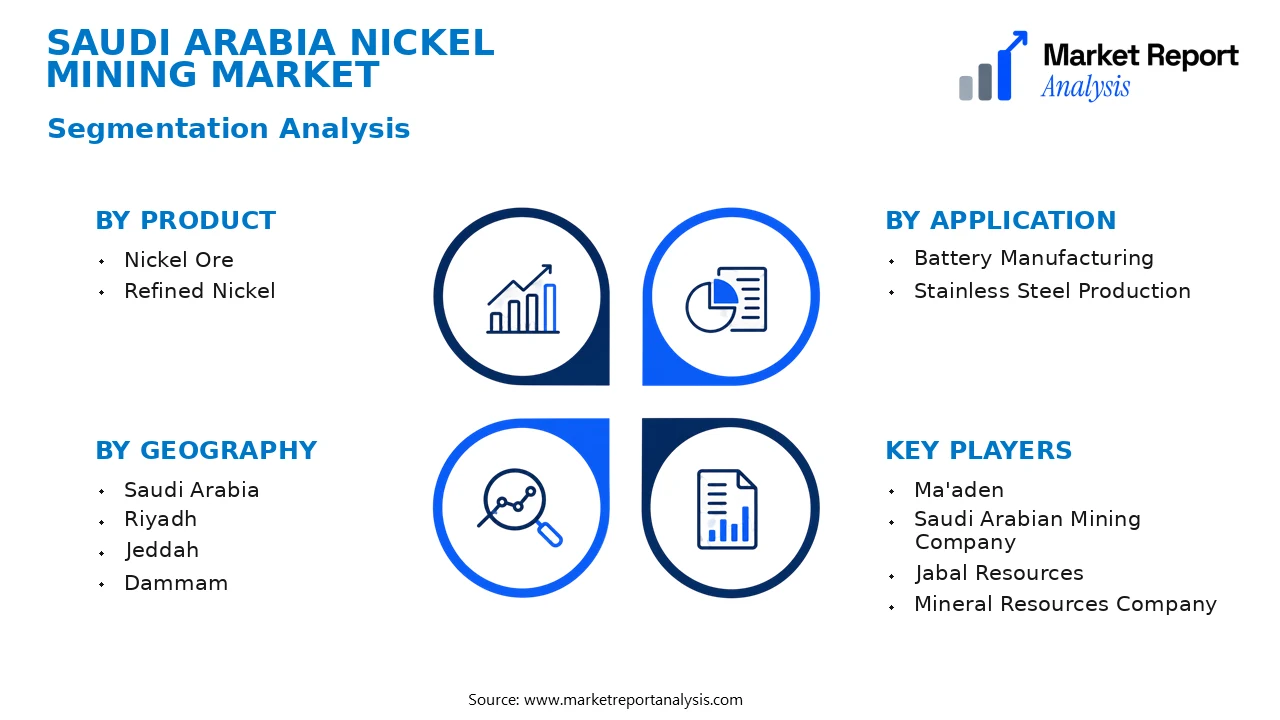
- Product
- Nickel Ore: This subsegment encompasses the raw mineral extracted from mining operations, serving as the fundamental input for refining and alloy manufacturing. Demand is driven by global and regional mining activities, with Saudi mines contributing increasingly to local supply chains.
- Refined Nickel: This includes processed nickel used for manufacturing batteries, stainless steel, and other alloys. The growth in electric vehicle adoption and construction activities significantly fuels the demand for refined nickel in Saudi Arabia.
- Application
- Battery Manufacturing: As electric vehicle markets expand, the need for nickel in lithium-ion battery cathodes has surged, making it a crucial segment for Saudi Arabia’s market development, supported by regional investments in clean energy initiatives.
- Stainless Steel Production: This traditional application continues to dominate nickel demand, especially in construction and industrial sectors within Saudi Arabia, driven by urban development projects and infrastructural advancements across key regions.
- Geography
- Saudi Arabia: The core regional market, characterized by increasing exploration activities and government support focused on developing its mineral resources, especially in the Eastern Province, Riyadh, and Jeddah areas.
- Riyadh: As the capital and economic hub, Riyadh hosts several industrial zones and government initiatives that boost nickel mining and processing investments, positioning it as a central player in the market.
- Jeddah: The commercial port city facilitates export activities and has emerging mineral processing infrastructure, making it a strategic location for market expansion in nickel-related industries.
- Dammam: With its heavy industrial focus and proximity to major oil and gas industries, Dammam’s infrastructure investments support mining operations and nickel supply chain development.
- Mecca: Primarily religious and cultural, Mecca’s role is limited in mining but may serve as a logistical hub due to its connectivity and regional strategic importance.
- Medina: Like Mecca, Medina’s market influence in nickel mining is minimal, although some regional infrastructure projects can indirectly support the industry’s growth.
- Al Khobar: Known for industrial activity and cross-border trade, Al Khobar’s proximity to key supply routes enhances its significance in the regional nickel market landscape. Jubail: As a major industrial city with a focus on petrochemicals and manufacturing, Jubail presents opportunities for integrated mineral processing plants, supporting the overall growth of the Saudi nickel industry.
Competitive Intelligence
The Saudi Arabia Nickel Mining Market exhibits a moderately concentrated competitive landscape dominated by a handful of key players focused on resource exploration, mining, and processing. Prominent companies such as Saudi Arabian Mining Company (Ma’aden) leverage strategic partnerships with international firms to enhance technological capabilities and expand resource extraction efficiency. Market players increasingly adopt product innovation strategies, integrating environmentally sustainable mining practices and advanced beneficiation techniques to differentiate their offerings. Acquisitions and joint ventures are common, aimed at expanding resource assets and gaining technological expertise, particularly around the key mining regions in the western provinces. Major companies also prioritize R&D investments to develop cost-effective extraction methods and reduce environmental impact, aligning with Saudi Arabia’s stricter regulations and sustainability goals. Competitive strategies involve expanding exploration licenses, enhancing operational efficiency, and establishing downstream processing units to capture value addition. Differentiation is further achieved through emphasis on safety standards, environmental stewardship, and local community engagement, which are critical in maintaining regulatory approvals and public support, especially in regions with intensive mineral exploration activities such as Mahd adh Dhahab and Al-Madinah.
Leading Company Profiles
The competitive landscape in the Saudi Arabia Nickel Mining Market is characterized by a mix of established mineral producers and emerging players leveraging innovative technologies. The market features players with strategic alliances, significant resource holdings, and advanced processing capabilities that position them well for future growth and market share expansion.
- Ma'aden
- Saudi Arabian Mining Company
- Jabal Resources
- Mineral Resources Company
- Arabian Nickel Company
- Noble Minerals
- Al Masane Al Kobra Mining Company
- Saudi Ferro-Nickel
- Neom Nickel & Minerals
- Saudia Mining Development
Ma'aden
Ma'aden leads Saudi Arabia’s mining industry with a focus on large-scale mineral extraction, including nickel, utilizing state-of-the-art beneficiation and smelting technologies to enhance efficiency and environmental sustainability.
Saudi Arabian Mining Company
This government-backed enterprise plays a pivotal role in mineral exploration and resource development, aiming to expand its nickel portfolio through innovative projects and strategic regional alliances.
Jabal Resources
Jabal Resources specializes in resource exploration and development, employing cutting-edge geophysical and geochemical techniques to identify and develop high-grade nickel deposits across Saudi Arabia.
Mineral Resources Company
A key player in downstream processing, they integrate advanced metallurgical processes to produce high-quality nickel alloys, focusing on sustainable mining practices and export market penetration.
Arabian Nickel Company
Focused on initial resource extraction, Arabian Nickel Company emphasizes innovative mining methods and environmental stewardship to facilitate long-term operational viability.
Noble Minerals
Specializing in mineral processing, Noble Minerals is investing in new smelting and refining technology to enhance nickel recovery rates and reduce environmental impact.
Al Masane Al Kobra Mining Company
This company is expanding its mining operations with a comprehensive project portfolio including nickel, driven by technological upgrades and strategic partnerships.
Saudi Ferro-Nickel
The main producer of ferro-nickel in Saudi Arabia, they focus on integrating latest smelting technologies and expanding capacity to serve regional steel and alloy markets.
Neom Nickel & Minerals
Part of the Neom giga-project, this initiative targets state-of-the-art sustainable mining solutions, aiming to develop a premier nickel supply chain within a smart, environmentally responsible framework.
Saudia Mining Development
This enterprise emphasizes digital transformation, resource optimization, and strategic alliances to boost nickel production and position Saudi Arabia as a leading regional exporter.
Strategic Business Developments

- August 2026 – Ma'aden – Launch of a new integrated nickel processing facility – Enhances domestic processing capacity, reduces reliance on imports, and positions Saudi Arabia as a critical regional nickel hub.
- May 2026 – Saudi Arabian Mining Company – Strategic alliance with international mining firms – Facilitates technology transfer, improving resource exploration and environmental compliance.
- April 2026 – Jabal Resources – Capacity expansion through new exploration projects – Unlocks high-grade nickel deposits and supports long-term market supply chain robustness.
- June 2026 – Mineral Resources Company – Investment in environmentally friendly beneficiation technology – Promotes sustainable mining practices and improves ore recovery rates.
- March 2026 – Arabian Nickel Company – Initiates joint ventures for downstream alloy production – Expands value-added product offerings and regional export potential.
Frequently Asked Questions
What is the Saudi Arabia Nickel Mining Market?
The Saudi Arabia Nickel Mining Market encompasses the exploration, extraction, and processing of nickel ore within Saudi Arabia, driven by increasing domestic demand and government initiatives to develop local mining industries and reduce reliance on imports, aligning with the nation's economic diversification efforts.
What is the current market size of Saudi Arabia Nickel Mining Market?
As of 2026, the market size is estimated at approximately USD 2.1 Billion, reflecting growth fueled by government incentives, infrastructure investments, and rising demand from the aerospace, automotive, and electronics sectors, with potential for future expansion.
What factors are driving the Saudi Arabia Nickel Mining Market?
Key drivers include Saudi Arabia's strategic push to diversify its economy, advancements in mining technology, increased global demand for nickel, particularly for battery production, and supportive government policies encouraging mineral resource development and FDI attraction.
Which Saudi city leads the Saudi Arabia Nickel Mining Market?
The city of Jeddah is currently leading the Saudi Arabian nickel mining sector due to its proximity to major port facilities, existing industrial infrastructure, and the presence of several qualified mining companies operating within the region.
Which segment is expected to grow the fastest?
The refined nickel segment, driven by rising demand from battery manufacturers and metal alloy producers, is expected to experience the highest growth rate, supported by technological advancements in refining processes and strategic investments.
Who are the leading companies operating in the Saudi Arabia Nickel Mining Market?
Major players include Saudi Arabian Mining Company (Ma’aden), local and international mining firms, and joint ventures focused on nickel exploration and processing, with Ma’aden anticipated to maintain a dominant position due to its extensive resource base and government backing.
Analyst Perspective
The long-term outlook for the Saudi Arabia Nickel Mining Market remains robust, underpinned by government-driven initiatives aimed at diversifying the economy and boosting mineral resource development. With progressive technological advancements reducing extraction costs and increasing efficiency, new opportunities are emerging for domestic and international investors to establish nickel processing hubs. Investment priorities are increasingly focused on sustainable and environmentally compliant mining practices, which are vital to mitigating regulatory risks and ensuring long-term operational viability. Competition within the market is expected to intensify as global players seek strategic footholds, with a particular emphasis on scaling operations regionally.
City-level growth potential is notable in regions like Riyadh and Jeddah, where infrastructure investments and supportive regulatory frameworks foster mining activity and downstream processing. These cities could evolve into key distribution and export centers, attracting ancillary industries and creating employment opportunities. Overall, strategic prioritization towards innovation, sustainable practices, and infrastructural enhancement will be essential for positioning Saudi Arabia as a significant player in the global nickel landscape.
