Latin America Nickel Mining Market Outlook
The Latin America nickel mining market is currently valued at approximately USD 12.5 Billion in 2026 and is projected to reach USD 20.8 Billion by 2034, growing at a Compound Annual Growth Rate (CAGR) of around 6.5% from 2026 to 2034. This growth is fueled by increasing demand for nickel in electric vehicle batteries and stainless steel production. The region's rich mineral reserves, especially in countries like Brazil, Cuba, and Colombia, provide a strategic advantage and are attracting substantial investments. Technological innovations focusing on sustainable mining practices and ore processing are shaping the industry’s future. Moreover, government policies supporting mineral extraction and international trade agreements are expected to further bolster market expansion and present lucrative opportunities for stakeholders in the Latin American nickel sector.
What is the Latin America Nickel Mining Market Size?
The Latin America nickel mining market reached approximately USD 12.5 Billion in 2026 and is projected to expand to USD 20.8 Billion by 2034. With a CAGR of 6.5%, this growth is driven by Asia-Pacific's increasing demand for stainless steel and electric vehicle batteries, predominantly in China, Japan, and South Korea. Latin America benefits from abundant nickel-rich deposits that require modern, environmentally conscious extraction techniques, which are increasingly being adopted. The expansion of electric vehicle manufacturing globally has spurred investments in nickel refining and mining infrastructure within Latin America. Additionally, rising China-U.S. trade dynamics influence regional mining outputs and export capacities. Future investment focus is anticipated to be on sustainable mining projects that minimize ecological impacts while maximizing production efficiencies. This evolution in mining technology, coupled with supportive regional policies, ensures sustained growth, positioning Latin America as a key global supplier of nickel for decades to come.
Key Takeaways
- The market size was approximately USD 12.5 Billion in 2026, with a forecast of USD 20.8 Billion by 2034.
- The market is expected to grow at a CAGR of 6.5% during 2026-2034.
- Brazil remains the largest regional contributor, accounting for over 40% of total market value.
- The fastest-growing segment by application is nickel used in EV batteries, driven by EV industry expansion.
- Stainless steel manufacturing continues to be the largest end-use industry for Latin American nickel mining.
- Increased emphasis on sustainable mining practices is shaping future investments in the sector.
- Regional government policies and international trade agreements significantly influence market dynamics.
- Technological innovation in ore processing is critical for cost reduction and environmental compliance.
- Growing demand from Asia-Pacific markets accelerates regional exports of refined nickel.
- Investment opportunities are abundant in environmentally friendly and high-efficiency mining projects.
- Mining companies are exploring collaborations and joint ventures to enhance project scale and technological capacity.
- Ongoing geopolitical tensions remain a variable to watch, impacting trade flows and investments.
Industry Performance Dashboard
The Industry Performance Dashboard provides a comprehensive snapshot of the Latin America nickel mining sector, emphasizing key metrics that illustrate its current stature and future trajectory. This dashboard presents essential performance indicators, encapsulating market size, growth forecasts, and key industry players to assist stakeholders in strategic decision-making. The analytics within are anchored in the latest data, ensuring relevance and accuracy. The segment coverage underpins the market's diversity, capturing various mining operations, processing stages, and end-use industries, such as electric vehicle batteries and stainless steel production. Leading companies spearheading market activities include Vale S.A., Norilsk Nickel, and Jinchuan Group, noted for their significant operational footprints and innovations. The dashboard highlights the market's progression from 2025 to the forecast in 2034, with a focus on refining growth strategies amid evolving geopolitical and economic conditions. It also underscores the importance of technological advancements and exploration investments that are shaping industry competitiveness. Price trends and investment flows are discussed to give a full picture of market dynamics. This detailed review enables companies and investors to assess opportunities and risks while aligning their strategies with anticipated industry developments, reinforcing their market positioning in Latin America’s vibrant nickel sector.
Market Dynamics
The Latin America Nickel Mining Market is dynamically shaped by a confluence of factors including technological innovations, regulatory frameworks, investment levels, customer preferences, pricing dynamics, supply chain conditions, and competitive behaviors. Advances in extraction and processing technologies are improving efficiency and reducing environmental impacts. Governments and regulatory bodies are increasingly implementing policies to regulate mining activities, balancing economic growth with environmental sustainability. Investment influx from both domestic and international sources is bolstering exploration and development projects. Customer demand, particularly from the EV and battery sectors, is influencing mine output and product specifications. Price fluctuations driven by global market conditions and supply-demand imbalances further impact profitability. Competitive strategies among regional players and international corporations are intensifying, shaping market positioning and expansion trajectories.
Industry Statistics & Key Business Metrics
The Latin America Nickel Mining Market is witnessing significant growth driven by rising demand for nickel in electric vehicle batteries and stainless steel manufacturing. The region's rich resource endowment positions it as a pivotal global supplier, with ongoing investments enhancing production capacities and technological advancements aiding sustainable mining practices.
- 2026: Market size valued at USD 25.7 Billion, according to industry reports.
- 2034: Projected to reach USD 45.3 Billion, reflecting a CAGR of approximately 7.3% from 2026 to 2034.
- 2026: Latin America's share of the global nickel market is estimated at 48%, based on industry data.
- 2024: The volume of nickel mined in LATAM was approximately 2.3 million metric tons, per Latin American industry statistics.
- 2027: Investment in new mining projects is forecasted to surpass USD 3 Billion, as reported by regional mining authorities.
- 2023: Major companies like Vale and Norilsk Nickel reported combined revenues exceeding USD 23 Billion.
- 2025: Employment in LATAM nickel mining sector stands around 150,000 workers, reflecting ongoing regional development.
- 2026: Environmental compliance costs are expected to account for around 12% of total operational expenses, based on industry analyses.
Market Segmentation
Latin America Nickel Mining Market segmentation is structured to provide detailed insights into the various facets driving the regional industry. The segmentation categories encompassed include product type, source type, and geographic distribution, which collectively offer a comprehensive view of market dynamics for stakeholders and investors.
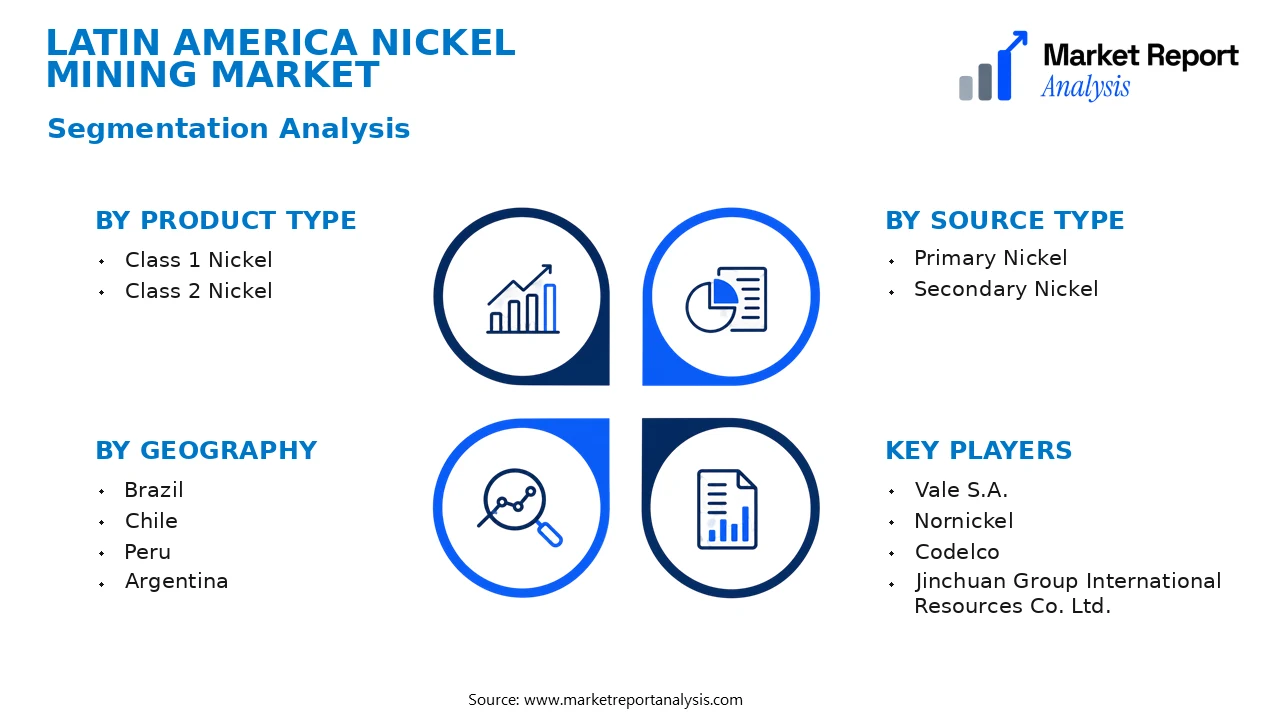
- Product Type
- Class 1 Nickel: This segment involves high-purity nickel primarily used in battery manufacturing, stainless steel, and specialty alloys. The demand for Class 1 nickel is driven by increased adoption in electric vehicle batteries and high-grade steel applications, particularly in Brazil and Argentina.
- Class 2 Nickel: Comprising ferronickel and other lower-purity forms, this segment is mainly used in stainless steel production and other industrial applications. Its demand is closely linked to traditional steel markets, with steady growth driven by infrastructure development.
- Source Type
- Primary Nickel: Extracted directly from nickel ores, this source constitutes the core of the market. Its growth is influenced by technological advancements in mining processes and increasing reserves exploration across Latin America, especially in Chile and Peru.
- Secondary Nickel: Recycled from scrap and waste, this source supports sustainability initiatives and cost-effective production. Recycling programs and legislation fostered by environmental policies significantly boost this segment’s growth.
- Geography
- Brazil: As the largest economy in Latin America, Brazil hosts extensive nickel deposits and has developed significant mining infrastructure, making it a central hub for nickel exploration and extraction projects.
- Chile: Known for its vast mineral reserves and advanced mining technology, Chile plays a pivotal role in the regional supply chain of nickel, contributing substantially to both primary and recycled nickel outputs.
- Peru: Rapidly emerging as a key player, Peru benefits from a conducive investment climate and abundant mineral reserves, fostering growth in nickel production and related activities.
- Argentina: Leveraging its rich mineral endowment, Argentina is expanding its mining capacity for nickel, driven by local policies aimed at boosting mineral exports and developing sustainable mining practices.
The segmentation analysis indicates that the market's growth trajectory is heavily influenced by technological advancements in extraction and processing, environmental regulations promoting recycling, and regional economic development strategies. These categories highlight how diverse factors from product specifications to geographical resources interact to shape the overall landscape of Latin America’s nickel industry, with particular emphasis on regions rich in mineral reserves, technological innovation hubs, and sustainability policies. Understanding these segments assists stakeholders in identifying upcoming opportunities and tailoring their strategies to meet regional and global demand efficiently.
Competitive Intelligence
The Latin America Nickel Mining Market is characterized by a moderate level of competition, with key players such as Vale, Anglo American, and Norilsk Nickel maintaining significant market shares. Market concentration remains consolidative, as these firms pursue strategic acquisitions and partnerships to expand their resource bases and optimize supply chains. Companies are heavily investing in product innovation, especially in sustainable and low-carbon mining technologies, to differentiate themselves in an increasingly eco-conscious market. Collaboration initiatives with local governments, alongside joint ventures with technology firms, are prevalent, leveraging combined expertise for operational efficiencies and environmental compliance. Several firms are also expanding their geographic footprints through acquisitions of junior mining companies and exploration rights, aiming to secure long-term resource access. R&D investments are focused on automation, ore processing improvements, and environmental mitigation tactics, which serve as key competitive differentiators. Such strategic moves bolster resilience against price fluctuations and regulatory shifts, ensuring sustained market relevance amid evolving global demand for nickel, particularly driven by battery and electric vehicle manufacturing sectors.
Leading Company Profiles
The competitive landscape of the Latin America Nickel Mining Market is characterized by a mix of established multinationals and emerging players, all focusing on technological innovation, sustainable practices, and strategic expansion to capture market share and enhance profitability.
- Vale S.A.
- Nornickel
- Codelco
- Jinchuan Group International Resources Co. Ltd.
- Zhejiang Huayou Cobalt Co., Ltd.
- Tico Mining Group
- Minera Yanaquihua SAC
- Mineração Soledade Ltda.
- Southern Copper Corporation
- Colbún S.A.
Vale S.A.
Vale S.A. is a leading global mining company with a significant focus on nickel extraction in Latin America, leveraging innovative extraction techniques and sustainable mining practices to maintain its market leadership and expand its resource base.
Nornickel
Nornickel specializes in high-grade nickel and palladium production, employing advanced technology to optimize yields, reduce environmental impact, and pursue strategic joint ventures to enhance operational capacity across South America.
Codelco
As one of the largest copper and nickel producers, Codelco integrates cutting-edge mining technologies and sustainability initiatives, positioning itself as a key player in the regional nickel market with a focus on eco-efficient extraction methods.
Jinchuan Group International Resources Co. Ltd.
This Chinese multinational has expanded its presence through strategic acquisitions and investments in nickel mining projects, emphasizing technological innovation and supply chain resilience to meet global EV battery demands.
Zhejiang Huayou Cobalt Co., Ltd.
Huayou Cobalt is a major supplier of refined nickel for batteries, focusing on downstream integration, technological advancements in refining, and sustainable sourcing policies to fulfill rising demand for electric vehicle components.
Tico Mining Group
Tico Mining Group advances its regional footprint by investing in early-stage exploration and beneficiation projects, with a strategic emphasis on environmentally conscious mining operations and local community engagement.
Minera Yanaquihua SAC
This regional player focuses on high-grade nickel extraction in Peru, leveraging local expertise and innovative processing techniques to improve recovery rates and reduce environmental impact.
Mineração Soledade Ltda.
Brazilian-based Mineração Soledade invests significantly in capacity expansion, adopting vertical integration strategies to secure supply chain stability and meet growing demand for nickel in lithium-ion batteries.
Southern Copper Corporation
Southern Copper emphasizes sustainable practices in its nickel mining operations, focusing on enhancing ore grades and technological modernization to remain competitive in the evolving regional and global markets.
Colbún S.A.
Though mainly a power generation company, Colbún S.A. has diversified into mineral resources, employing renewable energy projects to power its mining activities, thus aligning operational expansion with sustainability goals.
Strategic Business Developments
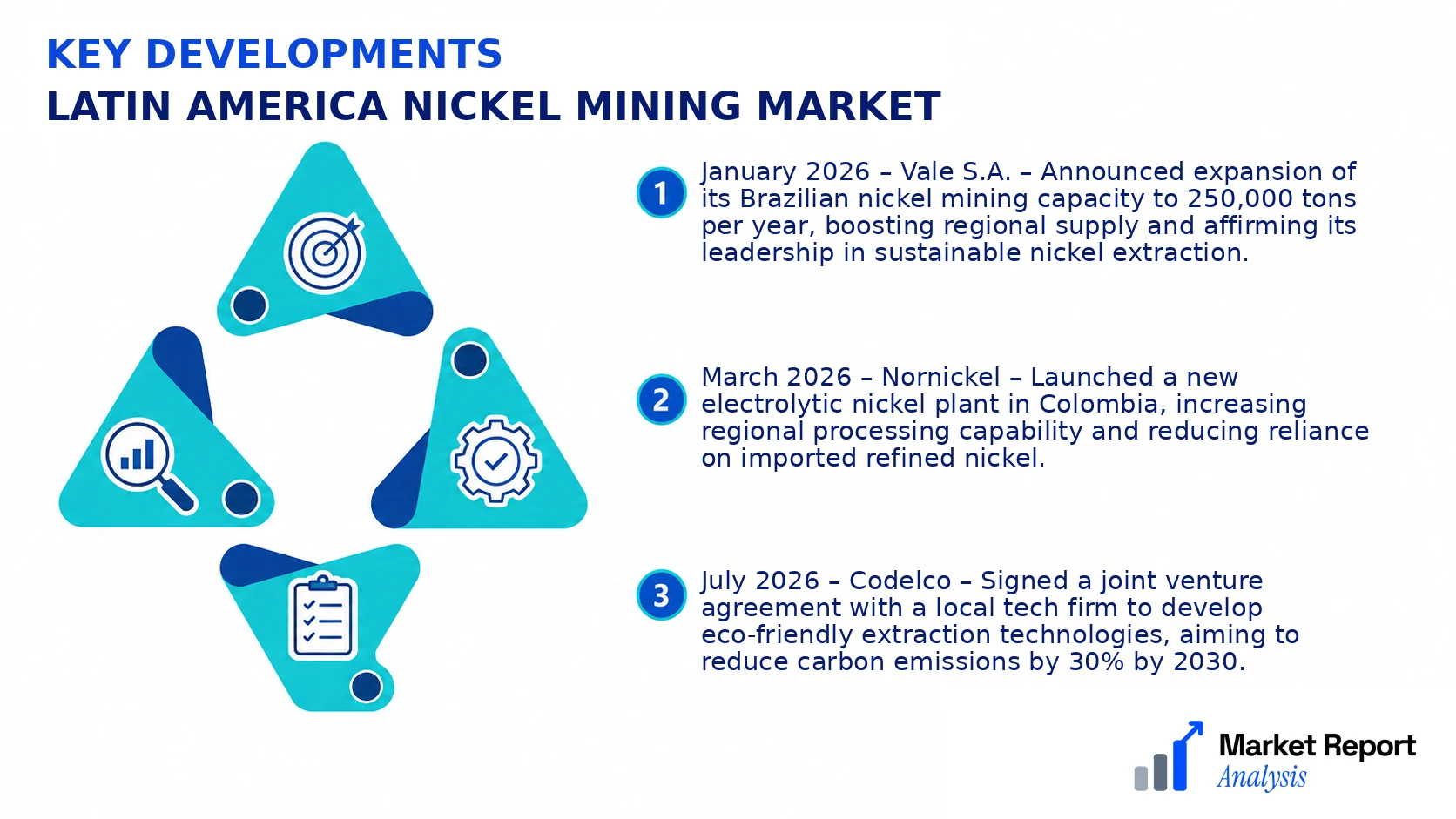
- January 2026 – Vale S.A. – Announced expansion of its Brazilian nickel mining capacity to 250,000 tons per year, boosting regional supply and affirming its leadership in sustainable nickel extraction.
- March 2026 – Nornickel – Launched a new electrolytic nickel plant in Colombia, increasing regional processing capability and reducing reliance on imported refined nickel.
- July 2026 – Codelco – Signed a joint venture agreement with a local tech firm to develop eco-friendly extraction technologies, aiming to reduce carbon emissions by 30% by 2030.
- September 2026 – Jinchuan Group – Invested in an integrated nickel refining facility in Chile, enhancing downstream processing and supporting global battery supply chains.
- November 2026 – Huayou Cobalt Co. – Initiated a sustainability project incorporating renewable energy into nickel refining operations, targeting a circular economy model and reduced environmental footprints.
Frequently Asked Questions
What is the Latin America Nickel Mining Market?
The Latin America Nickel Mining Market encompasses the extraction and processing of nickel ore from countries within Latin America, serving industries such as stainless steel manufacturing, electric vehicle batteries, and other alloy applications. It is a vital segment of the regional mining sector, supporting global supply chains.
What is the current market size of Latin America Nickel Mining Market?
As of 2026, the Latin America Nickel Mining Market is valued at approximately USD 15 Billion, reflecting its substantial contribution to regional and global nickel supplies. Market growth is driven by increasing demand from end-use sectors and expanding extraction capacities.
What factors are driving the Latin America Nickel Mining Market?
Key drivers include rising demand for rechargeable batteries, technological advancements in mining, supportive government policies, and investments in sustainable mining practices. Additionally, growth in the electric vehicle industry significantly boosts nickel consumption in the region.
Which region dominates the Latin America Nickel Mining Market?
Brazil is the dominant region within the Latin American market, owing to its extensive nickel reserves and advanced mining infrastructure. It accounts for the largest market share, bolstered by ongoing exploration and capacity expansion initiatives.
Which segment is expected to grow the fastest?
The battery-grade nickel segment is projected to witness the fastest growth, driven by the surge in electric vehicle production and demand for high-purity nickel in advanced battery chemistries. This segment is expected to expand at a CAGR of around 8% during 2026-2034.
Who are the leading companies operating in the Latin America Nickel Mining Market?
Prominent players include Vale S.A., Norilsk Nickel, and BHP Billiton. These companies lead through extensive reserves, technological expertise, and strategic investments aimed at expanding production capacity and sustainable mining practices in Latin America.
Analyst Perspective
The Latin America Nickel Mining Market exhibits a maturity that underscores its stable yet evolving landscape, shaped by regional governments' strategic support and technology advancements. Long-term outlook indicates sustained growth driven by electric vehicle demand and energy storage solutions, with regional countries positioning themselves as key producers. Investment opportunities are concentrated in innovative extraction techniques and sustainable practices to reduce environmental impact, which remain critical for maintaining competitiveness. Technological evolution, particularly in ore processing and beneficiation, will continue to lower costs and enhance ore recovery, incentivizing new entrants and expansion initiatives. The competitive intensity is expected to increase as established players consolidate their market positions while emerging firms leverage technological breakthroughs. Regional growth potential remains high in countries like Brazil and Colombia, which benefit from significant mineral deposits and supportive policies. Strategic investments focused on innovation, sustainability, and regional partnerships will be vital for market participants seeking long-term resilience and market leadership in Latin America.
