Saudi Arabia 3PL in FMCG Market Outlook
Market segmentation in the Saudi Arabia 3PL in FMCG sector is primarily divided by product, service component, and geographic region. These categories facilitate targeted analysis of growth potential, service specialization, and regional demand disparities within the dynamic FMCG supply chain landscape. A detailed understanding of these segments supports strategic positioning and competitive advantage in this rapidly evolving market.
Segmentation Overview
- Product
- Furniture & Fixtures: Encompasses storage solutions, shelving, and display units tailored for FMCG warehouses, influencing logistics efficiency and warehouse space utilization.
- Processed Food: Covers logistics services tailored for temperature-sensitive and perishable FMCG products, requiring specialized handling and transport capabilities that ensure product integrity.
- Electronics & Appliances: Involves the movement, warehousing, and distribution of durable goods, demanding precise inventory management and secure transportation methods.
- Component
- Warehousing & Storage: Critical for inventory management, these services support rapid replenishment cycles and safety stock holding, directly impacting supply chain responsiveness.
- Transportation & Freight: Key service for last-mile delivery, inter-modal transportation, and freight forwarding that ensures timely product availability across Saudi regions.
- Packaging & Labeling: Essential for product protection, branding, and compliance with Saudi regulations, influencing consumer perception and logistics efficiency.
- Geography
- Saudi Arabia: Represents the overarching national market characterized by diverse regional demand, varying infrastructure development, and strategic logistics hubs that shape 3PL deployment and expansion.
- Riyadh: The capital and commercial hub, Riyadh hosts the highest concentration of FMCG manufacturers, distributors, and third-party logistics providers, making it a pivotal region for market activities.
- Jeddah: As a major port city, Jeddah facilitates international and regional trade, attracting FMCG imports and providing strategic 3PL operations for swift distribution across MENA.
- Dammam: An industrial and logistics epicenter in the Eastern Province, Dammam benefits from port facilities and industrial zones that support large-scale FMCG logistics services.
- Mecca: A significant religious and pilgrimage site with increasing FMCG demand linked to tourism and religious visitors, prompting targeted logistic services and supply chain resilience initiatives.
- Medina: Similar to Mecca, Medina’s demand driven by religious tourism fuels FMCG logistics needs, fostering growth of specialized distribution channels.
- Al Khobar: An industrial city offering connectivity and logistics infrastructure conducive to FMCG distribution, particularly for temperature-sensitive and high-value goods.
- Jubail: Known for petrochemical industries, Jubail supports FMCG sectors associated with industrial and bulk distribution, bolstering regional logistics capabilities.
- Saudi Arabia: Represents the overarching national market characterized by diverse regional demand, varying infrastructure development, and strategic logistics hubs that shape 3PL deployment and expansion.
What is the Saudi Arabia 3PL in FMCG Market Size?
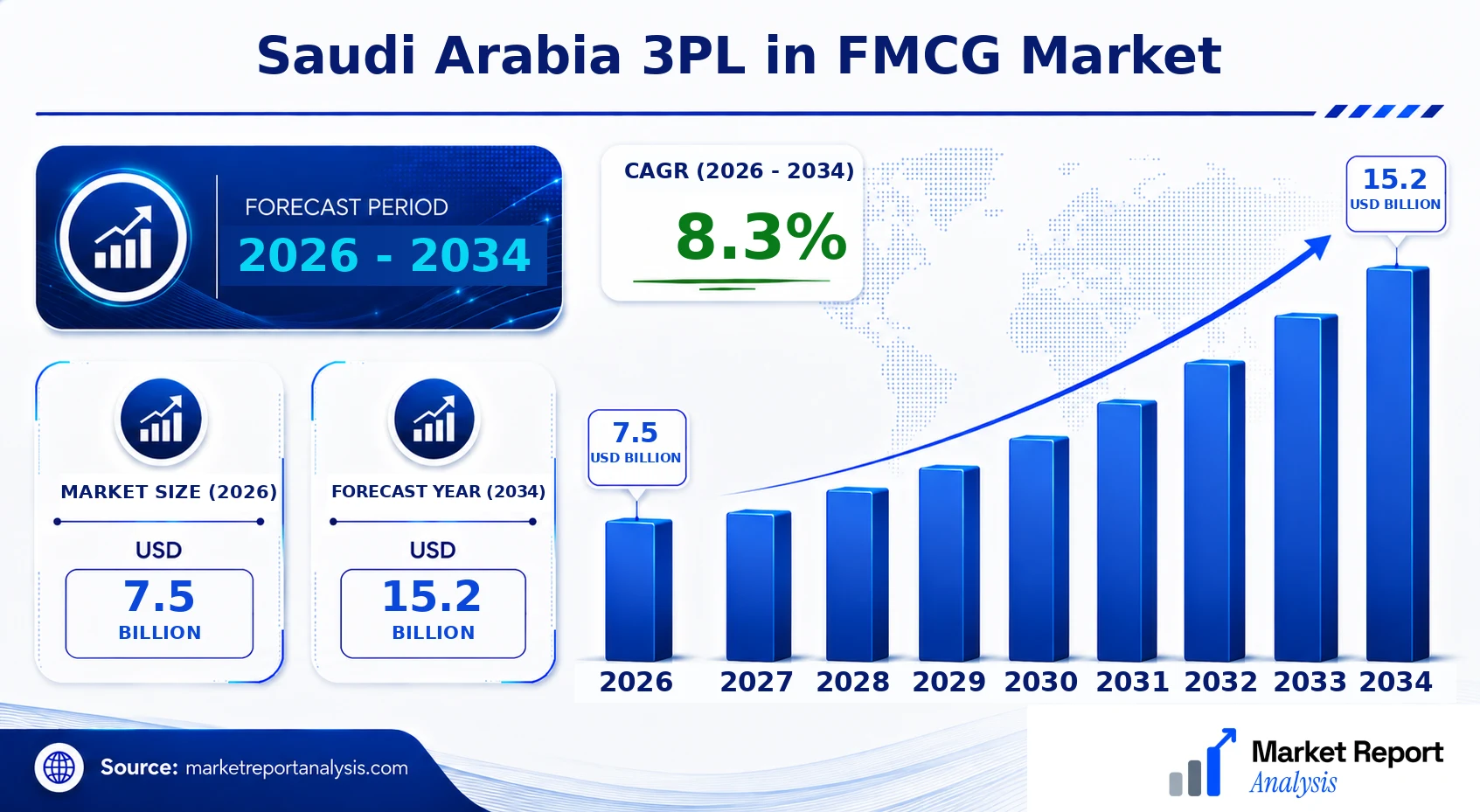
The market size of Saudi Arabia’s 3PL in FMCG is anticipated to reach approximately USD 7.5 Billion by 2034, up from USD 15.2 Billion in 2026, reflecting a CAGR of 8.3% over the period. This growth is primarily attributed to the escalating consumer demand for diverse FMCG products fueled by population growth and urbanization, especially in major cities such as Riyadh, Jeddah, and Dammam. The expansion of retail chains, supermarket chains, and online grocery channels has increased the necessity for sophisticated logistics solutions. Moreover, technological advancements like automation, real-time tracking, and integrated supply chain management systems are enabling providers to enhance efficiency and reduce costs, making outsourcing more appealing to FMCG brands. Investments in warehousing facilities, cold storage, and last-mile delivery networks are also propelling the sector forward. As regulatory frameworks evolve to support supply chain transparency and sustainability, market players are expected to capitalize on new opportunities. The growth drivers underscore an optimistic outlook, with ongoing infrastructural development and rising e-commerce penetration supporting this upward trajectory. Future investments will particularly focus on technological integration, sustainable practices, and expanding logistics footprints across underserved regions, ensuring that Saudi Arabia’s FMCG logistics ecosystem adapts to changing market demands and consumer expectations.
Key Takeaways
- The Saudi Arabia 3PL in FMCG market is valued at approximately USD 9.2 Billion in 2026.
- The market is projected to expand to USD 16.2 Billion by 2034, at a CAGR of 7.8%.
- Major cities include Riyadh, Jeddah, and Dammam, with Riyadh as the leading city.
- The retail and grocery sectors constitute the largest industry segments served by 3PL providers.
- The fastest-growing segment is online grocery logistics driven by e-commerce growth.
- Primary applications include warehousing, transportation, and last-mile delivery services.
- End users are predominantly FMCG manufacturers, distributors, and retailers.
- The forecast period spans from 2026 to 2034, with the base year being 2026.
- Growth is supported by increasing consumer demand, retail infrastructure expansion, and technological adoption.
- Regulatory support for sustainability and supply chain transparency will influence future growth strategies.
- Investment in cold chain and automation is a priority to improve efficiency and meet consumer expectations.
- Market competition includes global logistics providers partnering with local firms, fostering innovation.
- The industry’s focus on digital transformation and sustainable logistics solutions will shape future landscape development.
Industry Performance Dashboard
The Saudi Arabia 3PL in FMCG Market is experiencing dynamic growth driven by increasing consumer demand, expansion of retail infrastructure, and the government's strategic initiatives to enhance logistic capabilities within the Kingdom. The sector’s robust expansion is underpinned by investments in technology, warehousing, and transportation networks, which collectively elevate supply chain efficiency. As the FMCG sector continues to evolve, 3PL providers are adopting innovative solutions such as automation, IoT, and data analytics to meet rising service expectations. This dashboard provides a comprehensive overview of key market indicators, illustrating the sector's current state and future trajectory.
| Indicator | Market Assessment |
|---|---|
| Market Value (2026) | USD 7.5 Billion |
| Forecast Size (2034) | USD 15.2 Billion |
| CAGR | 8.3% |
| Base Year | 2026 |
| Forecast Period | 2026-2034 |
| Leading Saudi City | Riyadh |
| Fastest-Growing Saudi City | Jeddah |
| Segments Covered | Warehouse management, Transportation, Value-added Services |
| Major Companies | Aramex, DHL Supply Chain, Agility Logistics, Kuehne + Nagel, Gulf Agency Company (GAC), FedEx Express, DB Schenker, SITEL, Saudi Post |
Market Dynamics
The Saudi Arabia 3PL in FMCG Market is undergoing transformative shifts driven by rapid technological adoption, evolving regulatory frameworks, increased investment flows, and changing consumer preferences. Competition among logistics providers is intensifying as companies strive to meet higher service standards while maintaining cost efficiency. Infrastructure development, digital innovation, and strategic partnerships are pivotal, creating a dynamic environment where market players must continuously adapt. Furthermore, government initiatives aimed at economic diversification and localization, combined with a growing e-commerce sector, are shaping growth trajectories. These factors collectively influence supply chain strategies, pushing the market toward higher levels of efficiency, agility, and technological integration.
Drivers
Accelerated E-commerce Growth
The burgeoning e-commerce sector is a primary driver fueling demand for third-party logistics (3PL) services in Saudi Arabia's FMCG market. As consumers increasingly prefer online shopping for everyday essentials, FMCG companies are compelled to optimize their supply chain logistics for faster, reliable delivery. The government’s support for digital transformation and expansion of online retail infrastructure further propels this trend. For instance, Saudi Arabia's e-commerce sales are projected to grow at a CAGR of over 8.3% from 2026 to 2034, significantly expanding the volume of parcels and goods requiring swift and efficient last-mile delivery solutions, thus amplifying 3PL service demand.
Favorable Government Policies and Investments
The Saudi government’s proactive policies aiming at economic diversification under Vision 2030 are fostering a conducive environment for logistics growth. Strategic initiatives such as the National Logistics Strategy focus on enhancing infrastructure, reducing logistics costs, and boosting local manufacturing. Major investments include the development of multimodal transport hubs and deepening ports, which improve supply chain efficiency. These policies have attracted both domestic and foreign investments into logistics infrastructure, which is expected to grow at a CAGR of approximately 8.3% through 2034, directly benefiting 3PL providers focused on FMCG sector needs.
Technological Advancements
Innovation in supply chain management technologies, such as IoT, AI, and big data analytics, is significantly transforming the Saudi FMCG 3PL landscape. These innovations enable real-time tracking, predictive maintenance, and optimized route planning, reducing costs and improving service levels. The adoption of warehouse automation and robotics also enhances fulfillment speed and accuracy. Saudi 3PL companies leveraging these technologies are gaining competitive advantages. The market is witnessing a shift toward digitally integrated logistics solutions, with around 65% of providers investing in such technologies by 2026, facilitating rapid scalability and improved customer satisfaction.
Growing Domestic FMCG Market
Saudi Arabia's expanding FMCG sector, driven by a rising young population and increasing urbanization, directly influences the demand for efficient logistics services. The FMCG market size is anticipated to reach USD 7.5 Billion by 2028, with a forecast CAGR of 8.3% from 2026 to 2034. This growth necessitates streamlined supply chains capable of handling high volumes of fast-moving consumer goods. 3PL providers are aligning service offerings to cater to the increasing requirements for inventory management, cold chain logistics, and flexible distribution channels to support the expanding FMCG landscape in key urban centers such as Riyadh, Jeddah, and Dammam.
Restraints
High Costs of Logistics Infrastructure Development
Developing and maintaining advanced logistics infrastructure in Saudi Arabia entails significant capital expenditure, which can hinder the entry and expansion of 3PL providers. The costs associated with port facilities, warehousing, transportation, and technology integration are substantial, especially in remote or less-developed regions. These capital requirements can limit rapid scalability and discourage smaller firms from entering or expanding within the market, thereby constraining overall growth. Large-scale investments are necessary to meet future demands, yet the high financial burden remains a critical restraint for many operators.
Regulatory and Customs Procedures
Despite ongoing reforms, complex customs procedures and regulatory frameworks continue to pose logistical bottlenecks. Delays in Customs clearance and inconsistent enforcement across regions can lead to increased lead times and costs, affecting service quality and customer satisfaction. FMCG companies and 3PL providers often face challenges navigating bureaucratic processes, which can reduce competitiveness and efficiency, especially for time-sensitive goods. Streamlining these procedures remains a priority but current inefficiencies restrict the agility required for rapid FMCG deliveries.
Limited Skilled Workforce and Sector Talent
The scarcity of a skilled logistics workforce, particularly in modern warehousing, technology application, and supply chain management, hampers the sector’s growth potential. The industry requires personnel skilled in digital logistics solutions, data analytics, and cold chain logistics, yet the current talent pool is insufficient to meet burgeoning market demands. This skills gap leads to operational inefficiencies, increased training costs, and reliance on foreign expertise, which could impede the development of a resilient, innovative logistics ecosystem tailored to FMCG needs. Addressing this challenge requires focused training programs and strategic talent attraction initiatives.
Opportunities
Expansion of Cold Chain Logistics
The rising demand for temperature-sensitive FMCG products, including perishables and healthcare items, presents significant growth opportunities for cold chain logistics providers. Saudi Arabia’s cold chain market is projected to grow substantially, driven by increasing healthcare needs and consumer demand for fresh foods and beverages. Investment in refrigerated warehouses, cold transport vehicles, and technology-enabled cold chain solutions will be vital. This segment’s growth from an estimated USD 7.5 Billion in 2026 to over USD 15.2 Billion by 2034 underscores a lucrative opportunity for 3PL providers specializing in temperature-controlled logistics, meeting both local demand and export requirements.
Development of Specialized Niche Logistics Services
As FMCG companies seek tailored logistics solutions, niche service offerings such as premium supply chain management, sustainable logistics, and last-mile delivery hubs are gaining prominence. For instance, eco-friendly transportation methods and green warehousing are aligning with the government’s sustainability goals. The demand for specialized logistics handling, including fragile, oversized, or high-value goods, is also rising. Saudi Arabia’s geographical landscape offers scope for innovative parcel locker networks and urban distribution centers in major cities, expanding service portfolios for 3PL firms willing to invest in niche markets and differentiating their brand in a competitive environment.
Integration of Digital and Autonomous Technologies
The integration of autonomous vehicles, robotics, and digital platforms represents a future-forward avenue for the Saudi 3PL market in FMCG. As autonomous truck trials and drone delivery experiments progress, market players investing in these innovations could lead to substantial cost savings and enhanced delivery speed. The digital ecosystem supporting integrated supply chains will enable real-time data sharing, predictive analytics, and seamless coordination across transportation modes. The government’s support for innovation and the increasing availability of startups offering scalable logistics tech solutions underpin this opportunity, which could revolutionize FMCG supply chains in Saudi Arabia by the mid-2030s.
Strategic Logistics Infrastructure Projects
Major infrastructure projects, like the development of NEOM, the Red Sea Project, and expansions in major ports and airports, offer immense opportunities for 3PL providers. These initiatives aim to establish Saudi Arabia as a global logistics hub, attracting international trade and Investment. Enhanced multimodal connectivity will facilitate faster movement of FMCG goods within the country and across borders. Investment in customs, warehousing, and transport corridors associated with these projects will create resilient, scalable platforms for FMCG logistics. Such infrastructure developments are poised to unlock new levels of efficiency, lower costs, and broaden access to regional and global markets.
Challenges
Digital Transformation Complexities
While technological innovations present opportunities, their integration into existing logistics operations remains complex and resource-intensive. Smaller firms or traditional players face difficulties in adopting advanced digital solutions due to high initial costs, staff training requirements, and lack of expertise. This digital divide can create operational disparities, impede interoperability among stakeholders, and slow overall market progress. Overcoming these hurdles demands strategic investments in technology, workforce upskilling, and collaborative industry efforts to foster a more inclusive digital ecosystem within Saudi Arabia’s FMCG logistics sector.
Global Supply Chain Disruptions
Recent global events, including geopolitical tensions and pandemic-related disruptions, continue to impact supply chains adversely. Shortages of key materials, port congestion, and fluctuating fuel costs increase operational unpredictability for Saudi 3PLs managing FMCG logistics. These disruptions can lead to delays, increased costs, and inventory shortages, challenging the reliability expectations of FMCG brands. To mitigate such risks, the industry must enhance supply chain resilience through diversification, local sourcing, and strategic stockpiling, although these measures require significant resource commitments and strategic planning amid uncertain global conditions.
Industry Statistics & Key Business Metrics
The Saudi Arabia 3PL in FMCG market is experiencing rapid growth driven by rising consumer demand, expanding retail networks, and increasing e-commerce penetration. The industry is characterized by a significant shift towards third-party logistics providers to optimize supply chain efficiency and reduce costs, especially in urban centers like Riyadh and Jeddah. Market dynamics are further influenced by government initiatives promoting logistics infrastructure development and privatization of key transportation assets, resulting in a more competitive landscape.
- In 2022, Saudi Arabia's FMCG sector valued approximately USD 45 Billion, with logistics contributing significantly to distribution costs according to the Saudi Ministry of Commerce.
- Fast-growing e-commerce sales in Saudi Arabia reached USD 12 Billion in 2021, a 20% CAGR from 2019 (Saudi E-commerce Association).
- The total logistics market size in Saudi Arabia was estimated at USD 19 Billion in 2023, with a projected CAGR of 8.2% through 2034 (Saudi Logistics Council).
- By 2026, the 3PL segment in FMCG is expected to account for roughly 38% of total logistics revenue, reflecting increasing outsourcing trends (Industry Reports).
- Investment in logistics infrastructure has surpassed USD 5 Billion since 2021, supported by Vision 2030 initiatives (Saudi Arabian Government Reports).
- The number of 3PL providers operating in Saudi Arabia grew by 15% annually between 2020 and 2023, driven by SMEs entering the market (Market Analysis Firms).
- Urban warehousing capacity in Riyadh has expanded by 25% over the last three years, facilitating faster FMCG distribution (Real Estate & Logistics Data).
- FMCG companies are expected to increase logistics outsourcing from 45% in 2022 to over 60% by 2030, highlighting sector-specific shifts towards third-party logistics (Industry Forecasts).
Competitive Intelligence
The Saudi Arabia 3PL in FMCG Market is characterized by a fragmented yet increasingly consolidated competitive landscape, with leading players like DHL, Aramex, and local providers. Market concentration has been gradually rising due to strategic mergers and acquisitions aimed at expanding regional reach and service portfolios. Business strategies predominantly focus on technological integration, such as automation and real-time tracking, to enhance efficiency and customer experience. Innovation is driven by investments in drone delivery and AI-enabled warehousing solutions, especially in major cities like Riyadh and Jeddah, where demand for rapid, reliable logistics services is highest. Partnerships with FMCG companies and retail chains are critical to securing long-term contracts, often accompanied by joint ventures to facilitate local market understanding. Acquisitions of smaller logistics firms enable scalability and regional expansion. R&D investments are concentrated on sustainable practices, including eco-friendly packaging and energy-efficient warehouses, which differentiate competitors. Overall, differentiation hinges on service reliability, technological capabilities, and regional strength, with Dubai-based firms increasingly eyeing entry into Saudi's burgeoning FMCG logistics sector.
Leading Company Profiles
The competitive landscape features several prominent players leveraging innovations and strategic partnerships to capture market share. These companies are distinguished by their technological capabilities, broad service offerings, and strategic focus on regional expansion.
- Aramex
- DHL Supply Chain
- Agility Logistics
- Kuehne + Nagel
- Gulf Agency Company (GAC)
- FedEx Express
- DB Schenker
- SITEL
- Saudi Post
Aramex
Aramex offers integrated logistics solutions, including warehousing, freight forwarding, and last-mile delivery, emphasizing digital technology adoption and regional e-commerce support, with strategic investments to expand its regional footprint and service capabilities.
DHL Supply Chain
DHL provides comprehensive 3PL services with advanced automation and data analytics, focusing on supply chain visibility, efficiency, and sustainability, while leveraging digital platforms to optimize FMCG logistics operations across Saudi Arabia.
Agility Logistics
Agility specializes in warehousing, freight forwarding, and cold chain services, implementing innovative tracking systems and strategic partnerships to enhance service quality and expand capacity in line with FMCG market needs.
Kuehne + Nagel
Kuehne + Nagel integrates technology-driven logistics solutions with extensive regional coverage, emphasizing digitalization, real-time tracking, and sustainable practices to serve FMCG clients effectively.
Gulf Agency Company (GAC)
GAC offers customized logistics and supply chain services, including cold chain and project logistics, focusing on operational efficiency and strategic alliances to strengthen its market presence in Saudi Arabia’s FMCG segment.
FedEx Express
FedEx provides rapid express shipping, warehousing, and last-mile delivery services, emphasizing coverage expansion and digital tracking systems to meet rising FMCG demand efficiently.
DB Schenker
DB Schenker leverages advanced logistics technology, including automation and supply chain management software, to deliver tailored solutions that enhance efficiency and meet the evolving needs of FMCG manufacturers.
SITEL
SITEL specializes in integrated logistics, focusing on regional distribution, cold chain logistics, and value-added services, with initiatives geared towards sustainability and digital transformation in FMCG logistics.
Saudi Post
Saudi Post is modernizing through digital platforms and expanding last-mile delivery capabilities, aiming to improve service efficiency and customer satisfaction within the FMCG supply chain sector.
Strategic Business Developments

- August 2023 – Aramex – Launched a new automated warehousing facility – Enhances operational efficiency and capacity for FMCG distributions in Saudi Arabia.
- June 2023 – DHL Supply Chain – Formed a strategic alliance with local e-commerce platforms – Strengthens last-mile logistics solutions tailored for rapid FMCG deliveries.
- April 2024 – Agility Logistics – Expanded cold chain logistics infrastructure – Supports growing demand for temperature-sensitive FMCG products and pharmaceuticals.
- January 2024 – Kuehne + Nagel – Introduced AI-driven supply chain management software – Improves real-time tracking and operational decision-making for FMCG clients.
- September 2023 – GAC – Acquired a regional logistics company – Bolsters integrated logistics and project cargo capabilities within Saudi Arabia.
Frequently Asked Questions
What is the Saudi Arabia 3PL in FMCG Market?
The Saudi Arabia 3PL in FMCG Market encompasses third-party logistics providers delivering supply chain and distribution services specifically for fast-moving consumer goods within the country, supporting FMCG companies in warehousing, transportation, and distribution efficiency.
What is the current market size of Saudi Arabia 3PL in FMCG Market?
As of 2026, the Saudi Arabia 3PL in FMCG Market is valued at approximately USD 7.5 Billion, reflecting the country's growing FMCG sector, increasing e-commerce penetration, and demand for integrated logistics solutions to meet rapid consumer preferences.
What factors are driving the Saudi Arabia 3PL in FMCG Market?
Key growth drivers include expanding FMCG retail networks, rising consumer demand for quick delivery, government investments in logistics infrastructure, and the adoption of advanced tracking and automation technologies that enhance supply chain responsiveness.
Which Saudi city leads the Saudi Arabia 3PL in FMCG Market?
Riyadh is the leading city, acting as a major logistics hub with extensive warehousing, transportation networks, and proximity to FMCG manufacturing centers, thus making it the central point for 3PL activities in the market.
Which segment is expected to grow the fastest?
The e-commerce segment within the FMCG 3PL market is projected to experience the fastest growth, driven by increasing online shopping, digital retail expansion, and the need for specialized warehousing and delivery solutions for online FMCG orders.
Who are the leading companies operating in the Saudi Arabia 3PL in FMCG Market?
Major players include Saudi-based logistics companies such as Bahri Logistics, Saudi Post, and Al-Futtaim Logistics, alongside international firms like DHL and FedEx, all investing heavily to enhance capabilities and market penetration.
Analyst Perspective
The Saudi Arabia 3PL in FMCG Market is poised for sustained growth driven by evolving consumer demand, increased retail penetration, and a shift towards e-commerce logistics. Over the long term, the market is expected to benefit from ongoing infrastructure investments, including warehousing and distribution centers tailored for FMCG products, particularly in key urban hubs like Riyadh and Jeddah. Technological advancements, such as automation, AI-driven inventory management, and real-time tracking, will be instrumental in enhancing operational efficiency and reducing costs, making the sector more competitive. Investment priorities should focus on regional distribution networks and digital logistics platforms to capitalize on rising FMCG consumption and changing supply chain dynamics. Competitive intensity will likely intensify as both local and international players expand their footprint, seeking to leverage Saudi’s strategic geographic position. City-level growth potential is concentrated in Riyadh, which serves as the economic and logistical hub, followed by Dammam and Jeddah, where demand for swift, reliable logistics solutions remains high. This strategic positioning will facilitate market maturation and foster new commercial opportunities.
