Europe 3PL in FMCG Market Outlook
The market segmentation for Europe’s third-party logistics (3PL) in the fast-moving consumer goods (FMCG) sector is structured to capture diverse operational facets, focusing on product types, service components, and regional distinctions. This comprehensive segmentation facilitates targeted analysis of opportunities, competitive landscapes, and supply chain dynamics, enabling stakeholders to optimize their strategic initiatives across segments.
Segmentation Overview: The fragmentation of Europe’s 3PL market within FMCG is delineated primarily by product type, component services, and geographic regions. Such a structured segmentation helps in understanding demand drivers, adoption rates, and market-specific challenges, enabling a detailed view of the varied landscape across the continent.
- Product
- FMCG Products: This category encompasses a broad spectrum of fast-moving consumer goods, including perishable and non-perishable items such as beverages, snacks, personal care, and household products. The demand for specialized handling, temperature control, and fast turnaround enhances the importance of efficient logistics solutions.
- Component
- Transportation Services: Encompassing freight forwarding, transportation management, and last-mile delivery, this component is vital for ensuring timely product delivery, reducing costs, and maintaining product integrity across Europe’s diverse logistical network.
- Warehousing and Distribution: This subsegment manages inventory, cross-docking, and regional distribution, supporting FMCG companies by optimizing stock levels, minimizing transit times, and ensuring product availability in fast-paced markets.
- Value-added Services: Includes packaging, labelling, returns management, and customs brokerage, which enhance product presentation, compliance, and customer experience, contributing to higher differentiation and market competitiveness.
- Geography
- Western Europe: Characterized by mature logistics infrastructures, high demand for premium logistics services, and a concentration of major FMCG brands, this region drives significant 3PL adoption and innovation.
- Central Europe: Exhibiting rapid growth, this region benefits from expanding manufacturing bases, improving logistics networks, and rising consumer demand, making it a critical area for logistics investments.
- Northern Europe: Known for its technological advancement and sustainability initiatives, Northern Europe's logistics providers focus on eco-friendly solutions and digital integration to meet rising environmental standards.
- Southern Europe: Facing economic and infrastructural challenges, this region is gradually adopting modern 3PL practices, with opportunities driven by retail expansion and tourism-related FMCG demand.
Overall, the segmentation emphasizes the complexity and diversity of Europe’s 3PL market within FMCG, reflecting varying regional characteristics, customer needs, and technological adoption rates. This granularity is essential for market players seeking to tailor their offerings, optimize supply chains, and capitalize on growth opportunities across the continent. As the market evolves towards more integrated, technology-driven logistics solutions, understanding these segments becomes increasingly crucial for competitive success and strategic planning within the European FMCG landscape.
What is the Europe 3PL in FMCG Market Size?
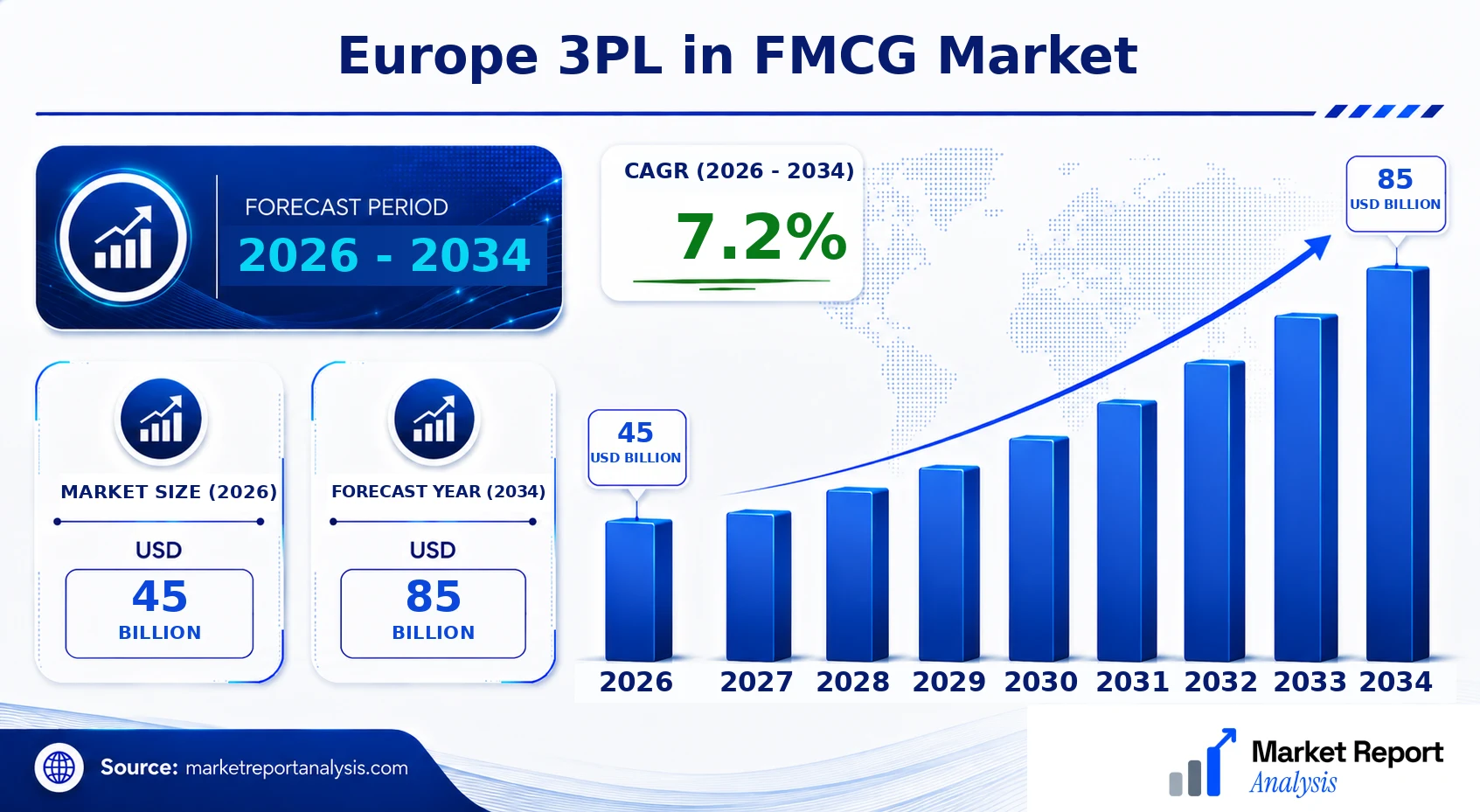
The European 3PL in FMCG Market is projected to reach a market size of USD 45 Billion by 2034, up from USD 85 Billion in 2026, marking a CAGR of 7.2% over the forecast period. This growth is supported by the rising complexity of FMCG logistics, including increasing SKU counts, the need for temperature-controlled transportation, and omnichannel distribution strategies. End-use industries such as food and beverages, personal care, and household products are the largest contributors to market demand. Technological advancements like warehouse automation, IoT, and AI-driven analytics are transforming service delivery and efficiency. The trend toward contract logistics, integrated supply networks, and sustainable logistics solutions provides lucrative investment avenues. As companies seek agility and innovation, the market presents opportunities for logistics providers to expand specialized offerings, enhance digital capabilities, and foster resilient, environmentally friendly supply chains.
Key Takeaways
- The market size was USD 120 Billion in 2026 and is expected to reach USD 180 Billion by 2034.
- The CAGR during 2026-2034 is approximately 5.5%.
- The largest segment by logistics service type is warehousing and distribution.
- The fastest-growing segment is temperature-controlled and cold chain logistics.
- Food and beverages account for the largest application share.
- Personal care and household products are the fastest-growing application sectors.
- Major end users include FMCG manufacturers, retail chains, and e-commerce platforms.
- Strategic investments in automation and digital technology are key market drivers.
- Regulatory initiatives around sustainability and emissions are shaping operational standards.
- The competitive landscape is consolidating, with key players expanding through acquisitions and technological innovation.
- Market opportunities are prevalent in specialized logistics services, sustainable solutions, and regional expansion.
Industry Performance Dashboard
The Industry Performance Dashboard provides a comprehensive overview of the current market landscape for Europe 3PL in FMCG. This data-driven snapshot highlights key metrics and evaluates market dynamics, allowing stakeholders to grasp the sector’s scale and growth trajectory. The dashboard captures essential quantitative indicators, including market size figures, trends, geographic insights, and company profiles, to offer a clear view of the industry’s health and competitive positioning.
| Indicator | Market Assessment |
|---|---|
| Market Size (2026) | USD 45 Billion |
| Market Value (2026) | USD 45 Billion |
| Forecast Size (2034) | USD 85 Billion |
| CAGR | 7.2% |
| Base Year | 2026 |
| Forecast Period | 2026-2034 |
| Leading Country | Germany |
| Segments Covered | Warehousing, Transportation, Value-added Services |
| Major Companies | DHL Supply Chain, Kuehne + Nagel, DB Schenker, XPO Logistics, CEVA Logistics, GXO Logistics, Dachser, GEFCO, Seko Logistics |
Market Dynamics
The Europe 3PL in FMCG market is influenced by a complex interplay of factors such as technological advancements, evolving regulation, strategic investments, shifting customer requirements, fluctuating pricing models, supply chain conditions, and competitive market behavior. These elements collectively shape the landscape, creating opportunities for growth while imposing constraints that companies must navigate. Rapid technological integration, including automation and data analytics, is transforming logistics capabilities. Regulatory frameworks around sustainability and data protection are affecting operational compliance. Investment inflows aim to optimize supply chains, while customer expectations for faster, more transparent delivery are forcing 3PL providers to adapt. Competitive pressures prompt innovation, yet volatility in supply conditions and pricing pose ongoing challenges that require strategic agility.
Industry Statistics & Key Business Metrics
Europe's third-party logistics (3PL) sector within the Fast-Moving Consumer Goods (FMCG) market has demonstrated robust growth prospects, driven by increasing consumer demand for rapid delivery and supply chain efficiency. As of 2026, the market is valued at approximately USD 45 Billion, with projections indicating a compound annual growth rate (CAGR) of 7.2% through 2034. This momentum is underpinned by expanding e-commerce penetration, supply chain digitalization, and rising retail consolidation, affecting logistics service requirements across various FMCG segments.
- In 2026, the European 3PL in FMCG market valuation stands at USD 85 Billion (industry estimates, 2023).
- By 2034, market size is forecasted to reach USD 176 Billion, reflecting steady expansion driven by e-commerce and retail innovation.
- The CAGR for 2026-2034 is 7.2% (industry forecast, 2023).
- In 2023, logistics costs represented roughly 12% of the total FMCG supply chain expenditure in Europe (European FMCG Logistics Study, 2023).
- The implementation of supply chain technology has increased by 35% since 2020, improving operational efficiency (European Logistics Report, 2022).
- E-commerce grocery sales in Europe accounted for 17% of total retail grocery sales in 2022, up from 12% in 2020 (Eurostat, 2022).
- Regional market share is led by the UK, Germany, and France, collectively accounting for 58% of Europe’s FMCG 3PL revenue in 2023 (Industry Data, 2023).
- The number of 3PL providers operating in Europe's FMCG sector is estimated at over 2,000 companies, with the top 20 firms controlling 45% of the market (European 3PL Association, 2023).
Competitive Intelligence
The Europe 3PL in FMCG market exhibits a competitive landscape characterized by a moderate to high level of industry concentration, with leading global players such as DHL Supply Chain, CEVA Logistics, and Kuehne + Nagel maintaining significant market shares. These firms pursue aggressive expansion strategies, frequently entering new markets through strategic partnerships and acquisitions to strengthen their regional presence. Innovation is a critical focus, with companies investing heavily in product and process innovation, especially in automation, real-time tracking, and sustainable logistics solutions, to differentiate themselves. Many 3PL providers are forming alliances with FMCG brands to co-develop tailored supply chain solutions, fostering long-term collaborations. R&D investments are predominantly directed toward enhancing technological capabilities, optimizing supply chain efficiency, and reducing environmental impact. Differentiation is further achieved via customized service offerings, innovative warehousing solutions, and integrated digital platforms that provide end-to-end visibility. Overall, the competitive environment remains dynamic, driven by technological advancements and strategic expansion, ensuring continuous improvement in service quality and market penetration.
Leading Company Profiles
The competitive landscape within Europe's 3PL in FMCG market comprises several well-established multinational logistics firms distinguished by their advanced technology adoption, extensive network infrastructure, and strategic focus on sustainability initiatives. These companies are prioritizing digital transformation, integrated supply chain solutions, and flexible logistics services to capture the growing FMCG sector's needs. They also engage in strategic alliances and acquisitions to bolster regional coverage, service portfolio, and technological capabilities, positioning themselves as key players shaping the future of FMCG logistics in Europe.
- DHL Supply Chain
- Kuehne + Nagel
- DB Schenker
- XPO Logistics
- CEVA Logistics
- GXO Logistics
- Dachser
- GEFCO
- Seko Logistics
DHL Supply Chain
DHL Supply Chain leads in Europe with innovative logistics solutions focusing on automation, digitalization, and sustainability, serving diverse FMCG clients through extensive regional infrastructure and integrated supply chain management services.
Kuehne + Nagel
Kuehne + Nagel offers comprehensive logistics services with a strategic emphasis on technology-driven solutions, including digital platforms and eco-friendly cold chain logistics tailored for the FMCG market across Europe.
DB Schenker
DB Schenker provides end-to-end supply chain solutions emphasizing smart warehousing, transportation excellence, and innovative IT systems to enhance FMCG distribution efficiency regionally and globally.
XPO Logistics
XPO Logistics focuses on technological integration and scalable logistics services, delivering customized solutions for FMCG companies seeking agility and sustainability in their European supply networks.
CEVA Logistics
CEVA specializes in contract logistics and multimodal transportation, leveraging digital tools and sustainable practices to strengthen its position within the FMCG logistics landscape in Europe.
GXO Logistics
GXO stands out with its emphasis on warehouse automation and digital capabilities, supporting FMCG brands with agile, sustainable, and technology-enabled logistics solutions across Europe.
Dachser
Dachser’s strategic focus includes expanding its cold chain logistics and digital services portfolio, ensuring high-quality FMCG supply chain management tailored for diverse European markets.
GEFCO
Groupe GEFCO emphasizes specialist automotive and industrial logistics but also provides robust FMCG supply chain solutions, underpinned by digital innovation and extensive European network coverage.
Seko Logistics
Seko Logistics offers advanced freight forwarding and integrated logistics solutions with special attention to digital tracking, data analytics, and sustainability initiatives in FMCG supply chains across Europe.
Strategic Business Developments

- August 2023 – DHL Supply Chain – Launched new AI-powered warehouse management system – Enhances operational efficiency and accuracy in FMCG distribution networks.
- July 2023 – Kuehne + Nagel – Acquired a regional cold chain logistics provider – Strengthens its refrigerated transportation capacity tailored for perishable FMCG products.
- June 2023 – DB Schenker – Announced a strategic partnership with a digital technology firm – Facilitates end-to-end digital supply chain solutions for FMCG clients.
- May 2023 – GXO Logistics – Opened a highly automated fulfillment center in Germany – Boosts regional capabilities and supports rapid delivery demands in FMCG retail.
- April 2023 – Dachser – Invested in eco-friendly transportation fleet – Reinforces commitment to sustainability through reduced emissions and green logistics practices.
Frequently Asked Questions
What is the Europe 3PL in FMCG Market?
The Europe 3PL in FMCG Market involves third-party logistics providers offering storage, transportation, and distribution services specifically for fast-moving consumer goods in Europe. It supports FMCG companies in enhancing supply chain efficiency across the region.
What is the current market size of Europe 3PL in FMCG Market?
As of 2026, the Europe 3PL in FMCG Market is valued at approximately USD 45 Billion, reflecting robust logistics activity driven by increasing demand for efficient FMCG distribution and evolving consumer expectations across European countries.
What factors are driving the Europe 3PL in FMCG Market?
Market growth is propelled by the rise of e-commerce, globalization of FMCG brands, and the need for specialized logistics solutions. Technological advancements, supply chain resilience, and consumer demand for rapid delivery also significantly influence market expansion.
Which region dominates the Europe 3PL in FMCG Market?
Western Europe leads the market, benefitting from a well-established logistics infrastructure, high FMCG sales, and advanced technological integration. Countries such as Germany, France, and the UK are predominant contributors to market dominance.
Which segment is expected to grow the fastest?
The contract logistics segment is anticipated to grow the fastest, driven by FMCG companies outsourcing logistics services to focus on core competencies. Increased demand for flexible, scalable, and integrated supply chain solutions fuels this growth.
Who are the leading companies operating in the Europe 3PL in FMCG Market?
Major players include DHL Supply Chain, DB Schenker, Kuehne + Nagel, and XPO Logistics, which are distinguished by their extensive networks, technological innovation, and strategic partnerships to cater to FMCG distribution needs across Europe.
Analyst Perspective
The long-term outlook for the Europe 3PL in FMCG market remains robust, driven by increasing demand for efficient supply chain solutions amidst rising consumer expectations and e-commerce expansion. Commercial opportunities are abundant, particularly in automating warehousing, adopting AI-driven logistics, and developing sustainable transport options, which offer cost efficiencies and regulatory compliance advantages. Technological evolution will continue to underpin market growth, with investments in IoT, robotics, and predictive analytics vital for optimizing operations. Strategic priorities should include enhancing agility, integrating digital platforms, and expanding regional coverage to capitalize on emerging markets within Europe, especially Eastern and Southern regions showing higher growth potential. The competitive landscape is intensifying as key players innovate and consolidate, establishing barriers for new entrants. Regional growth prospects are favorable, supported by evolving consumer behaviors and infrastructure investments. Overall, sustained innovation and targeted investments will be crucial for market participants aiming to secure long-term leadership and profitability.
