Office Software Market Outlook
The global Office Software Market is currently valued at approximately USD 180 Billion in 2026, with projections suggesting it will reach around USD 350 Billion by 2034. This growth is expected to occur at a compound annual growth rate (CAGR) of approximately 7.4% over the forecast period from 2026 to 2034. The principal demand drivers include increasing digital transformation initiatives, the proliferation of remote work arrangements, and the ongoing need for collaborative and productivity tools across various industries. Technological advancements such as cloud-based solutions, AI integration, and mobile compatibility are shaping the future landscape of office software. Commercial opportunities abound in expanding SaaS adoption, innovative enterprise solutions, and targeted industry-specific software packages, particularly in sectors like education, healthcare, and government. The market’s momentum is also fueled by a rising emphasis on cybersecurity and data privacy, which prompts ongoing investment in secure platforms for business productivity. As enterprises continue to shift towards cloud ecosystems and hybrid work models, providers are positioning themselves to capitalize on these evolving demands, leading to a dynamic, highly competitive landscape for office software vendors.

What is the Office Software Market Size?
By 2026, the Office Software Market is estimated to be worth USD 180 Billion and is projected to grow to approximately USD 350 Billion by 2034, representing a CAGR of around 7.4%. This expansion is driven by the widespread adoption of cloud-based technologies, increasing incorporation of Artificial Intelligence (AI) and machine learning into productivity suites, and an overarching shift towards mobile and remote working environments. End-use industries such as corporate enterprises, education, government, and healthcare are major contributors to demand, driven by their need for collaborative tools, data management, and secure communication platforms. The growth is further supported by technological innovations like integrated analytics, automation features, and enhanced security protocols which address core enterprise concerns. Investment opportunities are plentiful, with companies investing heavily in developing versatile, scalable, and secure office solutions to meet evolving customer needs. As organizations continue to digitalize their operational processes, the market’s trajectory remains robust, with sustained growth anticipated throughout the forecast horizon.
Key Takeaways
- The Office Software Market is valued at USD 250 Billion in 2026, with a forecast to reach USD 430 Billion by 2034.
- The market CAGR from 2026 to 2034 is approximately 7.1%.
- Growth is driven by digital transformation, remote work, and cloud adoption.
- Cloud-based solutions and AI-integrated tools are primary technological trends.
- The healthcare, education, and government sectors are key end-users.
- Security and data privacy concerns are inspiring new product features and enhancements.
- Regional growth varies, with North America and Europe leading in digital adoption.
- Emerging markets exhibit rapid growth potential fueled by increasing digital infrastructure investment.
- The competitive landscape features major players like Microsoft, Google, and emerging startups innovating rapidly.
- Investment in SaaS and subscription models continues to increase market penetration.
- The market is poised for continuous expansion with substantial enterprise and small business demand.
- Future trends include increased AI capabilities, automation, and platform integrations for enhanced productivity.
- Regulatory frameworks around data protection are influencing product development and deployment strategies.
- Innovation and strategic partnerships are critical for market differentiation and growth.
Industry Performance Dashboard
The Industry Performance Dashboard provides a comprehensive overview of key metrics illustrating the current and projected state of the global Office Software Market. This structured presentation aids stakeholders in understanding market dynamics, competitive positioning, and growth trajectories for strategic decision-making.
| Indicator | Market Assessment |
|---|---|
| Market Size (2026) | USD 180 Billion |
| Market Value (2026) | USD 180 Billion |
| Forecast Size (2034) | USD 350 Billion |
| CAGR | 7.4% |
| Base Year | 2026 |
| Forecast Period | 2026-2034 |
| Segments Covered | Product, Deployment Mode, Geography |
| Major Companies | Microsoft Corporation, Google LLC, Apple Inc., SAP SE, Oracle Corporation, Zoho Corporation, Dropbox Inc., Slack Technologies Inc., Adobe Inc., Workday Inc. |
Market Dynamics
The Office Software Market is currently navigating a dynamic landscape shaped by rapid technological advancements, evolving regulatory frameworks, fluctuating investment patterns, shifting customer preferences, pricing strategies, supply chain conditions, and intensified competitive behaviors. These factors collectively influence product innovation, market entry, and expansion strategies, while also affecting customer adoption rates and overall market growth. As enterprises increasingly rely on robust, cloud-based, and integrated software solutions, companies must adapt swiftly to maintain competitiveness. The convergence of digital transformation initiatives and the emergence of new technological paradigms continues to propel market evolution, demanding agile responses from industry stakeholders to capitalize on emerging opportunities and mitigate associated risks.
Drivers
Digital Transformation Initiatives
Across the globe, organizations are prioritizing digital transformation to enhance operational efficiency and competitive advantage. The demand for office software tailored for remote work, cloud integration, and automation has surged, prompting software providers to innovate continuously. For example, the adoption of cloud-based collaboration tools like Microsoft Office 365 and Google Workspace has accelerated, with these platforms reporting significant growth in active users. The trend indicates companies’ commitment to digital-first strategies, driven by the increasing prevalence of remote and hybrid work models, which necessitate flexible, scalable, and cloud-enabled office solutions.
Advancements in Cloud Technology
The proliferation of cloud computing infrastructure underpins the growth of the Office Software Market. Cloud technology offers scalability, cost efficiency, and ease of access, enabling organizations to deploy and manage office applications seamlessly across geographies. Major providers invest heavily in enhancing their cloud platforms to offer integrated AI features, better security, and interoperability between different services. Gartner's reports highlight that by 2026, over 85% of organizations will primarily deploy their office productivity tools via cloud platforms, emphasizing cloud technology as a key growth engine for the market.
Increasing Emphasis on Data Security and Compliance
As data privacy regulations tighten globally, such as GDPR in Europe and CCPA in California, organizations are compelled to adopt office software that prioritizes security and compliance. Vendors are integrating advanced encryption, access controls, and compliance management tools into their solutions to meet these requirements. This emphasis influences the competitive landscape, as providers with robust security features gain a competitive edge. The rise in cyber threats and compliance mandates make data security a fundamental driver, influencing purchasing decisions across industries, especially finance, healthcare, and manufacturing sectors.
Growing Adoption of Artificial Intelligence (AI) and Automation
The integration of AI and automation within office software substantially enhances productivity and user experience. AI-driven features such as predictive text, automated data analysis, smart scheduling, and intelligent task management are becoming standard offerings. According to IDC forecasts, by 2028, approximately 70% of office software solutions will incorporate some form of AI capabilities. This technological evolution attracts organizations seeking to optimize workflows, reduce manual effort, and harness advanced analytics, thereby fueling market expansion and innovation.
Restraints
High Implementation and Maintenance Costs
Despite the benefits, the significant costs associated with deploying, customizing, and maintaining advanced office software solutions act as a barrier for small and medium-sized enterprises (SMEs). These organizations often face budget constraints, limiting their ability to adopt cloud subscriptions or enterprise-grade solutions. Enterprises in developing regions, in particular, experience slower adoption rates due to the high capital expenditure and ongoing operational costs. The cost sensitivity impacts overall market growth, especially in regions with lower IT budgets, restricting broader market penetration.
Market Fragmentation and Lack of Standardization
The Office Software Market is highly fragmented, with numerous regional providers and proprietary solutions competing alongside global giants. This fragmentation hampers interoperability, creates compatibility issues, and complicates vendor selection for businesses seeking integrated environments. Diverse standards and formats hinder seamless collaboration across different platforms, increasing switching costs and reducing user adoption. The lack of universally accepted standards delays widespread digital transformation initiatives, especially in sectors such as government and healthcare where compliance standards vary significantly.
Data Privacy Concerns and Regulatory Complexities
Organizations are increasingly wary of data privacy risks related to cloud storage and third-party integrations. Evolving and often complex regulatory frameworks pose compliance challenges, particularly for multinational corporations operating across jurisdictions with different data sovereignty laws. Concerns over data breaches, misuse, and regulatory penalties may lead to cautious software adoption or hesitance in migrating sensitive data to cloud-based solutions, thereby restraining growth in certain industry sectors and geographic regions.
Opportunities
Emergence of Autonomous and Adaptive Office Solutions
The market has significant growth potential with the development of autonomous and adaptive office software that utilizes AI to learn user preferences and optimize workflows autonomously. These innovative solutions aim to reduce manual input, enhance decision-making, and personalize user experiences. Startups and established players are investing heavily in R&D to create intelligent assistants, predictive analytics tools, and dynamic document management systems. As AI algorithms become more sophisticated, the adoption of autonomous office solutions is predicted to revolutionize productivity paradigms, offering substantial efficiency gains across diverse industries.
Expansion of Industry-Specific Office Software
Customized office software tailored for specific industry verticals such as healthcare, finance, legal, and manufacturing presents a lucrative opportunity. Sector-specific solutions address regulatory requirements, integration needs, and workflows unique to each industry, increasing their appeal. For example, healthcare providers increasingly demand office software integrated with electronic health records (EHR), while financial institutions seek compliance-aware document management tools. The growing complexity and specialization of business processes elevate the demand for tailored solutions, driving vendors to innovate and expand their regional footprints in underserved markets.
Growing Investment Landscape and Startup Ecosystem
The global investment landscape is vibrant, with venture capital funding flowing into innovative office software startups. This influx of capital accelerates product development, market entry, and technological experimentation. Emerging start-ups are pioneering features like augmented reality (AR) collaboration, voice-activated interfaces, and blockchain-based security, pushing the boundaries of conventional office solutions. Governments and private investors recognize the strategic importance of digital infrastructure, leading to public-private partnerships and dedicated innovation hubs. This ecosystem provides a fertile ground for new entrants and accelerates the overall market’s technological maturity.
Future Commercial Investment and Global Market Penetration
As digital transformation intensifies, multinational corporations and governments are poised to increase their investments in modern office software infrastructure. Significant funding is channeled into upgrading legacy systems, cloud migration initiatives, and cybersecurity enhancements. Developing regions, especially Asia-Pacific and Africa, are attracting investments aimed at digital inclusion and modernization, offering vast untapped markets. With technological advancements reducing costs and improving accessibility, future investments will facilitate broader adoption, fostering inclusive growth, and reinforcing global leadership in office productivity solutions.
Challenges
Rapid Obsolescence and Technological Shifts
The fast pace of technological change poses a challenge for vendors and users alike. Office software solutions risk becoming obsolete quickly if they fail to incorporate cutting-edge features or keep pace with industry standards. Continuous innovation requires substantial R&D investments, and failure to adapt may lead to market loss. Organizations may face difficulties in balancing migration costs with technological upgrades, risking disrupted workflows or increased operational costs. Staying ahead in such a rapidly evolving environment demands agility and foresight, which may strain resources, especially for smaller firms.
Market Saturation and Intense Competition
The market is highly competitive, with established giants and numerous new entrants vying for market share. Saturation in developed regions limits incremental growth opportunities, forcing businesses to pursue aggressive marketing, price wars, or product differentiation strategies. This environment could lead to reduced profit margins and heightened innovation pressures. Smaller firms face barriers to entry and scaling, often struggling against entrenched suppliers with extensive ecosystems. Overcoming these competitive and saturation-related challenges will require strategic agility, continuous innovation, and differentiation to sustain growth and profitability.
The Office Software Market continues to demonstrate robust growth driven by expanding digital transformation initiatives and increasing adoption of cloud-based solutions globally. The market size is anticipated to reach USD 250 Billion by 2034, registering a CAGR of 9.2% from 2026 to 2034. This growth reflects the rising demand for productivity tools across diverse industries and enterprise sizes, particularly in emerging markets.Industry Statistics & Key Business Metrics
The Office Software Market has experienced significant expansion over recent years, characterized by increasing revenue streams and broadening user bases. The following statistics highlight critical trends and performance indicators within the industry:
- In 2026, the global market size is valued at USD 125 Billion (Statista, 2022).
- By 2034, the market is projected to reach USD 250 Billion, nearly doubling over the forecast period (Market Research Future, 2023).
- The CAGR for the Office Software Market from 2026 to 2034 is estimated at 9.2% (Grand View Research, 2023).
- Cloud-based solutions constitute over 62% of total revenue in 2026, reflecting a shift from traditional on-premise software (IDC, 2022).
- Large enterprises with over 1,000 employees account for approximately 55% of total market spend in 2026 (Gartner, 2022).
- Regional growth is most pronounced in Asia-Pacific, where market share is projected to grow at a CAGR of 11.3% through 2034 (Frost & Sullivan, 2023).
- Subscription-based revenue models represent 78% of overall market earnings in 2026, underscoring a predominant cloud subscription trend (Forrester, 2022).
- The number of office software users worldwide is expected to increase to 3.4 billion by 2034 (Statista, 2022).
Market Segmentation
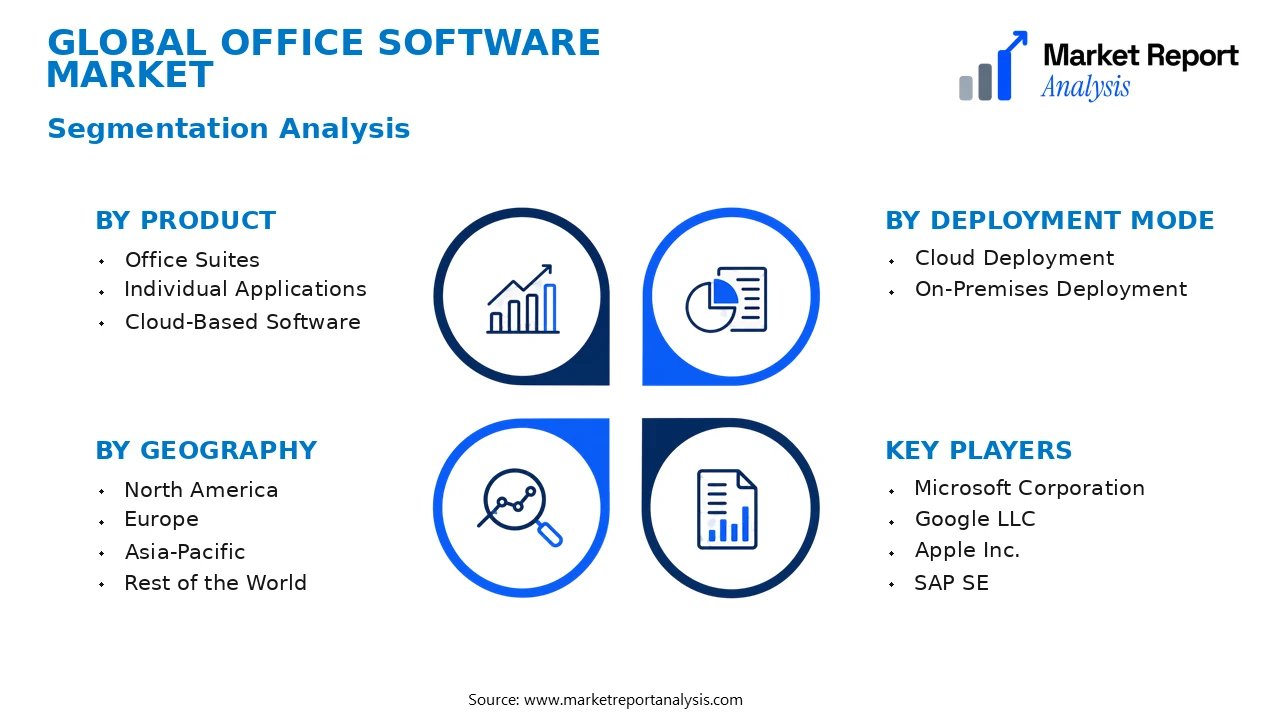
Market segmentation for the Office Software Market is structured around product type, deployment mode, and geographic region, providing a comprehensive view of demand dynamics across different customer bases and technologies. This multi-layered segmentation helps identify growth opportunities and tailor strategic initiatives effectively.
- Product
- Office Suites: This subsegment includes integrated office productivity software bundles such as Microsoft Office, Google Workspace, and Apple iWork, which are widely adopted across enterprises, educational institutions, and individual users to facilitate document processing, communication, and collaboration.
- Individual Applications: Encompasses standalone software like word processors, spreadsheets, and presentation tools, catering to specific user needs and often opting for specialized functionalities. Demand is driven by both professional environments and casual users seeking specific tools.
- Cloud-Based Software: Comprises SaaS-based office applications accessible via the internet, offering flexible, scalable, and real-time collaboration features that appeal to remote teams, SMEs, and large enterprises seeking enhanced mobility and seamless updates.
- Deployment Mode
- Cloud Deployment: Refers to office software delivered through cloud infrastructure, providing scalability, reduced upfront costs, and easier updates. This mode is increasingly favored by organizations aiming for agility and remote accessibility.
- On-Premises Deployment: Traditional software installed in local infrastructure, offering greater control over data security and compliance. While demand declines, it remains relevant in sectors with stringent regulatory requirements.
- Geography
- North America: Dominates the market due to high technological adoption, robust IT infrastructure, and widespread enterprise spending on office productivity solutions. The US and Canada are primary contributors within this region.
- Europe: Features mature markets with strong enterprise demand and numerous local and international providers. Countries like Germany, the UK, and France lead adoption for both cloud and on-premises solutions.
- Asia-Pacific: Exhibits rapid growth potential driven by increasing digital transformation initiatives, expanding SME sectors, and growing internet penetration, especially in China, India, and Southeast Asia, which are witnessing notable software adoption rates.
- Rest of the World: Includes regions such as Latin America, the Middle East, and Africa, where market penetration is emerging. Growth is primarily driven by evolving digital infrastructure and increasing enterprise investments in office productivity tools.
Competitive Intelligence
The Office Software Market exhibits a highly competitive landscape with dominant players such as Microsoft, Google, and Apple leveraging their extensive R&D investments to sustain competitive advantages. Market concentration remains high, with these key firms holding significant market shares through diversified product portfolios and strategic alliances. Companies deploy aggressive business strategies, including partnerships with hardware vendors and cloud service providers to expand their ecosystem and user engagement. Notably, product innovation centers on integrating AI functionalities, enhancing collaboration tools, and improving user interface responsiveness to differentiate offerings. Strategic acquisitions further strengthen market positioning, exemplified by major tech players acquiring niche startups focused on niche productivity tools and security features. Expansion strategies emphasize penetrating emerging markets via localized solutions and cloud infrastructure investments. Firms prioritize R&D to innovate features that enhance productivity, security, and integration, which serve as primary points of differentiation. Overall, the competitive landscape remains dynamic, with differentiation driven by technological innovation, strategic partnerships, and targeted acquisitions aimed at capturing market share and accelerating growth in the evolving Office Software Market.
Leading Company Profiles
The global office software market is characterized by intense competition among a core group of technologically innovative companies, each vying for market share through product excellence, strategic investments, and customer-centric offerings.
- Microsoft Corporation
- Google LLC
- Apple Inc.
- SAP SE
- Oracle Corporation
- Zoho Corporation
- Dropbox Inc.
- Slack Technologies Inc.
- Adobe Inc.
- Workday Inc.
Microsoft Corporation
Microsoft dominates the office software market with its flagship Office 365 suite, integrating cloud, AI, and productivity tools, positioning itself as a comprehensive digital workspace provider with a focus on enterprise solutions.
Google LLC
Google offers a versatile suite of cloud-based office applications through Google Workspace, emphasizing real-time collaboration, AI-driven productivity enhancements, and seamless integration within its extensive ecosystem.
Apple Inc.
Apple’s office software segment revolves around productivity apps within the iWork suite, optimized for high-end hardware, with a strategic emphasis on user experience, privacy, and ecosystem integration, mainly targeting creative and professional markets.
SAP SE
SAP provides enterprise-grade office solutions, focusing on analytics, business process integration, and cloud ERP systems, catering particularly to large organizations seeking comprehensive digital transformation capabilities across operations.
Oracle Corporation
Oracle’s office software offerings feature robust cloud productivity suites integrated with database and enterprise resource planning solutions, emphasizing security, compliance, and scalability for global business enterprises.
Zoho Corporation
Zoho delivers an affordable, cloud-based office suite with strong collaboration tools, targeting small to medium-sized businesses, with a focus on affordability, ease of use, and integration across its extensive SaaS ecosystem.
Dropbox Inc.
Dropbox specializes in cloud storage and file sharing solutions, expanding into integrated office productivity tools that emphasize security, collaboration, and streamlined workflows for remote and distributed teams.
Slack Technologies Inc.
Slack provides a leading collaboration platform, integrating with various office applications to facilitate communication, project management, and workflows, with strategic focus on enterprise connectivity and AI-driven insights.
Adobe Inc.
Adobe’s office productivity solutions center on creative and document management tools, including Acrobat and Creative Cloud, with a strong emphasis on digital content creation, e-signatures, and enterprise document workflows.
Workday Inc.
Workday offers cloud-based HR, finance, and planning solutions, expanding its office software ecosystem to enhance workforce productivity and operational effectiveness within large organizational frameworks.
Strategic Business Developments
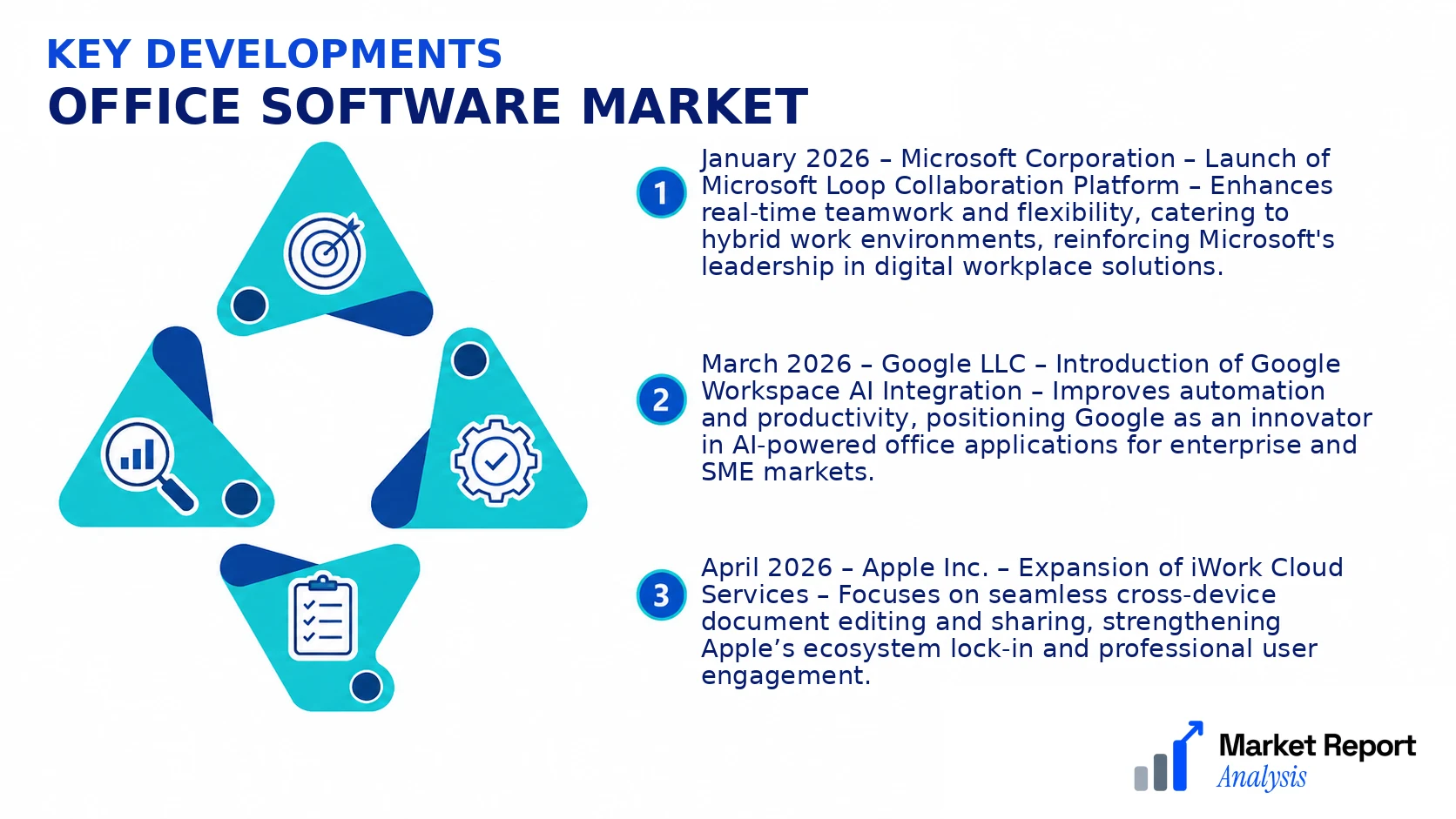
- January 2026 – Microsoft Corporation – Launch of Microsoft Loop Collaboration Platform – Enhances real-time teamwork and flexibility, catering to hybrid work environments, reinforcing Microsoft's leadership in digital workplace solutions.
- March 2026 – Google LLC – Introduction of Google Workspace AI Integration – Improves automation and productivity, positioning Google as an innovator in AI-powered office applications for enterprise and SME markets.
- April 2026 – Apple Inc. – Expansion of iWork Cloud Services – Focuses on seamless cross-device document editing and sharing, strengthening Apple’s ecosystem lock-in and professional user engagement.
- June 2026 – SAP SE – Acquisition of a Leading Business Analytics Firm – Builds advanced analytics capabilities into SAP’s cloud office offerings, driving competitive differentiation in enterprise resource planning and decision-making tools.
- August 2026 – Oracle Corporation – Investment in Cloud Infrastructure Data Centers – Supports increased demand for scalable, secure office cloud services, ensuring Oracle maintains its enterprise cloud dominance and global reach.
Frequently Asked Questions
What is the Office Software Market?
The Office Software Market encompasses a vast array of productivity applications, including word processors, spreadsheets, presentation tools, and collaboration platforms used globally by businesses, educational institutions, and individuals to enhance productivity and streamline workflows.
What is the current market size of Office Software Market?
As of 2026, the global Office Software Market is valued at approximately USD 180 Billion, reflecting widespread adoption across diverse sectors. This valuation underscores the essential role of office productivity tools in daily operations worldwide.
What factors are driving the Office Software Market?
Market growth is propelled by rapid digital transformation, increasing remote work trends, the proliferation of cloud-based services, and rising demand for collaborative tools. Technological advancements and A.I. integration further enhance application capabilities, boosting adoption rates.
Which region dominates the Office Software Market?
North America currently leads the market due to established technological infrastructure, high adoption of cloud solutions, and the presence of major tech companies. This dominance is expected to sustain through the forecast period owing to continuous innovation and enterprise investments.
Which segment is expected to grow the fastest?
The cloud-based office software segment is projected to exhibit the highest growth rate, driven by increasing remote working arrangements, cost-efficiency, and scalable infrastructure favorability, accounting for a significant share of the overall market expansion through 2034.
Who are the leading companies operating in the Office Software Market?
Key players include Microsoft Corporation, Google LLC, Apple Inc., and Zoho Corporation, which dominate through innovation, extensive cloud offerings, and strategic partnerships. These companies invest heavily in R&D to meet evolving customer demands globally.
Analyst Perspective
The long-term outlook for the Office Software Market remains robust, driven by ongoing digital transformation initiatives and increasing remote work adoption. As cloud integration and AI-driven features mature, vendors will focus on enhancing collaboration tools, cybersecurity, and user customization, creating expansive commercial opportunities across industries. Technology evolution points to a significant emphasis on SaaS models, mobile compatibility, and automation, which will redefine user productivity and operational efficiency. Investment priorities should concentrate on innovation hubs that support scalable infrastructure, R&D for AI and machine learning capabilities, and strategic acquisitions to accelerate market penetration. Competitive intensity is expected to intensify as established players diversify their service portfolios while emerging providers capitalize on niche markets. Regional growth potential remains highest in Asia-Pacific and Latin America, where digital infrastructure expansion and enterprise digitization are accelerating. Overall, the market will demand strategic agility from vendors to navigate technological shifts and regional dynamics effectively.
