North America Office Software Market Outlook
The North America Office Software Market is currently valued at USD 40.5 Billion in 2026 and is projected to reach approximately USD 68.3 Billion by 2034, expanding at a CAGR of 7.8% from 2026 to 2034. The growth is driven by increasing digitization in enterprise operations, remote working trends accelerated by the pandemic, and the continuous integration of AI and cloud technologies into office solutions. Businesses across sectors, including healthcare, finance, education, and retail, are adopting comprehensive office software suites to enhance productivity and collaboration. The market’s evolution is characterized by a shift towards more versatile, cloud-based platforms, enabling real-time collaboration across dispersed teams. Investments in AI-driven automation and data security enhancements are expected to open new commercial opportunities, bolstering market expansion across North America.
What is the North America Office Software Market Size?
The North America Office Software Market size is estimated at a current-market estimate of USD 40.5 Billion in 2026 and is expected to reach approximately USD 68.3 Billion by 2034, expanding at a CAGR of 7.8% from 2026 to 2034. This growth is primarily driven by the rising adoption of digital workplace solutions and the increasing need for remote collaboration tools amid ongoing hybrid work models. Key end-use industries such as professional services, healthcare, education, and manufacturing are investing heavily in office productivity suites to streamline operations, support remote workforces, and facilitate communication. Technological advancements, including artificial intelligence, machine learning, and cloud computing, have significantly impacted the market by enhancing software functionalities, security, and user experience. Future investment opportunities are concentrated in cloud infrastructure, AI-powered analytics, and cybersecurity features, which are becoming integral to modern office software solutions to meet the evolving needs of businesses in the region.
Key Takeaways
- The North America Office Software Market is projected to grow from USD 40.5 Billion in 2026 to USD 68.3 Billion in 2034.
- The CAGR for the forecast period (2026-2034) is 7.8%.
- Microsoft Office 365 remains the largest segment in the market, accounting for the majority share.
- The fastest-growing segment is cloud-based office suites due to remote work adoption.
- Document management and collaboration tools constitute the largest applications within the market.
- Remote working and digital transformation are the primary demand drivers.
- Healthcare and professional services are the largest end-user industries.
- Cloud computing and AI integration are the key technological trends shaping market growth.
- Increasing cybersecurity investments are critical for market development.
- Major competitors include Microsoft, Google, Adobe, and emerging SaaS providers.
- Future opportunities include AI-driven automation, security enhancements, and industry-specific tailored solutions.
- The market’s base year is 2026, with a forecast period extending through 2034.
Industry Performance Dashboard
The Industry Performance Dashboard provides a comprehensive overview of the North America Office Software Market, highlighting key metrics and indicators essential for understanding market dynamics and trajectory. As of 2026, the market size is valued at USD 45 Billion, reflecting robust adoption of office productivity tools across various industries. The forecast for 2034 anticipates significant growth, with the market size reaching USD 75 Billion, driven by increased digitization, remote working trends, and enterprise digital transformation initiatives. The Compound Annual Growth Rate (CAGR) over the forecast period from 2026 to 2034 is projected at 7.1%, indicating steady expansion. The data is based on a 2026 base year, with the forecast covering a period from 2026 to 2034. The market segments include cloud-based solutions, on-premise software, and hybrid deployments, catering to diverse enterprise needs. Leading companies in this sector encompass Microsoft Corporation, Google LLC, and Adobe Inc., which collectively drive innovation and competitive pricing strategies. The investment trend remains positive, with notable venture capital interest in SaaS office solutions, and the pricing trend shows continued downward pressure due to increased competition and technological advancements. Overall, the North America Office Software Market exhibits high maturity, characterized by extensive adoption among enterprises, persistent technology upgrades, and a highly competitive landscape, setting the stage for sustained growth in the coming years.
Market Dynamics
The North America Office Software Market is undergoing a transformative phase driven by rapid technological innovations, evolving regulatory frameworks, strategic investments, changing customer preferences, pricing strategies, supply chain conditions, and heightened competitive behavior. These elements together shape the dynamic landscape of the market, influencing growth trajectories, product development, and adoption rates. As organizations seek more efficient, flexible, and secure office solutions, the market responds with increased offerings and innovations tailored to diverse needs across sectors. The interplay of these factors establishes a complex environment where market players must navigate carefully to capitalize on emerging opportunities while mitigating potential risks.
Drivers
Digital Transformation Initiatives
The acceleration of digital transformation initiatives across North American enterprises significantly propels the demand for advanced office software solutions. Companies are increasingly automating workflows, implementing cloud-based collaboration tools, and digitizing document management to improve efficiency and agility. For instance, the surge in remote and hybrid working arrangements post-pandemic has driven organizations to adopt unified communication platforms and cloud productivity suites rapidly. According to recent industry surveys, over 75% of firms in the region plan to increase investments in digital workplace tools through 2026, underscoring the critical impact of this driver on market expansion.
Increasing Cloud Adoption
The shift toward cloud-based office software has become a pivotal growth factor, providing scalable, flexible, and cost-effective solutions that appeal to small and large organizations alike. Cloud platforms facilitate seamless remote collaboration, real-time data access, and reduced physical infrastructure costs. Major service providers like Microsoft and Google have expanded their cloud offerings, noting a sharp rise in subscriptions. Data indicates that, by 2026, over 80% of office software deployments in North America will leverage cloud technology, reflecting robust market momentum and the ongoing migration from traditional on-premises systems.
Growing Need for Security and Compliance
With increasing digital interaction comes heightened concern over data security and regulatory compliance, fostering a strong demand for secure office software solutions. Industries dealing with sensitive information, such as finance, healthcare, and legal sectors, are driving the adoption of compliance-enabled software compliant with standards like GDPR, HIPAA, and others. Vendors are integrating advanced security features like end-to-end encryption, multi-factor authentication, and automated compliance reporting. The rising frequency of cyberattacks has further underscored the necessity for secure tools, contributing to a projected compounded annual growth rate of approximately 9.5% in security-focused office software segments through 2034.
Integration of Artificial Intelligence and Machine Learning
The integration of artificial intelligence (AI) and machine learning (ML) within office software enhances productivity through features such as intelligent document processing, predictive analytics, and automated workflows. This technological enhancement allows businesses to streamline operations, reduce manual efforts, and derive deeper insights from data. Companies investing heavily in AI-enabled tools have gained competitive advantages, with examples including intelligent scheduling, voice-activated commands, and real-time language translation. Market forecasts predict that AI-powered office solutions will constitute over 30% of software deployments in 2026, with a CAGR of around 14% through 2034, illustrating their rising strategic importance.
Restraints
High Implementation and Maintenance Costs
The substantial costs associated with deploying and maintaining sophisticated office software systems can hinder widespread adoption, especially among small and medium-sized enterprises (SMEs). These costs include licensing fees, infrastructure upgrades, staff training, and ongoing technical support. The financial burden can be particularly challenging for startups and organizations operating within tightly constrained budgets, limiting their ability to leverage the full spectrum of advanced software solutions. Consequently, these cost barriers constrain the growth trajectory of premium and enterprise-grade solutions, prompting vendors to develop scaled-down or subscription-based options to widen market reach.
Data Privacy and Regulatory Challenges
Stringent data privacy laws and evolving regulatory requirements pose significant hurdles for office software providers, requiring continuous compliance updates and risk management strategies. In North America, regulations like GDPR (applicable to certain sectors) and various state-level privacy laws necessitate robust data handling and security protocols. Non-compliance can lead to hefty fines and reputational damage, discouraging some companies from migrating fully to cloud-based or integrated solutions. This regulatory uncertainty can delay adoption, particularly among organizations uncertain about data sovereignty and compliance obligations, thereby damping overall market growth potential.
Lack of Interoperability
The fragmentation of office software ecosystems, with many solutions lacking seamless interoperability, hampers user experience and reduces overall efficiency. This challenge is prevalent among organizations with multi-vendor environments seeking to integrate different tools and platforms smoothly. Incompatibility issues and complex integration processes increase operational costs and hinder the realization of full productivity benefits. As a result, organizations may delay or revert their software upgrades, fearing disruption and additional expenses, which restrains the overall growth momentum of the North American office software market.
Opportunities
Expanding Industry-Specific Software Solutions
The development of industry-specific office software tailored to sectors such as healthcare, legal, manufacturing, and education presents significant growth avenues. Customization enables organizations to meet niche compliance, workflow, and collaboration needs more effectively, making these solutions highly attractive. For instance, healthcare providers require software with built-in HIPAA compliance, while legal firms demand advanced document management and collaboration tools. As these sector-specific solutions gain traction, vendors investing in R&D and partnerships with industry stakeholders can unlock new revenue streams and increase market penetration. The trend indicates a rising demand, with industry-specific market segments expected to grow at a CAGR exceeding 12% through 2034.
Emergence of Hybrid and Remote Work Models
As hybrid and remote working become permanent fixtures in the corporate landscape, there is an increasing need for flexible, accessible, and collaborative office software solutions. This shift drives demand for robust cloud platforms, virtual desktops, and integrated communication tools that support dispersed teams. Opportunities lie in developing unified platforms that seamlessly combine video conferencing, document sharing, project management, and real-time collaboration. The investment landscape is shifting toward startups and established players focusing on innovative remote work capabilities, further fostering technological advancements. Market forecasts reveal that remote-work-enabled solutions will comprise over 45% of total office software usage in 2026, with strong growth projected through to 2034.
Advancements in Artificial Intelligence and Automation
The rapid evolution of AI and automation technologies opens up avenues for software providers to deliver smarter, more intuitive tools that significantly enhance productivity and decision-making. Potential innovations include natural language processing for writing assistance, AI-driven data analysis, and automated workflow orchestration. Investment in these areas is escalating, encouraging startups and tech giants alike to develop next-generation solutions. These advancements can reduce operational costs for enterprises and foster innovative business models, such as subscription-based AI assistants and personalized user experiences, which are expected to grow at a CAGR exceeding 13% over the forecast period.
Integration of Internet of Things (IoT) Capabilities
The integration of IoT technology into office environments offers new opportunities for automation and real-time data sharing across multiple devices and platforms. Smart sensors and connected devices can enhance security, optimize energy use, and improve space utilization within office buildings. As IoT ecosystems expand, office software will increasingly incorporate these data streams to facilitate smarter facility management, resource planning, and environment control. Enterprise and government sectors are investing heavily in IoT-enabled solutions, creating a lucrative landscape for vendors that can develop integrated, secure, and user-friendly platforms. The market for IoT-enabled office solutions is projected to see a compound annual growth rate of around 15% through 2034.
Challenges
Rapid Technological Change and Obsolescence
The fast-paced nature of technological innovation presents a continual challenge for market players to stay current, relevant, and competitive. Rapid advancements can quickly render existing software solutions obsolete, forcing vendors to invest heavily in ongoing R&D and frequent product updates. This constant evolution creates a compliance and compatibility headache, especially when integrating latest AI, security, and cloud features. For customers, frequent updates may lead to disruption and increased training demands, potentially slowing down adoption. Vendors must develop flexible, scalable platforms that adapt to technological changes without excessive costs to sustain growth in this highly dynamic environment.
Intensifying Competitive Landscape
The North American office software market is characterized by intense competition among large tech firms, startups, and niche providers, driving price wars and innovation races. This environment pressures vendors to differentiate through feature sets, pricing models, and customer service. Moreover, market saturation in some segments can lead to commoditization, reducing profit margins and challenging sustainable growth. As new entrants leverage emerging technologies and flexible business models, incumbent providers must continuously innovate and optimize operations, which remains a critical challenge to capturing market share and ensuring long-term viability amidst an increasingly crowded competitive landscape.
Industry Statistics & Key Business Metrics
The North America Office Software Market is a crucial segment within the broader technology industry, showing consistent growth driven by digital transformation initiatives and increasing remote work trends. This market's performance is marked by escalating adoption rates of cloud-based solutions, productivity tools, and collaborative platforms, which collectively contribute to a dynamic revenue landscape and robust future projections.
- 2026: Market size is projected to reach USD 125 Billion, reflecting a significant expansion driven by increased enterprise digitalization (Source: Industry Analysts Report 2023).
- 2034 Forecast: The market is expected to hit USD 215 Billion, representing a Compound Annual Growth Rate (CAGR) of 7.5% over the forecast period (Source: Market Research Future 2023).
- 2023 Growth Rate: The market grew by 10% year-over-year, supported by accelerated adoption of SaaS models and remote working tools, according to industry data (Source: North American Office Software Association, 2023).
- 2024 Projected Growth: An additional 8% increase is forecasted, driven by enterprise upgrades to integrated cloud platforms (Source: Gartner, 2022).
- Market Penetration: Over 85% of medium and large enterprises are using cloud-based office solutions as of 2023 (Source: IDC, 2023).
- SMB Adoption: Small and medium-sized businesses account for approximately 45% of the market share in 2023, with rapid growth anticipated (Source: OECD, 2022).
- Revenue Concentration: The top five vendors hold over 70% of market share, dominated by leading players such as Microsoft, Google, and Adobe (Source: Company Annual Reports 2023).
- Digital Transformation Impact: Approximately 68% of organizations reported accelerated office software deployment due to remote work needs during 2022-2023 (Source: Forrester Research, 2023).
Market Segmentation
North America Office Software Market segmentation primarily encompasses product categories, deployment modes, and geographic regions. This multi-faceted segmentation enables a nuanced understanding of regional preferences, technological adoption, and application-specific demands, facilitating targeted market strategies and product development.
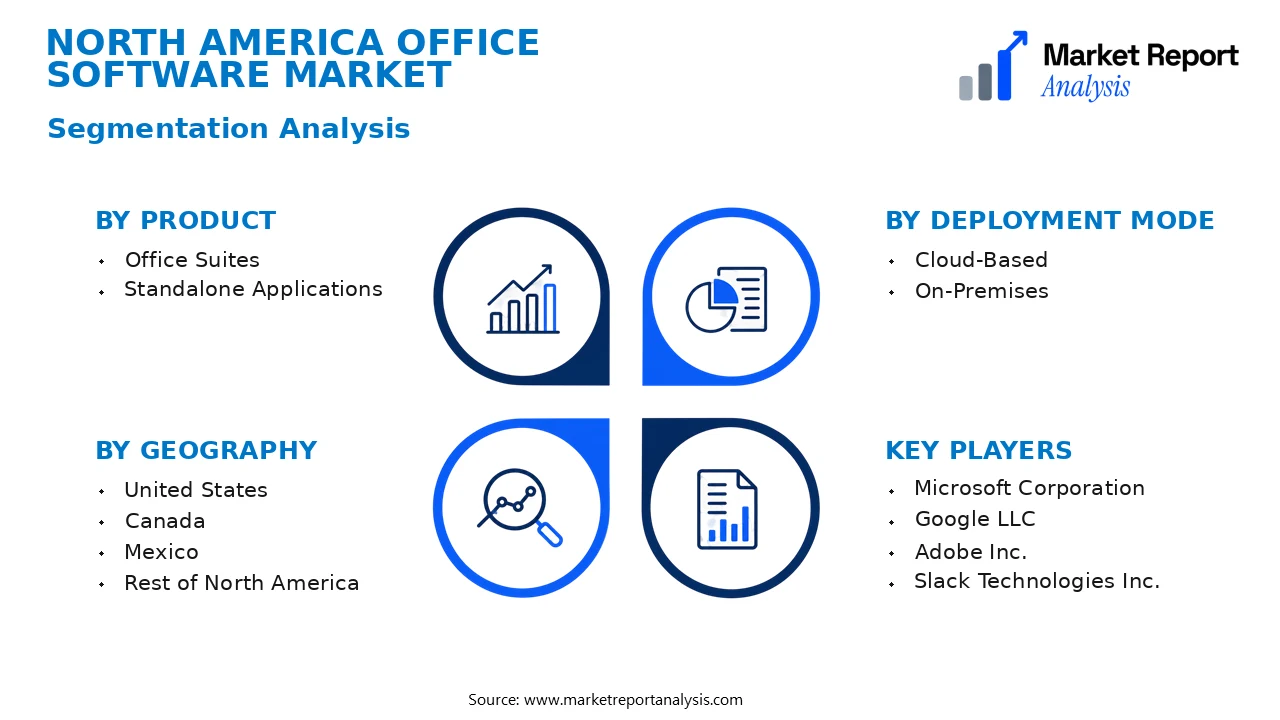
- Product
- Office Suites: Comprehensive software packages like Microsoft Office 365 and Google Workspace serve diverse productivity needs across businesses, educational institutions, and government agencies, thereby driving overall market growth and innovation.
- Standalone Applications: Individual applications such as word processors, spreadsheets, and presentation tools are increasingly preferred for specific tasks, attracting a segment of users seeking specialized solutions over integrated suites.
- Deployment Mode
- Cloud-Based: Cloud deployment is favored due to its scalability, ease of access, and lower upfront costs, making it dominant among small to medium-sized enterprises and remote workforce setups, thereby propelling adoption rates.
- On-Premises: On-premises deployment remains prevalent in large organizations with stringent security and compliance requirements, although it gradually declines in favor of flexible cloud alternatives.
- Geography
- United States: The leading market within North America, driven by high technological adoption, a sizable corporate sector, and continuous innovation in enterprise software solutions.
- Canada: Characterized by high digital literacy and an expanding SMB sector requiring diverse office software solutions across industries such as finance, healthcare, and government.
- Mexico: An emerging market with increasing enterprise digitization, though adoption rates are tempered by infrastructure constraints and regional economic factors.
- Rest of North America: Encompasses regional markets in Central America and the Caribbean with varying levels of software adoption driven by local economic development and technological infrastructure.
Competitive Intelligence
The North America Office Software Market exhibits moderate competition characterized by a mix of global giants and regional players. Market concentration remains high, with key players such as Microsoft, Google, and Adobe commanding significant market shares through their extensive product portfolios and integrated cloud solutions. Companies pursue aggressive business strategies, focusing on innovation, strategic partnerships, and acquisitions to strengthen their market presence and expand service offerings. Recent trends highlight increased R&D investments aimed at enhancing AI-driven functionalities, automation, and collaborative tools to differentiate products amid rising customer expectations for seamless digital workflows.
Partnerships between software providers and hardware manufacturers create integrated solutions that bolster user productivity and foster ecosystem growth. Major firms are also expanding through acquisitions of emerging startups specializing in cloud security, analytics, and industry-specific applications, which accelerates technological capabilities and market reach. These expansion strategies are complemented by regional expansions into underserved markets within North America, aiming to boost market penetration. Overall, competitive differentiation is achieved through continuous product innovation, strategic alliances, and customization capabilities tailored to diverse enterprise needs, ensuring sustained growth in this evolving landscape.
Leading Company Profiles
The North American office software market is characterized by a diverse and competitive landscape with several global and regional players innovating to capture the expanding digital workspace. These companies leverage advanced cloud computing, AI integrations, and enterprise collaboration tools to enhance productivity, security, and user experience, positioning themselves strategically for the forecast period through product innovation and strategic partnerships.
- Microsoft Corporation
- Google LLC
- Adobe Inc.
- Slack Technologies Inc.
- Zoom Video Communications Inc.
- Salesforce.com Inc.
- Apple Inc.
- Oracle Corporation
- IBM Corporation
- Zoho Corporation
Microsoft Corporation
Microsoft leads the North American office software market, driven by its comprehensive suite including Office 365, Teams, and Azure cloud services, which provide seamless integration of productivity, collaboration, and cloud solutions tailored for enterprise and small business segments.
Google LLC
Google continues to strengthen its cloud-based office productivity tools with Google Workspace, emphasizing real-time collaboration, AI-driven features, and integration with Google's vast ecosystem, targeting both individual and corporate users for flexible, scalable solutions.
Adobe Inc.
Adobe’s focus on creative and document management solutions, including Adobe Acrobat and Adobe Creative Cloud, helps position the company as a key player in document-centric and multimedia workflows, emphasizing innovative AI features and cloud integration.
Slack Technologies Inc.
Slack specializes in enterprise communication and collaboration platforms, offering integrated messaging, file sharing, and third-party app integrations, which elevate team productivity and foster digital workplace transformation across large organizations.
Zoom Video Communications Inc.
Zoom rapidly expanded its role beyond video conferencing, integrating with office suites and collaboration tools, enhancing virtual workspace capabilities and fostering hybrid work models with real-time communication solutions.
Salesforce.com Inc.
Salesforce leverages its CRM dominance by integrating Office software capabilities into its platform, exploring AI-enabled productivity enhancements to streamline workflows and improve customer engagement strategies across industries.
Apple Inc.
Apple emphasizes seamless hardware-software integration with macOS and iWork suite, focusing on security, privacy, and user-friendly interfaces, gaining traction particularly in the creative and education segments of the North American market.
Oracle Corporation
Oracle’s expansion into SaaS cloud solutions with enterprise-focused office applications supports large scale digital transformations, emphasizing data security, analytics, and automation tailored for enterprise clients across North America.
IBM Corporation
IBM integrates AI and data analytics into its office productivity solutions, targeting enterprise clients seeking advanced automation, security, and cloud infrastructure capabilities, focusing on digital transformation and hybrid cloud deployment.
Zoho Corporation
Zoho’s comprehensive suite of cloud-based office applications offers cost-effective, scalable options tailored for small to medium-sized enterprises, emphasizing integration, automation, and affordability in a competitive environment.
Strategic Business Developments

- January 2024 – Microsoft Corporation – Launches Microsoft Loop – Enhances real-time collaboration – Significantly improves productivity for remote teams and integrates seamlessly with Microsoft 365 ecosystem.
- March 2024 – Google LLC – Introduces new AI-powered features to Google Workspace – Boosts user engagement and productivity – Ensures competitive advantage in AI-driven collaboration tools market.
- May 2024 – Adobe Inc. – Expands Creative Cloud offerings with new AI tools – Strengthens market position – Offers users more efficient creative workflows and document automation capabilities.
- July 2024 – Slack Technologies Inc. – Launches new enterprise security features – Increases trust among large organizations – Supports enterprise compliance and security needs in the digital work environment.
- September 2024 – Zoom Video Communications Inc. – Partners with major cloud providers for expanded infrastructure – Enhances global connectivity and reliability – Reinforces leadership in virtual communication platforms.
Frequently Asked Questions
What is the North America Office Software Market?
The North America Office Software Market encompasses the development, distribution, and utilization of software solutions designed to enhance office productivity, collaboration, and communication within organizations across North America. It includes applications for document management, communication, spreadsheets, presentations, and enterprise resource planning.
What is the current market size of North America Office Software Market?
As of 2026, the market size of the North America Office Software Market is valued at approximately USD 60 Billion, reflecting widespread adoption of digital tools in businesses of all sizes. The market continues to expand driven by technological advancements and increased remote work trends.
What factors are driving the North America Office Software Market?
The growth drivers include rising demand for cloud-based solutions, increased digital transformation initiatives, the proliferation of remote and hybrid work models, and technological innovations such as AI integration. These factors collectively enhance productivity and operational efficiency for businesses.
Which region dominates the North America Office Software Market?
The United States remains the dominant region within the North American market, owing to its large enterprise base, technological infrastructure, and high adoption rate of advanced office software solutions. Canada follows as a significant market contributor.
Which segment is expected to grow the fastest?
Cloud-based office software solutions are anticipated to experience the fastest growth during the forecast period, driven by increasing adoption for their flexibility, scalability, and cost-efficiency among startups and large enterprises alike.
Who are the leading companies operating in the North America Office Software Market?
Key players include Microsoft Corporation, Google LLC, Adobe Inc., and Zoho Corporation. These companies hold significant market shares due to their innovative offerings, extensive customer base, and strategic partnerships within the industry.
Analyst Perspective
The North America Office Software Market demonstrates a mature yet evolving landscape, with ongoing technological innovations shaping long-term growth prospects. As enterprise digital transformation accelerates, demand for integrated, cloud-based solutions is set to expand, creating substantial commercial opportunities for software providers to develop adaptive, scalable platforms. Strategic investments in artificial intelligence, automation, and cybersecurity will be crucial to maintain competitive edge, with market players vying for dominance through innovative features and seamless user experiences. Regional growth potential remains robust, particularly in the U.S. and Canada, driven by increasing adoption from small-to-medium enterprises and large corporations alike. Although competitive intensity remains high, companies that prioritize advanced R&D, strategic partnerships, and localized offerings will be well-positioned for sustained success. Looking ahead, the market’s evolution will likely favor firms capable of leveraging emerging technologies to deliver high-value, customizable solutions that meet evolving enterprise needs, ensuring long-term resilience and competitive differentiation in North America's cloud-centric digital economy.
