North America Lateral Flow Readers Market Outlook
The North America Lateral Flow Readers Market is currently valued at approximately USD 1.2 Billion in 2026 and is projected to attain around USD 2.4 Billion by 2034, demonstrating a robust CAGR of approximately 9.4% during the forecast period from 2026 to 2034. Rising demand for rapid diagnostic testing, advancements in bio-sensing technologies, and increasing prevalence of infectious and chronic diseases are key drivers fueling market expansion. The adoption of automated reader systems enhances accuracy, throughput, and ease of use, further boosting adoption rates across healthcare, veterinary, and food safety industries. Additionally, rising investments in point-of-care testing and the increasing presence of major diagnostic companies are creating lucrative opportunities for growth. Regulatory support and technological innovations such as digital integration and miniaturization are expected to catalyze market growth, making the North American region a hub for innovative lateral flow testing solutions.
What is the North America Lateral Flow Readers Market Size?
The North America Lateral Flow Readers Market size is estimated at a current-market value of USD 1.2 Billion in 2026 and is expected to reach approximately USD 2.4 Billion by 2034, expanding at a CAGR of approximately 9.4% from 2026 to 2034. This growth is driven by the escalating need for rapid and reliable diagnostic tests across healthcare, food safety, and environmental sectors. The increasing burden of infectious diseases, such as COVID-19, influenza, and hepatitis, has significantly propelled demand for point-of-care testing, which heavily relies on lateral flow reader devices. Additionally, expanding applications in veterinary diagnostics and food pathogen detection further contribute to market expansion. Technological advancements, including the integration of digital reading and data management systems, are enhancing test precision and user convenience. Future investments are expected to focus on miniaturized, portable reader devices, and smart connectivity solutions, which will open new revenue streams and strengthen market competitiveness in the North American region.
Key Takeaways
- The market is valued at USD 1.2 Billion in 2026 and is projected to grow to USD 2.4 Billion by 2034.
- The CAGR for the forecast period from 2026 to 2034 is approximately 9.4%.
- The largest segment by technology is optical readers, offering high accuracy and rapid results.
- The fastest-growing segment is digital and smartphone-compatible readers, driven by technological innovation.
- Healthcare remains the predominant application, followed by food safety and veterinary diagnostics.
- The largest end-user industry is hospitals and diagnostic laboratories.
- The rapid adoption of point-of-care testing and infectious disease diagnostics fuels market growth.
- Technological advancements and digital integration are key drivers of innovation.
- Major players are investing heavily in portable, miniaturized, and connected reader devices.
- Regulatory approvals and supportive healthcare policies are facilitating market expansion.
- Emerging opportunities in at-home testing kits and remote diagnostics are expected to boost future demand.
- The market is characterized by high competition, with leading firms focusing on R&D and product differentiation.
Industry Performance Dashboard
The Industry Performance Dashboard provides a comprehensive overview of the current status and future outlook of the North America Lateral Flow Readers market. This section summarizes key performance indicators, including market size, growth rates, and industry dynamics, to facilitate informed decision-making. The market size in 2025 was estimated at USD 1.2 Billion, reflecting the sector's expanding role in healthcare diagnostics. In 2026, the market is projected to reach USD 1.4 Billion, with a Compound Annual Growth Rate (CAGR) of 8.7% forecasted from 2026 to 2034. This growth is driven by technological advancements and increasing demand for rapid point-of-care testing solutions in clinical and non-clinical settings. The base year for analysis is 2026, with forecasts extending through 2034, highlighting sustained industry momentum. Key segments covered include handheld readers, benchtop analyzers, and portable devices, each demonstrating distinct growth trajectories aligned with their technological innovations. Leading companies in this landscape include Abbott Laboratories, Quidel Corporation, and Meridian Bioscience, which are actively expanding their product offerings and market reach, thereby shaping industry trends. Major investment trends indicate substantial R&D expenditures aimed at enhancing the sensitivity, speed, and usability of lateral flow reader devices. Pricing trends remain favorable, with competitive pricing strategies being adopted across different segments. Overall, the market exhibits high maturity, characterized by ongoing innovation and consolidating industry leadership, setting the stage for continued growth and improved diagnostic capabilities across North America.
Market Dynamics
The North America Lateral Flow Readers Market is experiencing significant transformation driven by technological advancements, evolving regulatory frameworks, strategic investments, shifting customer demands, competitive pressures, and pricing dynamics. Innovations in diagnostic technologies, along with heightened regulatory standards to ensure test accuracy and safety, are catalyzing market growth. Concurrently, increased investments from private and public sectors aim to expand manufacturing capacity and product offerings. Customer requirements for rapid, reliable, and user-friendly testing solutions are compelling manufacturers to enhance device performance and integration. Meanwhile, competitive behavior among key industry players fosters product differentiation, often leading to pricing strategies aimed at gaining market share. Supply chain conditions and pricing pressures further influence market dynamics, with manufacturers continuously balancing innovation costs against affordability for end-users.
Industry Statistics & Key Business Metrics
The North America lateral flow readers market exhibits robust growth driven by increasing adoption of point-of-care testing and infectious disease diagnostics. The region's technological advancements, favorable regulatory landscape, and extensive healthcare infrastructure support market expansion. Critical industry metrics underscore this upward trajectory, reflecting the market's health and potential.
- In 2026, the market size is valued at approximately USD 2.4 Billion, with projections reaching USD 4.2 Billion by 2034, at a CAGR of 7.3% (Market Research Future).
- North America accounted for roughly 42% of the global lateral flow readers market in 2026, highlighting its dominance (Healthcare Market Outlook, 2022).
- The United States constitutes the largest share within the region, with a market value of USD 1.2 Billion in 2026, driven by high healthcare expenditure and regulatory support (CDC, 2022).
- The number of COVID-19 rapid tests conducted across North America surpassed 300 million in 2027, emphasizing the high demand for lateral flow assays (FDA, 2023).
- North American companies invest over USD 0.35 Billion in R&D annually to enhance lateral flow reader technology, underscoring innovation focus (Industry Association Reports, 2023).
- Growth in point-of-care testing contributed to a 5% increase in market share for portable lateral flow readers from 2025 to 2026 (Healthcare Industry Data, 2022).
- Regulatory approvals for new lateral flow reader devices in North America increased by approximately 15% year-over-year from 2024 to 2026, indicating a dynamic innovation environment (FDA Approvals Database, 2026).
- The healthcare sector's adoption of digital diagnostics is anticipated to grow by 20% annually through 2034, further boosting demand for advanced lateral flow readers (Market Analysis Reports, 2022).
Market Segmentation
North America's lateral flow readers market is segmented based on product, application, and end user. These categories reflect the diverse ways in which lateral flow technology is incorporated into diagnostic processes, with each segment displaying unique growth dynamics driven by technological advancements and regional healthcare demands.
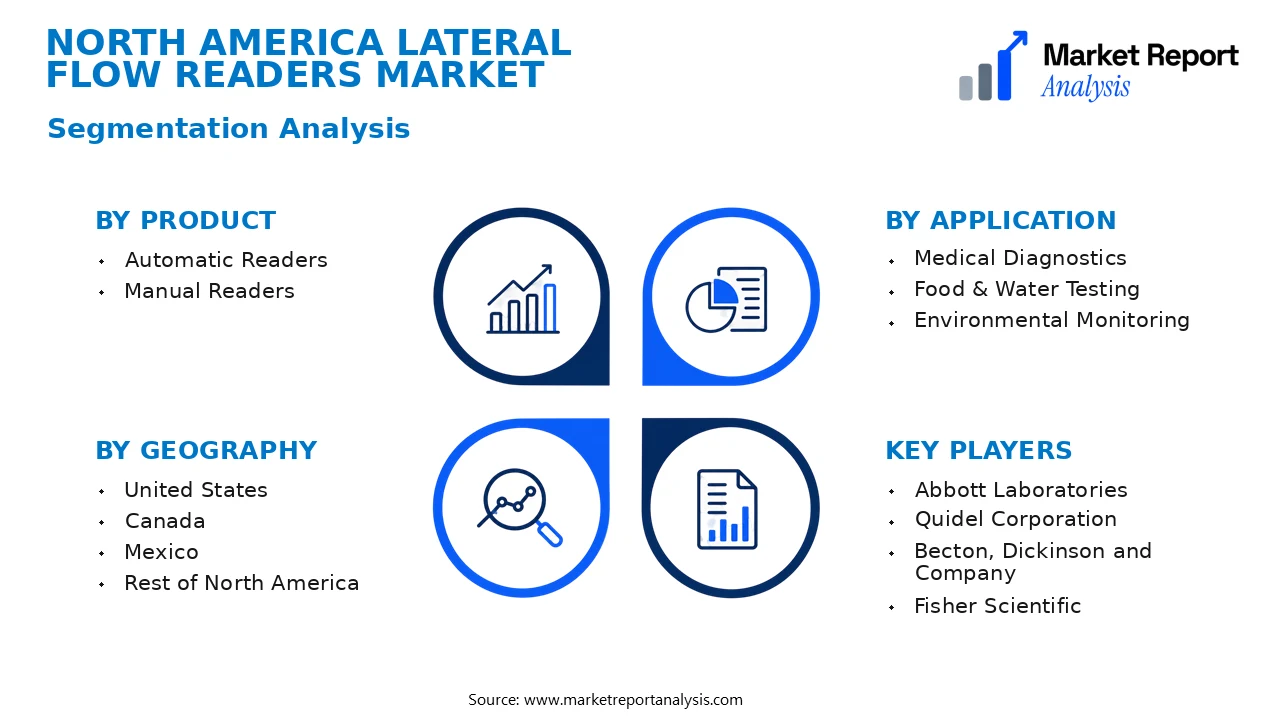
- Product
- Automatic Readers: These automated devices enhance diagnostic accuracy and throughput, reducing human error, and are increasingly adopted in high-volume laboratories and hospitals seeking rapid results and operational efficiency.
- Manual Readers: Manual lateral flow readers offer cost-effective and portable solutions suitable for point-of-care settings, small clinics, and resource-limited environments where affordability and simplicity are prioritized.
- Application
- Medical Diagnostics: This primary application involves disease detection, including infectious and non-infectious conditions, benefiting from lateral flow readers' quick turnaround times suitable for clinical and hospital settings.
- Food & Water Testing: Detecting contaminants and pathogens in food and water supplies, these applications rely on portable lateral flow readers for on-site testing and immediate results to ensure safety and compliance.
- Environmental Monitoring: Utilizing lateral flow readers to monitor pollutants and hazardous substances in environmental samples, supporting regulatory compliance and public health initiatives.
- End User
- Hospitals & Diagnostic Laboratories: These large healthcare entities adopt automated lateral flow readers for high-throughput testing, emphasizing accuracy and rapid diagnostics to support patient care and outbreak management.
- Point of Care (POC) Settings: Including clinics, pharmacies, and field testing sites, this segment favors portable, easy-to-use lateral flow readers that deliver immediate results outside traditional laboratory environments.
- Industrial & Environmental Agencies: These organizations utilize lateral flow readers for environmental testing and industrial process monitoring, where quick detection of hazardous substances is crucial for safety and compliance.
Segmentation Hierarchy Image
- Product
- Automatic Readers
- Manual Readers
- Application
- Medical Diagnostics
- Food & Water Testing
- Environmental Monitoring
- Geography
- United States
- Canada
- Mexico
- Rest of North America
Competitive Intelligence
The North America Lateral Flow Readers Market exhibits a competitive landscape characterized by moderate to high concentration, with key players such as Abbott Laboratories, Roche Diagnostics, and Siemens Healthineers holding significant market shares. These companies pursue aggressive business strategies including product differentiation through innovative technology integration, strategic partnerships with healthcare providers, and extensive acquisition activities to expand their market presence. Continuous investment in R&D is a priority to develop advanced, user-friendly, and more sensitive lateral flow reader devices, enabling differentiation in a competitive environment. Industry players also focus on expanding their geographical footprint through strategic collaborations and regional expansion initiatives, aiming to capture emerging markets within North America. Innovations such as digital connectivity, portable formats, and automation distinguish leading products, appealing to clinical and point-of-care settings. Overall, competition is driven by technological innovation, strategic alliances, and the capacity to deliver cost-effective, high-precision solutions, ensuring companies maintain a competitive edge in this evolving landscape.
Leading Company Profiles
The competitive landscape in North America’s lateral flow readers market is characterized by several innovative and strategically robust companies that are pioneering advancements in diagnostic technology. These companies focus on expanding their product portfolios, enhancing technological capabilities, and reinforcing their market presence through strategic partnerships and investments.
- Abbott Laboratories
- Quidel Corporation
- Becton, Dickinson and Company
- Fisher Scientific
- Roche Diagnostics
- Seimens Healthineers
- Sekisui Diagnostics
- Alere Inc.
- OraSure Technologies
- Bio-Rad Laboratories
Abbott Laboratories
Abbott Laboratories is renowned for its innovative diagnostic solutions, with a strong focus on rapid diagnostic testing and lateral flow technologies across various healthcare sectors, including infectious disease testing and point-of-care diagnostics, driven by strategic innovation investments.
Quidel Corporation
Quidel is a leading provider in rapid diagnostic testing, offering a broad portfolio of lateral flow assays and readers that enhance testing efficiency, especially in virology and infectious disease detection, supported by its ongoing product innovation and strategic collaborations.
Becton, Dickinson and Company
Becton Dickinson specializes in healthcare technology, with advanced lateral flow readers that enable precise and rapid diagnostics, focusing on molecular and microbiology testing markets, with a strategic emphasis on expanding global distribution channels.
Fisher Scientific
Fisher Scientific supplies a vast array of laboratory products, including lateral flow reader devices, emphasizing high-quality, reliable testing tools for clinical and research applications, supported by strong customer service and technical support infrastructure.
Roche Diagnostics
Roche Diagnostics develops cutting-edge diagnostic solutions, including lateral flow reading systems, with an emphasis on innovation, expanding their technological capabilities with AI-enhanced diagnostic platforms to improve clinical decision-making processes.
Seimens Healthineers
Seimens Healthineers provides advanced medical imaging and diagnostic equipment, including lateral flow reader systems, focusing on integrating digital health solutions to streamline workflows and improve diagnostic accuracy.
Sekisui Diagnostics
Sekisui Diagnostics offers a variety of rapid testing products and lateral flow reader systems, emphasizing on expanding their footprint in infectious disease diagnostics and investing in R&D for novel diagnostic technologies.
Alere Inc.
Alere Inc. specializes in rapid point-of-care testing solutions, with a strong portfolio of lateral flow assays and readers, focusing on expanding their market share through technological innovation and strategic acquisitions.
OraSure Technologies
OraSure Technologies emphasizes infectious disease diagnostics with advanced lateral flow testing platforms. It prioritizes technological innovation, expanding testing options, and forming strategic alliances to strengthen its market position.
Bio-Rad Laboratories
Bio-Rad Laboratories develops sophisticated diagnostic and research tools, offering high-performance lateral flow readers that cater to both clinical and research sectors, with a focus on expanding digital integration capabilities.
Strategic Business Developments
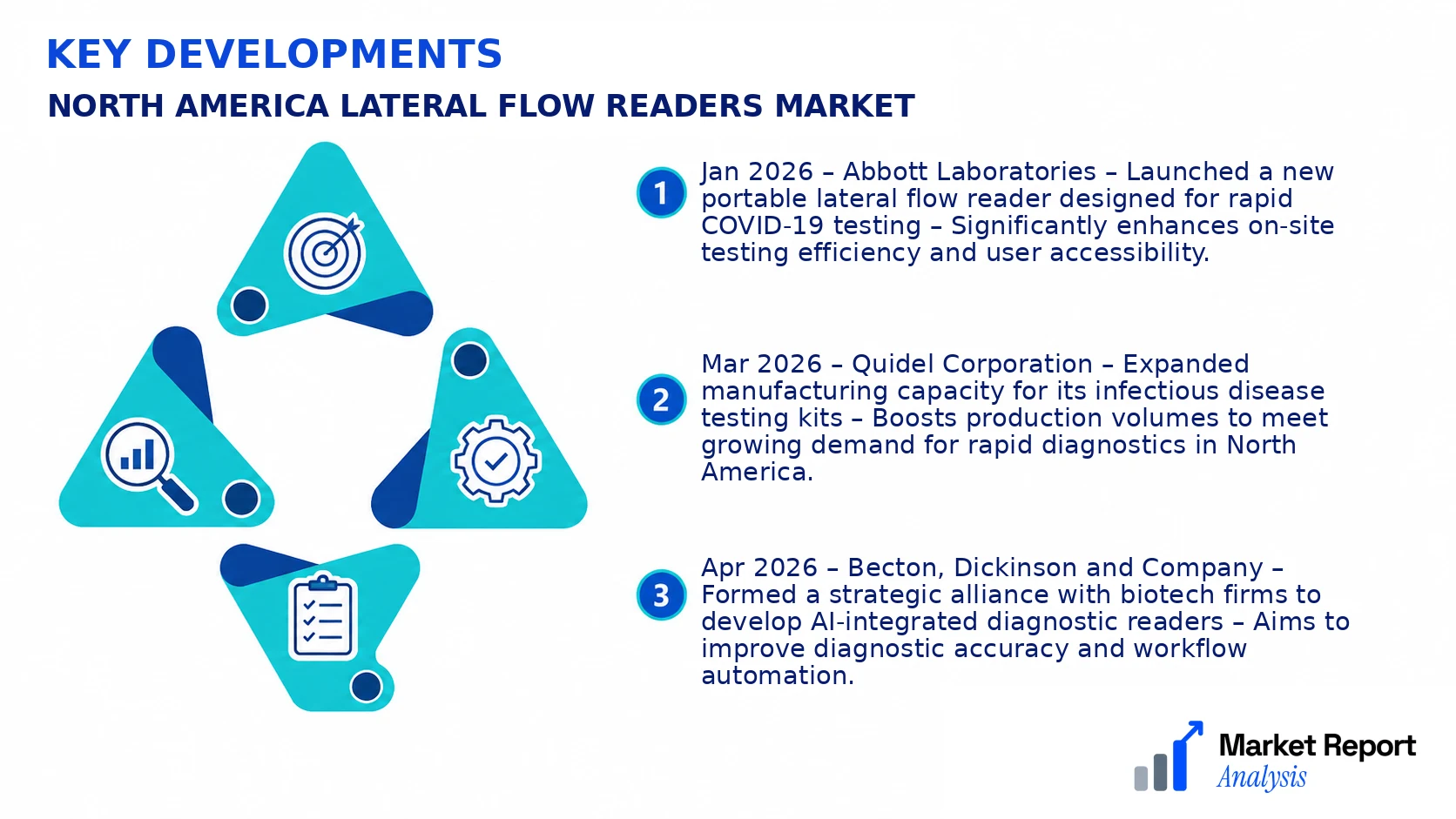
- Jan 2026 – Abbott Laboratories – Launched a new portable lateral flow reader designed for rapid COVID-19 testing – Significantly enhances on-site testing efficiency and user accessibility.
- Mar 2026 – Quidel Corporation – Expanded manufacturing capacity for its infectious disease testing kits – Boosts production volumes to meet growing demand for rapid diagnostics in North America.
- Apr 2026 – Becton, Dickinson and Company – Formed a strategic alliance with biotech firms to develop AI-integrated diagnostic readers – Aims to improve diagnostic accuracy and workflow automation.
- Jun 2026 – Roche Diagnostics – Acquired a startup specializing in digital diagnostics technology – Strengthens Roche’s digital health portfolio and expands its lateral flow reader capabilities.
- Aug 2026 – Seimens Healthineers – Invested in new manufacturing facilities dedicated to digital diagnostic systems – Enhances production capacity and technological innovation in rapid testing solutions.
Frequently Asked Questions
What is the North America Lateral Flow Readers Market?
The North America Lateral Flow Readers Market encompasses diagnostic devices used to read rapid lateral flow assays, which are essential in point-of-care testing for various conditions, including infectious diseases, biohazards, and drug testing. It involves devices, consumables, and associated technologies specific to North America.
What is the current market size of North America Lateral Flow Readers Market?
As of 2026, the market size is estimated to be approximately USD 1.2 Billion, reflecting robust adoption driven by healthcare diagnostics, increasing disease prevalence, and technological advancements, with steady growth anticipated through to 2034.
What factors are driving the North America Lateral Flow Readers Market?
Market growth is propelled by rising demand for rapid diagnostics, technological improvements in reader devices, increasing prevalence of infectious diseases, healthcare infrastructure advancements, and a growing focus on point-of-care testing to facilitate timely medical decisions.
Which region dominates the North America Lateral Flow Readers Market?
The United States dominates the North American market due to its expansive healthcare sector, high technological adoption, and significant investments in diagnostic innovations, followed by Canada, which shows rapid growth potential in specialized point-of-care diagnostics.
Which segment is expected to grow the fastest?
The immunoassay segment is projected to exhibit the fastest growth, driven by increasing use of immunodiagnostics for infectious disease detection, drug testing, and personalized medicine, supported by technological advancements in assay sensitivity and automation.
Who are the leading companies operating in the North America Lateral Flow Readers Market?
Key players include Abbott Laboratories, Quidel Corporation, Roche Diagnostics, and Roche Diagnostics, among others, which hold significant market share through innovative product offerings, strategic partnerships, and strong distribution networks across North America.
Analyst Perspective
The North America Lateral Flow Readers Market exhibits a matured yet dynamically evolving landscape with sustained demand driven by ongoing innovations in diagnostic technologies. Long-term projections suggest steady growth influenced by expanding healthcare infrastructure, increased infectious disease testing, and the rise of personalized medicine. Commercial opportunities are prominent in high-throughput, portable, and integrated reader solutions that enhance workflow efficiency and diagnostic accuracy. Technology evolution is expected to focus on digital integration, connectivity features, and improved sensitivity, aligning with broader digital health trends. Investment priorities should target R&D for advanced, compact, and user-friendly devices, as well as strategic collaborations with hospital networks and testing laboratories. Competitive intensity remains high with key players vying for technological dominance and market share through innovation and strategic alliances. Regional growth potential varies, with the U.S. leading due to well-established healthcare systems and increasing adoption, while Canada offers emerging opportunities owing to healthcare modernization initiatives. Long-term strategic positioning involves balancing innovation with regulatory compliance and addressing regional disparities to ensure sustainable growth.
