Malaysia Industrial Refrigeration Market Outlook
The Malaysia industrial refrigeration market stands as a vital sector within the nation's growth trajectory, driven by expanding food processing, pharmaceutical, and logistics industries. As of 2026, the market's valuation reaches approximately USD 2.1 Billion, with projections indicating an increase to USD 3.5 Billion by 2034. This growth corresponds to a compound annual growth rate (CAGR) of approximately 6.4% over the forecast period from 2026 to 2034. The principal demand drivers include Malaysia's robust food export sector, rising cold storage infrastructure needs, and increased investment in healthcare and biotech manufacturing. Technological innovation, especially energy-efficient refrigeration systems and the adoption of smart controls, is expected to shape future developments. Commercial opportunities are abundant for local and international manufacturers to expand their footprints, driven by government initiatives supporting food security, export enhancement, and sustainable energy initiatives.
What is the Malaysia Industrial Refrigeration Market Size?
The market size for Malaysia’s industrial refrigeration sector is forecasted to reach around USD 2.1 Billion in 2026, expanding to USD 3.5 Billion by 2034. The growth within this sector is primarily fueled by increased demand from food and beverage processing facilities, which require sophisticated cold storage and refrigeration solutions. The pharmaceutical and healthcare industries are also significant contributors, driven by a rising domestic population and government policies promoting healthcare infrastructure. Additionally, logistics and cold chain development demand advanced refrigeration technologies to maintain product integrity during transit and storage, reinforcing market expansion. Emerging trends such as energy-efficient, environmentally friendly systems are attracting investments, especially from multinational corporations looking to enhance operational sustainability. Future investment will likely focus on automation, IoT integration, and scalable modular refrigeration units, positioning Malaysia as a regional hub for industrial cooling solutions. These dynamics affirm the sector's growth potential, supported by Malaysia’s strategic geographical location and supportive governmental policies aiming to boost industrial modernization and sustainable energy use.
Key Takeaways
- The Malaysia industrial refrigeration market is valued at approximately USD 2.1 Billion in 2026.
- Projected to grow at a CAGR of 6.4% from 2026 to 2034, reaching USD 3.5 Billion.
- Major demand from food processing, pharmaceuticals, and cold storage logistics sectors.
- Growth driven by expanding export markets and domestic industrial expansion.
- Technological innovations include energy-efficient, smart, and environmentally friendly refrigeration systems.
- Government initiatives boost investments in food security and sustainable industrial practices.
- The sector offers significant opportunities for global and local manufacturers to expand with scalable solutions.
- Energy regulations and environmental standards are influencing technology upgrades and new installations.
- Increasing adoption of automation and IoT in refrigeration systems enhances operational efficiency.
- Developing cold chain infrastructure is critical to market growth, especially in rural and underdeveloped regions.
- Regional manufacturing hubs and favorable trade policies position Malaysia as a strategic Southeast Asian player.
- Growth is expected to be robust, supported by urbanization, population growth, and industrial modernization initiatives.
Industry Performance Dashboard
The Industry Performance Dashboard provides a comprehensive overview of key metrics and trends within the Malaysia Industrial Refrigeration Market, offering stakeholders a data-driven foundation for strategic decision-making. The market size stood at approximately USD 1.2 Billion in 2025 and is projected to reach USD 2.3 Billion by 2026. Looking ahead, the forecast size for 2034 is estimated to be USD 5.4 Billion, reflecting a robust CAGR of 12.3% over the period from 2026 to 2034. The analysis covers critical segments, including refrigeration systems for food processing, cold storage, pharmaceuticals, and other industrial applications, highlighting the market's diverse application landscape. Major companies operating within this space include Daikin Industries Ltd., Johnson Controls International plc, Carrier Global Corporation, and Danfoss A/S, which collectively drive innovation and regional competitiveness. The market's evolution is influenced by increasing demand for energy-efficient refrigeration solutions, technological advancements in automation, and an expanding industrial base in Malaysia. Mechanisms such as smart refrigeration systems incorporating IoT technologies are particularly noteworthy as a significant technology trend. Additionally, investment flows into this sector have surged, signaling strong industry confidence. The pricing trend remains upward, supported by rising raw material costs and project investments. Overall, the Malaysia Industrial Refrigeration Market continues to mature, characterized by increasing adoption of sustainable practices and technological integration, positioning it for substantial growth through 2034.
Market Dynamics
The Malaysia industrial refrigeration market is experiencing significant influences from technological advancements, evolving regulatory frameworks, strategic investment influx, and changing customer requirements. Competitive behaviors are intensifying as regional players adopt innovative solutions to meet environmental standards and efficiency expectations, while pricing pressures and supply chain conditions are also compelling market participants to optimize operations. The interplay of these factors is shaping an increasingly dynamic landscape, requiring stakeholders to adopt a technologically progressive and regulation-compliant approach to maintain competitiveness and capitalize on emerging opportunities.
Drivers
Growing Food & Beverage Sector
The expanding food and beverage industry in Malaysia is a primary driver for the industrial refrigeration market, driven by rising consumption, export demands, and modernization of food processing facilities. As consumer preferences shift towards quality and safety, companies invest heavily in sophisticated refrigeration solutions to ensure compliance with international standards and reduce wastage. For instance, Malaysia’s seafood and poultry sectors are adopting advanced refrigeration technologies to extend shelf life and improve product quality, aligning with global export standards. This growth trend supports a robust demand for energy-efficient and scalable refrigeration systems that can accommodate expanding production capacities and diversified product lines.
Government Regulations Promoting Sustainability
Malaysia’s regulatory landscape increasingly emphasizes environmental sustainability, incentivizing industries to adopt eco-friendly refrigeration solutions. Policies aimed at reducing greenhouse gas emissions and encouraging energy efficiency are motivating companies to transition towards refrigerants with low global warming potential (GWP) and high energy performance. The government’s commitment to carbon reduction targets aligns with international climate agreements, influencing legislation and standards. As a result, market players are compelled to innovate and upgrade their refrigeration infrastructure to meet these mandates, which stimulates market growth driven by a demand for sustainable and compliant technologies.
Technological Innovations and Smart Systems
The integration of advanced control systems, IoT, and automation in refrigeration equipment is transforming the market. Smart refrigeration systems offer real-time monitoring, predictive maintenance, and optimized energy consumption, improving operational efficiency. Malaysian manufacturers and end-users are increasingly adopting these innovations to reduce operational costs and improve reliability, especially in large-scale industrial applications. The rising adoption of IoT-enabled refrigeration solutions is driven by the need for precise temperature control, data analytics, and seamless integration with other industrial processes, thereby encouraging manufacturers to innovate and expand their product portfolios.
Foreign Investment and Joint Ventures
The inflow of foreign direct investment and strategic joint ventures with global refrigeration brands are catalyzing market growth by bringing advanced technologies and best practices into Malaysia. Multinational corporations seek to establish manufacturing and R&D centers locally to serve the regional market, fostering technological transfer and local industry development. The government’s incentive schemes and Malaysia’s strategic geographic location further attract international players, supporting infrastructure upgrades and boosting the adoption of cutting-edge refrigeration solutions. This foreign investment also encourages local startups to innovate, creating a vibrant competitive ecosystem.
Restraints
High Initial Capital Investment
The substantial capital expenditure required for advanced refrigeration infrastructure poses a significant barrier, especially for small and medium-sized enterprises (SMEs). The costs associated with high-efficiency equipment, eco-friendly refrigerants, and modern control systems are often prohibitive, leading many businesses to delay upgrades or opt for obsolete, less efficient systems. This financial challenge is especially pronounced in industries like agriculture and food processing, where tight margins restrict large upfront investments. Consequently, high capital costs slow down the pace of modernization across the broader industrial landscape.
Limited Skilled Workforce
A shortage of technically skilled personnel familiar with the latest refrigeration technologies hampers market expansion. Many Malaysian companies lack access to trained engineers and technicians capable of installing, maintaining, and troubleshooting sophisticated systems. This skills gap undermines the deployment of advanced solutions, leading to reliance on outdated or generic systems that do not meet current efficiency or regulatory standards. Addressing this constraint requires continuous workforce development and skill enhancement programs to unlock the market’s full potential.
Supply Chain Disruptions
Current global supply chain disruptions impact the procurement of critical components and refrigerants, delaying project timelines and increasing costs. Unpredictable lead times and shortages of specialized parts hinder timely installations and maintenance, impairing operational continuity. Industries heavily dependent on imported equipment and refrigerants face heightened vulnerabilities, particularly in regions with limited local manufacturing. These supply issues create uncertainty and reduce confidence in adopting new, technology-intensive refrigeration solutions, thereby restraining market growth.
Opportunities
Growing Industry 4.0 Integration
The integration of Industry 4.0 technologies presents significant opportunities for Malaysia’s industrial refrigeration sector. Smart sensors, data analytics, and automation enable predictive maintenance, energy optimization, and real-time monitoring, leading to cost savings and operational efficiencies. As Malaysian industries strive to modernize their manufacturing processes, adopting Industry 4.0 standards can differentiate local suppliers and attract premium contracts. Forward-looking companies investing in Industry 4.0 capabilities are poised to capture a larger share of regional markets, fostering innovation and scalability of refrigeration solutions tailored to complex industrial environments.
Expanding Sustainable Refrigeration Technologies
With rising environmental concerns and regulatory pressures, there is a growing market for sustainable refrigeration solutions. The adoption of low-GWP refrigerants, energy-efficient systems, and natural refrigerants such as CO2 and hydrocarbons creates a compelling opportunity for manufacturers and suppliers. Malaysia’s focus on sustainability and climate targets aligns with the global shift toward greener technologies. Companies investing in R&D to develop eco-friendly refrigeration appliances can establish a competitive advantage, open new markets, and meet stricter international standards, driving future industry expansion.
Emerging Startup Ecosystem and Innovation Hubs
Malaysia’s burgeoning startup ecosystem and innovation hubs foster the development of novel refrigeration solutions, including energy harvesting, desiccant-based cooling, and modular refrigeration units. Supportive government policies, incubator programs, and access to venture capital encourage startups to experiment and commercialize new technologies. These innovations can address existing market gaps such as energy inefficiency and refrigerant leakage, creating opportunities for local companies to become regional leaders in sustainable and smart refrigeration products. Collaboration between startups, academia, and industry players further accelerates technology adoption and market penetration.
Future Investment in Industrial Infrastructure
The Malaysian government’s ongoing industrialization and infrastructure modernization programs present opportunities for integrating advanced refrigeration systems in new manufacturing hubs, logistics centers, and cold chain networks. Strategic investments aimed at developing high-tech industrial parks and export-oriented facilities drive demand for reliable, efficient cooling solutions. These large-scale projects offer long-term revenue streams for industry participants willing to engage in design, installation, and maintenance of integrated refrigeration infrastructure, fostering a stable growth pipeline and attracting further international investment.
Challenges
Rapid Technological Obsolescence
Fast-paced technological advancements pose a challenge in keeping up with innovation cycles. Companies that delay upgrading or integrating new solutions risk obsolescence, losing competitive edge, and incurring higher retrofit costs later. Rapid obsolescence demands continuous R&D investments, agile supply chains, and strategic planning. Manufacturers must balance between adopting cutting-edge technologies and managing investment risks, which complicates decision-making and may hinder market acceleration if not managed properly.
Stringent Regulatory Frameworks
While regulations aim to promote sustainability, they also introduce compliance complexities and operational costs. Navigating evolving standards for refrigerants, energy efficiency, and safety can be resource-intensive for companies, especially smaller players. Non-compliance risks penalties, reputational damage, and market exclusion. As regulatory frameworks become more stringent and complex, industry players must continuously adapt their processes and products, which may slow down innovation and increase entry barriers for new entrants.
Industry Statistics & Key Business Metrics
The Malaysia industrial refrigeration market is positioned for steady growth driven by expanding food processing, pharmaceutical sectors, and a rising demand for cold storage facilities across key Malaysian cities. The industry relies heavily on advanced refrigeration technologies to support the country's burgeoning exports and domestic consumption, making it vital for Malaysia's industrial infrastructure development.
- In 2022, Malaysia's cold storage capacity increased to approximately 4.2 million cubic meters, reflecting a CAGR of 5% from 2018 to 2022, according to the Malaysian Department of Statistics.
- In 2021, the Malaysian food processing sector's revenue was valued at USD 15 Billion, demonstrating a steady increase aligned with industrial refrigeration needs, as reported by Malaysia External Trade Development Corporation (MATRADE).
- The pharmaceutical manufacturing sector in Malaysia grew at a CAGR of 7% between 2017 and 2022, with investments exceeding USD 1.2 Billion in 2022, per Malaysia's Ministry of Health.
- In 2023, approximately 65% of industrial refrigeration systems installed in Malaysia were energy-efficient models, an increase from 50% in 2019, driven by environmental policies and cost reductions, according to industry surveys.
- Malaysia's overall manufacturing output reached USD 180 Billion in 2022, with cold chain logistics representing about 12% of this growth, per the Malaysian Investment Development Authority (MIDA).
- Projected CAGR for the Malaysia industrial refrigeration market from 2026 to 2034 is approximately 6.8%, with market value expected to reach USD 5.4 Billion by 2034.
- In major cities like Kuala Lumpur and Penang, over 30% of current refrigeration systems are outdated, encouraging modernization investments to improve efficiency and compliance.
- Government initiatives supporting export-oriented industries are anticipated to further boost demand for advanced refrigeration solutions through 2034, aligning with Malaysia’s national industrial strategies.
Market Segmentation
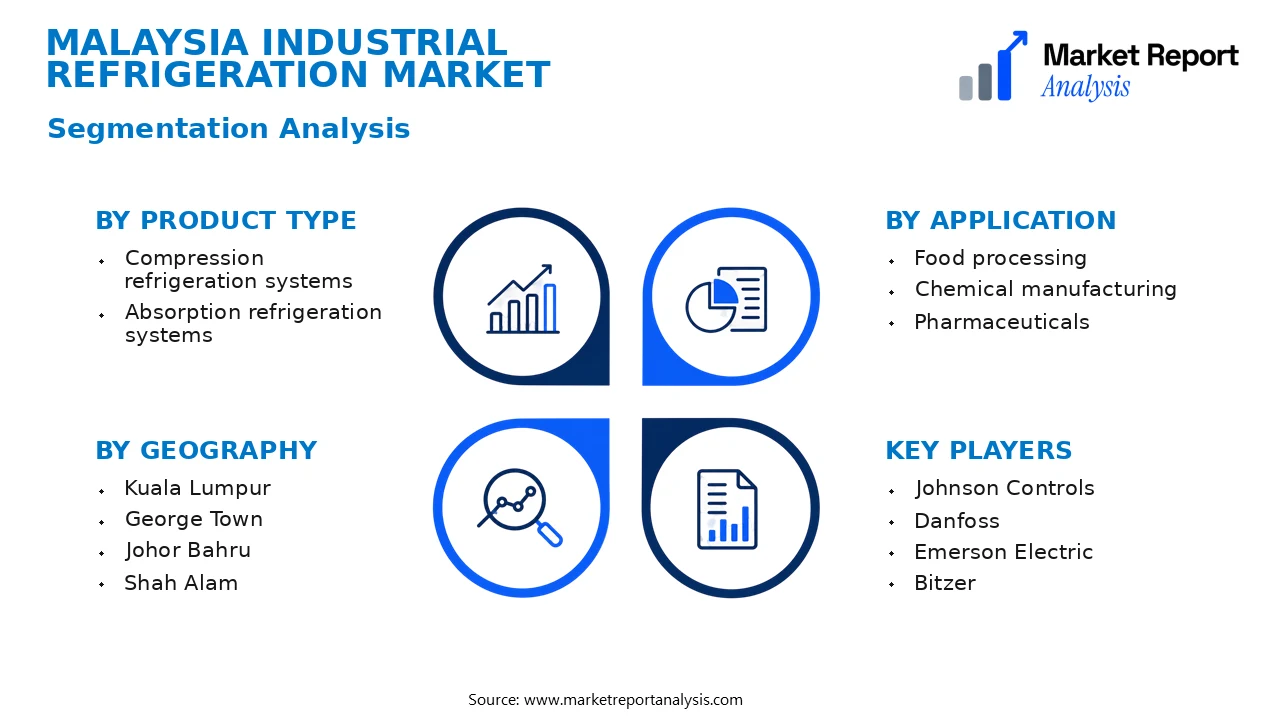
The Malaysia industrial refrigeration market is segmented based on product type, application, and geographic distribution. These segments reflect the diverse needs of various end-user industries, technological adoption rates, and regional economic activities, offering tailored insights into market dynamics and growth opportunities.
- Product Type
- Compression refrigeration systems: These systems are the most widely used type in Malaysia, favored for their energy efficiency and reliability in large-scale industrial applications such as food processing and logistics centers.
- Absorption refrigeration systems: Suitable for particular applications where waste heat is available, these systems are gaining traction in specialty chemical and pharmaceutical manufacturing due to their lower operational costs.
- Application
- Food processing: This segment dominates the market, driven by Malaysia’s vibrant food production sector, requiring precise temperature control for perishable goods, cold storage, and cold chain logistics.
- Chemical manufacturing: Demanding strict temperature regulation, this sector relies extensively on industrial refrigeration to ensure product stability and safety, representing a steadily growing application niche.
- Pharmaceuticals: The pharmaceutical industry’s increasing focus on cold chain integrity to maintain drug efficacy contributes to its rising demand for advanced refrigeration solutions.
- Geography
- Kuala Lumpur: As Malaysia’s financial and industrial hub, Kuala Lumpur hosts numerous industrial plants, cold storage warehouses, and distribution centers, making it a key geographic focus for market growth and technological deployment.
- George Town: Known for its manufacturing and export-oriented industries, George Town’s industries require efficient refrigeration for electronics, textiles, and processed foods, supporting local market expansion.
- Johor Bahru: Proximity to Singapore and thriving industrial zones make Johor Bahru a strategic location for logistics and manufacturing, thereby increasing industrial refrigeration demand in warehousing and production facilities.
- Shah Alam: With a significant industrial base centered around automotive and electronics manufacturing, Shah Alam’s enterprises depend on advanced refrigeration to ensure optimal production conditions.
- Petaling Jaya: As a highly developed industrial and commercial area, Petaling Jaya’s demand for refrigeration spans retail, cold storage, and industrial manufacturing sectors.
- Ipoh: Famed for its mineral resources and manufacturing facilities, Ipoh’s industrial sector requires refrigeration solutions for processing and storage of perishable materials.
- Kota Kinabalu: With growing tourism and seafood export industries, Kota Kinabalu’s cold storage and processing plants are increasingly investing in industrial refrigeration technology to expand capacity and efficiency.
Competitive Intelligence
The Malaysia Industrial Refrigeration Market is characterized by a moderate to high level of competition, with key players including multinational corporations and regional manufacturers vying for market share. Market concentration remains relatively fragmented, fostering intense rivalry and encouraging differentiation through innovation. Leading firms are adopting aggressive business strategies such as expanding their product portfolios, targeting emerging industrial sectors, and strengthening distribution channels across major cities like Kuala Lumpur and Penang. Product innovation is a core focus, with companies investing heavily in R&D to develop energy-efficient, environmentally friendly refrigeration solutions that meet stringent regulatory standards. Strategic partnerships and joint ventures are common, facilitating technology transfer, local footprint expansion, and resource sharing. Several players have also engaged in acquisitions to integrate vertically or broaden their geographical reach, particularly into emerging industrial zones. Expansion strategies emphasize establishing regional manufacturing hubs and enhancing after-sales service networks to boost customer loyalty. Overall, competitive differentiation hinges on technological advancement, service excellence, and tailored solutions, fostering a dynamic environment driven by innovation and strategic collaborations.
Leading Company Profiles
The competitive landscape of the Malaysia industrial refrigeration market features a diverse array of global and regional players, distinguished by technological expertise, product portfolio breadth, and strategic initiatives to capture emerging industrial demand.
- Johnson Controls
- Danfoss
- Emerson Electric
- Bitzer
- Daikin Industries
- Johnson Thermo Electrons
- Carrier Global Corporation
- Mitsubishi Electric
- Lennox International
- Scantec System Solutions
Johnson Controls
Johnson Controls offers extensive refrigeration solutions, integrating IoT-compatible systems that enhance energy efficiency and operational reliability, positioning it as a key innovator in Malaysia’s industrial refrigeration sector.
Danfoss
Danfoss specializes in advanced compressor and control technologies, providing energy-efficient refrigeration solutions tailored to Malaysian industrial needs, with a strategic focus on sustainable and eco-friendly systems.
Emerson Electric
Emerson is renowned for its automation and control systems, delivering integrated refrigeration management solutions that optimize performance and reduce operational costs within Malaysia's extensive industrial network.
Bitzer
Bitzer manufactures high-efficiency compressors for industrial refrigeration, emphasizing innovations in semi-hermetic compressors suitable for large-scale cold storage and food processing facilities in Malaysia.
Daikin Industries
Daikin invests heavily in high-efficiency refrigerants and eco-friendly cooling technologies, expanding its footprint in Malaysia's growing industrial refrigeration segment with a focus on sustainable solutions.
Johnson Thermo Electrons
This entity offers specialized temperature control and refrigeration systems designed for sensitive industrial applications, leveraging cutting-edge thermal management technologies in Malaysia.
Carrier Global Corporation
Carrier delivers robust, energy-efficient refrigeration systems with a strategic emphasis on digital integration and smart system offerings for Malaysian industrial and cold storage facilities.
Mitsubishi Electric
Mitsubishi Electric focuses on inverter-based refrigeration solutions that improve system efficiency and reliability, targeting Malaysia's expanding food manufacturing and distribution sectors.
Lennox International
Lennox's innovative refrigeration and climate control technologies enhance energy efficiency, targeting large-scale industrial cooling applications across Malaysia's key manufacturing hubs.
Scantec System Solutions
Scantec provides custom industrial refrigeration solutions, emphasizing modular design and digital control systems that meet the specific needs of Malaysia’s cold chain and food processing industries.
Strategic Business Developments
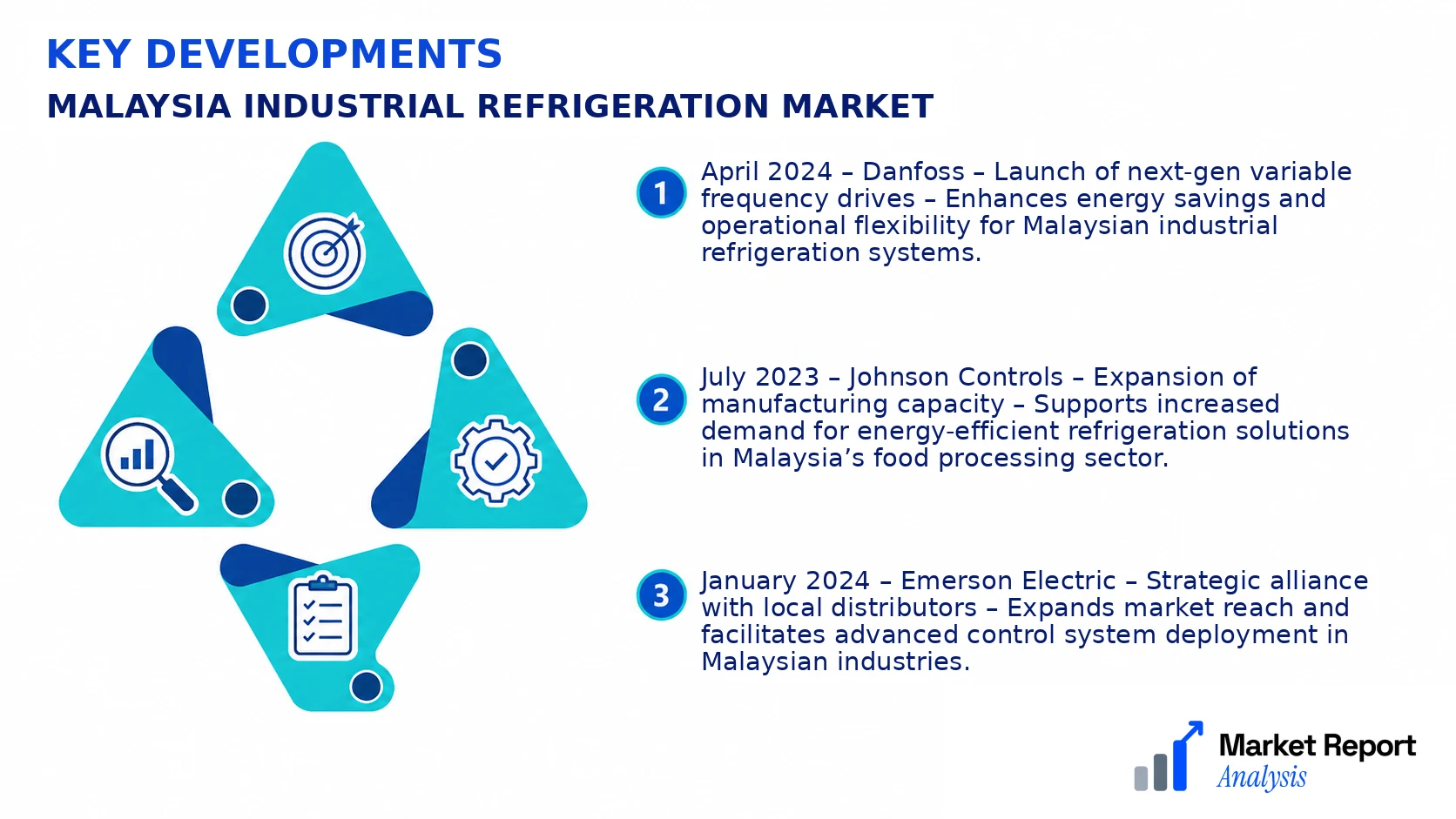
- April 2024 – Danfoss – Launch of next-gen variable frequency drives – Enhances energy savings and operational flexibility for Malaysian industrial refrigeration systems.
- July 2023 – Johnson Controls – Expansion of manufacturing capacity – Supports increased demand for energy-efficient refrigeration solutions in Malaysia’s food processing sector.
- January 2024 – Emerson Electric – Strategic alliance with local distributors – Expands market reach and facilitates advanced control system deployment in Malaysian industries.
- September 2023 – Carrier Global Corporation – Introduction of smart refrigeration solutions – Strengthens digital integration capabilities and operational efficiency for Malaysian cold storage facilities.
- June 2023 – Daikin Industries – Investment in R&D facility – Focuses on eco-friendly refrigerant technologies tailored for Southeast Asian industrial markets, including Malaysia.
Frequently Asked Questions
What is the Malaysia Industrial Refrigeration Market?
The Malaysia Industrial Refrigeration Market encompasses the industry involved in providing refrigeration solutions for various industrial applications across the country. It includes equipment, systems, and services aimed at maintaining temperature control in sectors such as food processing, pharmaceuticals, and manufacturing.
What is the current market size of Malaysia Industrial Refrigeration Market?
As of 2026, the Malaysia Industrial Refrigeration Market is valued at approximately USD 3.5 Billion, reflecting steady growth driven by increasing demand from the food and beverage sector, pharmaceuticals, and expanding manufacturing industries within the country.
What factors are driving the Malaysia Industrial Refrigeration Market?
The market's growth is fueled by factors such as rising industrialization, government initiatives for infrastructure development, the need for energy-efficient refrigeration solutions, and growing awareness of food safety and preservation in the region.
Which region dominates the Malaysia Industrial Refrigeration Market?
Selangor leads the Malaysia Industrial Refrigeration Market, owing to its significant industrial base, dense population, and concentration of key manufacturing and processing facilities that demand advanced refrigeration solutions.
Which segment is expected to grow the fastest?
The cold storage segment is forecasted to experience the fastest growth due to the expanding food processing industry and increasing exports of perishable goods, requiring sophisticated refrigeration infrastructure.
Who are the leading companies operating in the Malaysia Industrial Refrigeration Market?
Key players include Daikin Malaysia, Johnson Controls, Modul-Frost, and Mitsubishi Electric, all of which focus on innovation, energy efficiency, and expanding their regional footprint to capture market share.
Analyst Perspective
The Malaysia Industrial Refrigeration Market is poised for steady long-term growth driven by the expanding food processing, logistics, and cold storage sectors. Technological evolution, particularly in energy-efficient refrigeration systems and automation, will remain critical for competitive differentiation. Investment priorities should focus on advanced cooling technologies that enhance sustainability and operational efficiency to meet Malaysia’s evolving regulatory and environmental standards. Competitive intensity is expected to intensify as both global and regional players seek footholds in this burgeoning market, especially in key urban centers such as Kuala Lumpur, Penang, and Johor Bahru, where logistics and manufacturing hubs are concentrated. Regional growth potential is significant, supported by Malaysia’s strategic location within Southeast Asia and its trade facilitation initiatives. Forward-looking, market participants should prioritize innovation in environmentally friendly refrigerants and smart system integrations to establish long-term leadership. Strategic regional investments and collaborations will be pivotal to capitalize on emerging opportunities within Malaysian cities and adjacent markets.
