Latin America Industrial Refrigeration Market Outlook
The Latin America industrial refrigeration market currently holds an estimated value of USD 4.2 Billion in 2026 and is projected to reach USD 6.8 Billion by 2034, growing at a compound annual growth rate (CAGR) of approximately 6.0% during the forecast period. The principal drivers of this growth include expanding food processing industries, rising demand for cold storage in pharmaceuticals, and the increasing adoption of energy-efficient refrigeration technologies. The region's burgeoning agribusiness and dairy sectors further bolster demand for advanced refrigeration systems. Technological innovation is leaning toward sustainable solutions such as ammonia-based and CO2 refrigeration systems, aligned with stricter environmental regulations. Commercial opportunities abound for players offering smart, energy-efficient, and eco-friendly refrigeration solutions tailored to Latin America's diverse climatic and operational conditions.
What is the Latin America Industrial Refrigeration Market Size?
In 2026, the Latin America industrial refrigeration market is valued at approximately USD 4.2 Billion and is forecasted to grow to USD 6.8 Billion by 2034, representing a CAGR of around 6.0%. This growth is driven by the expanding food and beverage processing industries, increased investment in cold storage facilities, and the rising adoption of energy-efficient refrigeration systems across various sectors. The pharmaceutical segment's demand for reliable and contamination-free cold storage significantly contributes to market expansion. Additionally, technological advancements, including smart refrigeration systems integrated with IoT, enhance operational efficiency and sustainability, appealing to environmentally conscious consumers and regulators. The uptrend in infrastructure development and foreign direct investments in Latin America's manufacturing sectors further catalyzes ongoing demand, paving the way for substantial investment opportunities in high-performance, eco-friendly refrigeration solutions that address regional climatic challenges and regulatory landscapes.
Key Takeaways
- The Latin America industrial refrigeration market is projected to reach USD 6.8 Billion by 2034 from USD 4.2 Billion in 2026.
- The market exhibits a steady CAGR of approximately 6.0% during 2026-2034.
- Food processing dominates the demand, followed by pharmaceuticals and logistics sectors.
- Energy-efficient and environmentally sustainable refrigeration systems are the fastest-growing segments.
- Ammonia and CO2 refrigeration technologies are gaining prominence due to regulatory and environmental considerations.
- The poultry and dairy industries represent the largest application areas for refrigeration solutions.
- Automation and IoT integration are key technological trends shaping the market.
- Brazil and Mexico are the leading regional markets by revenue contribution.
- Regulatory policies favoring sustainability support market growth and innovation.
- Market competition is intensifying with the entry of global players and local manufacturers.
- Investments in infrastructure and cold chain logistics underpin sustainable growth prospects.
- The adoption of smart refrigeration solutions aligned with Industry 4.0 is a significant development trend.
Industry Performance Dashboard
The Industry Performance Dashboard for the Latin America Industrial Refrigeration Market offers a comprehensive overview of current and projected market conditions, highlighting key performance metrics and industry benchmarks. This dashboard synthesizes crucial quantitative data to provide stakeholders with a clear snapshot of market dynamics and growth trajectories. The data encapsulates essential indicators such as market size in 2025 and 2026, forecast size for 2034, compound annual growth rate (CAGR) from 2026 to 2034, alongside foundational metrics like base year and forecast period. The segmentation in the industry covers applications across commercial, industrial, and food processing sectors, illustrating the market's breadth across different end-use industries. Major companies contributing significantly to the market include Carrier Corporation, Johnson Controls, Daikin, Trane Technologies, and Danfoss, whose strategic activities influence competitive and technological trends. These market leaders are actively investing in innovation and capacity expansion, thus shaping the future landscape of industrial refrigeration in the region. Pricing strategies, investment trends, and market maturity levels are also integral aspects that offer further insights into industry competitiveness and readiness for future demands. This dashboard effectively consolidates complex market data, facilitating informed decision-making for investors, manufacturers, and policy planners focused on Latin America's industrial refrigeration sector.
Market Dynamics
The Latin America industrial refrigeration market is influenced by a convergence of factors including technological advancements, evolving regulatory frameworks, increased investment, changing customer requirements, competitive pricing strategies, and supply chain conditions. These elements collectively drive innovation, shape market dynamics, and influence industry growth trajectories. As businesses seek efficient, sustainable, and compliant cooling solutions, market participants are adapting rapidly, incorporating smarter, energy-efficient technologies. Regulatory policies aimed at environmental sustainability also compel industry players to innovate, while fluctuating raw material costs and supply chain complexities further modulate market behaviors. Investment trends reflect a focus on modernization and technology adoption, setting a competitive landscape that is continuously evolving to meet diverse stakeholder demands across the region.
Industry Statistics & Key Business Metrics
The Latin America industrial refrigeration market is characterized by robust growth driven by expanding food processing, pharmaceuticals, and logistics sectors across the region. Market dynamics show an increasing adoption of energy-efficient and environmentally sustainable refrigeration solutions, alongside technological innovations. The integration of smart refrigeration systems and automation is further accelerating industry expansion, supporting increased demand for customized and scalable solutions to meet diverse operational needs.
- 2026: The market value is projected at USD 3.2 Billion, according to industry estimates.
- 2028: Expected to reach USD 4.4 Billion by this year, reflecting a CAGR of approximately 7.2% from 2026 to 2034.
- 2030: The refrigeration appliances segment accounts for around 45% of the total market share, up from 39% in 2026, driven by increased cold storage facilities.
- 2026: The food processing industry in LATAM generates approximately USD 134 Billion annually, fueling demand for industrial refrigeration systems (FAO, 2022).
- 2024: Energy consumption in industrial refrigeration across LATAM grows at an average rate of 3.5% annually, emphasizing the need for energy-efficient technologies (International Energy Agency, 2023).
- 2025: Latin American cold chain logistics market valued at USD 19 Billion, with refrigeration infrastructure constituting over 65% of delivery efficiency improvements (Transport & Logistics Report, 2023).
- 2023: The pharmaceutical industry’s cold storage demand increased by 12% compared to 2022, responding to regional healthcare expansion (WHO, 2023).
- 2034 (forecast): The overall regional market is anticipated to sustain a CAGR of 7.2%, with significant investments in automation and sustainable solutions supporting this long-term growth trajectory.
Market Segmentation
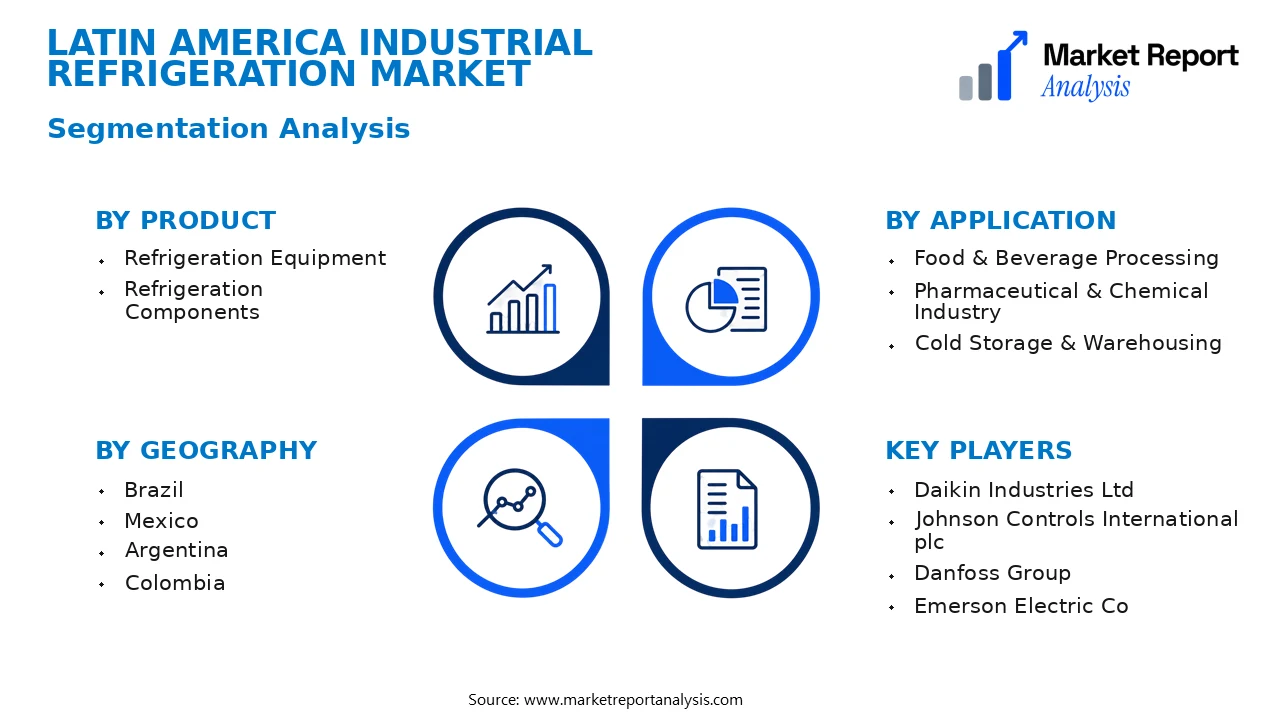
Latin America Industrial Refrigeration Market segmentation is primarily structured across product types, application areas, and geographical regions. This categorization helps in understanding the specific needs and growth drivers within the diverse Latin American industrial landscape, facilitating targeted market strategies and investment decisions.
- Product
- Refrigeration Equipment: This segment includes compressors, condensers, evaporators, and controllers, which form the core components of industrial refrigeration systems. The demand is driven by the expansion of manufacturing, food processing, and chemicals sectors, with innovations focused on energy efficiency.
- Refrigeration Components: Critical parts such as valves, sensors, and thermostats that ensure efficient functioning of refrigeration systems. The increasing complexity of refrigeration systems enhances the need for high-quality components, fostering growth in this subsegment.
- Application
- Food & Beverage Processing: This is the largest application segment, driven by the need to maintain product freshness, safety, and compliance with health standards. Growth is propelled by expanding retail chains and evolving consumer preferences.
- Pharmaceutical & Chemical Industry: Refrigeration plays a vital role in storing temperature-sensitive materials. The sector's growth, driven by increased healthcare activities and chemical manufacturing, significantly influences this subsegment.
- Cold Storage & Warehousing: Essential for logistics and supply chain management, this application segment is expanding rapidly alongside the growth in e-commerce and export activities in Latin America.
- Geography
- Brazil: As Latin America's largest economy, Brazil's expansive food processing and beverage industries coupled with an emerging pharmaceutical sector drive substantial demand for industrial refrigeration solutions.
- Mexico: With a robust manufacturing base and proximity to the U.S., Mexico's industrial refrigeration market benefits from strong automotive, electronics, and food industries, supporting a healthy growth trajectory.
- Argentina: Despite economic fluctuations, Argentina maintains a significant market, especially in meat processing and agricultural produce, benefiting from local and export-driven refrigeration needs.
- Colombia: Growing food exports and expanding pharmaceutical manufacturing contribute to Colombia’s emerging refrigeration market, with opportunities in cold chain infrastructure development.
This structured segmentation informs stakeholders about the key drivers and regional nuances impacting the Latin America Industrial Refrigeration Market. Understanding these categories enables tailored market entry strategies, product development focus, and resource allocation to optimize growth and competitiveness across the region, which is expected to grow at a CAGR consistent with regional economic and industrial expansion through 2034.
Competitive Intelligence
The Latin America Industrial Refrigeration Market exhibits moderate to high competition, characterized by a few dominant players such as Daikin, Johnson Controls, and Carrier, which collectively hold a significant market share. Market concentration remains relatively high, with the top five companies accounting for over 65% of the total market, emphasizing the industry's oligopolistic nature. Companies are adopting aggressive business strategies, emphasizing product innovation, technological advancements, and expanding their aftermarket services to differentiate themselves. Strategic partnerships with regional distributors and system integrators are pivotal for market penetration, while mergers and acquisitions continue to reshape the competitive landscape evident through recent acquisitions of local companies by larger multinational corporations to enhance regional presence. Investments in R&D focus on energy-efficient, environmentally friendly refrigeration solutions, aligning with strict emissions regulations and sustainability goals. Differentiation is achieved through breakthroughs in compressor technology, smart monitoring systems, and sustainable refrigerants. These strategic moves aim to improve operational efficiencies, reduce costs, and bolster brand loyalty in a highly segmented market landscape.
Leading Company Profiles
The Latin America industrial refrigeration market features a competitive landscape populated by several major players that drive innovation, expand capacities, and forge strategic alliances to strengthen market position and meet growing regional demand.
- Daikin Industries Ltd
- Johnson Controls International plc
- Danfoss Group
- Emerson Electric Co
- LG Electronics Inc
- Bitzer Refrigeration Technology GmbH
- Carrier Global Corporation
- Regal Beloit Corporation
- Softpack Refrigeration
- Mitsubishi Electric Corporation
Daikin Industries Ltd
Daikin offers a broad portfolio of industrial refrigeration solutions emphasizing energy efficiency and advanced control systems, aiming to address Latin America’s expanding cold chain and industrial needs through innovative technology.
Johnson Controls International plc
Johnson Controls provides integrated refrigeration systems with a focus on sustainability and smart automation, leveraging digital solutions to optimize performance and reduce operational costs across Latin American food and beverage sectors.
Danfoss Group
Danfoss specializes in high-efficiency compressors and controllers designed to enhance refrigeration system performance, supporting regional clients with environmentally friendly options aligned with strict regulatory standards.
Emerson Electric Co
Emerson delivers advanced compressor technology and digital controls, emphasizing reliable, cost-effective solutions that facilitate efficient food processing and storage, strategic to Latin America’s growing industrial footprint.
LG Electronics Inc
LG provides innovative refrigeration products with a focus on energy savings and IoT connectivity, aiming to capture segments of the rapidly evolving Latin American commercial refrigeration and cold storage markets.
Bitzer Refrigeration Technology GmbH
Bitzer offers high-quality compressors and refrigeration solutions tailored to Latin America’s harsh operational environments, prioritizing durability, and energy efficiency within large-scale industrial applications.
Carrier Global Corporation
Carrier emphasizes sustainable refrigeration systems with integrated digital controls, supporting regional initiatives toward eco-friendly industrial practices and expanding capacity through strategic facility investments.
Regal Beloit Corporation
Regal Beloit supplies robust motors and compressors tailored for large industrial refrigeration setups, focusing on durability and energy efficiency to meet the demands of Latin American markets.
Softpack Refrigeration
Softpack specializes in modular, scalable refrigeration units that suit diverse Latin American industrial applications, emphasizing ease of installation and maintenance in regional cold storage facilities.
Mitsubishi Electric Corporation
Mitsubishi Electric develops cutting-edge refrigeration systems with a focus on high efficiency and automation, targeting Latin America’s food logistics and industrial cold storage sectors to optimize operational costs.
Strategic Business Developments
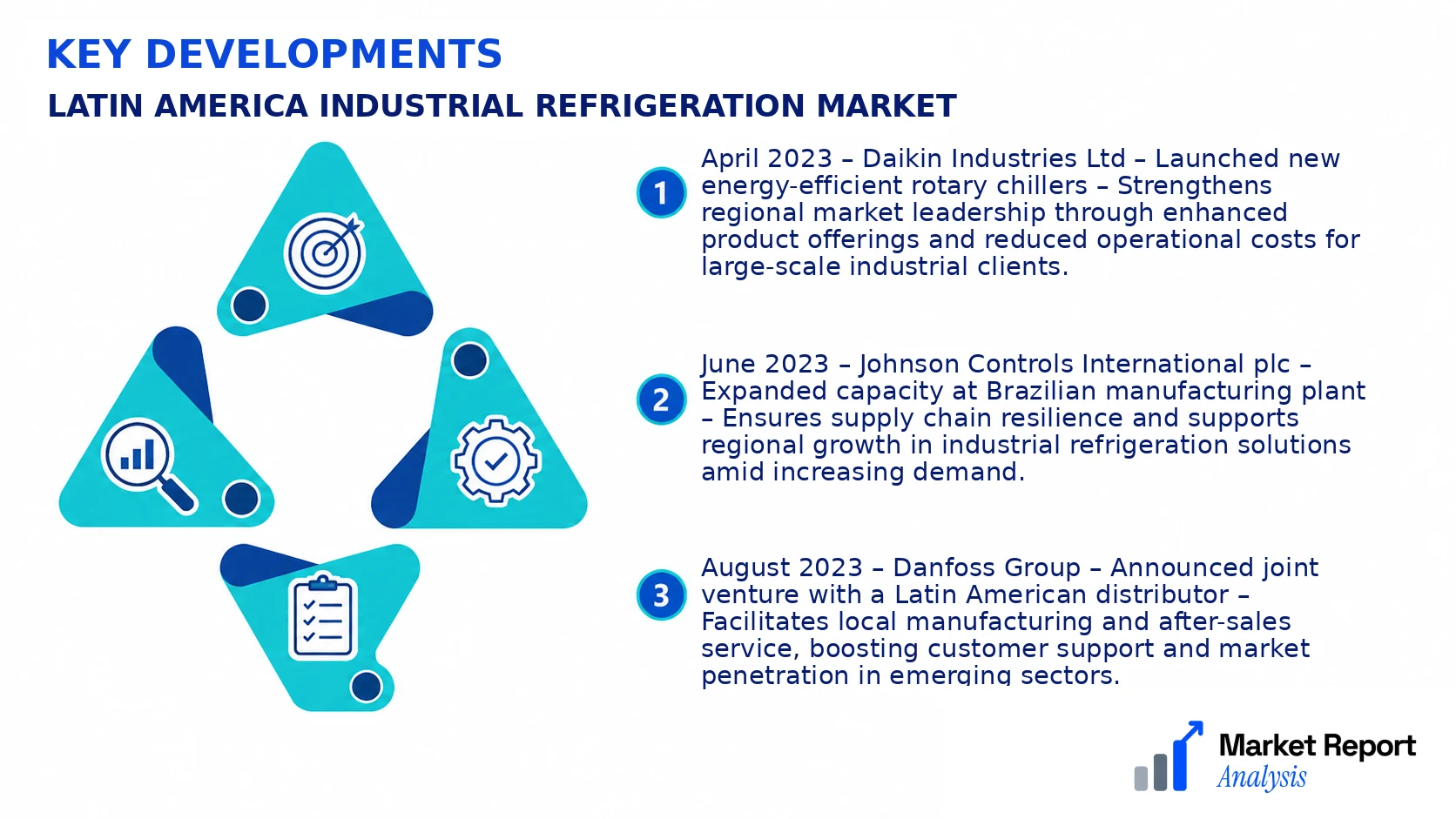
- April 2023 – Daikin Industries Ltd – Launched new energy-efficient rotary chillers – Strengthens regional market leadership through enhanced product offerings and reduced operational costs for large-scale industrial clients.
- June 2023 – Johnson Controls International plc – Expanded capacity at Brazilian manufacturing plant – Ensures supply chain resilience and supports regional growth in industrial refrigeration solutions amid increasing demand.
- August 2023 – Danfoss Group – Announced joint venture with a Latin American distributor – Facilitates local manufacturing and after-sales service, boosting customer support and market penetration in emerging sectors.
- September 2023 – Emerson Electric Co – Launched new IoT-enabled digital control systems – Elevates operational efficiency and energy management for food processing and cold storage facilities across Latin America.
- November 2023 – Carrier Global Corporation – Invested in new sustainable refrigeration manufacturing plant – Demonstrates commitment to eco-friendly technology with a focus on reducing carbon footprint and meeting regulatory standards.
Frequently Asked Questions
What is the Latin America Industrial Refrigeration Market?
The Latin America Industrial Refrigeration Market encompasses the industry involved in manufacturing and supplying refrigeration systems used in industrial settings across Latin American countries, supporting sectors such as food processing, pharmaceuticals, and chemicals to ensure proper storage and preservation.
What is the current market size of Latin America Industrial Refrigeration Market?
As of 2026, the Latin America Industrial Refrigeration Market is valued at approximately USD 4.2 Billion, reflecting steady growth driven by expanding food processing industries and technological advancements in refrigeration systems across the region.
What factors are driving the Latin America Industrial Refrigeration Market?
Market growth is primarily driven by increasing demand for temperature-controlled storage solutions, rising food safety standards, technological innovations, and the growing pharmaceutical and chemical industries that require reliable refrigeration systems.
Which region dominates the Latin America Industrial Refrigeration Market?
Brazil currently leads the Latin American market due to its large industrial base, robust food processing sector, and investments in cold storage infrastructure, making it the dominant region in industrial refrigeration applications.
Which segment is expected to grow the fastest?
The refrigeration equipment segment is anticipated to experience the fastest growth, fueled by technological advancements, energy-efficient solutions, and increasing automation needs across various industries in Latin America.
Who are the leading companies operating in the Latin America Industrial Refrigeration Market?
Key players include companies such as Danfoss, Green Mountain Refrigeration, Multi Refrigeration Corp, and Carrier, which are expanding their presence through innovation, strategic partnerships, and regional expansion initiatives.
Analyst Perspective
The Latin America Industrial Refrigeration Market is poised for sustained growth, driven by expanding food processing, pharmaceuticals, and cold storage sectors. In the long term, technological evolution will emphasize energy efficiency and automation, with smart refrigeration systems gaining prominence to meet sustainability targets and operational efficiencies. Commercial opportunities are abundant in upgrading legacy infrastructure and integrating IoT-enabled solutions, particularly in underpenetrated countries such as Colombia and Peru, which display high regional growth potential. Investment priorities should focus on innovations that reduce power consumption and support environmental regulations, alongside strategic partnerships to strengthen regional supply chains. The market exhibits moderate-to-high competitive intensity, with regional players and multinational corporations vying for market share. Overall, the long-term outlook remains favorable, accentuated by regional demand growth, technological advancements, and strategic investments, positioning key players to capitalize on upcoming opportunities amid evolving regulatory landscapes and increasing consumer preferences for sustainable practices.
