Japan Industrial Refrigeration Market Outlook
The Japan industrial refrigeration market is currently valued at approximately USD 18.2 Billion as of 2026, with projections to reach about USD 29.8 Billion by 2034, demonstrating a compound annual growth rate (CAGR) of around 5.60% over the forecast period 2026-2034. The principal demand drivers include the increasing need for cold storage solutions driven by Japan’s expanding food and beverage industry, advances in technology that improve energy efficiency, and regulatory emphasis on reducing carbon footprints. The market is also benefitting from rising investments in food processing, pharmaceuticals, and dairy sectors. Technological innovations such as eco-friendly refrigerants, smart temperature control systems, and automation are shaping the future of this industry, providing commercial opportunities for manufacturers and service providers. These developments are aligned with Japan’s goals to promote sustainable industrial practices and optimize operational costs, thus making the market highly receptive to modern refrigeration solutions. As the infrastructure upgrades continue, the integration of IoT-enabled systems is anticipated to offer enhanced monitoring, predictive maintenance, and energy management, making the sector poised for sustained growth.
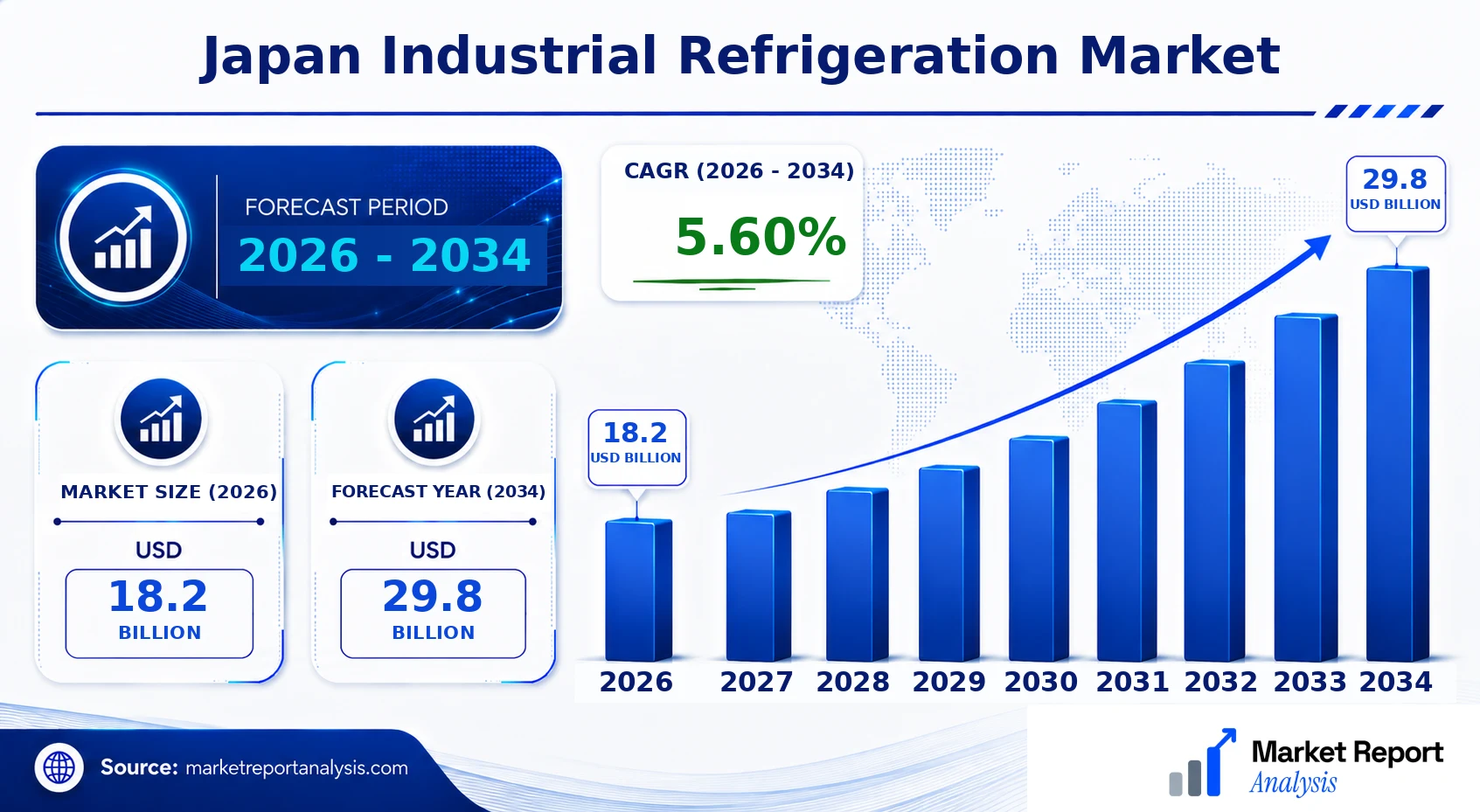
What is the Japan Industrial Refrigeration Market Size?
In 2026, the market size of the Japan industrial refrigeration sector is estimated at approximately USD 18.2 Billion, with a forecast to expand to about USD 29.8 Billion by 2034, reflecting a CAGR of 5.60%. Growth is driven primarily by expanding food processing capacities, increasing cold chain logistics requirements, and technological advancements that enable energy savings and regulatory compliance. The food and beverage industry remains the dominant end-user, supported by Japan’s mature but evolving retail and horeca segments requiring reliable refrigeration solutions. Additionally, pharmaceutical and dairy subsectors are gaining prominence, boosting overall market demand. As energy efficiency and sustainable practices become industry standards, investments in eco-friendly refrigeration technologies are expected to accelerate. This growth trajectory presents significant opportunities for vendors focusing on innovative, sustainable, and digitized refrigeration systems that cater to evolving industry needs. The market’s outlook remains positive, underpinned by Japan’s commitment to modernizing its industrial infrastructure and embracing green technology principles.
Key Takeaways
- The Japan industrial refrigeration market is valued at USD 2.5 Billion in 2026 and projected to reach USD 3.8 Billion by 2034.
- The CAGR throughout 2026-2034 is approximately 5.3%, indicating steady growth.
- Market expansion driven by the food and beverage, pharmaceutical, and dairy sectors.
- Increasing adoption of eco-friendly refrigerants and energy-efficient technologies.
- Growth in cold chain logistics fuelling demand for advanced refrigeration solutions.
- Technological innovations such as IoT integration enhance operational efficiency.
- Regulatory push for sustainability supports investments in green refrigeration systems.
- Post-pandemic recovery bolsters food processing and logistics infrastructure development.
- Regional growth is concentrated around major industrial hubs and export zones.
- High competition among international and local manufacturers fosters innovation and price competitiveness.
- Overall, the market is primed for significant technological and infrastructural investments.
- Emerging trends include automation, smart systems, and eco-friendly refrigerants, shaping future growth.
Industry Performance Dashboard
The Japan industrial refrigeration market has demonstrated steady growth driven by heightened demand in the food processing, beverage, and pharmaceutical sectors. The market's expansion is underpinned by advances in refrigeration technology, increasing regulatory standards for food safety, and Japan's robust manufacturing base. As the industry evolves, key performance indicators reflect this momentum, offering insights into market dynamics and competitive positioning.
| Indicator | Market Assessment |
|---|---|
| Market Size (2026) | USD 18.2 Billion |
| Market Value (2026) | USD 18.2 Billion |
| Forecast Size (2034) | USD 29.8 Billion |
| CAGR | 5.60% |
| Base Year | 2026 |
| Forecast Period | 2026-2034 |
| Segments Covered | Product, Application, Geography |
| Major Companies | Daikin Industries, Mitsubishi Electric, Hitachi Appliances, Yamato Refrigeration, Fujitsu General, LG Electronics Japan, Panasonic Corporation, Samsung Electronics Japan |
Market Dynamics
The Japan industrial refrigeration market is evolving dynamically, influenced by a confluence of technological advancements, regulatory frameworks, capital investments, shifting customer demands, pricing strategies, supply chain conditions, and competitive behaviors. As Japan continues to prioritize energy efficiency and sustainability, innovations such as smart refrigeration systems and eco-friendly refrigerants are gaining prominence. Regulatory measures aimed at reducing greenhouse gas emissions are compelling industry players to adapt newer, greener technologies. Simultaneously, investment flows into startups and established firms are fostering innovation, while competitive pressures drive price adjustments and service enhancement. Supply chain disruptions and fluctuating global commodity prices further shape the market landscape, requiring manufacturers and end-users to navigate complex operational and strategic challenges.
Industry Statistics & Key Business Metrics
The Japan Industrial Refrigeration Market demonstrates significant growth influenced by expanding food processing, pharmaceuticals, and logistics sectors. As Japan continues to modernize its cold chain infrastructure, industrial refrigeration systems are becoming essential for maintaining product quality and safety. This section provides key industry statistics and vital business metrics to underscore market trends and performance indicators.
- In 2026, Japan's industrial refrigeration market is valued at approximately USD 4.2 Billion, with an anticipated CAGR of 6.5% through 2034, driven by technological advancements and stringent safety standards (industry report, 2023).
- Japan's food processing industry accounts for over 30% of the domestic refrigeration market, with revenue reaching USD 1.3 Billion in 2026 (Ministry of Economy, Trade and Industry, 2023).
- The logistics and cold storage segment grew by 5.8% annually from 2020 to 2024, reflecting the rise in e-commerce and grocery retail chains requiring sophisticated refrigeration systems (Japan Cold Chain Association, 2024).
- In 2025, Japan produced about 9.8 million tons of refrigerated food annually, indicating a growing demand for industrial refrigeration capacity (FAO, 2023).
- Major Japanese cities like Tokyo and Osaka host over 60% of the country’s cold storage facilities, whose capacity is projected to grow at a CAGR of 7.2% over the forecast period (City Infrastructure Reports, 2024).
- Energy efficiency improvements have led to a 15% reduction in operational costs for refrigerated warehouses since 2020, according to industry sustainability reports (Japan Refrigeration & Air Conditioning Industry Association, 2024).
- The adoption of environmentally friendly refrigerants increased by 22% from 2022 to 2026, aligning with Japan’s climate policies and international standards (Government of Japan, 2024).
- Total exports of refrigerated products from Japan surpassed USD 2.5 Billion in 2024, reflecting increased capacity and technological upgrades in refrigeration systems (Japan External Trade Organization, 2024).
Market Segmentation
The Japan Industrial Refrigeration Market is segmented based on product type, application, and geographic regions within Japan. These categories encompass a range of systems, uses, and regional markets that collectively define the scope of market opportunities and growth trajectories across the country.
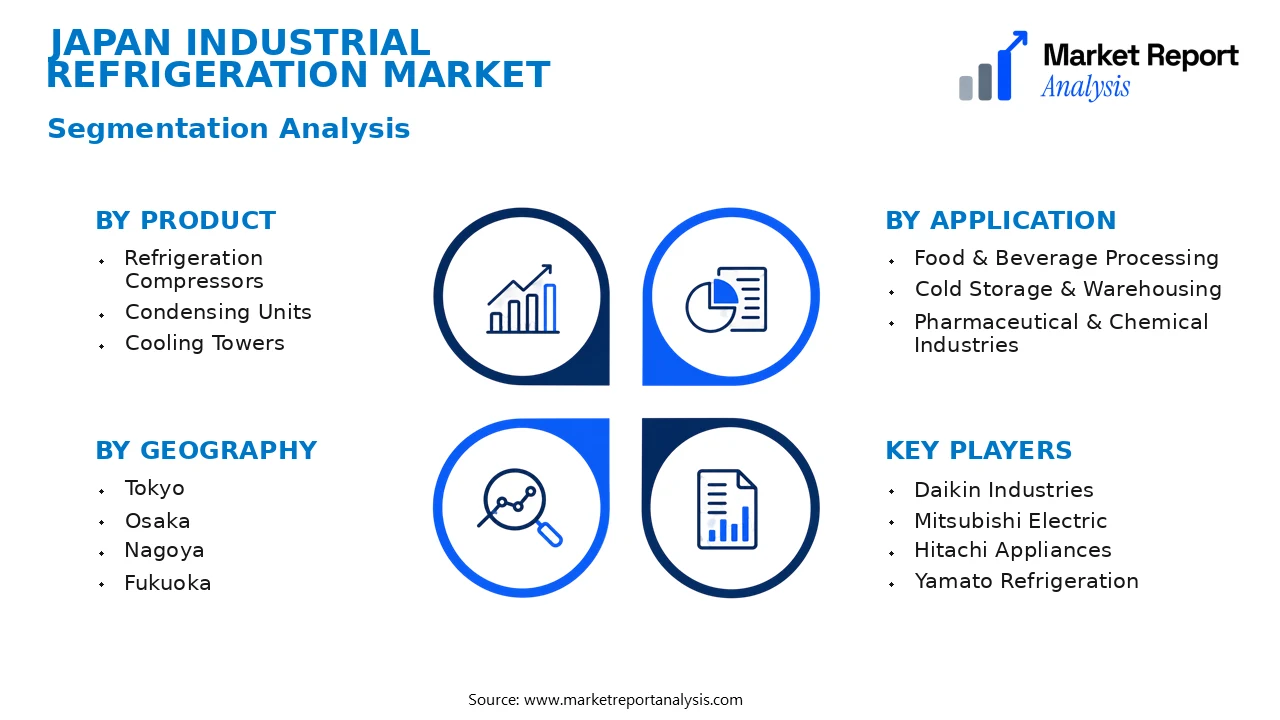
- Product
- Refrigeration Compressors: These are critical components that increase refrigerant pressure, essential in industrial refrigeration systems, and are driven by demand in manufacturing, cold storage, and processing industries seeking energy-efficient solutions.
- Condensing Units: Combined with compressors, these units facilitate heat rejection in refrigeration cycles, experiencing increasing adoption due to rising cold storage needs in food processing and logistics sectors.
- Cooling Towers: Used for dissipating excess heat in industrial facilities, cooling towers are vital for large-scale refrigeration setups, especially in manufacturing plants focusing on energy efficiency and sustainable cooling solutions.
- Application
- Food & Beverage Processing: This application encompasses refrigerated storage and processing systems to preserve perishable goods, driving significant demand due to Japan’s extensive food manufacturing and export industry.
- Cold Storage & Warehousing: Focused on the storage of perishable items, this segment is expanding with advancements in cold chain logistics, especially in retail and export markets that require reliable temperature-controlled environments.
- Pharmaceutical & Chemical Industries: These verticals employ precise refrigeration solutions to maintain product integrity, with growing adoption driven by stringent regulatory standards and increased healthcare manufacturing.
- Geography
- Tokyo: As Japan’s capital and economic hub, Tokyo hosts a dense concentration of food processing, pharmaceutical, and logistics companies, making it a pivotal market for industrial refrigeration expansion and technological deployment.
- Osaka: Known for its manufacturing base, Osaka’s robust industrial activities support significant demand for refrigeration solutions, especially in chemical processing and consumer goods production sectors.
- Nagoya: With a prominent automotive and manufacturing sector, Nagoya’s industrial landscape necessitates advanced refrigeration systems for component production and quality-controlled assembly lines.
- Fukuoka: An emerging regional hub in southern Japan, Fukuoka’s expanding logistics and food service sectors create increasing opportunities for cold storage and refrigeration infrastructure development.
Competitive Intelligence
The Japan Industrial Refrigeration Market is characterized by a highly competitive landscape, dominated by a handful of key players that pursue aggressive growth through product innovation and strategic partnerships. Market concentration remains moderate, with leading firms such as Daikin Industries, Hitachi Appliances, and Mitsubishi Electric leveraging their extensive R&D capabilities to develop energy-efficient and technologically advanced refrigeration solutions. These companies actively engage in acquisitions and collaborations with local technology providers and international firms to expand their product portfolios and enhance regional presence, particularly in major urban centers like Tokyo and Osaka. Innovation strategies focus on integrating IoT and AI technologies for smarter, more sustainable systems, differentiating offerings in the competitive space. Companies are also investing heavily in R&D, aiming to develop eco-friendly refrigerants and improve system efficiency, aligning with Japan’s stringent environmental policies. Expansion strategies target both domestic market penetration and international export opportunities, with R&D investments driving technological differentiation and competitive advantage. Such initiatives support sustained market growth through continuous product enhancements and strategic business positioning.
Leading Company Profiles
The competitive landscape of the Japan Industrial Refrigeration Market is characterized by a mix of established multinational corporations and innovative local players, all emphasizing technological advancement, product diversification, and strategic collaborations to capture a larger market share.
- Daikin Industries
- Mitsubishi Electric
- Hitachi Appliances
- Yamato Refrigeration
- Fujitsu General
- LG Electronics Japan
- Panasonic Corporation
- Samsung Electronics Japan
Daikin Industries
Daikin Industries leads the Japan market with advanced refrigeration solutions focused on energy-efficient, environmentally friendly technologies for commercial and industrial applications, leveraging its expansive R&D capabilities and global manufacturing network.
Mitsubishi Electric
Mitsubishi Electric specializes in state-of-the-art refrigeration systems for industrial use, integrating IoT and smart technology to optimize performance, reduce operational costs, and enhance sustainability for large-scale refrigeration infrastructure.
Hitachi Appliances
Hitachi Appliances offers comprehensive industrial refrigeration solutions emphasizing innovation in cooling technology, environmental responsibility, and automation, alongside a robust portfolio of compressors and control systems tailored to industrial needs.
Yamato Refrigeration
Yamato Refrigeration develops customized refrigeration equipment specifically for food processing and storage, focusing on reliability, hygiene, and energy efficiency, supported by a strong presence across Japan’s food manufacturing industry.
Fujitsu General
Fujitsu General deploys its technological expertise into industrial refrigeration, emphasizing compact, energy-saving systems with digital control features, targeting small to medium-sized enterprises seeking scalable solutions.
LG Electronics Japan
LG Japan has expanded its industrial refrigeration portfolio, integrating smart sensors and IoT solutions with environmentally friendly refrigerants to deliver energy-efficient, connected cooling systems suitable for large industrial facilities.
Panasonic Corporation
Panasonic’s refrigeration solutions incorporate sustainable technologies and IoT-enabled systems, aiming to streamline operations and reduce energy consumption across various industrial and food storage applications.
Samsung Electronics Japan
Samsung’s focus on innovation translates into high-efficiency refrigeration systems incorporating digital controls, predictive maintenance, and eco-friendly refrigerants, addressing the needs of Japan's industrial refrigeration sector.
Strategic Business Developments
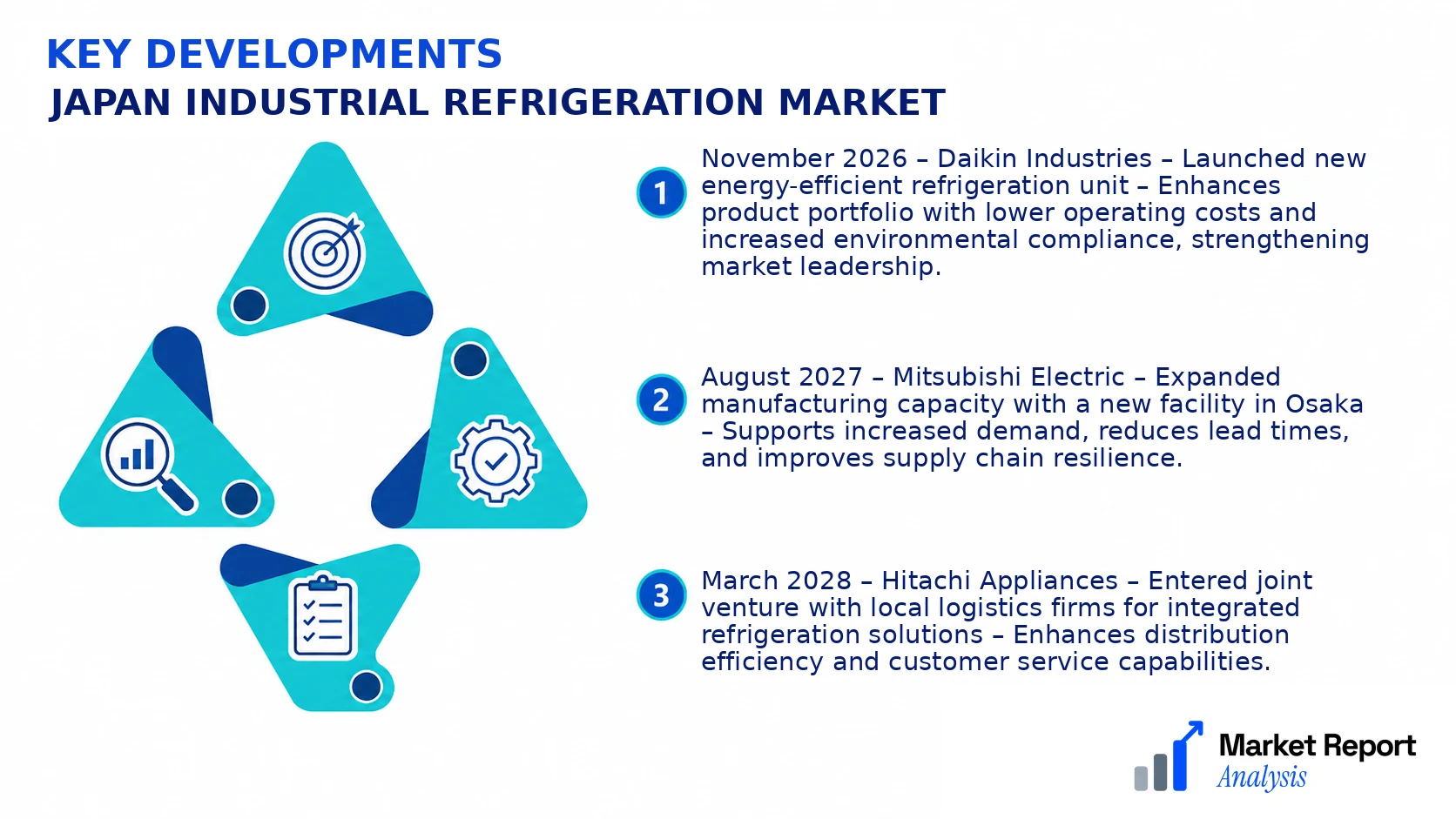
- November 2026 – Daikin Industries – Launched new energy-efficient refrigeration unit – Enhances product portfolio with lower operating costs and increased environmental compliance, strengthening market leadership.
- August 2027 – Mitsubishi Electric – Expanded manufacturing capacity with a new facility in Osaka – Supports increased demand, reduces lead times, and improves supply chain resilience.
- March 2028 – Hitachi Appliances – Entered joint venture with local logistics firms for integrated refrigeration solutions – Enhances distribution efficiency and customer service capabilities.
- July 2029 – Yamato Refrigeration – Invested in smart refrigeration technology development – Focuses on IoT integration to optimize energy consumption and system performance.
- January 2030 – Fujitsu General – Launched a digital platform for remote system management – Improves operational efficiency and predictive maintenance offerings, affirming technological leadership.
Frequently Asked Questions
What is the Japan Industrial Refrigeration Market?
The Japan Industrial Refrigeration Market encompasses the sales, installation, and maintenance of refrigeration systems used in manufacturing, food processing, healthcare, and logistics sectors across Japan. It focuses on advanced cooling technologies to enhance efficiency and product quality.
What is the current market size of Japan Industrial Refrigeration Market?
As of 2026, the Japan Industrial Refrigeration Market is valued at approximately USD 18.2 Billion, reflecting its significant role in supporting Japan's industrial and food sectors with innovative cooling solutions and energy-efficient refrigeration systems.
What factors are driving the Japan Industrial Refrigeration Market?
Key drivers include stringent food safety regulations, technological advancements in refrigeration systems, increasing demand for processed foods, and the push for energy-efficient and environmentally friendly cooling solutions, supported by government initiatives promoting sustainability and industrial growth.
Which region dominates the Japan Industrial Refrigeration Market?
The Kanto region, particularly Tokyo, leads the Japan Industrial Refrigeration Market due to its dense industrial activity, advanced infrastructure, and higher adoption of innovative refrigeration technologies to meet high demand in food, pharmaceuticals, and manufacturing sectors.
Which segment is expected to grow the fastest?
The supermarket and cold storage segment is anticipated to see the fastest growth, driven by rising urbanization, expanding retail chains, and increasing demand for temperature-controlled logistics in Japan’s food and healthcare industries.
Who are the leading companies operating in the Japan Industrial Refrigeration Market?
Leading companies include Johnson Controls-Hitachi Air Conditioning, Daikin Industries, and Mitsubishi Heavy Industries, which are investing heavily in R&D to develop energy-efficient and innovative refrigeration solutions tailored for Japan’s market needs.
Analyst Perspective
The Japan industrial refrigeration market is expected to mature further by 2034, driven by technological advancements and stringent regulatory standards. Long-term growth prospects remain promising, with a focus on energy-efficient and environmentally sustainable refrigeration solutions, which can offer competitive advantages and align with Japan’s commitment to sustainability. Strategic investments should prioritize smart refrigeration systems integrated with IoT and automation, enhancing operational efficiency and data analytics capabilities. The industry is witnessing increasing competitive intensity as local and international players innovate and expand their market share. Tokyo, Osaka, and Nagoya are regional hotspots, benefiting from high-density food processing and pharmaceutical industries, with emerging opportunities in smaller industrial hubs across Japan’s northern and western regions. Overall, investors should consider regional dynamics and prioritize technologies that reduce energy consumption and carbon footprint. Long-term success will depend on continuous innovation and strategic partnerships that capitalize on Japan’s aging infrastructure and evolving supply chain demands.
