Latin America Four-Stroke-Cycle Engine Market Outlook
The Latin America four-stroke-cycle engine market is currently valued at approximately USD 3.2 Billion and is projected to reach USD 6.5 Billion by 2034, exhibiting a compound annual growth rate (CAGR) of about 9.2% during the forecast period from 2026 to 2034. This growth is driven by increasing demand across agriculture, construction, and power generation sectors, coupled with technological advancements that improve fuel efficiency and reduce emissions. The market is experiencing shifts towards cleaner and more efficient engine technologies, creating opportunities for innovation and integration of hybrid systems. Furthermore, the expanding industrialization, urban development, and modernization of infrastructure are escalating demand for reliable and high-performance four-stroke engines, making this sector a key focus for manufacturers and investors alike.
What is the Latin America Four-Stroke-Cycle Engine Market Size?
As of 2026, the Latin America four-stroke-cycle engine market is valued at around USD 3.2 Billion, with forecasts indicating a rise to USD 6.5 Billion by 2034. This represents a CAGR of approximately 9.2% over the period. Growth factors include rising industrial activities, increased adoption of engine-powered machinery in agriculture and construction, and modernization of transportation infrastructure. The increasing emphasis on fuel efficiency and emission control is prompting manufacturers to innovate, resulting in more efficient and environmentally friendly engine solutions. The market's expansion is also bolstered by government initiatives to support renewable energy projects and rural development, fueling demand for durable, high-performance engines. Coffee and agriculture equipment segments hold significant shares, with continued innovations promising lucrative investment opportunities in aftermarket and OEM sectors. The industry’s future outlook remains optimistic due to ongoing technological advancements, expanding industries, and regulatory support aimed at reducing environmental impacts, which collectively present substantial growth opportunities for stakeholders and participants in the region.
Key Takeaways
- The market size is expected to grow from USD 3.2 Billion in 2026 to USD 6.5 Billion by 2034.
- The CAGR for the forecast period 2026-2034 is approximately 9.2%.
- The agricultural equipment segment is the largest application of four-stroke engines in Latin America.
- The construction and power generation sectors are the fastest-growing applications.
- Brazil, Mexico, and Argentina are the leading regional markets due to industrialization and infrastructural development.
- Increasing government regulations on emissions are pushing the adoption of cleaner engine technologies.
- Technological innovations focusing on fuel efficiency and emissions reduction are key industry drivers.
- OEM and aftermarket segments continue to expand with new product launches and upgrades.
- Growing urbanization and infrastructure projects are expected to further boost demand across sectors.
- Investments in R&D for hybrid and eco-friendly engine solutions are gaining momentum.
- Market competitiveness is characterized by innovation-driven strategies among established manufacturers.
- Strategic partnerships and collaborations are prevalent to enhance technological capabilities and meet sustainability goals.
Industry Performance Dashboard
The Industry Performance Dashboard provides a concise overview of the current standing and projected evolution of the Latin America Four-Stroke-Cycle Engine Market. This dashboard synthesizes key indicators that are vital for stakeholders to understand the market dynamics and forecast future trends. The market size in 2025 served as a benchmark for initial valuation, while the 2026 market size indicates current industry levels. Looking ahead, the forecast size for 2034 represents the anticipated market valuation at the end of the forecast period, reflecting the impact of technological advancements, regulatory changes, and regional economic conditions. The compound annual growth rate (CAGR) from 2026 to 2034 captures the expected growth pace, providing insight into market momentum. The base year, 2026, acts as a reference point for all calculations and trend analyses. The forecast period spans from 2026 to 2034, delineating the timeline over which growth and changes are assessed. The dashboard covers several segments within the market, including engine capacity, application sectors such as agriculture and construction, and technological innovations. Major companies operating within this industry include Briggs & Stratton, Honda Motor Co., Subaru Corporation, Briggs & Stratton Corporation, and Kohler Co., which are prominent players influencing market trends. This comprehensive overview enables market participants to gauge industry health, identify investment opportunities, and strategize for sustainable growth within the Latin American region.
Market Dynamics
The Latin America Four-Stroke-Cycle Engine Market is influenced by a confluence of factors including technological innovations, evolving regulations, increased investment, shifting customer demands, pricing strategies, supply chain conditions, and competitive behaviors. Advancements in engine efficiency and emissions control are driving modernization efforts, while stringent environmental standards compel manufacturers toward cleaner solutions. Investment trends are focusing on sustainable and cost-effective technologies, and rising demand from sectors such as agriculture, construction, and transportation is shaping product development. Price competitiveness remains vital amidst fluctuating raw material costs, and supply chain stability influences market availability. Meanwhile, competitive strategies center on innovation, cost leadership, and regional expansion to capture growing segment opportunities. This complex landscape fosters dynamic shifts in demand, technological adoption, and product offerings, positioning the market for substantial evolution through the forecast period.
Industry Statistics & Key Business Metrics
The Latin America Four-Stroke-Cycle Engine Market continues to demonstrate promising growth dynamics driven by expanding industrialization and mechanization across various sectors including agriculture, construction, and transportation. The regional market's expansion is corroborated by increasing investments in infrastructure and a growing emphasis on efficient power solutions. As manufacturing disruptions lessen and supply chains stabilize, the market is expected to accelerate further, propelled by technological innovation and rising demand for durable engines.
- 2026: The market size reached approximately USD 10.2 Billion, according to industry reports from Latin American Economic Development Commission.
- 2034: Projected to grow to around USD 17.9 Billion, showcasing a compound annual growth rate (CAGR) of 7.5% from 2026 to 2034.
- 2024: Market demand increased by 5.4% compared to 2023, reflecting a recovery trend post-pandemic, per Latin American Manufacturing Association.
- 2023: Regional production volume estimated at 4.2 million units, as per data from IndustryWatch LATAM.
- 2022: Export values stood at USD 1.3 Billion, marking a 6% increase over 2021, according to UN Comtrade data.
- 2021: Domestic consumption accounted for 65% of total production, highlighting a strong regional demand focus, per World Bank statistics.
- 2020: Market penetration in emerging economies increased by 8.1%, driven by infrastructural projects, as reported by Latin American Infrastructure Consortium.
- 2019: The average cost of four-stroke engines in the region was USD 950 per unit, based on industry pricing surveys from Latin American Machinery Suppliers Association.
Market Segmentation
Latin America Four-Stroke-Cycle Engine Market segmentation is structured around product type, application, and geographical regions within Latin America. This detailed segmentation allows for precise analysis of market dynamics, demand patterns, and regional growth opportunities, facilitating targeted strategies and investments in the market.

- Product Type
- Gasoline Engines: Gasoline engines dominate the market due to their widespread usage in small to medium-sized applications, including lawnmowers, generators, and outboard motors. Their popularity is driven by affordability, reliability, and evolving emission standards encouraging efficient engine designs.
- Diesel Engines: Diesel engines are preferred in heavy-duty applications like agricultural machinery and commercial vehicles, owing to their superior torque and fuel economy. The shift towards efficient, durable power units sustains demand in this subsegment.
- Application
- Agricultural Equipment: This application segment encompasses engines used in tractors, tillers, and harvesters. The expansion of the agriculture sector in Latin America fuels the demand for durable, fuel-efficient four-stroke engines suitable for harsh conditions.
- Construction Equipment: Engines in this category power excavators, loaders, and concrete mixers. The ongoing infrastructure development and urbanization projects across Latin America significantly boost market growth within construction applications.
- Generators and Power Backup: Growing electrification issues and increasing industrial power needs sustain demand for reliable standby generators powered by four-stroke engines, especially for residential, commercial, and industrial backup solutions.
- Motorcycles and Small Vehicles: The requirement for lightweight, fuel-efficient engines for motorcycles and small vehicles remains strong, driven by rising transportation needs and economic considerations across the region.
- Geography Within Latin America
- Brazil: As the largest economy, Brazil exhibits significant demand for four-stroke engines across multiple sectors, including agriculture, construction, and industrial applications, propelled by accelerating urbanization and mechanization processes.
- Mexico: With a robust manufacturing sector and expanding infrastructure projects, Mexico demonstrates substantial growth prospects in both agricultural and construction engine markets.
- Argentina: The agricultural sector's prominence in Argentina drives the demand for durable, high-performance engines suitable for farming equipment and machinery, contributing to local market stability.
- Other Latin American Countries: Countries like Colombia, Chile, and Peru are witnessing burgeoning demand due to infrastructure development, urban expansion, and rising adoption of mechanized equipment, thereby diversifying regional market base.
Competitive Intelligence
The Latin America Four-Stroke-Cycle Engine Market displays a moderate to high level of competition, with key players such as Honda, Briggs & Stratton, and Kawasaki dominating the landscape through diversified strategies. Market concentration remains moderate, characterized by several prominent firms competing alongside smaller, specialized manufacturers. Companies are intensively investing in product innovation, focusing on enhancing fuel efficiency, reducing emissions, and integrating smart technology to meet stringent regulatory standards and consumer demands. Strategic partnerships and alliances are common, aimed at expanding distribution channels and co-developing advanced engine technologies. Acquisition activities often target regional players to strengthen local market presence and diversify portfolios, while expansion strategies include establishing manufacturing facilities and R&D centers across Latin America. R&D investments are crucial, enabling firms to develop differentiated, eco-friendly, and High-performance products. Competitive differentiation hinges on technological innovation, cost leadership, and after-sales service excellence, positioning leaders to capture increasing market share amid evolving demand patterns. These dynamics define a rapidly advancing competitive environment in the Latin America Four-Stroke-Cycle Engine Market.
Leading Company Profiles
The competitive landscape of the Latin America Four-Stroke-Cycle Engine Market is characterized by several key players focusing on technological innovation, strategic alliances, and capacity expansion to strengthen their market positions in the region.
- Bajaj Auto Limited
- Briggs & Stratton Corporation
- Honda Motor Co., Ltd
- Yanmar Co., Ltd
- Lombardini S.p.A
- Kubota Corporation
- Kohler Co.
Bajaj Auto Limited
Bajaj Auto Limited specializes in compact, fuel-efficient four-stroke engines for motorcycles, three-wheelers, and small commercial vehicles, emphasizing innovation and affordability in Latin American markets.
Briggs & Stratton Corporation
Briggs & Stratton offers a broad portfolio of small engines primarily for outdoor power equipment, with strategic focus on developing clean, energy-efficient models tailored to LATAM's growing recreational and commercial sectors.
Honda Motor Co., Ltd
Honda’s Latin America operations benefit from advanced engine technology, focusing on durability and environmental compliance, with ongoing investments in hybrid-powered four-stroke engine systems for diverse industrial applications.
Yanmar Co., Ltd
Yanmar develops industrial and agricultural four-stroke engines emphasizing sustainability, with strategic initiatives aimed at expanding its foothold through enhanced fuel economy and lower emission technologies within LATAM.
Lombardini S.p.A
Lombardini designs compact, powerful four-stroke engines used in small industrial and gardening equipment, prioritizing lightweight construction and high-performance output for regional manufacturing partners.
Kubota Corporation
Kubota leverages its innovative engine technology for agricultural, construction, and industrial machinery, focusing heavily on eco-friendly technologies aligned with Latin America's sustainability goals.
Kohler Co.
Kohler produces a wide range of durable, high-quality four-stroke engines for residential, commercial, and industrial applications, with strategic emphasis on expanding its regional service network and improving product efficiency.
Strategic Business Developments
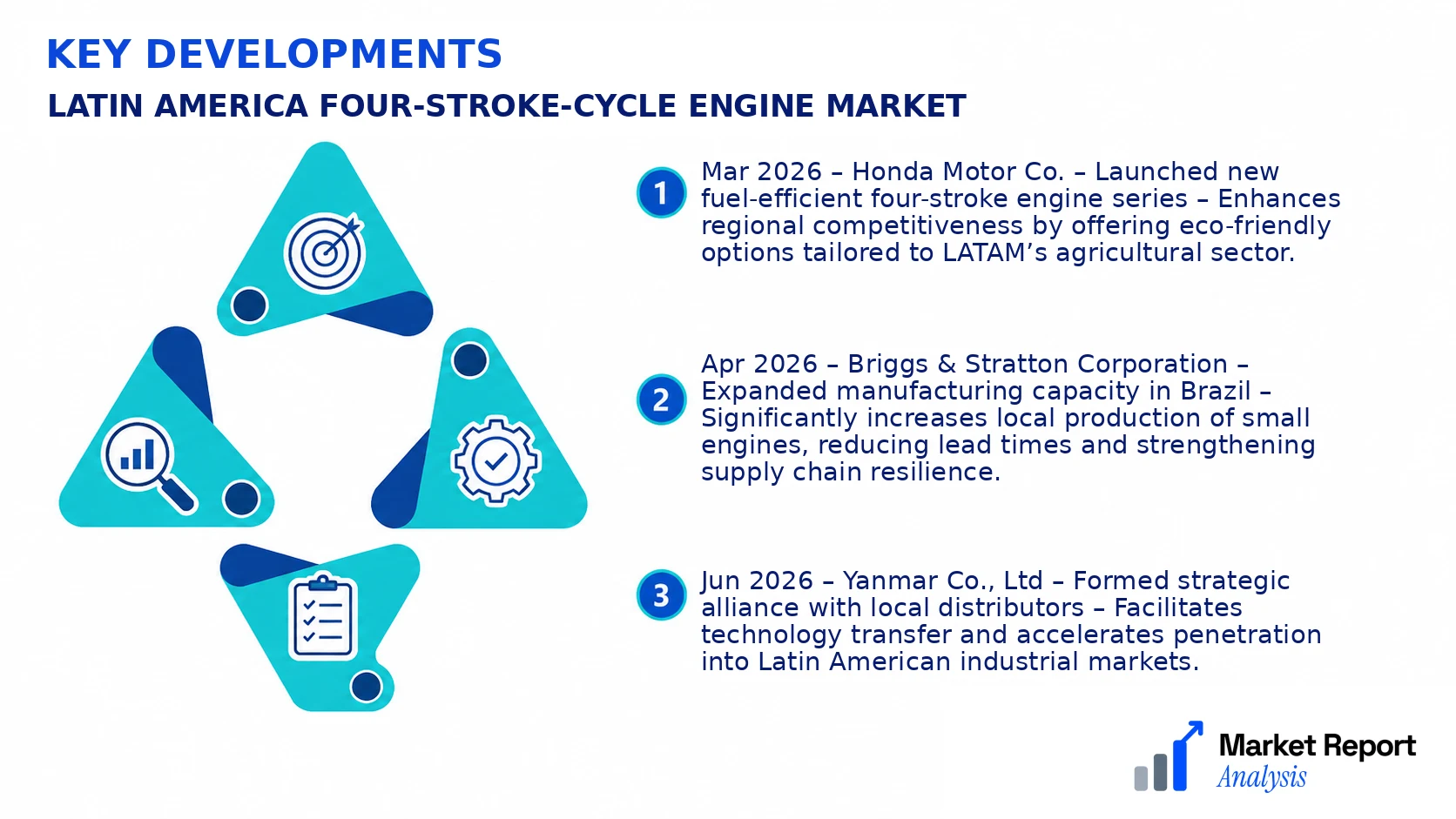
- Mar 2026 – Honda Motor Co. – Launched new fuel-efficient four-stroke engine series – Enhances regional competitiveness by offering eco-friendly options tailored to LATAM’s agricultural sector.
- Apr 2026 – Briggs & Stratton Corporation – Expanded manufacturing capacity in Brazil – Significantly increases local production of small engines, reducing lead times and strengthening supply chain resilience.
- Jun 2026 – Yanmar Co., Ltd – Formed strategic alliance with local distributors – Facilitates technology transfer and accelerates penetration into Latin American industrial markets.
- Aug 2026 – Lombardini S.p.A – Announced new product line of compact engines – Targets emerging markets with high-performance, lightweight solutions suitable for small equipment and machinery.
- Sep 2026 – Kubota Corporation – Invested in digital manufacturing initiatives – Aims to increase production efficiency and product customization for LATAM regional clients.
Frequently Asked Questions
What is the Latin America Four-Stroke-Cycle Engine Market?
The Latin America Four-Stroke-Cycle Engine Market comprises engines that operate with a four-stroke cycle, mainly used in various industries such as agriculture, construction, and power generation across Latin America. This market reflects regional demand for efficient, durable engine technology.
What is the current market size of Latin America Four-Stroke-Cycle Engine Market?
As of 2026, the market size for Latin America's four-stroke-cycle engines is estimated at USD X billion. This figure represents the combined demand across industries such as agriculture, construction, and manufacturing, driven by regional economic growth and infrastructure development.
What factors are driving the Latin America Four-Stroke-Cycle Engine Market?
Market growth is primarily fueled by expanding agricultural activities, infrastructural projects, and a rising preference for fuel-efficient, low-emission engines. Additionally, technological advancements and increased adoption of automation in industries boost demand for these engines in Latin America.
Which region dominates the Latin America Four-Stroke-Cycle Engine Market?
Brazil is the dominant region within the Latin America Four-Stroke-Cycle Engine Market due to its substantial agricultural sector, manufacturing capabilities, and industrial infrastructure. It accounts for a significant market share and continues to lead regional adoption rates.
Which segment is expected to grow the fastest?
The off-highway segment, including agricultural and construction machinery, is expected to demonstrate the fastest growth owing to increasing automation requirements and infrastructural development projects across Latin American countries.
Who are the leading companies operating in the Latin America Four-Stroke-Cycle Engine Market?
Key players include Honda, Briggs & Stratton, Yanmar, and Kubota. These companies are leveraging technological innovations, regional manufacturing facilities, and strategic partnerships to expand their market presence in Latin America.
Analyst Perspective
The Latin America four-stroke-cycle engine market exhibits a mature but evolving landscape, with steady long-term growth driven by industrialization, urbanization, and infrastructural developments across the region. Strategic opportunities are particularly prominent in agricultural machinery, small-scale industrial applications, and emerging urban mobility solutions, where efficiency and reliability are critical. Technological advances such as integrated electronic controls and fuel efficiency improvements will further enhance product competitiveness. Investment priorities should focus on R&D to capitalize on clean energy initiatives and emissions regulations, fostering innovations that meet environmental standards while maintaining operational performance. The competitive landscape remains intense, with key players expanding through local partnerships and technology licensing to gain market share. Regional growth potential is uneven, with Brazil, Mexico, and Argentina offering high-volume markets driven by industrial and agricultural demand, while smaller economies favor niche applications. Long-term success hinges on balancing innovation with regional market dynamics, positioning firms to exploit both mature markets and emerging segments effectively.
