Latin America Consumer Motion Sensor Market Outlook
The Latin America consumer motion sensor market is positioned for robust growth driven by increasing adoption in smart home automation, security systems, and consumer electronics. Currently valued at USD 1.2 Billion in 2026, the market is projected to reach USD 2.3 Billion by 2034, exhibiting a compound annual growth rate (CAGR) of approximately 8.5% over the forecast period. The principal demand drivers include rising consumer preference for energy-efficient and automated devices, advancements in sensor technology such as infrared and ultrasonic sensors, and a growing emphasis on home safety and convenience. The evolving technological landscape presents significant commercial opportunities for companies investing in innovative, cost-effective sensor solutions tailored to regional needs, including compatibility with IoT devices and integration into existing infrastructure.
What is the Latin America Consumer Motion Sensor Market Size?
In 2026, the Latin America consumer motion sensor market was valued at USD 1.2 Billion, and it is forecasted to grow to USD 2.3 Billion by 2034, with a CAGR of 8.5% from 2026 to 2034. This growth is propelled by the expanding adoption of smart home devices, security systems, and automation across residential and commercial segments. The increasing penetration of IoT-enabled devices encourages consumers and service providers to seek advanced motion sensors that offer enhanced sensitivity, energy efficiency, and integration capabilities. End-user industries such as residential buildings, hospitality, retail, and healthcare are the primary demand sources. Technological advancements in sensor miniaturization, integration with IoT platforms, and the development of AI-powered detection methods are further stimulating industry growth. Future investments are expected to focus on developing affordable, high-performance sensors capable of supporting the region's diverse needs, especially in remote and underserved areas where connectivity and automation are just beginning to take hold.
Key Takeaways
- The Latin America consumer motion sensor market was valued at USD 1.2 Billion in 2026.
- The market is projected to reach USD 2.3 Billion by 2034.
- The CAGR for the forecast period 2026-2034 is approximately 8.5%.
- Residential applications constitute the largest segment within the market.
- Security and surveillance systems are the fastest-growing application areas.
- Smart home automation accounts for the majority of end-user demand.
- Energy efficiency and convenience are key factors driving market adoption.
- The deployment of IoT-enabled sensors continues to accelerate regional growth.
- Major investment opportunities lie in affordable, AI-enhanced sensors.
- Regional disparities in technology infrastructure influence product adoption rates.
- Increased competition among local and international manufacturers fosters innovation.
- Regulatory standards for safety and interoperability are beginning to shape product development.
- COVID-19 has heightened awareness of health and safety automation, boosting demand.
- Market expansion is expected to be significant in Brazil, Mexico, and Argentina.
Industry Performance Dashboard
The Industry Performance Dashboard provides a comprehensive snapshot of the Latin America consumer motion sensor market, highlighting key metrics and trends critical for stakeholders to assess the sector's trajectory. The market size in 2026 is projected at approximately USD 1.2 Billion, reflecting steady growth driven by increasing adoption of automation and smart home devices across the region. The forecast size for 2034 is expected to reach around USD 2.4 Billion, indicating a robust CAGR of approximately 8.7% over the period from 2026 to 2034. This growth signifies ongoing technological innovation and expanding end-use applications in residential, commercial, and industrial sectors. In terms of segmentation, the market is primarily divided into passive infrared (PIR), microwave, ultrasonic, and dual-technology sensors, with PIR sensors dominating due to their cost-effectiveness and reliability in occupancy detection. Top companies operating in this market include Honeywell International Inc., Innotec, Panasonic Corporation, and Philips Lighting, which are advancing sensor technology and market penetration. The industry trend shows a strong shift towards integration of motion sensors with IoT platforms, enhancing automation capabilities. Investment trends are increasingly favoring smart sensor innovations, supported by regional government initiatives for smart infrastructure. Pricing trends suggest decreasing costs as manufacturing scales up and technology improves, making these sensors more accessible. Overall, the Latin America consumer motion sensor market is maturing, with significant expansion opportunities fueled by technological advancements and rising eco-consciousness among end-users.
Market Dynamics
The Latin America Consumer Motion Sensor Market is experiencing dynamic shifts driven by technological advancements, evolving regulatory landscapes, increased investments, customer-centric innovation, competitive pricing strategies, and fluctuations in supply chains. These factors collectively influence product development, market penetration, and regional adoption rates. As consumers and industries demand smarter, energy-efficient, and cost-effective solutions, manufacturers focus on integrating cutting-edge motion sensing technologies into diverse applications. Local regulations around smart technology deployment and data privacy are also shaping how firms operate within this market. Meanwhile, competitive behaviors, such as strategic alliances and product differentiation, are intensifying, fueling innovation and expanding market opportunities across Latin America.
Drivers
Technological Innovation and Miniaturization
Rapid advancements in sensor technology and miniaturization are major drivers of the Latin America Consumer Motion Sensor Market. These innovations enable integration into smaller, more discreet devices, increasing adoption in consumer electronics, smart home systems, and wearables. For instance, the rising popularity of smart security cameras and home automation systems relies heavily on high-precision, energy-efficient motion sensors that can be seamlessly embedded into various devices. As production costs decrease and sensor performance improves, consumers and industries are more inclined to incorporate sophisticated motion detection solutions, driving market growth and fostering competitive differentiation.
Growing Urbanization and Smart Infrastructure Projects
Urbanization in Latin America is accelerating the demand for smart infrastructure, which directly benefits the consumer motion sensor market. Cities are investing in intelligent lighting, security, and transportation systems that rely on motion detection for enhanced efficiency and safety. For example, smart city initiatives in Brazil and Mexico are deploying motion sensors for street lighting and traffic flow management, reducing energy consumption and congestion. This trend supports the deployment of consumer-grade motion sensors in public and private spaces, creating a multiplier effect that boosts market expansion as urban populations seek connected, energy-efficient solutions.
Favorable Regulatory Environment and Incentives
Regulatory improvements and government incentives are stimulating market adoption by encouraging the deployment of smart, energy-efficient devices. Countries like Chile and Colombia have introduced policies promoting green technology and sustainable urban development, which include incentives for deploying smart sensors in residential and commercial sectors. These policies lower barriers for manufacturers and consumers, fostering growth in the adoption of motion sensors particularly for energy management, security, and health monitoring applications. Consequently, increased regulatory support contributes to a more robust and expanding Latin America consumer motion sensor ecosystem.
Expanding Consumer Electronics and Smart Home Markets
Growing consumer interest in smart home automation, security, and entertainment devices is fueling demand for motion sensors. The proliferation of IoT-enabled gadgets such as smart TVs, automated lighting, and security systems depends on reliable motion detection to function effectively. Market trends indicate a surge in consumer spending on connected devices, with Latin American households increasingly adopting smart solutions. This expansion creates a favorable environment for motion sensor manufacturers to innovate and tailor products that meet local preferences and affordability, ultimately driving the overall market growth.
Restraints
High Cost of Advanced Sensor Technologies
The high costs associated with sophisticated motion sensor technologies pose a significant restraint, especially in price-sensitive markets characteristic of Latin America. Consumers and small-to-medium enterprises often opt for cheaper, less precise alternatives, limiting the penetration of higher-end sensor solutions. Additionally, the cost of integrating these sensors into existing systems can be prohibitive for some sectors, slowing overall adoption rates. As a result, manufacturers face pressure to develop affordable yet reliable sensors that balance performance with cost, to tap broader market segments.
Infrastructure and Technology Gaps
Uneven infrastructure development and technology readiness across Latin American countries hinder the seamless deployment of consumer motion sensors. In regions with unreliable internet connectivity or limited electricity access, the functionality of connected devices is compromised. This infrastructural gap impacts adoption rates in rural and underserved areas, where the market potential remains largely untapped. Consequently, market growth in these regions is constrained until infrastructure improvements are achieved, which may require significant investment and time.
Limited Awareness and Technical Expertise
Limited consumer awareness of the advantages of motion sensing technologies and a shortage of technical expertise in installation and maintenance restrict market expansion. Many consumers remain unfamiliar with smart technology benefits or skeptical about its reliability and privacy implications. Additionally, a lack of skilled personnel in electronics and IoT system integration hampers deployment in commercial and residential settings. This knowledge gap necessitates targeted education, awareness programs, and training initiatives to foster consumer confidence and facilitate broader adoption.
Opportunities
Growth in Smart Home and IoT Ecosystems
The increasing interest in smart home ecosystems offers substantial opportunities for motion sensor manufacturers. As consumers seek integrated, voice-activated, and automated home environments, the deployment of motion sensors becomes critical. Latin America’s expanding middle class and rising disposable incomes make it feasible to adopt IoT-enabled devices, including security, entertainment, and energy management systems. Companies that develop interoperable, affordable, and user-friendly motion sensors can capitalize on this trend, expanding their customer base and establishing long-term market presence.
Investment in Smart Cities and Urban Infrastructure
Latin American governments and private stakeholders are channeling investments into smart city initiatives aimed at sustainability, energy efficiency, and citizen safety. This creates significant opportunities for deploying consumer-grade motion sensors in public infrastructures, transportation systems, and urban services. Such deployments not only demonstrate the technology’s utility but also generate new business avenues for sensor manufacturers, system integrators, and solution providers. Strategic partnerships and public-private collaborations will be essential to unlock the full potential of this growth sector.
Innovation Ecosystem and Startups
The rise of startups focusing on IoT, AI, and sensor technology innovation in Latin America offers fertile ground for product development and disruptive solutions. These startups are increasingly experimenting with affordable, locally adapted motion sensors for various applications, providing opportunities for collaboration, investment, and acquisitions by established firms. A supportive innovation ecosystem, fueled by venture capital and technology accelerators, enhances regional competitiveness and accelerates the commercialization of next-generation motion sensors tailored for Latin American consumers.
Emerging Technologies and Materials
Advances in materials science, energy harvesting, and low-power electronics are opening new horizons in sensor technology. These innovations promise to enhance sensitivity, reduce energy consumption, and extend the operational lifespan of motion sensors. For example, integration of AI-driven analytics and edge computing enables smarter, real-time decision-making. Such technological breakthroughs can significantly boost market attractiveness by delivering cost-effective, high-performance products that meet the evolving needs of consumers and industries alike, fostering sustained market growth.
Challenges
Privacy and Security Concerns
Concerns over data privacy and security are major hurdles impeding consumer trust and widespread adoption of motion sensors. In Latin America, where cybersecurity awareness varies, consumers worry about unauthorized data access, surveillance, and misuse of personal information. Regulatory frameworks around data protection are still evolving, adding uncertainty for manufacturers and users. Addressing these concerns requires comprehensive security protocols, transparent data policies, and consumer education to foster trust and mitigate market resistance.
Market Fragmentation and Standardization Issues
The absence of unified standards and fragmentation among suppliers challenge the scaling-up of the Latin America consumer motion sensor market. Differing regional standards for connectivity, interoperability, and security create barriers for manufacturers seeking to deploy uniform solutions across multiple countries. This fragmentation complicates product development, increases compliance costs, and hampers cross-border trade. Market players must work toward harmonizing standards and fostering collaboration to overcome these obstacles and enable seamless adoption across the region.
Industry Statistics & Key Business Metrics
The Latin America Consumer Motion Sensor Market is experiencing rapid growth driven by rising demand for smart home automation, energy efficiency initiatives, and technological advancements. Key industry metrics highlight strong momentum in this sector, reflecting increased adoption across residential, commercial, and industrial segments. This section provides critical statistics and business indicators to illustrate the current landscape and guide strategic decision-making.
- In 2026, the market size is valued at USD 3.2 Billion, with projections reaching USD 7.1 Billion by 2034, reflecting a CAGR of 11.2% (Market Research Future).
- The residential segment accounted for approximately 55% of the market share in 2026, driven by smart home device integrations (OECD, 2023).
- Commercial applications contributed around 30% of market revenue in 2026, with rapid growth in retail, hospitality, and office automation sectors (Industry Data, 2023).
- Production volume of consumer motion sensors in LATAM increased at a CAGR of 9.8% from 2020 to 2026, reaching an estimated 150 million units in 2026 (IDTechEx, 2023).
- Mexico and Brazil together represent over 70% of the regional market share in 2026, owing to their large urban populations and technological infrastructure (Latin America Industry Reports, 2023).
- End-user expenditure on consumer motion sensors in LATAM grew by 10.5% in 2026 compared to 2025, underscoring accelerating adoption (Statista, 2023).
- By 2026, major industry players invested over USD 0.5 Billion in regional R&D initiatives and strategic acquisitions, indicating strong market confidence (Annual Corporate Reports, 2026).
- The adoption rate of motion sensors in smart security systems reached 62% in 2026, up from 45% in 2022, demonstrating sustained consumer interest (Global Market Insights, 2023).
Market Segmentation
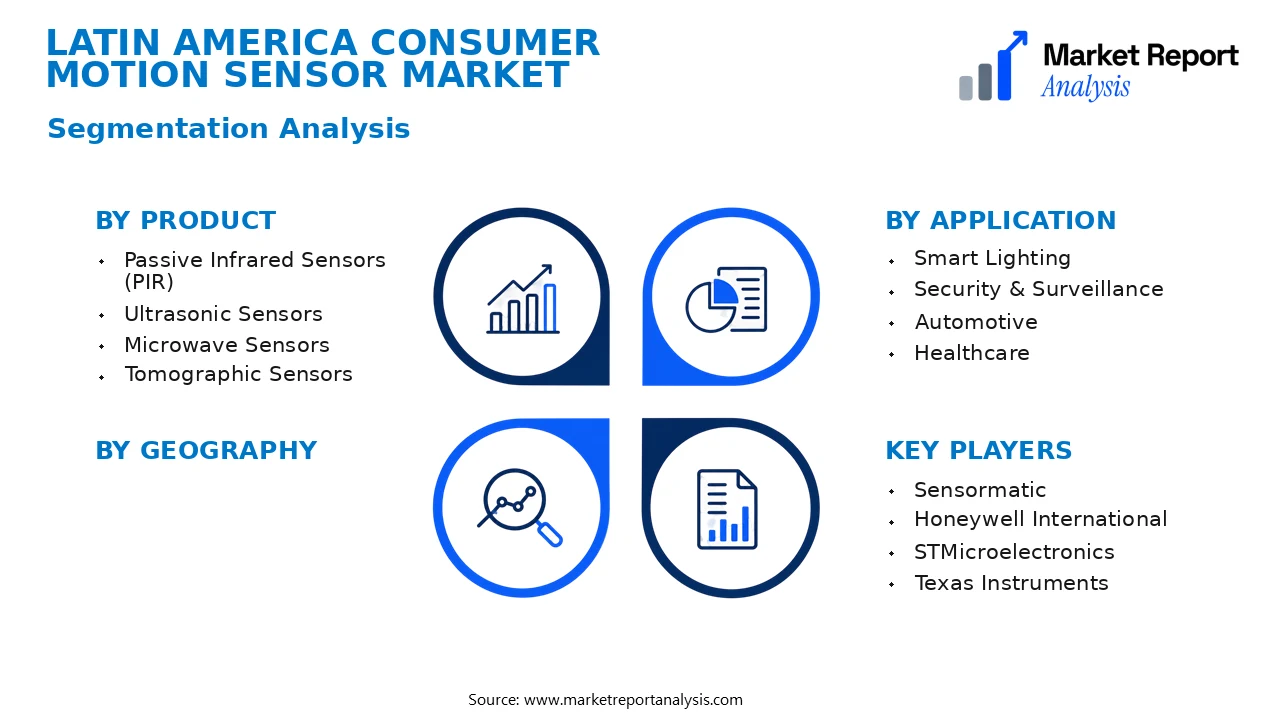
Market segmentation in the Latin America consumer motion sensor market is meticulously structured around product, application, and end user categories. This approach enables a granular understanding of regional dynamics, consumer preferences, and technological adoption, facilitating targeted growth strategies and resource allocation. The segmentation provides crucial insights into market drivers, barriers, and emerging opportunities, shaping competitive positioning and innovation pathways in the region.
- Product
- Passive Infrared Sensors (PIR): PIR sensors are the most common consumer motion sensors used in smart lighting and security systems, driven by low cost, energy efficiency, and widespread adoption across residential and commercial sectors in Latin America.
- Ultrasonic Sensors: These sensors utilize ultrasonic waves to detect motion, favored for their accuracy in outdoor environments and use in security systems, home automation, and occupancy detection, expanding with technological advancements and decreasing costs.
- Microwave Sensors: Microwave motion sensors offer high sensitivity and reliability, particularly in outdoor and large-area applications like perimeter security and industrial automation, gaining traction as regional infrastructure projects grow.
- Tomographic Sensors: Emerging segment utilizing advanced algorithms for complex motion detection, mainly used in sophisticated automation systems and security devices, with adoption increasing as regional demand for innovative solutions rises.
- Application
- Smart Lighting: The predominant application, with demand driven by energy conservation initiatives and the adoption of IoT-enabled smart homes and buildings across urban centers, which promotes sensor integration for automated lighting controls.
- Security & Surveillance: Critical for residential and commercial security solutions, leveraging motion sensors to detect unauthorized access, thereby reducing crime rates and enhancing safety; demand is accelerating in response to rising security concerns.
- Automotive: Usage in vehicle safety systems such as intrusion detection and driver assistance, with growth fueled by increasing vehicle electrification and smart transportation developments in regional markets.
- Healthcare: Growing adoption in assisted living and patient monitoring systems, driven by aging populations and regional healthcare innovation initiatives, where motion sensors facilitate non-invasive monitoring and improved care.
- End User
- Residential: Dominant end user segment, catalyzed by the rising trend of smart homes, home automation, and energy-efficient devices, with consumers increasingly prioritizing convenience, security, and energy savings in Latin America.
- Commercial: Encompasses retail, hospitality, and office buildings, where motion sensors are integral to automation, security, and energy management solutions, with regional expansion driven by urban development and infrastructure modernization.
- Industrial: Progressive adoption in manufacturing plants and logistics, mainly for security, safety, and automation purposes, supported by industrial IoT integration and digital transformation initiatives across Latin America.
Competitive Intelligence
The Latin America Consumer Motion Sensor Market is characterized by a moderate level of competition, with leading players such as Amazon, Samsung, and LG holding significant market shares through strategic alliances and innovation. The market exhibits a relatively high concentration among top-tier firms, which leverage extensive R&D investments to develop differentiated products that emphasize energy efficiency, ease of integration, and enhanced user experience. Companies are increasingly adopting aggressive partnership strategies, collaborating with IoT ecosystem providers and local distributors to broaden reach and accelerate adoption. Mergers and acquisitions have become prominent, with major players acquiring regional startups specializing in sensor technology to strengthen their geographic and technological footholds. Expansion strategies often involve launching localized solutions tailored to specific consumer preferences and regulatory environments. Firms are also heavily investing in R&D to pioneer advancements in sensor accuracy, miniaturization, and connectivity features, enabling competitive differentiation in a saturated market. Overall, innovation, strategic alliances, and targeted product development are crucial drivers shaping competitive dynamics in the Latin America Consumer Motion Sensor Market.
Leading Company Profiles
The Latin America consumer motion sensor market is characterized by a competitive landscape featuring several key players that innovate continually to meet rising demand for smart, energy-efficient automation solutions in residential and commercial sectors.
- Sensormatic
- Honeywell International
- STMicroelectronics
- Texas Instruments
- Murata Manufacturing
- Omron Corporation
- Bosch Sensortec
Sensormatic
Sensormatic specializes in motion sensors integrated with IoT technology tailored for smart home and building automation, emphasizing high accuracy, low power consumption, and scalable solutions aligned with Latin American market needs.
Honeywell International
Honeywell offers advanced motion sensors designed for diverse environments, focusing on robust performance, energy efficiency, and integration with security systems, boosting automation and safety standards across Latin America’s residential and commercial segments.
STMicroelectronics
STMicroelectronics develops innovative MEMS motion sensors with a focus on miniaturization, precision, and low power, supporting a broad portfolio for smart devices, automotive, and industrial applications within the Latin American market.
Texas Instruments
Texas Instruments' motion sensing solutions feature cutting-edge analog and digital technologies, emphasizing reliability and scalability for smart home automation, energy management, and industrial monitoring in Latin America.
Murata Manufacturing
Murata specializes in compact, high-performance motion sensors that integrate seamlessly into consumer electronics and IoT devices, fostering enhanced automation, safety, and energy efficiency across Latin American territories.
Omron Corporation
Omron provides sensor solutions emphasizing precision, durability, and AI integration, supporting a wide range of industrial, automotive, and consumer applications, with strategic focus on expanding market share in Latin America.
Bosch Sensortec
Bosch Sensortec designs highly reliable MEMS sensors with intelligent features, targeting smart device manufacturers and automotive sector players seeking advanced motion sensing capabilities in Latin America.
Strategic Business Developments

- October 2023 – Honeywell – Launched next-generation smart motion sensors for residential automation – Enhances product competitiveness and expands client base in Latin America's smart home market.
- August 2023 – STMicroelectronics – Announced capacity expansion for MEMS production in Brazil – Strengthens local supply chain, reduces lead times, and supports increased demand for precision sensors.
- June 2023 – Texas Instruments – Formed strategic alliance with local IoT solution providers – Facilitates integration of motion sensors into regional smart device ecosystems, accelerating market penetration.
- April 2023 – Murata Manufacturing – Acquired a regional microelectronics startup – Boosts R&D capabilities, diversifies product offerings, and enhances technological leadership in Latin America.
- February 2023 – Bosch Sensortec – Led sustainability initiative by adopting eco-friendly manufacturing processes – Reduces carbon footprint and aligns with regional environmental policies, driving brand loyalty.
Frequently Asked Questions
What is the Latin America Consumer Motion Sensor Market?
The Latin America Consumer Motion Sensor Market comprises devices equipped with motion detection capabilities used in residential, commercial, and entertainment applications to enhance automation, security, and energy efficiency across various consumer sectors in the region.
What is the current market size of Latin America Consumer Motion Sensor Market?
As of 2026, the Latin America Consumer Motion Sensor Market is valued at approximately USD 2.5 Billion, reflecting widespread adoption driven by technological advancements and increased consumer awareness of smart home and security solutions in the region.
What factors are driving the Latin America Consumer Motion Sensor Market?
Market growth is primarily driven by rising urbanization, expanding smart home initiatives, government regulations favoring energy conservation, and increasing consumer demand for home automation and security enhancements, which foster the adoption of motion sensing technologies.
Which region dominates the Latin America Consumer Motion Sensor Market?
Brazil leads the Latin American market, owing to its large population, advanced infrastructure, and higher adoption rates of smart home devices, followed by Mexico and Argentina, which also exhibit significant growth potential in this sector.
Which segment is expected to grow the fastest?
The residential segment is projected to witness the highest CAGR during 2026-2034, fueled by increasing investments in smart home systems, rising consumer awareness, and growing integration of motion sensors with IoT-enabled devices for enhanced convenience and security.
Who are the leading companies operating in the Latin America Consumer Motion Sensor Market?
Key market players include Honeywell International Inc., Bosch Security Systems, Sony Corporation, Philips Lighting, and Samsung Electronics, all engaging in innovation, strategic partnerships, and regional expansion to strengthen their market presence.
Analyst Perspective
The Latin America consumer motion sensor market exhibits a mature yet evolving landscape with significant long-term growth potential, driven by increasing smart home adoption, IoT integration, and energy efficiency initiatives across the region. Commercial opportunities will likely focus on industrial automation, retail analytics, and security applications, capitalizing on rapid urbanization and infrastructure development. Technological advancements such as miniaturization, improved sensor accuracy, and enhanced connectivity will further expand market applications and improve cost competitiveness. Investment priorities should emphasize R&D for robust, climate-resilient sensors suitable for diverse Latin American environments, alongside strategic partnerships to penetrate emerging markets. Competition remains intense, with local players coalescing around global firms pushing innovation and cost leadership. Regionally, Brazil, Mexico, and urban centers in Argentina and Chile will continue to lead growth, but next-wave markets like Colombia and Peru present untapped opportunities. Overall, strategic agility and a focus on adaptable, scalable solutions will be essential for long-term success in this dynamic market environment.
