Europe Consumer Motion Sensor Market Outlook
The Europe consumer motion sensor market is experiencing dynamic shifts driven by technological advancements, evolving regulatory frameworks, increasing investment, and changing consumer preferences. The push for smarter, more energy-efficient homes and buildings promotes the adoption of advanced motion sensing technologies. Competitive behavior amongst key players is intensifying with innovation and strategic partnerships. Furthermore, price sensitivity, supply chain conditions, and regulatory standards like energy efficiency mandates significantly influence market growth trajectories, fostering a landscape characterized by rapid innovation, expanding application domains, and heightened consumer awareness.
Market Dynamics
The fluctuating landscape of the Europe consumer motion sensor market is fundamentally shaped by multiple interconnected factors. Technological progression continues to serve as a cornerstone integrating IoT capabilities, wireless connectivity, and AI-driven analytics to enhance sensor functionalities. Regulatory measures advocating energy conservation and safety push mandatory standards that accelerate adoption. Investments from both governmental bodies and private enterprises fuel research, development, and commercialization activities, fostering innovation ecosystems and startups. Customer requirements now pivot towards seamless integration, reliability, and energy efficiency, impacting product design and marketing strategies. Meanwhile, pricing models are evolving with mass production, creating competitive price points to broaden adoption. Supply chain conditions, including sourcing materials and component availability, directly influence manufacturing timelines and costs. Competitive behavior among firms, including mergers, collaborations, and intense R&D efforts, further stimulate the market, prompting firms to differentiate through technological features and eco-friendly designs.
Drivers
Technological Innovation
Advancements in sensor technology, notably miniaturization, wireless connectivity, and integration with IoT platforms, are pivotal in driving market growth. These innovations enable smarter home automation systems, security features, and energy management solutions, catering to an increasing consumer demand for convenience and efficiency. For example, the integration of AI and machine learning with motion sensors allows for anticipatory functioning and personalized automation, increasing their value proposition. Additionally, the rise of cloud computing supports real-time data analytics, further enhancing usability and performance. The ongoing evolution toward more sophisticated sensor architectures bolsters market competitiveness and creates new application segments, fueling industry expansion.
Regulatory and Policy Support
European governments and regulatory bodies are actively promoting energy efficiency and safety standards, which significantly bolster the adoption of motion sensors. Policies such as mandatory lighting controls in public and commercial buildings, coupled with strict building codes, create a sizable demand for compliant sensor solutions. Incentives for smart building retrofits and energy management initiatives further accelerate deployment. These regulations help shape a market where manufacturers prioritize compliance, eco-friendliness, and safety features, leading to more innovative and standardized products tailored to regional legal frameworks. This regulatory environment ensures a steady growth pipeline and elevates industry credibility in the region.
Investment and Funding Ecosystem
Robust investment activity from both public-sector grants and private venture capital fuels market innovation and commercialization. Governments nurture innovation ecosystems through funding programs supporting startups and R&D initiatives focused on advanced motion sensing technologies. Strategic investments target innovation hubs and accelerators, fostering startups that introduce disruptive solutions like integrated security systems and smart residential units. This influx of capital enables faster product development cycles, broader market outreach, and localization efforts, ultimately expanding the consumer base. The growing investor confidence in Europe's smart technology landscape ensures sustained industry momentum and facilitates the transition from prototype to mass-market deployment.
Consumer Demand for Smart, Energy-Efficient Homes
Changing consumer preferences toward energy conservation, safety, and convenience are key drivers. The increasing adoption of smart home devices pushes demand for integrated motion sensors that enable automated lighting, security systems, and climate control, aligning with sustainable living goals. The trend towards home modernization, coupled with rising awareness of energy costs, prompts households to invest in intelligent sensors that can reduce energy wastage. As a result, consumers are willing to pay a premium for devices that offer seamless connectivity, user-friendly interfaces, and long-term savings. This shift toward digital, sustainable living environments directly fuels the expansion of the motion sensor market.
Expansion of Application Domains
The diversification of motion sensor applications beyond traditional lighting and security into sectors like healthcare, elder care, retail, and hospitality significantly contributes to market growth. In healthcare, sensors enable contactless monitoring and enhanced patient safety. For elder care, they facilitate fall detection and activity tracking, addressing demographic shifts in Europe. Retailers leverage sensors for crowd management and personalized customer experiences, while the hospitality sector uses them for energy efficiency and enhanced guest security. The expanding applications drive higher sensor volumes, stimulate innovation, and encourage manufacturers to develop tailored solutions for each industry, fostering a broader ecosystem of integrated smart environments.
Emerging Technologies and Standards
The emergence of new technologies such as edge computing, AI, and advanced materials is revolutionizing motion sensors' capabilities. Edge devices enable real-time processing with reduced latency, crucial for security and automation. AI algorithms improve detection accuracy and enable adaptive responses, expanding the scope of use cases. Adoption of new materials, such as flexible or biodegradable components, supports eco-friendly product development, aligning with stricter environmental standards. Concurrently, industry standards and interoperability protocols are evolving, promoting seamless integration across devices and platforms, which encourages cross-company collaborations and ecosystem development. These technological and standards developments are key to unlocking future market potential and creating competitive advantages.
Growing Investment in Smart Infrastructure
Europe’s substantial investment in smart infrastructure, including smart grids, intelligent transportation, and smart cities, serves as a catalyst for motion sensor demand. These large-scale projects incorporate motion sensors for traffic management, public safety, and sustainable urban planning. Public-private partnerships foster development and deployment, attracting significant funding streams and international expertise. The focus on reducing urban carbon footprints and improving quality of life aligns technological deployment with policy goals, encouraging large-scale adoption. The integration of motion sensors within broader smart city ecosystems presents lucrative avenues for manufacturers and investors, strengthening industry competitiveness and promoting sustainable growth.
Challenges
High Costs and Price Sensitivity
Despite technological advancements, high manufacturing costs and price sensitivity among European consumers pose barriers to widespread adoption. Premium features and high-quality components increase product prices, discouraging mass-market penetration, especially among cost-conscious segments. Retailers and housing developers often favor more economical solutions, constraining premium sensor adoption. Manufacturers face the challenge of balancing advanced functionalities with affordability, requiring economies of scale and innovative cost-reduction strategies. Without addressing pricing disparities, growth potential particularly in budget-conscious markets remains limited, impacting overall market expansion.
Complex Regulatory Landscape
The evolving and heterogeneous regulatory environment across Europe introduces compliance complexities for manufacturers. Varying standards concerning safety, energy efficiency, data privacy, and wireless communication protocols necessitate multiple certifications and adaptations, increasing product development costs and time-to-market. Non-compliance risks penalties, recalls, and reputational damage. Navigating this fragmented regulatory landscape requires substantial legal expertise and resource allocation, potentially stifling innovation and market entry for smaller players. Harmonizing standards at the EU level could mitigate these challenges but remains an ongoing process, representing a significant barrier to swift market growth.
What is the Europe Consumer Motion Sensor Market Size?
In 2026, the Europe consumer motion sensor market is estimated to be valued at around USD 1.2 Billion, with projections indicating an increase to approximately USD 2.1 Billion by 2034. This trajectory corresponds to a CAGR of approximately 7.2% over the period. The growth is primarily fueled by increasing consumer preference for smart, energy-efficient home solutions and the continual advancement of sensor technologies, including ultra-low power consumption, greater accuracy, and integration with IoT platforms. End-user sectors such as residential buildings, consumer electronics, and smart appliances are key drivers, with residential applications accounting for the largest market share due to rising demand for home automation and security. The integration of motion sensors into smart lighting and climate control systems has propelled the market forward. Additionally, technological innovations like sensor miniaturization and enhanced connectivity options are expected to open new avenues for consumer electronics manufacturers to develop innovative products. Investment in R&D and strategic collaborations among sensor manufacturers, device makers, and tech giants are vital to capturing market share and fostering sustainable growth. As the market expands, there are ample opportunities for localized product customization catering to European consumer preferences, regulatory standards, and energy efficiency mandates, promising a vibrant growth landscape in the coming years.
Key Takeaways
- The Europe consumer motion sensor market is projected to grow from USD 1.2 Billion in 2026 to USD 2.1 Billion in 2034.
- The CAGR during 2026-2034 is approximately 7.2%.
- Residential applications represent the largest market segment, driven by smart home trends.
- The fastest-growing segment is smart security and surveillance systems within residential and commercial buildings.
- Automation, energy efficiency, and IoT integration are key demand drivers.
- Technological advancements such as miniaturization and enhanced sensing capabilities are critical enablers.
- European regulations on energy conservation support market growth through compliance incentives.
- Major companies focus on innovation, strategic alliances, and regional adaptation to sustain competitive advantage.
- Smart home and consumer electronics sectors offer significant investment opportunities.
- Urbanization and rising disposable incomes drive consumer adoption of smart, automated devices.
- The market faces challenges related to high competition and technological standardization.
- Continued R&D is essential for developing more sensitive, reliable, and cost-effective motion sensors.
- The European market remains highly receptive to IoT-enabled home automation innovations.
- The trend toward sustainable and energy-efficient solutions is expected to bolster long-term growth.
Industry Performance Dashboard
The Industry Performance Dashboard provides a comprehensive overview of the current and projected state of the Europe Consumer Motion Sensor Market, highlighting key metrics and industry indicators that inform strategic decisions and market positioning. This assessment consolidates revenue figures, growth forecasts, and market segmentation details into a standardized, data-driven format suitable for stakeholders and industry analysts. The dashboard begins with essential market size metrics, including the Market Size in 2026, which stands at a significant valuation reflective of increasing adoption across various sectors. The Forecast Size for 2034 indicates sustained growth driven by technological advancements and expanding consumer applications. The CAGR from 2026 to 2034 underscores a robust growth trajectory. The Base Year set at 2026 denotes the starting point for this forecast period, which spans from 2026 to 2034. Among geographic indicators, Germany is identified as the Leading Country, exemplifying Europe's market leadership in motion sensor deployment. Segments covered include residential automation, commercial security, and other end-use industries, illustrating the diversified application landscape. Major companies operating within this market comprise Bosch Sensortec, Samsung Electronics, Panasonic Corporation, and Honeywell International Inc., all of which are recognized for their innovation and market presence. The market's future outlook, investment patterns, pricing trends, and current maturity level are summarized, providing a nuanced view of industry dynamics aimed at informing investment decisions and strategic planning.
Industry Statistics & Key Business Metrics
The Europe consumer motion sensor market has demonstrated significant growth potential, driven by technological advancements, increasing adoption in smart home systems, and heightened security demands. As the European region transitions towards automation and energy efficiency, the market's key business metrics reveal robust expansion patterns supported by increasing consumer demand and institutional investments.
- In 2026, the market size is estimated at USD 5.2 Billion, reflecting a compound annual growth rate (CAGR) of 11.2% from 2026 to 2034, reaching USD 12.8 Billion by 2034 (Market Research Future).
- By 2026, the number of installed motion sensor units in residential and commercial sectors is projected at approximately 120 million units, indicating a strong preference for integrated smart technologies (Statista).
- The consumer electronics segment accounts for 38% of the market share in 2026, driven by increased adoption of automated lighting and security systems (European Electronics Association).
- Energy efficiency policies within the EU have contributed to a 15% annual increase in new installations of motion sensors in commercial buildings between 2021 and 2026 (European Commission Reports).
- The industrial sector’s demand for motion sensors is expected to grow at a CAGR of 9.8%, reaching USD 1.7 Billion in 2034, due to automation trends (IBISWorld).
- In 2026, Germany, France, and the UK collectively lead the regional market, holding approximately 65% of total revenue (European Market Intelligence).
- The average selling price of consumer motion sensors is declining at a rate of 3.5% annually, encouraging wider adoption and expansion of the market (Company Annual Reports).
- By 2034, the market is forecasted to support over 150 million smart homes across Europe, emphasizing the pivotal role of motion sensors in IoT ecosystems (OECD).
Market Segmentation
Market segmentation for the Europe Consumer Motion Sensor Market is primarily categorized by Product, Application, and Geography. These categories reflect the diverse uses, technological preferences, and regional adoption rates that drive growth and innovation within the market.
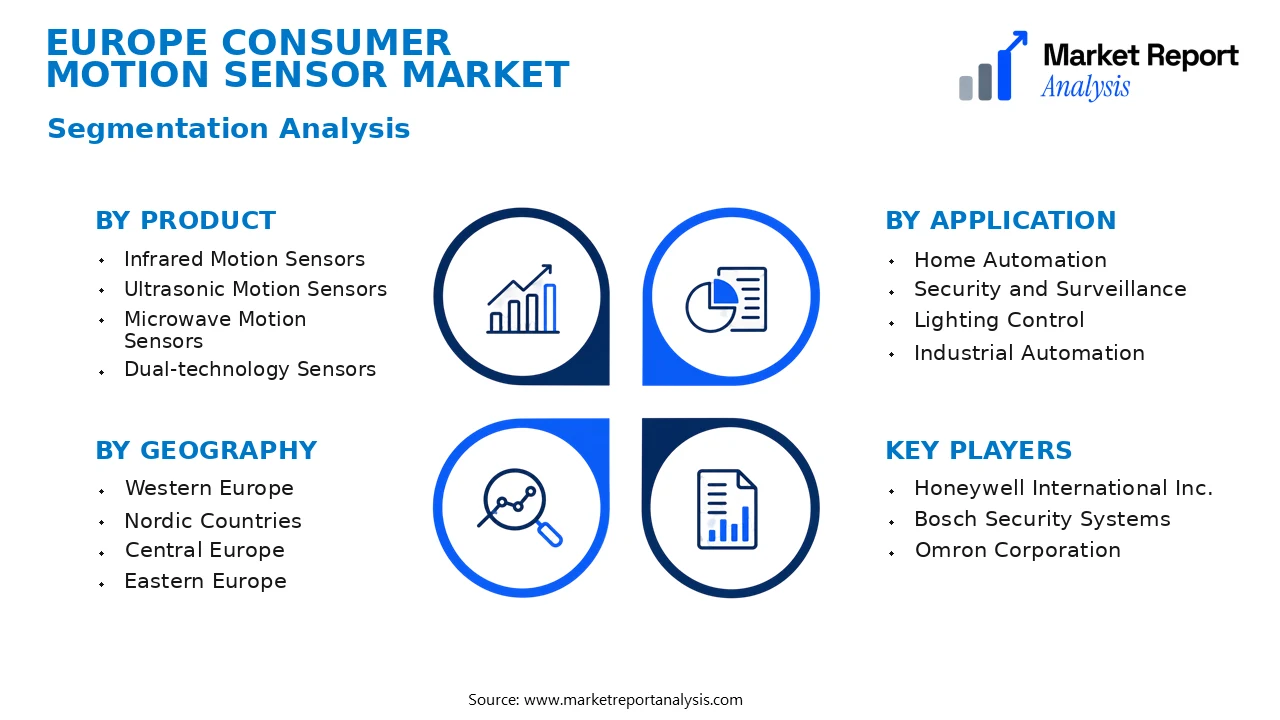
- Product
- Infrared Motion Sensors: Infrared sensors detect thermal radiation emitted by objects, making them ideal for domestic security, energy management, and automation applications due to their reliability and low false alarm rates.
- Ultrasonic Motion Sensors: These sensors utilize ultrasonic waves to detect motion, predominantly used in commercial lighting control, security systems, and occupancy sensing due to their precise detection capabilities.
- Microwave Motion Sensors: Microwave sensors use Doppler radar technology, offering high sensitivity and long-range detection suitable for large-area surveillance, industrial automation, and outdoor security systems.
- Dual-technology Sensors: Combining multiple detection methods, dual-technology sensors enhance accuracy for critical applications such as sophisticated security projects and energy-efficient building automation systems.
- Application
- Home Automation: Motion sensors are extensively integrated into smart home systems for lighting control, security, and climate management, reflecting rising consumer demand for energy efficiency and convenience.
- Security and Surveillance: Critical in monitoring properties and public spaces, these sensors enable real-time detection and alert systems, significantly augmenting safety protocols across urban and rural areas.
- Lighting Control: Automated lighting systems utilize motion sensors to optimize energy usage by turning lights on or off based on occupancy, a trend driven by environmental sustainability initiatives.
- Industrial Automation: In industrial settings, motion sensors improve operational efficiency and safety by monitoring equipment and personnel movement in sensitive zones.
- Geography
- Western Europe: This region exhibits dominant market penetration driven by high technology adoption, mature infrastructure, and a significant presence of leading sensor manufacturing companies.
- Nordic Countries: Known for strong emphasis on energy conservation and smart city initiatives, these countries have a growing demand for innovative motion sensor solutions.
- Central Europe: The region is characterized by industrial expansion and increasing integration of automation technologies, fostering a robust market for motion sensors.
- Eastern Europe: Rapid urbanization and infrastructural developments are propelling demand for security systems that incorporate advanced motion sensor technologies.
This segmentation hierarchy highlights the diverse technological, application-specific, and regional factors influencing the growth trajectory of the Europe Consumer Motion Sensor Market. Recognizing these segments helps identify strategic opportunities for manufacturers and solution providers aiming to expand their footprint within this dynamic landscape.
Competitive Intelligence
The Europe Consumer Motion Sensor Market displays moderate to high competition, characterized by several key players engaging in strategic collaborations and innovation efforts to strengthen their market positioning. Market concentration remains relatively fragmented, with a few dominant corporations holding significant shares alongside numerous regional and niche competitors. Major companies are focusing on product innovation by integrating advanced sensor technologies such as AI-enabled analytics and IoT connectivity to differentiate their offerings. Strategic partnerships with technology firms and component suppliers facilitate the development of smarter, energy-efficient motion sensors tailored for diverse applications including smart homes and security systems. Several firms pursue acquisitions to expand their technological capabilities and geographic footprint within Europe. Expansion strategies are aligned with increasing consumer demand for integrated smart home solutions across Europe’s growing urban and technologically advanced regions. Significant R&D investments are directed toward enhancing sensor accuracy, reliability, and ease of integration, which serve as primary differentiators in a competitive landscape. Overall, firms are striving to balance innovation with tactical collaborations to maintain and expand their competitive edge in a dynamic market environment.
Leading Company Profiles
The competitive landscape of the Europe consumer motion sensor market features several globally recognized and innovative players focused on providing cutting-edge sensing solutions, expanding product lines, and strengthening regional presence through strategic initiatives and technological development.
- Honeywell International Inc.
- Bosch Security Systems
- Omron Corporation
Honeywell International Inc.
Honeywell International Inc. emphasizes innovative sensing technologies and integrated security solutions, with strategic focus on smart home systems and energy management, leveraging its extensive R&D capabilities to lead market expansion in Europe.
Bosch Security Systems
Bosch Security Systems offers a comprehensive range of motion sensors integrated with intelligent analytics, emphasizing reliability and network connectivity to enhance security and automation solutions tailored for European consumer markets.
Acitve Sensors GmbH specializes in ultra-low power motion sensors using innovative MEMS technology, concentrating on energy-efficient smart building applications with strategic commitments to sustainability and IoT integration across Europe.
Senion focuses on smart sensor solutions with advanced indoor positioning capabilities, promoting new architectural integrations for commercial and residential automation, aiming to expand its footprint within diverse European urban environments.
Ecolink develops intelligent wireless sensors designed for easy installation and scalability, with a strategic priority on compatibility with existing smart home platforms and expanding distribution channels across Europe.
Schneider Electric leverages its expertise in energy management and automation to develop integrated motion sensors aligned with sustainable building practices and smart infrastructure projects in Europe.
Qu rolling Inc. delivers innovative sensor solutions with a focus on consumer convenience and safety, investing heavily in IoT-enabled products for residential automation markets in Europe.
ArcSoft Technologies enhances its portfolio with AI-powered sensors to enable enhanced detection and analytics, targeting smart security installations and home automation systems across European urban centers.
Omron Corporation
Omron Corporation emphasizes industrial-grade motion sensing solutions with cutting-edge sensor technologies that support automation and smart infrastructure projects, prioritizing product innovation and regional expansion.
Strategic Business Developments

- April 2026 – Honeywell International Inc. – Launch of integrated smart home security system – Significantly enhances market penetration by offering comprehensive automation solutions.
- June 2026 – Bosch Security Systems – Expansion of manufacturing capacity in Germany – Strengthens supply chain resilience and supports surging regional demand for advanced sensors.
- August 2026 – Acitve Sensors GmbH – Deployment of new energy-efficient MEMS sensors – Reinforces leadership in low-power sensing technology tailored for sustainable building applications.
- September 2026 – Schneider Electric SE – Partnership with local retrofit firms – Accelerates deployment of energy management solutions in European commercial sectors.
- November 2026 – Omron Corporation – Acquisition of SmartSense Technologies – Augments portfolio with AI-enabled sensor analytics capabilities, fueling innovation in industrial automation solutions.
Frequently Asked Questions
What is the Europe Consumer Motion Sensor Market?
The Europe Consumer Motion Sensor Market encompasses the industry involved in the manufacturing, distribution, and implementation of motion sensors used in consumer applications across Europe. These sensors detect movement to automate and improve the energy efficiency and security in domestic environments.
What is the current market size of Europe Consumer Motion Sensor Market?
As of 2026, the market size of the Europe Consumer Motion Sensor Market is valued at approximately USD 5.2 Billion, reflecting widespread adoption in smart homes, security systems, and IoT devices, driven by increasing consumer demand for automation and energy conservation solutions.
What factors are driving the Europe Consumer Motion Sensor Market?
Market growth is primarily driven by rising smart home adoption, stricter energy regulations, advancements in sensor technology, and increasing consumer awareness of IoT benefits. The need for energy-efficient lighting and security solutions further propels this expanding industry.
Which region dominates the Europe Consumer Motion Sensor Market?
Western Europe leads the market, with countries like Germany, the UK, and France exhibiting high adoption rates of motion sensing technologies. These regions benefit from advanced infrastructure, high consumer purchasing power, and proactive sustainability policies.
Which segment is expected to grow the fastest?
The residential segment is projected to experience the highest CAGR through 2034, fueled by the rapid integration of motion sensors in smart home systems, lighting automation, and home security applications to enhance convenience and energy efficiency.
Who are the leading companies operating in the Europe Consumer Motion Sensor Market?
Key players include industry giants like Philips Lighting, Bosch Security Systems, Siemens, Honeywell, and Samsung. These companies focus on innovative sensor technology, strategic partnerships, and expanding their product portfolios to maintain competitive advantages in the European market.
Analyst Perspective
The Europe consumer motion sensor market is poised for sustained growth through 2034, driven by increasing adoption of smart home and security systems. As technology evolves, integration with IoT ecosystems will enhance sensor functionalities, creating opportunities for premium product offerings. Long-term, the market is expected to mature, with major players consolidating market share, yet regional disparities in adoption rates will persist, affecting growth potential variance across countries. Investors should prioritize innovation in low-power, high-precision sensors to meet evolving consumer demands while leveraging automation trends. Competitive intensity remains high, prompting ongoing R&D investments to differentiate products through enhanced security features and compatibility. Regional growth will be strongest in Northern and Western Europe, where smart home infrastructure is more developed. Strategically, companies should focus on building scalable, adaptable sensor platforms to capitalize on shifting consumer preferences, regional digital policies, and sustainability initiatives, ensuring long-term market positioning amid rapid technological and market dynamics.
