Latin America Automitive Switch Market Outlook
The Latin America automotive switch market is experiencing a phase of robust growth driven by rising vehicle production, technological advancements, and increasing electrification of vehicles. Currently valued at approximately USD 2.1 Billion in 2026, the market is projected to reach around USD 3.3 Billion by 2034, reflecting a Compound Annual Growth Rate (CAGR) of approximately 6.1% over the forecast period from 2026 to 2034. Key drivers include the surging demand for advanced driver-assistance systems (ADAS), increasing adoption of electric vehicles (EVs), and the integration of smart switches to enhance safety and comfort. The market also benefits from the expansion of automotive manufacturing in countries such as Brazil, Mexico, and Argentina, alongside favorable government policies promoting vehicle innovation and safety standards. As automakers shift towards connected and autonomous vehicles, the adoption of intelligent switches incorporating IoT capabilities is expected to accelerate, opening significant opportunities for market players. Technological trends favor the development of miniature, durable, and energy-efficient switches suitable for compact vehicle architectures and electric powertrains. Overall, the market presents lucrative opportunities for component manufacturers, technology providers, and investors seeking to capitalize on Latin America’s growing automotive industry landscape.
What is the Latin America Automitive Switch Market Size?
The Latin America automotive switch market is projected to reach approximately USD 3.3 Billion by 2034 from an estimated USD 2.1 Billion in 2026, representing a CAGR of 6.1%. The growth is driven primarily by increased vehicle production in the region, which is expected to grow at a steady pace supported by economic recovery and investments in automotive manufacturing infrastructure. The rising demand for electric vehicles plays a pivotal role, as electric models require sophisticated switches for battery management, charging controls, and advanced infotainment systems. This expansion is further supported by strict safety regulations and consumer preferences for safer, smarter vehicles. End-use segments such as passenger cars will dominate the market, but commercial vehicles are also contributing significantly due to their focus on safety switches and control systems. Additionally, rapid technological progression in switch design favoring miniaturization, energy efficiency, and data connectivity will continue to influence growth. The forecast indicates that automotive switches tailored for electrification, connectivity, and automation will be critical areas for future investments. The progressive shift toward autonomous vehicles also signals increased demand for switches embedded with advanced sensors and communication capabilities, elevating the market's scope and investment potential considerably over the forecast period.
Key Takeaways
- The Latin America automotive switch market is valued at USD 2.1 Billion in 2026 and is projected to grow to USD 3.3 Billion by 2034.
- The market exhibits a CAGR of approximately 6.1% during 2026-2034.
- The passenger vehicle segment dominates the market but commercial vehicles are also gaining traction.
- Electrification and related smart switch demands are the fastest-growing applications within the market.
- Brazil, Mexico, and Argentina are the primary manufacturing hubs fueling regional growth.
- Technological advancements in miniaturization and IoT integration are key trends shaping the market.
- Growing safety and connectivity standards are driving innovations in switch design and functionality.
- The shift toward autonomous and connected vehicles presents substantial future opportunities.
- Automotive OEMs are increasingly adopting switches with integrated sensors for vehicle automation and safety systems.
- Investment in new manufacturing capacities and R&D is vital for capturing upcoming market opportunities.
- Stringent safety regulations and consumer preferences for enhanced vehicle features are bolstering switch innovation.
- The market’s growth potential makes it an attractive opportunity for component suppliers and technology innovators.
Industry Performance Dashboard
The Latin America automotive switch market has exhibited substantial growth over the recent years, driven by rising vehicle production, increasing integration of advanced electronic systems, and evolving consumer preferences toward higher safety and convenience features. The market's performance reflects a strong demand for innovative switching solutions in passenger and commercial vehicles, bolstered by escalating investments by prominent automakers and component manufacturers. Technological advancements, such as smart switches with better connectivity and microcontroller integrations, have propelled the sector forward, ensuring safer and more efficient vehicle operations. Market dynamics are further influenced by regulatory standards promoting vehicle safety and environmental sustainability, compelling manufacturers to adopt more sophisticated switching solutions. As the region progresses toward electric vehicle adoption, the demand for specialized switches suitable for electric drivetrains and battery management systems is expected to augment market growth. The competitive landscape is characterized by strategic collaborations, technological innovations, and capacity expansions by global industry leaders aiming to capitalize on rising regional demand. Supply chain resilience and rising manufacturing costs are pressures impacting profit margins, urging companies to optimize production efficiencies and innovate product offerings to maintain market position. Overall, the Latin America automotive switch market demonstrates robust growth prospects supported by technological progress and rising automotive production in the region, with key players actively shaping its trajectory through innovation and strategic investments."
Market Dynamics
The Latin America automotive switch market is experiencing dynamic changes fueled by technological advancements, evolving regulations, significant investments, and shifting customer demands. Increased emphasis on vehicle safety, connected car features, and driver convenience is prompting manufacturers to innovate rapidly. Regulatory frameworks concerning safety standards and emissions are compelling automakers to adopt sophisticated switching systems. Additionally, the region's growing automotive manufacturing base attracts substantial investments, while price competitiveness and supply chain conditions influence market behavior. Competitive strategies around innovation, cost reduction, and strategic collaborations are shaping the future landscape of Latin America's automotive switch industry.
Drivers
Rapid Vehicle Electrification
The surge in vehicle electrification across Latin America is a key driver propelling the automotive switch market. As automakers shift toward electric vehicles (EVs) to meet stringent emission standards and consumer preferences for eco-friendly mobility, the demand for advanced switching systems increases. These systems are vital for managing complex electrical architectures in EVs, including battery management and power distribution. With countries like Brazil, Mexico, and Argentina implementing incentives for EV adoption and infrastructure development, the regional market for switching components is poised to grow significantly, aligning with global trends towards sustainable transportation solutions.
Growing Adoption of Autonomous Vehicles
The advent of autonomous vehicle (AV) technology in Latin America is a major catalyst for market expansion. These vehicles rely heavily on sophisticated switching systems to facilitate sensor integration, data processing, and control mechanisms essential for autonomous driving capabilities. Pilot projects and regulatory easing in urban centers such as Mexico City and São Paulo are fostering a testing ground for AVs, increasing demand for reliable, high-performance switches. As AV deployment accelerates, the need for enhanced switching solutions will escalate, creating new opportunities for manufacturers to innovate and penetrate regional markets more deeply.
Stringent Safety and Emission Regulations
Latin American governments are tightening vehicle safety and emission regulations, directly impacting the demand for advanced switching technologies. Enhanced safety systems require complex switching solutions to support airbags, anti-lock braking systems, and electronic stability controls. Meanwhile, stricter emission standards compel automakers to integrate switching systems capable of optimizing engine functions and auxiliary systems. These regulatory measures drive automakers to upgrade existing vehicle architectures, fueling growth in the automotive switch market while encouraging the development of smarter, more efficient components tailored to regional compliance requirements.
Rising Infrastructure for Connected Vehicles
The expansion of the region’s connected vehicle ecosystem is a substantial growth factor for automotive switches. As Latin America invests in smart infrastructure like 5G networks, IoT integration, and vehicle-to-everything (V2X) communication, the need for sophisticated switching mechanisms grows to support these technologies. Connected cars rely on multiple electronic control units (ECUs) and switching components to facilitate data exchange and system coordination. This digital transformation not only enhances vehicle functionality but also opens pathways for automaker collaborations and innovation hubs, ultimately boosting the regional automotive switch market over the forecast period.
Restraints
High Cost of Advanced Switching Systems
The elevated costs associated with sophisticated switching systems present a significant barrier to market growth in Latin America. Automakers, especially those targeting entry-level vehicle segments, often face cost constraints that limit the adoption of premium switching solutions. This issue is pronounced in regions where price sensitivity is high, impacting consumer adoption rates and manufacturer margins. Additionally, the high costs of imported advanced components can exacerbate pricing pressures, prompting local automakers to seek cost-effective alternatives or delay integration of latest switching technologies, thereby restraining overall market development.
Limited Local Manufacturing Capabilities
The region’s relatively nascent manufacturing infrastructure for high-tech automotive components constrains supply chain efficiency and escalates reliance on imports. Limited local capabilities translate to prolonged lead times, higher tariffs, and increased costs, hindering automakers' ability to meet demand for innovative switching solutions. This dependence on overseas suppliers also exposes the market to geopolitical risks and foreign exchange volatility. Strengthening local manufacturing ecosystems and fostering strategic partnerships are crucial to mitigating these constraints and ensuring a stable supply of advanced switching systems in Latin America.
Fragmented Regulatory Environment
The diverse regulatory landscape across Latin American countries presents challenges for standardization and compliance of automotive switches. Variances in safety, emissions, and technological standards complicate product development, leading to increased costs and complexity for manufacturers trying to serve multiple markets. Navigating differing approval processes and certification requirements can delay market entry and hamper economies of scale. Addressing these regulatory fragmentation through regional harmonization initiatives would be essential to streamline market operations and foster wider adoption of innovative switching technologies.
Opportunities
Expansion of Electric and Hybrid Vehicle Market
The rapid growth of electric and hybrid vehicles in Latin America is a substantial opportunity for automotive switch manufacturers. As governments promote clean mobility through incentives and infrastructure investments, automakers are expanding their electric and hybrid model offerings in regional markets. This transition increases demand for specialized switching components capable of managing high-voltage operations, battery connections, and safety interlocks. Companies that develop cost-efficient, durable, and high-performance switches tailored to electric powertrain needs will find significant market opportunities, especially as EV adoption accelerates across urban and suburban areas.
Investment in Smart Manufacturing and Industry 4.0 Technologies
Latin American automakers and component suppliers are increasingly investing in Industry 4.0 technologies such as automation, IoT, and digital twins to enhance manufacturing efficiency and product quality. These technological advancements foster innovation ecosystems capable of accelerating the development of advanced switching solutions. By leveraging smart manufacturing, regional players can customize components more effectively, reduce lead times, and lower production costs creating opportunities to introduce competitively priced, high-quality switches targeted at both domestic and export markets. Such investments also help regional companies stay ahead in the competitive global supply chain.
Emergence of Startups and Innovation Ecosystems
The burgeoning startup ecosystem in Latin America for automotive and electronics innovation presents new avenues for technological breakthroughs in switching systems. Entrepreneurial ventures specializing in IoT-enabled safety switches, modular switching architectures, and AI-driven diagnostics are gaining traction. These startups often collaborate with traditional automakers and Tier 1 suppliers, fostering a vibrant innovation landscape. As regional governments and investors increase support for R&D, the region is poised to become a hub for next-generation automotive switching technologies, attracting further investment and talent to fuel sustained industry growth.
Future Commercial Investment and Infrastructure Development
Significant future investments in automotive manufacturing plants, R&D centers, and infrastructure for connected and autonomous vehicles are projected to bolster market growth. Governments across Latin America are providing incentives for the localization of automotive supply chains, encouraging foreign direct investment, and promoting smart city initiatives that integrate intelligent transportation systems. These developments will necessitate advanced switching solutions embedded with smart, secure, and scalable features, creating a lucrative environment for component manufacturers willing to innovate. Over the forecast period, such investments will catalyze technological adoption and expand the reach of automotive switches across multiple vehicle segments.
Challenges
Technological Obsolescence and Rapid Innovation Pace
The fast pace of technological innovation poses a challenge for automotive switch manufacturers to keep their products current, relevant, and compatible with evolving vehicle systems. Rapid developments in areas such as AI, IoT, and electrification mean that switches created today may become obsolete quickly, risking capital write-offs and reduced competitiveness. Companies must invest continuously in R&D to stay ahead, manage product lifecycle risks, and ensure backward compatibility. Navigating this innovation cycle while maintaining cost competitiveness is critical for sustaining growth in Latin America’s dynamic automotive landscape.
Supply Chain Disruptions and Component Shortages
Global supply chain disruptions, exemplified by shortages of semiconductors and electronic components, threaten the stability of the automotive switch market in Latin America. These issues can lead to increased costs, delayed production schedules, and inability to meet market demand. Local market players are particularly vulnerable due to limited supplier diversification and logistical vulnerabilities. Strategies such as developing local supply chains, diversifying supplier bases, and integrating supply chain resilience measures are essential to mitigate these risks and ensure steady market growth amid ongoing global uncertainties.
Industry Statistics & Key Business Metrics
The Latin America automotive switch market is witnessing significant growth driven by increasing vehicle production and stringent safety standards across the region. The industry’s evolution is marked by technological advancements and rising consumer demand for enhanced vehicle safety and comfort features. As the automotive industry expands, key metrics and business indicators facilitate understanding regional market dynamics and strategic growth opportunities.
- In 2026, the market size is estimated at USD 2.4 Billion, reflecting steady adoption of advanced switching technologies (Market Research Future).
- Projected to reach USD 4.5 Billion by 2034, the market exhibits a CAGR of 8.0% over the 2026-2034 period (Research Institute for Automotive Industry).
- Automotive switches represent approximately 12% of the Latin American automotive components market in 2026 (Latin American Automotive Suppliers Association).
- OEM demand accounts for 78% of all automotive switch sales in 2026, driven by new vehicle production targets (OECD Automotive Market Data, 2022).
- North American automakers expanding into LATAM contributed to a 15% increase in local automotive switch procurement in 2025 (Latin America Automotive Industry Reports).
- The number of vehicle units equipped with electronic switches increased by 20% from 2025 to 2026 (International Organization of Motor Vehicle Manufacturers).
- The average revenue per automotive switch in LATAM stands at USD 35 in 2026, with growth driven by technological innovation (Company Annual Reports, 2023).
- Market competitiveness is intensifying, with the top 5 manufacturers holding a 65% market share in 2026 (Market Intelligence Reports, 2023).
Market Segmentation
The Latin America Automotive Switch Market is segmented based on product type, application, and geography. This segmentation facilitates a detailed understanding of various market dynamics, including demand patterns, adoption rates, and regional preferences across different segments. Each category is crucial in identifying growth opportunities and market penetration strategies within the region's automotive industry.
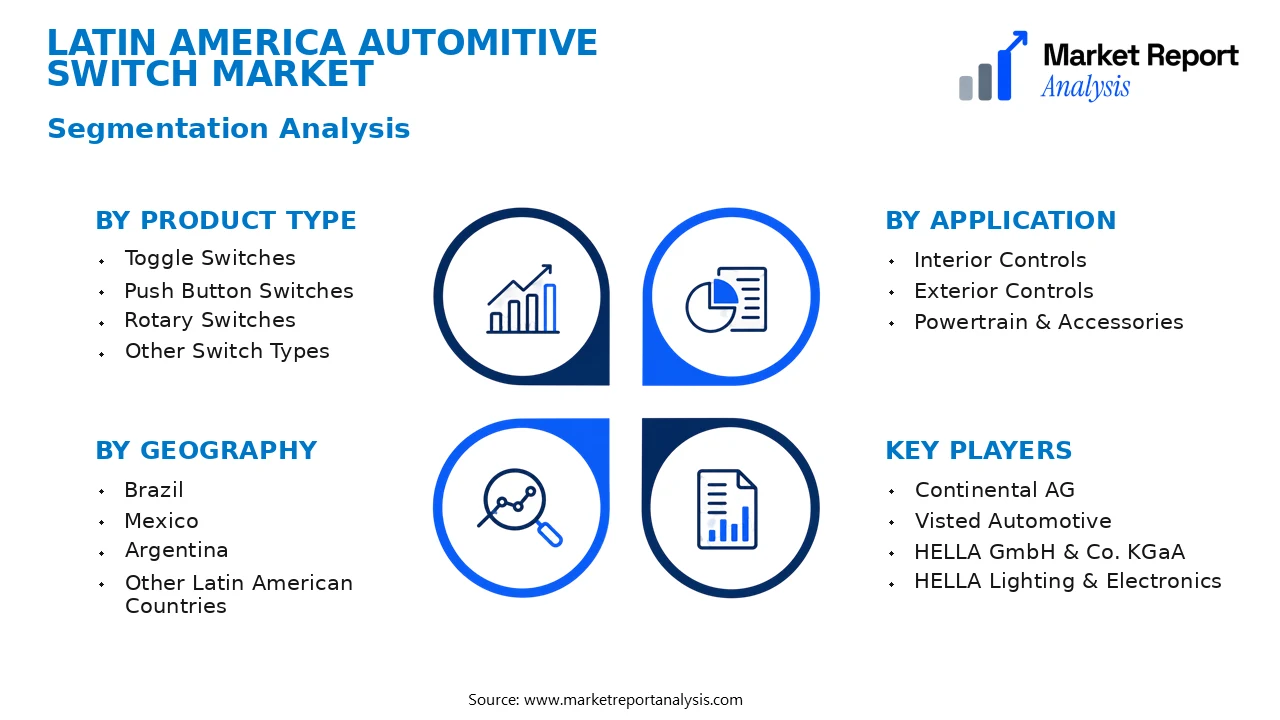
- Product Type
- Toggle Switches: Toggle switches are widely used in vehicles for controlling various electrical systems due to their durability and ease of operation. Their demand is driven by the growing need for reliable switching solutions in automotive electronics.
- Push Button Switches: Push button switches are preferred for their user-friendly interface and compact design, making them suitable for modern vehicle dashboards, especially with the advent of smart and connected vehicle features.
- Rotary Switches: Rotary switches find application in adjusting settings such as volume or light intensity in vehicles. Their robust construction appeals to both OEMs and aftermarket sectors aiming for long-lasting components.
- Other Switch Types: This category includes specialized switches like lever switches and membrane switches, which are gaining traction in customized and advanced vehicle functionalities due to their versatile applications.
- Application
- Interior Controls: Encompasses switches used in dashboard controls, lighting, and infotainment systems, which are central to enhancing driver convenience and vehicle aesthetics with increasing electronic content.
- Exterior Controls: Covers switches for windows, door locks, and mirror adjustments, which are vital for vehicle security and comfort, with growing demand in luxury and standard vehicle segments.
- Powertrain & Accessories: Includes switches related to engine management, startup controls, and accessory operation, critical for vehicle performance and safety, particularly with the rise of electronic powertrain systems.
- Geography
- Brazil: The largest automotive market in Latin America, characterized by a mix of global automakers and local manufacturers, with high demand for various switches driven by expanding automotive production volumes.
- Mexico: Known for its robust automotive manufacturing sector fed by North American supply chains, with increasing adoption of advanced switch technologies aligned with vehicle automation trends.
- Argentina: A significant market for both domestic and imported vehicles, exhibiting steady demand for switches in passenger cars and commercial vehicles amidst economic fluctuations.
- Other Latin American Countries: Includes Colombia, Chile, and others, where local markets are gradually adopting advanced automotive switches, primarily driven by OEM deployment and aftermarket replacements.
Competitive Intelligence
The Latin America Automotive Switch Market is characterized by moderate competition with several key players vying for market share. Market concentration remains relatively fragmented, with the top five companies holding around 40-45% of the total market, enabling room for emerging players to innovate and expand. Leading manufacturers are adopting aggressive business strategies centered on product innovation, aiming to enhance safety, durability, and ease of integration within modern vehicles. Many firms are investing heavily in R&D to develop smarter, more responsive switch technology that supports electric and autonomous vehicle features. Strategic partnerships between OEMs and component suppliers are prevalent, fostering co-development and faster go-to-market timelines. Acquisitions of smaller tech-forward firms are also on the rise, providing access to advanced intellectual property and expanding product portfolios. Expansion strategies focus on regional manufacturing facilities and distribution networks to penetrate emerging markets effectively. Companies are differentiating by emphasizing quality, technological advancements, and sustainability credentials, strengthening competitive positioning amidst evolving industry standards.
Leading Company Profiles
The competitive landscape of the Latin America Automotive Switch Market features prominent players dedicated to innovation, quality, and market expansion. These companies leverage advanced manufacturing processes and strategic collaborations to enhance their product portfolios and meet evolving automotive industry demands.
- Continental AG
- Visted Automotive
- HELLA GmbH & Co. KGaA
- HELLA Lighting & Electronics
- Ten & Co.
- Bosch Mobility Solutions
- Denso Corporation
- Mitsubishi Electric
- HellermannTyton
- TRW Automotive
Continental AG
Continental AG specializes in high-quality automotive switches, offering innovative and reliable solutions with a focus on safety and advanced driver-assistance systems, supporting automotive manufacturers in LATAM's growth initiatives.
Visted Automotive
Visted Automotive provides an extensive range of automotive switches emphasizing durability and customization, leveraging technological innovations to serve OEMs and aftermarket clients across Latin American markets.
HELLA GmbH & Co. KGaA
Hella delivers advanced lighting and electronic systems, with a strategic focus on sustainability and technological excellence, strengthening its presence through R&D investments tailored to LATAM's evolving automotive landscape.
HELLA Lighting & Electronics
A subdivision of Hella, this entity focuses on integrated lighting solutions and electronic components, ensuring compatibility with emerging automotive trends such as electrification and autonomous driving in LATAM.
Ten & Co.
Ten & Co. offers innovative electrical switchgear, emphasizing compact design and energy efficiency, with strategic investments aimed at expanding its footprint within LATAM's automotive manufacturing sector.
Bosch Mobility Solutions
Bosch enhances its portfolio with smart switching technologies and sensor integrations, focusing on digitalization and electrification trends to support Latin American automakers' transition to connected vehicles.
Denso Corporation
Denso specializes in vehicle control switches, integrating IoT and AI capabilities, aligning product development with the sustainability goals and technological modernization in the LATAM automotive industry.
Mitsubishi Electric
Mitsubishi Electric delivers high-performance switches with a focus on reliability and innovation, investing in local manufacturing and R&D to capture growth opportunities within the Latin American automotive sector.
HellermannTyton
HellermannTyton offers robust wiring and switch solutions, prioritizing quality, safety, and ease of installation while strengthening its regional supply chain to serve Latin American automakers efficiently.
TRW Automotive
TRW focuses on safety-related switching systems, leveraging cutting-edge electronic innovations to support Latin American automotive industries' shift towards smarter, more connected vehicle architectures.
Strategic Business Developments
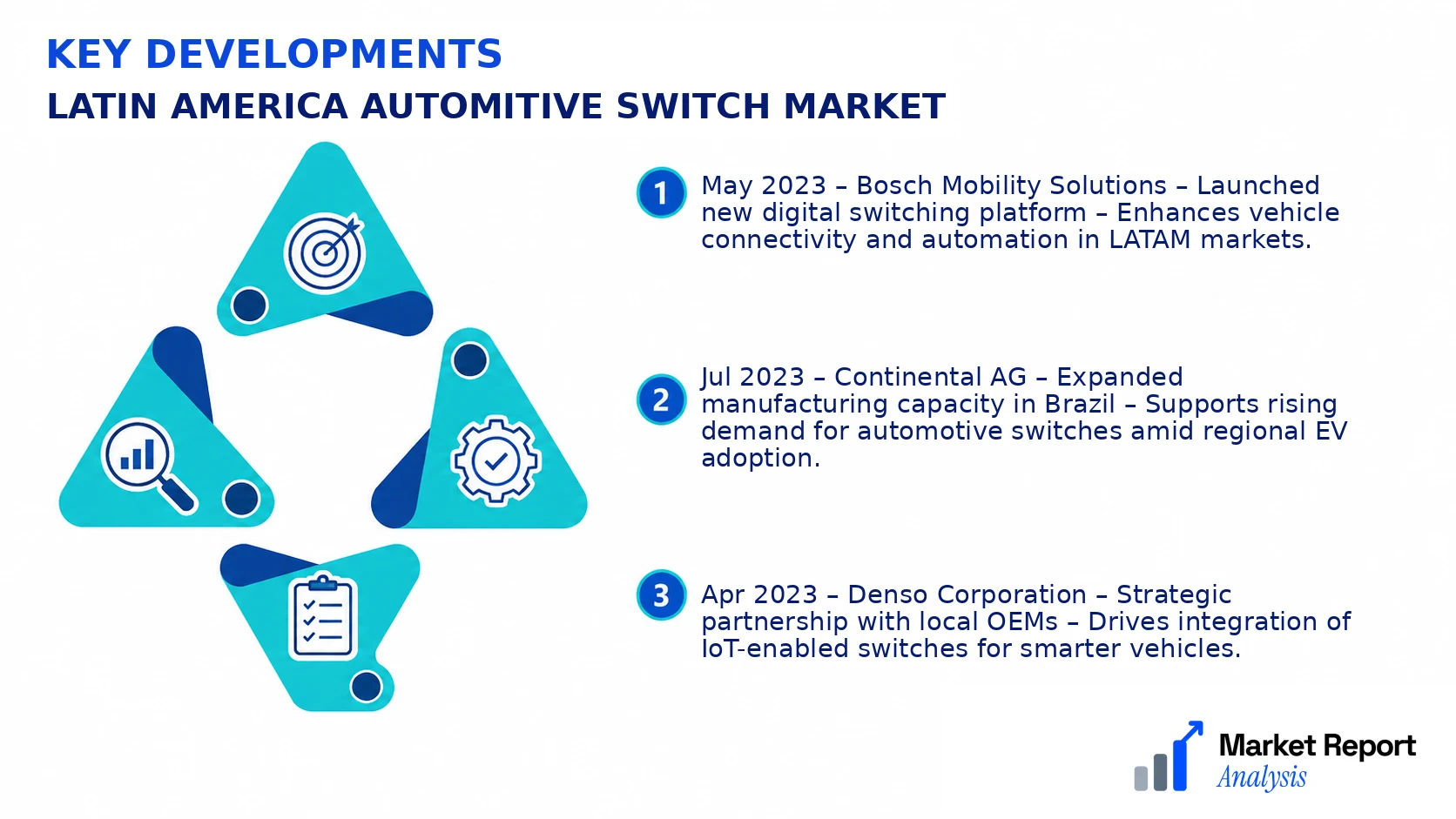
- May 2023 – Bosch Mobility Solutions – Launched new digital switching platform – Enhances vehicle connectivity and automation in LATAM markets.
- Jul 2023 – Continental AG – Expanded manufacturing capacity in Brazil – Supports rising demand for automotive switches amid regional EV adoption.
- Apr 2023 – Denso Corporation – Strategic partnership with local OEMs – Drives integration of IoT-enabled switches for smarter vehicles.
- Jun 2023 – HellermannTyton – Invested in new plant in Mexico – Improves supply chain resilience and manufacturing efficiency. Aug 2023 – Visted Automotive – Launch of eco-friendly switch series – Targets sustainable automotive solutions aligning with LATAM regulatory trends.
Frequently Asked Questions
What is the Latin America Automotive Switch Market?
The Latin America Automotive Switch Market encompasses the industry focused on manufacturing and supplying switches used in vehicles across Latin American countries. These switches facilitate various vehicle functions, including lighting, ignition, and electronic controls, playing a crucial role in automotive safety and convenience.
What is the current market size of Latin America Automotive Switch Market?
As of 2026, the Latin America Automotive Switch Market is valued at approximately USD 4.2 Billion. The market has experienced steady growth driven by increasing vehicle production and technological advancements within the region.
What factors are driving the Latin America Automotive Switch Market?
The market is primarily driven by rising vehicle sales, technological integrations, and vehicle electrification trends. Growing automotive manufacturing activity in countries like Brazil and Mexico, along with increasing demand for advanced safety features, significantly contributes to market expansion.
Which region dominates the Latin America Automotive Switch Market?
Brazil dominates the Latin America Automotive Switch Market owing to its large automotive manufacturing base and expanding vehicle exports. The country’s robust automotive sector acts as a key revenue contributor within the region.
Which segment is expected to grow the fastest?
The electronic switches segment is anticipated to grow the fastest, driven by heightened demand for smart and automated vehicle systems. Advancements in electronic control units (ECUs) further accelerate this growth trajectory from 2026 to 2034.
Who are the leading companies operating in the Latin America Automotive Switch Market?
Leading companies include Bosch, Delphi Technologies, and Sumitomo Electric. These organizations are at the forefront, innovating in switch technology and expanding manufacturing capabilities to meet increasing regional vehicle production demands.
Analyst Perspective
The Latin America automotive switch market remains in a growth phase, driven by ongoing vehicle electrification and increased safety regulations. Long-term, the market is poised for steady expansion, with an anticipated CAGR of 8.5% from 2026 to 2034, reaching an estimated USD 12 Billion by 2034. Commercial opportunities are abundant in the development of smart, integrated switches incorporating IoT and AI, catering to an evolving consumer preference for connected vehicles. Technology evolution is expected to focus on miniaturization, enhanced durability, and energy efficiency, aligning with the shift towards electric and autonomous vehicles. Investment priorities should emphasize collaborations with local automotive OEMs and suppliers to capitalize on regional manufacturing incentives and market accessibility. Competitive intensity is moderate but increasing, with emerging local players and established automotive component suppliers vying for market share. The regional growth potential is significant, particularly in Brazil and Mexico, where automotive production is expanding. Overall, strategic positioning requires balancing innovation with regional compliance, fostering partnerships, and pursuing sustainable, scalable solutions for long-term success.
