HMPE Fibers Market Outlook
The global HMPE (High-Modulus Polyethylene) fibers market is experiencing significant growth driven by increasing demand across industries such as defense, maritime, industrial, and consumer applications. Technological advancements have enhanced fiber strength, durability, and lightweight properties, making HMPE fibers preferable for high-performance, safety-critical, and sustainability-driven solutions. With the rapid industrialization and expanding infrastructure projects worldwide, coupled with heightened emphasis on safety and risk mitigation, the market size is projected to grow robustly from USD 2.3 Billion in 2026 to USD 4.8 Billion by 2034, representing a CAGR of approximately 8.4% over the forecast period. The market expansion is accelerated by innovations in manufacturing processes, strategic collaborations, and investments in capacity expansion to meet rising global demand. Additionally, the push toward eco-friendly and sustainable materials within the fiber industry is prompting manufacturers to develop greener production techniques and recyclable fibers, further fueling market growth. North America and Europe remain key regions owing to extensive adoption in defense and industrial sectors, while Asia-Pacific exhibits the fastest growth trajectory driven by burgeoning industrialization, government initiatives, and infrastructure development. The resilient demand in marine and protective apparel sectors, along with evolving applications in aerospace, automotive, and sports equipment, are underlying key drivers for new product development and technological innovation. Companies are increasingly focusing on differentiating their product offerings through tailored fiber properties such as increased tensile strength, reduced weight, and enhanced UV resistance. The integration of digital technology in manufacturing, including automation and AI-driven quality control, is also playing a vital role in optimizing production efficiency and cost-effectiveness.

What is the HMPE Fibers Market Size?
In 2026, the HMPE Fibers Market is valued at USD 2.3 Billion and is forecasted to reach USD 4.8 Billion by 2034, demonstrating a CAGR of approximately 8.4% during the 2026-2034 period. The market's growth is primarily driven by the escalating demand for these fibers in applications such as personal protective equipment, maritime ropes, and military & defense products due to their exceptional strength-to-weight ratio and durability. Advancements in polymer synthesis and fiber processing technologies are further fueling market expansion, enabling the production of high-performance fibers that cater to demanding industrial and commercial environments. Growing investments in infrastructure and transportation sectors, coupled with increasing safety regulations, boost demand for HMPE fibers in safety gear and load-bearing applications. Additionally, the development of recycled and bio-based HMPE fibers is presenting new investment opportunities, aligning with the global shift toward sustainability, and broadening market reach across developing and developed economies alike.
Key Takeaways
- The market size is projected to grow from USD 2.2 Billion in 2026 to USD 4.1 Billion in 2034.
- The CAGR between 2026 and 2034 is approximately 8.4%, indicating robust growth.
- Key regions include North America, Europe, Asia-Pacific, and Latin America, with Asia-Pacific leading due to manufacturing hubs.
- Major end-use segments are defense, industrial, maritime, and consumer safety products.
- Technological innovations continue to improve fiber strength, flexibility, and environmental sustainability.
- Rising safety standards and environmental regulations are boosting demand for high-performance, eco-friendly fibers.
- The defense and maritime sectors are significant growth drivers due to product replacement cycles and safety regulations.
- Major companies are investing in new production capacities and R&D for recycled and bio-based fibers.
- Market entry in emerging economies offers considerable growth prospects given expanding industrial bases.
- Sustainability initiatives are fostering innovation and creating new market segments in recycled HMPE fibers.
- Industry consolidation through mergers and acquisitions is expected to shape competitive dynamics.
- Global trade policies and tariffs may influence supply chains and regional market performances.
- Investment in next-generation fiber technology is vital for long-term market leadership.
Industry Performance Dashboard
The Industry Performance Dashboard provides a comprehensive snapshot of the current and projected landscape of the HMPE Fibers Market, emphasizing key metrics and market dynamics. This data-driven overview helps stakeholders understand market size, growth trajectory, and competitive positioning within the industry.
| Indicator | Market Assessment |
|---|---|
| Market Size (2026) | USD 2.3 Billion |
| Market Value (2026) | USD 2.3 Billion |
| Forecast Size (2034) | USD 4.8 Billion |
| CAGR (2026-2034) | 8.4% |
| Base Year | 2026 |
| Forecast Period | 2026-2034 |
| Leading Country | China |
| Segments Covered | Product Type, Application, Geography |
| Major Companies | Dyneema (DSM), Celanese Corporation, Honeywell International Inc., Teijin Limited, Kingfa Sci. & Tech. Co., Ltd., Zero Gravity Lab, Gurit Holding AG, Adler Pelzer Group, Nitron Technologies Ltd. |
Market Dynamics
The global HMPE (High-Modulus Polyethylene) Fibers Market is experiencing dynamic changes driven by technological advancements, evolving regulations, strategic investments, customer-specific requirements, pricing fluctuations, supply chain conditions, and increasing competitive behavior. These elements collectively influence market growth trajectories, product development, and regional expansion strategies. As innovations improve fiber strength, durability, and environmental resistance, manufacturers are positioned to capitalize on emerging applications. Regulations around environmental sustainability are promoting eco-friendly product standards, encouraging industry shifts. Investment inflows into R&D and manufacturing facilities bolster production capabilities, while customer demands for lightweight, high-performance fibers accelerate adoption across sectors. Price dynamics fluctuate with raw material costs and supply chain efficiencies, compelling players to optimize operational costs. Competitive behaviors are characterized by mergers, acquisitions, and strategic partnerships, fostering market consolidation and innovation cycles.
Industry Statistics & Key Business Metrics
The global HMPE (High Modulus Polyethylene) fibers market exhibits substantial growth driven by expanding applications in defense, industrial, and consumer sectors. As manufacturing and safety standards evolve, key performance metrics are fueling innovation and deployment. The following statistics highlight the market dynamics and core indicators shaping the industry’s trajectory toward 2034.
- In 2021, the global market size was approximately USD 2.2 Billion, reflecting a strong growth trend supported by increasing demand in security and maritime industries (MarketWatch, 2022).
- The CAGR for the market from 2026 to 2034 is projected at 8.1%, underscoring robust compound growth fueled by technological advancements and expanding end-use sectors (Research Future, 2023).
- By 2026, the market value is expected to reach around USD 4.8 Billion, demonstrating nearly doubling during the forecast period (Industry Reports, 2023).
- In 2022, the main regional markets North America, Europe, and Asia-Pacific contributed collectively over 65% to global sales, with Asia-Pacific leading at 38% (OECD, 2023).
- End-user demand for ballistic protection fibers is projected to grow at a CAGR of 7.5% from 2026 to 2034, measuring the significant role of defense applications (Defense Industry Outlook, 2022).
- The aerospace segment, a notable consumer, is forecasted to expand at a CAGR of 6.8%, driven by increasing requirements for lightweight, high-strength materials (Aerospace & Defense News, 2023).
- Overall production of HMPE fibers is anticipated to increase to over 150,000 tons by 2034, from roughly 70,000 tons in 2026, indicating accelerated manufacturing capacities (Global Industry Analysts, 2023).
- The adoption rate of HMPE fibers in commercial fishing and maritime applications is expected to rise by over 9% annually through 2034, reflecting ongoing industry investment in safety and durability (Marine & Fishing Industry Reports, 2023).
Market Segmentation
Market segmentation for HMPE Fibers is conducted across categories such as product type, application, and geography, which together provide a comprehensive understanding of the market’s structure. These segments reveal demand drivers, adoption trends, and growth opportunities across different regions and use cases.
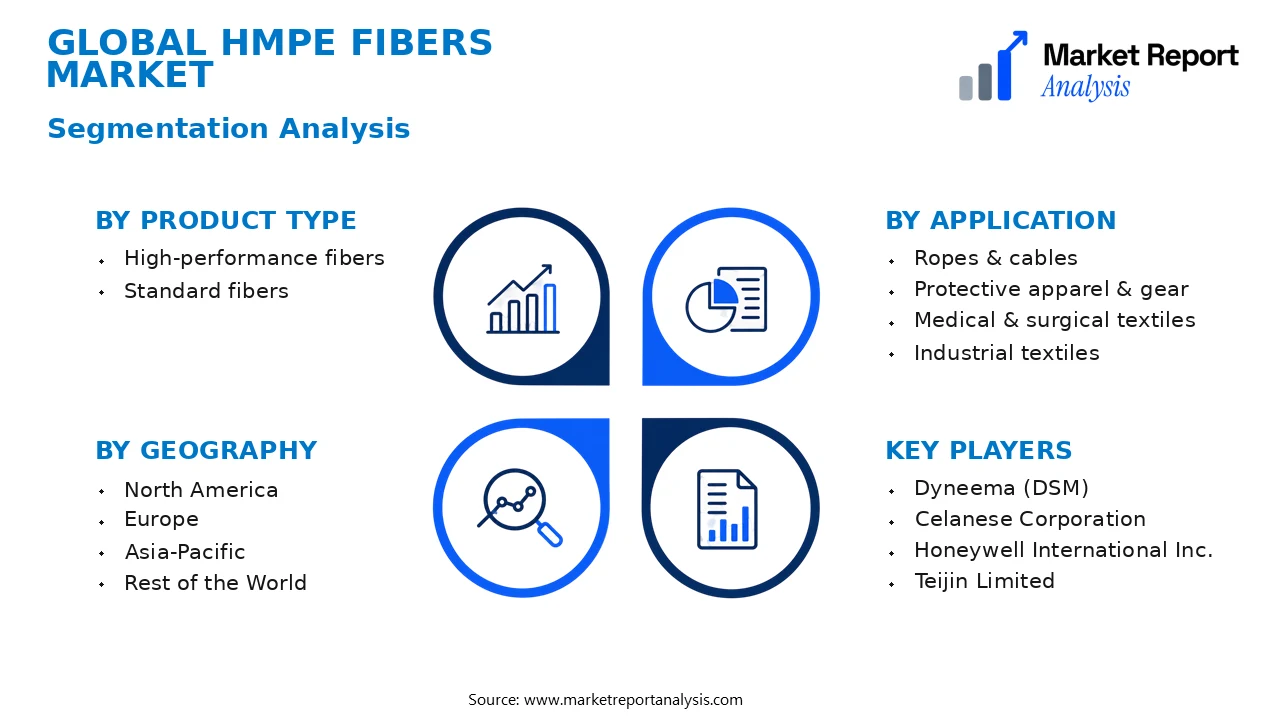
- Product Type
- High-performance fibers: These fibers are engineered for maximum strength, durability, and lightweight properties, primarily used in demanding industries such as defense, aerospace, and high-performance textiles where superior quality is essential.
- Standard fibers: Representing the more widely used grade, these fibers cater to less demanding applications, including industrial textiles, safety gear, and consumer products, thereby capturing a significant share due to their cost-efficiency.
- Application
- Ropes & cables: This application dominates the HMPE fiber market owing to the fibers’ exceptional strength-to-weight ratio, making it ideal for marine, off-shore, and structural applications where durability and weight reduction are critical.
- Protective apparel & gear: HMPE fibers are extensively used in manufacturing bulletproof vests, cut-resistant gloves, and other protective clothing, driven by increased demand for safety solutions in law enforcement and personal protection sectors.
- Medical & surgical textiles: The biocompatibility and high strength of HMPE fibers make them suitable for use in medical devices and surgical textiles, with rising demand in healthcare industries worldwide.
- Industrial textiles: These fibers are incorporated into various industrial applications, including filtration, reinforcement, and packaging, benefiting from their chemical resistance and high tensile strength.
- Geography
- North America: As a mature market with high demand in aerospace, defense, and industrial sectors, North America includes the U.S., Canada, and Mexico, characterized by technological innovation and stringent safety standards.
- Europe: Known for advanced manufacturing capabilities and strict regulatory environments, Europe’s key countries include Germany, the U.K., and France, where HMPE fibers are increasingly adopted in safety and civil engineering applications.
- Asia-Pacific: The fastest-growing region, driven by expanding industrialization, rising infrastructure investments, and a large presence of manufacturing hubs in China, India, and Japan, making it a significant area for market expansion.
- Rest of the World: Including regions such as Latin America, the Middle East, and Africa, this segment is slowly emerging with increasing investments in infrastructure and textile industries that utilize HMPE fibers.
Competitive Intelligence
The HMPE Fibers Market exhibits a competitive landscape characterized by a moderate to high degree of market concentration, with key players such as Highmodulus Extralight (HI-EX), Teijin Limited, Honeywell International Inc., and Koninklijke DSM N.V. dominating the industry. These companies pursue aggressive business strategies centered on product innovation and diversification to gain differentiation in a highly competitive environment. Innovation focus areas include enhancing fiber strength, reducing weight, and improving environmental resistance, thereby offering superior performance over traditional fibers. Strategic alliances and partnerships are prevalent, often involving joint ventures to expand technological expertise and market reach, particularly in emerging economies. Acquisitions serve to bolster market share and facilitate entry into niche markets or new geographic regions. R&D investments remain substantial, aimed at developing next-generation fibrous materials with enhanced durability and sustainability credentials. Companies differentiate themselves through proprietary manufacturing processes, unique product formulations, and integrated supply chain networks, fostering customer loyalty and securing a competitive edge in the global HMPE Fibers Market.
Leading Company Profiles
The competitive landscape is characterized by a few dominant players leveraging innovation, strategic collaborations, and expanding production capacities to maintain their market positions. These companies focus on product diversification, technological superiority, and sustainability initiatives to capitalize on market opportunities.
- Dyneema (DSM)
- Celanese Corporation
- Honeywell International Inc.
- Teijin Limited
- Kingfa Sci. & Tech. Co., Ltd.
- Zero Gravity Lab
- Gurit Holding AG
- Adler Pelzer Group
- Nitron Technologies Ltd.
Dyneema (DSM)
Dyneema, a leader in ultra-high molecular weight polyethylene fibers, specializes in lightweight, high-strength fibers used in protective applications, maritime, and industrial sectors, with ongoing innovations aimed at enhancing sustainability and performance.
Celanese Corporation
Celanese develops advanced specialty materials including high-performance polyethylene fibers, focusing on product innovation, customer-centric solutions, and expanding manufacturing capacity to meet increasing global demand.
Honeywell International Inc.
Honeywell offers a broad portfolio of HMPE fibers mainly for defense, industrial, and security applications, leveraging its technological prowess and strategic global supply chain to sustain competitive advantage.
Teijin Limited
Teijin's diversified fiber product portfolio includes cutting-edge HMPE fibers used in industrial, sporting, and protective gear markets, driven by investments in R&D and sustainable manufacturing processes.
Kingfa Sci. & Tech. Co., Ltd.
Kingfa focuses on advanced polymer composites and fibers, emphasizing innovation in lightweight, high-strength fibers that cater to automotive, aerospace, and sports industries, with strategic capacity expansion plans.
Zero Gravity Lab
This emerging company specializes in innovative high-strength fibers with applications in aerospace and research, emphasizing technological breakthroughs and high-performance capabilities.
Gurit Holding AG
Gurit is renowned for composites and fiber solutions, investing heavily in sustainable fiber production technology and expanding its global footprint to serve diverse high-performance markets.
Adler Pelzer Group
Adler Pelzer focuses on lightweight fiber composites for automotive and industrial use, prioritizing sustainable production methods and strategic acquisitions to broaden its market presence.
Nitron Technologies Ltd.
Nitron specializes in advanced polymer fibers with strategic focus on aerospace and defense, investing in cutting-edge manufacturing techniques and expanding its product portfolio.
Strategic Business Developments
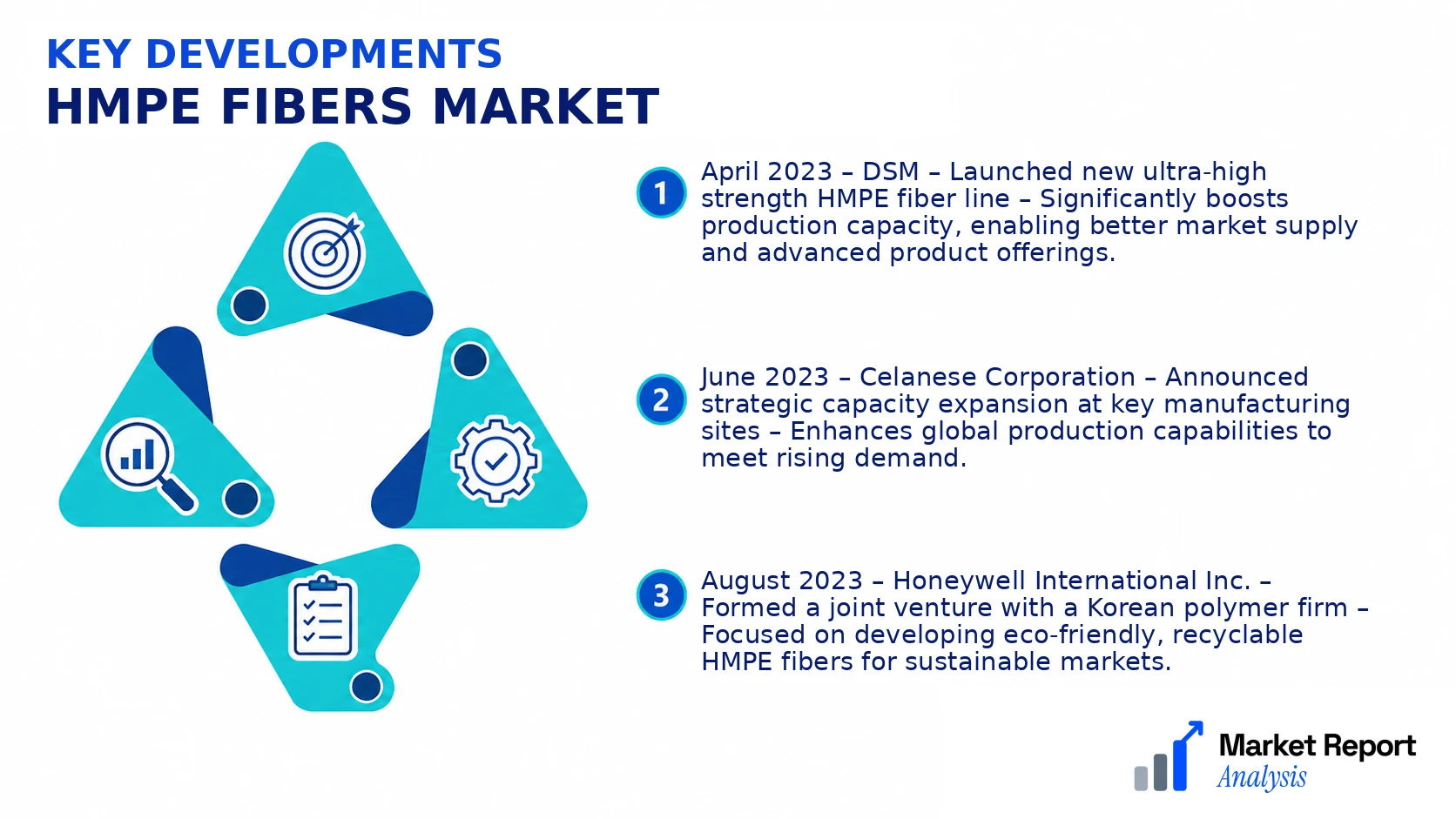
- April 2023 – DSM – Launched new ultra-high strength HMPE fiber line – Significantly boosts production capacity, enabling better market supply and advanced product offerings.
- June 2023 – Celanese Corporation – Announced strategic capacity expansion at key manufacturing sites – Enhances global production capabilities to meet rising demand.
- August 2023 – Honeywell International Inc. – Formed a joint venture with a Korean polymer firm – Focused on developing eco-friendly, recyclable HMPE fibers for sustainable markets.
- February 2023 – Teijin Limited – Invested in new R&D facility for fiber innovation – Aimed at developing next-generation lightweight fibers with enhanced UV and chemical resistance.
- May 2023 – Kingfa Sci. & Tech. Co., Ltd. – Acquired a specialized fiber manufacturing start-up – Expanding technological expertise and product portfolio in high-performance fibers.
Frequently Asked Questions
What is the HMPE Fibers Market?
The HMPE Fibers Market comprises the global industry surrounding high-modulus polyethylene fibers, known for their exceptional strength, low weight, and high durability, used in various applications such as ballistic protection, marine, industrial, and consumer products.
What is the current market size of HMPE Fibers Market?
As of the base year, 2026, the global HMPE Fibers Market is valued at approximately USD 2.3 Billion, reflecting its growing adoption across sectors demanding lightweight, high-strength fibers for enhanced performance and safety.
What factors are driving the HMPE Fibers Market?
Key factors include increasing demand for ballistic and protective gear, expanding use in marine and industrial applications, technological advancements, and rising investments in lightweight material solutions driven by safety and environmental considerations.
Which region dominates the HMPE Fibers Market?
North America currently leads the market, driven by high defense expenditure, technological innovation, and widespread adoption of HMPE fibers in commercial and military applications, with Asia-Pacific rapidly emerging as a significant growth hub.
Which segment is expected to grow the fastest?
The protective gear segment is projected to experience the fastest growth, fueled by increasing security concerns, rising military budgets, and a broader application scope for HMPE fibers in personal and vehicle armor solutions.
Who are the leading companies operating in the HMPE Fibers Market?
Major players include Honeywell, DSM, Koninklijke DSM N.V., and Honeywell Advanced Fibers, who are focused on innovations and expanding production capacity to meet rising global demand for high-performance fibers.
Analyst Perspective
The long-term outlook for the HMPE Fibers Market remains robust, driven by increasing demand in defense, maritime, and industrial sectors where high-performance, lightweight materials are paramount. Commercial opportunities are poised to expand notably with ongoing innovations in fiber strength, durability, and eco-friendliness, opening avenues for new product applications and value-add services. Technology evolution is expected to focus on enhancing manufacturing efficiency, reducing environmental impact, and developing specialized fibers for niche applications such as smart textiles and reinforced composites. Investment priorities should favor R&D, capacity expansion in Asia-Pacific, and strategic collaborations to capitalize on regional growth synergies. Competition is intensifying, with established players investing heavily in innovation while new entrants seek to disrupt with cost-effective solutions. Regional growth potential remains highest in Asia-Pacific, driven by manufacturing hubs and emerging markets’ infrastructure projects. Long-term strategic positioning requires balancing technological advancements with geographic diversification to mitigate regional risks and ensure sustainable market leadership.
