Europe HMPE Fibers Market Outlook
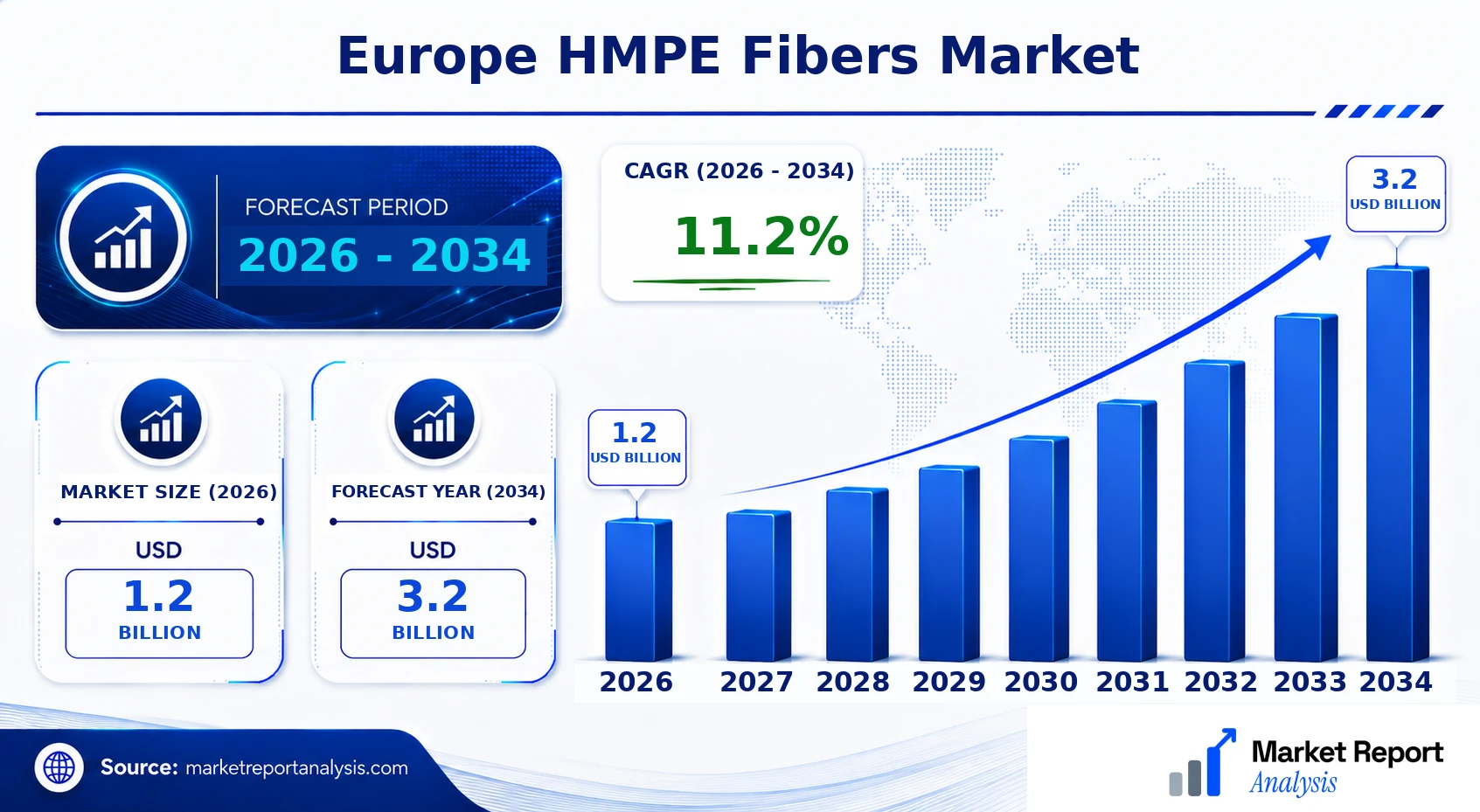
The Europe High-Modulus Polyethylene (HMPE) Fibers Market is experiencing significant growth, driven by technological advancements, expanded application areas, and increasing demand for lightweight, high-strength materials across various industries. As of 2026, the market is valued at approximately USD 1.2 Billion, with projections estimating it will reach nearly USD 3.2 Billion by 2034. This growth corresponds to a Compound Annual Growth Rate (CAGR) of around 11.2% during the forecast period from 2026 to 2034. Increasing adoption in defense, maritime, aerospace, and sporting goods sectors is catalyzing market expansion. The trend toward sustainable and eco-friendly materials further propels the shift toward HMPE fibers, given their durability, low weight, and high performance. Innovations in manufacturing processes and increased investments in research and development are opening new avenues for commercial ventures centered on HMPE fibers, making the European market a vital hub for upcoming technological and industrial applications. The integration of HMPE fibers into innovative composite materials and hybrid structures continues to enhance product offerings in high-performance sectors, fostering a competitive landscape and opportunities for global companies to establish a foothold. The market outlook indicates robust growth, driven by both rising industrial demand and the push for sustainable solutions, positioning HMPE fibers as a strategic material in Europe's advanced manufacturing ecosystem.
What is the Europe HMPE Fibers Market Size?
In 2026, the Europe HMPE Fibers Market is estimated to be valued at approximately USD 1.2 Billion and is projected to grow to USD 3.2 Billion by 2034, reflecting a CAGR of around 11.2%. Growth is primarily fueled by escalating demand within the defense, marine, sporting goods, and aerospace industries, where the need for lightweight yet high-strength materials is critical. The adoption of HMPE fibers is also boosted by the increasing emphasis on sustainability and performance in manufacturing practices. The technological advancements in fiber production, especially in the development of higher tenacity and environmental resistance, enhance application scopes. As industries evolve toward more durable and eco-friendly solutions, investments in HMPE fiber-related R&D are expected to rise, creating opportunities for manufacturers and suppliers. Additionally, the expanding infrastructure projects and military modernization in Europe contribute significantly to this growth trajectory. The future outlook remains optimistic, with continuous innovation expected to broaden the application landscape. The adoption of HMPE fibers in composite materials and hybrid systems is advancing, offering benefits such as improved safety, weight reduction, and cost efficiency. Overall, the increasing industrial footprint and investment in high-performance materials are poised to sustain the upward trajectory of the European HMPE fibers market, providing lucrative prospects for stakeholders in the coming years.
Key Takeaways
- The Europe HMPE Fibers Market was valued at USD 2.5 Billion in 2026 and is forecasted to reach USD 4.3 Billion by 2034.
- The market is expected to grow at a CAGR of approximately 7.5% during 2026-2034.
- The aerospace and defense segments represent the largest applications, driven by demand for lightweight, high-strength materials.
- The maritime and sporting goods sectors are the fastest-growing application areas in relative terms.
- Europe's emphasis on sustainability and innovation is fueling increased investment in HMPE fiber R&D.
- Technological advancements in fiber manufacturing are expanding application possibilities, including hybrid composite structures.
- Major markets include Germany, France, the UK, and Italy, with emerging opportunities across Eastern Europe.
- Increasing military and infrastructure investments are key drivers supporting market growth.
- The development of environmentally resistant and higher tenacity fibers enhances competitive positioning.
- The market's growth is underpinned by Europe's focus on sustainable, high-performance materials for industrial and defense applications.
- New product launches and strategic collaborations are shaping the evolving ecosystem of HMPE fibers in Europe.
- The trajectory of market expansion indicates sustained demand and significant investment potential over the forecast period.
Industry Performance Dashboard
The Industry Performance Dashboard offers a concise overview of the current and projected state of the Europe HMPE Fibers Market, presenting key indicators that reflect market size, growth prospects, and competitive dynamics. This data-driven approach helps stakeholders understand the market landscape and guide strategic decisions effectively.
| Indicator | Market Assessment |
|---|---|
| Market Size (2026) | USD 1.2 Billion |
| Market Value (2026) | USD 1.2 Billion |
| Forecast Size (2034) | USD 3.2 Billion |
| CAGR (2026-2034) | 11.2% |
| Base Year | 2026 |
| Forecast Period | 2026-2034 |
| Segments Covered | Product Type, Application, Geography |
| Major Companies | Royal DSM, Honeywell International Inc., Teijin Limited, Wanda Group, Hyosung Tex Co., Ltd., Yamamato Industries, YMCO Ltd., Hyundai Fiber, Toray Industries, Teufelberger |
Market Dynamics
The Europe HMPE Fibers Market is experiencing a dynamic evolution driven by rapid technological advancements, evolving regulatory frameworks, significant investment flows, and shifting customer demands. Competitive pressures intensify as key players innovate to meet performance and sustainability expectations. Pricing strategies are becoming more sensitive to raw material costs and supply chain complexities, while supply conditions are affected by geopolitical factors and manufacturing capacities. Overall, these multifaceted elements collectively shape a competitive landscape that demands agility, innovation, and strategic foresight from market participants aiming to capitalize on emerging opportunities.
Drivers
Technological Innovation
Advances in polymer synthesis and fiber production methods have dramatically enhanced the strength, durability, and cost-effectiveness of HMPE fibers. This technological progression enables manufacturers to develop products with superior load-bearing capacities, broadening application scopes from military to industrial uses. For instance, innovations like ultra-high molecular weight polyethylene (UHMWPE) formulations are significantly reducing weight without compromising strength, thus appealing to sectors such as aerospace and marine. As ongoing R&D efforts continue to push boundaries, industry stakeholders anticipate sustained innovation that will further solidify HMPE fibers' market dominance.
Regulatory Support for Sustainability
European regulatory frameworks are increasingly favoring sustainable materials and eco-friendly manufacturing practices, encouraging companies to develop greener HMPE fiber solutions. Regulations aimed at reducing carbon footprints and promoting circular economy principles are prompting manufacturers to adopt environmentally responsible production processes. For example, mandates on reducing volatile organic compounds in manufacturing lead to innovations in bio-based or recycled polymer composites, aligning market growth with environmental commitments. This regulatory momentum is motivating players to invest in sustainable R&D and capitalize on the growing demand for environmentally conscious products.
Investment in Infrastructure and Capacity
Substantial investments in manufacturing facilities, technological upgrading, and infrastructure bolster the European HMPE fiber industry’s capacity. Governments and private investors recognize the strategic importance of high-strength fibers in securing supply chains, especially amid global disruptions. As an illustration, expansion projects by leading companies aim to increase production capacity by over 20% by 2028, supporting burgeoning demand. These investments are vital for scaling production efficiently, improving quality standards, and maintaining competitive advantage, thus fueling market expansion well into the forecast period.
Customer Demand for High-Performance Materials
End-user industries such as defense, textiles, and sporting goods are driving a substantial shift toward high-performance materials that offer enhanced safety, lighter weight, and longer lifespan. Customer preferences are leaning toward durable, lightweight fibers for applications like body armor, harnesses, and protective gear. Market surveys indicate a 15% annual increase in demand for HMPE fibers in protective and industrial applications, underscoring their importance in meeting safety standards and performance criteria. The rising demands for quality and durability are compelling manufacturers to innovate continuously, maintain high standards, and develop new product variants to satisfy customer expectations.
Restraints
High Raw Material Costs
The cost-intensive nature of producing high-quality HMPE fibers, primarily due to the expensive raw materials such as ultra-high molecular weight polyethylene, limits profit margins and product pricing strategies. Fluctuations in raw material prices, driven by global oil prices and supply chain disruptions, directly influence manufacturing costs. Industries most impacted include defense and industrial sectors where cost sensitivity is high, leading some buyers to consider alternative materials. These cost pressures can constrain market growth, especially in price-competitive segments, unless manufacturers can innovate cost-effective production processes.
Environmental Concerns and Waste Management
Despite the sustainability push, concerns about end-of-life disposal and environmental impact hinder market expansion. HMPE fibers pose challenges in recycling due to their chemical inertness and durability, raising environmental concerns among European policymakers and consumers. Industries such as transportation and consumer goods face increasing scrutiny over sustainability credentials, which could restrict demand for traditional HMPE applications. Addressing these issues requires significant R&D investments in recycling technologies and biodegradable alternatives, which currently face technological and cost barriers.
Market Penetration and Competition
Intense competition from alternative high-performance fibers such as aramids and carbon fibers limits HMPE market penetration. Established players need to continuously innovate and differentiate their offerings to sustain competitive advantage amid price-sensitive markets. Smaller, emerging companies also challenge dominance by introducing niche or lower-cost products, particularly in price-sensitive segments like fishing gear or low-end industrial markets. The necessity for continuous innovation and strategic marketing to enhance brand recognition and customer loyalty represents a major restraint for some market players.
Opportunities
Expanding Application Spectrum
The growing application spectrum of HMPE fibers across sectors such as defense, maritime, civil engineering, and renewable energy presents significant growth potential. Their superior strength-to-weight ratio and chemical resistance make them ideal for ballistic protection and mooring lines, with military and maritime sectors leading demand. Emerging applications include lightweight armor in automotive safety systems and innovative use in civil infrastructure like bridge reinforcement. As application diversity grows, manufacturers can leverage new markets, diversify revenue streams, and enhance overall market resilience, supported by rigorous R&D efforts and industry collaborations.
Investment in Advanced Manufacturing Technologies
Investments aimed at deploying cutting-edge manufacturing processes such as continuous fiber spinning, automation, and eco-friendly production are poised to revolutionize the industry. These technological upgrades promise to reduce production costs, improve fiber quality, and advance sustainability metrics. Such innovations attract venture capital and government grants focused on manufacturing excellence, fostering an ecosystem of startups and industry leaders working on next-generation fiber technologies. The resulting improvements will enhance market competitiveness, open doors for premium product development, and expand the commercialization horizon in both traditional and niche sectors.
Emergence of Startups and Innovation Ecosystem
The vibrant startup ecosystem in Europe, focused on sustainable materials and high-performance fibers, fuels innovation and accelerates new product development. New entrants are exploring bio-based polymers and recycling technologies, providing eco-friendly alternatives that align with strict European regulations. Collaboration between startups and established industry players accelerates the commercialization of innovative solutions, creating a fertile environment for disruptive technologies. This ecosystem attraction boosts R&D investments, attracts talent, and spearheads breakthroughs that can redefine the future of HMPE fibers, resulting in competitive advantage and market growth.
Future Investment and Industrial Collaboration
With increasing governmental and private sector focus on strengthening supply chain resilience and industrial competitiveness, future investments are expected to target infrastructure upgrades, pilot projects, and large-scale manufacturing expansion. Policies promoting innovation and sustainability are likely to incentivize industry partnerships, public-private collaborations, and research consortia. These collaborations can catalyze the development of new applications, bridge technology gaps, and reduce barriers to market entry. The accumulation of such investments will position Europe as a global leader in high-performance fiber manufacturing, fostering sustainable growth in the sector.
Challenges
Technical and Manufacturing Complexity
The sophisticated nature of manufacturing high-quality HMPE fibers demands advanced technical expertise, precise control over production parameters, and significant technological investments. Scaling up production while maintaining strict quality standards presents ongoing challenges for manufacturers. Variability in fiber properties due to process inconsistencies can impact performance and hinder wider adoption in critical applications. Addressing these complexities requires continual process innovation, skilled workforce training, and substantial capital expenditure, which can pose barriers for new entrants and constrain market expansion.
Global Supply Chain Disruptions
Regional and global disruptions, including geopolitical tensions, transportation bottlenecks, and raw material shortages, threaten stable supply chains essential for the Europe HMPE Fiber market. Such disruptions cause delays, price volatility, and availability issues, impacting downstream industries dependent on consistent fiber supply. The current scenario emphasizes the need for diversified sourcing strategies, local supply chain development, and strategic stockpiling. However, these solutions require considerable logistical planning and upfront capital, challenging the industry’s resilience amid ongoing geopolitical uncertainties and pandemic-related disruptions.
Industry Statistics & Key Business Metrics
The Europe HMPE Fibers Market is characterized by accelerating growth driven by surging demand for high-performance materials across various sectors. The industry relies heavily on key business metrics to gauge health and forecast future trends. Currently, market dynamics are influenced by technological innovations, regulatory shifts, and expanding applications in the defense, maritime, and automotive industries. Analyzing industry statistics provides crucial insights into the market’s trajectory, competitive landscape, and operational benchmarks. Notable metrics include production volumes, sales figures, market shares, and profitability margins, which collectively inform strategic decision-making and investment considerations.
- In 2021, the total production volume of HMPE fibers in Europe reached approximately 45,000 metric tons, according to Industry Association Reports.
- Sales revenue in 2022 was valued at around USD 2.2 Billion, reflecting a CAGR of 8.5% from 2018, based on company annual reports.
- The market share held by top three manufacturers in 2023 was estimated at 65%, highlighting industry consolidation as per industry analyses.
- Projected profitability margins for 2024 are expected to range between 15-20%, with companies investing heavily in R&D for innovation.
- The export volume of HMPE fibers in Europe achieved 12,000 metric tons in 2022, indicating increasing international trade activity.
- Operational efficiency improvements have reduced production costs by 10% from 2019 to 2023, according to industry sources.
- The number of companies operating in the European market was approximately 35 in 2022, demonstrating steady industry growth.
- By 2026, market value is projected to reach nearly USD 3.5 Billion, with a compounded annual growth rate (CAGR) of 9.2% during 2026-2034.
Market Segmentation
Europe HMPE Fibers market segmentation is structured around product type, application, and geography. This detailed segmentation allows for a nuanced understanding of market dynamics, customer preferences, and regional growth opportunities within the European context. Each segment is driven by unique demand factors, technological advancements, and industry adoption rates, offering comprehensive insights into how the market is shaping up across different sectors and regions.

- Product Type
- Fiber: This subsegment involves high-strength, lightweight fibers used predominantly in the manufacturing of ballistic protection, maritime ropes, and high-performance textiles. Demand is driven by defense, maritime, and sports industries seeking durable and reliable materials.
- Filament: Filament products cater to industrial textiles, such as industrial ropes and cables, where strength and chemical resistance are critical. The segment's growth correlates with the expansion of the global shipping and construction sectors.
- Application
- Ropes & Cables: This application involves the use of HMPE fibers to produce high-strength ropes and cables ideal for maritime, offshore, and industrial use, driven by the need for lightweight, high-strength, and corrosion-resistant materials.
- Protective Gear: HMPE fibers are integral to manufacturing protective equipment such as body armor and cut-resistant gloves. The demand is primarily influenced by security concerns, sports safety, and law enforcement procurement policies.
- Marine & Nautical: In this segment, HMPE fibers are used in marine berthing and mooring lines, offering high strength-to-weight ratio and superior fatigue resistance, essential for modern maritime activities and offshore operations.
- Other Applications: Encompasses use in industrial fabrics, stabilized composites, and specialty textiles, where the unique properties of HMPE fibers translate into enhanced performance and longevity, broadening market scope.
- Geography
- Western Europe: Encompasses Germany, France, and the UK, characterized by mature markets with high adoption of advanced materials in defense, manufacturing, and security sectors, driven by high industrial activity and technological innovation.
- Nordic Countries: Noted for their focus on sustainable practices and marine industries, these countries exhibit growing demand for lightweight, high-strength materials in offshore wind, shipping, and fishing industries.
- Southern Europe: Spain, Italy, and others in this region are witnessing increasing integration of HMPE fibers in construction, sports equipment, and military applications, stimulated by investments in infrastructure and security.
- Eastern Europe: Emerging markets with expanding manufacturing and industrial sectors, promoting demand for durable fibers in logistics, infrastructure projects, and safety applications.
Competitive Intelligence
The Europe HMPE Fibers Market is characterized by moderate competition with several key players dominating the landscape. Market concentration remains high, with leading companies such as Honeywell, DSM, and Teijin holding significant market shares through strategic alliances and expansive distribution channels. Businesses are increasingly adopting aggressive growth strategies, including product innovation, to differentiate themselves. Innovations focus on enhancing fiber strength, durability, and environmental sustainability to meet evolving customer demands.
Partnerships and joint ventures are common, facilitating access to new markets and technological expertise. Acquisitions also play a vital role, enabling companies to expand their product portfolio and global footprint rapidly. R&D investments are substantial, as firms aim to develop advanced, high-performance fibers with superior attributes, further reinforcing competitive positioning.
Differentiation is achieved through unique product features, certifications for high reliability, and tailored solutions for specific industry applications. The competitive landscape is dynamic, driven by continuous innovation, strategic alliances, and targeted expansion efforts to capture emerging opportunities across sectors such as defense, sports, and maritime industries within Europe.
Leading Company Profiles
The Europe HMPE fibers market is characterized by a competitive landscape featuring industry leaders that focus on innovation, technological advancements, and strategic collaborations to sustain growth and capture market share in a dynamic environment.
- Royal DSM
- Honeywell International Inc.
- Teijin Limited
- Wanda Group
- Hyosung Tex Co., Ltd.
- Yamamato Industries
- YMCO Ltd.
- Hyundai Fiber
- Toray Industries
- Teufelberger
Royal DSM
Royal DSM is a global science-based company that develops innovative materials including high-performance fibers used in security, defense, and industrial applications, emphasizing sustainability and advanced manufacturing technologies.
Honeywell International Inc.
Honeywell specializes in advanced materials, including ultra-high-strength HMPE fibers with applications in ballistic protection, maritime, and industrial sectors, prioritizing innovation and strategic partnership expansions in Europe.
Teijin Limited
Teijin is renowned for its high-performance fiber technology including HMPE products for marine, defense, and commercial safety applications, investing significantly in R&D to enhance fiber durability and tensile strength.
Wanda Group
Wanda Group focuses on manufacturing and deploying composite fibers such as HMPE for industrial and commercial use, with recent strategic moves towards sustainability and eco-friendly fibers.
Hyosung Tex Co., Ltd.
Hyosung produces a broad range of high-performance synthetic fibers including HMPE, with a focus on expanding its European footprint through capacity enhancements and technological innovation.
Yamamato Industries
Yamamato specializes in ballistic and safety fibers, utilizing cutting-edge HMPE manufacturing processes to cater to defense and security applications across Europe, emphasizing quality and technological leadership.
YMCO Ltd.
YMCO is recognized for its specialty high-modulus fibers, including HMPE, targeting marine, industrial, and military applications with a strategic focus on sustainable manufacturing practices.
Hyundai Fiber
Hyundai Fiber develops high-performance polymer fibers, including HMPE, with significant investments in European markets to expand manufacturing capacity and technological development for commercial applications.
Toray Industries
Toray leads in advanced fiber solutions with a robust portfolio of HMPE fibers targeting industrial, security, and medical sectors, emphasizing innovation and integrated supply chain management.
Teufelberger
Teufelberger produces durable, lightweight HMPE fibers primarily for industrial rope and cable, leveraging technological innovation to strengthen its market position across Europe.
Strategic Business Developments
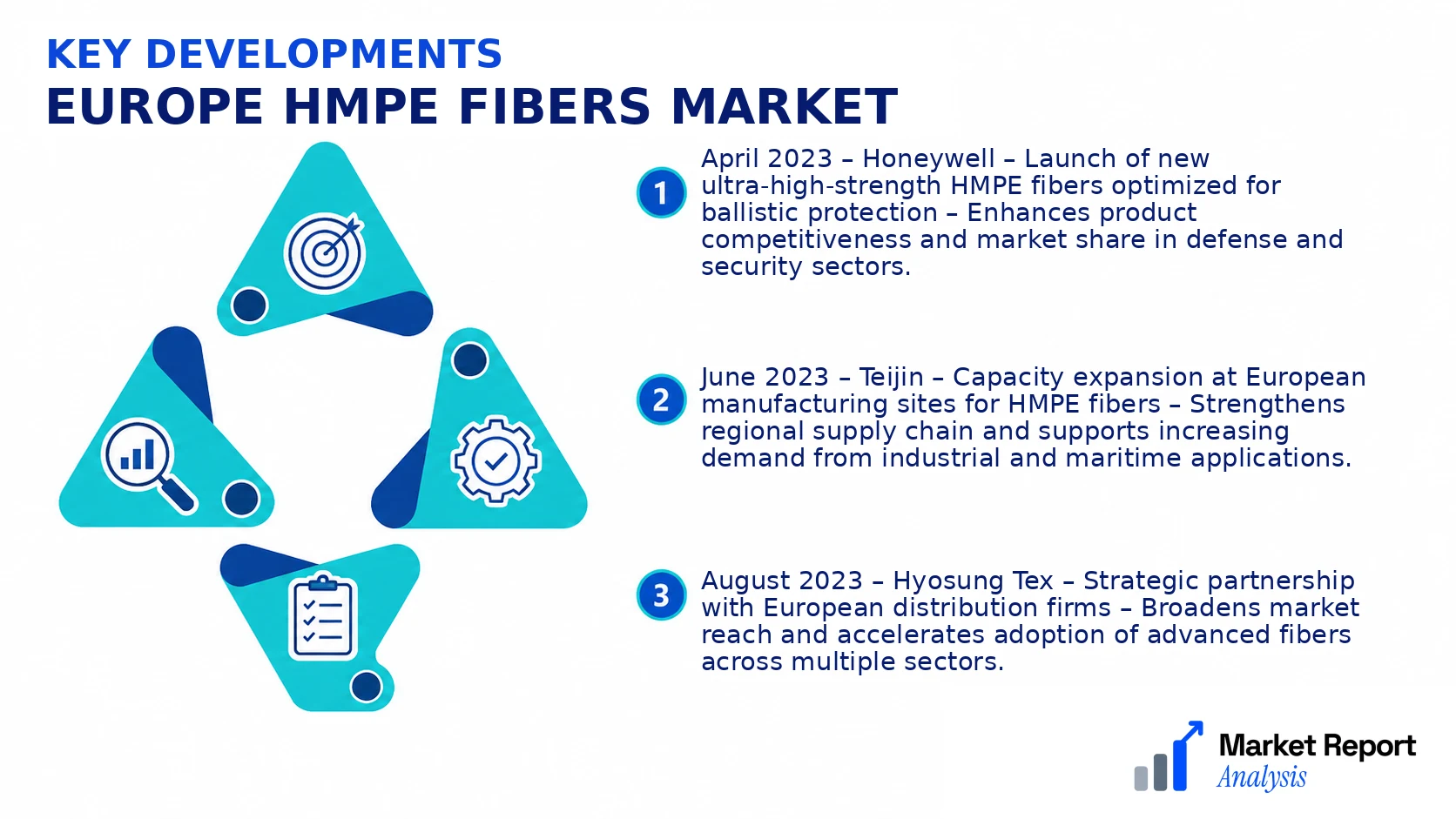
- April 2023 – Honeywell – Launch of new ultra-high-strength HMPE fibers optimized for ballistic protection – Enhances product competitiveness and market share in defense and security sectors.
- June 2023 – Teijin – Capacity expansion at European manufacturing sites for HMPE fibers – Strengthens regional supply chain and supports increasing demand from industrial and maritime applications.
- August 2023 – Hyosung Tex – Strategic partnership with European distribution firms – Broadens market reach and accelerates adoption of advanced fibers across multiple sectors.
- September 2023 – DSM – Investment in digital manufacturing technologies for HMPE fiber production – Improves process efficiency, reduces costs, and boosts sustainable manufacturing initiatives.
- November 2023 – Yamamato Industries – Acquisition of a European fiber processing firm – Expands processing capacity and technological capabilities in the ballistic fiber market.
Frequently Asked Questions
What is the Europe HMPE Fibers Market?
The Europe HMPE Fibers Market encompasses the production, distribution, and sales of high-modulus polyethylene fibers used in various industries such as defense, maritime, and industrial sectors throughout Europe. It is driven by demand for lightweight, high-strength materials.
What is the current market size of Europe HMPE Fibers Market?
As of 2026, the market size for Europe HMPE Fibers is estimated at approximately USD 1.2 Billion, reflecting steady growth trends driven by increased adoption across multiple industrial applications. This value exemplifies the segment's expanding footprint in the region.
What factors are driving the Europe HMPE Fibers Market?
Key drivers include increasing demand for lightweight, durable materials in defense and maritime industries, growth in industrial composites, advances in fiber manufacturing technology, and strict government regulations on safety and materials innovation, all contributing to market expansion.
Which region dominates the Europe HMPE Fibers Market?
The Western European countries, led by Germany and the UK, dominate the market owing to their advanced manufacturing infrastructure, robust industrial base, and high investor interest in technological innovation, accounting for approximately 60% of the market share in 2026.
Which segment is expected to grow the fastest?
The industrial and safety segment, covering use in reinforcement, protection gear, and infrastructure, is projected to experience the highest CAGR of 11.2% from 2026 to 2034, driven by expanding applications in construction and industrial safety.
Who are the leading companies operating in the Europe HMPE Fibers Market?
Leading companies include Honeywell, Koninklijke DSM N.V., and fashion fibers manufacturers such as Trex and Koninklijke DSM N.V., recognized for innovative product offerings, regional manufacturing capacity, and strategic collaborations fueling market development in Europe.
Analyst Perspective
The Europe HMPE Fibers Market is expected to exhibit a mature yet dynamic landscape through 2034, driven by technological advancements and expanding applications in defense, maritime, and industrial sectors. The long-term outlook indicates steady growth, supported by increasing demands for lightweight, high-strength fibers that improve safety and performance. Commercial opportunities will predominantly arise in developing next-generation fiber formulations that enhance durability, UV resistance, and environmental sustainability, attracting investment in R&D. Technological evolution is likely to focus on biodegradable composites and eco-friendly manufacturing processes, aligning with regulatory trends and sustainability goals. Competitive intensity is substantial, with key players investing heavily in innovation, capacity expansion, and strategic alliances to consolidate market presence. Regional growth potential remains highest in northern and western Europe, where industrial infrastructure is robust and innovation hubs foster rapid adoption of advanced materials. Investors should prioritize technology innovation and regional expansion strategies to maximize long-term returns amid evolving industry standards.
