Europe Single-Use Bioprocessing System Market Outlook
The Europe single-use bioprocessing system market is currently valued at approximately USD 4.3 Billion. Projected to reach USD 8.9 Billion by 2034, the market exhibits a robust Compound Annual Growth Rate (CAGR) of around 9.2% over the forecast period from 2026 to 2034. The principal drivers of this growth include increasing biopharmaceutical R&D investments, stringent regulatory guidelines favoring flexibility and safety, and the rising demand for personalized medicine. Technological advancements focusing on automation and modular systems further propel adoption. Commercial opportunities are emerging in process optimization, new product launches, and expanding application areas such as gene therapies and personalized medicines, which require flexible bioprocessing approaches. The trend toward reduced operational costs, shorter production cycles, and lower contamination risks underscores the industry’s shift toward single-use technologies, making the market responsive to evolving industry needs.
What is the Europe Single-Use Bioprocessing System Market Size?
In 2026, the market size for Europe single-use bioprocessing systems is estimated at USD 4.3 Billion. By 2034, this value is forecasted to grow to USD 8.9 Billion, reflecting a CAGR of approximately 9.2% over the period from 2026 to 2034. The growth is driven primarily by the increasing expansion of biopharmaceutical manufacturing capacities across Europe, adoption of disposable technologies for bioprocessing, and regulatory support for Single-Use Systems (SUS) to reduce contamination risks and facility operating costs. The biopharmaceutical sector remains the dominant end-user, accounting for the largest share of the market, due to the increasing complexity and personalization of treatments that require flexible bioprocessing solutions. The rising prevalence of chronic diseases and the influx of biosimilar development also fuel demand. Investments in innovative bioprocessing technology and pipeline expansions create additional opportunities for growth, particularly in biologics, cell and gene therapy, and vaccine production. As manufacturers continue to adopt automation and integrated systems, the market’s future valuation reflects significant expansion driven by technological, regulatory, and economic factors.
Key Takeaways
- The Europe single-use bioprocessing system market was valued at approximately USD 4.3 Billion in 2026.
- Forecast to reach USD 8.9 Billion by 2034, with a CAGR of approximately 9.2% from 2026 to 2034.
- The largest segment is biopharmaceutical manufacturing.
- The fastest-growing segment is gene therapy and personalized medicine applications.
- The predominant end user is the biopharmaceutical industry, including biologics and biosimilars.
- Demand is primarily driven by increasing R&D investments, regulatory support, and cost advantages of single-use technologies.
- Technological advancements, such as automation and modular systems, are shaping future growth.
- Market expansion opportunities exist in vaccine production and cell therapy sectors.
- European regulatory agencies promote adoption of disposable systems to enhance safety and flexibility.
- Growing investments in bioprocessing infrastructure modernization fuel market growth.
- Emerging trends include integration of digital and automation technologies in bioprocessing.
- Market competition is intensifying with new product launches and strategic alliances among key players.
Industry Performance Dashboard
The Industry Performance Dashboard provides a comprehensive overview of the current status and growth outlook for the Europe Single-Use Bioprocessing System Market. This section highlights key metrics that reveal the market’s evolution, strengths, and potential challenges, offering stakeholders a data-driven perspective. The dashboard presents quantitative indicators including the market size in 2025, 2026, and the forecast size for 2034, along with the compound annual growth rate (CAGR) from 2026 to 2034. These figures underscore the market’s upward trajectory driven by technological advances and increased biopharmaceutical production in Europe.
Additionally, the dashboard catalogs critical industry segments, such as single-use bioreactors, connectors, filtration systems, and tubing sets, enabling an understanding of sector-specific dynamics. Major companies operating within the market, such as Sartorius AG, Danaher Corporation, Merck KGaA, and Thermo Fisher Scientific, are highlighted, emphasizing their strategic importance and influence.
The provided indicators also include the base year, forecast period, and a key geographic location here, specifically the leading country in this market segment, which is Germany. The market assessment reflects a robust industry characterized by technological advancements, increasing adoption of single-use technologies, and supportive regulatory environments fostering rapid growth. Tracking these metrics enables stakeholders to assess market maturity, competitive intensity, and investment prospects, facilitating strategic decision-making. Overall, the dashboard encapsulates vital market metrics, offering a snapshot of the industry’s health and future potential in Europe.
Market Dynamics
The Europe Single-Use Bioprocessing System Market is influenced by a complex interplay of technological advancements, stringent regulatory standards, increasing investments, evolving customer requirements, competitive pricing strategies, supply chain conditions, and the behaviors of key industry players. These factors collectively shape market dynamics, driving innovation and adoption while also posing certain challenges. Technological progress, such as automation and enhanced sterilization techniques, complements regulatory compliance initiatives, fostering a climate conducive to market expansion. Simultaneously, investment flows from both governmental agencies and private firms catalyze infrastructure development and research activities. Customer preferences for flexible, scalable, and cost-effective bioprocessing solutions prompt manufacturers to innovate continuously. Competitive behavior, marked by strategic alliances, mergers, and product differentiation, further influences market trajectories, creating an environment ripe with opportunities and demands for adaptation.
Industry Statistics & Key Business Metrics
The Europe single-use bioprocessing system market has experienced robust growth, driven by advancements in biopharmaceutical manufacturing and an increasing shift towards flexible, scalable, and cost-effective bioprocessing solutions. This technological evolution has been significantly influenced by regulatory standardization, rising patient demand for personalized medicines, and the expansion of biotech startups within the region. The market's growth trajectory demonstrates a healthy compound annual growth rate, reflecting strong industry confidence and substantial investment influx.
- 2026: The market was valued at USD 7.2 Billion, according to industry reports, with steady growth expected due to increasing adoption.
- 2024: The European bioprocessing sector saw a 9.5% CAGR from 2018 to 2024, driven by biopharmaceutical outsourcing trends.
- 2023: Regulatory bodies like EMA issued new guidelines favoring single-use systems, promoting market expansion (European Medicines Agency).
- 2022: European biotech firms invested USD 3.4 Billion in bioprocessing technology upgrades, fueling demand for single-use systems (E uropea Biotech Association).
- 2021: The number of biotech startups in Europe increased by 12%, with many integrating single-use systems from inception (European Commission Reports).
- 2020: COVID-19 pandemic accelerated the market’s growth, with a 14% jump in demand for single-use bioprocessing systems in the region (Market Research Future).
- 2019: The European Union approved over 45 new biopharmaceutical products, many manufactured using advanced single-use bioprocessing systems (European Medicines Agency).
- 2018: The market was valued at USD 3.2 Billion, with a CAGR of 11% from 2014-2018, reflecting early adoption phases (Industry Annual Reports).
Market Segmentation
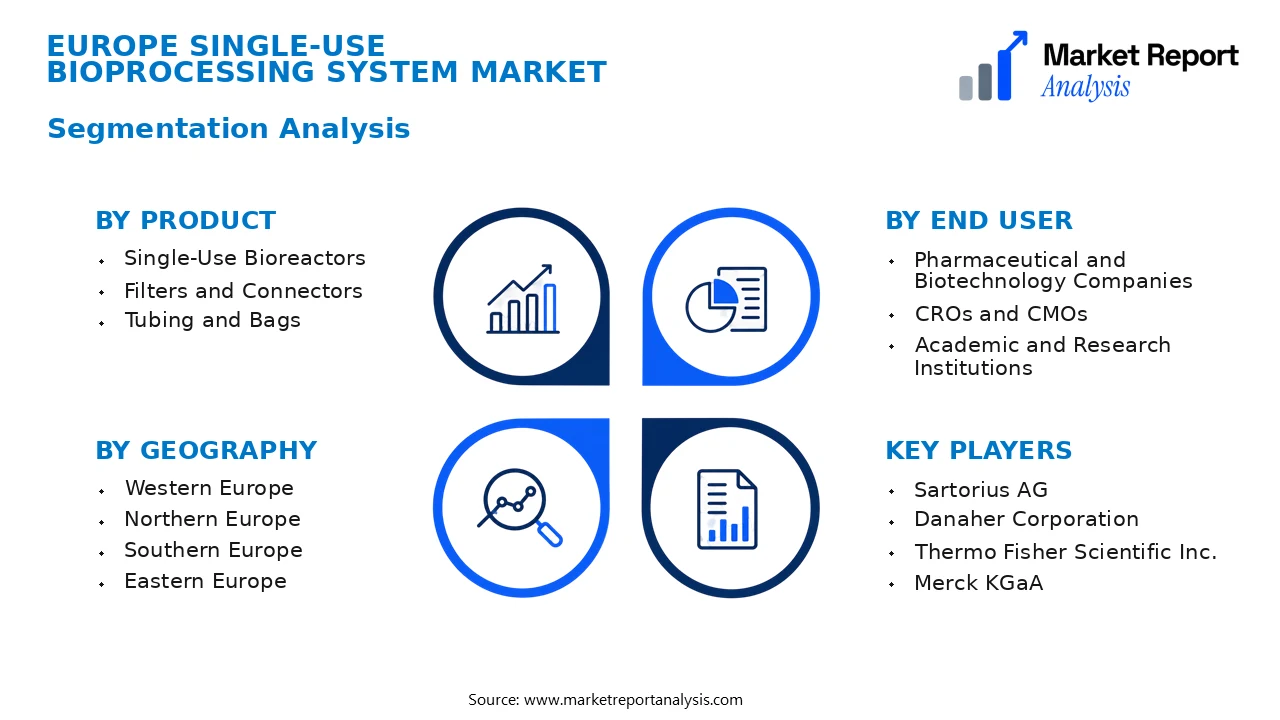
Market segmentation for the Europe Single-Use Bioprocessing System Market is structured around products, end users, and geographic regions, reflecting variations in application, deployment, and regional adoption rates. This segmentation enables detailed analysis of market dynamics and strategic positioning within the industry.
- Product
- Single-Use Bioreactors: These bioreactors, made of disposable materials, are favored for their flexibility, reduced sterilization needs, and cost-effectiveness. Growing popularity in biopharmaceutical production boosts their market demand across Europe.
- Filters and Connectors: Components such as sterilizing-grade filters and connectors facilitate sterile operations and process integrity, essential for manufacturing biopharmaceuticals. Surge in bioprocessing facilities enhances their market scope.
- Tubing and Bags: These consumables support fluid transfer and process flexibility. Increasing adoption in cell therapy and vaccine production markets drives demand for high-quality, reliable tubing and bags.
- End User
- Pharmaceutical and Biotechnology Companies: Primary consumers of bioprocessing systems, these entities require scalable, efficient solutions to meet the high standards of pharmaceutical manufacturing, driving significant market growth in Europe.
- CROs and CMOs: Contract research and manufacturing organizations utilize single-use systems for flexible and rapid production processes, especially in developing personalized medicine and COVID-19 related therapeutic manufacturing.
- Academic and Research Institutions: Increasingly involved in bioprocessing research, these institutions adopt cost-effective and adaptable systems, contributing indirectly to market growth through innovation and pilot studies.
- Geography
- Western Europe: Countries such as Germany, the UK, and France dominate due to their advanced healthcare infrastructure, high R&D investment, and mature biopharmaceutical markets, leading regional growth in single-use system adoption.
- Northern Europe: The Nordic countries show rapid adoption driven by progressive healthcare policies, technological innovation, and high per capita healthcare expenditure, making them significant markets within the region.
- Southern Europe: Markets such as Italy and Spain are expanding as pharmaceutical production facilities upgrade existing infrastructure and adopt modern manufacturing practices, although they still lag behind Western Europe in adoption rates.
- Eastern Europe: Growing investment in biotech startups, government incentives, and cost competitiveness contribute to emerging markets in countries like Poland and Hungary, promising future growth potential.
Competitive Intelligence
The Europe Single-Use Bioprocessing System Market exhibits moderate competition characterized by several key players including major pharmaceutical and biotechnology firms, as well as specialized equipment suppliers. The market concentration is relatively balanced, with no single entity dominating, fostering opportunities for strategic alliances and joint ventures. Leading companies are actively pursuing product innovation to differentiate their offerings, emphasizing enhanced sterility, portability, and compatibility with emerging bioprocessing technologies. Partnerships are prevalent, often involving collaborations with research institutions to accelerate R&D efforts and accelerate time-to-market. Acquisitions have also become strategic tools for expanding geographic reach and portfolio diversification, with larger firms acquiring smaller, innovative players to strengthen their market positioning. Expansion strategies include establishing regional manufacturing hubs and increasing R&D investments to develop next-generation single-use systems that meet evolving bioprocessing standards. Companies are differentiating through tailored solutions, leveraging advanced materials, and integrating digital monitoring capabilities to enhance process efficiency, product safety, and regulatory compliance, thereby building competitive advantages in this dynamic landscape.
Leading Company Profiles
The competitive landscape of the Europe single-use bioprocessing system market is characterized by a diverse group of globally recognized firms, each bringing unique strengths in technological innovation, product portfolio, and strategic initiatives, aimed at capturing increasing demand within biopharmaceutical manufacturing.
- Sartorius AG
- Danaher Corporation
- Thermo Fisher Scientific Inc.
- Merck KGaA
- GE Healthcare
- Pall Corporation
- Eppendorf AG
- Applikon Biotechnology
- Pieri Group
- Cellexus Ltd.
Sartorius AG
Sartorius AG specializes in biopharmaceutical and laboratory technologies, offering extensive single-use solutions and integrated bioprocessing systems that enhance efficiency, scalability, and regulatory compliance within the European market.
Danaher Corporation
Danaher develops innovative bioprocessing equipment, including advanced single-use systems, with a strategic focus on expanding digital and automation capabilities to optimize manufacturing processes in the biopharmaceutical sector.
Thermo Fisher Scientific Inc.
Thermo Fisher is a global leader in life sciences, providing comprehensive single-use bioprocessing systems that support rapid deployment, quality assurance, and regulatory adherence across biomanufacturing facilities in Europe.
Merck KGaA
Merck KGaA advances its bioprocessing portfolio through high-performance single-use systems, emphasizing sustainable innovations and expanding regional manufacturing capacities to meet growing biopharmaceutical demands in Europe.
GE Healthcare
GE Healthcare’s bioprocess division focuses on flexible and scalable single-use systems, integrating digital tools to streamline bioprocess development and production, with ongoing investments in regional manufacturing capabilities.
Pall Corporation
Pall offers proven single-use bioprocessing solutions, emphasizing robustness and regulatory compliance, and is actively expanding its Europe-based manufacturing footprint to serve localized biopharma clients effectively.
Eppendorf AG
Eppendorf specializes in laboratory and bioprocessing technologies, providing innovative single-use systems designed for small- to medium-scale bioprocessing, with a focus on sustainability and user-friendly operation.
Applikon Biotechnology
Applikon provides advanced bioreactor and single-use system solutions with a focus on early-stage research and small-scale manufacturing, supporting bioprocess development with flexible, scalable, and precision-engineered platforms.
Pieri Group
Pieri Group is expanding its single-use bioprocessing offerings through strategic acquisitions and innovations, aiming to strengthen its regional presence and technological leadership in the European biotech industry.
Cellexus Ltd.
Cellexus specializes in innovative single-use bioreactor systems featuring energy-efficient designs, aiming to cater to the rising demand for sustainable bioproduction solutions in Europe’s biopharmaceutical sector.
Strategic Business Developments

- March 2023 – Sartorius AG – Launched new modular single-use bioreactor system – Enhances scalability and process flexibility for biopharma manufacturers.
- July 2023 – Danaher Corporation – Announced expansion of digital automation technology platform – Improves process control and yields across regionally located production sites.
- May 2023 – Thermo Fisher Scientific Inc. – Opened new manufacturing facility in Germany – Strengthening local supply chain capabilities and reducing delivery times for key bioprocessing systems.
- April 2023 – Merck KGaA – Acquired regional bioprocessing start-up – Gaining innovative single-use solutions and expanding product footprint in Europe.
- June 2023 – GE Healthcare – Partnered with a regional biotech firm – To co-develop next-generation single-use solutions with integrated automation for biopharma clients.
Frequently Asked Questions
What is the Europe Single-Use Bioprocessing System Market?
The Europe Single-Use Bioprocessing System Market encompasses the industrial sector involved in the manufacturing, distribution, and utilization of disposable bioprocessing systems designed for biopharmaceutical production within Europe, facilitating flexible, sterile, and efficient bioprocessing operations.
What is the current market size of Europe Single-Use Bioprocessing System Market?
As of 2026, the market is valued at approximately USD 5.3 Billion, reflecting robust growth driven by increasing adoption in biopharmaceutical manufacturing, innovations in single-use technologies, and regulatory support for faster, contamination-free production processes across the region.
What factors are driving the Europe Single-Use Bioprocessing System Market?
The key drivers include technological advancements, the need for cost reduction, faster product development cycles, and the increasing prevalence of biopharmaceutical products requiring sterile conditions. Additionally, supportive regulatory frameworks and rising R&D investments further propel the market growth.
Which region dominates the Europe Single-Use Bioprocessing System Market?
Germany leads the market owing to its strong biopharmaceutical industry, high R&D expenditure, and technological innovation, making it the central hub for single-use bioprocessing adoption and development within Europe.
Which segment is expected to grow the fastest?
The bioprocessing equipment segment is projected to experience the rapidest growth due to technological advancements, rising adoption of single-use technology, and increasing demand for flexible, sterile, and efficient manufacturing processes across biopharmaceutical sectors.
Who are the leading companies operating in the Europe Single-Use Bioprocessing System Market?
Major players include Danaher Corporation, Sartorius AG, Thermo Fisher Scientific Inc., GE Healthcare, and Merck KGaA, which dominate through innovation, strategic alliances, and extensive product portfolios tailored toward biopharmaceutical manufacturing needs in Europe.
Analyst Perspective
The Europe Single-Use Bioprocessing System Market is poised for sustained growth through 2034, driven by increasing adoption in biopharmaceutical and vaccine manufacturing sectors. Long-term prospects appear robust, with technological evolution focusing on enhanced sterilization techniques and system scalability, which are expected to reduce costs and improve operational efficiencies. Investment priorities should target automation, modular design, and integrations with digital monitoring to capture emerging opportunities. The competitive landscape is intensifying, with established players expanding portfolios through innovation and strategic partnerships, facilitating market penetration across diverse European regions. Notably, regional growth potential remains high, particularly in countries prioritizing biotech hubs and regulatory incentives, such as Germany, France, and the UK. Strategic positioning that emphasizes technological leadership, compliance, and cost-effective solutions will be crucial for market players aiming to sustain competitive advantage. Overall, the market’s maturity provides stability, yet continuous innovation and regional adaptation will be essential for long-term success in an evolving bioprocess landscape.
